

|
시장보고서
상품코드
2097476
직원 데이터 프라이버시 및 컴플라이언스 플랫폼 시장 : 시장 점유율 분석, 업계 동향 및 통계, 성장 예측(2026-2031년)Employee Data Privacy and Compliance Platform - Market Share Analysis, Industry Trends & Statistics, Growth Forecasts (2026 - 2031) |
||||||
 Mordor Intelligence
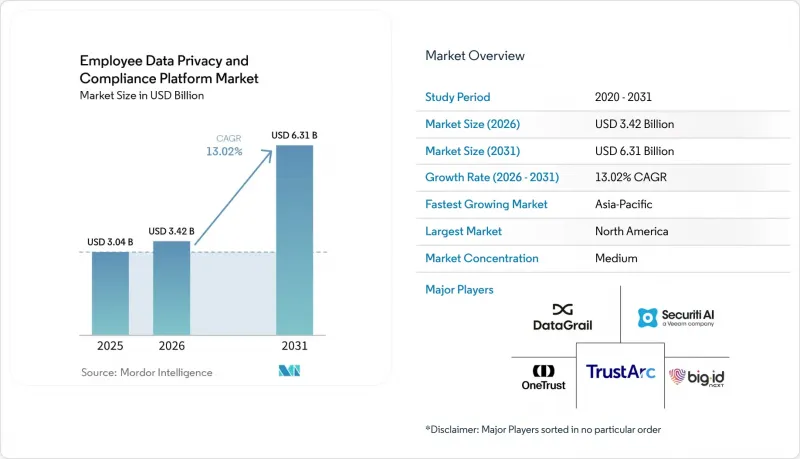
Mordor Intelligence에 의하면, 직원 데이터 프라이버시 및 컴플라이언스 플랫폼 시장 규모는 2025년에 30억 4,000만 달러로 평가되었고, 2026년에 34억 2,000만 달러로 추정되고, 2031년까지 63억 1,000만 달러에 이를 것으로 예측되며, 2026-2031년 CAGR 13.02%로 성장할 전망입니다.
본 보고서는 컴포넌트별(플랫폼 및 서비스), 도입 형태별(클라우드 기반, 온프레미스형, 하이브리드형), 조직 규모별(대기업 및 중소기업), 최종 사용자 산업별(의료 및 생명과학, 정보기술 및 통신, 기타) 및 지역별로 분류되어 있습니다. 시장 전망은 금액(달러) 기준으로 제시되어 있습니다.
세계의 직원 데이터 프라이버시 및 컴플라이언스 플랫폼 시장 동향 및 인사이트
관할 구역을 초월하는 직원 개인정보 보호권의 확대
직원 데이터 프라이버시 및 컴플라이언스 플랫폼 시장에 대한 가장 강력한 구조적 동력은 고용주가 관리하고 문서화해야 하는 사항에 대한 법적 정의의 확대에 있습니다. 조직은 현재 여러 국가에 걸쳐 직원 정보를 처리할 때 정확성, 통지, 불만 처리, 보존 및 정보 유출 대응과 관련하여 더 광범위한 의무에 직면해 있습니다. 규정 준수상의 과제는 규정이 늘어나고 있을 뿐만 아니라, 관할 구역마다 규정이 완전히 일치하지 않는다는 점에도 있으며, 이로 인해 표준화된 수동 프로세스만으로는 충분한 효과를 얻을 수 없게 되었습니다. 이러한 상황으로 인해 개인정보 보호 규정 준수는 단순한 법적 검토 작업에서 인사, 법무, 보안, IT 각 팀의 일상적인 업무 요건으로 변화했습니다. 그 결과, 직원 데이터 프라이버시 및 컴플라이언스 플랫폼 시장은 스프레드시트나 범용 관리 도구보다 전용 워크플로우 시스템을 우선시하는 예산 배분 결정의 혜택을 받고 있습니다. 이러한 변화는 두세 개의 관할 구역에서 사업을 운영하는 고용주에게 특히 중요합니다. 왜냐하면 동의, 이용 목적의 제한, 문서화, 그리고 직원의 권리에 관한 청구에 대해 서로 중복되지 않는 의무를 관리해야 하기 때문입니다.
AI를 활용한 채용, 모니터링 및 ADMT 거버넌스 요건
AI를 활용한 채용, 성과 모니터링 및 고용 관련 의사 결정에 관한 규정은 직원 데이터 프라이버시 및 컴플라이언스 플랫폼 시장의 지출을 직접적으로 견인하는 요인이 되고 있습니다. 자동화된 시스템이 채용이나 직원 관리에 영향을 미치는 경우, 고용주는 위험을 문서화하고, 통지를 제공하며, 공정성을 평가하고, 감독을 유지해야 합니다. 영국 정보위원회(ICO)는 2026년 3월, 채용 관련 조사 결과 약 300건의 권고를 내렸다고 보고하며, 채용 과정에서 자동화된 의사결정 도구가 사용될 경우 DPIA(데이터 보호 영향 평가)가 필요할 가능성이 높다고 밝혔습니다. 고용주는 도입 후 반복 가능한 워크플로우, 증거 추적, 지속적인 재평가가 필요하기 때문에 이러한 의무를 법적 검토만으로는 관리하기 어렵습니다. 따라서 직원 데이터 프라이버시 및 컴플라이언스 플랫폼 시장의 각 벤더들은 정책 라이브러리에만 초점을 맞추는 것이 아니라, 내장형 평가 도구, 자동 트리거, 감사 대비가 완료된 문서화를 중시하고 있습니다. AI가 이미 도입되어 생산성 평가, 인력 분석, 직원 모니터링에 활용되고 있는 이용 사례에서는 수요 증가가 가장 두드러집니다. 왜냐하면 이러한 이용 사례에서는 거버넌스상의 위험이 즉시 발생하기 때문입니다.
인사, ID 관리, IT 시스템에 걸친 복잡한 통합
직원 데이터 프라이버시 및 컴플라이언스 플랫폼 시장의 주요 운영상의 제약은 직원 데이터가 단일 시스템에 저장되는 경우가 거의 없다는 점입니다. 데이터는 HRMS 환경, 급여 계산 도구, ID 관리 플랫폼, 협업 소프트웨어, 모니터링 도구, 그리고 스키마와 접근 제어 방식이 서로 다른 지역별 데이터베이스에 걸쳐 존재합니다. 이러한 환경에 개인정보 보호 플랫폼을 연결하려면 대개 API 연동, 데이터 정규화, 권한 재검토, 그리고 부서 간 협업에 소요되는 시간이 필요하지만, 구매자는 초기에 이러한 요소를 과소평가하는 경향이 있습니다. 사업 부문이나 국가별로 별도의 시스템을 운영하는 대기업의 경우, 단일 규정 준수 워크플로가 서로 연동되지 않은 여러 정보원에 의존하는 경우가 있어 이 과제는 더욱 심각해집니다. 이로 인해 도입 비용이 증가하고 가치 실현까지 걸리는 시간이 길어지므로, 중견 기업의 구매 결정이 지연되거나 다국적 기업의 도입이 복잡해질 가능성이 있습니다. 따라서 미리 구축된 커넥터, 인증된 통합 기능 및 API 우선 제품 설계를 갖춘 벤더는 직원 데이터 프라이버시 및 컴플라이언스 플랫폼 시장에서 실행 면에서 큰 우위를 점하게 됩니다.
부문 분석
2025년 시장에서 플랫폼이 68.31%를 차지했으며, 구매자들은 여전히 분산된 단일 기능 도구보다 통합 시스템을 선호하는 것으로 나타났습니다. 이러한 점유율은 데이터 탐색, 권한 관리, 동의 처리, 개인정보 보호 평가 및 국경을 초월한 규정 준수 관리를 하나로 연결하는 단일 운영 계층이 선호되고 있음을 반영합니다. 직원 데이터 프라이버시 및 컴플라이언스 플랫폼 업계에서 이는 중요한 의미를 지닙니다. 이는 기반이 되는 워크플로가 상호 의존적이며, 팀이 이를 별도의 용도으로 관리할 경우 가치가 떨어지기 때문입니다. 데이터 탐색과 분류는 여전히 핵심을 이루고 있습니다. 직원 정보가 어디에 존재하는지 알지 못하면 조직은 신뢰할 수 있는 기록을 유지하거나 영향 평가를 수행할 수 없기 때문입니다. 또한, AI 기반 도구를 통해 새로운 알림 및 투명성 요구 사항이 생겨남에 따라, 고용 환경에서 동의 및 선호도와 관련된 워크플로우의 중요성도 높아지고 있습니다.
직원 기록에 대한 접근은 현재 보안과 개인정보 보호 양쪽 모두의 문제로 다루어지고 있기 때문에 직원 ID 및 접근 거버넌스 도구가 주목받고 있습니다. 또한, 특히 조직이 고위험 처리를 문서화하고 내부 감사나 규제 당국의 심사에 대비해 증거를 보존해야 하는 경우, 개인정보 보호 위험 및 영향 평가 모듈에 대한 수요도 증가하고 있습니다. 서비스 부문은 가장 빠르게 성장하는 분야로, 2026-2031년 연평균 성장률(CAGR) 14.98%로 성장을 지속할 전망입니다. 이는 많은 구매자가 소프트웨어의 초기 도입 후에도 여전히 외부 지원을 필요로 하고 있음을 보여줍니다. 직원 데이터 프라이버시 및 컴플라이언스 플랫폼 시장의 이 부문이 확대되고 있는 이유는 고객이 설정, 정책 조정, 워크플로우 설계, 지속적인 모니터링과 같은 업무를 사내에서 구축하기보다는 외부에 위탁하는 경우가 많기 때문입니다. 이러한 수요는 특히 중소기업이나 규제가 엄격한 기업에서 두드러지는데, 이러한 기업들은 직면한 규정의 복잡성으로 인해 개인정보 보호 담당 팀의 인력이 제한적인 경우가 많기 때문입니다. BigID가 2026년 3월 직원의 AI 사용을 위한 통합 AI 거버넌스를 출시한 것도, 벤더들이 모니터링, 접근 제어, 정책 적용을 보다 광범위한 엔터프라이즈 프로그램에 통합함으로써 서비스 주도형 제공 방식으로 전환하고 있음을 보여줍니다. 이러한 변화는 기업의 AI 거버넌스 요구에 대응하기 위한 종합적인 솔루션에 대한 중요성이 높아지고 있음을 여실히 보여줍니다.
2025년 시장에서 클라우드 기반 도입이 66.23%를 차지했으며, 이는 인사 및 규정 준수 시스템의 SaaS 환경으로의 광범위한 전환과 발맞추어 진행되고 있음을 뒷받침합니다. 벤더는 기존의 온프레미스 모델보다 신속하게 규제 업데이트, 커넥터 개선, 워크플로우 강화를 제공할 수 있기 때문에 구매자들은 클라우드 도입을 선호하고 있습니다. 직원 데이터 프라이버시 및 컴플라이언스 플랫폼 시장도 클라우드 제공을 통한 유지 관리 부담 경감이라는 혜택을 누리고 있습니다. 특히 법무, 인사, 개인정보 보호, 보안 팀에 분산된 접근 권한이 필요한 조직의 경우 그 이점이 큽니다. 국방 분야, 특정 금융 기관, 그리고 여전히 현지 관리가 필수적인 공공 부문과 같은 규제가 엄격한 환경에서는 온프레미스 구축이 여전히 중요하게 여겨지고 있습니다. 하지만 클라우드 기반 관리를 통해 더욱 강력한 모니터링, 손쉬운 업그레이드, 그리고 전 세계 개인정보 보호 프로그램 전반에 걸친 가시성 향상이 실현됨에 따라 온프레미스 배포의 역할은 점차 축소되고 있습니다.
하이브리드 배포는 2031년까지 연평균 성장률(CAGR)이 14.56%로 가장 빠르게 성장하는 모델이며, 이러한 성장은 일시적인 과도기라기보다는 실용적인 절충점을 반영한 것입니다. 다국적 기업들은 하이브리드 모델을 활용하여 기밀 데이터나 거주지 제한이 있는 데이터를 로컬 환경에 보관하는 한편, 클라우드 제어 계층을 통해 정책, 보고서, 워크플로우 조정을 관리하고 있습니다. 이 아키텍처는 거주지 요건과 운영상의 유연성을 모두 충족해야 하는 아시아태평양(APAC) 및 유럽에서 사업을 전개하는 조직에 특히 유용합니다. 하이브리드 환경을 위한 직원 데이터 프라이버시 및 컴플라이언스 플랫폼 시장은 직원 기록이나 로그에 대한 국가별 관리 권한을 희생하지 않으면서도 통합된 거버넌스를 추구하는 고용주들에 의해 주도되고 있습니다. 또한, 하이브리드 모델은 AI 관련 규정 준수 워크플로우의 활용 확대와도 부합합니다. 고용주는 추론 기록의 로컬 처리를 요구하면서도, 평가 및 문서화에 대해서는 전 세계적으로 조율하고자 할 수 있기 때문입니다. 이러한 유연성과 관리 권한의 융합이야말로 하이브리드 모델이 틈새 도입 옵션에서 전 세계 직원 개인정보 보호 프로그램의 견고한 아키텍처 선택지로 진화하고 있는 이유입니다.
지역별 분석
2025년, 북미는 직원 데이터 프라이버시 및 컴플라이언스 플랫폼 시장 점유율의 37.29%를 차지하며 최대 지역 시장이 되었습니다. 이 지역이 1위를 차지한 배경에는 기업용 기술 구매자가 밀집해 있다는 점, 클라우드 기반 인사 시스템의 광범위한 활용, 그리고 주 차원의 개인정보 보호 프레임워크와 관련된 규정 준수 부담의 확대가 있습니다. 또한, 미국의 고용주들은 AI를 활용한 채용, 승진, 감시에 관한 의사결정과 관련된 보다 적극적인 거버넌스 과제를 해결하고 있으며, 이로 인해 정책 재검토가 시스템 수준의 투자로 전환되고 있습니다. 이러한 동향으로 인해, 특히 여러 주에서 사업을 영위하는 고용주들에게 있어 일회성 법적 해석보다는 여러 관할 구역에 걸친 워크플로우 관리의 가치가 높아지고 있습니다. 따라서 직원 데이터 프라이버시 및 컴플라이언스 플랫폼 시장은 여전히 북미를 핵심으로 하고 있습니다. 이 지역에서는 구매자가 중복되는 법적 요건을 아우르며, 통지, 문서화, 위험 평가 및 직원 권리에 관한 프로세스를 조정할 수 있는 플랫폼을 필요로 하는 경우가 많기 때문입니다.
유럽은 계속해서 2위 지역 클러스터로 자리 잡고 있으며, 영국, 독일, 프랑스, 이탈리아, 스페인이 주도적인 역할을 하고 있습니다. 유럽에서는 일반 데이터 보호 규정(GDPR(EU 개인정보보호규정)) 외에도 감시, 비례의 원칙, 단체 협약과 관련된 고용 특유 기대 사항이 직원 개인정보 보호를 형성하고 있기 때문에 지역적 수요는 견조한 추세를 보이고 있습니다. AI를 활용한 생산성 향상 도구나 감시 도구 도입을 검토하는 고용주에게 있어 법적 환경은 더욱 엄격해지고 있습니다. 이는 문서화, 필요성 입증, 거버넌스 기준이 지역 전체에서 더 엄격하게 적용되기 시작했기 때문입니다. 이로 인해 유럽은 직원 데이터 프라이버시 및 컴플라이언스 플랫폼 시장에서 중심적인 위치를 계속 차지하고 있습니다. 그 이유는 법 집행의 압력뿐만 아니라, 고용주가 장기적인 증거 보존, 현지 법규 준수, 그리고 내부적 책임성을 다할 수 있는 시스템을 필요로 하기 때문이기도 합니다.
아시아태평양은 2031년까지 연평균 성장률(CAGR) 14.09%로 확대될 것으로 예측되며, 직원 데이터 프라이버시 및 컴플라이언스 플랫폼 시장에서 이 지역이 가장 높은 성장률을 보일 것으로 전망됩니다. 이러한 성장은 인도, 일본, 한국, 호주에서 더욱 엄격한 개인정보 보호 요건이 도입되고 있는 데 힘입은 것으로, 이로 인해 현지 고용주와 해당 지역에 배송 센터를 둔 다국적 기업 모두의 조달이 증가하고 있습니다. 인도가 중요한 이유는 법 집행 및 시행이 진전됨에 따라 고용주들이 직원 데이터에 대한 동의 공식화, 불만 처리, 정보 유출 대응을 강요받고 있기 때문입니다. 일본도 중요한 시장으로, 개인정보 보호 개혁으로 인해 직장 환경 내 직원 정보 및 생체 인식 데이터와 관련된 규정 준수 부담이 확대되고 있습니다. 남미는 아직 초기 단계에 있지만, 브라질에서는 보다 체계화된 개인정보 보호 규정 하에서 직원 데이터를 관리해야 하는 대기업들 사이에서 수요가 발생하고 있습니다. 중동 및 아프리카도 부상하고 있으며, 현지화 및 자국 내 호스팅 요건이 도입 옵션을 좌우함에 따라 관심이 높아지고 있습니다. 이 지역 전반에 걸쳐 직원 데이터 프라이버시 및 컴플라이언스 플랫폼 시장은 공통된 추세로부터 혜택을 받고 있습니다. 즉, 고용주들은 중앙 집중식 감독 기능을 저해하지 않으면서 현지 상황에 맞게 조정할 수 있는 시스템을 원하고 있습니다.
기타 혜택 :
- 엑셀 형식 시장 예측(ME) 시트
- 3개월간의 애널리스트 지원
자주 묻는 질문
목차
제1장 서론
제2장 조사 방법
제3장 주요 요약
제4장 시장 구도
제5장 시장 규모 및 성장 예측
제6장 경쟁 구도
제7장 시장 기회 및 향후 전망
AJY 26.08.07According to Mordor Intelligence, the employee data privacy and compliance platform market size is projected to be USD 3.04 billion in 2025, USD 3.42 billion in 2026, and reach USD 6.31 billion by 2031, growing at a CAGR of 13.02% from 2026 to 2031.
This report is Segmented by Component (Platforms, and Services), Deployment Mode (Cloud-Based, On-Premises, and Hybrid), Organization Size (Large Enterprises, and Small and Medium-Sized Enterprises), End-User Industry (Healthcare and Life Sciences, Information Technology and Telecommunications, and More), and Geography. The Market Forecasts are Provided in Terms of Value (USD).
Global Employee Data Privacy and Compliance Platform Market Trends and Insights
Expansion of Employee Privacy Rights Across Jurisdictions
The strongest structural support for the employee data privacy and compliance platform market comes from the widening legal definition of what employers must govern and document. Organizations now face a broader set of obligations regarding accuracy, notice, grievance handling, retention, and breach response when processing employee information across multiple countries. The compliance challenge is not only that more rules exist, but also that they do not align neatly across jurisdictions, which makes standardized manual processes less effective. This has pushed privacy compliance from a legal review exercise into a daily operational requirement for HR, legal, security, and IT teams. As a result, the employee data privacy and compliance platform market is benefiting from budget decisions that increasingly favor dedicated workflow systems over spreadsheets or general controls tooling. The change is especially important for employers operating across 2 or 3 jurisdictions, because they must now manage non-overlapping obligations on consent, purpose limitation, documentation, and employee rights requests.
AI Hiring, Monitoring, and ADMT Governance Requirements
Rules for AI-assisted hiring, performance monitoring, and employment decision-making are becoming a direct driver of spending in the employee data privacy and compliance platform market. Employers are being asked to document risk, provide notice, assess fairness, and maintain oversight when automated systems influence recruitment or worker management. The UK Information Commissioner's Office reported in March 2026 that its recruitment review led to nearly 300 recommendations and stated that DPIAs are likely required when automated decision-making tools are used in hiring. These obligations are difficult to manage through legal review alone because employers need repeatable workflows, evidence trails, and ongoing reassessment after deployment. That is why vendors in the employee data privacy and compliance platform market are emphasizing embedded assessment tools, automated triggers, and audit-ready documentation, rather than focusing solely on policy libraries. The demand uplift is strongest where AI is already active in hiring, productivity scoring, workforce analytics, and employee monitoring, because those use cases generate immediate governance exposure.
Complex Integration Across HR, Identity, and IT Systems
The main operational restraint in the employee data privacy and compliance platform market is that employee data is rarely stored in one system. It spans HRMS environments, payroll tools, identity platforms, collaboration software, monitoring tools, and regional databases with varying schemas and access controls. Connecting a privacy platform to this environment often requires API work, normalization, permissions review, and cross-functional project time that buyers may underestimate at the start. The challenge becomes more severe in large enterprises that operate separate systems across business units or countries, as a single compliance workflow may depend on multiple disconnected sources. This increases implementation costs and slows time to value, which can delay buying decisions in the mid-market and complicate rollouts in multinational organizations. Vendors with pre-built connectors, certified integrations, and API-first product design, therefore, hold a meaningful execution advantage in the employee data privacy and compliance platform market.
Other drivers and restraints analyzed in the detailed report include:
- Automation of RoPA, DPIA, and Retention Workflows
- Shift toward Cloud-Native Privacy Operations
- Fast-Changing Local Rules Create Configuration and Liability Risk
For complete list of drivers and restraints, kindly check the Table Of Contents.
Segment Analysis
Platforms accounted for 68.31% of the 2025 market, indicating that buyers still favor integrated systems over fragmented point tools. That share reflects a preference for a single operating layer that connects data discovery, rights management, consent handling, privacy assessments, and cross-border compliance controls. In the employee data privacy and compliance platform industry, this matters because the underlying workflows are interdependent, and value drops when teams manage them in separate applications. Data discovery and classification remain the foundation because organizations cannot maintain reliable records or trigger impact assessments without knowing where employee information resides. Consent and preference workflows are also becoming more relevant inside employment settings as AI-supported tools create new notice and transparency requirements.
Workforce identity and access governance tools are gaining traction because access to employee records is now treated as both a security and a privacy issue. Privacy risk and impact assessment modules are also in stronger demand, especially where organizations must document high-risk processing and maintain evidence for internal review or regulator scrutiny. The services segment is the fastest-growing component, with a 14.98% CAGR from 2026 to 2031, indicating that many buyers still need external support after the initial software purchase. This segment of the employee data privacy and compliance platform market is expanding because clients often outsource configuration, policy tuning, workflow design, and ongoing monitoring rather than building those capabilities internally. Demand is especially evident among SMEs and highly regulated enterprises, where privacy teams are often lean due to the complexity of the rules they face. BigID's March 2026 launch of integrated AI governance for employee AI use also showed how product vendors are moving closer to service-led delivery by packaging monitoring, access controls, and policy enforcement into broader enterprise programs. This shift highlights the growing emphasis on comprehensive solutions to address enterprise AI governance needs.
Cloud-based deployment accounted for 66.23% of the 2025 market, confirming that this category has moved in step with the broader migration of HR and compliance systems to SaaS environments. Buyers favor cloud deployment because vendors can issue regulatory updates, connector improvements, and workflow enhancements more quickly than in traditional on-premises models. The employee data privacy and compliance platform market also benefits from the lower maintenance burden of cloud delivery, especially for organizations that need distributed access across legal, HR, privacy, and security teams. On-premises deployment still matters in some regulated settings, including defense, certain financial institutions, and public sector environments where localized control remains non-negotiable. Even so, its role is narrowing because cloud-based administration now offers stronger oversight, easier upgrades, and better visibility across global privacy programs.
Hybrid deployment is the fastest-growing model with a 14.56% CAGR through 2031, and that growth reflects a practical compromise rather than a temporary transition stage. Multinationals are using hybrid models to keep sensitive or residency-bound data in local environments while managing policies, reporting, and workflow coordination through cloud control layers. This architecture is especially useful when organizations operate across APAC and Europe, where residency requirements and operational flexibility must coexist. The employee data privacy and compliance platform market for hybrid environments is being driven by employers seeking centralized governance without sacrificing country-level control over employee records and logs. Hybrid also aligns with the growing use of AI-related compliance workflows, as employers may want local handling of inference records while still coordinating assessments and documentation globally. That mix of flexibility and control is why hybrid is evolving from a niche deployment option into a durable architecture choice for global workforce privacy programs.
Complete Report Scope:
- By Component
- Platforms
- Data Discovery and Classification Platforms
- Consent and Preference Management Platforms
- Workforce Identity and Access Governance Platforms
- Privacy Risk and Impact Assessment Platforms
- Data Residency and Cross-Border Compliance Platforms
- Other Platforms
- Services
- Professional services
- Managed services
- Platforms
- By Deployment Mode
- Cloud-based
- On-premises
- Hybrid
- By Organization Size
- Large enterprises
- Small and Medium-Sized Enterprises
- By End-user Industry
- Banking, Financial Services and Insurance
- Healthcare and Life Sciences
- Information Technology and Telecommunications
- Retail and E-Commerce
- Government and Public Sector
- Manufacturing
- Other End-User Industries
- By Geography
- North America
- United States
- Canada
- Mexico
- South America
- Brazil
- Argentina
- Chile
- Rest of South America
- Europe
- United Kingdom
- Germany
- France
- Italy
- Spain
- Russia
- Rest of Europe
- Asia-Pacific
- China
- Japan
- India
- South Korea
- Australia and New Zealand
- Rest of Asia-Pacific
- Middle East
- United Arab Emirates
- Saudi Arabia
- Turkey
- Rest of Middle East
- Africa
- South Africa
- Nigeria
- Rest of Africa
- North America
Geography Analysis
North America held 37.29% of the employee data privacy and compliance platform market share in 2025, making it the largest regional market. The region's lead came from its dense base of enterprise technology buyers, broad use of cloud HR systems, and an expanding compliance burden tied to state-level privacy frameworks. Employers in the United States are also dealing with a more active governance agenda around AI-supported hiring, promotion, and monitoring decisions, which is turning policy review into system-level spending. That dynamic has made multi-jurisdictional workflow management more valuable than one-off legal interpretation, especially for employers operating across several states. The employee data privacy and compliance platform market, therefore, remains anchored in North America, where buyers often need platforms that can coordinate notices, documentation, risk assessments, and employee rights processes across overlapping legal requirements.
Europe remained the second-largest regional cluster, led by the United Kingdom, Germany, France, Italy, and Spain. Regional demand stayed strong because both general data protection rules and employment-specific expectations around monitoring, proportionality, and collective arrangements shape workforce privacy in Europe. The legal environment has become more exacting for employers seeking to use AI-supported productivity or monitoring tools, as documentation, necessity, and governance standards are being applied more tightly across the region. This keeps Europe central to the employee data privacy and compliance platform market, not only because of enforcement pressure, but also because employers need systems that can sustain evidence, local adaptation, and internal accountability over time.
Asia-Pacific is projected to expand at a 14.09% CAGR through 2031, giving the region the fastest growth rate in the employee data privacy and compliance platform market. Growth is being driven by the rollout of tighter privacy expectations across India, Japan, South Korea, and Australia, which is increasing procurement among both local employers and multinationals with regional delivery centers. India is important because enforcement and implementation are pushing employers to formalize consent, grievance handling, and breach response for employee data. Japan also matters because privacy reform is broadening the compliance load around employee information and biometric data in workplace settings. South America is still at an earlier stage, but Brazil is generating demand among large employers that must govern workforce data under more structured privacy rules. The Middle East and Africa are also emerging, with interest rising as localization and sovereign hosting requirements shape deployment choices. Across these geographies, the employee data privacy and compliance platform market is gaining from the same pattern: employers want systems that can adapt locally without losing central oversight.
- OneTrust LLC
- BigID, Inc.
- TrustArc Inc.
- Securiti, LLC
- DataGrail, Inc.
- Transcend Inc.
- Relyance Inc.
- Osano, Inc., a Public Benefit Corporation
- Ketch Kloud, Inc.
- Didomi SAS
- Usercentrics GmbH
- DataCo GmbH
- ComplyCloud ApS
- 2B Advice GmbH
- Smart Global Governance
- PrivacyAgent B.V.
- SayMine Technologies Ltd.
- Privado Inc.
- Syrenis Limited
- Enzuzo Inc.
- Proteus-Cyber Ltd.
Additional Benefits:
- The market estimate (ME) sheet in Excel format
- 3 months of analyst support
TABLE OF CONTENTS
1 INTRODUCTION
- 1.1 Study Assumptions and Market Definition
- 1.2 Scope of the Study
2 RESEARCH METHODOLOGY
3 EXECUTIVE SUMMARY
4 MARKET LANDSCAPE
- 4.1 Market Overview
- 4.2 Market Drivers
- 4.2.1 Expansion of Employee Privacy Rights across Jurisdictions
- 4.2.2 Shift toward Cloud-Native Privacy Operations
- 4.2.3 Automation of RoPA, DPIA, and Retention Workflows
- 4.2.4 Cross-Border Transfer and Data Residency Compliance Needs
- 4.2.5 AI Hiring, Monitoring, and ADMT Governance Requirements
- 4.2.6 Rising Volume and Complexity of Employee Rights Requests
- 4.3 Market Restraints
- 4.3.1 Complex Integration Across HR, Identity, and IT Systems
- 4.3.2 Budget Competition with Broader GRC and Security Platforms
- 4.3.3 Employee Surveillance Sensitivities and Works Council Pushback
- 4.3.4 Fast-Changing Local Rules Create Configuration and Liability Risk
- 4.4 Industry Value Chain Analysis
- 4.5 Regulatory Landscape
- 4.6 Technological Outlook
- 4.7 Impact of Macroeconomic Factors on the Market
- 4.8 Porter's Five Forces Analysis
- 4.8.1 Threat of New Entrants
- 4.8.2 Bargaining Power of Buyers
- 4.8.3 Bargaining Power of Suppliers
- 4.8.4 Threat of Substitutes
- 4.8.5 Intensity of Competitive Rivalry
5 MARKET SIZE AND GROWTH FORECASTS (VALUE)
- 5.1 By Component
- 5.1.1 Platforms
- 5.1.1.1 Data Discovery and Classification Platforms
- 5.1.1.2 Consent and Preference Management Platforms
- 5.1.1.3 Workforce Identity and Access Governance Platforms
- 5.1.1.4 Privacy Risk and Impact Assessment Platforms
- 5.1.1.5 Data Residency and Cross-Border Compliance Platforms
- 5.1.1.6 Other Platforms
- 5.1.2 Services
- 5.1.2.1 Professional services
- 5.1.2.2 Managed services
- 5.1.1 Platforms
- 5.2 By Deployment Mode
- 5.2.1 Cloud-based
- 5.2.2 On-premises
- 5.2.3 Hybrid
- 5.3 By Organization Size
- 5.3.1 Large enterprises
- 5.3.2 Small and Medium-Sized Enterprises
- 5.4 By End-user Industry
- 5.4.1 Banking, Financial Services and Insurance
- 5.4.2 Healthcare and Life Sciences
- 5.4.3 Information Technology and Telecommunications
- 5.4.4 Retail and E-Commerce
- 5.4.5 Government and Public Sector
- 5.4.6 Manufacturing
- 5.4.7 Other End-User Industries
- 5.5 By Geography
- 5.5.1 North America
- 5.5.1.1 United States
- 5.5.1.2 Canada
- 5.5.1.3 Mexico
- 5.5.2 South America
- 5.5.2.1 Brazil
- 5.5.2.2 Argentina
- 5.5.2.3 Chile
- 5.5.2.4 Rest of South America
- 5.5.3 Europe
- 5.5.3.1 United Kingdom
- 5.5.3.2 Germany
- 5.5.3.3 France
- 5.5.3.4 Italy
- 5.5.3.5 Spain
- 5.5.3.6 Russia
- 5.5.3.7 Rest of Europe
- 5.5.4 Asia-Pacific
- 5.5.4.1 China
- 5.5.4.2 Japan
- 5.5.4.3 India
- 5.5.4.4 South Korea
- 5.5.4.5 Australia and New Zealand
- 5.5.4.6 Rest of Asia-Pacific
- 5.5.5 Middle East
- 5.5.5.1 United Arab Emirates
- 5.5.5.2 Saudi Arabia
- 5.5.5.3 Turkey
- 5.5.5.4 Rest of Middle East
- 5.5.6 Africa
- 5.5.6.1 South Africa
- 5.5.6.2 Nigeria
- 5.5.6.3 Rest of Africa
- 5.5.1 North America
6 COMPETITIVE LANDSCAPE
- 6.1 Market Concentration
- 6.2 Strategic Moves
- 6.3 Market Share Analysis
- 6.4 Company Profiles (includes Global Level Overview, Market Level Overview, Core Segments, Financials as available, Strategic Information, Market Rank/Share, Products and Services, Recent Developments)
- 6.4.1 OneTrust LLC
- 6.4.2 BigID, Inc.
- 6.4.3 TrustArc Inc.
- 6.4.4 Securiti, LLC
- 6.4.5 DataGrail, Inc.
- 6.4.6 Transcend Inc.
- 6.4.7 Relyance Inc.
- 6.4.8 Osano, Inc., a Public Benefit Corporation
- 6.4.9 Ketch Kloud, Inc.
- 6.4.10 Didomi SAS
- 6.4.11 Usercentrics GmbH
- 6.4.12 DataCo GmbH
- 6.4.13 ComplyCloud ApS
- 6.4.14 2B Advice GmbH
- 6.4.15 Smart Global Governance
- 6.4.16 PrivacyAgent B.V.
- 6.4.17 SayMine Technologies Ltd.
- 6.4.18 Privado Inc.
- 6.4.19 Syrenis Limited
- 6.4.20 Enzuzo Inc.
- 6.4.21 Proteus-Cyber Ltd.
7 MARKET OPPORTUNITIES AND FUTURE OUTLOOK
- 7.1 White-space and unmet-need assessment


