

|
시장보고서
상품코드
2097482
유럽(EU)의 AI 법 HR 컴플라이언스 플랫폼 시장 : 시장 점유율 분석, 업계 동향 및 통계, 성장 예측(2026-2031년)EU AI Act HR Compliance Platform - Market Share Analysis, Industry Trends & Statistics, Growth Forecasts (2026 - 2031) |
||||||
 Mordor Intelligence
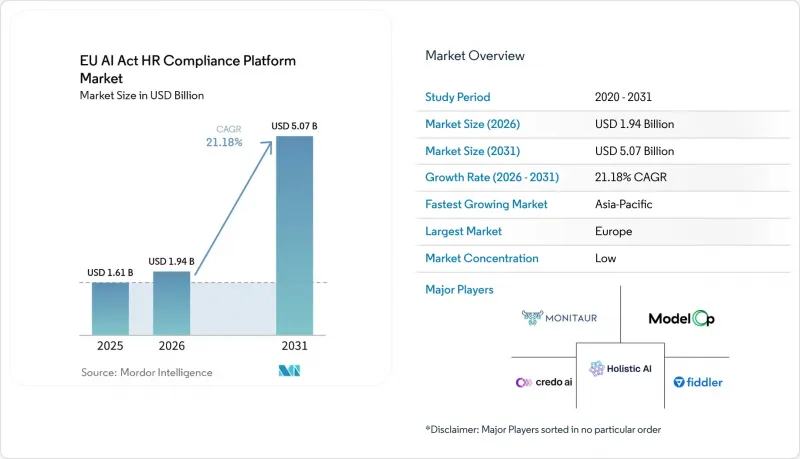
Mordor Intelligence에 의하면, 유럽(EU)의 AI 법 HR 컴플라이언스 플랫폼 시장 규모는 2025년에 16억 1,000만 달러로 평가되었고, 2026년 19억 4,000만 달러에서, 2031년까지 50억 7,000만 달러에 이를 것으로 예측되며, 2026-2031년 CAGR 21.18%로 성장할 전망입니다.
본 보고서는 컴포넌트별(소프트웨어 및 서비스), 기능별(AI 인벤토리 및 분류 등), 배포 방식별(클라우드, 온프레미스, 하이브리드), 조직 규모별(대기업 및 중소기업), 최종 이용 산업별(은행/금융서비스/보험 등) 및 지역별로 분류되어 있습니다. 시장 전망은 금액(달러) 기준으로 제시되어 있습니다.
유럽연합(EU)의 AI 법 HR 컴플라이언스 플랫폼 시장 동향 및 인사이트
EU AI법의 고위험 인사 관련 의무로 인해 규정 준수를 위한 전용 예산이 공식적으로 책정됨
규정(EU) 2024/1689의 부속서 III에서는 채용, 후보자 평가, 승진 및 해고 결정, 행동 프로파일링에 기반한 업무 배정, 그리고 성과 모니터링에 사용되는 AI 시스템을 고위험으로 분류하고 있으며, 인사 분야에서 이러한 도구를 도입하는 조직에 직접적인 규정 준수 부담을 부과하고 있습니다. 2026년 8월의 시행 기한에 더해, 최대 1,500만 유로(1,635만 달러) 또는 전 세계 연간 매출액의 3%에 해당하는 과징금이 설정됨에 따라, 유럽(EU) AI 법 HR 컴플라이언스 플랫폼 시장은 시범 단계의 실험에서 공식적인 예산 주기로 전환되고 있습니다. 이 규제는 타사 인사 AI 소프트웨어를 구매하는 기업에게도 중요한 의미를 지닙니다. 왜냐하면 도입 기업은 여전히 제26조 및 관련 규정에 따라 인적 감독, 로그 기록, 사고 보고, 그리고 직원 통지 기록을 유지해야 하기 때문입니다. 이러한 체계로 인해 수요는 모델을 누가 구축했는지에 대한 점보다, 고용주가 일상 업무에서 모델이 규정 준수에 부합하도록 사용되고 있음을 입증할 수 있는지에 따라 크게 좌우될 것입니다. 유럽연합 집행위원회의 지침 및 일정에 관한 최신 정보를 통해, 직원 통지 및 AI 리터러시를 포함한 일부 의무가 이미 적용되고 있음이 재확인되었으며, 이에 따라 향후 시행 시점을 기다리는 것의 실용적 가치는 낮아지고 있습니다.
기성 거버넌스 제품군이 스프레드시트 기반의 HR AI 관리를 대체하고 있습니다.
여전히 스프레드시트를 사용하여 HR AI 시스템을 추적하고 있는 조직들은 수기 기록만으로는 제12조의 로그 기록, 제72조의 시판 후 모니터링, 또는 제73조에 따른 15일 이내 중대 사고 보고 요건을 충족할 수 없습니다는 사실을 깨닫기 시작하고 있습니다. 이것이 바로 유럽(EU) AI 법 HR 컴플라이언스 플랫폼 시장이 전용으로 설계된 소프트웨어로 전환되고 있는 이유입니다. 이러한 변화는 단순한 소프트웨어 선호도를 넘어서는 것입니다. 구매자들은 현재 구조화된 증거 기록, 역할 기반 워크플로우, 그리고 내부 추적 도구로는 일반적으로 대규모로 제공할 수 없는 재현 가능한 관리 조치를 필요로 하고 있기 때문입니다. ISO/IEC 42001은 이러한 구매 결정의 일부가 되고 있으며, 마이크로소프트의 규정 준수 문서에서는 2025년 하반기까지 AI 거버넌스가 기업용 벤더 설문지의 표준 항목이 될 것이라고 지적하고 있습니다. 구매자들은 EU AI 법, ISO/IEC 42001 및 관련 프레임워크에 걸친 관리 조치를 단일 시스템에 매핑하는 플랫폼을 점점 더 선호하고 있습니다. 이는 동일한 거버넌스 투자로 여러 규정 준수 프로그램을 지원할 수 있기 때문입니다. 따라서 유럽(EU) AI 법 HR 컴플라이언스 플랫폼 시장은 증거 자동화, 프레임워크 매핑, 감사 대응 능력이 저비용의 수동 거버넌스 방식을 대체하는 조달 동향의 혜택을 받고 있습니다.
각국의 해석 차이가 유럽 전역에서의 제품 표준화를 지연시키고 있습니다.
해당 규정은 회원국들에게 국내 감독 체제 구축을 의무화하고 있지만, 시행을 위한 준비가 유럽 전역에서 동일한 속도로 진행되고 있지 않아, 그 결과 유럽(EU) AI법 HR 컴플라이언스 스테이션 플랫폼 시장은 단기적으로 표준화가 어려운 상황에 놓여 있습니다. 구매 기업이 필요로 하는 것은 단순히 규정을 준수하는 제품뿐만 아니라, 운영 관행이 서로 다른 여러 관할 구역에서 자사의 증거 파일과 워크플로가 수용될 것이라는 확신입니다. 따라서 벤더는 단일 지역 설정이 아닌, 국가별 정책 팩, 매핑, 문서 템플릿을 유지할 수밖에 없게 되었습니다. 엄격한 공통 기준을 준수하는 제품은 규제 요건이 완화된 환경에서는 구매자의 비용과 운영 부담을 증가시킬 가능성이 있는 반면, 기능이 제한된 제품은 규제가 엄격한 환경에서는 구매자를 위험에 빠뜨릴 우려가 있습니다. 이러한 현지화 부담은 제품 표준화를 지연시키며, 서비스 품질을 저하시키지 않으면서 지속적인 규제 해석 작업을 감당할 수 있는 벤더에게 유리하게 작용하고 있습니다.
부문 분석
2025년, 유럽(EU) AI 법 HR 컴플라이언스 플랫폼 시장에서 소프트웨어가 67.39%의 점유율을 차지했습니다. 이는 재고 관리, 자동화된 정책 매핑, 감사 추적 기록 생성 측면에서 구매자들이 여전히 사내 개발보다 기성 거버넌스 플랫폼을 선호하고 있음을 보여줍니다. 이러한 우위는 일반적인 거버넌스, 리스크, 컴플라이언스(GRC) 도구의 한계를 반영합니다. 이러한 도구들은 AI 법에서 요구하는 구조화된 로그, 기술 문서, 편향 테스트 기록을 포착하도록 설계되지 않았기 때문입니다. 또한, 많은 구매자가 AI법 준비와 병행하여 ISO/IEC 42001 대응을 추진하고 있으며, 이러한 프로그램에는 소프트웨어만으로는 작성할 수 없는 역량 프레임워크, 경영 검토, 시정 조치 기록이 필요하기 때문에 서비스에 대한 수요도 계속해서 견조합니다. 실제로 소프트웨어 기능의 깊이와 지속적인 도입 및 규정 준수 관리 지원을 결합할 수 있는 벤더가 가장 큰 강점을 가지고 있으며, 그 결과 구성 요소별 수요는 2025년 시장 점유율 분배만으로는 추측할 수 있는 것보다 더 균형 잡힌 양상을 보이고 있습니다.
서비스 시장은 2026-2031년 연평균 성장률(CAGR) 23.49%로 확대될 것으로 예측되며, 이 부문은 시장 전체의 성장 속도를 상회하고 있습니다. 이는 구매자가 HR AI와 관련된 의무를 이행하기 위해서는 소프트웨어 라이선스 이상의 것이 필요함을 보여줍니다. 주요 과제는 실행에 있습니다. 왜냐하면 HR 기술 스택 전체에서 데이터 피드, 사용자 권한, 검토 절차 및 문서화 워크플로가 올바르게 설정되어 있지 않은 한, 플랫폼 도입만으로는 규정 준수를 입증하는 증거 파일이 자동으로 생성되지 않기 때문입니다. 많은 초기 프로그램이 전용 거버넌스 플랫폼이 성숙하기 전에 시작되었기 때문에 기업들은 현재 지원자 추적 시스템, 인사 정보 시스템, 성과 평가 도구, 그리고 규제가 요구하는 증거 구조 간에 통합상의 격차를 겪고 있습니다. 그 결과, 특히 기업이 여러 국가나 사업 부문에 걸쳐 단일 운영 모델을 원할 경우, 구현, 통합 및 규정 준수 관리 업무에 대한 수요가 증가하고 있습니다.
2025년에는 정책 관리 및 통제 매핑이 35.19%를 차지했습니다. 이는 대부분의 조직이 테스트나 사고 대응 워크플로우에 투자하기 전에, 먼저 대상 AI 이용 사례를 식별하고 이를 구체적인 의무와 연계하는 것부터 시작하고 있음을 반영합니다. 이러한 순서는 유럽(EU) AI 법 HR 컴플라이언스 플랫폼 시장에서 일반적입니다. 기업들은 증거 수집을 자동화하기 전에, 먼저 자사가 어떤 시스템을 사용하고 있는지, 해당 시스템이 왜 부속서 III의 적용 대상이 될 수 있는지, 그리고 어떤 내부 정책을 변경해야 하는지 파악해야 하기 때문입니다. 편향 및 공정성 테스트는 2031년까지의 EU AI 법규 준수 플랫폼 시장 규모 전망에서 연평균 성장률(CAGR) 22.04%로 확대될 것으로 예측됩니다. 이는 구매자들이 의무 사항 파악 단계에서 기술적 규정 준수 입증 단계로 전환함에 따라, 지출의 물결이 뒤늦게 찾아오겠지만 그 기세가 더욱 거세질 것임을 반영합니다. 이러한 움직임은 특히 고용 결정이 보호 대상 그룹에 영향을 미치는 경우, 비공식적인 내부 검토보다 신뢰성이 높고 감사 기준을 충족하는 편향 평가를 지지하는 학술적·법적 논의에 힘입고 있습니다.
AI 인벤토리 및 분류는 여전히 다른 모든 모듈을 위한 실질적인 기반을 형성하고 있습니다. 이는 이것이 없으면 조직이 소유권을 할당하거나, 부속서 III의 적용 범위를 판단하거나, 관리 대상 시스템의 최신 등록부를 유지할 수 없기 때문입니다. 설명 가능성과 투명성 관리의 중요성도 커지고 있습니다. 이는 구직자나 직원이 AI 지원 결정에 대해 의미 있는 설명을 요구할 가능성이 있으며, 이를 위해서는 기술적 증거와 사용자 대상 커뮤니케이션 워크플로우가 모두 필요하기 때문입니다. 모니터링 및 인시던트 관리는 HR AI 도구가本番 운영으로 전환된 후 발생하는 출시 후 모니터링 및 신속한 보고 의무를 충족하기 위한 것입니다. 적합성 지원, 등록 워크플로우, 구조화된 제출 서류 작성 등의 기타 기능은 마감 기한이 다가올수록 중요성이 커지지만, 초기 도입 단계에서는 여전히 정책 매핑이 중심이 됩니다. 이는 정책 매핑이 이후의 모든 규정 준수 업무에 대한 논리적 기반을 확립하기 때문입니다.
지역별 분석
2025년 유럽(EU) AI 법 HR 컴플라이언스 플랫폼 시장 규모에서 유럽은 38.71%의 점유율을 차지했습니다. 이러한 선두 위상은 해당 규제가 유럽에서 비롯된 데다, 인사 AI 관련 의무가 정책 논의 단계에서 강제력 있는 실무로 전환될 것으로 예상했던 기업들의 조기 준비 투자 덕분입니다. 또한, 유럽연합(EU) 역내에서 해당 AI를 도입할 경우 감독, 로그 기록, 투명성 및 시장 출시 후 모니터링에 관한 직접적인 법적 요건이 부과된다는 사실도 이 지역 시장에 호재가 되고 있으며, 구매자들이 조기에 투자해야 할 더 강력한 이유가 되고 있습니다. 각국별 시행 속도에 차이가 있다는 점도 유럽의 위상을 뒷받침하고 있습니다. 이는 여러 회원국에서 사업을 전개하는 기업들이 현지 감독 관행이 안정된 패턴으로 정착되기 전에 증거를 정리하기 위한 단일 플랫폼 계층을 필요로 하기 때문입니다. 이러한 동향으로 인해 일부 집행 세부 사항이 아직 유동적인 상황에서도 이 지역은 현재 수요 중심지로 남아 있습니다.
북미는 2025년 지역별 순위에서 2위를 차지했는데, 그 주된 요인은 EU 내 사업 운영과 국내 인사 AI 활용에 대해 단일 거버넌스 접근 방식을 필요로 하는 다국적 기업들 때문입니다. 이러한 구매자들에게 있어 유럽(EU) AI 법 HR 컴플라이언스 플랫폼 시장의 가치는 유럽에만 국한되지 않습니다. 로그 기록, 공정성 검토, 설명 가능성에 관한 관리 기능은 미국 및 캐나다의 고용 및 거버넌스 관련 중복되는 요건에도 대응할 수 있기 때문입니다. 따라서 통합된 AI 거버넌스 팀은 지역별로 개별적인 프로세스를 유지하는 대신, 단일 증거 모델을 여러 관할권에 적용할 수 있는 플랫폼을 선택하고 있습니다. 멕시코는 여전히 초기 단계에 있으며, 수요는 국내 규제뿐만 아니라 수출 지향 기업 및 EU 관련 고객과공급 관계와도 밀접하게 연결되어 있습니다.
아시아태평양은 유럽(EU) AI 법 HR 컴플라이언스 플랫폼 시장에서 연평균 성장률(CAGR) 22.67%로 확대될 것으로 예측되며, 2026-2031년 가장 빠르게 성장하는 지역 부문이 될 전망입니다. 그 주된 요인은 EU의 프레임워크를 반영한 단일 국내법이 아니라, 다국적 벤더 및 공급업체와의 관계를 통해 EU 준수 조달 기준이 확산되고 있다는 점입니다. 이로 인해 일본, 한국, 인도, 호주, 뉴질랜드 등의 국가에서 수요가 발생하고 있습니다. 이러한 국가들에서는 법적 요건의 발생원이 타국에 있는 경우에도 고용주나 소프트웨어 벤더는 거버넌스 체계의 구축 현황을 입증해야 합니다. 중동 수요는 프레임워크를 초월한 거버넌스 지원을 요구하는 전 세계의 은행, 기술 기업, 공공기관에 의해 형성되고 있습니다. 한편, 아프리카 수요는 금융 서비스 및 다국적 기업의 사업 확장이 주도하고 있습니다. 남미는 여전히 발전 단계에 있으며, 브라질을 중심으로 칠레와 아르헨티나에서도 움직임이 나타나고 있습니다. 이들 국가에서는 EU를 상대방으로 하는 상업 계약에 컴플라이언스 증명 요건이 점점 더 많이 포함되고 있습니다.
기타 혜택 :
- 엑셀 형식 시장 예측(ME) 시트
- 3개월간의 애널리스트 지원
자주 묻는 질문
목차
제1장 서론
제2장 조사 방법
제3장 주요 요약
제4장 시장 구도
제5장 시장 규모 및 성장 예측
제6장 경쟁 구도
제7장 시장 기회 및 향후 전망
AJY 26.08.07According to Mordor Intelligence, the EU AI act HR compliance platform market size is projected to be USD 1.61 billion in 2025, USD 1.94 billion in 2026, and reach USD 5.07 billion by 2031, growing at a CAGR of 21.18% from 2026 to 2031.
This report is Segmented by Component (Software, and Services), Function (AI Inventory and Classification, and More), Deployment Mode (Cloud, On-Premises, and Hybrid), Organization Size (Large Enterprises, and Small and Medium-Sized Enterprises), End-Use Industry (Banking, Financial Services, and Insurance, and More), and Geography. The Market Forecasts are Provided in Terms of Value (USD).
Global EU AI Act HR Compliance Platform Market Trends and Insights
EU AI Act High-Risk HR Obligations Formalize Dedicated Compliance Budgets
Annex III of Regulation (EU) 2024/1689 classifies AI systems used in recruitment, candidate evaluation, promotion and termination decisions, task allocation based on behavioral profiling, and performance monitoring as high-risk, placing a direct compliance burden on organizations that deploy these tools in HR settings. The August 2026 enforcement baseline, together with penalties of up to EUR 15 million (USD 16.35 million) or 3% of global annual turnover, has pushed the EU AI Act HR compliance platform market into formal budget cycles rather than pilot-stage experimentation. The regulation matters even for companies that buy third-party HR AI software, because deployers still must maintain human oversight, logging, incident reporting, and worker notification records under Article 26 and related provisions. That design makes demand less dependent on who built the model and more on whether the employer can prove the model is used compliantly in daily operations. The European Commission's guidance and timeline updates have reinforced that some obligations, including worker notification and AI literacy, already apply, thereby reducing the practical value of waiting for later enforcement milestones.
Off-the-Shelf Governance Suites Replace Spreadsheet-Based HR AI Controls
Organizations that still track HR AI systems through spreadsheets are finding that manual records do not satisfy Article 12 logging, Article 72 post-market monitoring, or the 15-day serious incident reporting window under Article 73, which is why the EU AI Act HR compliance platform market is shifting toward purpose-built software. This change is more than a software preference, because buyers now need structured evidence trails, role-based workflows, and repeatable controls that internal trackers usually cannot provide at scale. ISO/IEC 42001 has become part of that buying logic, and Microsoft's compliance documentation noted that AI governance had become a standard line item in enterprise vendor questionnaires by the second half of 2025. Buyers increasingly prefer platforms that map controls across the EU AI Act, ISO/IEC 42001, and related frameworks into a single system, because the same governance investment can support multiple compliance programs. The EU AI Act HR compliance platform market, therefore, benefits from a procurement shift in which evidence automation, framework mapping, and audit readiness are replacing low-cost manual governance approaches.
Fragmented National Interpretation Slows Product Standardization Across Europe
The regulation required member states to set up national supervisory structures, but enforcement readiness has not progressed at the same pace across Europe, which makes the EU AI Act HR compliance platform market harder to standardize in the near term. Buyers do not just need a compliant product; they need confidence that their evidence files and workflows will be accepted across several jurisdictions with different operating practices. That pushes vendors to maintain country-specific policy packs, control mappings, and document templates rather than a single regional configuration. A strict common-denominator product can raise costs and operational burdens for buyers in less demanding settings, while a lighter product can expose them in stricter settings. This localization burden slows product standardization and favors vendors that can absorb ongoing regulatory interpretation work without weakening service quality.
Other drivers and restraints analyzed in the detailed report include:
- Bias Testing and Explainability Become Standard Buying Criteria in Hiring AI
- Cloud Delivery Speeds Regulatory Content Updates Across Multi-Country HR Deployments
- Legacy Black-Box HR Models Limit Explainability and Remediation Readiness
For complete list of drivers and restraints, kindly check the Table Of Contents.
Segment Analysis
Software held 67.39% of the EU AI Act HR compliance platform market share in 2025, which shows that buyers still prefer pre-built governance platforms over internal development for inventory management, automated policy mapping, and audit trail generation. This lead reflects the limits of general governance, risk, and compliance tools, which were not designed to capture the structured logging, technical documentation, and bias-testing records required under the AI Act. Service demand also remains strong because many buyers pursue ISO/IEC 42001 readiness alongside AI Act preparation, and those programs require competency frameworks, management reviews, and corrective action records that software alone cannot create. In practice, the strongest vendors are those that can pair software depth with ongoing implementation and compliance management support, which makes component demand more balanced than the 2025 share split alone might suggest.
Services are projected to expand at a 23.49% CAGR from 2026 to 2031, putting this category ahead of the overall market pace and showing that buyers need more than software licenses to meet HR AI obligations. The main issue is execution, because platform deployment does not automatically produce compliant evidence files unless data feeds, user permissions, review steps, and documentation workflows are configured correctly across the HR technology stack. Many early programs were launched before dedicated governance platforms matured, so enterprises now face integration gaps between applicant tracking systems, HR information systems, performance tools, and the evidence structure required under the regulation. That has kept implementation, integration, and managed compliance work in demand, especially when companies want a single operating model across multiple countries and business units.
Policy management and controls mapping accounted for 35.19% in 2025, reflecting how most organizations start by identifying covered AI use cases and linking them to specific obligations before investing in testing or incident workflows. That sequence has been common in the EU AI Act HR compliance platform market because companies first need to know what systems they use, why those systems may fall under Annex III, and what internal policies need to change before they can automate evidence gathering. Bias and fairness testing is projected to expand at a 22.04% CAGR in the EU AI Act HR compliance platform market size outlook through 2031, reflecting a later but sharper wave of spending as buyers shift from mapping obligations to proving technical compliance. The push is reinforced by academic and legal discussions that favor a more credible, audit-grade bias assessment over informal internal reviews, especially when employment decisions affect protected groups.
AI inventory and classification remain the practical foundation for every other module, because organizations cannot assign ownership, determine Annex III exposure, or maintain a current register of governed systems without it. Explainability and transparency management are also gaining weight because candidates and workers may request meaningful explanations of AI-assisted decisions, which require both technical evidence and user-facing communication workflows. Monitoring and incident management serve the post-market monitoring and rapid reporting obligations that arise once HR AI tools move into live production use. Other functions, such as conformity support, registration workflows, and structured filing preparation, become more important as deadlines draw closer, but early deployment still centers on policy mapping because it sets the logic for all downstream compliance work.
Complete Report Scope:
- By Component
- Software
- Services
- Implementation and Integration Services
- Managed Compliance Services
- By Function
- AI Inventory and Classification
- Policy Management and Controls Mapping
- Bias and Fairness Testing
- Explainability and Transparency Management
- Monitoring and Incident Management
- Other Functions
- By Deployment Mode
- Cloud
- On-Premises
- Hybrid
- By Organization Size
- Large Enterprises
- Small and Medium-Sized Enterprises
- By End-Use Industry
- Banking, Financial Services, and Insurance
- Healthcare and Life Sciences
- Government and Public Sector
- Information Technology and Telecom
- Retail and eCommerce
- Manufacturing
- Other End-Use Industries
- By Geography
- North America
- South America
- Europe
- Germany
- United Kingdom
- France
- Italy
- Spain
- Russia
- Rest of Europe
- Asia-Pacific
- Middle East
- Africa
Geography Analysis
Europe accounted for 38.71% share of the EU AI Act HR compliance platform market size in 2025, and that lead came from the regulation's origin in the region and from earlier readiness spending among enterprises that expected HR AI obligations to move from policy debate into enforceable practice. The regional market also benefits from the fact that covered deployments within the European Union are subject to direct legal requirements for oversight, logging, transparency, and post-market monitoring, which gives buyers a stronger reason to invest earlier. The uneven pace of national implementation has also supported Europe's position, because companies operating across several member states want a single platform layer to organize evidence before local supervisory practices settle into a stable pattern. That dynamic keeps the region at the center of current demand even when some enforcement details remain in motion.
North America held the second-largest regional position in 2025, driven mainly by multinational employers that need a single governance approach for EU operations and domestic HR AI use. For these buyers, the value of the EU AI Act HR compliance platform market extends beyond Europe, as controls for logging, fairness review, and explainability can also support overlapping employment and governance expectations in the United States and Canada. This has encouraged centralized AI governance teams to choose platforms that can map a single evidence model across multiple jurisdictions rather than maintain separate local processes. Mexico remained earlier stage, with demand tied more closely to export-oriented businesses and supply relationships with EU-connected customers than to domestic regulation alone.
Asia-Pacific is projected to expand at a 22.67% CAGR in the EU AI Act HR compliance platform market, making it the fastest-growing regional segment from 2026 to 2031. The main driver is not a single local law that mirrors the EU framework, but the spread of EU-aligned procurement standards through multinational vendor and supplier relationships. That has created demand in countries such as Japan, South Korea, India, Australia, and New Zealand, where employers and software vendors need to demonstrate governance readiness even when the legal trigger originated elsewhere. Middle East demand is being shaped by global banks, technology firms, and public entities seeking cross-framework governance support, while financial services and multinational operating footprints are driving African demand. South America remains nascent, centered on Brazil, with additional activity in Chile and Argentina, where EU-facing commercial contracts increasingly include compliance attestation requirements.
- Credo AI, Inc.
- Holistic AI Limited
- Fiddler AI, Inc.
- Arthur AI, Inc.
- ModelOp, Inc.
- Monitaur, Inc.
- ValidMind Inc.
- Modulos AG
- 2021.AI ApS
- Enzai Ltd.
- Trustible, PBC
- Truyo, Inc.
- LatticeFlow AI AG
- Seldon Technologies Limited
- Fairly AI Inc.
- Aporia Technologies Ltd.
- Optro, Inc.
- DataRobot, Inc.
- Domino Data Lab, Inc.
- H2O.AI, Inc.
Additional Benefits:
- The market estimate (ME) sheet in Excel format
- 3 months of analyst support
TABLE OF CONTENTS
1 INTRODUCTION
- 1.1 Study Assumptions and Market Definition
- 1.2 Scope of the Study
2 RESEARCH METHODOLOGY
3 EXECUTIVE SUMMARY
4 MARKET LANDSCAPE
- 4.1 Market Overview
- 4.2 Market Drivers
- 4.2.1 EU AI Act High-Risk HR Obligations Formalize Dedicated Compliance Budgets
- 4.2.2 Off-the-Shelf Governance Suites Are Replacing Spreadsheet-Based HR AI Controls
- 4.2.3 Bias Testing and Explainability Are Becoming Standard Buying Criteria in Hiring AI
- 4.2.4 Cloud Delivery Speeds Regulatory Content Updates Across Multi-Country HR Deployments
- 4.2.5 Deployer-Side Vendor Assurance Burden Creates Demand for Shared Evidence Hubs
- 4.2.6 Worker Consultation and Candidate Challenge Risk Raise Demand for Traceable Oversight Logs
- 4.3 Market Restraints
- 4.3.1 Fragmented National Interpretation Slows Product Standardization Across Europe
- 4.3.2 Legacy Black-Box HR Models Limit Explainability and Remediation Readiness
- 4.3.3 Standalone Platforms Depend on Upstream HR Tech Vendors for Critical Technical Evidence
- 4.3.4 Limited Access to Representative Workforce Demographic Data Weakens Fairness Testing
- 4.4 Industry Value Chain Analysis
- 4.5 Regulatory Landscape
- 4.6 Technological Outlook
- 4.7 Impact of Macroeconomic Factors on the Market
- 4.8 Porter's Five Forces Analysis
- 4.8.1 Threat of New Entrants
- 4.8.2 Bargaining Power of Buyers
- 4.8.3 Bargaining Power of Suppliers
- 4.8.4 Threat of Substitutes
- 4.8.5 Intensity of Competitive Rivalry
5 MARKET SIZE AND GROWTH FORECASTS (VALUE)
- 5.1 By Component
- 5.1.1 Software
- 5.1.2 Services
- 5.1.2.1 Implementation and Integration Services
- 5.1.2.2 Managed Compliance Services
- 5.2 By Function
- 5.2.1 AI Inventory and Classification
- 5.2.2 Policy Management and Controls Mapping
- 5.2.3 Bias and Fairness Testing
- 5.2.4 Explainability and Transparency Management
- 5.2.5 Monitoring and Incident Management
- 5.2.6 Other Functions
- 5.3 By Deployment Mode
- 5.3.1 Cloud
- 5.3.2 On-Premises
- 5.3.3 Hybrid
- 5.4 By Organization Size
- 5.4.1 Large Enterprises
- 5.4.2 Small and Medium-Sized Enterprises
- 5.5 By End-Use Industry
- 5.5.1 Banking, Financial Services, and Insurance
- 5.5.2 Healthcare and Life Sciences
- 5.5.3 Government and Public Sector
- 5.5.4 Information Technology and Telecom
- 5.5.5 Retail and eCommerce
- 5.5.6 Manufacturing
- 5.5.7 Other End-Use Industries
- 5.6 By Geography
- 5.6.1 North America
- 5.6.2 South America
- 5.6.3 Europe
- 5.6.3.1 Germany
- 5.6.3.2 United Kingdom
- 5.6.3.3 France
- 5.6.3.4 Italy
- 5.6.3.5 Spain
- 5.6.3.6 Russia
- 5.6.3.7 Rest of Europe
- 5.6.4 Asia-Pacific
- 5.6.5 Middle East
- 5.6.6 Africa
6 COMPETITIVE LANDSCAPE
- 6.1 Market Concentration
- 6.2 Strategic Moves
- 6.3 Market Share Analysis
- 6.4 Company Profiles (includes Global Level Overview, Market Level Overview, Core Segments, Financials as available, Strategic Information, Market Rank/Share, Products and Services, Recent Developments)
- 6.4.1 Credo AI, Inc.
- 6.4.2 Holistic AI Limited
- 6.4.3 Fiddler AI, Inc.
- 6.4.4 Arthur AI, Inc.
- 6.4.5 ModelOp, Inc.
- 6.4.6 Monitaur, Inc.
- 6.4.7 ValidMind Inc.
- 6.4.8 Modulos AG
- 6.4.9 2021.AI ApS
- 6.4.10 Enzai Ltd.
- 6.4.11 Trustible, PBC
- 6.4.12 Truyo, Inc.
- 6.4.13 LatticeFlow AI AG
- 6.4.14 Seldon Technologies Limited
- 6.4.15 Fairly AI Inc.
- 6.4.16 Aporia Technologies Ltd.
- 6.4.17 Optro, Inc.
- 6.4.18 DataRobot, Inc.
- 6.4.19 Domino Data Lab, Inc.
- 6.4.20 H2O.ai, Inc.
7 MARKET OPPORTUNITIES AND FUTURE OUTLOOK
- 7.1 White-Space and Unmet-Need Assessment


