

|
시장보고서
상품코드
2097498
발포 음료 정제 시장 : 시장 점유율 분석, 업계 동향 및 통계, 성장 예측(2026-2031년)Effervescent Drink Tablets - Market Share Analysis, Industry Trends & Statistics, Growth Forecasts (2026 - 2031) |
||||||
 Mordor Intelligence
Mordor Intelligence에 의하면, 발포 음료 정제 시장 규모는 2025년에 81억 8,000만 달러로 평가되었고, 2026년 87억 2,000만 달러에서, 2031년까지 125억 9,000만 달러에 이를 것으로 예측되며, 2026-2031년 CAGR 7.6%로 성장할 전망입니다.
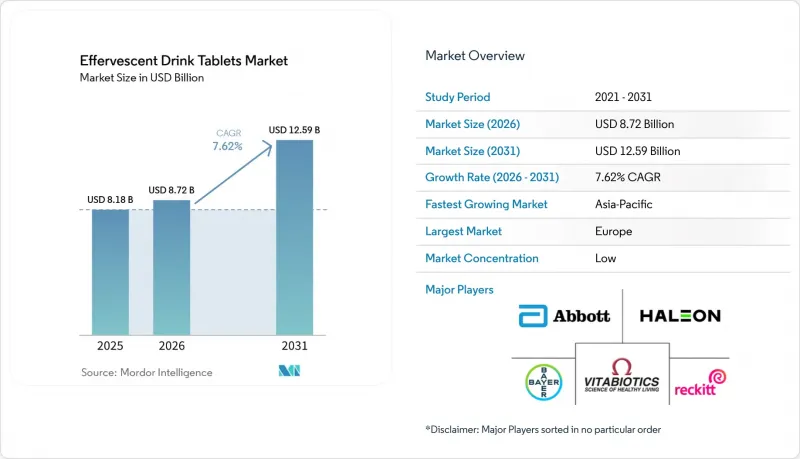
본 보고서는 맛별(감귤류, 사과, 베리류, 망고, 기타), 카테고리별(기존 및 무설탕), 기능성별(에너지 및 수분 보충, 면역력 향상 등), 판매 채널별(슈퍼마켓 및 하이퍼마켓, 편의점, 약국, 온라인 소매, 기타), 지역별(북미, 유럽, 아시아태평양, 남미, 중동 및 아프리카)로 분류되어 있습니다. 예측치는 금액(달러)으로 표시되어 있습니다.
세계의 발포 음료 정제 시장 동향 및 인사이트
간편한 수분 보충 및 영양 섭취에 대한 수요 증가
편리한 수분 보충 및 영양 섭취에 대한 수요 증가는 전 세계 발포 음료 정제 시장의 성장을 견인하는 주요 요인입니다. 이는 소비자들이 수분 보충, 에너지 보충, 면역력 향상, 그리고 전반적인 건강을 지원하는 휴대성이 뛰어나고 섭취하기 쉬운 솔루션을 점점 더 많이 찾고 있기 때문입니다. 발포성 정제는 기존의 알약이나 즉석 음료에 비해 빠른 용해, 영양소 흡수율 향상, 정확한 투여량, 그리고 높은 편의성을 제공하기 때문에 활동적인 라이프스타일, 여행, 직장 내 섭취에 특히 매력적입니다. 전 세계 정부와 공중보건 기관은 적절한 수분 보충과 예방적 영양 섭취를 지속적으로 장려하고 있으며, 피트니스 및 야외 활동 참여가 증가함에 따라 전해질과 비타민을 주성분으로 하는 제품에 대한 수요가 더욱 확대되고 있습니다. 업계 분석에 따르면, 전해질 정제 및 분말은 스포츠 영양 및 일상적인 건강 유지 분야에서 활용이 확대되는 혜택을 받아 여전히 가장 널리 채택되고 있는 수분 보충 보충제 형태 중 하나입니다. 제품 혁신이 이러한 추세를 뒷받침하고 있습니다. 2025년 4월, Phizz사는 수분 보충과 에너지 공급을 강화하기 위해 전해질, 비타민, 천연 카페인을 조합한 ‘Phizz Daily Energy Hydration Tablets’를 출시했습니다. 2026년에는 각 제조업체들이 수분 보충 및 기능성 영양 요구에 부응하여, 첨단 전해질, 콜라겐, 마그네슘, 종합 비타민을 배합한 발포 정으로 제품 라인업을 확충했습니다. 이는 다기능 웰니스 제품에 대한 소비자의 선호도가 높아지고 있음을 반영합니다.
섭취하기 쉬운 보충제 형태에 대한 고령층의 수용
인구 동향의 변화가 이 시장 수요를 조용히 견인하고 있습니다. 세계보건기구(WHO)는 2025년 10월 발표에서 중요한 전환점을 강조했습니다. 불과 4년 후인 2030년까지 전 세계 인구의 6명 중 1명이 60세 이상이 되어, 그 총수는 약 14억 명에 달할 것이라는 내용입니다. 또한 2050년에는 그 수가 2배인 21억 명에 달할 것으로 전망됩니다. 더 자세히 살펴보면, JAMA지에 게재된 미국 국민건강영양조사(NHANES)의 25년간 연구에서 주목할 만한 동향이 밝혀졌습니다. 65세 이상 성인의 건강보조식품 이용률은 1999년 62%에서 2023년 78%로 급증하여, 다른 어떤 연령대보다 높은 증가세를 보였습니다. 이러한 추세는 발포정에게 미묘하지만 중요한 의미를 지닙니다. 2025년 『RSC Pharmaceutics』지에 게재된 총설에서는 지역사회에서 생활하는 고령자의 최대 15%가 연하 장애를 겪고 있다고 지적되었습니다. 이로 인해 쉽게 녹는 발포성 제품은 기존의 정제에 비해 임상적으로 선호되는 선택지가 되고 있습니다. 생체이용률 및 삼키기 용이성에 관한 임상적 근거를 바탕으로, 건강한 노화를 위한 해결책으로서 발포성 제품을 전략적으로 판매하는 브랜드는 기존 보충제 형태로는 충족하기 어려운 수요를 효과적으로 활용하고 있습니다.
높은 습기 민감도와 포장 복잡성
발포 정제는 그 특성상 습기를 흡수하기 쉬운 경향이 있습니다. 발포를 일으키는 중탄산나트륨과 구연산의 혼합물이 주변 습기와 접촉하면 예정보다 빨리 반응해 버립니다. 이로 인해 맛과 식감의 경험이 저하될 뿐만 아니라, 정제의 영양가도 떨어지게 됩니다. 그 결과, 이러한 정제에는 습도를 25% 미만으로 유지할 수 있는 1차 포장이 필요합니다. 이 요건으로 인해 표준 정제 형태에 비해 재료비와 물류 비용이 대폭 상승합니다. 이는 습도가 종종 80%를 초과하는 동남아시아나 사하라 이남 아프리카의 열대 지역에서 사업을 전개하는 브랜드에서 특히 두드러집니다. 2025년 7월, Aptar CSP Technologies는 획기적인 듀얼 액티브 소재 과학 기술을 도입했습니다. 이 혁신적인 기술은 포장 내의 습도와 산소 농도를 모두 정교하게 관리하여, 발포 정제 제조업체가 과도한 포장을 필요로 하지 않으면서도 유통 기한을 연장할 수 있도록 해줍니다. 그러나 고품질 방습 튜브나 건조제가 포함된 캡을 채택하는 데는 과제가 있습니다. 이러한 첨단 솔루션은 유익한 반면, 이익률을 압박하는 요인이 됩니다. 이는 가격에 민감한 소비자를 대상으로 하는 프라이빗 브랜드나 수탁 제조 SKU에서 특히 두드러집니다. 그 결과, 중소규모 기업들은 이익률 압박에 직면하지 않고 사업을 확장하기가 어려워지고 있습니다.
부문 분석
연평균 성장률(CAGR) 8.46%를 기록한 사과 맛 부문은 시장에서 가장 빠르게 성장하는 선택지로 부상하고 있습니다. 이러한 급속한 성장으로 인해 사과 맛은 기존에 자리 잡았던 맛을 능가하게 되었습니다. 특히 미국과 유럽의 소비자들이 사과를 ‘깔끔하고 자연스러운 단맛’과 연관 짓는 경향이 강해지면서, 감귤류에서 흔히 볼 수 있는 인공적인 신맛과는 차별화되는 점이 주요 요인입니다. 2025년에는 감귤 계열이 32.71%라는 최대 시장 점유율을 차지하고 있지만, 그 우위는 비타민 C와 발포성의 역사적 연관성에 기인합니다. 이러한 연관성은 약국 구매자들의 선택 범위에 깊이 뿌리내리고 있으며, 바이엘의 ‘Redoxon’부터 비타바이오틱스의 ‘Feroglobin Fizz’에 이르기까지 폭넓게 나타납니다. 한편, 아시아태평양(APAC) 시장에서는 베리나 망고 맛 부문이 기세를 얻고 있습니다. 이곳에서는 열대 과일 맛이 젊은 소비자들의 공감을 더욱 강하게 불러일으키며, 전 세계 판매량에서는 뒤처져 있지만 구매 의향의 상승을 주도하고 있습니다.
'기타 맛'이라는 하위 부문은 다양한 혁신의 거점으로 진화하고 있습니다. 여기에는 임상적인 수분 보충을 목적으로 한 무향 전해질 정제부터 독자적인 식물 블렌드, 카페인이 함유된 맛 시스템에 이르기까지 모든 것이 포함됩니다. 주목할 만한 또 다른 동향으로, 각 브랜드가 면역력 향상, 에너지 보충, 미용 효과와 같은 기능성을 하나의 정제에 결합하는 경향이 강해짐에 따라, 맛에 대한 선호 순위도 변화하고 있습니다. 이러한 변화로 인해 순수한 감귤 계열에 초점을 맞추기보다는 면역력 향상에 효과적인 엘더베리와 감귤 계열의 조합 등 여러 가지 효과를 설득력 있게 보여줄 수 있는 맛이 선호되고 있습니다. 이러한 미묘한 기능성 신호보다는 단순히 판매량만을 중시하여 맛 라인업을 결정하는 브랜드는 시장의 성숙에 따라 상품화(commoditization)에 직면할 가능성이 있습니다.
2025년에 59.62%의 점유율을 차지한 것으로 평가된 기존 발포 정제는 최소한의 성분보다는 친숙한 맛을 중시하는 충성도 높은 소비자층의 지지를 받아 계속해서 시장을 주도하고 있습니다. 한편, ‘무설탕’ 부문은 연평균 성장률(CAGR) 9.11%를 기록하며 빠르게 점유율을 확대되고 있습니다. 이러한 성장 추세는 클린 라벨과 저칼로리를 선호하는 현대 소비자의 성향을 반영할 뿐만 아니라, 천연 감미료의 혁신에 의해서도 뒷받침되고 있습니다. 특히, 에리스리톨과 스테비아의 혼합물은 현재 자당과 동등한 식감과 단맛을 구현하면서도 혈당에 영향을 미치지 않는 제품으로 자리 잡았습니다. 기존 정제 제품의 주요 위협은 기존 사용자가 타사 제품으로 전환하는 것이 아니라, 신규 고객 확보에 어려움을 겪고 있다는 점에 있습니다. 처음 구매하는 소비자들은 대표적인 선택지로 무설탕 제품을 점점 더 선호하는 추세입니다.
업계에서 주목할 만한 변화로, 레킷 벤키저(Reckitt Benckiser)는 2024년 9월, 발포 정제 ‘에어본(Airborne)’의 성분을 재검토하여 미량 영양소, 비타민 C, D, 아연, A, E, 망간, 셀레늄을 풍부하게 함유했음을 강조했습니다. 이 성분들은 각각 1일 권장 섭취량의 20% 이상을 차지하며, 첨가당을 일절 사용하지 않았습니다. 이러한 움직임은 더 광범위한 추세를 여실히 보여줍니다. 즉, 기존 제품조차도 더 깨끗한 영양 성분 구성으로 전환되고 있다는 것입니다. 무설탕 트렌드를 간과하고 제품 라인 확충을 2027년까지 미루는 제조업체는 귀중한 진열 공간을 잃게 될 수도 있습니다. 신규 진출기업들은 단순히 ‘클린 라벨’에 발을 들일 뿐만 아니라, 이를 전체 제품 포트폴리오에 걸친 핵심 원칙으로 정착시키려 하고 있습니다.
지역별 분석
2025년 전 세계 발포 음료 정제 시장에서 유럽이 36.40%의 점유율을 차지했다는 사실은 다른 지역의 경쟁사들이 아직 구축 중인 구조적 우위를 여실히 보여줍니다. 여기에는 약사들의 강력한 추천 네트워크, 발포성 제제에 대한 소비자의 친숙함(예 : 벨로카, 레독슨), 그리고 제품의 신뢰성을 높이는 성분 공개를 의무화하는 규제 체계 등이 포함됩니다. 유럽 집행위원회에 의한 영양 보충제 내 비타민 및 미네랄의 ‘최대 허용 수준’ 조화(2026년 3분기에 공식 증거 제출 요청이 예상)는 유럽 집행위원회 규정(EU) 2025/352에 의해 개정된 지침 2002/46/EC 하에서 규정 준수 체계가 성분 기준치를 더욱 엄격하게 함으로써 경쟁 환경을 일변시킬 가능성이 있습니다. 독일, 영국, 프랑스와 같은 주요 시장에서는 약국 유통 채널에서 프리미엄 가격대가 유지되고 있는 반면, 폴란드, 스웨덴, 네덜란드에서는 현대적인 소매 채널의 확대로 인해 빠르게 성장하는 하위 시장으로 부상하고 있습니다. 혁신에 대한 투자는 계속해서 견조하며, 독일과 영국은 새로운 기능성 성분의 조합을 시험적으로 도입하는 세계 브랜드들의 출시 거점이 되고 있습니다.
아시아태평양은 인도와 중국의 스포츠 참여율 상승, 동남아시아의 전자상거래 급속한 성장, 그리고 소셜 커머스를 통해 발포제 형태의 제품을 접하는 젊은 층 증가에 힘입어 연평균 성장률(CAGR) 9.38%로 성장하고 있으며, 이는 전 세계에서 가장 빠른 속도입니다. 인도에는 독자적인 비즈니스 기회가 있으며, 그 예로 바이엘 컨슈머 헬스가 2026년 6월 AYUSH 카테고리에서 인도 최초의 프로바이오틱스 함유 제산제 ‘알카 셀처’를 출시하여 4년 이내에 1억 가구를 타겟으로 하고 있습니다. 또한 ‘Fast&Up;’이나 ‘Wellbeing Nutrition’과 같은 국내 브랜드들도 급속히 규모를 확대되고 있습니다. 웰빙 뉴트리션(Wellbeing Nutrition)사는 2024 회계연도에 1억 1,000만 카롤 루피(1,320만 달러)였던 매출을 2026년도에는 400카롤 루피(4,800만 달러)까지 확대될 전망이며, 발포제 형태를 회사의 정체성 핵심으로 삼고 있습니다. 호주와 한국에서는 임상적으로 입증된 클린 라벨 제제에 대해 소비자들이 더 높은 가격을 지불할 의향을 보이고 있어, 프리미엄 시장이라는 측면이 더해지고 있습니다.
미국을 필두로 한 북미는 견고한 2위 자리를 차지하고 있습니다. 소비자들은 스포츠용 전해질 제품(예 : Nuun)이나 면역 지원 정제(예 : Airborne)를 선호합니다. 남미, 특히 브라질, 아르헨티나, 콜롬비아는 신흥 시장으로, 중산층의 소득 증가가 발포 정제 구매를 견인하고 있지만, 유통망 부족으로 인해 지방 지역으로의 확산에는 한계가 있습니다. 중동 및 아프리카에서는 UAE, 사우디아라비아, 남아프리카공화국에서 기회가 포착되며, 건강 의식이 높은 도시권 소비자와 여행 소매 채널을 이용하는 관광객이 많아 틈새 시장이지만 프리미엄 수요가 발생하고 있습니다. 남미 및 중동 및 아프리카 모두에서 온라인 소매 및 퀵 커머스 플랫폼이 약국 유통망 확대의 지연을 보완하여 제품 보급을 가속화할 것으로 예측됩니다.
기타 혜택 :
- 엑셀 형식 시장 예측(ME) 시트
- 3개월간의 애널리스트 지원
자주 묻는 질문
목차
제1장 서론
제2장 조사 방법
제3장 주요 요약
제4장 시장 구도
제5장 시장 규모 및 성장 예측
제6장 경쟁 구도
제7장 시장 기회 및 향후 전망
AJY 26.08.07According to Mordor Intelligence, the effervescent drink tablets market size is projected to be USD 8.18 billion in 2025, USD 8.72 billion in 2026, and reach USD 12.59 billion by 2031, growing at a CAGR of 7.6% from 2026 to 2031.

This report is Segmented by Flavor (Citrus, Apple, Berries, Mango, and Others), Category (Conventional and Zero Sugar), Functionality (Energy and Hydration, Immunity and More), Distribution Channel (Supermarkets/Hypermarkets, Convenience Stores, Pharmacies, Online Retail, and Others), and Geography (North America, Europe, Asia-Pacific, South America, and Middle East and Africa). Forecasts in Value (USD).
Global Effervescent Drink Tablets Market Trends and Insights
Rising demand for convenient hydration and nutritional delivery
The rising demand for convenient hydration and nutritional delivery is a key factor driving growth in the global effervescent drink tablets market, as consumers increasingly seek portable, easy-to-consume solutions that support hydration, energy, immunity, and overall wellness. Effervescent tablets offer rapid dissolution, improved nutrient absorption, precise dosing, and greater convenience compared to traditional tablets and ready-to-drink beverages, making them particularly attractive for active lifestyles, travel, and workplace consumption. Government and public health agencies worldwide continue to promote adequate hydration and preventive nutrition, while growing participation in fitness and outdoor activities further supports demand for electrolyte and vitamin-based formulations. Industry analyses indicate that electrolyte tablets and powders remain among the most widely adopted hydration supplement formats, benefiting from increasing use in sports nutrition and daily wellness routines. Product innovation is reinforcing this trend; in April 2025, Phizz launched Phizz Daily Energy Hydration Tablets, combining electrolytes, vitamins, and natural caffeine for enhanced hydration and energy support. In 2026, manufacturers expanded portfolios with advanced electrolyte, collagen, magnesium, and multivitamin effervescent tablets targeting hydration and functional nutrition needs, reflecting growing consumer preference for multifunctional wellness products.
Aging consumer adoption of easy-to-consume supplement formats
Demographic shifts are quietly steering the demand in this market. The World Health Organization, in an October 2025 announcement, highlighted a significant milestone: by 2030, a mere four years away, 1 in 6 individuals globally will be aged 60 or older, totaling approximately 1.4 billion. Fast forward to 2050, and that number is set to double, reaching 2.1 billion. Delving deeper, a 25-year study from the US National Health and Nutrition Examination Survey, published in JAMA, unveiled a notable trend: supplement usage among adults aged 65 and older surged from 62% in 1999 to 78% in 2023, outpacing every other age demographic. This trend has a subtle yet significant implication for effervescent tablets: a 2025 review in RSC Pharmaceutics highlighted that up to 15% of older adults in community settings face dysphagia, or swallowing difficulties. This makes effervescent drinks, which dissolve easily, a clinically preferred choice over traditional tablets. Brands that strategically market effervescent products as a solution for healthy aging, bolstered by clinical evidence on their bioavailability and ease of swallowing, are capitalizing on a demand that conventional supplement formats struggle to meet.
High moisture sensitivity and packaging complexity
Effervescent tablets are naturally prone to moisture absorption. When the sodium bicarbonate-citric acid system, responsible for carbonation, comes into contact with ambient humidity, it reacts prematurely. This not only diminishes the sensory experience but also the nutritional quality of the tablets. As a result, these tablets require primary packaging that maintains humidity levels below 25%. This requirement significantly raises material and logistics costs compared to standard tablet formats. This is especially pronounced for brands operating in tropical regions of Southeast Asia and Sub-Saharan Africa, where humidity levels often soar above 80%. In July 2025, Aptar CSP Technologies introduced a groundbreaking dual-active material science technology. This innovation adeptly manages both moisture and oxygen levels in packaging, offering effervescent manufacturers an extended shelf life without the need for excessive packaging. However, the adoption of premium moisture-barrier tubes and desiccant closures poses a challenge. These advanced solutions, while beneficial, strain profitability margins. This is particularly true for private-label and contract-manufactured SKUs that cater to budget-conscious consumers. As a result, smaller players find it challenging to scale without facing margin pressures.
Other drivers and restraints analyzed in the detailed report include:
- Expansion of sports nutrition and recovery use cases
- Growth in zero sugar and clean-label effervescent formulations
- Sodium load concerns in frequent use products
For complete list of drivers and restraints, kindly check the Table Of Contents.
Segment Analysis
With an 8.46% CAGR, the apple flavor segment has emerged as the market's fastest-growing choice. This surge has seen it eclipse more established profiles, particularly as consumers in the US and Europe increasingly associate Apple with a clean, natural sweetness, distancing it from the artificial tartness often linked to citrus. While citrus commands the largest market share at 32.71% in 2025, its dominance is anchored in a historical association with Vitamin C effervescence. This connection, deeply embedded in pharmacy buyer repertoires, spans from Bayer's Redoxon to Vitabiotics' Feroglobin Fizz. Meanwhile, in the APAC markets, the berry and mango flavor segments are gaining momentum. Here, tropical fruit profiles resonate more with younger consumers, driving a higher purchase intent, even if they lag in global volume.
The "Other Flavors" sub-segment is evolving into a diverse innovation hub. It encompasses everything from unflavored electrolyte tablets aimed at clinical hydration to proprietary botanical blends and caffeinated flavor systems. Another trend to monitor: as brands increasingly stack functional benefits, like immunity, energy, and beauty, into single tablets, the flavor preference hierarchy is evolving. This shift favors profiles that can credibly signal multiple benefits, such as elderberry-citrus for immunity, over a singular focus on pure citrus. Brands that prioritize flavor portfolios solely for volume, rather than these nuanced functional signals, may find themselves facing commoditization as the market matures.
Conventional effervescent tablets, holding a 59.62% share in 2025, continue to lead the market, buoyed by a loyal consumer base that values familiar tastes over minimalist ingredients. Meanwhile, the Zero Sugar segment is rapidly gaining ground, boasting a 9.11% CAGR. This growth trajectory not only mirrors the aspirational values of today's consumers. favoring clean labels and low calories, but is also bolstered by innovations in natural sweeteners. Notably, blends of erythritol and stevia are now achieving the same mouthfeel and sweetness as sucrose, but without the glycaemic repercussions. The primary threat to Conventional tablets isn't from current users switching allegiance, but from the brand's struggle to attract newcomers: first-time buyers are increasingly gravitating towards zero sugar options as their go-to choice.
In a notable industry shift, Reckitt Benckiser reformulated its Airborne effervescent tablets in September 2024, spotlighting a rich blend of micronutrients, Vitamin C, D, Zinc, A, E, Manganese, and Selenium, each at over 20% of daily values, all while steering clear of added sugars. This move underscores a broader trend: even traditional Conventional products are pivoting towards cleaner nutritional profiles. Manufacturers who overlook the zero-sugar trend and delay line extensions until 2027 may find themselves losing valuable shelf space. Newer entrants are not just dabbling in clean labels; they're embedding it as a core principle across their entire product portfolios.
Complete Report Scope:
- Flavor
- Citrus
- Apple
- Berries
- Mango
- Other Flavors
- Category
- Conventional
- Zero Sugar
- Functionality
- Energy and Hydration
- Immunity
- Weight Management
- Beauty Nutrition
- Other Functionalities
- Distribution Channel
- Supermarkets and Hypermarkets
- Convenience Stores
- Pharmacies/Drug Stores
- Online Retail Stores
- Other Distribution Channels
- Geography
- North America
- United States
- Canada
- Mexico
- Rest of North America
- Europe
- United Kingdom
- Germany
- France
- Italy
- Spain
- Sweden
- Belgium
- Poland
- Netherlands
- Rest of Europe
- Asia-Pacific
- China
- Japan
- India
- Thailand
- Singapore
- Indonesia
- South Korea
- Australia
- Rest of Asia-Pacific
- South America
- Brazil
- Argentina
- Colombia
- Peru
- Chile
- Rest of South America
- Middle East and Africa
- United Arab Emirates
- South Africa
- Saudi Arabia
- Nigeria
- Egypt
- Morocco
- Turkey
- Rest of Middle East and Africa
- North America
Geography Analysis
Europe's 36.40% share of the global effervescent drink tablets market in 2025 highlights structural advantages that competitors in other regions are still developing. These include strong pharmacist recommendation networks, consumer familiarity with effervescent formats (e.g., Berocca and Redoxon), and a regulatory framework requiring formulation disclosures, which enhance product credibility. The European Commission's harmonization of Maximum Permitted Levels for vitamins and minerals in food supplements, with a formal evidence call expected in Q3 2026, could reshape competition as compliance frameworks tighten ingredient thresholds under Directive 2002/46/EC, amended by Commission Regulation (EU) 2025/352. Key markets like Germany, the UK, and France sustain premium pricing in pharmacy channels, while Poland, Sweden, and the Netherlands are emerging as faster-growth sub-markets due to modern trade expansion. Innovation investment remains strong, with Germany and the UK serving as launch hubs for global brands testing new functional stack formulations.
Asia-Pacific is growing at a 9.38% CAGR, the fastest globally, driven by rising sports participation in India and China, rapid e-commerce growth in Southeast Asia, and a youth demographic discovering effervescent formats via social commerce. India offers a distinct opportunity, highlighted by Bayer Consumer Health's June 2026 launch of Alka-Seltzer as the country's first probiotic-supported antacid under the AYUSH category, targeting 100 million households within four years. Domestic brands like Fast&Up and Wellbeing Nutrition are scaling rapidly. Wellbeing Nutrition projects revenue growth from INR 110 crore (USD 13.2 million) in FY2024 to INR 400 crore (USD 48 million) in FY2026, with effervescent formats central to its identity. Australia and South Korea add a premium-market dimension, with consumers willing to pay more for clinically validated, clean-label formulations.
North America, led by the U.S., holds a strong second-place position. Consumers favor sports electrolyte formats (e.g., Nuun) and immunity tablets (e.g., Airborne). South America, particularly Brazil, Argentina, and Colombia, is an emerging market where rising middle-class incomes are driving effervescent tablet purchases, though distribution gaps limit rural penetration. The Middle East and Africa, with opportunities in the UAE, Saudi Arabia, and South Africa, show niche but premium demand driven by health-conscious urban consumers and high tourist traffic in travel retail. In both South America and MEA, online retail and quick-commerce platforms are expected to accelerate adoption, bypassing slower pharmacy distribution expansion.
- Bayer AG
- Haleon plc
- Reckitt Benckiser Group plc
- Nuun Hydration
- Vitabiotics Ltd.
- Novartis AG
- Pfizer Inc.
- Sanofi S.A.
- Abbott Laboratories
- Nestle S.A.
- Herbalife International of America, Inc.
- Perrigo Company plc
- Amerilab Technologies, Inc.
- HERMES ARZNEIMITTEL GmbH
- Bliss GVS Pharma Ltd.
- CHIESI Farmaceutici S.p.A.
- S. G. Biopharm Pvt. Ltd.
- Wellbeing Nutrition
- Fast&Up
- Swisse Wellness Pty Ltd.
Additional Benefits:
- The market estimate (ME) sheet in Excel format
- 3 months of analyst support
TABLE OF CONTENTS
1 INTRODUCTION
- 1.1 Study Assumptions and Market Definition
- 1.2 Scope of the Study
2 RESEARCH METHODOLOGY
3 EXECUTIVE SUMMARY
4 MARKET LANDSCAPE
- 4.1 Market Overview
- 4.2 Market Drivers
- 4.2.1 Rising Demand for Convenient Hydration and Nutritional Delivery
- 4.2.2 Aging Consumer Adoption of Easy-To-Consume Supplement Formats
- 4.2.3 Expansion of Sports Nutrition and Recovery Use Cases
- 4.2.4 Growth in Zero Sugar and Clean-Label Effervescent Formulations
- 4.2.5 Under-Served Travel, Outdoor, and On-The-Go Rehydration Use Cases
- 4.2.6 Rising Premiumization Through Functional Blends and Multi-Benefit Tablets
- 4.3 Market Restraints
- 4.3.1 High Moisture Sensitivity and Packaging Complexity
- 4.3.2 Sodium Load Concerns in Frequent Use Products
- 4.3.3 Manufacturing Variability in Acid-Base Stability and Dosage Uniformity
- 4.3.4 Limited Reimbursement and Cost Pressure Versus Conventional Dosage Forms
- 4.4 Consumer Behavior Analysis
- 4.5 Regulatory Landscape
- 4.6 Technological Outlook
- 4.7 Porter's Five Forces
- 4.7.1 Threat of New Entrants
- 4.7.2 Bargaining Power of Buyers
- 4.7.3 Bargaining Power of Suppliers
- 4.7.4 Threat of Substitutes
- 4.7.5 Intensity of Competitive Rivalry
5 MARKET SIZE AND GROWTH FORECASTS (VALUE)
- 5.1 Flavor
- 5.1.1 Citrus
- 5.1.2 Apple
- 5.1.3 Berries
- 5.1.4 Mango
- 5.1.5 Other Flavors
- 5.2 Category
- 5.2.1 Conventional
- 5.2.2 Zero Sugar
- 5.3 Functionality
- 5.3.1 Energy and Hydration
- 5.3.2 Immunity
- 5.3.3 Weight Management
- 5.3.4 Beauty Nutrition
- 5.3.5 Other Functionalities
- 5.4 Distribution Channel
- 5.4.1 Supermarkets and Hypermarkets
- 5.4.2 Convenience Stores
- 5.4.3 Pharmacies/Drug Stores
- 5.4.4 Online Retail Stores
- 5.4.5 Other Distribution Channels
- 5.5 Geography
- 5.5.1 North America
- 5.5.1.1 United States
- 5.5.1.2 Canada
- 5.5.1.3 Mexico
- 5.5.1.4 Rest of North America
- 5.5.2 Europe
- 5.5.2.1 United Kingdom
- 5.5.2.2 Germany
- 5.5.2.3 France
- 5.5.2.4 Italy
- 5.5.2.5 Spain
- 5.5.2.6 Sweden
- 5.5.2.7 Belgium
- 5.5.2.8 Poland
- 5.5.2.9 Netherlands
- 5.5.2.10 Rest of Europe
- 5.5.3 Asia-Pacific
- 5.5.3.1 China
- 5.5.3.2 Japan
- 5.5.3.3 India
- 5.5.3.4 Thailand
- 5.5.3.5 Singapore
- 5.5.3.6 Indonesia
- 5.5.3.7 South Korea
- 5.5.3.8 Australia
- 5.5.3.9 Rest of Asia-Pacific
- 5.5.4 South America
- 5.5.4.1 Brazil
- 5.5.4.2 Argentina
- 5.5.4.3 Colombia
- 5.5.4.4 Peru
- 5.5.4.5 Chile
- 5.5.4.6 Rest of South America
- 5.5.5 Middle East and Africa
- 5.5.5.1 United Arab Emirates
- 5.5.5.2 South Africa
- 5.5.5.3 Saudi Arabia
- 5.5.5.4 Nigeria
- 5.5.5.5 Egypt
- 5.5.5.6 Morocco
- 5.5.5.7 Turkey
- 5.5.5.8 Rest of Middle East and Africa
- 5.5.1 North America
6 COMPETITIVE LANDSCAPE
- 6.1 Market Concentration
- 6.2 Strategic Moves
- 6.3 Market Ranking Analysis
- 6.4 Company Profiles
- 6.4.1 Bayer AG
- 6.4.2 Haleon plc
- 6.4.3 Reckitt Benckiser Group plc
- 6.4.4 Nuun Hydration
- 6.4.5 Vitabiotics Ltd.
- 6.4.6 Novartis AG
- 6.4.7 Pfizer Inc.
- 6.4.8 Sanofi S.A.
- 6.4.9 Abbott Laboratories
- 6.4.10 Nestle S.A.
- 6.4.11 Herbalife International of America, Inc.
- 6.4.12 Perrigo Company plc
- 6.4.13 Amerilab Technologies, Inc.
- 6.4.14 HERMES ARZNEIMITTEL GmbH
- 6.4.15 Bliss GVS Pharma Ltd.
- 6.4.16 CHIESI Farmaceutici S.p.A.
- 6.4.17 S. G. Biopharm Pvt. Ltd.
- 6.4.18 Wellbeing Nutrition
- 6.4.19 Fast&Up
- 6.4.20 Swisse Wellness Pty Ltd.


