|
시장보고서
상품코드
2097501
산화방지제 : 시장 점유율 분석, 업계 동향 및 통계, 성장 예측(2026-2031년)Antioxidants - Market Share Analysis, Industry Trends & Statistics, Growth Forecasts (2026 - 2031) |
||||||
 Mordor Intelligence
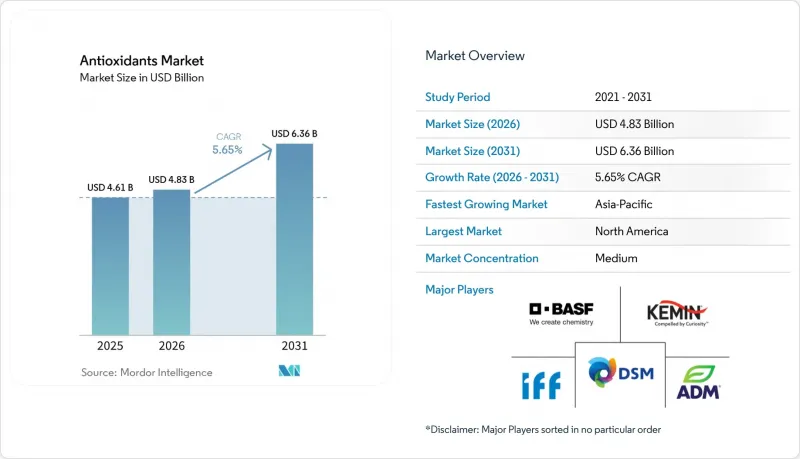
Mordor Intelligence에 의하면, 2025년에 46억 1,000만 달러 규모로 평가된 산화방지제 시장은 2026년에는 48억 3,000만 달러로 확대되어 2031년까지 63억 6,000만 달러에 이를 것으로 예측되며, 2026년부터 2031년까지 연평균 복합 성장률(CAGR)은 5.65%를 나타낼 전망입니다.
본 보고서는 유형(토코페롤, 로즈마리 추출물, 녹차 추출물, BHA, BHT, 기타), 성질(천연, 합성), 형태(건조, 액체), 용도(식품 및 음료, 의약품·퍼스널케어, 연료·윤활유, 플라스틱 첨가제, 기타), 지역(북미, 유럽, 아시아태평양, 남미, 중동 및 아프리카)별로 분류되어 있습니다. 시장 전망은 금액(달러) 기준으로 제시되어 있습니다.
세계의 산화방지제 시장 동향 및 인사이트
천연 산화방지제에 대한 수요 증가
산화방지제 시장은 소비자 수요와 제품 재처방의 필요성에 힘입어 식품, 화장품, 영양보충제 분야에서 식물 유래 솔루션으로 전환되고 있습니다. 2026년 2월 FDA가 시판 후 심사 체계를 바탕으로 BHA의 안전성 재평가를 실시한 것과 같은 규제 조치도 이러한 추세를 가속화하고 있습니다. 구매자들은 향후 규제 시행에 앞서 천연 유래 대체재로 전환을 추진하고 있습니다. 케민(Kemin)사가 2025년에 실시한 로즈마리 유래 'OLESSENCE' 플랫폼의 확장은 배합 품질은 물론, 작물 개발부터 완성된 원료에 이르기까지 수직 통합의 중요성이 높아지고 있음을 여실히 보여줍니다. 그러나 이러한 전환은 고르지 않게 진행되고 있으며, 안정적인 공급과 입증된 성능을 갖춘 확장 가능한 원료는 틈새 시장용 추출물보다 더 빠르게 성장하고 있습니다. 추적 가능한 조달, 일관된 추출 및 응용 분야 지원을 확보하고 있는 공급업체는 산화방지제 시장에서 수익성을 유지하는 데 유리한 입장에 있습니다.
기능성 식품 및 음료의 확대
기능성 식품 및 음료는 산화방지제가 일상 소비에 널리 침투할 수 있는 길을 열어주고 있습니다. 과거에는 주로 유통 기한 연장에 사용되던 이 제품들에 포함된 산화방지제는 현재 건강, 웰니스, 그리고 유효 성분으로서의 존재감과 점점 더 밀접하게 연결되고 있습니다. 2025년 『Discover Applied Sciences』지에 게재된 연구에서는 식물 유래 항산화 물질의 혼합물, 특히 폴리페놀과 비타민 C의 조합이 개별 화합물보다 더 강력한 자유 라디칼 소거 능력을 보인다는 점이 강조되었습니다. 이러한 발견은 여러 성분의 시너지 효과를 활용한 제품 형태를 뒷받침하고 있으며, 공급업체들은 단일 원료 이상의 가치를 제공할 수 있게 되었습니다. 가장 수요가 높은 것은 음료, 건강기능식품, 미용 제품에 원활하게 통합될 수 있고, 처방 변경을 최소화할 수 있는 천연 항산화 물질입니다. 또한, 산화방지제 시장에서 이러한 추세는 특히 배합, 용해성, 제품 표시의 일관성 같은 분야에서 기술 지원의 가치를 높이고 있습니다.
엄격한 규제 준수
산화방지제 시장에서는 특히 식품 용도로 사용되는 합성 성분에 대해 규제 준수에 대한 압박이 커지고 있습니다. FDA가 2026년 2월에 실시한 BHA 재평가는 미국 내 보다 적극적인 시판 후 관리 접근 방식을 부각시키고 있습니다. 주 차원에서 학교 급식 내 BHA 사용을 제한하려는 움직임으로 인해 미국 시장 내에서 규제의 일관성이 상실되어 조달 및 배합 결정이 복잡해지고 있습니다. 유럽에서는 식품 첨가물에 대한 재평가가 지속되고 있으며, 안전성에 관한 확실한 문서가 없는 성분에 대해 더욱 엄격한 감시가 이루어지고 있습니다. 이러한 규제상의 과제로 인해 문서화 비용이 증가하고 상품화가 지연되며, 중소 공급업체의 경우 도입 속도가 둔화되고 있습니다. 반면 대기업은 규제 대응 팀, 확립된 서류, 그리고 전 세계 고객 네트워크를 보유하고 있어 이러한 과제를 보다 효과적으로 관리하고 있습니다.
부문 분석
2025년, 토코페롤은 산화방지제 시장의 18.62%를 차지하며 매출 기준 최대 카테고리로서의 지위를 유지했습니다. 이러한 우위는 식품 보존, 영양 보조제, 화장품, 동물사료 및 폴리머 안정제 등 광범위한 분야에서 활용되고 있기 때문입니다. 토코페롤은 영양학적 가치와 산화 억제 효과를 겸비하고 있어, 하나의 배합에 여러 원료를 사용할 필요성을 줄여줍니다. 이러한 균형 덕분에 성능을 희생하지 않으면서도 친숙한 성분을 찾는 구매자들에게 토코페롤은 산화방지제 업계의 중심적인 존재로 자리매김하고 있습니다. 또한, 다양한 투여 형태 및 가공 시스템과의 폭넓은 호환성도 그 위상을 뒷받침하고 있습니다.
녹차 추출물은 산화방지제 시장에서 가장 빠르게 성장하고 있는 유형로, 2026년부터 2031년까지 연평균 성장률(CAGR) 6.8%가 예상됩니다. 이러한 성장은 기능성 음료, 의약품, 퍼스널케어, 영양 보충제 등에서의 활용에 기인합니다. 배합 담당자들이 단순한 배경적 안정제가 아닌, 눈에 보이는 생체 활성 성분을 추구하는 수요의 혜택을 받고 있습니다. 이로 인해 녹차 추출물은 순수하게 비용 위주의 배합보다는 프리미엄 제품에서 더 중요한 역할을 수행하고 있습니다. 로즈마리 추출물, 아스코르브산, BHA, BHT, 에리소르빈산 등의 다른 유형들도 각각 특정 가공상의 요구 사항, 표시 목표 또는 비용 구조에 여전히 부합하기 때문에 중요한 위치를 차지하고 있습니다.
2025년, 천연 산화방지제는 산화방지제 시장에서 43.25%의 점유율을 차지하며 금액 기준 1위를 유지했습니다. 식물 유래 성분을 선호하는 소비자 경향은 식품, 퍼스널케어, 뉴트라슈티컬 각 분야 수요를 견인하고 있습니다. 유럽에서 진행 중인 식품 첨가물의 재평가로 인해 특정 성분에 대한 감시가 강화되고 있으며, 규제적 근거가 명확한 천연 유래 대체품이 간접적으로 우대받고 있습니다. 이 부문 내에서는 수요에 편차가 있으며, 토코페롤, 로즈마리 추출물, 아스코르브산의 경우 소규모 식물 유래 성분보다 재조제 수요가 더 높습니다. 농업 분야의 조달 및 추출 능력을 통합한 공급업체는 이러한 시장 변화로부터 혜택을 볼 수 있는 유리한 위치에 있습니다.
합성 산화방지제는 산화방지제 시장에서 가장 빠르게 성장하는 부문으로, 2026년부터 2031년까지 연평균 성장률(CAGR) 7.25%를 나타낼 것으로 전망됩니다. 이러한 성장은 주로 폴리머 안정화, 고무 가공, 연료 및 윤활유 시스템과 같은 산업용도로 인해 주도되고 있으며, 이러한 분야에서는 천연 유래 대체재가 제한적입니다. 2026년 4월, BASF는 비용 압박에도 불구하고 산업 수요가 견조함을 반영하여, 플라스틱 용도의 산화 방지제 및 관련 첨가제에 대해 최대 25%의 가격 인상을 발표했습니다. 또한, 이 부문은 내열성, 긴 수명 및 공정 안정성이 ‘클린 라벨’에 대한 우려를 상회하는 분야에서도 호조를 보이고 있습니다. 규정 준수 요구는 여전히 높은 수준이지만, 기술적 전문 지식을 갖추고 규제 대응을 완료한 경험 많은 제조업체들은 경쟁 우위를 유지하고 있습니다.
지역별 분석
2025년, 북미는 산화방지제 시장에서 33.37%의 점유율을 차지하며 지역별 1위를 유지했습니다. 이 지역은 견조한 가공식품 산업, 높은 건강기능식품 수요, 그리고 클린 라벨 제품의 보급 확대라는 혜택을 누리고 있습니다. 2026년 2월 FDA가 실시한 BHA 재평가는 식품 제조업체에 대한 배합 변경 압력을 강화하는 동시에 대체 원료의 필요성을 부각시켰습니다. 주 차원의 BHA 규제로 인해 일부 구매업체의 경우 계획 기간이 더욱 단축되어 조달 결정의 시급성이 높아지고 있습니다. 멕시코는 소비 거점일 뿐만 아니라 생산 거점으로서도 이 지역을 뒷받침하고 있으며, 이는 BASF가 푸에블라에서 아민계 산화방지제의 생산 능력을 확대한 사실에서도 드러납니다.
아시아태평양은 산화방지제 시장에서 가장 빠르게 성장하고 있는 지역으로, 2026년부터 2031년까지 연평균 성장률(CAGR) 7.79%를 나타낼 것으로 전망됩니다. 중국은 식품 보존, 플라스틱, 의약품, 퍼스널케어, 연료 및 윤활유 분야의 산화방지제 사용을 통해 성장을 주도하고 있습니다. 인도에서는 식물 유래 원료에 대한 친숙함에 힘입어, 포장 식품 수요 증가와 뉴트라슈티컬 제품 소비 확대에 따라 시장이 성장하고 있습니다. 일본, 한국, 호주, 싱가포르는 의약품 및 화장품 등급 산화방지제에 대한 프리미엄 수요에 기여하고 있습니다. 2026년, 말레이시아 조호르주에서 진행될 리안롱(Lianlong)의 제조 및 연구개발 프로젝트는 아시아태평양이 단순한 수요 거점에 그치지 않고 생산 거점으로서의 역할을 확대하고 있음을 여실히 보여줍니다.
유럽은 확립된 식품 가공, 폴리머, 제약 산업의 뒷받침을 받아 산화방지제 시장에서 여전히 2위의 규모를 자랑하고 있습니다. 이 지역의 성장은 식품 첨가물에 대한 재평가와 지속 가능한 농업 관행을 촉진하는 정책에 의해 주도되고 있으며, 이러한 요인들이 식물 유래 원료의 사용을 뒷받침하고 있습니다. 브라질과 아르헨티나를 필두로 한 남미는 식품 수출, 산업화, 그리고 대두 유래 토코페롤 공급을 통해 성장하고 있습니다. 중동 및 아프리카는 시장 규모는 작지만, 포장 식품 소매, 관광 관련 푸드서비스, 축산 분야에서 꾸준한 수요가 나타나고 있습니다.
기타 혜택 :
- 엑셀 형식 시장 예측(ME) 시트
- 3개월간의 애널리스트 지원
자주 묻는 질문
목차
제1장 서론
제2장 조사 방법
제3장 주요 요약
제4장 시장 구도
제5장 시장 규모 및 성장 예측
제6장 경쟁 구도
제7장 시장 기회 및 향후 전망
KTH 26.08.05According to Mordor Intelligence, the antioxidants market, valued at USD 4.61 billion in 2025, is expected to grow to USD 4.83 billion in 2026 and reach USD 6.36 billion by 2031, with a 5.65% CAGR from 2026 to 2031.
This report is Segmented by Type (Tocopherols, Rosemary Extract, Green Tea Extract, BHA, BHT, Others), Nature (Natural, Synthetic), Form (Dry, Liquid), Application (Food and Beverage, Pharma and Personal Care, Fuel and Lubricant, Plastic Additives, Others), and Geography (North America, Europe, Asia-Pacific, South America, Middle East and Africa). The Market Forecasts are Provided in Terms of Value (USD).
Global Antioxidants Market Trends and Insights
Growing Demand for Natural Antioxidants
The antioxidants market is shifting towards plant-based solutions in food, cosmetics, and nutraceuticals, driven by consumer demand and reformulation needs. Regulatory actions, such as the FDA's safety reassessment of BHA in February 2026 under its post-market review framework, are accelerating this trend. Buyers are moving to natural alternatives ahead of potential restrictions. Kemin's 2025 expansion of its rosemary-based OLESSENCE platform highlights the rising importance of vertical control, from crop development to finished ingredients, alongside formulation quality. However, the shift is uneven, with scalable ingredients offering stable supply and proven performance growing faster than niche extracts. Suppliers that ensure traceable sourcing, consistent extraction, and application support are better positioned to maintain margins in the antioxidants market.
Expansion of Functional Foods and Beverages
Functional foods and beverages are paving a wider path for antioxidants into daily consumption. Once primarily used to extend shelf life, antioxidants in these products are now increasingly associated with health, wellness, and active ingredient prominence. Research published in Discover Applied Sciences in 2025 highlighted that blends of plant-derived antioxidants, particularly combinations of polyphenols and vitamin C, exhibited a stronger ability to scavenge free radicals than individual compounds. This finding bolsters product formats that harness the synergy of multiple ingredients, allowing suppliers to provide more than just a single raw material. The strongest demand is for natural antioxidants that seamlessly integrate into beverages, supplements, and beauty products, minimizing the need for extensive reformulation. Furthermore, in the antioxidants market, this trend is enhancing the value of technical support, particularly in areas like blending, solubility, and aligning product claims.
Stringent Regulatory Compliances
Compliance pressures are increasing in the antioxidants market, especially for synthetic ingredients used in food applications. The FDA's February 2026 reassessment of BHA highlights a more active post-market approach in the U.S. State-level restrictions on BHA in school food settings are creating inconsistent regulations within the U.S. market, complicating sourcing and formulation decisions. In Europe, the ongoing re-evaluation of food additives is putting more scrutiny on ingredients without strong safety documentation. These regulatory challenges raise documentation costs, delay commercialization, and slow adoption for smaller suppliers. Larger companies, however, manage these challenges more effectively due to their regulatory teams, established files, and global customer networks.
Other drivers and restraints analyzed in the detailed report include:
- Clean-Label Ingredient Preference
- Rising Use in Processed Foods to Prevent Oxidation
- Consumer Skepticism Toward Isolated Antioxidant Supplements
For complete list of drivers and restraints, kindly check the Table Of Contents.
Segment Analysis
Tocopherols captured 18.62% of the antioxidants market in 2025, which kept them as the largest type by revenue. Their lead comes from broad use across food preservation, dietary supplements, cosmetics, animal nutrition, and polymer stabilization. They offer a combination of nutritional relevance and oxidation control that reduces the need for multiple inputs in one formula. That balance keeps tocopherols central to the antioxidants industry where buyers want familiar ingredients without giving up performance. Their position is also supported by wide compatibility across different delivery formats and processing systems.
Green Tea Extract is the fastest-growing type in the antioxidants market, with a projected CAGR of 6.8% from 2026 to 2031. Growth comes from its use across functional beverages, pharmaceuticals, personal care, and dietary supplements. It benefits from demand where formulators want a visible bioactive ingredient and not only a background stabilizer. This gives Green Tea Extract a stronger role in premium products than in purely cost-driven formulations. Other types such as rosemary extract, ascorbic acid, BHA, BHT, and erythorbic acid remain important because each one still fits a specific processing need, label goal, or cost profile.
In 2025, Natural Antioxidants held a 43.25% share of the antioxidants market, maintaining their value-based lead. Consumers' preference for plant-based ingredients drives demand across food, personal care, and nutraceutical sectors. Europe's ongoing food additive re-evaluation has increased scrutiny on certain ingredients, indirectly favoring natural alternatives with clearer regulatory support. Within this segment, demand is uneven; tocopherols, rosemary extract, and ascorbic acid see higher reformulation demand than smaller botanicals. Suppliers with integrated agricultural sourcing and extraction capabilities are well-positioned to benefit from these market shifts.
Synthetic Antioxidants are the fastest-growing segment in the antioxidants market, with a projected CAGR of 7.25% from 2026 to 2031. This growth is mainly fueled by industrial applications like polymer stabilization, rubber processing, and fuel and lubricant systems, where natural substitutes are limited. In April 2026, BASF announced a price hike of up to 25% on antioxidants and related additives for plastic applications, reflecting strong industrial demand despite cost pressures. The segment also thrives in areas where heat resistance, long service life, and process stability outweigh clean-label concerns. While compliance demands remain high, experienced producers with technical expertise and completed regulatory work maintain a competitive edge.
Complete Report Scope:
- By Type
- Tocopherols
- Rosemary extract
- Green Tea Extract
- Butylated hydroxyanisole (BHA)
- Butylated hydroxytoluene (BHT)
- Erythorbic acid and Derivatives
- Ascorbic acid
- Others
- By Nature
- Natural Antioxidants
- Synthetic Antioxidants
- By Form
- Dry Antioxidants
- Liquid Antioxidants
- By Application
- Food and Beverage
- Pharmaceuticals and Personal Care Products
- Fuel and Lubricant
- Plastic Additives
- Other Applications
- By Geography
- North America
- United States
- Canada
- Mexico
- Rest of North America
- Europe
- Germany
- United Kingdom
- Italy
- France
- Spain
- Netherlands
- Poland
- Belgium
- Sweden
- Rest of Europe
- Asia-Pacific
- China
- India
- Japan
- Australia
- Indonesia
- South Korea
- Thailand
- Singapore
- Rest of Asia-Pacific
- South America
- Brazil
- Argentina
- Colombia
- Chile
- Peru
- Rest of South America
- Middle East and Africa
- South Africa
- Saudi Arabia
- United Arab Emirates
- Nigeria
- Egypt
- Morocco
- Turkey
- Rest of Middle East and Africa
- North America
Geography Analysis
In 2025, North America held a 33.37% share of the antioxidants market, maintaining its position as the leading regional segment. The region benefits from a strong processed food industry, high supplement demand, and growing adoption of clean-label products. The FDA's February 2026 reevaluation of BHA increased reformulation pressures on food manufacturers and highlighted the need for alternative ingredients. State-level BHA restrictions further shortened planning timelines for some buyers, increasing urgency in sourcing decisions. Mexico supports the region as both a consumption hub and production center, reflected in BASF's expansion of aminic antioxidant capacity in Puebla.
Asia-Pacific is the fastest-growing region in the antioxidants market, with a projected CAGR of 7.79% from 2026 to 2031. China drives growth with its use of antioxidants in food preservation, plastics, pharmaceuticals, personal care, and fuel and lubricants. India is expanding due to rising packaged food demand and growing nutraceutical consumption, supported by familiarity with botanical ingredients. Japan, South Korea, Australia, and Singapore contribute to premium demand for pharmaceutical and cosmetic-grade antioxidants. In 2026, Rianlon's manufacturing and R&D project in Johor, Malaysia, highlights Asia-Pacific's growing role as a production hub, beyond being just a demand center.
Europe remains the second-largest region in the antioxidants market, supported by its established food processing, polymer, and pharmaceutical industries. Growth in the region is driven by food additive reevaluations and policies promoting sustainable agricultural practices, which strengthen the use of botanical raw materials. South America, led by Brazil and Argentina, is growing through food exports, industrialization, and soy-linked tocopherol supply. The Middle East and Africa, though smaller in market value, see steady demand from packaged food retail, tourism-related food services, and livestock applications.
- BASF SE
- Koninklijke DSM N.V.
- Archer Daniels Midland Company
- Kemin Industries, Inc.
- International Flavors and Fragrances Inc.
- Cargill, Incorporated
- Camlin Fine Sciences Ltd.
- Kalsec Inc.
- Eastman Chemical Company
- Barentz International B.V.
- Naturex S.A.
- BTSA Biotecnologias Aplicadas, S.L.
- ADEKA Corporation
- Songwon Industrial Co., Ltd.
- SI Group, Inc.
- LANXESS AG
- Clariant AG
- Evonik Industries AG
- Zhejiang NHU Co., Ltd.
- Rianlon Corporation
Additional Benefits:
- The market estimate (ME) sheet in Excel format
- 3 months of analyst support
TABLE OF CONTENTS
1 INTRODUCTION
- 1.1 Study Assumptions and Market Definition
- 1.2 Scope of the Study
2 RESEARCH METHODOLOGY
3 EXECUTIVE SUMMARY
4 MARKET LANDSCAPE
- 4.1 Market Overview
- 4.2 Market Drivers
- 4.2.1 Growing demand for natural antioxidants
- 4.2.2 Rising health awareness among consumers
- 4.2.3 Expansion of functional foods and beverages
- 4.2.4 Clean-label ingredient preference
- 4.2.5 Rising use in nutraceuticals and dietary supplements
- 4.2.6 Rising use in processed foods to prevent oxidation
- 4.3 Market Restraints
- 4.3.1 Stringent regulatory compliances
- 4.3.2 Concerns over synthetic antioxidant safety
- 4.3.3 Competition from alternative preservation methods
- 4.3.4 Consumer skepticism toward isolated antioxidant supplements
- 4.4 Supply Chain Analysis
- 4.5 Regulatory Landscape
- 4.6 Technological Outlook
- 4.7 Porter's Five Forces
- 4.7.1 Bargaining Power of Suppliers
- 4.7.2 Bargaining Power of Buyers
- 4.7.3 Threat of New Entrants
- 4.7.4 Threat of Substitutes
- 4.7.5 Competitive Rivalry
5 MARKET SIZE AND GROWTH FORECASTS (VALUE)
- 5.1 By Type
- 5.1.1 Tocopherols
- 5.1.2 Rosemary extract
- 5.1.3 Green Tea Extract
- 5.1.4 Butylated hydroxyanisole (BHA)
- 5.1.5 Butylated hydroxytoluene (BHT)
- 5.1.6 Erythorbic acid and Derivatives
- 5.1.7 Ascorbic acid
- 5.1.8 Others
- 5.2 By Nature
- 5.2.1 Natural Antioxidants
- 5.2.2 Synthetic Antioxidants
- 5.3 By Form
- 5.3.1 Dry Antioxidants
- 5.3.2 Liquid Antioxidants
- 5.4 By Application
- 5.4.1 Food and Beverage
- 5.4.2 Pharmaceuticals and Personal Care Products
- 5.4.3 Fuel and Lubricant
- 5.4.4 Plastic Additives
- 5.4.5 Other Applications
- 5.5 By Geography
- 5.5.1 North America
- 5.5.1.1 United States
- 5.5.1.2 Canada
- 5.5.1.3 Mexico
- 5.5.1.4 Rest of North America
- 5.5.2 Europe
- 5.5.2.1 Germany
- 5.5.2.2 United Kingdom
- 5.5.2.3 Italy
- 5.5.2.4 France
- 5.5.2.5 Spain
- 5.5.2.6 Netherlands
- 5.5.2.7 Poland
- 5.5.2.8 Belgium
- 5.5.2.9 Sweden
- 5.5.2.10 Rest of Europe
- 5.5.3 Asia-Pacific
- 5.5.3.1 China
- 5.5.3.2 India
- 5.5.3.3 Japan
- 5.5.3.4 Australia
- 5.5.3.5 Indonesia
- 5.5.3.6 South Korea
- 5.5.3.7 Thailand
- 5.5.3.8 Singapore
- 5.5.3.9 Rest of Asia-Pacific
- 5.5.4 South America
- 5.5.4.1 Brazil
- 5.5.4.2 Argentina
- 5.5.4.3 Colombia
- 5.5.4.4 Chile
- 5.5.4.5 Peru
- 5.5.4.6 Rest of South America
- 5.5.5 Middle East and Africa
- 5.5.5.1 South Africa
- 5.5.5.2 Saudi Arabia
- 5.5.5.3 United Arab Emirates
- 5.5.5.4 Nigeria
- 5.5.5.5 Egypt
- 5.5.5.6 Morocco
- 5.5.5.7 Turkey
- 5.5.5.8 Rest of Middle East and Africa
- 5.5.1 North America
6 COMPETITIVE LANDSCAPE
- 6.1 Market Concentration
- 6.2 Strategic Moves
- 6.3 Market Ranking Analysis
- 6.4 Company Profiles (includes Global level Overview, Market level overview, Core Segments, Financials (if available), Strategic Information, Products, Recent Developments)
- 6.4.1 BASF SE
- 6.4.2 Koninklijke DSM N.V.
- 6.4.3 Archer Daniels Midland Company
- 6.4.4 Kemin Industries, Inc.
- 6.4.5 International Flavors and Fragrances Inc.
- 6.4.6 Cargill, Incorporated
- 6.4.7 Camlin Fine Sciences Ltd.
- 6.4.8 Kalsec Inc.
- 6.4.9 Eastman Chemical Company
- 6.4.10 Barentz International B.V.
- 6.4.11 Naturex S.A.
- 6.4.12 BTSA Biotecnologias Aplicadas, S.L.
- 6.4.13 ADEKA Corporation
- 6.4.14 Songwon Industrial Co., Ltd.
- 6.4.15 SI Group, Inc.
- 6.4.16 LANXESS AG
- 6.4.17 Clariant AG
- 6.4.18 Evonik Industries AG
- 6.4.19 Zhejiang NHU Co., Ltd.
- 6.4.20 Rianlon Corporation