|
시장보고서
상품코드
2097504
비가열 살균 : 시장 점유율 분석, 업계 동향 및 통계, 성장 예측(2026-2031년)Non-thermal Pasteurization - Market Share Analysis, Industry Trends & Statistics, Growth Forecasts (2026 - 2031) |
||||||
 Mordor Intelligence
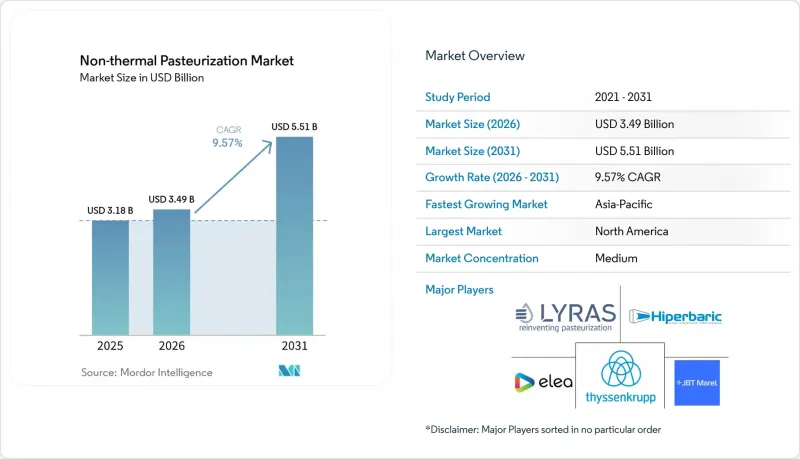
Mordor Intelligence에 의하면, 비가열 살균 시장 규모는 2025년에 31억 8,000만 달러로 평가되었습니다. 2026년 34억 9,000만 달러에서 2031년까지 55억 1,000만 달러에 이를 것으로 예상되며, 예측 기간(2026-2031년) CAGR은 9.57%를 나타낼 전망입니다.
본 보고서는 기술별(HPP, PEF, MVH, 초음파, 방사선, 기타), 형태별(액체, 고체, 반고체), 용도별(식품 및 음료, 의약품, 영양보조식품, 기타), 지역별(북미, 유럽, 아시아태평양, 남미, 중동 및 아프리카)로 분류되어 있습니다. 시장 전망은 금액(달러) 기준으로 제시되어 있습니다.
세계의 비가열 살균 시장 동향 및 인사이트
클린 라벨을 적용한 최소 가공 식품에 대한 수요 증가
원재료 투명성에 대한 소비자 주도적 압력은 기존의 식품 안전 경제학만으로는 설명할 수 없는 방식으로, 비가열 살균 시장에 구조적인 호재로 작용하고 있습니다. 국제식품정보협의회(IFIC)의 2025년 조사에 따르면, ‘건강한 식품’을 ‘가공이 최소화되었거나 무가공’으로 정의하는 미국 소비자의 비율은 2022년 20%에서 2025년에는 28%로 증가했으며, 같은 기간 동안 ‘ “인공 첨가물이나 방부제가 제한적이거나 포함되지 않은” 식품이라고 답한 비율도 18%에서 25%로 상승했습니다. 이러한 변화는 상업적으로 직접적인 영향을 미치고 있습니다. HPP 및 PEF 처리를 거친 제품은 가공 비용 증가분을 상쇄할 수 있는 소매가 인상을 실현하고 있으며, 규모 확대에 따라 단위당 수익성을 향상시키고 있습니다. 여기서 중요하지만 충분히 인식되지 않은 인사이트은 클린 라벨에 대한 수요가 균일한 소비자 동향이 아니라는 점입니다. 이러한 수요는 외식업체 및 소매업체를 포함한 기관 구매자들에 의해 주도되고 있으며, 이들이 클린 라벨에 관한 공급업체 사양을 부과함으로써 소비자 조사에서 시사하는 것보다 공급망의 더 깊은 곳까지 미치는 B2B 수요를 창출하고 있습니다. 열 살균에 비해 에너지 소비를 60-90%, 물 사용량을 60-80% 절감하는 Lyras A/S사의 UV(자외선) 기반 살균 기술은 세계 산업용 효소 분야의 선두 기업인 노보자임스(Novozymes)에 채택되었습니다. 그 이유는 이 기술의 깨끗하고 비열적 가공 공정이 노보자임즈의 지속가능성 정책과 부합하기 때문입니다. 이러한 파급 효과는 PEF의 조사 결과에도 나타나고 있으며, 방부제를 사용하지 않는 식물성 우유 및 음료를 제조하는 PEF의 능력을 검증한 동료 심사를 거친 학술지에 게재된 논문 수는 2019년부터 2025년에 걸쳐 거의 두 배로 증가했습니다.
열에 의한 손상 없이 유통기한 연장
비열처리를 통한 유통기한 연장은 식품의 안전성과 관능적 품질 사이의 상충 관계를 해소하므로, 기존의 보존 방법과는 본질적으로 다른 가치 제안을 제공합니다. 400-600 MPa의 압력으로 HPP를 적용하면, 마이아르드 반응을 유발하거나 열에 민감한 효소 및 비타민을 분해하지 않고도 식물성 병원균을 불활성화할 수 있습니다. 이를 통해 미처리 동등 제품에 비해 유통기한이 3-6배 긴 제품을 신선한 풍미를 그대로 유지한 채 제조할 수 있게 됩니다. 전략적인 측면에서는 비열 살균 처리를 통해 지금까지 신선 식품의 장거리 운송 및 수출을 비경제적으로 만들었던 물류상의 장벽이 해소되어, 고급 신선 식품의 판로가 되는 지역 시장이 효과적으로 확대된다는 점입니다. JBT Marel 산하의 Avure Technologies는 2025년 2월, HPP 처리를 통해 열에 약한 비타민 및 식물성 영양소를 포함한 생리활성 화합물이 여러 농산물 카테고리에서 열처리로 달성되는 수준보다 현저히 높은 수준으로 유지된다는 것을 확인한 조사 결과를 발표했습니다. 저스트-인-타임(Just-in-Time) 보충 주기로 운영되는 소매 및 외식 산업의 구매자에게 있어, 첨가물을 사용하지 않고 유통 기한을 연장할 수 있다는 점은 재고 관리 측면에서 직접적인 이점이 되며, 식품 폐기물 및 평가 감액 위험을 줄여줍니다. 그다지 주목받지는 않지만, 부수적인 상업적 효과로서 HPP를 통한 유통기한 연장으로 제조업체는 신속한 재고 회전에 필요한 인프라가 충분히 갖춰지지 않은 아시아태평양(APAC)이나 남미의 콜드체인 시장에 진출할 수 있게 됩니다.
HPP 및 PEF 설비의 높은 자본 집약도
자본 측면의 장벽은 비열 살균 시장 확대에 있어 가장 뿌리 깊은 구조적 제약 요인으로 작용하고 있습니다. 특히, 설비 자금 조달이 제한적인 중소득 국가나 신흥 시장 지역에서 이러한 경향이 두드러집니다. 산업 규모의 HPP 및 PEF 시스템은 조달 비용이 고액이기 때문에 전용 설비 소유를 정당화할 수 있을 정도의 가공량을 확보하지 못한 중소규모 식품 제조업체에게 자금 조달의 큰 장벽이 되고 있습니다. 이 과제는 가압 시 약 15%의 부피 감소를 견뎌야 하는 내압성 포장재가 필요하다는 점에서 더욱 복잡해지고 있으며, 그 결과 설비 구입 비용에 더해 조달 및 제품 재설계 비용이 발생합니다. EaaS 모델과 위탁 가공 네트워크의 확대로 인해 북미에서는 이러한 제약이 부분적으로 해소되고 있습니다. 북미에서는 2025년 시점에서 노스캐롤라이나주 및 펜실베이니아주에 신설된 시설을 포함한 Hiperbaric사의 세계 위탁 가공 네트워크를 통해, 설비 투자 부담 없이 1파운드 단위 또는 1배치 단위로 HPP를 이용할 수 있게 되었습니다. 그러나 아시아태평양(APAC), 남미, 중동 및 아프리카(MEA) 지역에서는 위탁 가공 인프라의 밀도가 여전히 낮기 때문에 이 지역의 제조업체들은 설비 자본 비용을 전액 부담하거나 HPP 도입을 완전히 포기할 수밖에 없습니다. 특히 PEF 도입에는 복합적인 장벽이 존재합니다. 확립된 서비스 네트워크를 갖춘 성숙한 설비 시장을 가진 HPP와 달리, PEF 시스템의 운영 및 검증에는 더 높은 수준의 기술적 전문 지식이 필요하며, 자격을 갖춘 운영자의 수가 제한적이기 때문입니다.
부문 분석
2025년, HPP는 비열 살균 시장에서 48.73%의 점유율을 차지하며 다른 모든 기술에 비해 확실한 선두를 유지했습니다. 이러한 우위는 오랜 상업적 실적, 식품 안전성에 대한 명확한 수용, 그리고 음료, 즉석 육류 제품, 수산물, 소스, 고급 냉장 식품 등 광범위한 분야에서의 적용 가능성에서 비롯됩니다. PEF는 가장 빠르게 성장하는 기술로, 2031년까지 연평균 성장률(CAGR)이 10.67%를 나타낼 것으로 예측됩니다. 이는 비열 살균 시장이 HPP를 넘어, 대량 및 연속 가공 라인을 처리할 수 있는 기술로 확대되고 있음을 보여줍니다. MVH, 초음파 처리 및 방사선 조사가 나머지 시장 점유율을 차지하고 있으며, 각각은 급속한 체적 가열, 질량 이동 향상, 또는 표적 미생물 저감이 주요 우선순위인 보다 제한적인 이용 사례에 대응하고 있습니다.
'기타' 범주에는 아직 상업적 도입 실적이 미미하지만, 비열 살균 시장 내의 매우 특수한 액체 용도에서 중요한 역할을 할 수 있는 기술이 포함되어 있습니다. Lyras사는 불투명한 액체를 위한 UV-C 기반 솔루션으로 ‘라스라이제이션(Laserization)’을 포지셔닝하고 있으며, 이 회사에 따르면 이 시스템은 열살균에 비해 에너지 사용량을 60%에서 90%, 물 사용량을 60%에서 80%까지 절감할 수 있다고 합니다. 아이슬란드의 Mjolkursamsalan에 도입된 사례는 물, 위생, 제품 품질이 모두 중요한 유제품 시스템에서도 틈새 대체 기술이 진입할 수 있음을 보여줍니다. HPP는 포장 후 처리가 가능하며 공정 후 오염 위험을 줄일 수 있어, 비열 살균 시장에서 여전히 가장 확고한 입지를 구축하고 있습니다. 이는 높은 안전성이 요구되는 냉장 식품 분야에서 여전히 큰 장점으로 작용하고 있습니다.
지역별 분석
북미는 비가열 살균 시장에서 최대 점유율을 유지하며, 2025년에는 32.36%를 차지했습니다. 미국이 이러한 주도적 지위를 확립한 것은 가장 성숙한 HPP 설비 기반과 가장 광범위한 위탁 가공 네트워크를 모두 갖추고 있기 때문이며, 이를 통해 비열 살균 시장의 대형 브랜드와 중소규모 가공업체 모두에게 진입 장벽이 낮아졌습니다. 또한, 미국 내 도입은 규제 측면에서의 로드맵이 명확하다는 점도 호재로 작용하고 있습니다. FDA 및 USDA-FSIS는 주스, 굴, 즉석 육류 제품과 관련된 식품 안전 용도에서 HPP의 역할을 이미 확립했기 때문입니다. 2024년 12월 USDA-FSIS의 리스테리아 관련 발표는 이러한 추세에 더욱 탄력을 주었습니다. 이는 위생 관리만을 중시하는 접근 방식을 채택하고 있는 가공업체들이 2025년 1월 이후 더욱 엄격한 규정 준수 환경에 직면하게 될 것이기 때문입니다. 캐나다와 멕시코는 비가열 살균 시장에 대한 지역적 견인차 역할을 하고 있습니다. 한편, 2005년 칠레를 시작으로 라틴아메리카에서 도입된 실적은 수출 지향적인 식품 부문이 상업적 HPP 확장을 위한 첫 번째 실질적인 길이 될 수 있음을 보여줍니다.
유럽은 비가열 살균 시장에서 여전히 2위의 규모를 유지하고 있으며, 독일, 스페인, 네덜란드, 영국이 북미 이외 지역에서 가장 확고한 기반을 형성하고 있습니다. 이 지역의 큰 강점은 기술 검증 관련 서비스 인프라에 있으며, 티센크루프(ThyssenKrupp)사의 쿠아켄브루크에 위치한 ‘센터 오브 엑설런스(Center of Excellence)’에서는 위탁 가공, 제품 개발, 미생물학적 시험 및 검증 지원을 제공하여 신규 사용자의 도입 위험을 경감시키고 있습니다. 또한, 유럽에서는 비가열 살균 시장의 일부 분야에서 규제 절차가 더욱 신중해지고 있습니다. 특히 EU 규정 하에서 신규 식품 심사가 일부 동물 유래 제품의 상용화 일정에 영향을 미치는 분야에서 이러한 경향이 두드러집니다. 이러한 차이로 인해 일부 제품의 출시가 지연되는 한편, 공급업체는 보다 견고한 문서화 및 검증 역량을 구축해야 하는 압박을 받고 있으며, 이는 규모가 크고 기술적으로 준비가 잘 된 사업자에게 이점이 됩니다. 남미는 여전히 비가열 살균 시장에서 신흥 지역이지만, 브라질, 칠레, 콜롬비아, 페루가 주요 도입 거점으로 두각을 나타내고 있으며, 육류, 수산물, 과즙의 수출이 품질을 유지하면서 수입국의 식품 안전 기준을 충족하는 기술에 대한 수요를 견인하고 있습니다.
아시아태평양은 비가열 살균 시장에서 가장 빠르게 성장하는 지역이며, 이 지역의 비가열 살균 시장 규모는 2031년까지 연평균 성장률(CAGR) 11.38%로 성장할 것으로 예측됩니다. 중국은 이 지역에서 가장 중요한 전환점이 되고 있습니다. 이는 JB/T 15299-2025에 따라 장비 사양이 공식적으로 규정된 데 더해, 중국농업대학이 가공 장비에서 NFC 주스, 야채 주스, 차 음료, 액상 커피 등 제품 수준 카테고리에 이르기까지 더 광범위한 그룹 표준화 노력을 지원했기 때문입니다. 인도, 일본, 한국, 호주, 싱가포르, 인도네시아에서도 고급 포장 식품에 대한 수요가 증가하고 식품 가공 인프라가 정비됨에 따라 비가열 살균 시장에서의 입지를 강화하고 있습니다. 중동 및 아프리카는 여전히 초기 단계에 있지만, 아랍에미리트(UAE)와 남아프리카공화국은 고급 음료, 유제품, 육류 제품에 대한 적용이 비가열 살균 시장의 첫 번째 도입 물결을 뒷받침하는 초기 거점으로 부상하기 시작하고 있습니다.
기타 혜택 :
- 엑셀 형식 시장 예측(ME) 시트
- 3개월간의 애널리스트 지원
자주 묻는 질문
목차
제1장 서론
제2장 조사 방법
제3장 주요 요약
제4장 시장 역학
제5장 시장 규모 및 성장 예측
제6장 경쟁 구도
제7장 시장 기회 및 향후 동향
KTH 26.08.05According to Mordor Intelligence, the non-thermal pasteurization market size was valued at USD 3.18 billion in 2025 and estimated to grow from USD 3.49 billion in 2026 to reach USD 5.51 billion by 2031, at a CAGR of 9.57% during the forecast period (2026-2031).
This report is Segmented by Technique (HPP, PEF, MVH, Ultrasonic, Irradiation, Others), Form (Liquid, Solid, Semi-Solid), Application (Food and Beverages, Pharmaceuticals, Nutraceuticals, Others), and Geography (North America, Europe, Asia-Pacific, South America, Middle East and Africa). The Market Forecasts are Provided in Terms of Value (USD).
Global Non-thermal Pasteurization Market Trends and Insights
Rising demand for clean-label, minimally processed foods
Consumer-led pressure on ingredient transparency is acting as a structural tailwind for the non-thermal pasteurization market in a way that traditional food safety economics alone cannot explain. A 2025 survey by the International Food Information Council (IFIC) found that the share of US consumers defining "healthy food" as "minimally or no processing" increased from 20% in 2022 to 28% in 2025, with "limited or no artificial ingredients or preservatives" rising from 18% to 25% over the same period. This shift has direct commercial consequences: HPP and PEF-processed products command retail price premiums that offset the processing cost premium, improving unit economics at scale. The critical but under-appreciated insight here is that clean-label demand is not a homogeneous consumer trend; it is being reinforced by institutional buyers, including foodservice operators and retailers, who are imposing clean-label supplier specifications, creating a B2B pull that reaches further into the supply chain than consumer surveys suggest. Lyras A/S's UV-based pasteurization technology, which saves 60-90% in energy and 60-80% in water use compared to thermal pasteurization, has been adopted by Novozymes, a global industrial enzyme leader, precisely because its clean, non-thermal processing profile aligns with corporate sustainability claims. The knock-on effect is visible in PEF research output, where publications in peer-reviewed journals examining PEF's ability to produce preservative-free plant-based milks and beverages nearly doubled between 2019 and 2025.
Shelf-life extension without thermal damage
Shelf-life extension through non-thermal processing offers a materially different value proposition than conventional preservation, as it eliminates the trade-off between food safety and sensory quality. HPP applied at pressures of 400-600 MPa inactivates vegetative pathogens without triggering the Maillard reaction or degrading heat-sensitive enzymes and vitamins, enabling the production of products with shelf lives 3 to 6 times longer than untreated equivalents while retaining a fresh-like profile. The strategic implication is that non-thermal pasteurization effectively expands the addressable geographic market for premium perishable goods by closing the logistics gap that previously made long-haul or export distribution of fresh products uneconomical. JBT Marel's Avure Technologies published research findings in February 2025 confirming that HPP processing preserves bioactive compounds, including heat-sensitive vitamins and phytonutrients, at levels significantly higher than those achieved with thermal treatment across multiple produce categories. For retail and foodservice buyers operating on just-in-time replenishment cycles, extended shelf life without additives is a direct inventory management benefit that reduces food waste and write-down risk. The secondary commercial effect, less remarked upon, is that shelf-life extension through HPP allows manufacturers to enter cold-chain markets in APAC and South America that lack the infrastructure density for rapid inventory turnover.
High capital intensity for HPP and PEF installations
Capital barriers represent the most persistent structural constraint on the expansion of the non-thermal pasteurization market, particularly in middle-income and emerging market geographies where access to equipment financing is limited. Industrial-scale HPP and PEF systems entail high procurement costs, creating a significant financing hurdle for small- and mid-size food manufacturers that lack the processing volume to justify dedicated equipment ownership. The challenge is compounded by the need for pressure-flexible packaging materials, which must withstand approximately 15% volume reduction during pressurization and therefore incur procurement and reformulation costs beyond equipment acquisition. The EaaS model and tolling network expansion are partially addressing this constraint in North America, where Hiperbaric's global tolling network, which includes newly established facilities in North Carolina and Pennsylvania as of 2025, provides access to HPP on a per-pound or per-batch basis without a capex commitment. However, in APAC, South America, and MEA, tolling infrastructure density remains low, meaning that manufacturers in these regions must absorb the full capital cost of equipment or forgo HPP adoption entirely. PEF adoption specifically faces a compounded barrier: unlike HPP, which has a mature equipment market with established service networks, PEF systems require more technical expertise to operate and validate, limiting the pool of qualified operators.
Other drivers and restraints analyzed in the detailed report include:
- Food safety compliance and pathogen control pressure
- Expansion of cold-chain premium beverage formats
- Regulatory uncertainty for irradiation and cross-border labeling
For complete list of drivers and restraints, kindly check the Table Of Contents.
Segment Analysis
HPP held 48.73% of the non-thermal pasteurization market share in 2025, maintaining a clear lead over all other techniques. Its lead comes from a long commercial history, clear food safety acceptance, and broad fit across beverages, ready-to-eat meat, seafood, sauces, and premium refrigerated foods. PEF is the fastest-growing technique, with a projected CAGR of 10.67% through 2031, indicating that the non-thermal pasteurization market is expanding beyond HPP into technologies that can serve large-volume, continuous processing lines. MVH, ultrasonic processing, and irradiation make up the remaining share, and each serves narrower use cases where rapid volumetric heating, enhanced mass transfer, or targeted microbial reduction is the main priority.
The Others category includes technologies that still have smaller commercial footprints but can matter in very specific liquid applications within the non-thermal pasteurization market. Lyras has positioned raslysation as a UV-C-based solution for opaque liquids, and the company states that the system can reduce energy use by 60% to 90% and water use by 60% to 80% compared with thermal pasteurization. Its installation at Mjolkursamsalan in Iceland shows that niche alternatives can enter dairy systems where water, hygiene, and product quality are all important. HPP still has the strongest structural position in the non-thermal pasteurization market because it works after packaging and lowers the chance of post-process contamination, which remains a major advantage in high-safety chilled foods.
Complete Report Scope:
- By Technique / Technology
- High Pressure Processing (HPP)
- Pulsed Electric Field (PEF)
- Microwave Volumetric Heating (MVH)
- Ultrasonic
- Irradiation
- Others
- By Form
- Liquid
- Solid
- Semi-Solid
- By Application
- Food and Beverages
- Beverages
- Fruits & Vegetables
- Meat & Seafood
- Dairy & Dairy Alternatives
- Ready-to-eat Meals
- Sauces & Dips
- Pharmaceuticals
- Nutraceuticals
- Others
- Food and Beverages
- By Geography
- North America
- United States
- Canada
- Mexico
- Rest of North America
- Europe
- Germany
- United Kingdom
- Italy
- France
- Spain
- Netherlands
- Poland
- Belgium
- Sweden
- Rest of Europe
- Asia-Pacific
- China
- India
- Japan
- South Korea
- Australia
- Indonesia
- Thailand
- Singapore
- Rest of Asia-Pacific
- South America
- Brazil
- Argentina
- Colombia
- Chile
- Peru
- Rest of South America
- Middle East and Africa
- South Africa
- Saudi Arabia
- United Arab Emirates
- Turkey
- Nigeria
- Egypt
- Morocco
- Rest of Middle East and Africa
- North America
Geography Analysis
North America retained the largest share of the non-thermal pasteurization market, accounting for 32.36% in 2025. The United States anchors this lead because it combines the most mature installed HPP base with the broadest tolling network, which lowers entry barriers for both large brands and smaller processors in the non-thermal pasteurization market. U.S. adoption has also benefited from a clearer regulatory path, as FDA and USDA-FSIS have already established the role of HPP in food safety applications relevant to juices, oysters, and ready-to-eat meat systems. The USDA-FSIS December 2024 Listeria announcement added further momentum, as processors using sanitation-only approaches now face a more stringent compliance environment from January 2025 onward. Canada and Mexico add regional support to the non-thermal pasteurization market, while Latin American rollout history, starting with Chile in 2005, shows how export-oriented food sectors can become the first practical route for commercial HPP expansion.
Europe remained the second-largest geography in the non-thermal pasteurization market, with Germany, Spain, the Netherlands, and the UK forming the most established base outside North America. A major regional strength is the service infrastructure around technology validation, and thyssenkrupp's Centre of Excellence in Quakenbruck offers toll processing, product development, microbiological testing, and validation support that reduce adoption risk for new users. Europe also has a more cautious regulatory path in parts of the non-thermal pasteurization market, especially where novel food review affects commercialization timelines for some animal-origin applications under EU rules. That difference slows some product launches, but it also pushes suppliers to build stronger documentation and validation capabilities, which benefits larger and more technically prepared operators. South America is still an emerging part of the non-thermal pasteurization market, but Brazil, Chile, Colombia, and Peru stand out as the main adoption hubs, with meat, seafood, and juice exports driving demand for technologies that preserve quality while meeting importer food safety expectations.
Asia-Pacific is the fastest-growing region in the non-thermal pasteurization market, and the Asia-Pacific non-thermal pasteurization market size is projected to expand at 11.38% CAGR through 2031. China is the region's most important turning point, because JB/T 15299-2025 formalized equipment specifications and China Agricultural University backed a broader group standard effort that extends from processing equipment into product-level categories such as NFC juice, vegetable juice, tea beverages, and coffee liquids. India, Japan, South Korea, Australia, Singapore, and Indonesia are also building relevance in the non-thermal pasteurization market as premium packaged food demand rises and food processing infrastructure improves. The Middle East and Africa remain early-stage, but the UAE and South Africa have started to emerge as initial centers where premium beverage, dairy, and meat applications can support first-wave deployment in the non-thermal pasteurization market.
- JBT Marel Corporation
- Hiperbaric S.A.
- thyssenkrupp AG
- Kobe Steel, Ltd. / Kobelco
- Elea Technology GmbH
- Pulsemaster B.V.
- Lyras A/S
- Syntegon Technology GmbH
- MULTIVAC Sepp Haggenmuller SE & Co. KG
- Stansted Fluid Power Ltd.
- Nordion Inc. / Sotera Health
- AseptoRay Ltd.
- American Pasteurization Company
- Universal Pure, LLC
- Lineage, Inc.
- HPP Food Technology S.L.
- Bao Tou KeFa High Pressure Technology Co., Ltd.
- FresherTech
- Hydrolock
- EXDIN Solutions Sp. z o.o.
Additional Benefits:
- The market estimate (ME) sheet in Excel format
- 3 months of analyst support
TABLE OF CONTENTS
1 INTRODUCTION
- 1.1 Study Assumptions and Market Definition
- 1.2 Scope of the Study
2 RESEARCH METHODOLOGY
3 EXECUTIVE SUMMARY
4 MARKET DYNAMICS
- 4.1 Market Overview
- 4.2 Market Drivers
- 4.2.1 Rising Demand for Clean-Label, Minimally Processed Foods
- 4.2.2 Shelf-Life Extension Without Thermal Damage
- 4.2.3 Food Safety Compliance and Pathogen Control Pressure
- 4.2.4 Expansion of Cold-Chain Premium Beverage Formats
- 4.2.5 Equipment-as-a-Service Models Lowering Adoption Barriers
- 4.2.6 Rising use of HPP in Meat and Seafood Processing
- 4.3 Market Restraints
- 4.3.1 High Capital Intensity for HPP and PEF Installations
- 4.3.2 Validation, Packaging, and Line-Integration Complexity
- 4.3.3 Regulatory Uncertainty for Irradiation and Cross-Border Labeling
- 4.3.4 High Energy and Maintenance Cost Concerns
- 4.4 Supply Chain Analysis
- 4.5 Regulatory Landscape
- 4.6 Technological Outlook
- 4.7 Porter's Five Forces
- 4.7.1 Threat of New Entrants
- 4.7.2 Bargaining Power of Buyers/Consumers
- 4.7.3 Bargaining Power of Suppliers
- 4.7.4 Threat of Substitute Products
- 4.7.5 Intensity of Competitive Rivalry
5 MARKET SIZE AND GROWTH FORECASTS (VALUE)
- 5.1 By Technique / Technology
- 5.1.1 High Pressure Processing (HPP)
- 5.1.2 Pulsed Electric Field (PEF)
- 5.1.3 Microwave Volumetric Heating (MVH)
- 5.1.4 Ultrasonic
- 5.1.5 Irradiation
- 5.1.6 Others
- 5.2 By Form
- 5.2.1 Liquid
- 5.2.2 Solid
- 5.2.3 Semi-Solid
- 5.3 By Application
- 5.3.1 Food and Beverages
- 5.3.1.1 Beverages
- 5.3.1.2 Fruits & Vegetables
- 5.3.1.3 Meat & Seafood
- 5.3.1.4 Dairy & Dairy Alternatives
- 5.3.1.5 Ready-to-eat Meals
- 5.3.1.6 Sauces & Dips
- 5.3.2 Pharmaceuticals
- 5.3.3 Nutraceuticals
- 5.3.4 Others
- 5.3.1 Food and Beverages
- 5.4 By Geography
- 5.4.1 North America
- 5.4.1.1 United States
- 5.4.1.2 Canada
- 5.4.1.3 Mexico
- 5.4.1.4 Rest of North America
- 5.4.2 Europe
- 5.4.2.1 Germany
- 5.4.2.2 United Kingdom
- 5.4.2.3 Italy
- 5.4.2.4 France
- 5.4.2.5 Spain
- 5.4.2.6 Netherlands
- 5.4.2.7 Poland
- 5.4.2.8 Belgium
- 5.4.2.9 Sweden
- 5.4.2.10 Rest of Europe
- 5.4.3 Asia-Pacific
- 5.4.3.1 China
- 5.4.3.2 India
- 5.4.3.3 Japan
- 5.4.3.4 South Korea
- 5.4.3.5 Australia
- 5.4.3.6 Indonesia
- 5.4.3.7 Thailand
- 5.4.3.8 Singapore
- 5.4.3.9 Rest of Asia-Pacific
- 5.4.4 South America
- 5.4.4.1 Brazil
- 5.4.4.2 Argentina
- 5.4.4.3 Colombia
- 5.4.4.4 Chile
- 5.4.4.5 Peru
- 5.4.4.6 Rest of South America
- 5.4.5 Middle East and Africa
- 5.4.5.1 South Africa
- 5.4.5.2 Saudi Arabia
- 5.4.5.3 United Arab Emirates
- 5.4.5.4 Turkey
- 5.4.5.5 Nigeria
- 5.4.5.6 Egypt
- 5.4.5.7 Morocco
- 5.4.5.8 Rest of Middle East and Africa
- 5.4.1 North America
6 COMPETITIVE LANDSCAPE
- 6.1 Market Concentration
- 6.2 Strategic Moves
- 6.3 Market Ranking Analysis
- 6.4 Company Profiles (includes Global level Overview, Market level overview, Core Segments, Financials, Strategic Information, Market Rank/Share, Products and Services, Recent Developments)
- 6.4.1 JBT Marel Corporation
- 6.4.2 Hiperbaric S.A.
- 6.4.3 thyssenkrupp AG
- 6.4.4 Kobe Steel, Ltd. / Kobelco
- 6.4.5 Elea Technology GmbH
- 6.4.6 Pulsemaster B.V.
- 6.4.7 Lyras A/S
- 6.4.8 Syntegon Technology GmbH
- 6.4.9 MULTIVAC Sepp Haggenmuller SE & Co. KG
- 6.4.10 Stansted Fluid Power Ltd.
- 6.4.11 Nordion Inc. / Sotera Health
- 6.4.12 AseptoRay Ltd.
- 6.4.13 American Pasteurization Company
- 6.4.14 Universal Pure, LLC
- 6.4.15 Lineage, Inc.
- 6.4.16 HPP Food Technology S.L.
- 6.4.17 Bao Tou KeFa High Pressure Technology Co., Ltd.
- 6.4.18 FresherTech
- 6.4.19 Hydrolock
- 6.4.20 EXDIN Solutions Sp. z o.o.