

|
시장보고서
상품코드
2098497
분산형 GPU 시장 : 점유율 분석, 업계 동향 및 통계, 성장 예측(2026-2031년)Disaggregated GPU - Market Share Analysis, Industry Trends & Statistics, Growth Forecasts (2026 - 2031) |
||||||
 Mordor Intelligence
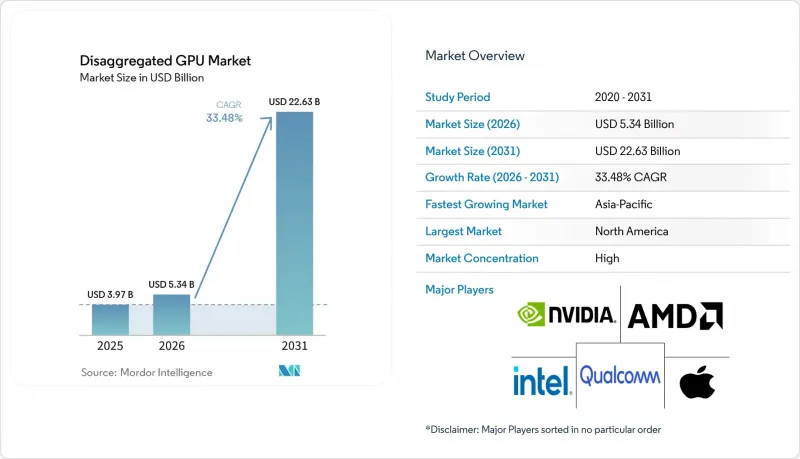
Mordor Intelligence에 의하면, 분산형 GPU 시장 규모는 2025년에 39억 7,000만 달러, 2026년에 53억 4,000만 달러가 되고, 2031년까지 226억 3,000만 달러에 이를 것으로 예측되며, 2026년부터 2031년까지 CAGR 33.48%로 성장할 전망입니다.
본 보고서는 구성 요소별(하드웨어, 소프트웨어 등), 가속기 유형별(PCIe 기반 디어그리게이션, NVLink/NVSwitch 기반 디어그리게이션 등), 배포 모드별(On-Premise, 클라우드), 용도(AI 및 고성능 컴퓨팅 등), 최종 사용자(하이퍼스케일 클라우드 제공업체, 클라우드 서비스 제공업체 등), 그리고 지역별로 분류되어 있습니다. 시장 전망은 금액(달러) 기준으로 제시되어 있습니다.
세계 분산형 GPU 시장 동향 및 인사이트
AI 훈련 클러스터에서 GPU 풀링 수요 증가
대규모 AI 훈련을 수행할 때는 다수의 물리적 GPU를 단일 공유 논리 리소스로 처리하는 것이 필수적이기 때문에 디스어그리게이션 GPU 시장은 GPU 풀링으로부터 직접적인 견인력을 받고 있습니다. NVIDIA의 6세대 NVLink는 GPU당 1.8 TB/s의 양방향 대역폭을 실현하며, NVLink Switch 시스템은 단일 NVL72 랙 내에서 72개의 GPU를 지원함으로써, 총 130 TB/s의 도메인 내 대역폭을 제공함으로써, 과거 인접한 랙을 고립된 연산 아일랜드로 분할했던 통신상의 제약을 완화했습니다. 이러한 변화는 1조 파라미터 규모의 모델에 있어 중요합니다. 메모리와 대역폭에 대한 부하가 단일 노드 내부가 아닌 훈련 클러스터 전체로 확대되었기 때문입니다. 또한 분산형 GPU 시장에서는 유휴 상태의 용량을 활성 워크로드에 훨씬 더 신속하게 할당할 수 있는 아키텍처가 제안되고 있습니다. 에이전트형 AI는 또 다른 수요 계층을 추가하고 있습니다. 프리필 단계는 계산 부하가 높고, 디코딩 단계는 메모리 대역폭 부하가 높기 때문에 이 패턴에서는 지연이 수반되는 수동 스케줄링 사이클 대신 몇 초 단위로 풀을 재할당해야 합니다. AWS는 Blackwell 노드에서 llm-d와 NVIDIA Inference Xfer Library를 사용하여 이 운영 모델을 실제 운영 환경에서 입증했습니다. 그 결과, 분산 추론을 통해 높은 동시 실행 수에서 처리량이 70% 향상되었습니다.
연산과 메모리의 분리형 아키텍처로의 전환
또한, 운영자가 연산과 로컬 메모리를 분리하고 메모리 용량을 풀화된 인프라 계층으로 취급함에 따라, 분산형 GPU 시장도 발전하고 있습니다. 『Tsinghua Science and Technology』지에 게재된 연구에 따르면, CXL 기반 메모리 디어그리게이션은 지능형 컴퓨팅 센터에 있어 중요한 아키텍처적 진보라고 설명되고 있습니다. 이는 공유 메모리 풀에 표준 로드 및 스토어 연산을 통해 여러 연산 노드에서 접근할 수 있기 때문입니다. ByteDance의 연구진은 이러한 방향을 더욱 발전시켜, Micron의 CXL Type-3 카드와 TITAN-II CXL 스위치로 구성된 768GB의 공유 메모리 풀을 시연했습니다. 이를 통해 NVIDIA H100 GPU를 탑재한 3개의 노드 간에 용도 코드를 변경하지 않고도 GPU 간의 집합적 통신이 가능해졌습니다. 이것이 중요한 이유는 롱 컨텍스트 추론이 100만 토큰을 초과하고 KV 캐시 수요가 각 가속기에서 사용 가능한 HBM 용량을 상회하기 때문에 GPU 플릿 전체를 교체하는 것보다 풀링된 메모리를 추가하는 것이 더 현실적이기 때문입니다. 따라서 분산형 GPU 시장에 있어 CXL은 기술적 대안일 뿐만 아니라, 실리콘의 전면적인 교체를 강요하지 않으면서 더 많은 메모리 용량이 필요한 사업자에게 경제적인 해결책으로도 이점을 제공합니다.
고급 상호 연결 및 패브릭 통합의 복잡성
분산형 GPU 시장은 여전히 큰 통합 장벽에 직면해 있습니다. 그 이유는 많은 도입 사례에서 단일 클러스터 내에서 NVLink, PCIe, InfiniBand, 이더넷 및 CXL을 연동해야 하기 때문입니다. HotNets 2025에서 발표된 조사에 따르면, 호스트 내 이종 상호 연결에 걸친 효과적인 경로 관리를 위해서는 PCIe 스위치, GPU 패브릭 컨트롤러, RDMA NIC 및 이더넷 스위치의 동시 연동이 필요하지만, 현재의 소프트웨어 스택으로는 그 복잡성을 완전히 추상화하지 못하고 있습니다. NVIDIA의 ‘NVLink Fusion’은 MediaTek, Marvell, Qualcomm, 후지쯔의 맞춤형 CPU가 NVIDIA GPU와 네이티브로 연결될 수 있도록 함으로써 이 문제의 일부를 완화했으나, 이러한 움직임은 완전히 중립적인 멀티 벤더 패브릭을 구축하기보다는 독자적인 사양의 경로를 확대하는 결과로 이어졌습니다. Ultra Accelerator Link 규격은 벤더 중립적인 대안을 제공하는 것을 목적으로 하고 있지만, 정보에 따르면 양산용 하드웨어의 등장은 2026년 하반기가 되어야할 것으로 예상되며, 광범위한 도입은 2027년까지 미뤄질 가능성이 높다고 합니다. 또한, 분산형 GPU 시장은 중국에서 지역적인 상호 운용성의 장벽에 직면해 있습니다. 중국에서는 국내 가속기 생태계가 호환되지 않는 통신 프로토콜을 사용하고 있어, 통신 사업자가 대규모로 실현할 수 있는 실용적인 리소스 풀링의 이점이 제한되고 있습니다.
부문 분석
2025년 분산형 GPU 시장에서 하드웨어가 81.32%를 차지했습니다. 이는 상호 연결 패브릭, 스위치 트레이, 메모리 모듈 및 랙 스케일 컴퓨팅 시스템에 드는 높은 초기 비용을 반영한 것입니다. 각 Vera Rubin NVL72 랙에는 72개의 Blackwell GPU, 36개의 Vera CPU, NVLink 스위치 칩, BlueField-4 DPU 및 Spectrum-X 이더넷 네트워크가 통합되어 단일 패브릭 기반의 자본 단위를 형성합니다. 따라서 비통합형 GPU 시장의 초기 투자는 대규모 하이퍼스케일 조달 주기에 집중되어 있습니다. 이 조달 모델이 중요한 이유는 구매자가 개별 카드나 서버를 구매하는 것이 아니라, 단일 도입 프로젝트 내에서 연산, 네트워크, 관리 기능을 통합한 플랫폼을 채택하고 있기 때문입니다. 따라서 분산형 GPU 시장은 특히 하이퍼스케일러가 노드 단위의 단계적 추가가 아닌 풀 랙 단위로 새로운 AI 처리 능력을 구축하고 있기 때문에 현 단계에서는 하드웨어 중심의 수익 구성을 보이고 있습니다. 서비스는 여전히 구성 요소 중 가장 작은 비중을 차지하고 있지만, 통합, 관리형 운영 및 GPU-as-a-Service(GPUaaS) 제공은 시스템 통합사업자와 전문 클라우드 사업자에게 여전히 매력적인 수익률 가능성을 내포하고 있습니다.
비집약형 GPU 시장에서 2026년부터 2031년까지 소프트웨어 분야가 34.08%라는 가장 높은 연평균 성장률(CAGR)을 나타낼 전망입니다. 이는 오케스트레이션 계층, 분리 도구, 추론 프레임워크가 각 GPU에서 사업자가 얻을 수 있는 가치를 점점 더 결정짓게 될 것이기 때문입니다. NVIDIA Dynamo는 프리필과 디코딩 할당을 분리함으로써 공장 규모의 가동률을 향상시켰습니다. 이 설계는 LLM-D와 같은 오픈소스 대체 솔루션이 향후 엔터프라이즈 배포에서 따라야 할 기준을 확립했습니다. 이로 인해 하드웨어 교체 주기가 둔화되거나 기존 패브릭이 그대로 유지되는 경우에도 소프트웨어 업그레이드를 지속할 수 있게 되어, 디어그리게이트 GPU 업계의 수익 패턴이 변화하게 될 것입니다. 2024년 및 2025년에 분산형형 하드웨어를 도입한 사업자는 물리적 상호 연결 자산을 교체하기 전에 새로운 오케스트레이션 계층을 추가할 가능성이 높습니다. 이를 통해 랙 교체 시기에 대한 의존도가 낮은 지속적인 소프트웨어 수익의 길이 열리게 됩니다. 장기적으로는 하드웨어가 절대적인 지출의 주축으로 남아 있더라도, 이러한 동향으로 인해 분산형 GPU 시장에서 소프트웨어가 더 큰 역할을 하게 될 것입니다.
NVLink/NVSwitch 기반의 디스어그리게이션은 2025년 분산형 GPU 시장 점유율의 44.21%를 차지하고 있으며, 이는 AI 트레이닝 패브릭에서 NVIDIA의 확고한 입지와 밀결합형 GPU 통신에 대한 기존의 선호도를 반영합니다. 6세대 NVLink는 2024년에 GPU당 1.8 TB/s의 대역폭을 실현했으며, 새로운 NVLink Switch 시스템에서는 72개의 GPU 간에 모든 GPU 간 통신이 가능해져 총 130 TB/s의 대역폭을 제공했습니다. 이를 통해 고밀도 로컬 통신이 필요한 스케일업 클러스터를 위한 디스어그리게이션 GPU 시장에 고성능 대안이 제시되었습니다. PCIe 기반 디어그리게이션은 많은 멀티 GPU 시스템에서 베이스라인 패브릭으로서 확고한 역할을 유지하며, 독자적인 기술에 대한 의존도를 낮게 억제하는 동시에 폭넓은 호환성을 제공했습니다. InfiniBand 및 이더넷 기반 접근 방식은 스케일아웃 환경에서 여전히 중요하며, 특히 이더넷은 기존 네트워크 투자를 기반으로 대규모 AI 클러스터를 확장하고자 하는 사업자에게 그 중요성이 더욱 커졌습니다. 이러한 분화는 디스어그리게이션된 GPU 시장이 단일 범용 패브릭으로 향하는 것이 아니라, 성능, 개방성, 그리고 기존 인프라가 각각 최종 아키텍처에 영향을 미치는 계층형 모델로 나아가고 있음을 의미합니다.
CXL 기반 디스어그리게이션은 CXL 3.0의 메모리 풀링과 PCIe 7.0의 물리 계층을 통해 대역폭을 128 GT/s로 두 배로 늘려, 총 처리량을 대폭 향상시키는 번들 포트를 도입한 CXL 4.0 사양에 힘입어, 2031년까지 연평균 성장률(CAGR) 34.46%로 확대될 것으로 예측됩니다. 『Tsinghua Science and Technology』지의 조사에 따르면, CXL 메모리 디어그리게이션과 GPU 연산 디어그리게이션은 스택의 서로 다른 계층에 대응하는 것으로 나타났으며, 이는 향후 디어그리게이션된 GPU 시장의 도입 과정에서 둘 중 하나를 선택하도록 강요하기보다는 이 둘을 결합하는 방향으로 나아갈 것임을 시사합니다. Samsung Electronics는 Marvell 및 Liquid AI와 공동으로 GPU 메모리를 확장하기 위한 ‘Pangea CXL 메모리 플랫폼’을 개발하고 있습니다. 이는 HBM의 한계로 인해 추론 배치 크기나 작업 컨텍스트의 깊이가 제약받을 가능성이 있기 때문입니다. 실제로 NVLink는 랙 내 GPU 간의 긴밀하게 결합된 통신에 적합한 반면, CXL은 노드 간 또는 더 광범위한 시스템 도메인에 걸쳐 메모리 용량 확장 및 메모리 공유를 실현합니다. 이러한 상호 보완적인 관계 덕분에, 분산형된 GPU 시장은 프로덕션 환경의 클러스터에서 이미 확립된 고대역폭 GPU 패브릭의 역할을 훼손하지 않으면서도, 더욱 구성 가능한 아키텍처로 성숙해 나갈 것입니다.
지역별 분석
2025년, 북미는 52.71%의 점유율을 차지하며 분산형 GPU 시장에서 가장 규모가 큰 지역 점유율을 기록했습니다. 이는 미국 내 하이퍼스케일 구축의 진전 상황을 반영합니다. AWS, Google Cloud, Microsoft Azure 및 Oracle Cloud Infrastructure는 모두 2026년 하반기에 NVIDIA Vera Rubin NVL72 시스템을 도입할 기업으로 꼽히고 있으며, 이러한 주요 구매 기업의 집중이 해당 지역의 분산형 GPU 시장 기반을 지속적으로 뒷받침하고 있습니다. 또한 북미는 탄탄한 하드웨어 생태계, 대규모 AI 연구 활동, 그리고 CoreWeave, Lambda, Nscale 등의 제공업체를 포함한 성숙한 GPU 클라우드 레이어의 혜택도 누리고 있습니다. 2025년 9월, NVIDIA가 Intel과 제휴하여 NVLink 및 x86 기반의 맞춤형 AI 데이터센터용 CPU를 개발함에 따라, 해당 지역공급망이 강화되고 오케스트레이션용 CPU와 GPU 패브릭의 통합이 더욱 진전되었습니다. 캐나다는 미국의 하이퍼스케일 수요와의 근접성과 유리한 전력 비용으로 이를 보완하고 있지만, 남미는 여전히 초기 단계에 있으며 광범위한 On-Premise 구축보다는 브라질이나 콜롬비아의 하이퍼스케일 가용성 구역에 의존하는 경향이 강합니다.
유럽은 분산형 GPU 시장에서 의미 있는 비중을 차지하고 있으나 상대적으로 작은 점유율을 보이고 있으며, 사용자 응답에 따르면 독일, 영국, 프랑스가 주요 도입 거점으로 나타났습니다. 유럽연합(EU)의 에너지 효율 지침에 따르면, IT 부하가 500kW를 초과하는 데이터센터에 대해 전력 사용 효율(PUE) 보고가 의무화되어 있으며, 이를 통해 보다 효율적인 분산형형 설계가 촉진되는 동시에, 사업자는 시설의 성능을 측정 가능한 형태로 입증해야 합니다. 독일의 자동차 및 정밀 제조 산업은 디지털 트윈과 물리적 시뮬레이션 워크로드에 대한 수요를 뒷받침하고 있으며, 이러한 분야에서는 고정된 서버 할당보다 풀링된 인프라를 통해 버스트 컴퓨팅 도입을 정당화하기 쉬운 상황입니다. 영국은 활발한 GPU 클라우드 분야를 통해 기여하고 있는 반면, 프랑스와 이탈리아는 분산형된 GPU 용량을 통합한 국가 주도의 AI 컴퓨팅 프로그램을 확대되고 있습니다.
아시아태평양은 2026년부터 2031년까지 연평균 성장률(CAGR) 34.39%로 확대될 것으로 예측되며, 예측 기간 동안 분산형 GPU 시장에서 이 지역이 가장 높은 성장률을 보일 것으로 전망됩니다. 이 지역의 성장을 주도하는 요인은 중국의 하이퍼스케일 AI 투자, 한국의 수직 통합형 메모리 공급망, 일본의 제조 및 자동화 수요, 그리고 인도와 싱가포르의 공공 AI 인프라 프로그램입니다. 중국은 독자적인 상호 연결 방식을 기반으로 한 국내 분산형형 아키텍처를 구축하고 있으며, 이로 인해 중국의 스택은 분산형 GPU 시장의 다른 지역에서 사용되는 것과는 다른, 지역별로 분리된 구조를 형성하고 있습니다. 한국은 SK하이닉스가 HBM3e 생산에서 차지하는 위상의 혜택을 누리고 있으며, 이를 통해 국내 사업자들은 메모리 서브시스템에 조기에 접근할 수 있게 되어 데이터센터에 대한 자본 투자가 가속화되고 있습니다. 인도 역시 정부 주도의 AI 이니셔티브와 하이퍼스케일 클라우드 존의 확장에 따라 빠르게 움직이기 시작하고 있습니다. 한편, 중동 및 아프리카는 개발 초기 단계에 머물러 있지만, UAE와 사우디아라비아의 국가 주도 AI 투자 프로그램으로부터 지원을 받고 있습니다.
기타 혜택:
- 엑셀 형식 시장 예측(ME) 시트
- 3개월간의 애널리스트 지원
자주 묻는 질문
목차
제1장 서론
제2장 조사 방법
제3장 주요 요약
제4장 시장 구도
제5장 시장 규모와 성장 예측
제6장 경쟁 구도
제7장 시장 기회와 향후 전망
JHS 26.08.07According to Mordor Intelligence, the disaggregated GPU market size is projected to be USD 3.97 billion in 2025, USD 5.34 billion in 2026, and reach USD 22.63 billion by 2031, growing at a CAGR of 33.48% from 2026 to 2031.
This report is Segmented by Component (Hardware, Software, and More), Accelerator Type (PCIe-Based Disaggregation, NVLink/NVSwitch-Based Disaggregation, and More), Deployment Mode (On-Premise, and Cloud), Application (AI and High Performance Computing, and More), End User (Hyperscale Cloud Providers, Cloud Service Providers, and More), and Geography. The Market Forecasts are Provided in Terms of Value (USD).
Global Disaggregated GPU Market Trends and Insights
Rising Demand for GPU Pooling in AI Training Clusters
The disaggregated GPU market is gaining direct support from GPU pooling, as large AI training runs now depend on treating many physical GPUs as a single shared logical resource. NVIDIA's sixth-generation NVLink delivered 1.8 TB/s of bidirectional bandwidth per GPU, and NVLink Switch systems supported 72 GPUs in a single NVL72 rack, delivering 130 TB/s of aggregate in-domain bandwidth, reducing the communication limits that used to separate adjacent racks into isolated compute islands. That shift matters for trillion-parameter models because memory and bandwidth pressure now extend across full training clusters rather than within a single node, and the disaggregated GPU market is responding with architectures that let idle capacity join active workloads much more quickly. Agentic AI is adding another layer of demand, since prefill stages are compute-heavy while decode stages are memory-bandwidth-heavy, and this pattern requires pools to be reassigned in seconds rather than through slower manual scheduling cycles. AWS demonstrated this operating model in production using llm-d and the NVIDIA Inference Xfer Library on Blackwell nodes, where disaggregated inference improved throughput by 70% at high concurrency.
Shift Toward Separated Compute and Memory Architectures
The disaggregated GPU market is also moving forward as operators separate compute from local memory and treat memory capacity as a pooled infrastructure layer. Research published in Tsinghua Science and Technology described CXL-based memory disaggregation as a major architectural step for intelligent computing centers, because shared memory pools can be reached by multiple compute nodes through standard load and store operations. ByteDance researchers extended this direction by demonstrating a 768 GB shared memory pool built from Micron CXL Type-3 cards and a TITAN-II CXL switch, enabling collective GPU communication across 3 nodes with NVIDIA H100 GPUs and no application code changes. This matters because long-context inference exceeds 1 million tokens and KV cache demand exceeds the HBM available on each accelerator, making adding pooled memory more practical than replacing whole GPU fleets. The disaggregated GPU market, therefore, gains from CXL not only as a technical option but also as an economic path for operators that need more memory capacity without forcing a full silicon refresh.
High Interconnect And Fabric Integration Complexity
The disaggregated GPU market still faces a significant integration barrier because many deployments must coordinate NVLink, PCIe, InfiniBand, Ethernet, and CXL within a single cluster. Research presented at HotNets 2025 showed that effective path management across intra-host heterogeneous interconnects requires simultaneous coordination of PCIe switches, GPU fabric controllers, RDMA NICs, and Ethernet switches, and current software stacks do not fully abstract that complexity. NVIDIA's NVLink Fusion reduced part of that problem by letting custom CPUs from MediaTek, Marvell, Qualcomm, and Fujitsu connect natively with NVIDIA GPUs, but that move expanded a proprietary path rather than creating a fully neutral multi-vendor fabric. The Ultra Accelerator Link standard is meant to offer a vendor-neutral alternative, yet the input indicates that production hardware was not expected until late 2026 and broad deployments were likely to stretch into 2027. The disaggregated GPU market also faces a regional interoperability ceiling in China, where domestic accelerator ecosystems use incompatible communication protocols, limiting the practical pooling benefits operators can achieve at scale.
Other drivers and restraints analyzed in the detailed report include:
- Expansion of Hyperscale and Cloud-Native AI Infrastructure
- Power And Thermal Efficiency Gains Through Resource Disaggregation
- Software Orchestration Fragmentation Across GPU Stacks
For complete list of drivers and restraints, kindly check the Table Of Contents.
Segment Analysis
Hardware accounted for 81.32% of the disaggregated GPU market in 2025, reflecting the high upfront costs of interconnect fabrics, switch trays, memory modules, and rack-scale compute systems. Each Vera Rubin NVL72 rack combined 72 Blackwell GPUs, 36 Vera CPUs, NVLink switch chips, BlueField-4 DPUs, and Spectrum-X Ethernet networking into a single fabric-based capital unit, keeping early spending in the disaggregated GPU market concentrated in large hyperscale procurement cycles. That procurement model matters because buyers are not purchasing isolated cards or servers; they are committing to tightly integrated platforms that bundle compute, networking, and management capabilities within a single deployment event. The disaggregated GPU market, therefore, shows a hardware-heavy revenue mix in its current phase, especially as hyperscalers build new AI capacity in full racks rather than through gradual node-by-node additions. Services remained the smallest component layer, yet integration, managed operations, and GPU-as-a-service delivery still carried attractive margin potential for system integrators and specialist cloud operators.
Software is projected to record the fastest 34.08% CAGR from 2026 to 2031 in the disaggregated GPU market, as orchestration layers, isolation tools, and inference frameworks increasingly determine the value operators extract from each GPU. NVIDIA Dynamo separated prefill and decode assignments to lift factory-scale utilization, and that design set a reference point that open-source alternatives such as llm-d now need to match for enterprise deployments. This changes the revenue pattern of the disaggregated GPU industry, because software upgrades can continue even when hardware refresh cycles slow or when installed fabric remains in place. Operators that installed disaggregated hardware in 2024 and 2025 are likely to add new orchestration layers before replacing physical interconnect assets, creating a path for recurring software revenue that is less tied to rack replacement timing. Over time, that dynamic should give software a larger role in the disaggregated GPU market even if hardware continues to anchor absolute spending.
NVLink/NVSwitch-based disaggregation held 44.21% of the disaggregated GPU market share in 2025, reflecting NVIDIA's strong position in AI training fabrics and the installed preference for tightly coupled GPU communication. The sixth-generation NVLink delivered 1.8 TB/s per GPU in 2024, and newer NVLink Switch systems enabled all-to-all communication across 72 GPUs with 130 TB/s of aggregate bandwidth, giving the disaggregated GPU market a high-performance option for scale-up clusters that need dense local communication. PCIe-based disaggregation maintained a durable role as the baseline fabric in many multi-GPU systems, offering broad compatibility without the same level of proprietary dependence. InfiniBand and Ethernet-based approaches continued to matter in scale-out settings, and Ethernet in particular gained relevance where operators wanted to extend large AI clusters by building on existing networking investments. That split means the disaggregated GPU market is not moving toward one universal fabric, but toward a layered model in which performance, openness, and installed infrastructure each influence the final architecture.
CXL-based disaggregation is projected to expand at a 34.46% CAGR through 2031, supported by CXL 3.0 memory pooling and the CXL 4.0 specification, which doubled bandwidth to 128 GT/s via PCIe 7.0 physical layers and introduced bundled ports for much higher total throughput. Research in Tsinghua Science and Technology showed that CXL memory disaggregation and GPU compute disaggregation serve different layers of the stack, which suggests that future deployments in the disaggregated GPU market will combine them rather than force a choice between them. Samsung Electronics is developing its Pangea CXL memory platform with Marvell and Liquid AI to expand GPU memory, where HBM limits can restrict inference batch sizes and working context depth. In practice, NVLink is well-suited to tightly coupled GPU-to-GPU communication inside the rack, while CXL extends memory capacity and memory sharing across nodes and broader system domains. That complementary relationship should help the disaggregated GPU market mature into more composable architectures without reducing the role of high-bandwidth GPU fabrics already established in production clusters.
Complete Report Scope:
- By Component
- Hardware
- Software
- Services
- By Accelerator Type
- PCIe-Based Disaggregation
- NVLink/NVSwitch-Based Disaggregation
- Ethernet Fabric-Based Disaggregation
- InfiniBand Fabric-Based Disaggregation
- CXL-Based Disaggregation
- By Deployment Model
- On-Premise
- Cloud-Based
- By Application
- AI and High Performance Computing
- Data Analytics
- Digital Twin and Simulation
- Rendering and Visualization
- Scientific Research
- By End-User
- Hyperscale Cloud Providers
- Cloud Service Providers
- Enterprises
- Government and Defense Organizations
- Research and Academic Institutions
- Telecommunications Providers
- By Geography
- North America
- United States
- Canada
- Mexico
- Europe
- Germany
- United Kingdom
- France
- Italy
- Rest of Europe
- Asia-Pacific
- China
- Japan
- South Korea
- India
- Southeast Asia
- Rest of Asia-Pacific
- South America
- Middle East and Africa
- North America
Geography Analysis
North America held a 52.71% share in 2025, giving it the largest regional share in the disaggregated GPU market and reflecting the depth of hyperscale buildouts across the US. AWS, Google Cloud, Microsoft Azure, and Oracle Cloud Infrastructure were all named as second-half 2026 deployers of NVIDIA Vera Rubin NVL72 systems, and that concentration of leading buyers continues to anchor the disaggregated GPU market in the region. North America also benefits from a dense hardware ecosystem, major AI research activity, and a mature GPU cloud layer, including providers such as CoreWeave, Lambda, and Nscale. NVIDIA's September 2025 collaboration with Intel to develop custom AI data center CPUs based on NVLink and x86 deepened regional supply chains and enabled stronger integration between orchestration CPUs and GPU fabrics. Canada adds support through proximity to US hyperscale demand and favorable power economics, while South America remains at an earlier stage and is tied more to hyperscale availability zones in Brazil and Colombia than to broad on-premise deployment.
Europe held a meaningful but smaller share of the disaggregated GPU market, with Germany, the United Kingdom, and France as the main deployment centers in user input. The European Union Energy Efficiency Directive requires power usage effectiveness reporting for data centers with an IT load above 500 kW, which supports more efficient, disaggregated designs and requires operators to demonstrate measurable facility performance. Germany's automotive and precision manufacturing base supports demand for digital twin and physics simulation workloads, where burst compute is easier to justify through pooled infrastructure than through fixed server allocations. The United Kingdom contributes through an active GPU cloud segment, while France and Italy are extending sovereign AI compute programs that incorporate disaggregated GPU capacity.
Asia-Pacific is projected to expand at a 34.39% CAGR between 2026 and 2031, giving the region the fastest growth rate in the disaggregated GPU market during the forecast period. The region is being driven by China's hyperscale AI spending, South Korea's vertically integrated memory supply chain, Japan's manufacturing and automation needs, and public AI infrastructure programs in India and Singapore. China is building domestic disaggregated architectures around proprietary interconnect approaches, creating a split regional structure in which Chinese stacks differ from those used elsewhere in the disaggregated GPU market. South Korea benefits from SK Hynix's position in HBM3e output, which helps domestic operators secure earlier access to memory subsystems and supports faster data center capital deployment. India is also moving quickly as government-backed AI initiatives and hyperscale cloud zones expand, while the Middle East and Africa remain earlier in development but are gaining support from sovereign AI investment programs in the UAE and Saudi Arabia.
- NVIDIA Corporation
- Advanced Micro Devices, Inc.
- Intel Corporation
- Qualcomm Incorporated
- Apple Inc.
- Samsung Electronics Co., Ltd.
- MediaTek Inc.
- Arm Holdings plc
- Imagination Technologies Limited
- Hewlett Packard Enterprise Company
- Dell Technologies Inc.
- Super Micro Computer, Inc.
- Lenovo Group Limited
- ASUSTeK Computer Inc.
- Gigabyte Technology Co., Ltd.
- Micro-Star International Co., Ltd.
- Alibaba Group Holding Limited
- Tencent Holdings Limited
- Amazon.com, Inc.
- Microsoft Corporation
Additional Benefits:
- The market estimate (ME) sheet in Excel format
- 3 months of analyst support
TABLE OF CONTENTS
1 INTRODUCTION
- 1.1 Study Assumptions and Market Definition
- 1.2 Scope of the Study
2 RESEARCH METHODOLOGY
3 EXECUTIVE SUMMARY
4 MARKET LANDSCAPE
- 4.1 Market Overview
- 4.2 Market Drivers
- 4.2.1 Rising Demand for GPU Pooling in AI Training Clusters
- 4.2.2 Shift Toward Separated Compute and Memory Architectures
- 4.2.3 Expansion of Hyperscale and Cloud-Native AI Infrastructure
- 4.2.4 Power and Thermal Efficiency Gains Through Resource Disaggregation
- 4.2.5 Faster Fleet Utilization Through Multi-Tenant GPU Allocation
- 4.2.6 Shorter Upgrade Cycles in Modular Data Center Architectures
- 4.3 Market Restraints
- 4.3.1 High Interconnect and Fabric Integration Complexity
- 4.3.2 Software Orchestration Fragmentation Across GPU Stacks
- 4.3.3 Capital Intensity of Retrofitting Legacy Data Centers
- 4.3.4 Latency Tradeoffs in Remote Memory and Disaggregated Access
- 4.4 Industry Value Chain Analysis
- 4.5 Regulatory Landscape
- 4.6 Technological Outlook
- 4.7 Porter's Five Forces Analysis
- 4.7.1 Bargaining Power of Suppliers
- 4.7.2 Bargaining Power of Buyers
- 4.7.3 Threat of New Entrants
- 4.7.4 Threat of Substitutes
- 4.7.5 Intensity of Competitive Rivalry
- 4.8 Impact of Macroeconomic Factors on the Market
5 MARKET SIZE AND GROWTH FORECASTS (VALUE)
- 5.1 By Component
- 5.1.1 Hardware
- 5.1.2 Software
- 5.1.3 Services
- 5.2 By Accelerator Type
- 5.2.1 PCIe-Based Disaggregation
- 5.2.2 NVLink/NVSwitch-Based Disaggregation
- 5.2.3 Ethernet Fabric-Based Disaggregation
- 5.2.4 InfiniBand Fabric-Based Disaggregation
- 5.2.5 CXL-Based Disaggregation
- 5.3 By Deployment Model
- 5.3.1 On-Premise
- 5.3.2 Cloud-Based
- 5.4 By Application
- 5.4.1 AI and High Performance Computing
- 5.4.2 Data Analytics
- 5.4.3 Digital Twin and Simulation
- 5.4.4 Rendering and Visualization
- 5.4.5 Scientific Research
- 5.5 By End-User
- 5.5.1 Hyperscale Cloud Providers
- 5.5.2 Cloud Service Providers
- 5.5.3 Enterprises
- 5.5.4 Government and Defense Organizations
- 5.5.5 Research and Academic Institutions
- 5.5.6 Telecommunications Providers
- 5.6 By Geography
- 5.6.1 North America
- 5.6.1.1 United States
- 5.6.1.2 Canada
- 5.6.1.3 Mexico
- 5.6.2 Europe
- 5.6.2.1 Germany
- 5.6.2.2 United Kingdom
- 5.6.2.3 France
- 5.6.2.4 Italy
- 5.6.2.5 Rest of Europe
- 5.6.3 Asia-Pacific
- 5.6.3.1 China
- 5.6.3.2 Japan
- 5.6.3.3 South Korea
- 5.6.3.4 India
- 5.6.3.5 Southeast Asia
- 5.6.3.6 Rest of Asia-Pacific
- 5.6.4 South America
- 5.6.5 Middle East and Africa
- 5.6.1 North America
6 COMPETITIVE LANDSCAPE
- 6.1 Market Concentration
- 6.2 Strategic Moves
- 6.3 Market Positioning Analysis
- 6.4 Company Profiles (includes Global Level Overview, Market Level Overview, Core Segments, Financials as available, Strategic Information, Market Rank/Share, Products and Services, Recent Developments)
- 6.5 NVIDIA Corporation
- 6.6 Advanced Micro Devices, Inc.
- 6.7 Intel Corporation
- 6.8 Qualcomm Incorporated
- 6.9 Apple Inc.
- 6.10 Samsung Electronics Co., Ltd.
- 6.11 MediaTek Inc.
- 6.12 Arm Holdings plc
- 6.13 Imagination Technologies Limited
- 6.14 Hewlett Packard Enterprise Company
- 6.15 Dell Technologies Inc.
- 6.16 Super Micro Computer, Inc.
- 6.17 Lenovo Group Limited
- 6.18 ASUSTeK Computer Inc.
- 6.19 Gigabyte Technology Co., Ltd.
- 6.20 Micro-Star International Co., Ltd.
- 6.21 Alibaba Group Holding Limited
- 6.22 Tencent Holdings Limited
- 6.23 Amazon.com, Inc.
- 6.24 Microsoft Corporation
7 MARKET OPPORTUNITIES AND FUTURE OUTLOOK
- 7.1 White-Space and Unmet-Need Assessment


