

|
시장보고서
상품코드
2099868
CXL 메모리 풀링 및 분산형 인프라 시장 : 시장 점유율 분석, 업계 동향 및 통계, 성장 예측(2026-2031년)CXL Memory Pooling and Disaggregated Infrastructure - Market Share Analysis, Industry Trends & Statistics, Growth Forecasts (2026 - 2031) |
||||||
 Mordor Intelligence
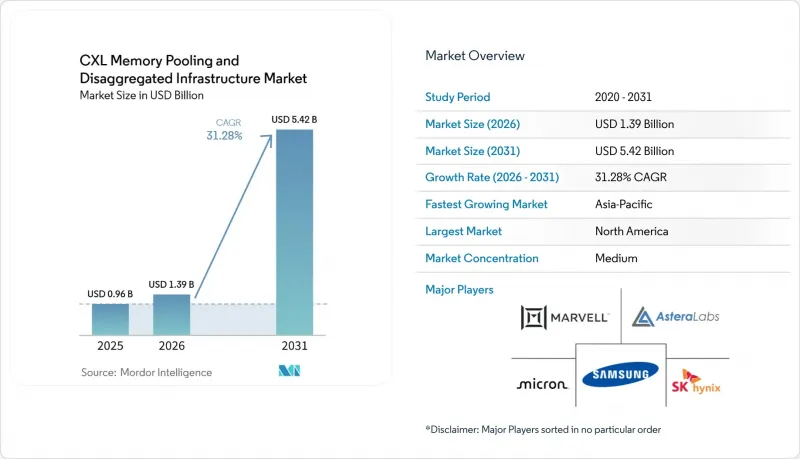
Mordor Intelligence에 의하면, CXL 메모리 풀링 및 분산형 인프라 시장 규모는 2025년에 9억 6,000만 달러로 평가되었고, 2026년에 13억 9,000만 달러로 성장이 추정되고, 2031년까지 54억 2,000만 달러에 이를 것으로 예측됩니다.
2026-2031년 연평균 성장률(CAGR) 31.28%로 성장할 것으로 전망됩니다.
본 보고서는 구성 요소별(CXL 메모리 모듈, CXL 컨트롤러, CXL 스위치, 소프트웨어 및 오케스트레이션), 도입 아키텍처별(메모리 확장 등), 용도별(인공지능 및 머신러닝, 고성능 컴퓨팅 및 과학 계산 등), 지역별로 분류되어 있습니다. 시장 전망은 금액(달러) 기준으로 제시되어 있습니다.
세계의 CXL 메모리 풀링 및 분산형 인프라 시장 동향과 인사이트
AI 클러스터의 메모리 한계에 따른 압박
가속기의 처리량과 서버 내 DRAM 용량 간의 격차는 CXL 메모리 풀링 및 분산형 인프라 시장의 채택을 촉진하는 가장 강력한 당면 요인으로 작용하고 있습니다. 2026년 DDR5 서버 메모리 비용은 1GB당 30-40달러였으나, AI 워크로드에서는 18개월마다 메모리 수요가 두 배로 증가하고 있어, 이로 인해 하이퍼스케일러 및 엔터프라이즈 AI 사업자에게 단순한 DIMM 기반의 확장 방식은 비용 부담이 컸습니다. 공유 CXL 풀을 통해 KV 캐시 수요를 로컬 DRAM의 범위를 넘어 DRAM에 가까운 지연 시간으로 확장할 수 있게 되어, GPU 가동률 저하를 방지하고 토큰당 추론 비용을 절감할 수 있습니다. 이러한 압박은 토큰 경제학이 단순한 훈련 처리량뿐만 아니라 메모리 효율성에 크게 의존하는 추론 시스템에서 특히 두드러집니다. Penguin Solutions는 2026년 3월, 최대 11TB의 CXL 기반 메모리를 탑재하고 NVMe 기반 접근 방식보다 10배 빠른 최초의 상용 CXL 기반 KV 캐시 서버를 출시하며, 상용 도입이 시범 단계를 벗어났음을 입증했습니다.
하이퍼스케일 환경에서의 컴포저블 인프라로의 전환
각 하이퍼스케일러 기업들은 메모리, 연산 리소스, 가속기를 개별적으로 프로비저닝하고 워크로드의 변화에 따라 이동할 수 있는 ‘컴포저블 풀’을 중심으로 데이터센터의 조달 체계를 재구축하고 있습니다. 이러한 변화는 GPU 활용 효율 및 랙 밀도의 한계와 밀접한 관련이 있으며, CXL 메모리 풀링 및 디스어그리게이트드 인프라 시장을 단순한 서버 단위의 메모리 확장을 넘어 랙 규모의 설계로 발전시키고 있습니다. 이러한 변화로 인해 공유 메모리를 틈새 시장용 부속품이 아닌 표준 랙 구성 요소로 기능하게 할 수 있는 스위칭 패브릭에 대한 수요가 증가하고 있습니다. Astera Labs에 따르면, 이 회사의 ‘Scorpio X 시리즈’ 320레인 스마트 패브릭 스위치는 2026년 하반기에 양산 단계에 진입하여, AllReduce의 지연 시간을 최소 50% 단축함으로써 운영자에게 더 대규모의 풀형 배포를 위한 실용적인 로드맵을 제공할 것입니다. 이러한 패브릭이 AI 랙에서 보급됨에 따라, 분산된 메모리 계층을 추가하는 한계 비용은 낮아지고, 동적 메모리 할당의 소프트웨어적 타당성을 입증하기가 더 쉬워집니다.
CXL의 세대 간 및 벤더 스택 간 상호 운용성 격차
표준화가 진행되고 있음에도 불구하고, 상호 운용성은 여전히 조달에 있어 큰 걸림돌이 되고 있습니다. 조사에 따르면, CXL 캐시 일관성 프로토콜에는 서로 다른 메모리 일관성 모델을 가진 이종 호스트 아키텍처 간에 안전한 상호 운용성을 보장하는 메커니즘이 여전히 부족하여, 플랫폼과 디바이스의 호환성 검증을 쌍별로 수행할 수밖에 없는 상황입니다. 이로 인해 멀티 벤더 풀 구축을 희망하는 구매자나 하이퍼스케일러처럼 사내 검증 역량을 갖추지 못한 구매자의 경우, 엔지니어링 비용이 증가하게 됩니다. 이 문제는 패브릭 계층에서 더욱 두드러집니다. 이 계층에서는 스위치 구현이 아직 성숙 단계에 이르지 못했으며, 벤더 간에 프로덕션 환경에 대응하는 토폴로지가 완전히 통일되어 있지 않습니다. 그 결과, CXL 메모리 풀링 및 디스어그리게이트 인프라 시장이 가장 빠르게 확대되고 있으며, 이 분야에서는 구매자가 하드웨어 조합을 세밀하게 제어하고 더 긴 검증 주기에 대응할 수 있습니다.
부문 분석
CXL 스위치는 CXL 메모리 풀링 및 분산형 인프라 시장에서 가장 빠르게 성장하고 있는 구성 요소이며, 아키텍처가 단일 서버 확장에서 랙 수준의 공유 메모리 패브릭으로 전환됨에 따라, 2031년까지 연평균 성장률(CAGR)은 32.57%를 나타낼 것으로 전망됩니다. Marvell은 XConn Technologies 인수를 통해 개발된 260레인 CXL 3.0 스위치 'Structera S 30260'을 발표하고, 2026년 3분기에 샘플 출하를 시작할 것이라고 밝혔습니다. 이로써 해당 제품은 AI용 랙 스케일 메모리 풀링을 위해 특별히 설계된 최초의 스위치가 됩니다. 이 스위치의 양산 개시는 CPU 플랫폼의 준비 상황과 밀접한 관련이 있습니다. 멀티호스트 패브릭 기능을 구현하려면 2026년부터 2027년에 걸쳐 출시될 예정인 차세대 프로세서가 필요하기 때문입니다. 따라서 CXL 메모리 업계가 예측 기간 후반에 이 부문의 수익 집중을 강화하는 방향으로 포지셔닝하고 있음에도 불구하고, 단기적인 스위치 출하량은 소폭에 그칠 전망입니다.
CXL 메모리 모듈은 CXL 2.0 지원 서버 플랫폼에서의 유형 3 메모리 익스팬더 채택에 힘입어, 2025년 CXL 메모리 풀링 및 디스어그리게이트드 인프라 시장 규모의 44.17%를 차지했습니다. Samsung Electronics가 2026년 7월에 실시한 평가에 따르면, CXL 메모리는 8-GPU 구성에서 DRAM 성능의 92%를 유지하면서도 훨씬 더 큰 용량을 실현하고 있으며, 이는 AI 서버용 하이퍼스케일러의 인증 작업에 영향을 미치고 있습니다. SK하이닉스는 2025년 4월, 96GB CMM-DDR5 모듈에 대한 고객 검증을 완료했습니다. 이를 통해 DDR5 대비 용량이 50% 증가하고 대역폭도 30% 향상되어 36GB/s를 달성했으나, 128GB 버전에 대해서는 여전히 검증 중입니다. 컨트롤러 분야에서는 경쟁이 격화되고 있으며, Montage Technology사의 CXL 3.1 Memory eXpander Controller가 AMD 및 인텔로부터 지지를 얻었습니다. 한편, 오케스트레이션 소프트웨어는 현재 규모는 작지만, 종량제 메모리 풀이 성숙해짐에 따라 지속적인 수익원이 될 가능성이 높을 것으로 전망됩니다.
지역별 분석
2025년, 북미는 38.69%의 점유율을 차지하며 CXL 메모리 풀링 및 분산형 인프라 업계에서 가장 규모가 큰 지역 시장이 되었습니다. 이러한 선두 위상은 AWS, Microsoft Azure, Google Cloud, Meta의 설비 투자를 반영한 것으로, 이들 기업은 모두 CXL 생태계의 초기부터 지지해 온 기업이며 이미 프로덕션 환경으로의 도입을 추진하고 있습니다. Astera Labs는 자사의 ‘Leo CXL Smart Memory Controllers’가 2025년 Microsoft Azure M 시리즈 가상 머신에서 검증되었다고 발표했습니다. 이는 파일럿 단계에서 프로덕션 환경에 대응하는 퍼블릭 클라우드 인프라로의 확실한 한 걸음을 의미합니다. Meta의 'Vistara' 프로젝트에서는 폐기된 서버에서 회수된 구형 DDR4 DIMM을 CXL을 통해 DDR5 기반 본격적인 시스템과 병용함으로써 재사용할 수 있음이 입증되었습니다. 이를 통해 메모리 비용 절감과 하이퍼스케일 환경에서의 탄소 발자국 감축이 실현됩니다. 또한, 데이터 주권 및 규정 준수 목적으로 온프레미스 AI 추론 능력을 요구하는 규제 대상 부문의 존재 역시 해당 지역 수요를 뒷받침하고 있습니다.
아시아태평양은 2031년까지 연평균 성장률(CAGR) 34.12%로 확대될 것으로 예측되며, CXL 메모리 풀링 및 디스어그리게이트드 인프라 시장에서 가장 두드러진 성장을 보일 지역이 될 것입니다. 이 지역은 한국과 대만의 메모리 제조업체 및 ODM 생산 능력이 공급 측면에서 집중되어 있는 이점을 누리고 있을 뿐만 아니라, 중국, 일본, 한국, 인도, 호주 전역에서 대규모 데이터센터에 대한 투자도 확대되고 있습니다. Samsung Electronics는 2026년 7월, CXL을 차기 주요 메모리 전략의 우선순위로 삼고 있다고 발표했습니다. 2026년 9월 이후 AMD EPYC Venice 기반의 샘플 검증을 계획하고 있으며, 2027년 1분기 양산 개시를 목표로 하고 있습니다. SK하이닉스도 CFMS 2026에서 CMM-DDR5를 시연했으며, CXL 3.0 및 3.1 디바이스용 독자적인 컨트롤러를 개발 중이어서, 이를 통해 해당 지역 내 공급망 입지가 더욱 강화될 전망입니다. 인도의 데이터센터 성장에 대한 정부 지원과 일본의 국가적 AI 컴퓨팅 추진은 지역 내 수요가 제조 능력을 뒤따르는 것이 아니라 제조 능력과 병행하여 증가하고 있음을 시사합니다.
유럽은 2025년에도 의미 있는 시장 점유율을 유지했습니다. 이는 각국의 AI 목표와 데이터 거주지 규제가 기업 및 공공 부문 환경에서 온프레미스형 분산 메모리 도입을 촉진했기 때문입니다. EU가 지원하는 CAPE 프로젝트는 엣지 마이크로 데이터센터 내 동적 메모리 풀링을 위해 CXL 지원 PCIe Gen 5 및 Gen 6 패브릭을 통합하고 있으며, 이는 각국의 컴퓨팅 프로그램이 하이퍼스케일 이외의 도입 경로를 어떻게 창출하고 있는지를 보여줍니다. 남미, 중동 및 아프리카는 현재 규모는 작지만, 정부 주도의 주권 AI 프로그램과 코로케이션 시설의 확장을 통해 랙스케일 및 엣지 지향 CXL 도입 모델에 적합한 미래 수요 경로가 형성되고 있습니다. 이는 예측 기간 후반에 CXL 메모리 풀링 및 디스어그리게이트드 인프라 시장이 하이퍼스케일 영역 밖에서 보다 광범위한 엣지 계층으로 확장될 가능성이 높음을 의미합니다.
기타 혜택 :
- 엑셀 형식 시장 예측(ME) 시트
- 3개월간의 애널리스트 지원
자주 묻는 질문
목차
제1장 서론
제2장 조사 방법
제3장 주요 요약
제4장 시장 구도
제5장 시장 규모 및 성장 예측
제6장 경쟁 구도
제7장 시장 기회 및 향후 전망
AJY 26.08.11According to Mordor Intelligence, the CXL memory pooling and Disaggregated Infrastructure Market size is projected to be USD 0.96 billion in 2025, USD 1.39 billion in 2026, and reach USD 5.42 billion by 2031, growing at a CAGR of 31.28% from 2026 to 2031.
This report is Segmented by Component (CXL Memory Modules, CXL Controllers, CXL Switches, and Software and Orchestration), Deployment Architecture (Memory Expansion, and More), Application (Artificial Intelligence and Machine Learning, High-Performance Computing and Scientific Computing, and More), and Geography. The Market Forecasts are Provided in Terms of Value (USD).
Global CXL Memory Pooling and Disaggregated Infrastructure Market Trends and Insights
AI Cluster Memory Wall Pressure
The gap between accelerator throughput and on-server DRAM capacity is the strongest immediate force behind adoption in the CXL memory pooling and disaggregated infrastructure market. DDR5 server memory costs stood at USD 30-40 per GB in 2026, while AI workloads are doubling memory needs every 18 months, which made simple DIMM-based scaling expensive for hyperscalers and enterprise AI operators alike. Shared CXL pools let KV cache demand extend beyond local DRAM at near-DRAM latency, helping avoid GPU underuse and reducing inference cost per token. This pressure is especially visible in inference systems, where token economics depend heavily on memory efficiency rather than on raw training throughput alone. Penguin Solutions launched the first production-ready CXL-based KV cache server in March 2026, with up to 11 TB of CXL-based memory and 10x faster speeds than NVMe-based approaches, demonstrating that commercial deployments had moved beyond the pilot stage.
Hyperscale Shift to Composable Infrastructure
Hyperscalers are restructuring data center procurement around composable pools where memory, compute, and accelerators can be provisioned independently and moved as workloads change. That shift is tied to GPU utilization economics and rack-density limits, pushing the CXL memory pooling and disaggregated infrastructure market toward rack-scale designs rather than server-bound memory expansion alone. This change raises demand for switching fabrics that can make shared memory a standard rack component rather than a niche attachment. Astera Labs said its Scorpio X-Series 320-lane Smart Fabric Switch entered the production ramp in H2 2026 and cuts AllReduce latency by at least 50%, providing operators with a practical path toward larger pooled deployments. As these fabrics become more common in AI racks, the marginal cost of adding disaggregated memory tiers falls, making the software case for dynamic memory allocation easier to justify.
Interoperability Gaps Across CXL Generations and Vendor Stacks
Interoperability remains a real brake on procurement even as standardization improves. Research showed that the CXL cache-coherence protocol still lacks mechanisms to guarantee safe interoperability across heterogeneous host architectures with different memory consistency models, forcing platform-device qualification on a pair-by-pair basis. That raises engineering cost for buyers who want multi-vendor pools and do not have the internal validation capacity of hyperscalers. The issue is sharper at the fabric layer, where switch implementations are still maturing and where production-ready topologies are not yet fully uniform across vendors. As a result, the CXL memory pooling and disaggregated infrastructure market is progressing fastest, where buyers can control hardware combinations closely and absorb longer qualification cycles.
Other drivers and restraints analyzed in the detailed report include:
- Standardization of CXL 3.x and 4.0 Fabric Features
- Energy Efficiency and Rack Utilization Gains from Memory Pooling
- Limited Volume Availability of Production-Qualified CXL Type 3 and Switch Ecosystems
For complete list of drivers and restraints, kindly check the Table Of Contents.
Segment Analysis
CXL Switches are the fastest-growing component in the CXL memory pooling and disaggregated infrastructure markett, with a 32.57% CAGR through 2031, as architecture moves from single-server expansion toward rack-level shared memory fabrics. Marvell announced the Structera S 30260, a 260-lane CXL 3.0 switch developed through the XConn Technologies acquisition, and said sampling would begin in Q3 2026, making it the first switch purpose-built for AI rack-scale memory pooling. The switch ramp is closely tied to CPU platform readiness because multi-host fabric features require newer processor generations, which are arriving through 2026 and 2027. That keeps near-term switch volumes modest even as the CXL memory industry positions this category for stronger revenue concentration later in the forecast period.
CXL Memory Modules commanded 44.17% share of the CXL memory pooling and disaggregated infrastructure market size in 2025, supported by Type 3 memory expander adoption on CXL 2.0-capable server platforms. Samsung's July 2026 evaluation showed that CXL memory maintained 92% of DRAM performance in 8-GPU configurations while delivering much larger capacity, which is influencing hyperscaler qualification work for AI servers. SK hynix completed customer validation of its 96 GB CMM-DDR5 module in April 2025, delivering a 50% capacity increase and a 30% bandwidth improvement to 36 GB/s over DDR5, while a 128 GB version remained under validation. Controllers are drawing more competition as Montage Technology's CXL 3.1 Memory eXpander Controller gained support from AMD and Intel, while orchestration software remains smaller today but is likely to become a recurring revenue layer as pay-per-use memory pools mature.
Complete Report Scope:
- By Component
- CXL Memory Modules
- CXL Controllers
- CXL Switches
- Software and Orchestration
- By Deployment Architecture
- Memory Expansion
- Memory Pooling
- Other Deployment Architectures
- By Application
- Artificial Intelligence and Machine Learning
- In-Memory Databases and Real-Time Analytics
- High-Performance Computing and Scientific Computing
- Cloud Infrastructure and Virtualization
- Other Applications
- By Geography
- North America
- United States
- Canada
- Mexico
- Europe
- Germany
- United Kingdom
- France
- Italy
- Rest of Europe
- Asia-Pacific
- China
- Japan
- South Korea
- Taiwan
- India
- Rest of Asia-Pacific
- South America
- Middle East and Africa
- North America
Geography Analysis
North America held a 38.69% share in 2025, making it the largest regional market for CXL memory pooling and disaggregated infrastructure industry. That lead reflected capital spending by AWS, Microsoft Azure, Google Cloud, and Meta, all of which were early backers of the CXL ecosystem and are already moving into production deployment. Astera Labs said its Leo CXL Smart Memory Controllers were validated on Microsoft Azure M-Series virtual machines in 2025, marking a clear step from pilot work toward production-ready public cloud infrastructure. Meta's Vistara project showed that older DDR4 DIMMs from retired servers can be repurposed alongside DDR5 production systems via CXL, reducing memory costs and supporting a lower carbon footprint in hyperscale environments. Demand in the region is also supported by regulated sectors seeking on-premises AI inference capacity for data sovereignty and compliance purposes.
Asia-Pacific is projected to expand at a 34.12% CAGR through 2031, which makes it the fastest-growing geography in the CXL memory pooling and disaggregated infrastructure market. The region benefits from the supply-side concentration of memory manufacturers and ODM capacity in South Korea and Taiwan, while large data center investments are also expanding across China, Japan, South Korea, India, and Australia. Samsung said in July 2026 that it was treating CXL as its next major memory priority, with AMD EPYC Venice-based sample validation planned after September 2026 and commercial production targeted for Q1 2027. SK hynix also demonstrated CMM-DDR5 at CFMS 2026 and is developing its own controllers for CXL 3.0 and 3.1 devices, which supports a stronger regional supply chain position. India's public support for data center growth and Japan's national AI computing efforts suggest that regional demand is building alongside manufacturing strength rather than trailing it.
Europe maintained a meaningful share in 2025, as sovereign AI goals and data residency rules favored on-premises disaggregated memory deployment in enterprise and public sector environments. The EU-backed CAPE project is integrating PCIe Gen 5 and Gen 6 fabric with CXL support for dynamic memory pooling in edge micro data centers, which shows how sovereign compute programs are creating non-hyperscale adoption paths. South America and the Middle East and Africa remain smaller today, but government-backed sovereign AI programs and colocation expansion are creating a future demand path that fits rack-scale and edge-oriented CXL deployment models. This means the CXL memory pooling and disaggregated infrastructure market is likely to develop a broader edge layer outside the hyperscale footprint over the latter part of the forecast period.
- Marvell Technology, Inc.
- Astera Labs, Inc.
- Samsung Electronics Co., Ltd.
- Micron Technology, Inc.
- SK Hynix Inc.
- Liqid Inc.
- MemVerge Inc.
- Intel Corporation
- Advanced Micro Devices, Inc.
- Montage Technology Co., Ltd.
- Dell Technologies Inc.
- Hewlett Packard Enterprise Company
- Super Micro Computer, Inc.
Additional Benefits:
- The market estimate (ME) sheet in Excel format
- 3 months of analyst support
TABLE OF CONTENTS
1 INTRODUCTION
- 1.1 Study Assumptions and Market Definition
- 1.2 Scope of the Study
2 RESEARCH METHODOLOGY
3 EXECUTIVE SUMMARY
4 MARKET LANDSCAPE
- 4.1 Market Overview
- 4.2 Market Drivers
- 4.2.1 AI Cluster Memory Wall Pressure
- 4.2.2 Hyperscale Shift to Composable Infrastructure
- 4.2.3 Standardization of CXL 3.x and 4.0 Fabric Features
- 4.2.4 Energy Efficiency and Rack Utilization Gains from Memory Pooling
- 4.2.5 Fabric-Level Telemetry and NUMA-Aware Software Orchestration
- 4.2.6 Procurement Preference for Shared Memory in Sovereign AI and Edge Micro Data Centers
- 4.3 Market Restraints
- 4.3.1 Interoperability Gaps Across CXL Generations and Vendor Stacks
- 4.3.2 Limited Volume Availability of Production-Qualified CXL Type 3 and Switch Ecosystems
- 4.3.3 Software Licensing Friction in Pay-Per-Use Disaggregated Models
- 4.3.4 Memory Latency Sensitivity in Production AI and HPC Workloads
- 4.4 Industry Value Chain Analysis
- 4.5 Regulatory Landscape
- 4.6 Technological Outlook
- 4.7 Porter's Five Forces Analysis
- 4.7.1 Bargaining Power of Buyers
- 4.7.2 Bargaining Power of Suppliers
- 4.7.3 Threat of New Entrants
- 4.7.4 Threat of Substitutes
- 4.7.5 Intensity of Competitive Rivalry
- 4.8 Impact of Macroeconomic Factors on the Market
5 MARKET SIZE AND GROWTH FORECASTS (VALUE)
- 5.1 By Component
- 5.1.1 CXL Memory Modules
- 5.1.2 CXL Controllers
- 5.1.3 CXL Switches
- 5.1.4 Software and Orchestration
- 5.2 By Deployment Architecture
- 5.2.1 Memory Expansion
- 5.2.2 Memory Pooling
- 5.2.3 Other Deployment Architectures
- 5.3 By Application
- 5.3.1 Artificial Intelligence and Machine Learning
- 5.3.2 In-Memory Databases and Real-Time Analytics
- 5.3.3 High-Performance Computing and Scientific Computing
- 5.3.4 Cloud Infrastructure and Virtualization
- 5.3.5 Other Applications
- 5.4 By Geography
- 5.4.1 North America
- 5.4.1.1 United States
- 5.4.1.2 Canada
- 5.4.1.3 Mexico
- 5.4.2 Europe
- 5.4.2.1 Germany
- 5.4.2.2 United Kingdom
- 5.4.2.3 France
- 5.4.2.4 Italy
- 5.4.2.5 Rest of Europe
- 5.4.3 Asia-Pacific
- 5.4.3.1 China
- 5.4.3.2 Japan
- 5.4.3.3 South Korea
- 5.4.3.4 Taiwan
- 5.4.3.5 India
- 5.4.3.6 Rest of Asia-Pacific
- 5.4.4 South America
- 5.4.5 Middle East and Africa
- 5.4.1 North America
6 COMPETITIVE LANDSCAPE
- 6.1 Market Concentration
- 6.2 Strategic Moves
- 6.3 Market Share Analysis
- 6.4 Company Profiles (includes Global Level Overview, Market Level Overview, Core Segments, Financials as available, Strategic Information, Market Rank/Share, Products and Services, Recent Developments)
- 6.4.1 Marvell Technology, Inc.
- 6.4.2 Astera Labs, Inc.
- 6.4.3 Samsung Electronics Co., Ltd.
- 6.4.4 Micron Technology, Inc.
- 6.4.5 SK Hynix Inc.
- 6.4.6 Liqid Inc.
- 6.4.7 MemVerge Inc.
- 6.4.8 Intel Corporation
- 6.4.9 Advanced Micro Devices, Inc.
- 6.4.10 Montage Technology Co., Ltd.
- 6.4.11 Dell Technologies Inc.
- 6.4.12 Hewlett Packard Enterprise Company
- 6.4.13 Super Micro Computer, Inc.
7 MARKET OPPORTUNITIES AND FUTURE OUTLOOK
- 7.1 White Space and Unmet Need Assessment


