

|
시장보고서
상품코드
2098514
브랜드 액티베이션 서비스 시장 : 점유율 분석, 업계 동향 및 통계, 성장 예측(2026-2031년)Brand Activation Services - Market Share Analysis, Industry Trends & Statistics, Growth Forecasts (2026 - 2031) |
||||||
 Mordor Intelligence
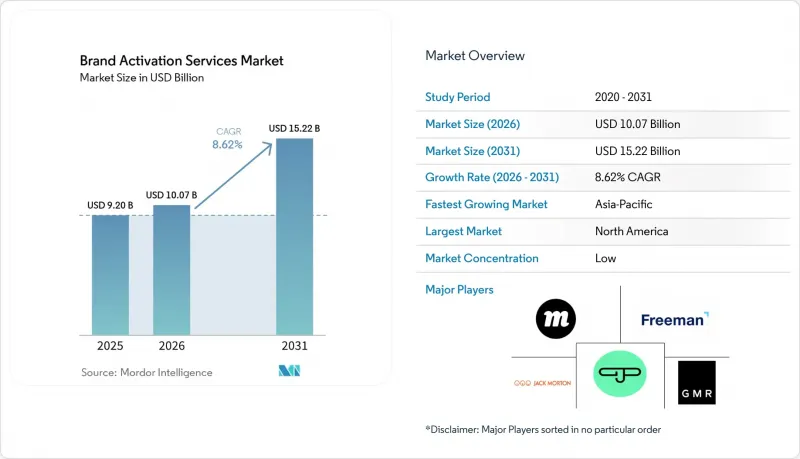
Mordor Intelligence에 의하면, 브랜드 액티베이션 서비스 시장 규모는 2025년 92억 달러에서 2026년에는 100억 7,000만 달러로 확대되어 2026년부터 2031년까지 CAGR 8.62%로 성장을 지속하여, 2031년에는 152억 2,000만 달러에 이를 것으로 예측됩니다.
본 보고서는 서비스 유형별(전략 및 캠페인 기획 등), 최종 이용 산업별(소매 및 소비재, 식품 및 음료, 미용·퍼스널케어, 자동차, 기술·통신, 은행, 금융서비스 및 보험(BFSI), 헬스케어 및 제약 등), 채널별(오프라인 및 온사이트 액티베이션 등), 그리고 지역별로 분류되어 있습니다. 시장 전망은 금액(달러) 기준으로 제시되어 있습니다.
세계 브랜드 액티베이션 서비스 시장 동향 및 인사이트
측정 가능한 체험형 지출로의 예산 재분배
마케팅 팀은 참여도, 리드의 질, 구매 의향으로 명확하게 이어지는 프로그램에 더 많은 예산을 할당하고 있습니다. 브랜드 액티베이션 서비스 시장에서 이러한 경향이 중요시되는 이유는 액티베이션가 더 이상 대규모 캠페인을 위한 일회성 지원 활동으로 취급되지 않기 때문입니다. 브랜드가 액티베이션(활성화)를 지속적인 채널로 자리매김하게 되면, 조달 심사, 보고 규칙, 다년 계획 등 미디어 바이잉과 유사한 거버넌스가 적용되게 됩니다. 이러한 변화로 인해 이벤트 활동과 자사 소유의 오디언스 데이터, 그리고 하류의 상업적 조치를 연결할 수 있는 대행사의 가치가 높아지고 있습니다. 또한, 일회성 이벤트가 아닌 대규모의 재현 가능한 프로그램을 지원할 수 있는 벤더에게 브랜드 액티베이션 서비스 시장은 더욱 유리한 환경으로 변모하고 있습니다.
퍼스트파티 데이터 수집 및 동의 기반 참여에 대한 수요 증가
라이브 및 라이브-디지털 형식의 액티베이션운 대여된 디지털 오디언스에서 얻는 것보다 기록하기 쉬운 직접적인 동의 신호를 생성하기 때문에 그 가치가 높아지고 있습니다. 2025년 2월, 어도비는 미국에서 ‘Real-Time CDP Collaboration’을 출시하여 광고주와 퍼블리셔가 개인을 식별할 수 있는 고객 정보를 직접 공개하지 않고도 동의 기반의 퍼스트파티 데이터를 활용할 수 있도록 했습니다. 2025년 7월, 캘리포니아주 개인정보보호국은 자동화된 의사결정 기술, 위험 평가 및 연례 사이버 보안 감사를 포괄하는 규정 제정 패키지의 최종안을 승인했습니다. 이러한 변화로 인해 데이터가 풍부한 이벤트 프로그램에 대한 규정 준수 기준이 높아졌으며, 보다 견고한 동의 획득 및 데이터 처리 프로세스를 갖춘 액티베이션 파트너에게 경쟁 우위가 주어지고 있습니다. 그 결과, 브랜드 액티베이션 서비스 시장은 측정 가능하고 개인정보 보호를 고려한 오디언스 확보에 대한 클라이언트 수요 증가로 인해 혜택을 보고 있습니다.
투자 수익률(ROI)의 어트리뷰션 및 측정 과제
어트리뷰션은 여전히 지출의 급속한 확장을 가로막는 가장 뚜렷한 장벽으로 남아 있습니다. 많은 액티베이션 프로그램에서는 방문자 수, 스캔 횟수, 또는 즉각적인 리드 수를 파악하고 있지만, 이러한 신호를 몇 주 후에 나타나는 구매 행동과 명확하게 연결 짓지 못하고 있습니다. 브랜드 액티베이션 서비스 시장에서 이러한 상황은 보고상의 공백을 초래하며, 재무 부서가 예산을 신속하게 확대하는 데 소극적인 태도를 보이게 하는 요인이 되고 있습니다. 이 문제는 브랜드가 먼저 경험을 기획하고, 이벤트 종료 후에야 비로소 측정 단계를 추가하는 경우 더욱 심각해집니다. 동의 획득, 행동 추적, CRM 연동을 처음부터 기획서에 반영하는 대행사는 브랜드 액티베이션 서비스 시장에서 예산을 확보하는 데 있어 더 유리한 입장에 있습니다.
부문 분석
2025년, 브랜드 액티베이션 서비스 시장에서 ‘제작 및 액티베이션 실행’은 32.92%의 점유율을 차지하며 최대 서비스 분야로 부상했습니다. 이러한 선두 위상은 대규모 액티베이션 프로그램에서 물류, 제작, 인력 배치, 현장 관리가 여전히 중요함을 반영합니다. 전 세계 많은 고객사가 여러 행사장 및 시장에 걸쳐 일관된 실행을 여전히 필요로 하고 있기 때문에 이 부문은 계속해서 중심적인 위치를 차지하고 있습니다. ‘전략 및 캠페인 기획’과 ‘크리에이티브 및 체험 디자인’은 고객사가 제작 시작 전에 보다 강력한 자문 기능을 요구하고 있기 때문에 계속해서 중요한 위치를 차지하고 있습니다.
'기술 및 디지털 레이어 통합'은 2026년부터 2031년까지 연평균 성장률(CAGR) 9.42%로 확대될 것으로 예측되며, 브랜드 액티베이션 서비스 시장에서 가장 빠르게 성장하는 서비스 유형이 될 전망입니다. 이러한 변화는 라이브 프로그램에서 몰입형 디지털 레이어, 인터랙티브 도구 및 오디언스 데이터 시스템의 활용 확대에 힘입고 있습니다. 조지 P. 존슨(George P. Johnson)사의 NRF 2026 관련 조사 결과에 따르면, 기술 주도형 체험 디자인이 단순한 부가 요소가 아닌 액티베이션 실행의 핵심 부분으로 자리 잡고 있음을 보여줍니다. 디지털 요소를 통해 단일 오프라인 이벤트의 가치를 다양한 컨텐츠 및 관객 채널로 확장할 수 있게 됨에 따라 서비스 구성도 변화하고 있습니다. 향후 이러한 추세에 따라 브랜드 액티베이션 서비스 시장에서 기술 통합의 역할은 더욱 커질 것으로 예측됩니다.
지역별 분석
2025년, 북미는 브랜드 액티베이션 서비스 시장의 34.92% 점유율을 차지하며 지역별 부문 중 1위를 기록했습니다. 이 지역은 높은 대행사 밀도, 성숙한 스폰서십 문화, 고품질 이벤트 인프라, 그리고 대규모 기업 고객 기반과 같은 강점을 활용하고 있습니다. 미국은 주요 스포츠, 엔터테인먼트 및 기업 행사 일정이 연중 내내 진행되는 브랜드 액티베이션 계획을 뒷받침하고 있어 여전히 주요 수요 거점으로 자리 잡고 있습니다. 이에 따라 브랜드 액티베이션 서비스 시장의 다중 시장 프로젝트에서 북미가 계속해서 중심적인 위치를 차지하고 있습니다.
아시아태평양은 2026년부터 2031년까지 연평균 성장률(CAGR) 9.73%를 나타낼 것으로 예측되며, 브랜드 액티베이션 서비스 시장에서 가장 두드러진 성장을 보일 것으로 전망됩니다. 이 지역은 도시 지역의 소비자 확대, 모바일 우선 구매 행동, 크리에이터 생태계와 상거래 주도형 경험 간의 연계 강화와 같은 요인으로부터 혜택을 받고 있습니다. 중국 정보통신기술 아카데미에 따르면, 2025년 11월 기준 중국의 체험 경제 규모는 18조 4,000억 위안(2조 5,600억 달러)에 달했습니다. 이러한 규모는 소매 및 소비자 참여 분야에서 체험 주도형 형식에 대한 폭넓은 수요를 뒷받침하고 있습니다. 따라서 아시아태평양은 브랜드 액티베이션 서비스 시장에 있어 계속해서 중요한 성장 동력이 되고 있습니다.
유럽은 성숙하고 개인정보 보호 의식이 높은 지역으로, 규정 준수 요건이 이벤트에서 퍼스트파티 데이터 수집 방식을 규정하고 있습니다. 캘리포니아주의 개인정보 보호 규정 제정과 어도비(Adobe)의 동의 중심 협업 모델은 모두 오디언스 데이터 활용에 대한 거버넌스 강화라는 더 광범위한 상업적 추세를 반영하고 있습니다. 남미에서는 소비자 부문이 소비 모멘텀을 회복하고 있는 반면, 아프리카는 여전히 규모가 가장 작은 지역이지만 모듈식이며 비용 효율적인 액티베이션 방식에서 초기 성장세가 나타나고 있습니다. 이로 인해 브랜드 액티베이션 서비스 시장은 규제가 잘 갖춰진 성숙한 지역과 성장 속도가 빠른 신흥 지역이 공존하는 상황을 보이고 있습니다.
기타 혜택:
- 엑셀 형식 시장 예측(ME) 시트
- 3개월간의 애널리스트 지원
자주 묻는 질문
목차
제1장 서론
제2장 조사 방법
제3장 주요 요약
제4장 시장 구도
제5장 시장 규모와 성장 예측
제6장 경쟁 구도
제7장 시장 기회와 향후 전망
JHS 26.08.07According to Mordor Intelligence, the brand activation services market size is expected to grow from USD 9.20 billion in 2025 to USD 10.07 billion in 2026 and is forecast to reach USD 15.22 billion by 2031 at 8.62% CAGR over 2026-2031.
This report is Segmented by Service Type ( Strategy and Campaign Planning, and More), End-Use Industry (Retail and Consumer Goods, Food and Beverage, Beauty and Personal Care, Automotive, Technology and Telecommunications, BFSI, Healthcare and Pharmaceuticals, and More), Channel (Offline and On-Ground Activations, and More), and Geography. The Market Forecasts are Provided in Terms of Value (USD).
Global Brand Activation Services Market Trends and Insights
Budget Reallocation Toward Measurable Experiential Spend
Marketing teams are allocating more budget to programs that clearly connect to engagement, lead quality, and purchase intent. In the brand activation services market, this matters because activation is no longer being treated as a one-off support activity for large campaigns. Once brands classify activation as an ongoing channel, they apply the same governance as media buying, including procurement reviews, reporting rules, and multi-year planning. That shift is raising the value of agencies that can connect event activity with owned audience data and downstream commercial actions. It is also making the brand activation services market more favorable to vendors that can support large, repeatable programs instead of isolated events.
Rising Demand for First-Party Data Capture and Consent-Based Engagement
Live and live-digital activation formats are gaining value because they generate direct consent signals that are easier to document than those from rented digital audiences. In February 2025, Adobe launched Real-Time CDP Collaboration in the United States, enabling advertisers and publishers to work with consent-driven first-party data without directly exposing identifiable customer information. In July 2025, the California Privacy Protection Agency approved final text for a rulemaking package covering automated decision-making technology, risk assessments, and annual cybersecurity audits. These changes are raising the compliance standard for data-rich event programs and giving an advantage to activation partners with stronger consent and data-handling processes. As a result, the brand activation services market is benefiting from a wider client need for audience acquisition that is both measurable and privacy-aware.
Return on Investment Attribution and Measurement Gaps
Attribution remains the clearest limit on faster spending growth. Many activation programs still capture attendance, scans, or immediate leads, but they do not connect those signals cleanly to purchase behavior that appears weeks later. In the brand activation services market, this creates a reporting gap that makes finance teams less willing to expand budgets at pace. The problem becomes larger when brands plan the experience first and add measurement only after the event is complete. Agencies that build consent capture, behavioral tracking, and CRM linkage into the brief from the start are better placed to protect spending in the brand activation services market.
Other drivers and restraints analyzed in the detailed report include:
- Expansion of Hybrid and Digital Amplification Layers
- Higher Brand Trust and Recall From In-Person Participation
- Rising Production, Venue, Labor, and Logistics Costs
For complete list of drivers and restraints, kindly check the Table Of Contents.
Segment Analysis
Production and Activation Execution held 32.92% of the brand activation services market share in 2025, making it the largest service line. That lead reflects the continuing importance of logistics, fabrication, staffing, and on-site management in large-scale activation programs. The segment remains central because many global clients still need consistent execution across multiple venues and markets. Strategy and Campaign Planning, along with Creative and Experience Design, continue to matter because clients want stronger advisory input before production begins.
Technology and Digital Layer Integration is projected to expand at a 9.42% CAGR from 2026 to 2031, making it the fastest-growing service type in the brand activation services market. The shift is supported by the growing use of immersive digital layers, interactive tools, and audience data systems in live programs. George P. Johnson's NRF 2026 work reflects how technology-led experience design is becoming part of core activation delivery rather than a peripheral add-on. This changes the service mix because digital components can extend the value of a single physical event across multiple content and audience channels. Over time, that trend should continue to elevate the role of technology integration in the brand activation services market.
Complete Report Scope:
- By Service Type
- Strategy and Campaign Planning
- Creative and Experience Design
- Production and Activation Execution
- Technology and Digital Layer Integration
- By End-use Industry
- Retail and Consumer Goods
- Food and Beverage
- Beauty and Personal Care
- Automotive
- Technology and Telecommunications
- Healthcare and Pharmaceuticals
- BFSI
- Media and Entertainment
- Travel and Hospitality
- Other End-use Industries
- By Channel
- Offline and On-Ground Activations
- Online and Digital Activations
- Hybrid Activations
- By Geography
- North America
- United States
- Canada
- Mexico
- South America
- Brazil
- Argentina
- Rest of South America
- Europe
- Germany
- United Kingdom
- France
- Italy
- Spain
- Rest of Europe
- Asia-Pacific
- China
- India
- Japan
- South Korea
- Southeast Asia
- Rest of Asia-Pacific
- Middle East
- United Arab Emirates
- Saudi Arabia
- Rest of the Middle East
- Africa
- South Africa
- Egypt
- Nigeria
- Rest of Africa
- North America
Geography Analysis
North America held 34.92% of the brand activation services market share in 2025, making it the leading regional segment. The region benefits from strong agency density, mature sponsorship culture, premium event infrastructure, and a large base of enterprise clients. The United States remains the main demand center because major sports, entertainment, and corporate calendars support year-round activation planning. This keeps North America at the center of multi-market assignments in the brand activation services market.
Asia-Pacific is projected to grow at a 9.73% CAGR from 2026 to 2031, making it the fastest-growing geography in the brand activation services market. The region is benefiting from urban consumer expansion, mobile-first shopping behavior, and stronger links between creator ecosystems and commerce-led experiences. China's experience economy reached CNY 18.4 trillion (USD 2.56 trillion) by November 2025, according to the China Academy of Information and Communications Technology. That scale is supporting wider demand for experience-led formats in retail and consumer engagement. Asia-Pacific, therefore, remains an important growth engine for the brand activation services market.
Europe is a mature, privacy-conscious region where compliance requirements shape how first-party data is collected at events. The California privacy rulemaking and Adobe's consent-focused collaboration model both reflect the wider commercial direction toward stronger governance in audience data use. South America is recovering as consumer-facing sectors rebuild spending momentum, while Africa remains the smallest region but shows early growth in modular and cost-efficient activation formats. This leaves the brand activation services market with a mix of mature regulated regions and faster-growth emerging regions.
- Jack Morton Worldwide
- George P. Johnson Company
- Momentum Worldwide, LLC
- GMR Marketing LLC
- TRO Group Ltd.
- Freeman Expositions, Inc.
- Sparks, a Freeman Company
- Impact XM, LLC
- FIRST Agency, Inc.
- INVNT Group, Inc.
- NVE Experience Agency, Inc.
- Opus Agency, LLC
- Auditoire Group
- Imagination Ltd.
- Mosaic Sales Solutions US Operating Co., LLC
- Inspira Marketing Group, LLC
- Cheil Worldwide Inc.
- INNOCEAN Worldwide, Inc.
- MKTG, Inc.
- Pico Far East Holdings Limited
Additional Benefits:
- The market estimate (ME) sheet in Excel format
- 3 months of analyst support
TABLE OF CONTENTS
1 INTRODUCTION
- 1.1 Study Assumptions and Market Definition
- 1.2 Scope of the Study
2 RESEARCH METHODOLOGY
3 EXECUTIVE SUMMARY
4 MARKET LANDSCAPE
- 4.1 Market Overview
- 4.2 Market Drivers
- 4.2.1 Budget Reallocation Toward Measurable Experiential Spend
- 4.2.2 Rising Demand for First-Party Data Capture and Consent-Based Engagement
- 4.2.3 Expansion of Hybrid and Digital Amplification Layers
- 4.2.4 Higher Brand Trust and Recall From In-Person Participation
- 4.2.5 Retail Media and Creator Commerce Convergence Expands Shopper Activation Budgets
- 4.2.6 Micro-Activations and Modular Pop-Ups Improve Unit Economics
- 4.3 Market Restraints
- 4.3.1 Return on Investment Attribution and Measurement Gaps
- 4.3.2 Rising Production, Venue, Labor, and Logistics Costs
- 4.3.3 Privacy Compliance Friction in Data-Rich Activations
- 4.3.4 Retail Media Fragmentation Raises Execution Complexity
- 4.4 Industry Value Chain Analysis
- 4.5 Impact of Macroeconomic Factors on the Market
- 4.6 Regulatory Landscape
- 4.7 Technological Outlook
- 4.8 Porter's Five Forces Analysis
- 4.8.1 Threat of New Entrants
- 4.8.2 Bargaining Power of Buyers
- 4.8.3 Bargaining Power of Suppliers
- 4.8.4 Threat of Substitutes
- 4.8.5 Intensity of Competitive Rivalry
5 MARKET SIZE AND GROWTH FORECASTS (VALUE)
- 5.1 By Service Type
- 5.1.1 Strategy and Campaign Planning
- 5.1.2 Creative and Experience Design
- 5.1.3 Production and Activation Execution
- 5.1.4 Technology and Digital Layer Integration
- 5.2 By End-use Industry
- 5.2.1 Retail and Consumer Goods
- 5.2.2 Food and Beverage
- 5.2.3 Beauty and Personal Care
- 5.2.4 Automotive
- 5.2.5 Technology and Telecommunications
- 5.2.6 Healthcare and Pharmaceuticals
- 5.2.7 BFSI
- 5.2.8 Media and Entertainment
- 5.2.9 Travel and Hospitality
- 5.2.10 Other End-use Industries
- 5.3 By Channel
- 5.3.1 Offline and On-Ground Activations
- 5.3.2 Online and Digital Activations
- 5.3.3 Hybrid Activations
- 5.4 By Geography
- 5.4.1 North America
- 5.4.1.1 United States
- 5.4.1.2 Canada
- 5.4.1.3 Mexico
- 5.4.2 South America
- 5.4.2.1 Brazil
- 5.4.2.2 Argentina
- 5.4.2.3 Rest of South America
- 5.4.3 Europe
- 5.4.3.1 Germany
- 5.4.3.2 United Kingdom
- 5.4.3.3 France
- 5.4.3.4 Italy
- 5.4.3.5 Spain
- 5.4.3.6 Rest of Europe
- 5.4.4 Asia-Pacific
- 5.4.4.1 China
- 5.4.4.2 India
- 5.4.4.3 Japan
- 5.4.4.4 South Korea
- 5.4.4.5 Southeast Asia
- 5.4.4.6 Rest of Asia-Pacific
- 5.4.5 Middle East
- 5.4.5.1 United Arab Emirates
- 5.4.5.2 Saudi Arabia
- 5.4.5.3 Rest of the Middle East
- 5.4.6 Africa
- 5.4.6.1 South Africa
- 5.4.6.2 Egypt
- 5.4.6.3 Nigeria
- 5.4.6.4 Rest of Africa
- 5.4.1 North America
6 COMPETITIVE LANDSCAPE
- 6.1 Market Concentration
- 6.2 Strategic Moves
- 6.3 Market Share Analysis
- 6.4 Company Profiles (includes Global Level Overview, Market Level Overview, Core Segments, Financials as available, Strategic Information, Market Rank/Share, Products and Services, Recent Developments)
- 6.4.1 Jack Morton Worldwide
- 6.4.2 George P. Johnson Company
- 6.4.3 Momentum Worldwide, LLC
- 6.4.4 GMR Marketing LLC
- 6.4.5 TRO Group Ltd.
- 6.4.6 Freeman Expositions, Inc.
- 6.4.7 Sparks, a Freeman Company
- 6.4.8 Impact XM, LLC
- 6.4.9 FIRST Agency, Inc.
- 6.4.10 INVNT Group, Inc.
- 6.4.11 NVE Experience Agency, Inc.
- 6.4.12 Opus Agency, LLC
- 6.4.13 Auditoire Group
- 6.4.14 Imagination Ltd.
- 6.4.15 Mosaic Sales Solutions US Operating Co., LLC
- 6.4.16 Inspira Marketing Group, LLC
- 6.4.17 Cheil Worldwide Inc.
- 6.4.18 INNOCEAN Worldwide, Inc.
- 6.4.19 MKTG, Inc.
- 6.4.20 Pico Far East Holdings Limited
7 MARKET OPPORTUNITIES AND FUTURE OUTLOOK
- 7.1 White-Space and Unmet-Need Assessment


