

|
시장보고서
상품코드
2098522
휴머노이드 로봇 GPU 시장 : 점유율 분석, 업계 동향 및 통계, 성장 예측(2026-2031년)Humanoid Robot GPU - Market Share Analysis, Industry Trends & Statistics, Growth Forecasts (2026 - 2031) |
||||||
 Mordor Intelligence
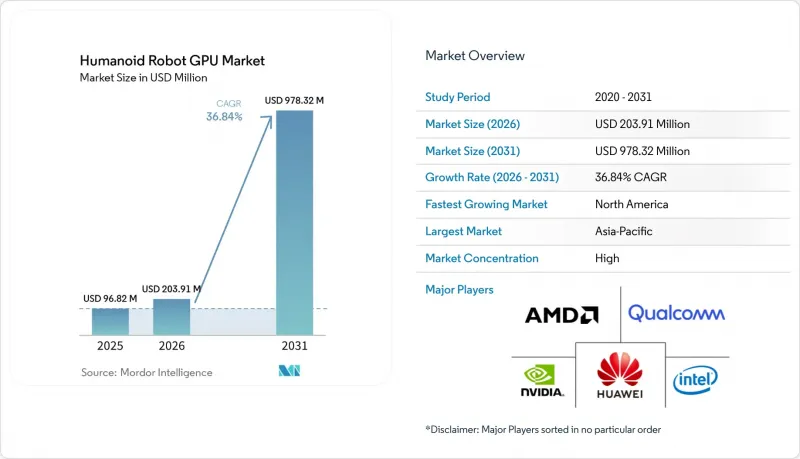
Mordor Intelligence에 의하면, 휴머노이드 로봇 GPU 시장 규모는 2025년 9,682만 달러에서 2026년에는 2억 391만 달러로 확대되어 2031년까지 9억 7,832만 달러에 이를 것으로 예상되고 있어 2026년부터 2031년까지 CAGR 36.84%로 성장할 전망입니다.
본 보고서는 GPU 유형(데이터센터용 훈련용 GPU, 엣지 AI용 GPU, 임베디드용 GPU, 통합형 GPU 플랫폼), 배포 유형(온보드 컴퓨팅, 하이브리드 컴퓨팅 등), GPU 기능(동작 계획·제어 등), 로봇의 능력(정교한 조작 등), 최종 이용 산업(자동차 등), 지역별로 분류되어 있습니다. 시장 전망은 금액(달러) 기준으로 제시되어 있습니다.
전 세계 휴머노이드 로봇 GPU 시장 동향 및 인사이트
휴머노이드 로봇에서 물리적 AI의 연산 부하 증가
휴머노이드 로봇 GPU 시장이 확대되고 있는 배경에는 물리 AI 워크로드가 단일 시각 처리나 제어 작업에 의존하는 것이 아니라, 여러 모델 레이어를 동시에 실행하게 된 점이 있습니다. NVIDIA는 이러한 수요에 대응하기 위해 Jetson AGX Thor T5000을 출시했습니다. 이 제품은 2,070 FP4 테라플롭스의 성능을 갖추고 있어 Jetson AGX Orin 플랫폼에 비해 획기적인 발전을 이루었으며, 연산 요구 사항이 얼마나 급속도로 높아지고 있는지를 여실히 보여줍니다. 휴머노이드 로봇 GPU 시장은 메모리 요구 사항에 의해서도 형성되고 있습니다. NVIDIA는 하드웨어 가이드라인 ‘GR00T’에서 훈련 시스템용으로 24GB 이상의 VRAM, 엣지 추론용으로 128GB의 통합 메모리를 권장하고 있습니다. 이는 제한적인 모방 작업에서 보다 광범위한 범용 동작으로 전환하는 개발자들이 훈련용 하드웨어와 온보드 추론용 하드웨어를 동시에 확장해야 하기 때문에 중요한 사항입니다. 또한 NVIDIA는 물리적 AI를 위한 ‘클라우드에서 로봇으로의 컴퓨팅’을 휴머노이드 개발의 기반 계층으로 자리매김했습니다. 이를 통해 데이터센터용 및 임베디드 GPU 제품 모두에서 지속적인 수요가 뒷받침되고 있습니다.
온보드 실시간 추론에 대한 수요 증가
휴머노이드 로봇 GPU 시장은 온보드 추론으로 전환되고 있습니다. 이는 지연 시간 및 데이터 처리 제약으로 인해 실제 운영 환경에서 클라우드에 대한 지속적인 의존이 더 이상 현실적이지 않기 때문입니다. 1X Technologies사는 2026년 당시 Jetson Thor가 NEO 로봇의 실시간 센서 처리에 필요한 온보드 연산 요건을 충족하는 유일한 제품이었다고 밝혔으며, 이는 임베디드 성능의 하이엔드 분야에서 선택지가 얼마나 제한적인지를 여실히 보여줍니다. 또한, Boston Dynamics사도 NVIDIA사와의 협력을 확대하여 Jetson Thor를 Atlas에 통합했습니다. 이를 통해 무거운 워크로드를 외부에 맡기는 대신, 서버급 추론 능력을 로봇 본체에 탑재할 수 있게 되었습니다. 휴머노이드 로봇 GPU 시장에서 이러한 아키텍처 변경은 중요한 의미를 지닙니다. 왜냐하면 도입되는 로봇 한 대마다 중앙 집중식 훈련 클러스터에 대한 의존뿐만 아니라 직접적인 하드웨어 판매로 이어지기 때문입니다. 도입 사례가 생산 라인이나 창고의 워크플로로 확대됨에 따라, 로컬 추론은 선택적인 프리미엄 기능이 아니라 표준적인 설계 요건이 되어가고 있습니다.
높은 전력 소비와 열 설계의 복잡성
휴머노이드 로봇 GPU 시장은 온보드 연산 처리가 이동, 센싱, 구동과 제한된 배터리 용량을 공유해야 하기 때문에 여전히 직접적인 운영상의 제약에 직면해 있습니다. Jetson Thor에 관한 NVIDIA의 개발자 토론에서는 SoC 수준의 전력 분배조차도 열 설계 팀에게 실질적인 과제가 되고 있음이 밝혀졌습니다. 특히 개발자가 모듈의 설정 가능한 TDP 범위 내에서 지속적인 성능을 모델링하려고 시도할 때 그 과제는 더욱 두드러집니다. 또한 NVIDIA는 15Ah, 0.972kWh 배터리를 탑재하고 약 3시간의 가동 시간을 자랑하는 레퍼런스 로봇 ‘Isaac GR00T’에 대해서도 설명했습니다. 이는 산업용 1교대 근무 시간에는 턱없이 부족하여, 배터리 교체나 고정 전원 공급과 같은 우회책을 강구할 수밖에 없습니다. 휴머노이드 로봇 GPU 시장에서 이러한 전력 상한선은 피크 시간대의 추론 부하와 액추에이터 부하가 동시에 시스템에 집중되기 때문에 도입의 걸림돌이 되고 있습니다. 또한, 통합적인 열 관리, 전력 제어 및 시스템 전반의 최적화에 투자할 수 있는 대형 벤더들에게 유리하게 작용하고 있습니다.
부문 분석
2025년 휴머노이드 로봇 GPU 시장에서 데이터센터용 훈련용 GPU가 64.92%의 점유율을 차지했습니다. 이는 지출의 대부분이 여전히 실제 가동 중인 로봇이 아닌, 모델 개발이라는 업스트림 공정에 집중되어 있음을 보여줍니다. 휴머노이드 로봇 GPU 시장이 이 훈련 단계에 의존했던 이유는 범용 로봇 정책에서 상용 로봇군의 확대에 앞서 대규모 시뮬레이션, 합성 데이터 생성 및 지속적인 모델 개선이 필요하기 때문입니다. NVIDIA가 주창하는 ‘클라우드 투 로봇(Cloud-to-Robot)’이라는 물리적 AI 포지셔닝은 데이터센터 시스템을 로봇의 훈련, 시뮬레이션 및 배포 워크플로우에 직접 연결함으로써 이러한 수요 패턴을 반영했습니다. 또한, 이 휴머노이드 로봇 GPU 시장은 임베디드 시스템의 중요성을 보여주는 사례이기도 했습니다. Jetson Orin이 초기 배포를 뒷받침했고, Jetson Thor가 보다 고도화된 상용 휴머노이드를 위한 온보드 연산 레퍼런스 역할을 맡았기 때문입니다.
NVIDIA 생태계의 모멘텀은 Boston Dynamics와 1X의 공식적인 약속을 통해 더욱 공고해졌습니다. 두 회사 모두 온보드 추론 및 센서 처리를 위해 자사의 로봇 로드맵을 Jetson Thor와 연계하고 있습니다. 통합형 GPU 플랫폼은 2026년부터 2031년까지 연평균 성장률(CAGR) 37.61%를 나타낼 것으로 예측되며, 이 시장에서 가장 빠르게 성장하는 부문이 될 전망입니다. 휴머노이드 로봇 GPU 시장이 이러한 방향으로 나아가고 있는 이유는 통합 플랫폼이 기판의 복잡성을 줄이고 이동형 로봇에서 순수한 디스크리트 방식보다 전력, 열 부하, 연산 능력의 균형을 더 적절하게 맞출 수 있기 때문입니다. CES 2026에서 퀄컴이 발표한 로봇 플랫폼은 휴머노이드 및 이동형 로봇 용도를 위해 CPU, GPU, AI 가속 기능을 단일 아키텍처에 통합한 설계를 채택하고 있어 이러한 변화를 반영하고 있습니다. 휴머노이드 로봇 GPU 업계에 있어 이는 향후 경쟁의 초점이 단일 기기의 최고 연산 성능뿐만 아니라 풀스택 효율성에 맞추어질 가능성이 높다는 것을 의미합니다.
2025년에는 오프보드 훈련 및 시뮬레이션이 매출의 65.38%를 차지했으며, 당시 휴머노이드 로봇 GPU 시장은 여전히 개발 인프라에 중점을 두고 있었음을 알 수 있습니다. 벤더와 로봇 개발자들은 디지털 환경이라면 실제 세계에서의 테스트로는 감당할 수 없을 정도로 대규모로 정책을 테스트할 수 있기 때문에 여전히 시뮬레이션 클러스터에 막대한 투자를 하고 있었습니다. NVIDIA는 휴머노이드 개발 스택을 Omniverse, Isaac 및 Blackwell 시스템과 연동했는데, 이는 오프보드 훈련이 이 시장에서 여전히 중심적인 위치를 차지하고 있음을 반영합니다. 또한 휴머노이드 로봇 GPU 시장에서는 로봇이 로컬에서 추론을 수행하는 동시에, 다운타임 동안 클라우드나 데이터센터로부터 대규모 모델 업데이트를 수신하는 하이브리드 모델에 대한 지원도 계속되었습니다. 이 하이브리드 접근 방식은 모든 연산 단계를 로봇에 강제하지 않으면서도 운영자가 집중 훈련을 통해 얻은 성과를 활용할 수 있게 해주므로, 현재의 상용화 단계에 적합합니다.
온보드 연산은 2031년까지 연평균 성장률(CAGR) 38.14%로 확대될 것으로 예측되며, 휴머노이드 로봇 GPU 시장에서 가장 빠르게 성장하는 도입 형태가 될 것입니다. 이러한 성장 가속화는 지연 시간, 개인정보 보호 및 운영 지속성 측면에서 지속적으로 오프보드에 의존하는 것이 정당화되기 어려운 생산 환경 때문입니다. 1X사와 보스턴 다이내믹스는 모두, 이미 도입된 로봇에서 실시간 추론 및 센서 처리를 실현하는 방안으로 온보드 Jetson Thor 통합을 꼽고 있으며, 이는 이 부문에 구체적인 상업적 근거를 제공합니다. 도입이 확대됨에 따라 휴머노이드 로봇 GPU 시장은 중앙 집중형 개발용 연산 리소스와 분산형 임베디드 추론 하드웨어 사이에서 보다 균형 잡힌 구성으로 전환될 것으로 보입니다.
지역별 분석
2025년, 아시아태평양은 매출의 47.62%를 차지하며 휴머노이드 로봇 GPU 시장에서 가장 규모가 큰 지역이 되었습니다. 이러한 우위는 중국의 휴머노이드 OEM 활동 집중, 일본 및 한국의 반도체 산업 기반, 그리고 초안에 명시된 물리적 AI 프로그램에 대한 광범위한 정부 지원에 기인합니다. 아시아태평양의 휴머노이드 로봇 GPU 시장은 센서, 패키징, 메모리, 연산 기능의 통합을 대규모로 지원할 수 있는 공급망의 혜택도 받고 있습니다. 이 지역에서는 NVIDIA 기반 도입을 보완하는 형태로 국내산 연산 플랫폼이 등장하기 시작했는데, 이는 구매 결정에 있어 현지화 목표가 더욱 중요한 요소로 부상하고 있다는 점에서 중요한 의미를 지닙니다. 이러한 변화가 있음에도 불구하고, 아시아태평양의 휴머노이드 로봇 GPU 시장은 여전히 지역 내 OEM 업체들이 시범 생산에서 재현 가능한 상용화 단계로 얼마나 신속하게 전환할 수 있는지에 따라 크게 좌우될 것입니다.
북미는 2031년까지 연평균 성장률(CAGR) 38.57%로 확대될 것으로 예측되며, 휴머노이드 로봇 GPU 시장에서 가장 빠르게 성장하는 지역 부문이 될 전망입니다. 이 지역은 AI 인프라의 방대한 도입 실적과 상업적으로 가장 주목받는 휴머노이드 개발 기업 몇 곳이 결합되어 있어, 훈련과 도입 양면에서 확고한 입지를 구축하고 있습니다. NVIDIA의 Jetson Thor 로드맵 및 생태계에 관한 메시지는 이러한 개발 기반을 강력히 의식한 것이었습니다. 한편, Boston Dynamics와 1X는 모두 자사의 로봇 스택을 NVIDIA의 온보드 연산 경로와 연동하고 있습니다. 북미의 휴머노이드 로봇 GPU 시장은 ‘Robots-as-a-Service(RaaS)’ 모델에 의해서도 뒷받침되고 있습니다. 이 모델을 통해 도입은 일회성 장비 판매가 아닌, 하드웨어 및 소프트웨어에 대한 지속적인 수요 흐름으로 변화합니다. Agility Robotics와 Toyota Motor Manufacturing Canada 간의 상업 계약은 이 모델이 실제 산업 운영으로 전환되어, 단위 수준에서 임베디드 GPU 수요를 뒷받침하고 있음을 보여줍니다.
2025년 휴머노이드 로봇 GPU 시장 매출에서 유럽은 큰 점유율을 차지했습니다. 이는 독일의 자동차 분야 도입과 해당 지역 전체의 광범위한 산업 자동화 인프라가 주도한 결과입니다. BMW의 라이프치히 프로그램은 자동차 생산 분야에서 물리적 AI의 주목할 만한 사례를 유럽에 제시하며, 산업 분야에서의 조기 도입에 있어 이 지역의 역할을 강화했습니다. 남미, 중동 및 아프리카의 기여도는 여전히 미미하지만, 2025년 후반에 마르카도 리브레와 애질리티 로보틱스가 체결한 계약을 통해 휴머노이드 로봇 GPU 시장은 남미로 진출할 명확한 경로를 확보했습니다. 이 지역 전반에 걸쳐 상용 도입이 일상적인 인간과 로봇의 협업에 가까워짐에 따라, 안전 기준 준수 및 시스템의 결정론적 동작이 더욱 중요해질 것입니다.
기타 혜택:
- 엑셀 형식 시장 예측(ME) 시트
- 3개월간의 애널리스트 지원
자주 묻는 질문
목차
제1장 서론
제2장 조사 방법
제3장 주요 요약
제4장 시장 구도
제5장 시장 규모와 성장 예측
제6장 경쟁 구도
제7장 시장 기회와 향후 전망
JHS 26.08.07According to Mordor Intelligence, the humanoid robot GPU market size is expected to increase from USD 96.82 million in 2025 to USD 203.91 million in 2026 and reach USD 978.32 million by 2031, growing at a CAGR of 36.84% over 2026-2031.
This report is Segmented by GPU Type (Data Center Training GPUs, Edge AI GPUs, Embedded GPUs, and Integrated GPU Platforms), Deployment Type (Onboard Compute, Hybrid Compute, and More), GPU Function (Motion Planning and Control, and More), Robot Capability (Dexterous Manipulation, and More), End Use Industry (Automotive, and More), and Geography. The Market Forecasts are Provided in Terms of Value (USD).
Global Humanoid Robot GPU Market Trends and Insights
Rising Physical AI Compute Intensity in Humanoid Robots
The humanoid robot GPU market is expanding because physical AI workloads now run multiple model layers simultaneously rather than relying on a single vision or control task. NVIDIA positioned the Jetson AGX Thor T5000 to address this need with 2,070 FP4 teraflops, a significant leap from the Jetson AGX Orin platform and a clear indication of how quickly compute requirements are rising. The same GPU market for humanoid robots is also being shaped by memory requirements, as NVIDIA listed 24GB and higher VRAM for training systems and 128GB unified memory for edge inference in its GR00T hardware guidance. That matters because a developer moving from narrow imitation tasks to broader generalist behavior has to scale training hardware and onboard inference hardware simultaneously. NVIDIA also framed cloud-to-robot computing for physical AI as a foundational layer for humanoid development, which supports continued demand across both data center and embedded GPU products.
Growing Demand for Onboard Real-Time Inference
The humanoid robot GPU market is shifting toward onboard inference because latency and data-handling limitations make continuous cloud dependence less practical in live operating environments. 1X Technologies stated in 2026 that Jetson Thor was the only product available at the time that met the NEO robot's onboard compute requirement for real-time sensor processing, underscoring how narrow the field still is at the high end of embedded performance. Boston Dynamics also expanded its collaboration with NVIDIA to integrate Jetson Thor into Atlas, bringing server-class reasoning capability onto the robot itself rather than keeping the heavy workload offboard. In the humanoid robot GPU market, that architecture change matters because every additional robot deployed becomes a direct hardware sale rather than depending solely on centralized training clusters. As more deployments move into production lines and warehouse workflows, local inference is becoming a standard design requirement rather than an optional premium feature.
High Power Draw and Thermal Design Complexity
The humanoid robot GPU market still faces a direct operating constraint because onboard compute has to share limited battery capacity with locomotion, sensing, and actuation. NVIDIA developer discussions about Jetson Thor showed that even the SoC-level power breakdown is a practical challenge for thermal design teams, especially when developers try to model sustained performance within the module's configurable TDP range. NVIDIA also described its Isaac GR00T reference robot with a 15Ah and 0.972kWh battery and around 3 hours of operating life, which remains well below a full industrial shift and forces workarounds such as battery swaps or fixed power support. In the humanoid-robot GPU market, that power ceiling slows adoption because peak inference and actuator loads hit the same system simultaneously. It also favors larger vendors that can invest in integrated thermal management, power governors, and full-system optimization.
Other drivers and restraints analyzed in the detailed report include:
- Increasing Use of Synthetic Data and Simulation Pipelines
- Expanding Pilot Deployments in Automotive Manufacturing
- Elevated Bill of Materials and Total Cost Of Ownership
For complete list of drivers and restraints, kindly check the Table Of Contents.
Segment Analysis
Data Center Training GPUs held 64.92% of the humanoid robot GPU market share in 2025, indicating that most spending still sat upstream in model development rather than in fielded robots. The humanoid robot GPU market relied on that training layer because generalist robot policies need large-scale simulation, synthetic data generation, and continuous model refinement before commercial fleets can expand. NVIDIA's cloud-to-robot positioning for physical AI reflected this demand pattern by tying data center systems directly to robot training, simulation, and deployment workflows. The same humanoid robot GPU market also showed why embedded systems matter, as Jetson Orin had supported earlier deployments, and Jetson Thor moved into the role of reference onboard compute for more advanced commercial humanoids.
NVIDIA's ecosystem traction was reinforced by public commitments from Boston Dynamics and 1X, both of which tied their robot roadmaps to Jetson Thor for onboard reasoning and sensor processing. Integrated GPU Platforms are projected to grow at a 37.61% CAGR from 2026 to 2031, making them the fastest-growing segment of this market. The humanoid robot GPU market is moving in that direction because integrated platforms reduce board complexity and can better balance power, thermal load, and compute than purely discrete approaches in mobile robots. Qualcomm's robotics platform launch at CES 2026 reflected this shift with a design built around CPU, GPU, and AI acceleration in one architecture for humanoid and mobile robotics use. For the humanoid robot GPU industry, that means the next phase of competition is likely to center on full-stack efficiency rather than peak standalone compute alone.
Offboard Training and Simulation accounted for 65.38% of revenue in 2025, indicating that the humanoid robot GPU market remained focused on development infrastructure at that time. Vendors and robot developers still spent heavily on simulation clusters because digital environments let them test policies at a much larger scale than real-world trials can support. NVIDIA linked its humanoid development stack to Omniverse, Isaac, and Blackwell systems, which reflects how central offboard training remains in this market. The humanoid robot GPU market also continued to support hybrid models in which robots execute local inference while receiving heavier model updates from the cloud or data centers during downtime. That hybrid approach fits the current commercial stage because it lets operators use centralized training gains without forcing every compute step onto the robot.
Onboard Compute is forecast to expand at a 38.14% CAGR through 2031, which makes it the fastest-growing deployment mode in the humanoid robot GPU market. That acceleration follows from production settings in which latency, privacy, and operational continuity make constant offboard dependence hard to justify. 1X and Boston Dynamics both pointed to onboard Jetson Thor integration as the path to real-time reasoning and sensor processing on deployed robots, which gives this segment tangible commercial backing. As deployments widen, the humanoid robot GPU market is likely to move toward a more balanced split between centralized development compute and distributed embedded inference hardware.
Complete Report Scope:
- By GPU Type
- Data Center Training GPUs
- Edge AI GPUs
- Embedded GPUs
- Integrated GPU Platforms
- By Deployment Type
- Onboard Compute
- Offboard Training And Simulation
- Hybrid Compute
- By GPU Function
- Training and Simulation
- Inference and Perception
- Motion Planning and Control
- Digital Twin and Synthetic Data Generation
- By Robot Capability
- Real-Time Perception
- Motion Planning and Control
- Dexterous Manipulation
- Multi-Modal Reasoning
- By End Use Industry
- Automotive
- Logistics and Warehousing
- Manufacturing and Assembly
- Research and Education
- Healthcare and Assisted Living
- Defense and Security
- By Geography
- North America
- United States
- Canada
- Mexico
- Europe
- Germany
- United Kingdom
- France
- Italy
- Rest of Europe
- Asia-Pacific
- China
- Japan
- South Korea
- India
- Southeast Asia
- Rest of Asia-Pacific
- South America
- Middle East and Africa
- North America
Geography Analysis
Asia-Pacific accounted for 47.62% of revenue in 2025, making it the largest region in the humanoid robot GPU market. That lead came from the concentration of humanoid OEM activity in China, the semiconductor base in Japan and South Korea, and broader public support for physical AI programs described in the draft. The humanoid robot GPU market in Asia-Pacific also benefits from a supply chain that can support sensors, packaging, memory, and compute integration at scale. Domestic compute platforms are beginning to supplement NVIDIA-based deployments in the region, which matters because localization goals are becoming a stronger factor in purchasing decisions. Even with that shift, the humanoid robot GPU market in Asia-Pacific remains closely tied to how quickly regional OEMs can move from pilot output toward repeatable commercial deployment.
North America is projected to expand at a 38.57% CAGR through 2031, making it the fastest-growing regional segment in the humanoid robot GPU market. The region combines a large installed base of AI infrastructure with several of the most commercially visible humanoid developers, which gives it a strong position in both training and deployment. NVIDIA's Jetson Thor roadmap and ecosystem messaging were directed heavily toward this development base, while Boston Dynamics and 1X both linked their robot stacks to NVIDIA's onboard compute path. The humanoid robot GPU market in North America is also supported by the Robots-as-a-Service model, which turns deployments into a recurring hardware and software demand stream instead of a one-time equipment sale. Agility Robotics' commercial agreement with Toyota Motor Manufacturing Canada shows how that model is moving into live industrial operations and supporting embedded GPU demand at the unit level.
Europe accounted for a significant share of 2025 revenue in the humanoid robot GPU market, led by Germany's automotive deployments and the region's broader industrial automation base. BMW's Leipzig program gave Europe a visible reference point for physical AI in automotive production and reinforced the region's role in early industrial adoption. South America and the Middle East and Africa remained smaller contributors, but the humanoid robot GPU market gained a clear South American entry point through Mercado Libre's agreement with Agility Robotics in late 2025. Across these regions, safety compliance and deterministic system behavior are likely to matter more as commercial deployments move closer to routine human-robot collaboration.
- NVIDIA Corporation
- Qualcomm Incorporated
- Intel Corporation
- Advanced Micro Devices, Inc.
- Huawei Technologies Co., Ltd.
- Tesla, Inc.
- Baidu, Inc.
- Horizon Robotics Inc.
- Rockchip Electronics Co., Ltd.
- MediaTek Inc.
- Samsung Electronics Co., Ltd.
- Alphabet Inc.
- Amazon.com, Inc.
- Foxconn Technology Co., Ltd.
- Agility Robotics, Inc.
- Figure AI, Inc.
- Apptronik, Inc.
- Boston Dynamics, Inc.
- UBTECH Robotics Corp Ltd.
- Unitree Robotics
- Sanctuary Cognitive Systems Corporation
- 1X Technologies AS
- Fourier Intelligence Co., Ltd.
- XPENG Inc.
- Siemens AG
- ABB Ltd.
- KUKA AG
Additional Benefits:
- The market estimate (ME) sheet in Excel format
- 3 months of analyst support
TABLE OF CONTENTS
1 INTRODUCTION
- 1.1 Study Assumptions and Market Definition
- 1.2 Scope of the Study
2 RESEARCH METHODOLOGY
3 EXECUTIVE SUMMARY
4 MARKET LANDSCAPE
- 4.1 Market Overview
- 4.2 Market Drivers
- 4.2.1 Rising Physical AI Compute Intensity In Humanoid Robots
- 4.2.2 Growing Demand For Onboard Real-Time Inference
- 4.2.3 Increasing Use Of Synthetic Data And Simulation Pipelines
- 4.2.4 Expanding Pilot Deployments In Automotive Manufacturing
- 4.2.5 Rising Preference For Edge Processing To Reduce Latency And Cloud Dependency
- 4.2.6 Strategic Platform Lock-In By Leading Robotics Compute Vendors
- 4.3 Market Restraints
- 4.3.1 High Power Draw And Thermal Design Complexity
- 4.3.2 Elevated Bill Of Materials And Total Cost Of Ownership
- 4.3.3 Software Portability And Developer Ecosystem Fragmentation
- 4.3.4 Limited Real-World Training Data For Edge Cases
- 4.4 Industry Value Chain Analysis
- 4.5 Regulatory Landscape
- 4.6 Technological Outlook
- 4.7 Porter's Five Forces Analysis
- 4.7.1 Bargaining Power of Suppliers
- 4.7.2 Bargaining Power of Buyers
- 4.7.3 Threat of New Entrants
- 4.7.4 Threat of Substitutes
- 4.7.5 Competitive Rivalry
5 MARKET SIZE AND GROWTH FORECASTS (VALUE)
- 5.1 By GPU Type
- 5.1.1 Data Center Training GPUs
- 5.1.2 Edge AI GPUs
- 5.1.3 Embedded GPUs
- 5.1.4 Integrated GPU Platforms
- 5.2 By Deployment Type
- 5.2.1 Onboard Compute
- 5.2.2 Offboard Training And Simulation
- 5.2.3 Hybrid Compute
- 5.3 By GPU Function
- 5.3.1 Training and Simulation
- 5.3.2 Inference and Perception
- 5.3.3 Motion Planning and Control
- 5.3.4 Digital Twin and Synthetic Data Generation
- 5.4 By Robot Capability
- 5.4.1 Real-Time Perception
- 5.4.2 Motion Planning and Control
- 5.4.3 Dexterous Manipulation
- 5.4.4 Multi-Modal Reasoning
- 5.5 By End Use Industry
- 5.5.1 Automotive
- 5.5.2 Logistics and Warehousing
- 5.5.3 Manufacturing and Assembly
- 5.5.4 Research and Education
- 5.5.5 Healthcare and Assisted Living
- 5.5.6 Defense and Security
- 5.6 By Geography
- 5.6.1 North America
- 5.6.1.1 United States
- 5.6.1.2 Canada
- 5.6.1.3 Mexico
- 5.6.2 Europe
- 5.6.2.1 Germany
- 5.6.2.2 United Kingdom
- 5.6.2.3 France
- 5.6.2.4 Italy
- 5.6.2.5 Rest of Europe
- 5.6.3 Asia-Pacific
- 5.6.3.1 China
- 5.6.3.2 Japan
- 5.6.3.3 South Korea
- 5.6.3.4 India
- 5.6.3.5 Southeast Asia
- 5.6.3.6 Rest of Asia-Pacific
- 5.6.4 South America
- 5.6.5 Middle East and Africa
- 5.6.1 North America
6 COMPETITIVE LANDSCAPE
- 6.1 Market Concentration
- 6.2 Strategic Moves
- 6.3 Vendor Positioning Analysis
- 6.4 Company Profiles (includes Global Level Overview, Market Level Overview, Core Segments, Financials as available, Strategic Information, Market Rank/Share, Products and Services, Recent Developments)
- 6.4.1 NVIDIA Corporation
- 6.4.2 Qualcomm Incorporated
- 6.4.3 Intel Corporation
- 6.4.4 Advanced Micro Devices, Inc.
- 6.4.5 Huawei Technologies Co., Ltd.
- 6.4.6 Tesla, Inc.
- 6.4.7 Baidu, Inc.
- 6.4.8 Horizon Robotics Inc.
- 6.4.9 Rockchip Electronics Co., Ltd.
- 6.4.10 MediaTek Inc.
- 6.4.11 Samsung Electronics Co., Ltd.
- 6.4.12 Alphabet Inc.
- 6.4.13 Amazon.com, Inc.
- 6.4.14 Foxconn Technology Co., Ltd.
- 6.4.15 Agility Robotics, Inc.
- 6.4.16 Figure AI, Inc.
- 6.4.17 Apptronik, Inc.
- 6.4.18 Boston Dynamics, Inc.
- 6.4.19 UBTECH Robotics Corp Ltd.
- 6.4.20 Unitree Robotics
- 6.4.21 Sanctuary Cognitive Systems Corporation
- 6.4.22 1X Technologies AS
- 6.4.23 Fourier Intelligence Co., Ltd.
- 6.4.24 XPENG Inc.
- 6.4.25 Siemens AG
- 6.4.26 ABB Ltd.
- 6.4.27 KUKA AG
7 MARKET OPPORTUNITIES AND FUTURE OUTLOOK
- 7.1 White-Space and Unmet-Need Assessment


