

|
시장보고서
상품코드
2098539
자동차용 AI 가속기 시장 : 점유율 분석, 업계 동향 및 통계, 성장 예측(2026-2031년)Automotive AI Accelerator - Market Share Analysis, Industry Trends & Statistics, Growth Forecasts (2026 - 2031) |
||||||
 Mordor Intelligence
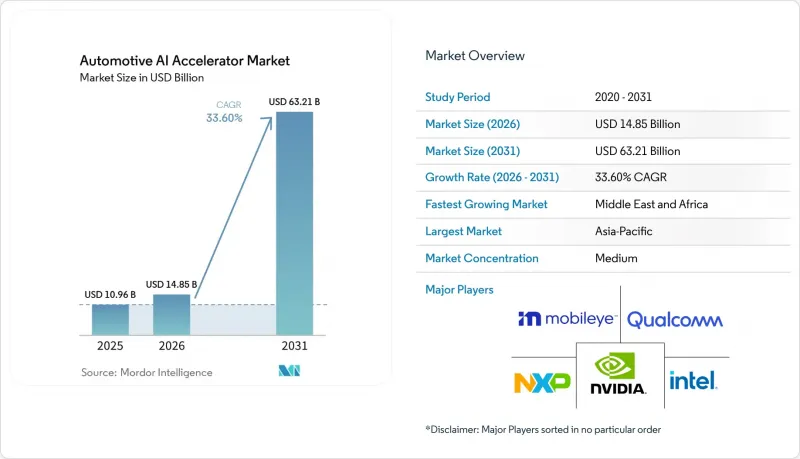
Mordor Intelligence에 의하면, 자동차용 AI 가속기 시장 규모는 2025년 109억 6,000만 달러에서 2026년에는 148억 5,000만 달러로 확대되어 2026년부터 2031년까지 CAGR 33.60%로 성장을 지속하여, 2031년에는 632억 1,000만 달러에 이를 것으로 예측됩니다.
본 보고서는 제공 형태(하드웨어 및 소프트웨어), 프로세서 유형(GPU 기반 가속기, NPU/AI ASIC 가속기 등), 용도(ADAS 및 능동 안전, 자율주행 및 로보택시 연산 처리, 지능형 콕핏 및 차량 내 AI 등), 차종(승용차 및 상용차), 지역별로 분류되어 있습니다. 시장 전망은 금액(달러) 기준으로 제시되어 있습니다.
전 세계 자동차용 AI 가속기 시장 동향과 인사이트
ADAS 및 능동 안전 기능의 채택 확대
Euro NCAP의 2026년 개정으로 신차 평가 방법이 변경되어, 100점 만점의 ‘안전 운전’ 카테고리가 도입되었습니다. 이에 따라 유럽의 주류 안전 프로그램에서 요구되는 실용적인 연산 능력 기준치가 상향 조정되었습니다. 그 결과, 제동 보조, 차선 유지 보조, 운전자 모니터링 등의 기능이 양산차에서 인증상 비중을 높이게 되었으며, 이에 따라 자동차용 AI 가속기 시장은 더욱 대규모의 ADAS 조달 프로그램으로 나아가고 있습니다. 모빌아이(Mobileye)는 2026년 1월, 2025년 말 기준으로 향후 8년간의 매출 전망이 245억 달러에 달한다고 발표하며, 주요 OEM 프로그램 전반에 걸쳐 설계 채택이 확대되고 있음을 보여주었습니다. 또한, 상위 10대 자동차 제조업체 중 2곳의 프로그램에서 EyeQ6H 기반의 서라운드 ADAS 시스템을 1,900만 대 이상 공급할 예정이라고 발표했으며, 이는 AI가 탑재된 안전 하드웨어가 매우 대규모의 양산 단계로 접어들고 있음을 시사합니다. 이러한 기능이 프리미엄 등급에서 더 폭넓은 라인업으로 확대됨에 따라 자동차용 AI 가속기 시장은 규모를 키우고 있지만, 한편으로 각 공급업체들은 이익률을 유지하기 위해 각 컴퓨팅 플랫폼에 더 많은 기능을 통합해야 한다는 압박에 직면해 있습니다.
차량용 실시간 추론에 대한 수요 증가
자동차용 AI 가속기 시장에서는 안전성, 응답성, 기능의 신뢰성이 지연이 수반되는 원격 실행이 아닌 로컬 처리에 의존하기 때문에 차량용 추론에 대한 수요가 높아지고 있습니다. Horizon Robotics에 따르면, 자사의 'Journey 6' 시리즈는 2025년까지 100개 이상의 차종에 탑재되어 누적 1,000만 대에 달할 전망이라고 합니다. 이는 양산 프로그램에서 대규모 로컬 AI 실행이 중시되고 있음을 보여줍니다. 또한 퀄컴과 Leapmotor는 2026년 1월, Snapdragon Cockpit Elite와 Ride Elite를 단일 아키텍처로 통합한 중앙 컴퓨터를 발표했습니다. 이는 차량 내 실시간 멀티도메인 처리를 향한 명확한 움직임을 반영하고 있습니다. 이러한 변화는 자동차용 AI 가속기 시장에 중요한 의미를 지닙니다. 로컬 추론은 단순히 연산 수요를 증가시킬 뿐만 아니라, 그 수요의 본질 자체를 변화시켜 자동차 특유의 엄격한 전력, 패키징, 안전성 제약 조건 속에서 AI 작업을 유지할 수 있는 플랫폼을 우선시하게 만들기 때문입니다. 또한, 각 OEM 업체는 이러한 구성을 통해 저지연과 소프트웨어 연동을 간소화할 수 있으므로, 콕핏, 센싱, 능동 안전 분야의 워크로드를 통합적으로 처리할 수 있는 프로세서의 가치도 높아집니다.
엄격한 열 설계 및 전력 효율 제약
열 설계는 자동차용 AI 가속기 시장에 있어 여전히 현실적인 제약으로 남아 있습니다. 이는 연산 밀도가 높아짐에 따라 차량 내부의 냉각, 패키징 및 에너지 관리 부담이 증가하기 때문입니다. 이 문제는 전기차(EV) 프로그램에서 더욱 두드러지며, 특히 여러 AI 기능이 동시에 실행될 경우 추가적인 연산 부하가 주행 거리나 열 안정성 목표 달성을 직접적으로 방해할 가능성이 있습니다. ST마이크로일렉트로닉스는 2026년 2월, Neural-ART 가속기를 통합한 최초의 자동차용 마이크로컨트롤러 ‘Stellar P3E’를 발표했습니다. 이 제품은 대형 중앙처리장치(CPU)보다 낮은 열 부하를 필요로 하는 엣지 AI 이용 사례를 위해 설계되었습니다. 이 제품의 방향성은 자동차용 AI 가속기 시장이 단순한 TOPS(초당 연산 횟수)의 성장뿐만 아니라, 효율 향상 및 특정 작업에 특화된 실리콘에서도 가치를 발견하고 있는 이유를 보여줍니다. 성능과 자동차용 전력 예산의 균형을 맞추지 못하는 벤더는 설령 그 연산 능력이 기술적으로 뛰어나더라도 대량 생산 프로그램에서 시장 점유율을 잃을 위험이 있습니다.
부문 분석
2025년 매출에서 하드웨어가 차지하는 비중은 64.46%였습니다. 이는 자동차용 AI 가속기 시장에서 소프트웨어를 통한 수익화가 확대되기 전에, 여전히 실리콘, 메모리 액세스, 패키징 및 기판 수준의 통합이 최우선 과제임을 보여줍니다. 각 OEM 업체들은 ADAS, 콕핏 및 향후 자율주행 프로그램에 필요한 연산 기반을 우선 확보해야 하므로, 이러한 구성 비율은 시장의 현재 단계와 부합합니다. 또한, 하드웨어 계층은 스택 내에서 여전히 초기 비용이 가장 높은 부분입니다. 이는 자동차 등급 인증, 긴 제품 수명 요건, 차량 통합과 같은 요인들이 검증된 반도체 플랫폼에 대한 투자를 촉진하고 있기 때문입니다. 자동차용 AI 가속기 시장에서 소프트웨어가 향후 수익의 더 큰 원천이 된다 하더라도, 이러한 상황으로 인해 하드웨어에 대한 지출은 높은 수준을 유지할 것입니다. 이 부문의 위상은 업데이트 주도형 비즈니스 모델이 지속적인 가치를 창출하기 위해서는 우선 연산 능력을 구축해야 한다는 사실도 반영하고 있습니다.
소프트웨어는 여전히 가장 빠르게 성장하는 제공 부문이며, 2031년까지의 연평균 성장률(CAGR)은 33.88%로 예측됩니다. 이러한 추세는 가치의 원천이 일회성 칩 판매를 넘어 점차 확대되고 있음을 보여줍니다. 자동차용 AI 가속기 업계는 기반이 되는 연산 능력이 이미 차량에 탑재된 후, 소프트웨어 업데이트를 통해 기능을 활성화, 개선 또는 확장할 수 있는 시스템으로 전환되고 있습니다. 퀄컴(Qualcomm)의 혼합 도메인 중앙 연산 접근 방식과 ST마이크로일렉트로닉스(STMicroelectronics)의 엣지 AI 컨트롤러 출시는 모두 여러 소프트웨어 워크로드가 동일한 실리콘 기반을 공유할 수 있는 플랫폼을 지향하고 있습니다. 이는 자동차용 AI 가속기 시장에서 소프트웨어의 성장이 하드웨어의 성장을 대체하는 것이 아니라, 이미 도입된 각 연산 플랫폼의 경제적 수명을 연장함으로써 그 위에 구축되고 있음을 의미합니다. 차량 아키텍처가 중앙 집중화됨에 따라 소프트웨어도 하드웨어 선택과 분리하기 어려워지고, 그 결과 전환 비용이 증가하며 플랫폼 생태계의 중요성이 커지고 있습니다.
2025년에는 GPU 기반 가속기가 매출의 37.22%를 차지하고, 이는 자동차용 AI 가속기 시장이 여전히 확립된 고성능 연산 플랫폼과 그 성숙한 소프트웨어 환경에 의존하고 있음을 보여줍니다. GPU는 대규모 신경망 워크로드를 지원하고, 광범위한 툴에 접근할 수 있으며, 연구 단계에서 양산 단계로의 쉬운 확장이 가능했기 때문에 자율주행 개발에서 명확한 우위를 점하며 이 분야에 진출했습니다. 많은 OEM 및 로보택시 프로그램이 이미 GPU 호환 환경을 중심으로 지각 및 계획 스택을 구축하고 있기 때문에 이러한 도입 기반은 여전히 중요합니다. 자동차용 AI 가속기 시장에서 이는 소프트웨어의 연속성이 순수한 성능만큼이나 중요한 하이엔드 도메인 컨트롤러나 복잡한 자율주행 프로그램에서 GPU 공급업체에게 우위를 제공합니다. 또한, 다른 프로세서 유형이 더 빠르게 확대되고 있음에도 불구하고 하이엔드 시장에서 리더십을 지속할 수 있는 이유도 이를 통해 설명됩니다.
NPU 및 AI ASIC 플랫폼은 2031년까지 연평균 성장률(CAGR) 34.09%를 나타낼 것으로 예측되며, 이는 자동차용 AI 가속기 시장의 다음 단계에서는 추론 효율성이 보다 직접적으로 평가될 것임을 시사합니다. Horizon Robotics는 자사의 ‘Journey 6’ 제품군이 100개 이상의 차종에 탑재되었다고 발표했는데, 이는 전용 설계된 AI 연산 리소스가 시범 프로그램 단계를 넘어 양산형 ADAS의 광범위한 분야로 확대될 수 있음을 보여줍니다. 또한 STMicroelectronics는 대형 멀티칩 구성에 비해 열 부하와 시스템 부하가 적고, 통합된 AI 가속화의 이점을 누릴 수 있는 엣지 인텔리전스 태스크를 위해 ‘Stellar P3E’를 포지셔닝하고 있습니다. 많은 프로그램에서 CPU, 그래픽, 신호 처리, AI 리소스를 동시에 필요로 하기 때문에 이종 SoC의 중요성은 여전히 남아 있지만, 자동차용 AI 가속기 업계는 이러한 광범위한 설계 속에서 보다 전문화된 추론 블록으로 명확하게 전환되고 있습니다. 열 제한, 전력 예산, 비용 압박이 심화되는 가운데, 가장 큰 성과를 가져다주는 것은 최고의 이론적 성능이 아니라, 와트당 실용적인 로컬 AI 처리 능력을 더 높게 제공할 수 있는 프로세서 유형일 것으로 보입니다.
지역별 분석
2025년에는 아시아태평양이 매출의 38.18%를 차지하며, 이 지역은 자동차용 AI 가속기 시장에서 선두를 달리고 있습니다. 중국은 강력한 전기차(EV) 생산, 활발한 ADAS 도입, 그리고 칩 제조업체와 자동차 제조업체 간의 긴밀한 협력에 대한 관심 증가가 맞물려, 그 주도적 지위의 핵심으로 자리 잡고 있습니다. Horizon Robotics는 자사의 'Journey 6' 시리즈가 100개 이상의 차종에 탑재되었다고 발표했으며, 이는 로컬 AI 연산 플랫폼이 해당 지역에서 양산 측면에서 폭넓게 중요성을 더해가고 있음을 여실히 보여줍니다. 일본 또한 확립된 반도체 및 차량용 전자기기 기술력을 통해 중요한 위치를 유지하고 있으며, 르네사스는 NCAP에 중점을 둔 기능을 갖춘 ‘R-Car V4H’를 레벨 2 플러스 및 레벨 3 이용 사례에 계속해서 포지셔닝하고 있습니다. 한국은 자동차 등급 메모리 공급을 통해 강점을 발휘하고 있는 반면, 인도는 Mobileye가 마힌드라사로부터 최소 6개 차종을 대상으로 하는 대규모 설계 채택을 확보했다고 보고함에 따라, 향후 프로그램에서 주목할 만한 거점으로 부상하고 있습니다.
중동 및 아프리카은 2031년까지 연평균 성장률(CAGR) 34.32%를 나타낼 것으로 예측되며, 자동차용 AI 가속기 시장에서 가장 빠르게 성장하는 지역 블록이 될 전망입니다. 이러한 성장은 국내의 광범위한 자동차 제조에 의존하는 것이 아니라, 급속히 진행되는 스마트 모빌리티 도입, 자율주행 교통에 대한 정부 지원, 그리고 첨단 서비스를 조기에 상용화하려는 의지에 힘입은 것입니다. 두바이 도로교통청(RTA)은 2026년 3월, Uber 및 Apollo Go를 통해 상용 자율주행 택시 운행을 시작했으며, WeRide도 Uber와 제휴하여 두바이에서 완전 무인 자율주행 상용 로보택시 운행을 개시했습니다. 이러한 움직임이 중요한 이유는 실제 운영 환경에서 양산 수준의 자율주행을 지원할 수 있는 컴퓨팅 플랫폼에 대한 실질적인 수요를 창출하기 때문입니다. 자동차용 AI 가속기 시장에서 이 지역은 현재로서는 수익 기반 측면에서 규모가 작지만, 향후 도입 모델에 있어 중요한 신호 시장이 되고 있습니다.
자동차용 AI 가속기 시장에서 유럽과 북미는 다음 주요 지역 클러스터를 형성하고 있지만, 그 강점은 서로 다릅니다. 유럽은 더욱 엄격한 안전 규제와 ADAS 기능의 급속한 확대에 힘입어, 주류 양산 프로그램에서 높은 연산 수요를 뒷받침하고 있습니다. 퀄컴이 BMW와 공동 개발한 시스템이나 엔비디아가 메르세데스-벤츠와 진행 중인 협력 사례는 유럽이 프리미엄 차종 프로그램 및 전 세계적으로 전개 가능한 소프트웨어·하드웨어 스택 분야에서 여전히 중요한 역할을 하고 있음을 보여줍니다. 북미는 자율주행 트럭 및 고성능 컴퓨팅 도입에 있어 여전히 매우 중요한 위치를 차지하고 있지만, 남미는 여전히 초기 단계 시장이며, AI 관련 기능은 주로 다른 지역에서 이미 엄격한 안전 기준을 충족하는 수입차를 통해 도입되고 있습니다.
기타 혜택:
- 엑셀 형식 시장 예측(ME) 시트
- 3개월간의 애널리스트 지원
자주 묻는 질문
목차
제1장 서론
제2장 조사 방법
제3장 주요 요약
제4장 시장 구도
제5장 시장 규모와 성장 예측
제6장 경쟁 구도
제7장 시장 기회와 향후 전망
JHS 26.08.07According to Mordor Intelligence, the automotive AI accelerator market size is expected to grow from USD 10.96 billion in 2025 to USD 14.85 billion in 2026 and is forecast to reach USD 63.21 billion by 2031 at 33.60% CAGR over 2026-2031.
This report is Segmented by Offering (Hardware, and Software), Processor Type (GPU-Based Accelerators, NPU / AI ASIC Accelerators, and More), Application (ADAS and Active Safety, Autonomous Driving and Robotaxi Compute, Intelligent Cockpit and In-Cabin AI, and More), Vehicle Type (Passenger Vehicles, and Commercial Vehicles), and Geography. The Market Forecasts are Provided in Terms of Value (USD).
Global Automotive AI Accelerator Market Trends and Insights
Rising Adoption Of ADAS And Active Safety Functions
Euro NCAP's 2026 revision changed how new vehicles are assessed and introduced a 100-point Safe Driving category, which raised the practical compute threshold for mainstream safety programs in Europe. This has pushed the automotive AI accelerator market toward larger ADAS procurement programs because features such as braking support, lane assistance, and driver monitoring now carry greater approval weight in volume vehicles. Mobileye said in January 2026 that its 8-year revenue pipeline reached USD 24.5 billion at the end of 2025, showing how design wins have expanded across large OEM programs. It also announced future delivery of more than 19 million EyeQ6H-based Surround ADAS systems across 2 top-10 automaker programs, which shows that AI-enabled safety hardware is moving into very large production runs. As these functions shift from premium trims into broader lineups, the automotive AI accelerator market gains volume, while suppliers face pressure to bundle more functions on each compute platform to protect margins.
Growing Demand For On-Vehicle Real-Time Inference
The automotive AI accelerator market is seeing stronger demand for on-vehicle inference because safety, responsiveness, and feature reliability depend on local processing rather than delayed remote execution. Horizon Robotics said its Journey 6 series was being deployed across more than 100 vehicle models in 2025 and was tracking toward 10 million cumulative units, which signals that production programs are favoring local AI execution at scale. Qualcomm and Leapmotor presented a central computer in January 2026 that combines Snapdragon Cockpit Elite and Ride Elite on one architecture, which reflects a clear move toward real-time multi-domain processing inside the vehicle. This shift matters for the automotive AI accelerator market because local inference does not just add compute demand, it changes the kind of compute demand, favoring platforms that can sustain AI tasks within tight automotive power, packaging, and safety limits. It also raises the value of processors that can handle cockpit, sensing, and active safety workloads together, since OEMs gain lower latency and simpler software coordination from that setup.
High Thermal Design And Power Efficiency Constraints
Thermal design remains a real restraint for the automotive AI accelerator market because higher compute density adds cooling, packaging, and energy management burdens inside the vehicle. The issue is more visible in EV programs, where added compute draw can work directly against range and thermal stability targets, especially when several AI functions run at the same time. STMicroelectronics introduced Stellar P3E in February 2026 as the first automotive microcontroller with an integrated Neural-ART accelerator, and the product was positioned for edge AI use cases that need a lower thermal footprint than larger central processors. That product direction shows why the automotive AI accelerator market is not only rewarding raw TOPS growth, it is also rewarding better efficiency and more task-specific silicon. Vendors that cannot balance performance with automotive power budgets risk losing share in volume programs, even when their compute capability remains technically strong.
Other drivers and restraints analyzed in the detailed report include:
- Software-Defined Vehicle Architectures Increasing Centralized Compute Demand
- Expansion Of Level 2 Plus And Level 3 Automation Programs
- Functional Safety And Validation Complexity
For complete list of drivers and restraints, kindly check the Table Of Contents.
Segment Analysis
Hardware accounted for 64.46% of revenue in 2025, which shows that the automotive AI accelerator market still depends first on silicon, memory access, packaging, and board-level integration before software monetization can scale. This mix fits the current stage of the market because OEMs must first secure the compute base required for ADAS, cockpit, and future autonomy programs. The hardware layer also remains the part of the stack with the largest upfront cost, since automotive-grade qualification, long product life requirements, and vehicle integration all push spending toward proven semiconductor platforms. In the automotive AI accelerator market, this keeps hardware spending elevated even when software becomes a larger source of future margin. The segment's position also reflects the fact that compute capability must be installed before update-led business models can generate recurring value.
Software is still the fastest-growing offering segment, with a 33.88% CAGR expected through 2031, and that direction says the value pool is gradually broadening beyond one-time chip sales. The automotive AI accelerator industry is shifting toward systems where features can be activated, refined, or extended through software updates once the underlying compute has already been placed in the vehicle. Qualcomm's mixed-domain central compute approach and STMicroelectronics' edge AI controller launch both point to platforms where multiple software workloads can share the same silicon foundation. That means software growth is not replacing hardware growth inside the automotive AI accelerator market, it is building on top of it by making each installed compute platform economically useful for longer. As vehicle architectures centralize, software also becomes harder to separate from hardware choice, which raises switching costs and makes platform ecosystems more important.
GPU-based accelerators held 37.22% of revenue in 2025, which shows that the automotive AI accelerator market still leans on established high-compute platforms and their mature software environments. GPUs entered the category with a clear advantage in autonomous driving development because they supported large neural workloads, broad tool access, and easier scaling from research into production. That installed base still matters because many OEM and robotaxi programs have already built perception and planning stacks around GPU-compatible environments. In the automotive AI accelerator market, this gives GPU suppliers an advantage in high-end domain controllers and complex autonomy programs where software continuity matters as much as raw performance. It also explains why leadership at the top end can remain durable even as other processor types expand faster.
NPU and AI ASIC platforms are projected to grow at a 34.09% CAGR through 2031, which shows that the next phase of the automotive AI accelerator market is likely to reward inference efficiency more directly. Horizon Robotics said its Journey 6 family was being deployed across more than 100 models, which shows how purpose-built AI compute can move beyond pilot programs into broad production ADAS volumes. STMicroelectronics also positioned its Stellar P3E for edge intelligence tasks that benefit from integrated AI acceleration with a smaller thermal and system burden than larger multi-chip setups. Heterogeneous SoCs will still matter because many programs need CPU, graphics, signal, and AI resources together, but the automotive AI accelerator industry is clearly moving toward more specialized inference blocks within those broader designs. As thermal limits, power budgets, and cost pressure become tighter, the fastest gains are likely to come from processor types that can deliver more useful local AI per watt rather than the highest theoretical performance.
Complete Report Scope:
- By Offering
- Hardware
- Software
- By Processor / Accelerator Type
- GPU-Based Accelerators
- NPU / AI ASIC Accelerators
- FPGA-Based Accelerators
- DSP / Vision Processing Accelerators
- Heterogeneous AI SoCs
- By Application
- ADAS and Active Safety
- Autonomous Driving and Robotaxi Compute
- Intelligent Cockpit and In-Cabin AI
- Telematics and Connected Vehicle Services
- Predictive Maintenance and Fleet Intelligence
- By Vehicle Type
- Passenger Vehicles
- Commercial Vehicles
- By Geography
- North America
- United States
- Canada
- Mexico
- Europe
- Germany
- United Kingdom
- France
- Italy
- Rest of Europe
- Asia-Pacific
- China
- Japan
- South Korea
- India
- Southeast Asia
- Rest of Asia-Pacific
- South America
- Middle East and Africa
- North America
Geography Analysis
Asia-Pacific accounted for 38.18% of revenue in 2025, giving the region the leading position in the automotive AI accelerator market. China remains central to that lead because the region combines strong EV production, active ADAS rollout, and growing interest in closer chip and automaker coordination. Horizon Robotics said its Journey 6 series was being deployed across more than 100 vehicle models, which highlights how local AI compute platforms are gaining broad production relevance in the region. Japan also remains important through established semiconductor and vehicle electronics capability, and Renesas continues to position the R-Car V4H for Level 2 Plus and Level 3 use cases with NCAP-focused functionality. South Korea adds strength through automotive-grade memory supply, while India is becoming a more visible destination for future programs after Mobileye reported a major Mahindra design win covering at least 6 vehicle models.
The Middle East and Africa are expected to grow at a 34.32% CAGR through 2031, making it the fastest-growing regional block in the automotive AI accelerator market. This growth does not rest on broad domestic vehicle manufacturing, but on fast-moving smart mobility deployment, public backing for autonomous transport, and a willingness to commercialize advanced services early. Dubai's Roads and Transport Authority launched commercial autonomous taxi operations through Uber and Apollo Go in March 2026, and WeRide also began fully driverless commercial robotaxi operations in Dubai with Uber. Those moves matter because they create live demand for compute platforms that can support production-grade autonomy in real operating conditions. In the automotive AI accelerator market, this makes the region a smaller revenue base today, but an important signal market for future deployment models.
Europe and North America form the next major regional cluster in the automotive AI accelerator market, though their strengths are different. Europe is being pushed by tighter safety frameworks and faster ADAS content expansion, which supports higher compute needs in mainstream production programs. Qualcomm's jointly developed system with BMW and NVIDIA's work with Mercedes-Benz show how Europe remains important for premium vehicle programs and globally deployable software-hardware stacks. North America remains highly relevant in autonomous trucking and advanced compute deployment, while South America is still an early-stage market where AI content mainly enters through imported vehicles that already meet stricter safety expectations elsewhere.
- NVIDIA Corporation
- Qualcomm Technologies, Inc.
- NXP Semiconductors N.V.
- Renesas Electronics Corporation
- Texas Instruments Incorporated
- Intel Corporation
- Mobileye Global Inc.
- Advanced Micro Devices, Inc.
- STMicroelectronics N.V.
- Infineon Technologies AG
- Ambarella, Inc.
- Arm Holdings plc
- Micron Technology, Inc.
- Robert Bosch GmbH
- Aptiv PLC
- Continental AG
- Horizon Robotics
- Hailo Technologies Ltd.
- Kneron, Inc.
- SiMa.AI
Additional Benefits:
- The market estimate (ME) sheet in Excel format
- 3 months of analyst support
TABLE OF CONTENTS
1 INTRODUCTION
- 1.1 Study Assumptions and Market Definition
- 1.2 Scope of the Study
2 RESEARCH METHODOLOGY
3 EXECUTIVE SUMMARY
4 MARKET LANDSCAPE
- 4.1 Market Overview
- 4.2 Market Drivers
- 4.2.1 Rising Adoption of ADAS and Active Safety Functions
- 4.2.2 Growing Demand for On-Vehicle Real-Time Inference
- 4.2.3 Software-Defined Vehicle Architectures Increasing Centralized Compute Demand
- 4.2.4 Expansion of Level 2 Plus and Level 3 Automation Programs
- 4.2.5 Increasing AI Content in Intelligent Cockpits and Driver Monitoring
- 4.2.6 Automaker and Semiconductor Co-Development of Automotive Edge AI Platforms
- 4.3 Market Restraints
- 4.3.1 High Thermal Design and Power Efficiency Constraints
- 4.3.2 Functional Safety and Validation Complexity
- 4.3.3 Long Qualification Cycles and Automotive Grade Supply Risk
- 4.3.4 Cybersecurity Exposure in Multi-Domain AI Architectures
- 4.4 Impact of Macroeconomic Factors on the Market
- 4.5 Market Positioning Analysis
- 4.6 Regulatory Landscape
- 4.7 Technological Outlook
- 4.8 Porter's Five Forces Analysis
- 4.8.1 Bargaining Power of Suppliers
- 4.8.2 Bargaining Power of Buyers
- 4.8.3 Threat of New Entrants
- 4.8.4 Threat of Substitutes
- 4.8.5 Intensity of Competitive Rivalry
5 MARKET SIZE AND GROWTH FORECASTS (VALUE)
- 5.1 By Offering
- 5.1.1 Hardware
- 5.1.2 Software
- 5.2 By Processor / Accelerator Type
- 5.2.1 GPU-Based Accelerators
- 5.2.2 NPU / AI ASIC Accelerators
- 5.2.3 FPGA-Based Accelerators
- 5.2.4 DSP / Vision Processing Accelerators
- 5.2.5 Heterogeneous AI SoCs
- 5.3 By Application
- 5.3.1 ADAS and Active Safety
- 5.3.2 Autonomous Driving and Robotaxi Compute
- 5.3.3 Intelligent Cockpit and In-Cabin AI
- 5.3.4 Telematics and Connected Vehicle Services
- 5.3.5 Predictive Maintenance and Fleet Intelligence
- 5.4 By Vehicle Type
- 5.4.1 Passenger Vehicles
- 5.4.2 Commercial Vehicles
- 5.5 By Geography
- 5.5.1 North America
- 5.5.1.1 United States
- 5.5.1.2 Canada
- 5.5.1.3 Mexico
- 5.5.2 Europe
- 5.5.2.1 Germany
- 5.5.2.2 United Kingdom
- 5.5.2.3 France
- 5.5.2.4 Italy
- 5.5.2.5 Rest of Europe
- 5.5.3 Asia-Pacific
- 5.5.3.1 China
- 5.5.3.2 Japan
- 5.5.3.3 South Korea
- 5.5.3.4 India
- 5.5.3.5 Southeast Asia
- 5.5.3.6 Rest of Asia-Pacific
- 5.5.4 South America
- 5.5.5 Middle East and Africa
- 5.5.1 North America
6 COMPETITIVE LANDSCAPE
- 6.1 Market Concentration
- 6.2 Strategic Moves
- 6.3 Market Share Analysis
- 6.4 Company Profiles (includes Global Level Overview, Market Level Overview, Core Segments, Financials as available, Strategic Information, Market Rank/Share, Products and Services, Recent Developments)
- 6.4.1 NVIDIA Corporation
- 6.4.2 Qualcomm Technologies, Inc.
- 6.4.3 NXP Semiconductors N.V.
- 6.4.4 Renesas Electronics Corporation
- 6.4.5 Texas Instruments Incorporated
- 6.4.6 Intel Corporation
- 6.4.7 Mobileye Global Inc.
- 6.4.8 Advanced Micro Devices, Inc.
- 6.4.9 STMicroelectronics N.V.
- 6.4.10 Infineon Technologies AG
- 6.4.11 Ambarella, Inc.
- 6.4.12 Arm Holdings plc
- 6.4.13 Micron Technology, Inc.
- 6.4.14 Robert Bosch GmbH
- 6.4.15 Aptiv PLC
- 6.4.16 Continental AG
- 6.4.17 Horizon Robotics
- 6.4.18 Hailo Technologies Ltd.
- 6.4.19 Kneron, Inc.
- 6.4.20 SiMa.ai
7 MARKET OPPORTUNITIES AND FUTURE OUTLOOK
- 7.1 White-Space and Unmet-Need Assessment


