

|
시장보고서
상품코드
2099764
자동차 AI 프로세서용 HBM : 시장 점유율 분석, 업계 동향 및 통계, 성장 예측(2026-2031년)HBM For Automotive AI Processor - Market Share Analysis, Industry Trends & Statistics, Growth Forecasts (2026 - 2031) |
||||||
 Mordor Intelligence
Mordor Intelligence에 의하면, 자동차 AI 프로세서용 HBM 시장 규모는 2025년 2,033만 달러로 평가되었습니다. 2026년에는 3,019만 달러로 확대되어 2031년까지 2억 9,081만 달러에 이를 것으로 예상되고 2026년부터 2031년에 걸쳐 CAGR 57.31%로 성장할 전망입니다.
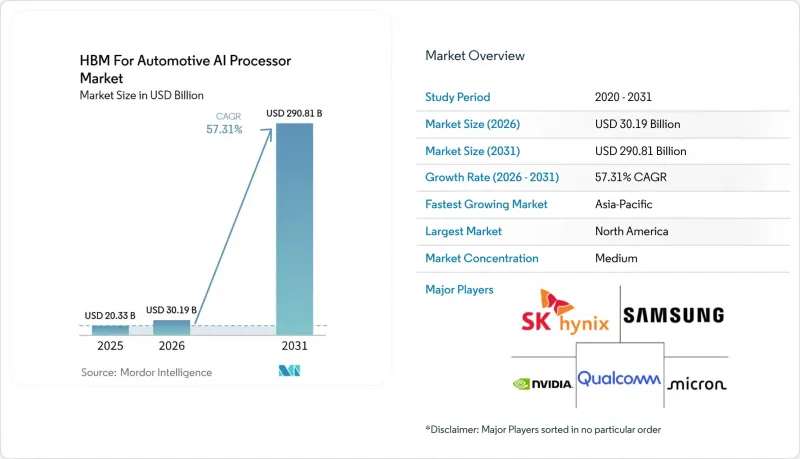
본 보고서는 HBM 세대별(HBM2E, HBM3, HBM3E, HBM4), 프로세서 유형별(GPU 기반 AI 프로세서, NPU 기반 AI 프로세서 등), 용도별(ADAS(L1-L2+), 자율주행(L3-L5), AI 콕핏 및 탑승자 모니터링 등), 차량 유형별(승용차, 소형 상용차 등), 그리고 지역별로 분류되어 있습니다. 시장 예측은 금액(달러) 기준으로 제시되어 있습니다.
세계의 자동차 AI 프로세서용 HBM 시장 동향 및 인사이트
차량 컴퓨팅의 중앙 집중화로 대역폭 수요 증가
자동차 AI 프로세서용 HBM 시장은 분산형 ECU 레이아웃에서 더 많은 기능을 공유 처리 도메인으로 집약하는 중앙 집중형 차량 컴퓨팅 플랫폼으로의 전환에 의해 주도되고 있습니다. NVIDIA에 따르면, DRIVE AGX Thor는 클러스터, 인포테인먼트, 자율주행, 주차 기능을 하나의 SoC에 통합하며 최대 2,000 FP4 테라플롭스까지 확장 가능하여, 플랫폼 수준의 차량 컴퓨팅 밀도가 얼마나 빠르게 높아지고 있는지를 보여줍니다. 마이크론(Micron)은 레벨 3 시스템에는 100 GB/s에서 256GB/s의 DRAM 대역폭이 필요한 반면, 고급 레벨 4 플랫폼에서는 더 높은 부하가 가해지는 센서 퓨전 조건 하에서 1 TB/s를 초과하는 대역폭이 필요할 것이라고 밝혔습니다. 이러한 차이는 중요한 의미를 지닙니다. 현재의 LPDDR5X 구현은 이미 높은 처리량 수준에 근접해 있기 때문에 성능 향상의 다음 단계는 컨트롤러 추가보다는 오히려 메모리 아키텍처 자체의 변경에 의존하게 될 것이기 때문입니다. 또한, ISO 26262 표준과 장기간에 걸친 검증 주기도 허용되는 메모리 선택의 폭을 좁히고 있습니다. 이는 서브시스템이 동일한 차량 프로그램 내에서 안전성과 지속적인 성능을 모두 지원해야 하기 때문입니다. OEM이 중앙 집중식 컴퓨팅을 채택하면 메모리 로드맵이 개발 후반 단계의 부품 교체 문제가 아니라 플랫폼 결정의 일부가 되므로, 자동차 AI 프로세서용 HBM 시장 수요 기반은 더욱 견고해질 것입니다.
ADAS 안전 요구 사항이 메모리 처리량 향상을 촉진
ADAS 하드웨어의 기술적 최저 기준이 높아지고 있는 점도 자동차 AI 프로세서용 HBM 시장에 호재가 되고 있습니다. 이는 안전 시스템이 더 많은 센서를 활용하며 소프트웨어 의존도가 높은 작동 환경으로 전환되고 있기 때문입니다. 마이크론(Micron)의 자동차용 메모리 프레임워크에서는 고급 LPDDR5X 이용 사례를 위해 256비트에서 512비트의 메모리 버스 폭과 8.5Gbps의 I/O 전송 속도가 강조되고 있으며, 이는 현재 시스템이 기존 메모리 설계를 이미 한계까지 끌어올리고 있음을 보여줍니다. 차량이 카메라, 레이더, 라이다(LiDAR) 데이터를 동시에 처리하는 양이 늘어남에 따라, 과제는 개별 기능 실행에서 엄격한 전력 및 열 제한 하에서의 지속적인 멀티센서 융합으로 전환되고 있습니다. Mobileye는 2026년 1월, 향후 출시될 EyeQ6H의 수주량이 1,900만 시스템을 넘어섰다고 발표했는데, 이는 더욱 통합된 지각 및 주변 ADAS 아키텍처에 대한 OEM 업체들의 폭넓은 합의를 시사합니다. 이 규모가 중요한 이유는 대량으로 도입되는 ADAS가 자동차 AI 프로세서용 HBM 시장에서 미래의 자율주행 프로그램이 구축될 기반이 되는 하드웨어 기준을 형성하기 때문입니다. 안전 스택의 계산 부하가 증가함에 따라 메모리 처리량은 부차적인 조정 변수가 아니라 핵심적인 설계 기준에 가까워지고 있습니다.
자동차용 인증 주기가 상용화를 지연시킨다.
자동차용 메모리는 데이터센터용 메모리와 동일한 일정에 따라 진행할 수 없기 때문에 인증은 여전히 자동차 AI 프로세서용 HBM 시장에서 가장 큰 제약 요인 중 하나입니다. Weebit Nano에 따르면, AEC-Q100 인증 프로세스에서는 3개의 생산 로트(각 로트당 77개 샘플)에 걸친 스트레스 테스트가 필요하며, 1,000-2,000시간에 걸친 가속 시험에서 고장이 전혀 발생하지 않아야 한다고 합니다. 이 프레임워크에는 -55°C에서 150°C에 이르는 온도 사이클 테스트와 철저한 고장 분석도 포함되어 있어, HBM과 같은 적층형 메모리 아키텍처의 경우 인증 부담이 특히 커집니다. 이러한 부담은 메모리 다이뿐만 아니라 베이스 다이, 실리콘 관통 비아(TSV), 패키징 스택, 프로세서 통합 등 모든 요소가 차량 환경에서 장기적인 신뢰성을 입증해야 하기 때문입니다. 기능 안전은 또 다른 요구 사항을 부과합니다. 플랫폼을 전체 OEM 프로그램에 배포하려면 ISO 26262에 기반한 문서화 및 안전성 검증이 메모리 설계와 일치해야 하기 때문입니다. 이 때문에 수요 신호가 뚜렷하고, 더 광범위한 AI 메모리 생태계 내의 다른 분야에서는 생산 능력이 존재함에도 불구하고, 자동차 AI 프로세서 시장에서 HBM의 상용화는 지연되고 있습니다.
부문 분석
2025년, HBM2E는 자동차 AI 프로세서용 HBM 시장 점유율의 75.31%를 차지했습니다. 이는 동세대 HBM이 이미 양산 중인 자동차 AI 플랫폼에 채택되어 있으며, 자동차 설계 주기가 장기간에 걸쳐 있다는 점을 반영한 것입니다. 그러나 이러한 상황은 기술 발전의 정체를 의미하지는 않았습니다. 왜냐하면 수익 기반의 상당 부분은 초기 차량 출시 후에도 양산 체제가 유지된 이전 프로세서 선정에서 비롯되었기 때문입니다. 자동차 AI 프로세서용 HBM 시장에서 이러한 초기 계약이 중요한 이유는 자동차 프로그램에서는 일반적으로 메모리 선정이 확정된 후에도 수년간 생산이 지속되기 때문입니다. 이로 인해 차세대 제품이 향후 차량 출시를 위한 평가 및 인증 단계에 있는 동안에도 HBM2E에 대한 지속적인 수요가 유지될 것입니다. 따라서 HBM3 및 HBM3E는 중간적인 위치에 있으며, 기술적으로는 차세대 자동차 AI 플랫폼에 가깝지만, 보다 광범위한 채택으로 이어지기 위해서는 여전히 자동차 등급의 검증이 필요합니다.
HBM4는 2026년부터 2031년에 걸쳐 연평균 성장률(CAGR) 57.91%로 확대될 것으로 예측되며, 자동차 AI 프로세서용 HBM 시장에서 가장 큰 성장이 기대되는 차세대 제품이 될 것입니다. SK하이닉스는 2025년 3월, 세계 최초로 HBM4개발을 완료하고 양산을 위한 준비를 마쳤다고 발표했으며, 이는 공급업체의 로드맵이 이미 다음 대역폭 단계로 맞추어져 있음을 뒷받침합니다. 이 회사는 그 후 2026년 6월, 핀당 16Gbps의 데이터 전송 속도와 HBM4보다 20% 이상 뛰어난 전력 효율을 갖춘 12층 HBM4E 샘플을 출하하며, 성능 향상 속도가 얼마나 빠른지를 보여주었습니다. 하지만 AEC-Q100 규격 및 안전 요건으로 인해 제품의 초기 출시부터 자동차 등급으로 활용되기까지의 기간이 길어질 것으로 예상되므로, 자동차 분야의 진전은 데이터센터 분야에 비해 뒤처질 전망입니다. 이는 자동차 AI 프로세서 업계의 HBM 시장에서 HBM2E가 기존 시스템을 지원하는 한편, HBM4가 차기 설계 채택을 주도해 나가는 등 장기간에 걸친 중복 기간이 발생할 가능성이 높음을 의미합니다.
2025년, GPU 기반 AI 프로세서는 자동차 AI 프로세서용 HBM 시장 규모의 51.12%를 차지했으며, 이는 프리미엄 자동차 프로그램에서 GPU 중심의 컴퓨팅 플랫폼이 꾸준히 도입되고 있는 실태와 일치합니다. 이러한 선두 위치는 NVIDIA의 DRIVE 생태계의 상업적 보급과 밀접한 관련이 있으며, 해당 생태계는 첨단 자율주행 프로그램과 관련하여 전 세계 다수의 OEM으로부터 설계 채택 확약을 확보하고 있습니다. 자동차 AI 프로세서용 HBM 시장에서 GPU 플랫폼은 여전히 가장 명확한 생산 기준점이 되고 있습니다. 이는 GPU 플랫폼이 차량 프로그램에 더 일찍 도입되어 프리미엄 용도 전반에 걸쳐 더 광범위한 도입 기반을 구축해 왔기 때문입니다. 한편, 특히 콕핏, ADAS, 중앙 집중형 컴퓨팅의 융합이 진행됨에 따라 OEM 각사는 더 적은 칩으로 더 많은 영역을 처리하기를 원하고 있어, 수요의 중심이 이동하기 시작하고 있습니다. 이러한 변화로 인해 독립적인 컴퓨팅 블록의 매력은 줄어들고, 통합된 자동차 설계 내에 여러 가속기를 통합하는 아키텍처가 선호되고 있습니다.
이종 AI SoC는 2026년부터 2031년까지 연평균 성장률(CAGR) 58.29%로 확대될 것으로 예측되며, 자동차 AI 프로세서용 HBM 시장에서 가장 빠르게 성장하는 프로세서 그룹이 될 전망입니다. 이러한 부상은 도메인 통합을 향한 더 광범위한 움직임을 반영하며, 여기서 프로세서의 가치는 AI 가속, 그래픽, 연결성 및 메모리 액세스를 하나의 플랫폼 내에서 얼마나 효과적으로 통합할 수 있는지에 달려 있습니다. 퀄컴(Qualcomm)의 BMW와의 양산 도입 및 스텔란티스(Stellantis)와의 2026년 협력 확대는 차세대 차량 아키텍처 전반에 걸친 다중 도메인 전개를 위해 확장 가능한 자동차용 SoC가 어떻게 자리매김하고 있는지를 보여줍니다. ASIC 기반 및 NPU 기반 프로세서는 폭넓은 유연성보다 효율성, 비용 관리, 또는 검증된 기능이 더 중요한 특정 워크로드에서 여전히 가치를 지닙니다. FPGA 기반 프로세서는 프로토타이핑 및 검증에 유용하지만, 자동차 AI 프로세서용 HBM 업계에서는 더 높은 통합성과 명확한 시스템 확장성을 제공하는 양산 대응 플랫폼이 점점 더 지지를 받고 있습니다.
지역별 분석
2025년, 북미는 자동차 AI 프로세서용 HBM 시장 점유율의 41.78%를 차지하며, 현재 수요 측면에서 주요 지역 거점이 되었습니다. 이 지역은 NVIDIA의 광범위한 DRIVE 생태계 구축의 혜택을 받고 있으며, Mercedes-Benz, Toyota, GM, Hyundai, Kia, Nissan, BYD, Geely, Isuzu 등 하이엔드 자율주행 프로그램에 참여하는 각사와 설계 계약을 체결했습니다. 마이크론(Micron)과 제너럴 모터스(GM)는 2026년 7월 1일 전략적 고객 계약을 체결하여 GM의 차량 생산을 위한 장기적인 메모리 및 스토리지 공급을 확보했습니다. 이를 통해 향후 자동차 플랫폼에서 현지 조달에 대한 지지가 더욱 강화되고 있습니다. 또한, 2025년 9월 BMW와 공동으로 퀄컴의 ‘라이드 파일럿(Ride Pilot)’이 출시되어 60개국 이상에서 검증되고 있는 점도, 북미 플랫폼 공급업체들이 자국 지역을 훨씬 넘어 자율주행 프로그램에 막대한 영향을 미치고 있음을 보여줍니다.
2025년, 유럽은 여전히 주요 수요 거점으로 자리매김했습니다. 이는 프리미엄 OEM의 집중과 첨단 차량용 전자 시스템 프로그램 덕분에 해당 지역이 자동차 AI 프로세서 시장을 위한 HBM과 밀접하게 연결되어 있었기 때문입니다. NVIDIA에 따르면, 메르세데스-벤츠의 차세대 S-클래스는 L4 지원 아키텍처를 갖춘 NVIDIA DRIVE AV를 기반으로 개발되고 있으며, 이를 통해 유럽은 고대역폭 메모리 채택에 있어 중요한 프리미엄 설계 도입 지역이 되었습니다. 스텔란티스와 퀄컴은 2026년 5월, 차세대 차량 아키텍처 전반에 ‘스냅드래곤 디지털 섀시(Snapdragon Digital Chassis)’ 플랫폼을 도입하기 위해 다년간의 제휴를 확대했습니다. 이를 통해 해당 지역의 콕핏, 커넥티비티, ADAS로의 전환이 더욱 가속화되었습니다. 따라서 이 지역의 동향은 메모리의 초기 공급량 그 자체보다는 유럽의 프리미엄 프로그램이 미래 차량용 컴퓨팅 스택의 기술적 기준을 어떻게 지속적으로 확립해 나가고 있는지에 초점이 맞추어져 있습니다.
아시아태평양은 2026년부터 2031년까지 연평균 성장률(CAGR) 58.22%로 확대될 것으로 예상되며, 자동차 AI 프로세서용 HBM 시장에서 가장 빠르게 성장하는 지역이 될 것입니다. 이 지역의 성장은 메모리 제조의 집적, 첨단 차량 컴퓨팅 분야에서 아시아 OEM의 역할 확대, 그리고 현재 DRIVE 생태계 내에 자리 잡고 있는 자율주행 프로그램 증가와 밀접한 관련이 있습니다. SK 하이닉스는 2026년 6월 12층 HBM4E 샘플을 출하하며 전력 효율 향상과 스택 용량 확대를 강조했습니다. 이는 차세대 자동차용 메모리 공급 측면에서 해당 지역의 중요성을 뒷받침하는 것입니다. 또한, 현대자동차와 기아는 2026년 3월, DRIVE Hyperion 기반의 차세대 자율주행 기술을 위해 NVIDIA와의 전략적 제휴를 확대했습니다. 이는 향후 차량 플랫폼 전개에서 아시아태평양의 역할을 한층 더 공고히 하는 것입니다. 한편, 남미, 중동 및 아프리카는 첨단 자율주행 기술의 도입이나 현지에서의 고성능 플랫폼 제조가 아직 충분히 발전하지 않았기 때문에 자동차 AI 프로세서용 HBM 시장에서는 여전히 초기 단계에 머물러 있습니다.
기타 혜택 :
- 엑셀 형식 시장 예측(ME) 시트
- 3개월간의 애널리스트 지원
자주 묻는 질문
목차
제1장 서론
제2장 조사 방법
제3장 주요 요약
제4장 시장 구도
제5장 시장 규모 및 성장 예측
제6장 경쟁 구도
제7장 시장 기회 및 향후 전망
KTH 26.08.10According to Mordor Intelligence, the HBM for automotive AI processor market size is expected to increase from USD 20.33 million in 2025 to USD 30.19 million in 2026 and reach USD 290.81 million by 2031, growing at a CAGR of 57.31% over 2026-2031.
This report is Segmented by HBM Generation (HBM2E, HBM3, HBM3E, and HBM4), Processor Type (GPU Based AI Processors, NPU Based AI Processors, and More), Application (ADAS (L1-L2+), Autonomous Driving (L3-L5), AI Cockpit and Occupant Monitoring, and More), Vehicle Type (Passenger Cars, Light Commercial, and Morel), and Geography. The Market Forecasts are Provided in Terms of Value (USD).
Global HBM For Automotive AI Processor Market Trends and Insights
Centralized Vehicle Compute Increases Bandwidth Intensity
The HBM for automotive AI processor market is being pushed by the move from distributed ECU layouts to centralized vehicle compute platforms that pull more functions into a shared processing domain. NVIDIA said DRIVE AGX Thor consolidates cluster, infotainment, automated driving, and parking into one SoC and scales up to 2,000 FP4 teraflops, which shows how quickly vehicle compute density is rising at the platform level. Micron stated that Level 3 systems require 100 GB/s to 256 GB/s of DRAM bandwidth, while advanced Level 4 platforms can move beyond 1 TB/s under heavier sensor fusion conditions. That gap matters because current LPDDR5X implementations already stretch toward high throughput levels, so the next step in performance depends less on adding controllers and more on changing the memory architecture itself. ISO 26262 and long validation cycles also narrow the range of acceptable memory choices because the subsystem has to support both safety and sustained performance inside the same vehicle program. Once an OEM commits to centralized compute, the HBM for automotive AI processors market gains a stronger demand base because the memory roadmap becomes part of the platform decision rather than a late-stage component swap.
ADAS Safety Requirements Push Higher Memory Throughput
The HBM for automotive AI processor market is also benefiting from the rising technical floor for ADAS hardware as safety systems move into more sensor-rich and software-heavy operating conditions. Micron's automotive memory framework highlighted 256-bit to 512-bit memory bus widths and 8.5 Gbps I/O signaling rates for advanced LPDDR5X use cases, which shows how far current systems already push conventional memory designs. As vehicles process more camera, radar, and lidar data at the same time, the problem shifts from isolated feature execution toward sustained multi-sensor fusion under strict power and thermal limits. Mobileye said in January 2026 that future EyeQ6H commitments exceeded 19 million systems, which points to broad OEM alignment behind more integrated perception and surround ADAS architectures. That scale matters because high-volume ADAS deployments shape the hardware baseline that future autonomy programs build on top of in the HBM for automotive AI processors market. As the safety stack becomes more compute-intensive, memory throughput moves closer to a core design criterion instead of a secondary tuning variable.
Automotive Qualification Cycles Slow Commercialization
Qualification remains one of the strongest limits on the HBM for automotive AI processor market because automotive memory cannot move on the same timetable as data-center memory. Weebit Nano described the AEC-Q100 path as requiring stress testing across 3 production lots with 77 samples per lot and zero failures over 1,000 to 2,000 hours of accelerated testing. The same framework also includes temperature cycling from -55°C to 150°C and full failure analysis, which makes the qualification burden especially heavy for a stacked memory architecture such as HBM. That burden extends beyond the memory die because the base die, through-silicon vias, packaging stack, and processor integration all have to prove long-cycle reliability in vehicle conditions. Functional safety adds a second layer because ISO 26262 documentation and safety validation must align with the memory design before the platform can scale across OEM programs. This slows commercialization in the HBM for automotive AI processor market even when demand signals are strong and capacity exists elsewhere in the broader AI memory ecosystem.
Other drivers and restraints analyzed in the detailed report include:
- Software-Defined Vehicle Architectures Raise In-Vehicle Data Loads
- Automotive AI Processors Need Low Latency Memory for Real-Time Inference
- Thermal And Power Constraints Limit HBM Adoption in Mass Market Vehicles
For complete list of drivers and restraints, kindly check the Table Of Contents.
Segment Analysis
HBM2E held 75.31% of the HBM for automotive AI processor market share in 2025, which reflected the generation already tied to production automotive AI platforms and long vehicle design cycles. That position did not signal a pause in technology progress, because much of the revenue base came from earlier processor selections that stayed locked into production after initial vehicle launch. In the HBM for automotive AI processor market, those earlier commitments matter because automotive programs usually stay in production for several years after the memory choice is finalized. That creates a durable tail for HBM2E even while newer generations move into evaluation and qualification for future vehicle launches. HBM3 and HBM3E therefore sit in an intermediate position, where they are technically closer to the next wave of automotive AI platforms but still depend on automotive-grade validation before broader adoption can follow.
HBM4 is projected to expand at a 57.91% CAGR from 2026 to 2031, which makes it the strongest forward generation in the HBM for automotive AI processor market. SK Hynix said in March 2025 that it completed the world's first HBM4 development and prepared for mass production, which confirms that supplier roadmaps are already aligned around the next bandwidth step. The company later shipped 12-layer HBM4E samples in June 2026 with 16 Gbps per pin data transfer speed and more than 20% better power efficiency than HBM4, showing how quickly the performance ladder is moving. Even so, the automotive path will remain slower than the data-center path because AEC-Q100 and safety requirements stretch the timing between initial product release and vehicle-grade availability. This means the HBM for automotive AI processor industry is likely to see a long overlap period where HBM2E supports the installed base while HBM4 builds the next round of design wins.
GPU-based AI processors accounted for 51.12% of the HBM for automotive AI processor market size in 2025, which matched the strong deployment base of GPU-centered compute platforms in premium automotive programs. That lead is closely tied to the commercial reach of NVIDIA's DRIVE ecosystem, which has secured design commitments from a broad list of global OEMs for advanced automated driving programs. In the HBM for automotive AI processor market, GPU platforms still offer the clearest production reference point because they entered vehicle programs earlier and built a wider installed base across premium applications. At the same time, the center of demand is starting to shift because OEMs want fewer chips handling more domains, especially as cockpit, ADAS, and centralized compute begin to converge. That shift reduces the appeal of discrete compute blocks and supports architectures that combine multiple accelerators inside a unified automotive design.
Heterogeneous AI SoCs are projected to expand at a 58.29% CAGR from 2026 to 2031, which makes them the fastest-growing processor group in the HBM for automotive AI processor market. Their rise reflects a broader move toward domain convergence, where the value of the processor depends on how well it combines AI acceleration, graphics, connectivity, and memory access within one platform. Qualcomm's production deployment with BMW and its expanded 2026 collaboration with Stellantis show how scalable automotive SoCs are being positioned for multi-domain deployment across next-generation vehicle architectures. ASIC-based and NPU-based processors still hold value for focused workloads where efficiency, cost control, or validated function matter more than broad flexibility. FPGA-based processors remain useful in prototyping and validation, but the HBM for automotive AI processor industry is increasingly favoring production-ready platforms that offer higher integration and cleaner system scaling.
Complete Report Scope:
- By HBM Generation
- HBM2E
- HBM3
- HBM3E
- HBM4
- By Processor Type
- GPU Based AI Processors
- ASIC Based AI Processors
- NPU Based AI Processors
- FPGA Based AI Processors
- Heterogeneous AI SoCs
- By Application
- ADAS (L1-L2+)
- Autonomous Driving (L3-L5)
- AI Cockpit and Occupant Monitoring
- Telematics, Connectivity, and V2X
- Automotive Edge AI Computing
- By Vehicle Type
- Passenger Cars
- Light Commercial Vehicles
- Heavy Commercial Vehicles
- By Geography
- North America
- United States
- Canada
- Mexico
- Europe
- Germany
- United Kingdom
- France
- Italy
- Rest of Europe
- Asia-Pacific
- China
- Japan
- South Korea
- Taiwan
- India
- Rest of Asia-Pacific
- South America
- Middle East and Africa
- North America
Geography Analysis
North America held 41.78% of HBM for automotive AI processor market share in 2025, which made it the leading regional base for current demand. The region benefits from NVIDIA's broad DRIVE ecosystem footprint, with design commitments spanning Mercedes-Benz, Toyota, GM, Hyundai, Kia, Nissan, BYD, Geely, Isuzu, and others across high-end automated driving programs. Micron and General Motors signed a Strategic Customer Agreement on July 1, 2026 to secure long-term memory and storage supply for GM vehicle production, which strengthens the local sourcing case for future automotive platforms. Qualcomm's Ride Pilot debut with BMW in September 2025 and its validation across more than 60 countries also show how North American platform suppliers are influencing automated driving programs well beyond their home region.
Europe remained a major demand center in 2025 because premium OEM concentration and advanced vehicle electronics programs kept the region tightly linked to the HBM for automotive AI processor market. NVIDIA said Mercedes-Benz's upcoming S-Class is being built on NVIDIA DRIVE AV with an L4-ready architecture, which makes Europe an important premium design-win region for high-bandwidth memory adoption. Stellantis and Qualcomm expanded their multi-year collaboration in May 2026 to deploy Snapdragon Digital Chassis platforms across next-generation vehicle architectures, which added scale to the region's cockpit, connectivity, and ADAS transition. The regional pattern is therefore less about early memory volume on its own and more about how premium programs in Europe keep setting the technical baseline for future vehicle compute stacks.
Asia-Pacific is projected to expand at a 58.22% CAGR from 2026 to 2031, which makes it the fastest-growing region in the HBM for automotive AI processor market. Growth in the region is tied to the concentration of memory manufacturing, the rising role of Asian OEMs in advanced vehicle compute, and the widening number of automated driving programs that now sit inside the DRIVE ecosystem. SK Hynix shipped 12-layer HBM4E samples in June 2026 and highlighted better power efficiency and larger stack capacity, which underscores the region's importance on the supply side of next-generation automotive memory. Hyundai Motor and Kia also expanded their strategic partnership with NVIDIA in March 2026 for next-generation autonomous driving technology based on DRIVE Hyperion, which reinforces Asia-Pacific's role in future vehicle platform rollouts. South America and Middle East and Africa remained earlier-stage regions for the HBM for automotive AI processors market because high-autonomy deployment and local high-performance platform manufacturing are still less developed there.
- SK hynix Inc.
- Samsung Electronics Co., Ltd.
- Micron Technology, Inc.
- NVIDIA Corporation
- Qualcomm Technologies, Inc.
- Intel Corporation
- Mobileye Global Inc.
- Renesas Electronics Corporation
- NXP Semiconductors N.V.
- Infineon Technologies AG
- STMicroelectronics N.V.
- Ambarella, Inc.
- Marvell Technology, Inc.
- Broadcom Inc.
- AMD (Advanced Micro Devices, Inc.)
- Arm Holdings plc
- TSMC
- Cadence Design Systems, Inc.
- Synopsys, Inc.
- Rambus Inc.
Additional Benefits:
- The market estimate (ME) sheet in Excel format
- 3 months of analyst support
TABLE OF CONTENTS
1 INTRODUCTION
- 1.1 Study Assumptions and Market Definition
- 1.2 Scope of the Study
2 RESEARCH METHODOLOGY
3 EXECUTIVE SUMMARY
4 MARKET LANDSCAPE
- 4.1 Market Overview
- 4.2 Market Drivers
- 4.2.1 Centralized Vehicle Compute Increases Bandwidth Intensity
- 4.2.2 ADAS Safety Requirements Push Higher Memory Throughput
- 4.2.3 Software Defined Vehicle Architectures Raise In-Vehicle Data Loads
- 4.2.4 Automotive AI Processors Need Low Latency Memory for Real-Time Inference
- 4.2.5 In-Cabin Generative AI Expands Compute and Memory Demand
- 4.2.6 HBM Qualification Tied to Premium Platform Design Wins
- 4.3 Market Restraints
- 4.3.1 Automotive Qualification Cycles Slow Commercialization
- 4.3.2 Thermal and Power Constraints Limit HBM Adoption in Mass Market Vehicles
- 4.3.3 HBM Cost Premium Restricts Penetration Beyond Premium Segments
- 4.3.4 Supply Concentration Creates Allocation Risk for Automakers and Tier 1 Suppliers
- 4.4 Industry Value Chain Analysis
- 4.5 Regulatory Landscape
- 4.6 Technological Outlook
- 4.7 Porter's Five Forces Analysis
- 4.7.1 Bargaining Power of Suppliers
- 4.7.2 Bargaining Power of Buyers
- 4.7.3 Threat of New Entrants
- 4.7.4 Threat of Substitutes
- 4.7.5 Intensity of Competitive Rivalry
5 MARKET SIZE AND GROWTH FORECASTS (VALUE)
- 5.1 By HBM Generation
- 5.1.1 HBM2E
- 5.1.2 HBM3
- 5.1.3 HBM3E
- 5.1.4 HBM4
- 5.2 By Processor Type
- 5.2.1 GPU Based AI Processors
- 5.2.2 ASIC Based AI Processors
- 5.2.3 NPU Based AI Processors
- 5.2.4 FPGA Based AI Processors
- 5.2.5 Heterogeneous AI SoCs
- 5.3 By Application
- 5.3.1 ADAS (L1-L2+)
- 5.3.2 Autonomous Driving (L3-L5)
- 5.3.3 AI Cockpit and Occupant Monitoring
- 5.3.4 Telematics, Connectivity, and V2X
- 5.3.5 Automotive Edge AI Computing
- 5.4 By Vehicle Type
- 5.4.1 Passenger Cars
- 5.4.2 Light Commercial Vehicles
- 5.4.3 Heavy Commercial Vehicles
- 5.5 By Geography
- 5.5.1 North America
- 5.5.1.1 United States
- 5.5.1.2 Canada
- 5.5.1.3 Mexico
- 5.5.2 Europe
- 5.5.2.1 Germany
- 5.5.2.2 United Kingdom
- 5.5.2.3 France
- 5.5.2.4 Italy
- 5.5.2.5 Rest of Europe
- 5.5.3 Asia-Pacific
- 5.5.3.1 China
- 5.5.3.2 Japan
- 5.5.3.3 South Korea
- 5.5.3.4 Taiwan
- 5.5.3.5 India
- 5.5.3.6 Rest of Asia-Pacific
- 5.5.4 South America
- 5.5.5 Middle East and Africa
- 5.5.1 North America
6 COMPETITIVE LANDSCAPE
- 6.1 Market Concentration
- 6.2 Strategic Moves
- 6.3 Market Share Analysis
- 6.4 Company Profiles (includes Global Level Overview, Market Level Overview, Core Segments, Financials as available, Strategic Information, Market Rank/Share, Products and Services, Recent Developments)
- 6.4.1 SK hynix Inc.
- 6.4.2 Samsung Electronics Co., Ltd.
- 6.4.3 Micron Technology, Inc.
- 6.4.4 NVIDIA Corporation
- 6.4.5 Qualcomm Technologies, Inc.
- 6.4.6 Intel Corporation
- 6.4.7 Mobileye Global Inc.
- 6.4.8 Renesas Electronics Corporation
- 6.4.9 NXP Semiconductors N.V.
- 6.4.10 Infineon Technologies AG
- 6.4.11 STMicroelectronics N.V.
- 6.4.12 Ambarella, Inc.
- 6.4.13 Marvell Technology, Inc.
- 6.4.14 Broadcom Inc.
- 6.4.15 AMD (Advanced Micro Devices, Inc.)
- 6.4.16 Arm Holdings plc
- 6.4.17 TSMC
- 6.4.18 Cadence Design Systems, Inc.
- 6.4.19 Synopsys, Inc.
- 6.4.20 Rambus Inc.
7 MARKET OPPORTUNITIES AND FUTURE OUTLOOK
- 7.1 White-Space and Unmet Need Assessment


