

|
시장보고서
상품코드
2098547
비인간 정체성(NHI) 보안 : 시장 점유율 분석, 업계 동향과 통계, 성장 예측(2026-2031년)Non-Human Identity (NHI) Security - Market Share Analysis, Industry Trends & Statistics, Growth Forecasts (2026 - 2031) |
||||||
 Mordor Intelligence
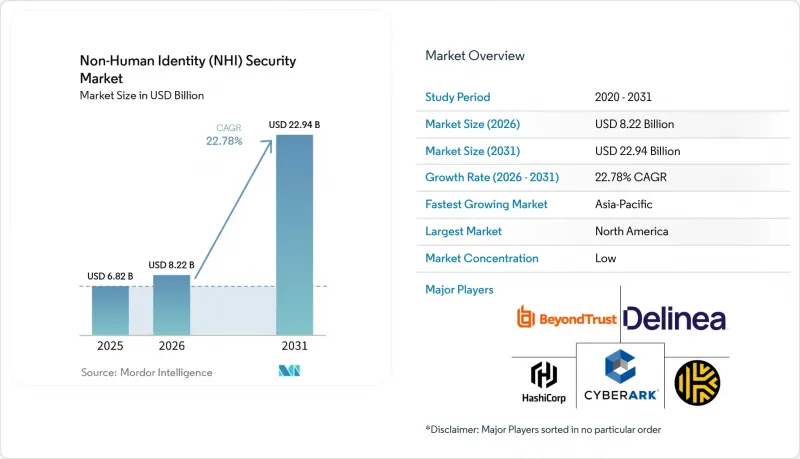
Mordor Intelligence에 의하면, 비인간 정체성(NHI) 보안 시장 규모는 2025년 68억 2,000만 달러, 2026년 82억 2,000만 달러에서 2031년까지 229억 4,000만 달러에 달할 것으로 예측되며, 2026-2031년 연평균 복합 성장률(CAGR)은 22.78%를 나타낼 전망입니다.
본 보고서는 구성 요소(솔루션 및 서비스), ID 유형(용도 ID 및 서비스 ID 등), 도입 형태(클라우드, On-Premise, 하이브리드), 기업 규모(대기업, 중소기업), 최종 사용자 산업(은행, 금융서비스 및 보험(BFSI), 헬스케어 및 생명과학 등), 지역별로 분류되어 있습니다. 시장 전망은 금액(달러) 기준으로 제시되어 있습니다.
전 세계 비인간 신원(NHI) 보안 시장 동향 및 인사이트
API, 클라우드 워크로드 및 머신 간 액세스의 급속한 확대
API 주도형 아키텍처는 비인간 신원(NHI) 보안 시장에서 가장 강력한 수요 견인 요인으로 자리 잡고 있습니다. 이는 모든 클라우드 서비스, 마이크로서비스, CI/CD 워크플로우 및 통합 엔드포인트가 최소 한 개의 머신 ID를 생성하기 때문입니다. 따라서 현대 기업들은 AI 에이전트나 자동화 봇이 환경에 추가되기 전부터 이미 방대한 수의 서비스 계정, 토큰 및 키를 관리하고 있습니다. CyberArk는 2025년에 평균적인 기업에서 머신 ID의 수가 휴먼 ID의 수를 82 대 1로 앞지를 것이라고 보고하며, 머신 인증 정보의 수가 얼마나 빠르게 보안 팀의 주요 부담이 되고 있는지를 부각시키고 있습니다. 또한, 새로운 도입으로 인해 서비스 간에 새로운 신뢰 관계가 구축되므로, ID 증가는 선형적이지 않고 용도 계층, 클라우드 계층, 통합 계층으로 동시에 확산되는 경향이 있습니다. 이러한 경향으로 인해 비인간 ID 보안 시장 전체에서 ID 감지, 로테이션 및 정책 적용이 구매 기준의 핵심 요소로 계속 자리 잡고 있습니다. IETF WIMSE 이니셔티브의 표준화 작업 또한 워크로드 ID 인증이 틈새 주제에서 머신 간 보안의 핵심 인프라 제어 수단으로 전환되고 있음을 보여줍니다.
과도한 권한을 가진 서비스 계정으로 인한 침해 비용 증가
과도한 권한을 가진 서비스 계정은 인간 계정의 침해와는 다른 위험 프로파일을 생성하기 때문에 비인간 신원(NHI) 보안 시장의 지출을 지속적으로 견인하고 있습니다. 이러한 계정은 대개 다단계 인증 없이 운영되며, 직원 계정과 같은 행동 감지가 거의 발동되지 않아 수년에 걸쳐 권한이 축적되는 경향이 있습니다. IBM은 2025년에 자격 증명 기반 정보 유출을 식별하고 차단하는 데 평균 246일이 소요되었으며, 평균 비용은 467만 달러에 달했다고 보고하여, 장기간 숨겨져 있던 ID 노출에 대해 경영진이 계속해서 주의를 기울여야 할 필요성을 부각시켰습니다. BeyondTrust의 조사에 따르면, 2025년에 평가된 기업 환경의 70% 이상에서 휴면 상태의 특권 서비스 계정이 발견되었습니다. 한편, Entro Security사의 보고서에 따르면 NHI(비인간 ID)의 20분의 1이 완전한 관리자 권한을 가지고 있으며, 그 중 상당수가 9개월 이상 비활성 상태로 남아 있었던 것으로 밝혀졌습니다. 그 결과, 공격 표면 문제는 단순한 ‘정리’ 문제로 그치지 않습니다. 그 근본 원인은 기계 규모의 ID가 아니라, 인간을 위해 구축된 거버넌스 프로세스에 있기 때문입니다. 이러한 불일치로 인해 NHI 보안 시장 전반에서 감지, 정책 및 최소 권한 통제에 대한 지속적인 수요가 계속 뒷받침되고 있습니다.
NHI를 위한 표준화된 접근 제어 프레임워크의 부재
널리 채택된 기계 신원 보증 프레임워크의 부재는 비인간 신원(NHI) 보안 시장의 발전을 여전히 지연시키고 있습니다. 이는 구매자가 정책 설계, 성숙도 평가 또는 예산 정당화를 수행할 수 있는 단일 벤치마크가 부족하기 때문입니다. OWASP는 'Non-Human Identities Top 10'을 발표했고, 업계 단체들도 워크로드 ID의 표준화를 추진하고 있지만, 오랫동안 확립되어 온 인간용 ID 보증 모델에 직접적으로 상응하는 것은 여전히 존재하지 않습니다. 이 때문에 많은 조직은 단일한 공인된 구조 내에서 통제 조치를 구현하기보다는 여러 출처의 통제 조치를 조합하고 있습니다. 클라우드 보안 연합(CSA)은 2026년 보고서에서 16%가 넘는 조직이 AI 관련 신원 생성 현황을 전혀 추적하지 않고 있다고 지적하며, 신원의 수가 증가하고 있음에도 불구하고 정책 적용 범위가 여전히 불충분함을 보여주고 있습니다. 그 결과, 보안, 인프라, 용도 각 팀 간의 내부 협력이 지연되고 있습니다. 표준이 일반적인 기업 관행에 가까워질 때까지는 이 문제가 NHI 보안 시장의 도입 속도를 크게 저해하는 요인으로 남아 있을 것입니다.
부문 분석
2025년에는 솔루션이 시장의 61.09%를 차지했으며, 구매자들이 우선적으로 감지, 포지션 관리 및 실시간 정책 제어를 위한 소프트웨어 플랫폼을 선호한 것으로 나타났습니다. 여전히 가장 큰 예산은 수동 인벤토리 작업에 의존하지 않고 클라우드, 용도, 인프라 환경 전반에 걸쳐 머신 ID를 식별할 수 있는 도구에 할당되었습니다. 이러한 추세는 API 키, OAuth 토큰, 인증서, 서비스 계정 및 AI 관련 인증 정보가 일상적인 워크플로우 전반에 확산되면서 발생한 운영상의 부담을 반영한 것입니다. 따라서 비인간 ID(NHI) 보안 시장에서는 단순한 가시성을 제공하는 데 그치지 않고, 감지 및 라이프사이클 관리를 통합할 수 있는 벤더가 선호되었습니다. 또한, IBM이 2026년에 ‘Machine Identity Management’를 출시한 것은 기업 수요가 일회성 평가에서 자동화된 발급, 갱신, 만료 및 거버넌스로 전환되고 있음을 뒷받침하는 사례였습니다.
서비스 분야는 2031년까지 연평균 성장률(CAGR) 23.84%를 나타낼 것으로 예측되며, 이는 도입의 심화가 플랫폼 선정과 거의 동등한 중요성을 띠고 있음을 보여줍니다. 많은 도입 사례에서 실제 운영 환경에서 정책의 성과가 가시화되기 전에 기존의 PAM, CIEM, SIEM 및 클라우드 ID 스택과의 통합이 필요합니다. 또한, 구매 기업은 반드시 동일한 신원 워크플로를 공유하지 않는 팀 간에, 인증 정보의 순환, 소유권 매핑, 접근 권한 검토, 그리고 운영 모델 설계에 대한 지원도 필요로 합니다. NHI 프로그램이 성숙해짐에 따라 컨설팅, 관리형 운영, 그리고 시정 조치 지원은 비인간 신원(NHI) 보안 시장에서의 제품 도입에 있어 계속해서 필수적인 보완 요소가 될 것입니다. 플랫폼 투자와 운영 지원의 균형을 고려할 때, 이 카테고리는 초기 인식 단계에서 보다 체계화된 기업 수준의 실행 단계로 전환되고 있음을 시사합니다.
2025년, 용도 및 서비스 ID는 시장의 27.14%를 차지하며 비인간 ID(NHI) 보안 시장에서 가장 큰 ID 유형이 되었습니다. 이러한 우위는 일상적인 업무 운영에서 OAuth 토큰, API 키, SaaS 통합 인증 정보 및 서비스 계정이 널리 사용되고 있음을 반영합니다. 또한, 이러한 ID의 상당수는 용도 성능, 통합 신뢰성 및 출시 일정과 밀접하게 연결되어 있어 변경이 어렵습니다. Entro Security는 2025년 보고서에서 NHI의 47%가 1년 이상 변경되지 않았다고 지적했습니다. 많은 정적 인증 정보는 로테이션을 수행할 경우 워크플로가 중단되는 애플리케이션 통합 계층에 집중되어 있습니다. 이러한 규모와 운영상의 민감성이 결합되어 용도 ID는 구매자들의 주요 관심사로 남아 있습니다.
워크로드 및 컨테이너 ID는 2031년까지 연평균 성장률(CAGR) 23.95%로 확대될 것으로 예상되며, 이는 ID 카테고리 중 가장 빠르게 성장하는 분야가 될 것입니다. 클라우드 네이티브 컴퓨팅 재단(CNCF)은 2026년에도 쿠버네티스 환경 내 워크로드 ID의 핵심 접근 방식으로 SPIFFE와 SPIRE를 계속해서 제시했습니다. 이는 특히 영구적인 시크릿을 사용하지 않고 암호학적 증명을 요구하는 조직에게 중요합니다. 이는 클라우드 네이티브 환경이 수명이 짧은 인증 정보에서 더 강력한 런타임 신뢰 제어 방식으로 전환됨에 따라, 비인간 ID(NHI) 보안 업계 내에서 더 광범위한 플랫폼 전환이 진행되고 있음을 시사합니다. 또한, 산업용 IoT 도입이 진행되고 DevSecOps 인증서 사용이 확대됨에 따라, 기계 및 장치의 신원, 그리고 암호화 신원 시장도 확대되고 있어 전반적인 대상 시장이 성장하고 있습니다. 클라우드 보안 연합(CSA)이 공급망 및 제3자에 의한 침해 위험 증가와 관련하여 버라이즌의 2026년 조사 결과를 인용한 것은 외부 신뢰 경계를 넘어선 API 및 워크로드의 신원을 관리해야 할 시급성을 더욱 강조하고 있습니다.
지역별 분석
2025년, 북미는 비인간 신원(NHI) 보안 시장의 32.15%를 차지하며 매출 측면에서 가장 큰 기여를 한 지역이 되었습니다. 이 지역은 클라우드 네이티브 기업의 높은 집중도, 제로 트러스트의 적극적인 도입, 그리고 전문 NHI 벤더를 지원해 온 벤처 환경의 혜택을 받고 있습니다. 또한, 플랫폼 통합이 가장 활발한 지역이기도 하며, 팔로알토 네트웍스는 2026년 2월 사이버아크 인수를 완료했고, 시스코는 2026년 5월 아스트릭스 시큐리티를 인수하여 신원 및 AI 에이전트의 거버넌스 기능을 강화했습니다. 금융 서비스 및 기술 분야의 구매자들은 대규모 머신 아이덴티티 환경을 운영하고 있으며, 거버넌스에 대한 기대도 높기 때문에 여전히 주요 수요원으로 남아 있습니다.
유럽은 데이터 주권에 대한 강한 중시와 금융 부문의 운영 탄력성에 대한 집중에 힘입어 계속해서 2위 지역 시장으로서의 지위를 유지했습니다. 영국, 독일, 프랑스에서는 규제 대상 부문이 기존 IAM 환경과 통합 가능한 On-Premise 및 하이브리드형 솔루션을 선호함에 따라 도입을 지속적으로 주도했습니다. '디지털 운영 복원력 법(Digital Operational Resilience Act)'은 추적 가능한 ICT 액세스 제어를 위한 견고한 규정 준수 계층을 추가하고 있으며, 이는 금융 기관의 기계 ID 거버넌스에 대한 다년간의 조달을 뒷받침하고 있습니다. 또한, 11만 5,000명 이상의 개발자를 보호하고 61만 개 이상의 리포지토리를 모니터링하는 GitGuardian의 2026년 버전 업데이트 역시, 유럽 및 기타 지역에서 사업을 전개하는 개발 중심 조직 내에서 시크릿 보안에 대한 강력한 수요가 있음을 보여줍니다.
아시아태평양은 2031년까지 연평균 성장률(CAGR) 24.39%로 확대될 것으로 예상되며, 이에 따라 비인간 신원(NHI) 보안 시장에서 가장 빠르게 성장하는 지역 부문이 될 것입니다. 중국은 대규모 클라우드 인프라 확장과 머신 아이덴티티 제어를 지원할 수 있는 국내 기술 제공업체의 존재에 힘입어 2025년 지역별 매출 점유율 1위를 차지했습니다. 인도는 디지털 프로그램, 핀테크의 확대, IT 서비스의 성장에 힘입어 서비스 계정 및 API 인증 정보의 양이 증가하고 있어, 이 지역에서 가장 빠르게 성장하는 국가로 계속 자리매김할 것으로 예측됩니다. 일본, 한국, 호주 역시 기업들의 지속적인 클라우드 도입과 자동화 및 AI 관련 워크로드에 대한 거버넌스 강화에 대한 관심 증가를 통해 지역 전체 수요를 뒷받침하고 있습니다. 중동 및 아프리카는 여전히 초기 단계 시장이지만, 걸프 국가들의 디지털 전환 노력과 남아프리카공화국 및 나이지리아의 금융 및 보험·증권(BFSI) 업계 및 통신 업계에서 수요가 향후 도입을 위한 발판이 되고 있습니다.
기타 혜택:
- 엑셀 형식 시장 예측(ME) 시트
- 3개월간의 애널리스트 지원
자주 묻는 질문
목차
제1장 서론
제2장 조사 방법
제3장 주요 요약
제4장 시장 구도
제5장 시장 규모와 성장 예측
제6장 경쟁 구도
제7장 시장 기회와 향후 전망
KTH 26.08.06According to Mordor Intelligence, the non-Human identity (NHI) security market size is projected to expand from USD 6.82 billion in 2025 and USD 8.22 billion in 2026 to USD 22.94 billion by 2031, registering a CAGR of 22.78% between 2026 and 2031.
This report is Segmented by Component (Solutions and Services), Identity Type (Application and Service Identities, and More), Deployment (Cloud, On-Premises, and Hybrid), Enterprise Size (Large Enterprises, and Small and Medium Enterprises), End-User Industry (BFSI, Healthcare and Life Sciences, and More), and Geography. The Market Forecasts are Provided in Terms of Value (USD).
Global Non-Human Identity (NHI) Security Market Trends and Insights
Rapid Expansion of APIs, Cloud Workloads, and Machine-To-Machine Access
API-led architectures remain the strongest demand driver for the Non-Human Identity (NHI) Security Market because every cloud service, microservice, CI/CD workflow, and integration endpoint creates at least 1 machine identity. Modern enterprises therefore manage very large populations of service accounts, tokens, and keys, even before AI agents and automation bots are added to the environment. CyberArk reported in 2025 that machine identities outnumbered human identities by 82:1 in the average enterprise, underscoring how quickly machine credential populations have become the primary burden on security teams. New deployments also create new trust relationships between services, so identity growth is not linear and tends to spread across the application, cloud, and integration layers simultaneously. This pattern keeps discovery, rotation, and policy enforcement near the center of buying criteria across the Non-Human Identity Security Market. The standardization work under the IETF WIMSE effort also shows that workload identity attestation is moving from a niche topic toward a core infrastructure control for machine-to-machine security.
Rising Breach Costs from Over-Privileged Service Accounts
Over-privileged service accounts continue to drive spending in the Non-Human Identity (NHI) Security Market because they create a different risk profile from human account compromise. These accounts often operate without multi-factor authentication; they rarely trigger the same behavioral checks as employee accounts, and they tend to accumulate permissions over many years. IBM reported in 2025 that credential-based breaches took an average of 246 days to identify and contain, at an average cost of USD 4.67 million, highlighting the need to keep executive focus on identity exposure that remains hidden for long periods. BeyondTrust found dormant privileged service accounts in more than 70% of enterprise environments assessed in 2025, while Entro Security reported that 1 in 20 NHIs had full administrative privileges and many had remained inactive for more than 9 months. The result is that the attack surface is not just a cleanup issue, because it stems from governance processes built for people rather than for machine-scale identities. That mismatch continues to support durable demand for discovery, policy, and least-privilege controls across the NHI Security Market.
Absence of Standardized Access Control Frameworks For NHIs
The lack of a widely adopted machine identity assurance framework continues to slow the Non-Human Identity (NHI) Security Market because buyers lack a single benchmark for policy design, maturity scoring, or budget justification. OWASP has published its Non-Human Identities Top 10, and industry groups have pushed workload identity standards, yet there is still no direct equivalent to long-established human identity assurance models. This leaves many organizations combining controls from several sources rather than implementing them in a single recognized structure. Cloud Security Alliance reported in 2026 that more than 16% of organizations did not track the creation of AI-related identities at all, indicating that policy coverage remains weak even as identity populations expand. The result is slower internal alignment between security, infrastructure, and application teams. Until standards move closer to common enterprise practice, this issue should remain a real drag on deployment speed in the NHI Security Market.
Other drivers and restraints analyzed in the detailed report include:
- Cloud-Native and Kubernetes Identity Sprawl
- Zero Trust Enforcement Across Non-Human Workloads
- Integration Complexity Across Legacy and Hybrid IT Environments
For complete list of drivers and restraints, kindly check the Table Of Contents.
Segment Analysis
Solutions held 61.09% of the market in 2025, which showed that buyers first prioritized software platforms for discovery, posture management, and real-time policy control. The largest budgets still flowed to tooling that could identify machine identities across cloud, application, and infrastructure environments without relying on manual inventory work. This preference reflected the operational burden created by API keys, OAuth tokens, certificates, service accounts, and AI-related credentials that had spread across daily workflows. The Non-Human Identity (NHI) Security Market, therefore, favored solution vendors that could unify discovery with lifecycle actions instead of offering visibility alone. IBM's 2026 launch of Machine Identity Management also reinforced that enterprise demand had moved toward automated issuance, renewal, revocation, and governance rather than one-time assessment.
The Services segment is projected to grow at a 23.84% CAGR through 2031, indicating that implementation depth is becoming almost as important as platform selection. Many deployments require integration with existing PAM, CIEM, SIEM, and cloud identity stacks before policy outcomes become visible in production. Buyers also need support for credential rotation, ownership mapping, access reviews, and operating model design across teams that do not always share the same identity workflows. As NHI programs mature, consulting, managed operations, and remediation support should remain essential complements to product adoption in the Non-Human Identity (NHI) Security Market. The balance between platform spending and operational support suggests that the category is moving from early awareness into more structured enterprise execution.
Application and Service Identities accounted for 27.14% of the market in 2025, making them the largest identity type inside the Non-Human Identity (NHI) Security Market. Their lead reflected the heavy use of OAuth tokens, API keys, SaaS integration credentials, and service accounts across ordinary business operations. These identities are also difficult to change because many are tightly linked to application performance, integration reliability, and release timelines. Entro Security reported in 2025 that 47% of NHIs had remained unchanged for more than 1 year, with many static credentials concentrated in application integration layers where rotation can break workflows. That mix of scale and operational sensitivity kept application identities at the center of buyer concern.
Workload and Container Identities are projected to expand at a 23.95% CAGR through 2031, which makes it the fastest-growing identity category. The Cloud Native Computing Foundation continued in 2026 to frame SPIFFE and SPIRE as important approaches to workload identity in Kubernetes environments, especially for organizations seeking cryptographic attestation without persistent secrets. This points to a broader platform shift within the Non-Human Identity (NHI) Security industry, as cloud-native environments move toward shorter-lived credentials and stronger runtime trust controls. Machine and Device Identities and Cryptographic Identities are also expanding as industrial IoT adoption, and the use of DevSecOps certificates expands the overall addressable base. Cloud Security Alliance's reference to Verizon's 2026 findings on higher supply chain and third-party breach exposure adds urgency to governing API and workload identities across external trust boundaries.
Complete Report Scope:
- By Component
- Solutions
- Services
- By Identity Type
- Application and Service Identities
- Workload and Container Identities
- Machine and Device Identities
- Cryptographic Identities
- By Deployment
- Cloud
- On-Premises
- Hybrid
- By Enterprise Size
- Large Enterprises
- Small and Medium Enterprises
- By End-user Industry
- BFSI
- Healthcare and Life Sciences
- Information Technology and Telecom
- Retail and E-commerce
- Industrial Manufacturing
- Government and Public Sector
- Other End-user Industries
- By Geography
- North America
- United States
- Canada
- Mexico
- South America
- Brazil
- Argentina
- Rest of South America
- Europe
- Germany
- United Kingdom
- France
- Italy
- Spain
- Russia
- Rest of Europe
- Asia-Pacific
- China
- India
- Japan
- South Korea
- Australia
- Rest of Asia-Pacific
- Middle East and Africa
- Middle East
- Saudi Arabia
- United Arab Emirates
- Rest of Middle East
- Africa
- South Africa
- Nigeria
- Rest of Africa
- Middle East
- North America
Geography Analysis
North America accounted for 32.15% of the Non-Human Identity (NHI) Security Market in 2025, making it the largest regional contributor by revenue. The region benefits from a high concentration of cloud-native enterprises, strong zero-trust adoption, and a venture environment that has supported specialist NHI vendors. It also remains the most active region for platform consolidation, with Palo Alto Networks completing its acquisition of CyberArk in February 2026 and Cisco acquiring Astrix Security in May 2026 to strengthen identity and AI agent governance capabilities. Financial services and technology buyers remain the main demand centers because they run large machine identity estates and face higher governance expectations.
Europe remained the second-largest regional market, supported by strong data sovereignty priorities and the financial sector's focus on operational resilience. The United Kingdom, Germany, and France continued to lead adoption as regulated sectors favored on-premises and hybrid options that could integrate with established IAM estates. The Digital Operational Resilience Act has added a durable compliance layer for traceable ICT access control, which supports multi-year procurement for machine identity governance in financial institutions. GitGuardian's 2026 update on protecting more than 115,000 developers and monitoring more than 610,000 repositories also points to strong demand for secrets security across development-heavy organizations operating in Europe and other regions.
Asia-Pacific is projected to expand at a 24.39% CAGR through 2031, which makes it the fastest-growing regional segment in the Non-Human Identity (NHI) Security Market. China held the largest regional revenue share in 2025, supported by large-scale cloud infrastructure expansion and the presence of domestic technology providers that can support machine identity controls. India is expected to remain the fastest-growing country in the region as digital programs, fintech expansion, and IT services growth create larger volumes of service accounts and API credentials. Japan, South Korea, and Australia also support regional demand through continued enterprise cloud adoption and growing interest in stronger governance for automation and AI-linked workloads. The Middle East and Africa remained earlier-stage markets, but digital transformation programs in the Gulf and demand from BFSI and telecom in South Africa and Nigeria continued to create an entry point for future adoption.
- CyberArk Software Ltd.
- Delinea, Inc.
- BeyondTrust Corporation
- HashiCorp, Inc.
- Keeper Security, Inc.
- One Identity, LLC
- AppViewX, Inc.
- Aembit, Inc.
- Akeyless Security Ltd.
- Astrix Security Ltd.
- Clutch Security Ltd.
- Entro Security Ltd.
- GitGuardian SAS
- P0 Security, Inc.
- Permiso Security, Inc.
- Silverfort Ltd.
- Teleport Security, Inc.
- Token Security Ltd.
- Britive, Inc.
- Saviynt, Inc.
Additional Benefits:
- The market estimate (ME) sheet in Excel format
- 3 months of analyst support
TABLE OF CONTENTS
1 INTRODUCTION
- 1.1 Study Assumptions and Market Definition
- 1.2 Scope of the Study
2 RESEARCH METHODOLOGY
3 EXECUTIVE SUMMARY
4 MARKET LANDSCAPE
- 4.1 Market Overview
- 4.2 Market Drivers
- 4.2.1 Rapid Expansion of APIs, Cloud Workloads, and Machine-to-Machine Access
- 4.2.2 Rising Breach Costs From Over-Privileged Service Accounts
- 4.2.3 Cloud-Native and Kubernetes Identity Sprawl
- 4.2.4 Zero Trust Enforcement Across Non-Human Workloads
- 4.2.5 Under-Governed AI Agents and Automation Bots
- 4.2.6 Secretless and Ephemeral Credential Rotation Demand
- 4.3 Market Restraints
- 4.3.1 Absence of Standardized Access Control Frameworks for NHIs
- 4.3.2 Integration Complexity Across Legacy and Hybrid IT Environments
- 4.3.3 Limited Discovery and Ownership Mapping for Ephemeral Identities
- 4.3.4 Procurement Friction From IAM, PAM, CIEM, and Secrets Tool Overlap
- 4.4 Impact of Macroeconomic Factors on the Market
- 4.5 Industry Value-Chain Analysis
- 4.6 Regulatory Landscape
- 4.7 Technological Outlook
- 4.8 Porter's Five Forces Analysis
- 4.8.1 Bargaining Power of Buyers
- 4.8.2 Bargaining Power of Suppliers
- 4.8.3 Threat of New Entrants
- 4.8.4 Threat of Substitutes
- 4.8.5 Intensity of Competitive Rivalry
5 MARKET SIZE AND GROWTH FORECASTS (VALUE)
- 5.1 By Component
- 5.1.1 Solutions
- 5.1.2 Services
- 5.2 By Identity Type
- 5.2.1 Application and Service Identities
- 5.2.2 Workload and Container Identities
- 5.2.3 Machine and Device Identities
- 5.2.4 Cryptographic Identities
- 5.3 By Deployment
- 5.3.1 Cloud
- 5.3.2 On-Premises
- 5.3.3 Hybrid
- 5.4 By Enterprise Size
- 5.4.1 Large Enterprises
- 5.4.2 Small and Medium Enterprises
- 5.5 By End-user Industry
- 5.5.1 BFSI
- 5.5.2 Healthcare and Life Sciences
- 5.5.3 Information Technology and Telecom
- 5.5.4 Retail and E-commerce
- 5.5.5 Industrial Manufacturing
- 5.5.6 Government and Public Sector
- 5.5.7 Other End-user Industries
- 5.6 By Geography
- 5.6.1 North America
- 5.6.1.1 United States
- 5.6.1.2 Canada
- 5.6.1.3 Mexico
- 5.6.2 South America
- 5.6.2.1 Brazil
- 5.6.2.2 Argentina
- 5.6.2.3 Rest of South America
- 5.6.3 Europe
- 5.6.3.1 Germany
- 5.6.3.2 United Kingdom
- 5.6.3.3 France
- 5.6.3.4 Italy
- 5.6.3.5 Spain
- 5.6.3.6 Russia
- 5.6.3.7 Rest of Europe
- 5.6.4 Asia-Pacific
- 5.6.4.1 China
- 5.6.4.2 India
- 5.6.4.3 Japan
- 5.6.4.4 South Korea
- 5.6.4.5 Australia
- 5.6.4.6 Rest of Asia-Pacific
- 5.6.5 Middle East and Africa
- 5.6.5.1 Middle East
- 5.6.5.1.1 Saudi Arabia
- 5.6.5.1.2 United Arab Emirates
- 5.6.5.1.3 Rest of Middle East
- 5.6.5.2 Africa
- 5.6.5.2.1 South Africa
- 5.6.5.2.2 Nigeria
- 5.6.5.2.3 Rest of Africa
- 5.6.5.1 Middle East
- 5.6.1 North America
6 COMPETITIVE LANDSCAPE
- 6.1 Market Concentration
- 6.2 Strategic Moves
- 6.3 Market Share Analysis
- 6.4 Company Profiles (includes Global Level Overview, Market Level Overview, Core Segments, Financials as available, Strategic Information, Market Rank/Share, Products and Services, Recent Developments)
- 6.4.1 CyberArk Software Ltd.
- 6.4.2 Delinea, Inc.
- 6.4.3 BeyondTrust Corporation
- 6.4.4 HashiCorp, Inc.
- 6.4.5 Keeper Security, Inc.
- 6.4.6 One Identity, LLC
- 6.4.7 AppViewX, Inc.
- 6.4.8 Aembit, Inc.
- 6.4.9 Akeyless Security Ltd.
- 6.4.10 Astrix Security Ltd.
- 6.4.11 Clutch Security Ltd.
- 6.4.12 Entro Security Ltd.
- 6.4.13 GitGuardian SAS
- 6.4.14 P0 Security, Inc.
- 6.4.15 Permiso Security, Inc.
- 6.4.16 Silverfort Ltd.
- 6.4.17 Teleport Security, Inc.
- 6.4.18 Token Security Ltd.
- 6.4.19 Britive, Inc.
- 6.4.20 Saviynt, Inc.
7 MARKET OPPORTUNITIES AND FUTURE OUTLOOK
- 7.1 White-Space and Unmet-Need Assessment


