|
시장보고서
상품코드
2125261
소비자 ID 및 액세스 관리 : 시장 점유율 분석, 업계 동향 및 통계, 성장 예측(2026-2031년)Consumer Identity And Access Management - Market Share Analysis, Industry Trends & Statistics, Growth Forecasts (2026 - 2031) |
||||||
 Mordor Intelligence
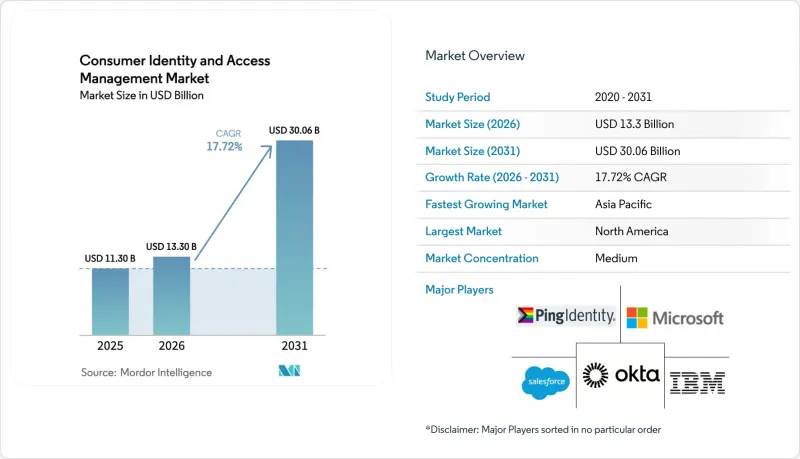
Mordor Intelligence에 의하면, 소비자 ID 및 액세스 관리 시장 규모는 2025년에 113억 달러로 평가되었습니다. 2026년 133억 달러에서 2031년까지 300억 6,000만 달러에 이를 것으로 예상되며, 예측 기간(2026-2031년) CAGR은 17.72%를 나타낼 전망입니다.
본 보고서는 구성 요소별(솔루션, 서비스), 배포 방식별(클라우드 기반, On-Premise), 최종 사용자 산업별(은행, 금융서비스 및 보험(BFSI), 헬스케어, IT 및 통신, 정부, 에너지·유틸리티, 운송, 항공우주 및 방위, 교육), 인증 유형별(다중 요소 인증(MFA), 기타),조직 규모별(대기업, 중소기업(SME)), 지역별로 분류되어 있습니다.
세계의 소비자 ID 및 액세스 관리 시장 동향 및 인사이트
생성형 AI를 활용한 적응형 인증
생성형 AI를 통해 CIAM은 사후 대응형 제어에서 예측적 위험 평가로 전환되고 있습니다. Strivacity의 ‘AI Assist’는 사용자 여정의 실시간 분석과 자동화된 규정 준수 점검을 실현하고 있으며, 분석가들은 2025년까지 조직의 35%가 ID 관리 기능에 생성형 AI를 통합할 것으로 예측했습니다. 행동, 기기 지문, 컨텍스트에 기반한 동적 정책은 보안을 강화하는 동시에 사용자의 불편을 줄여줍니다. 이는 Clear와 Epic을 통합하여 환자의 신속한 로그인을 실현하고 있는 의료 서비스 제공업체가 중시하는 균형입니다. 적응형 메커니즘은 개별 위험 프로파일에 맞추어 단계별 인증 요건을 조정하여, 전환율을 저하시키는 과도한 인증으로 인한 피로를 줄여줍니다.
개인정보 보호와 사용자 경험(UX) 간의 상충 관계에 대한 인식이 높아지면서 예산이 확대될 전망
2024년 5월에 발효된 eIDAS 2.0 규정에 따라 EU 회원국은 2026년까지 각국의 디지털 ID 지갑을 발급해야 할 의무가 있으며, 이에 따라 기업들은 개인정보 보호를 중시하는 CIAM 전략의 도입을 서두르고 있습니다. 소비자들은 마찰 없는 이용 경험을 원하기 때문에 기업들은 편의성을 희생하며 보안을 우선시하던 기존 로그인 화면을 점차 폐지하고 있습니다. 의료 서비스 제공업체들은 이러한 변화를 여실히 보여주고 있습니다. ID 지갑을 통해 환자는 HIPAA 준수를 유지하면서 네트워크를 넘나들며 기록을 조회할 수 있게 됩니다. 개인정보 보호는 우수한 사용자 경험의 제약 요인에서 그 실현 요인으로 변화하고 있습니다.
API 계층에서의 봇 공격이 CIAM 대응 속도를 앞지르고 있습니다.
API를 악용하는 봇은 고객 경험을 저해하고 보안 비용을 증가시키고 있습니다. 기업들은 현재 평균 613개의 API 엔드포인트를 관리하고 있으며, 이는 공격 표면을 확대시키고 있습니다. 관련 사고는 2024년에 28% 증가하여 연간 1,860억 달러의 비용이 발생했습니다. 효과적인 방지를 위해서는 CIAM과 전용 API 보안 분석을 통합해야 하지만, 이로 인해 예산이 부족해지고 도입 기간이 길어지게 됩니다.
부문별 분석
기업들이 턴키 방식의 도입을 요구하는 가운데, 서비스 매출은 소프트웨어 매출을 상회하고 있습니다. 2025년에는 솔루션 시장에서 구성 요소 부문이 소비자 ID 및 액세스 관리 시장 규모의 62.85%를 차지했으나, 서비스는 2031년까지 연평균 18.6%의 성장이 예상됩니다. 대기업은 오케스트레이션을 전문가에게 맡기고 있으며, JumpCloud의 설문조사에서 42%가 아웃소싱을 하고 있다고 응답한 중소기업도 이를 따르고 있습니다.
개인정보 보호, 적응형 인증, 다중 채널 동의 워크플로우의 복잡성이 증가함에 따라 매니지드 서비스의 매력이 높아지고 있습니다. 의료 기관은 사내 코딩을 최소화하는 명확한 통합 기능에 의존하고 있습니다. 소비자 ID 및 액세스 관리 시장의 도입이 확대됨에 따라, 경쟁사와의 차별화는 기능 목록보다 도입의 품질에 더 중점을 두게 되고 있습니다.
2025년 시점에서 클라우드 도입은 소비자 ID 및 액세스 관리 시장 규모의 77.35%를 차지했으며, 레거시 On-Premise 환경이 단계적으로 폐지됨에 따라 연평균 성장률(CAGR) 19.35%로 성장할 전망입니다. 마이크로소프트의 ‘Entra ID’는 지속적인 기능 제공을 실현하고 있으며, 리스크 회피 성향이 강한 산업 분야에서도 클라우드가 보안 기준을 충족하거나 그 이상을 달성하고 있음을 납득시키고 있습니다.
데이터 주권 및 저지연 요구에 대응하기 위해 하이브리드 배포는 여전히 존재하지만, 신규 도입의 대부분은 기본적으로 클라우드를 선택하고 있습니다. 기업들은 API 우선의 확장성과 자동 스케일링을 중시하고 있습니다. 관리형 서비스 제공업체는 표준화된 스택을 구축함으로써 가치 실현까지의 시간을 단축하고, 지역을 초월하여 규정 준수 관련 정보를 최신 상태로 유지하고 있으며, 이로 인해 클라우드에 대한 선호도가 더욱 강해지고 있습니다.
지역별 분석
북미는 확고히 자리 잡은 기업용 프로그램과 풍부한 벤더 생태계 덕분에 2025년 매출의 43.25%를 차지했습니다. 지속적인 기능 강화는 적응형 위험 분석 및 CPRA 규제 준수에 중점을 두고 있지만, 기본 보급률이 상승함에 따라 전반적인 성장률은 완만해지고 있습니다. CISA의 조사에서도 드러나듯이, 정부가 중소기업의 비용 효율성에 주력하고 있는 점이 더 광범위한 도입을 촉진하여 소비자 ID 및 액세스 관리 시장을 활기차게 유지하고 있습니다.
아시아태평양은 정부의 ID 지갑 구상, 슈퍼 앱의 경제적 효과, 모바일 우선 소비자 습관에 힘입어 연평균 성장률(CAGR) 17.98%로 가장 높은 성장률을 나타낼 것으로 예측됩니다. OECD 회원국의 ICT 성장률은 2024년에 평균 7.6%를 나타낼 것으로 예측되며, 아시아태평양 주요국에서는 더욱 높은 성장세를 보이고 있어 ID 플랫폼에 있어 유망한 시장임을 입증하고 있습니다. 각 벤더사는 수요를 확보하기 위해 데이터 스토리지의 현지화를 추진하며 각국의 기준을 준수하고 있습니다.
유럽에서는 2026년까지 상호 운용 가능한 전자 지갑을 의무화하는 ‘eIDAS 2.0’을 배경으로 시장이 확대되고 있습니다. 이러한 노력에 따라 공공 부문과 민간 부문이 공통의 디지털 ID 프레임워크를 통해 협력함에 따라, 소비자 ID 및 액세스 관리 시장은 더욱 확대될 전망입니다. 개인정보 보호 분야의 선도적 입지를 바탕으로 유럽 벤더들은 전문 지식을 해외로 수출할 수 있는 위치에 있지만, 도입 일정의 불일치나 경제적 역풍으로 인해 실행상의 위험도 발생하고 있습니다.
기타 혜택
- 엑셀 형식 시장 예측(ME) 시트
- 3개월간의 애널리스트 지원
자주 묻는 질문
목차
제1장 서론
제2장 조사 방법
제3장 주요 요약
제4장 시장 구도
제5장 시장 규모 및 성장 예측
제6장 경쟁 구도
제7장 시장 기회 및 향후 전망
KTHAccording to Mordor Intelligence, the customer identity and access management market size was valued at USD 11.3 billion in 2025 and estimated to grow from USD 13.3 billion in 2026 to reach USD 30.06 billion by 2031, at a CAGR of 17.72% during the forecast period (2026-2031).
This report is Segmented by Component (Solutions, Services), Deployment Mode (Cloud-Based, On-Premise), End-User Industry (BFSI, Healthcare, IT and Telecom, Government, Energy and Utilities, Transportation, Aerospace and Defense, Education), Authentication Type (Multifactor (MFA), and More), Organisation Size (Large Enterprises, Small- and Medium-Sized Enterprises (SMEs)), and Geography.
Global Consumer Identity And Access Management Market Trends and Insights
Gen-AI Adaptive Authentication
Generative AI moves CIAM from reactive control to predictive risk assessment. Strivacity's AI Assist shows real-time analysis of user journeys and automated compliance checks, and analysts expect 35% of organizations to embed generative AI in identity functions by 2025. Dynamic policies based on behavior, device fingerprinting, and context trim user friction while raising security, a balance valued by healthcare providers integrating Clear with Epic for rapid patient sign-in. Adaptive mechanisms tailor step-up requirements to individual risk profiles and mitigate over-authentication fatigue that erodes conversion rates.
Growing Privacy-UX Trade-off Awareness Drives Budgets
The eIDAS 2.0 mandate effective May 2024 obliges EU states to issue national digital identity wallets by 2026, pushing enterprises to adopt privacy-protective CIAM strategies. Consumers demand frictionless journeys, so firms abandon legacy log-in screens that prioritize security at the expense of convenience. Healthcare providers illustrate this pivot; identity wallets let patients retrieve records across networks while retaining HIPAA compliance. Privacy moves from blocker to enabler of superior user experience.
API-layer Bot Attacks Outpace CIAM Mitigation Speed
Bots exploiting APIs compromise customer journeys and raise security costs. Enterprises now manage an average 613 API endpoints that widen attack surfaces, and related incidents climbed 28% in 2024, costing USD 186 billion annually. Effective deterrence requires integrating CIAM with dedicated API security analytics, stretching budgets, and prolonging roll-outs.
Other drivers and restraints analyzed in the detailed report include:
- Surge in Embedded Finance & Super-apps Requiring Federated CIAM
- Mandatory PSD3/CPRA Consent Orchestration Compliance
- CIO Skill Gap in CIAM Orchestration & DevSecOps Integration
For complete list of drivers and restraints, kindly check the Table Of Contents.
Segment Analysis
Services revenue is outpacing software as firms seek turnkey deployment. The component segment captured 62.85% of the customer identity and access management market size for solutions in 2025, yet services are forecast to grow 18.6% annually through 2031. Large enterprises shift orchestration to experts, and SMEs, citing JumpCloud's survey of 42% outsourcing, follow suit.
The rising complexity of privacy, adaptive authentication, and multi-channel consent workflows makes managed services attractive. Healthcare organizations rely on Clear integrations that minimize in-house coding. As customer identity and access management market adoption broadens, competitive differentiation leans more on implementation quality than feature checklists.
Cloud installations accounted for 77.35% share of the customer identity and access management market size in 2025 and will advance at a 19.35% CAGR as legacy on-premise estates retire. Microsoft's Entra ID showcases continuous feature delivery, convincing risk-averse sectors that cloud meets or exceeds security benchmarks.
Hybrid deployments remain for data-sovereignty or low-latency needs, but most new roll-outs default to cloud. Enterprises prize API-first extensibility and automated scaling. Managed service providers build standardized stacks that shorten time-to-value and keep compliance artefacts current across regions, reinforcing cloud preference.
Complete Report Scope:
- By Component
- Solutions
- Authentication and Authorisation
- Identity Verification and Proofing
- User Profile and Consent Management
- Services
- Professional
- Managed
- Solutions
- By Deployment Mode
- Cloud-based
- On-premise
- By End-user Industry
- BFSI
- Healthcare
- IT and Telecom
- Government
- Energy and Utilities
- Transportation
- Aerospace and Defense
- Education
- By Authentication Type
- Multifactor (MFA)
- Passwordless / Passkey
- Biometric
- Social and Federated Login
- By Organisation Size
- Large Enterprises
- Small- and Medium-sized Enterprises (SMEs)
- Geography
- North America
- United States
- Canada
- Mexico
- South America
- Brazil
- Argentina
- Chile
- Europe
- Germany
- United Kingdom
- France
- Italy
- Spain
- Russia
- Asia-Pacific
- China
- Japan
- India
- South Korea
- Rest of ASEAN
- Middle East and Africa
- GCC
- Turkey
- South Africa
- Rest of Africa
- North America
Geography Analysis
North America held 43.25% of 2025 revenue owing to entrenched enterprise programs and plentiful vendor ecosystems. Ongoing enhancements focus on adaptive risk analytics and regulatory alignment with CPRA, yet overall expansion rates moderate as base penetration grows. Government attention on SME affordability, reflected in CISA studies, supports broader adoption and keeps the customer identity and access management market vibrant.
Asia-Pacific is forecast to record the fastest 17.98% CAGR, propelled by government identity wallet schemes, super-app economics, and mobile-first consumer habits. ICT growth across OECD member economies averaged 7.6% in 2024 and was higher in leading APAC nations, underlining fertile ground for identity platforms. Vendors localize data storage and comply with national standards to capture demand.
Europe advances on the back of eIDAS 2.0, which mandates interoperable wallets by 2026. The initiative will enlarge the customer identity and access management market as public and private sectors converge on shared digital ID frameworks. Privacy leadership positions European vendors to export expertise abroad, although varied implementation timelines and economic headwinds inject execution risk.
- Microsoft Corporation
- IBM Corporation
- Okta Inc. (incl. Auth0)
- Ping Identity Holdings
- ForgeRock Inc.
- Salesforce Inc.
- Amazon Web Services Inc.
- Broadcom Inc. (Symantec)
- Thales Group (Gemalto)
- HID Global (Assa Abloy)
- CyberArk Software Ltd.
- Micro Focus Intl. plc
- Duo Security (Cisco)
- OneLogin (One Identity)
- Strivacity
- Frontegg
- LoginRadius Inc.
- Authgear
- SAASPASS Inc.
- IDCUBE Systems Pvt Ltd.
- AlertEnterprise Inc.
- Convergint Technologies LLC
Additional Benefits:
- The market estimate (ME) sheet in Excel format
- 3 months of analyst support
TABLE OF CONTENTS
1 INTRODUCTION
- 1.1 Study Assumptions and Market Definition
- 1.2 Scope of the Study
2 RESEARCH METHODOLOGY
3 EXECUTIVE SUMMARY
4 MARKET LANDSCAPE
- 4.1 Market Overview
- 4.2 Market Drivers
- 4.2.1 Gen-AI-Powered Adaptive Authentication
- 4.2.2 Growing Privacy-UX Trade-Off Awareness Drives CIAM Budgets
- 4.2.3 Surge in Embedded Finance and Super-Apps Requiring Federated CIAM
- 4.2.4 Mandatory PSD3/CPRA Consent Orchestration Compliance
- 4.2.5 Passwordless FIDO2 Rollout by Big Tech Normalises Passkeys
- 4.2.6 Rise of Digital Identity Wallets (Eidas 2.0, NIST)
- 4.3 Market Restraints
- 4.3.1 API-Layer Bot Attacks Outpace CIAM Mitigation Speed
- 4.3.2 Fragmented Data-Residency Laws (E.G., India, Brazil, UAE) Inflate TCO
- 4.3.3 CIO Skill-Gap in CIAM Orchestration and Devsecops Integration
- 4.3.4 Customer-Trust Erosion From High-Profile Identity Breaches (Okta 2023)
- 4.4 Regulatory Landscape
- 4.5 Technological Outlook
- 4.6 Porter's Five Forces Analysis
- 4.6.1 Bargaining Power of Suppliers
- 4.6.2 Bargaining Power of Buyers
- 4.6.3 Threat of New Entrants
- 4.6.4 Threat of Substitutes
- 4.6.5 Intensity of Competitive Rivalry
5 MARKET SIZE AND GROWTH FORECASTS (VALUE)
- 5.1 By Component
- 5.1.1 Solutions
- 5.1.1.1 Authentication and Authorisation
- 5.1.1.2 Identity Verification and Proofing
- 5.1.1.3 User Profile and Consent Management
- 5.1.2 Services
- 5.1.2.1 Professional
- 5.1.2.2 Managed
- 5.1.1 Solutions
- 5.2 By Deployment Mode
- 5.2.1 Cloud-based
- 5.2.2 On-premise
- 5.3 By End-user Industry
- 5.3.1 BFSI
- 5.3.2 Healthcare
- 5.3.3 IT and Telecom
- 5.3.4 Government
- 5.3.5 Energy and Utilities
- 5.3.6 Transportation
- 5.3.7 Aerospace and Defense
- 5.3.8 Education
- 5.4 By Authentication Type
- 5.4.1 Multifactor (MFA)
- 5.4.2 Passwordless / Passkey
- 5.4.3 Biometric
- 5.4.4 Social and Federated Login
- 5.5 By Organisation Size
- 5.5.1 Large Enterprises
- 5.5.2 Small- and Medium-sized Enterprises (SMEs)
- 5.6 Geography
- 5.6.1 North America
- 5.6.1.1 United States
- 5.6.1.2 Canada
- 5.6.1.3 Mexico
- 5.6.2 South America
- 5.6.2.1 Brazil
- 5.6.2.2 Argentina
- 5.6.2.3 Chile
- 5.6.3 Europe
- 5.6.3.1 Germany
- 5.6.3.2 United Kingdom
- 5.6.3.3 France
- 5.6.3.4 Italy
- 5.6.3.5 Spain
- 5.6.3.6 Russia
- 5.6.4 Asia-Pacific
- 5.6.4.1 China
- 5.6.4.2 Japan
- 5.6.4.3 India
- 5.6.4.4 South Korea
- 5.6.4.5 Rest of ASEAN
- 5.6.5 Middle East and Africa
- 5.6.5.1 GCC
- 5.6.5.2 Turkey
- 5.6.5.3 South Africa
- 5.6.5.4 Rest of Africa
- 5.6.1 North America
6 COMPETITIVE LANDSCAPE
- 6.1 Market Concentration
- 6.2 Strategic Moves
- 6.3 Market Share Analysis
- 6.4 Company Profiles (includes Global level Overview, Market level overview, Core Segments, Financials as available, Strategic Information, Market Rank/Share for key companies, Products and Services, and Recent Developments)
- 6.4.1 Microsoft Corporation
- 6.4.2 IBM Corporation
- 6.4.3 Okta Inc. (incl. Auth0)
- 6.4.4 Ping Identity Holdings
- 6.4.5 ForgeRock Inc.
- 6.4.6 Salesforce Inc.
- 6.4.7 Amazon Web Services Inc.
- 6.4.8 Broadcom Inc. (Symantec)
- 6.4.9 Thales Group (Gemalto)
- 6.4.10 HID Global (Assa Abloy)
- 6.4.11 CyberArk Software Ltd.
- 6.4.12 Micro Focus Intl. plc
- 6.4.13 Duo Security (Cisco)
- 6.4.14 OneLogin (One Identity)
- 6.4.15 Strivacity
- 6.4.16 Frontegg
- 6.4.17 LoginRadius Inc.
- 6.4.18 Authgear
- 6.4.19 SAASPASS Inc.
- 6.4.20 IDCUBE Systems Pvt Ltd.
- 6.4.21 AlertEnterprise Inc.
- 6.4.22 Convergint Technologies LLC
7 MARKET OPPORTUNITIES AND FUTURE OUTLOOK
- 7.1 White-space and Unmet-Need Assessment