

|
시장보고서
상품코드
2099473
AI 활용 진단 방사선유전체학 디바이스 : 시장 점유율 분석, 업계 동향 및 통계, 성장 예측(2026-2031년)AI-Powered Diagnostic Radiogenomics Devices - Market Share Analysis, Industry Trends & Statistics, Growth Forecasts (2026 - 2031) |
||||||
 Mordor Intelligence
Mordor Intelligence에 의하면, AI 활용 진단 방사선유전체학 디바이스 시장 규모는 2025년 11억 5,000만 달러로 평가되었습니다. 2026년 13억 7,000만 달러에서 2031년까지 33억 6,000만 달러로 확대되고 2026년부터 2031년까지 연평균 복합 성장률(CAGR)은 19.65%를 나타낼 전망입니다.
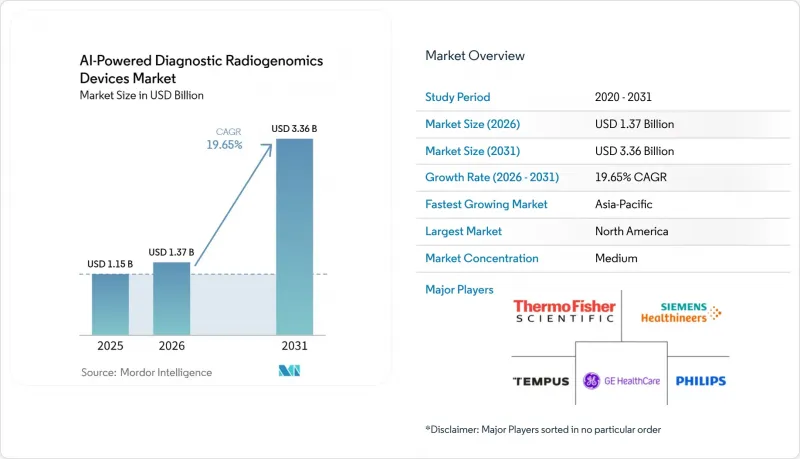
본 보고서는 구성 요소(하드웨어, 소프트웨어, 서비스), 영상 진단법(MRI, CT 등), 유전체 입력(DNA 변이, RNA 발현 및 트랜스크립토믹스 등), 임상 용도(변이 및 바이오마커 상태 예측 등), 최종 사용자(병원 및 진료소 등), 지역(북미 등)별로 분류되어 있습니다. 시장 전망은 금액(달러) 기준으로 제시되어 있습니다.
세계의 AI 활용 진단 방사선유전체학 디바이스 시장 동향 및 인사이트
다중 모달 정밀 진단에 대한 수요 증가
AI 활용 진단 방사선유전체학 디바이스 시장은 단일 소스 분석에서 벗어나고 있습니다. 이는 임상의들이 영상, 유전체, 전사체, 단백체 및 환자 기록 데이터를 통합할 수 있는 단일 워크플로우를 점점 더 요구하고 있기 때문입니다. 다중 모달 AI 시스템은 단일 데이터 유형만을 기반으로 구축된 모델보다 분자 아형의 예측 및 치료 반응 평가에서 우수한 성능을 보여주고 있으며, 이로 인해 정밀 의학의 과정에서 그 중요성이 더욱 높아지고 있습니다. 큰 변화 중 하나는 이러한 시스템이 더 이상 모든 환자로부터의 완전한 크로스모달 데이터에 의존하지 않게 되었습니다는 점입니다. 이는 새로운 모델 설계 덕분에 이미 이용 가능한 데이터에서 누락된 입력값을 추론할 수 있게 되었기 때문입니다. 이러한 변화로 인해 유전체 분석이 부분적으로만 수행되는 병원에서도 활용이 가능해졌으며, 의료 기관이 진단 경로 전체를 단번에 재구축해야 하는 부담을 덜어줌으로써 더 많은 기관이 AI 활용 진단 방사선유전체학 디바이스 시장에 진입할 수 있게 되었습니다. 또한 HONeYBEE 프레임워크는 DNA 메틸화, 유전자 발현, 체세포 돌연변이에 걸친 모듈식 통합이 의료 기관 차원에서 저비용 도입을 어떻게 지원할 수 있는지를 보여줍니다. 종양학, 신경학, 순환기학 각 팀에서 동시에 수요가 발생함에 따라, AI 활용 진단 방사선유전체학 디바이스 시장은 순수한 종양학용 툴셋이 일반적으로 제공하는 범위보다 더 광범위한 임상 기반을 확보해 가고 있습니다.
'종양학 우선' 임상 이용 사례의 확대
AI 활용 진단 방사선유전체학 디바이스 시장은 여전히 종양학이 주도하고 있지만, 그 이용 사례는 검출 단계에서 치료법 선택, 임상시험 등록, 그리고 지속적인 치료 반응 평가로 전환되고 있습니다. Lunit사는 AACR 2025에서 염색된 조직 이미지를 바탕으로 비소세포폐암의 EGFR 변이를 AI로 예측하는 데이터를 발표했습니다. 이는 완전한 분자 검사가 완료되기 전의 조기 선별 검사를 가속화하는 것입니다. 제약 기업들은 동반 진단의 개발을 지원하고 환자 선정 시 불확실성을 줄일 수 있는 바이오마커 연계형 도구를 필요로 하고 있어, 이러한 도입을 뒷받침하고 있습니다. ClinicalTrials.gov에 등록된 2026년 식도암 관련 연구에 따르면, 라디오믹스, 패토믹스, 유전체학 및 기타 멀티오믹스 계층이 이미 결합되어 가장 확립된 종양 영역을 넘어 치료 반응과 예후를 예측하고 있는 것으로 나타났습니다. 2025년에 발표된 간세포암에 관한 논문에서도, 머신러닝을 활용한 라디오유전체학 바이오마커가 주요 영상 진단법에서 위험비 1.415-1.890 범위 내에서 예후를 구분할 수 있음이 밝혀졌습니다. 이 적응증이 폐암, 뇌종양, 유방암에서 소화기암, 전립선암, 간암으로 확대됨에 따라, AI 활용 진단 방사선유전체학 디바이스 시장은 좁은 범위의 변이 스크리닝 모델이 시사하는 것보다 더 큰 수익 잠재력을 지니고 있습니다.
임상 등급의 라벨링된 방사선 유전체학 데이터셋 부족
AI 활용 진단 방사선유전체학 디바이스 시장은 영상 특징과 확인된 분자병리학적 소견을 연결하는 고품질의 라벨링된 데이터셋이 여전히 부족하여 근본적인 공급 문제에 직면해 있습니다. 현재 모델의 대부분은 영상 데이터와 유전체 데이터가 서로 다른 시기에, 서로 다른 임상 목적으로 수집된 후향적 코호트를 기반으로 구축되어 있어, 이로 인해 노이즈가 발생하고 기관 간 이식성이 약화되고 있습니다. 이 문제는 전사체 및 단백체 수준에서 더욱 심각합니다. 이는 이러한 검사가 일반적인 영상 진단의 일부가 아니며, 추가 비용 없이 소급적으로 추가할 수 없기 때문입니다. 연합 학습(Federated Learning)은 환자 데이터를 이동시키지 않고도 기관 간 모델 개발을 가능하게 한다는 점에서 유용하지만, 라벨 불일치나 데이터 품질의 편차와 같은 과제를 해결해 주지는 않습니다. 유럽 암 영상 이니셔티브(European Cancer Imaging Initiative)는 2025년 9월까지 9가지 암 유형에 걸친 83개의 영상 데이터 세트를 연계하여 10만 7,000명의 피험자를 포괄했습니다. 이는 진전을 보여주는 것이지만, 광범위한 임상 등급의 일반화에 필요한 수준에는 아직 미치지 못합니다. 전향적 다중 모달 데이터 수집이 연구 주도형이 아닌 일상적인 관행이 될 때까지는 이러한 한계가 모델의 성능을 계속 제한하고 AI 활용 진단 방사선유전체학 디바이스 시장의 확장을 계속 지연시킬 것입니다.
부문 분석
2025년, 소프트웨어는 매출의 51.38%를 차지하며 AI 활용 진단 방사선유전체학 디바이스 시장에서 가장 큰 구성 요소가 되었습니다. 이러한 위상은 추론 엔진, 모델 관리 계층 및 임상 의사결정 지원 플랫폼이 수행하는 핵심적인 역할을 반영합니다. 왜냐하면 이러한 요소들은 영상 및 유전체 신호가 실용적인 임상 결과로 변환되는 접점에 위치해 있기 때문입니다. 소프트웨어가 주도적인 위치를 차지하고 있다는 사실은 특히 병원이 이미 핵심적인 영상 진단 자산을 보유하고 있는 경우, 구매자들이 고정 설비의 교체를 넘어 유연한 도입을 계속해서 우선시하고 있음을 보여줍니다. 하지만 보다 개방적인 아키텍처와 기반 모델 프레임워크가 이 분야에 진입함에 따라 제품 계층 간의 배타성은 점차 약화되고 있습니다. 즉, AI 활용 진단 방사선유전체학 디바이스 시장에서 알고리즘에 대한 단순한 접근만으로는 더 이상 수익성을 유지하기에 불충분해졌습니다. 더 강력한 차별화 요소는 벤더가 해당 소프트웨어를 실제 병원 환경에 도입하고, 장기적으로 규정 준수를 이행하면서 안정성과 유용성을 유지할 수 있는지 여부입니다.
서비스 분야는 2031년까지 연평균 성장률(CAGR) 23.87%로 확대될 것으로 예측되며, AI 활용 진단 방사선유전체학 디바이스 시장에서 가장 성장세가 두드러지는 분야입니다. 병원에서는 검증, 도입, 모니터링, 규제 대응 업데이트 등을 포괄하는 관리형 계약을 선호하는 경향이 강해지고 있습니다. 이는 이러한 업무가 각 병원의 IT 팀이나 임상 운영 팀의 부담이 되고 있기 때문입니다. 이러한 변화는 가치가 단순한 소프트웨어 라이선스에서 일상 진료에서 멀티모달 AI를 지속적으로 작동시키는 종합적인 운영 모델로 전환되고 있음을 보여주며, 중요한 의미를 지닙니다. 하드웨어는 여전히 중요하며, 특히 영상 진단 장비 제조업체들이 MRI, CT, PET 시스템에 AI 가속화 및 신경망 처리 기능을 통합하고 있는 분야에서는 그 중요성이 두드러지지만, 업데이트 주기가 길고 많은 AI 기능이 업그레이드를 통해 추가될 수 있기 때문에 성장 속도는 완만합니다. 실용적인 관점에서 볼 때, AI 활용 진단 방사선유전체학 디바이스 업계는 서비스 주도형 플랫폼으로 전환되고 있으며, 수익의 지속성은 일회성 도입이 아닌 통합의 깊이에 좌우되고 있습니다.
2025년, MRI는 38.13%의 점유율을 차지하며, AI 활용 진단 방사선유전체학 디바이스 시장에서 계속해서 주요 모달리티로서의 지위를 유지했습니다. 이러한 우위는 연조직의 콘트라스트가 뛰어나다는 점과, 유전체과의 상관관계가 더 명확한 임상적 의의를 지닌 뇌암, 전립선암, 유방암 워크플로우에서 확립된 사용 실적에서 비롯됩니다. 이러한 분야에서는 신경교종의 돌연변이 예측, 전립선의 다중 매개변수 영상 진단, 유방 병변의 특성 평가와 같은 고부가가치 활용 사례가 지속적으로 뒷받침되고 있습니다. GE 헬스케어는 2026년, 20만 건의 MRI 시리즈로 학습된 임상 등급 3D MRI 기반 모델 ‘Decipher-MR’을 발표했습니다. 이는 광범위한 AI 영상 진단 용도 분야에서 MRI가 여전히 주요 개발 초점으로 남아 있음을 보여줍니다. 그 결과, 다른 모달리티가 주변에서 확대되고 있는 상황에서도 MRI는 여전히 AI 활용 진단 방사선유전체학 디바이스 시장의 수익 하한선을 결정짓고 있습니다.
다중 모달리티 융합은 2031년까지 연평균 성장률(CAGR) 24.15%를 나타낼 것으로 예측되며, AI 활용 진단 방사선유전체학 디바이스 시장에서 가장 빠르게 발전하고 있는 모달리티 부문입니다. 중요한 변화로는 서로 다른 시점의 데이터를 소급적으로 결합하는 것이 더욱 현실화됨에 따라, 임상적으로 유용한 융합 영상을 얻기 위해 모든 데이터 소스를 동일한 검사 세션에서 획득할 필요가 없어졌습니다는 점을 들 수 있습니다. 이를 통해 AI 워크플로우에 통합할 수 있는 환자 수와 의료 기관의 수가 대폭 증가합니다. VHIO를 통해 발표된 스페인의 연구에 따르면, 전립선암 및 간세포암 사례에서 PET와 MRI를 동시에 시행함으로써 단일 모달리티로는 재현할 수 없는 해부학적 및 기능적 종양 정보를 얻을 수 있는 것으로 나타났습니다. CT, PET, 초음파, X선 및 유방촬영술은 여전히 중요한 수익원이지만, 융합 아키텍처는 보다 풍부한 라디오믹스 표현형을 지원하고 유전체 분석과의 연계를 강화함으로써 임상적 가능성의 한계를 높이고 있습니다. 이에 따라 AI 활용 진단 방사선유전체학 디바이스 업계는 모달리티 주도 구조에서 데이터 융합 주도 구조로 전환되고 있습니다.
지역별 분석
2025년, 북미는 매출의 44.64%를 차지하며, AI 활용 진단 방사선유전체학 디바이스 시장에서 가장 규모가 큰 지역 점유율을 기록했습니다. 이 지역은 학술적 암 센터가 밀집해 있다는 점, 확립된 영상 진단 인프라, 그리고 공급업체와 참조 기관 간의 긴밀한 협력과 같은 이점을 갖추고 있습니다. GE 헬스케어와 메이요 클리닉은 2026년 7월, 진행성 전립선암을 대상으로 StarGuide SPECT/CT, MIM LesionID Pro 및 혈액 유래 바이오마커를 결합한 'MI-BET' 테라노스틱스 공동 프로젝트를 시작했습니다. 이는 영상 진단과 바이오마커의 통합이 우선순위가 높은 치료 현장으로 이동하고 있음을 보여줍니다. 또한, 미국의 병원 네트워크는 서비스 주도형 도입에 유리한 기반을 제공합니다. 이는 기업 계약을 통해 검증, 보고서 작성 및 후속 조치 모델 관리를 종합적으로 처리할 수 있기 때문입니다. 이에 따라 AI 활용 진단 방사선유전체학 디바이스 시장에서 북미는 제품 테스트와 상업적 실증 양면에서 계속해서 중심적인 위치를 차지하고 있습니다.
유럽은 조정된 영상 데이터 프로그램과 견고한 종양학 연구 인프라에 힘입어, AI 활용 진단 방사선유전체학 디바이스 시장에서 여전히 2위의 규모를 유지하고 있습니다. 제출된 초안에도 명시된 바와 같이, 독일이 법정 건강보험에서 저선량 CT 폐암 검진을 승인함에 따라 2026년 4월 이후 AI 지원 영상 판독 및 바이오마커 추출을 위한 실제 임상 환경이 확대될 것입니다. 동시에, GDPR(EU 개인정보보호규정) 및 EU AI법의 요건에 따라 공급업체들은 개인정보를 보호하고, 보다 엄격하게 관리되는 도입 모델로 전환하고 있습니다. 이는 도입을 지연시킬 가능성은 있지만, 장기적인 신뢰를 강화하는 결과로 이어질 것입니다.
아시아태평양은 2031년까지 연평균 성장률(CAGR) 25.72%로 확대될 것으로 예측되며, AI 활용 진단 방사선유전체학 디바이스 시장에서 가장 빠르게 성장하는 지역이 될 전망입니다. 일본이 특히 주목받는 이유는 일루미나(Illumina)사의 ‘TruSight Oncology Comprehensive’ 시스템에 대한 보험 적용이 2026년 6월 1일부터 발효되었기 때문입니다. 이를 통해 AI 지원형 종양학 워크플로우의 기반이 되는 유전체 프로파일링에 대한 접근성이 확대될 것입니다. 또한 일본에서는 도쿄대학이 암 유전체 내 구조적 이상 해석에 관한 연구를 진행 중이며, 설명 가능한 유전체 AI의 발전에도 기여하고 있습니다. 중국에서는 AI 영상 진단이 방사선과 전문의 부족 및 도시와 농촌 간의 접근성 격차 해소에도 활용되고 있어 시장 규모 확대가 예상됩니다. 한편, 한국은 AI 관련 기업을 통해 수출용 종양 영상 진단 역량 구축을 지속하고 있습니다. 남미, 중동 및 아프리카는 여전히 초기 단계 시장입니다. 그렇지만 공중보건 프로그램, 바이오뱅크와의 제휴, 그리고 각국의 유전체 연구소를 통해 AI 활용 진단 방사선유전체학 디바이스 시장으로의 진입 기회가 서서히 창출되고 있습니다. 지역을 불문하고, AI 활용 진단 방사선유전체학 디바이스 시장 규모는 영상 진단 인프라만의 영향뿐만 아니라, 정책 지원, 데이터 접근성, 그리고 워크플로우 준비 상황에 따라 더욱 균등하게 영향을 받게 되고 있습니다.
기타 혜택 :
- 엑셀 형식 시장 예측(ME) 시트
- 3개월간의 애널리스트 지원
자주 묻는 질문
목차
제1장 서론
제2장 조사 방법
제3장 주요 요약
제4장 시장 구도
제5장 시장 규모 및 성장 예측
제6장 경쟁 구도
제7장 시장 기회 및 향후 전망
KTH 26.08.10According to Mordor Intelligence, the AI-Powered diagnostic radiogenomics devices market size is projected to expand from USD 1.15 billion in 2025 and USD 1.37 billion in 2026 to USD 3.36 billion by 2031, registering a CAGR of 19.65% between 2026 to 2031.
This report is Segmented by Component (Hardware, Software, Services), Imaging Modality (MRI, CT. And More), Genomic Input (DNA Variants, RNA Expression and Transcriptomics, and More), Clinical Application (Mutation and Biomarker Status Prediction and More), End User (Hospitals and Clinics and More), and Geography (North America and More). Market Forecasts are Provided in Terms of Value (USD).
Global AI-Powered Diagnostic Radiogenomics Devices Market Trends and Insights
Rising Demand for Multimodal Precision Diagnostics
The AI-powered diagnostic radiogenomics devices market is moving away from single-source analysis because clinicians increasingly want one workflow that can combine imaging, genomic, transcriptomic, proteomic, and patient record data. Multimodal AI systems are showing better performance in molecular subtype prediction and treatment response assessment than models built on one data type alone, which is making them more relevant for precision care pathways. A major shift is that these systems no longer depend on complete cross-modal data from every patient, because newer model designs can infer missing inputs from the data that are already available. That change is widening access for hospitals with partial genomics coverage, and it is bringing more institutions into the AI-powered diagnostic radiogenomics devices market without forcing them to rebuild their entire diagnostic pathway at once. The HONeYBEE framework also shows how modular embeddings across DNA methylation, gene expression, and somatic mutations can support lower-cost deployment at the institution level. As demand comes from oncology, neurology, and cardiovascular teams at the same time, the AI-powered diagnostic radiogenomics devices market is gaining a broader clinical base than a pure oncology tool set would normally deliver.
Expanding Oncology-First Clinical Use Cases
The AI-powered diagnostic radiogenomics devices market is still led by oncology, but the use case is moving past detection toward treatment selection, trial enrollment, and ongoing response assessment. Lunit presented data at AACR 2025 showing AI-based prediction of EGFR mutations in non-small cell lung cancer from stained tissue images, which supports faster early screening before full molecular workup is completed. Drug developers are helping push this adoption because they need biomarker-linked tools that can support companion diagnostic development and reduce uncertainty in patient selection. A registered 2026 ClinicalTrials.gov study in esophageal cancer shows that radiomics, pathomics, genomics, and other multi-omics layers are already being combined to predict treatment response and prognosis beyond the most established tumor settings. A 2025 hepatocellular carcinoma publication also showed that a machine learning radiogenomics biomarker could separate prognosis across major imaging modalities with a hazard ratio range of 1.415 to 1.890. As this indication set extends from lung, brain, and breast into GI, prostate, and hepatic cancers, the AI-powered diagnostic radiogenomics devices market gains revenue potential that is larger than a narrow mutation screening model would suggest.
Limited Clinical-Grade Labelled Radiogenomics Datasets
The AI-powered diagnostic radiogenomics devices market still faces a basic supply problem because high-quality labeled datasets that connect imaging features with confirmed molecular pathology remain scarce. Many current models are built on retrospective cohorts where imaging and genomic data were collected at different times and for different clinical purposes, which introduces noise and weakens transferability across sites. The issue is more severe for transcriptomic and proteomic layers, because those assays are not part of most routine imaging encounters and cannot be added retrospectively without extra cost. Federated learning helps by allowing model development across institutions without moving patient data, but it does not remove the challenge of inconsistent labels and uneven data quality. The European Cancer Imaging Initiative had connected 83 imaging datasets across 9 cancer types, covering 107,000 subjects by September 2025, which shows progress but still falls short of what broad clinical-grade generalization needs. Until prospective multimodal data collection becomes routine rather than research-led, this limitation will continue to cap model performance and slow scaling in the AI-powered diagnostic radiogenomics devices market.
Other drivers and restraints analyzed in the detailed report include:
- Increasing Hospital-Level AI Workflow Integration
- Growing Genomic Data Availability for Model Training
- Reimbursement Uncertainty for AI-Enabled Companion Diagnostics
For complete list of drivers and restraints, kindly check the Table Of Contents.
Segment Analysis
Software accounted for 51.38% of revenue in 2025, which made it the largest component in the AI-powered diagnostic radiogenomics devices market. That position reflects the central role of inference engines, model management layers, and clinical decision support platforms, because these elements sit at the point where imaging and genomic signals are turned into usable clinical output. The software lead also shows that buyers continue to prioritize flexible deployment over fixed equipment replacement, especially where hospitals already own core imaging assets. Even so, the product layer is becoming less exclusive as more open architectures and foundation model frameworks enter the field, which means simple access to an algorithm is no longer enough to protect margins in the AI-powered diagnostic radiogenomics devices market. The stronger differentiator is whether a vendor can place that software into a live hospital environment and keep it compliant, stable, and useful over time.
Services is projected to advance at a 23.87% CAGR through 2031, which makes it the fastest-growing component in the AI-powered diagnostic radiogenomics devices market. Hospitals are increasingly favoring managed contracts that cover validation, deployment, monitoring, and regulatory updates because those tasks stretch local IT and clinical operations teams. This shift matters because it moves value from the software license alone toward the full operating model that keeps multimodal AI functioning in routine care. Hardware remains important, especially where imaging OEMs embed AI acceleration and neural processing capabilities into MRI, CT, and PET systems, but its growth is slower because replacement cycles are longer and many AI functions can still be added through upgrades. In practical terms, the AI-powered diagnostic radiogenomics devices industry is moving toward service-backed platforms where revenue durability depends on integration depth rather than on one-time installation.
MRI held 38.13% share in 2025, which kept it as the leading modality in the AI-powered diagnostic radiogenomics devices market. Its lead comes from strong soft-tissue contrast and its established use in brain, prostate, and breast cancer workflows, where genomic correlation has clearer clinical relevance. These settings continue to support high-value use cases such as glioma mutation prediction, multiparametric prostate imaging, and breast lesion characterization. GE HealthCare presented Decipher-MR in 2026 as a clinical-grade 3D MRI foundation model trained on 200,000 MRI series, which underlines how MRI remains a major development focus for broad AI imaging applications. As a result, MRI still sets the revenue floor for the AI-powered diagnostic radiogenomics devices market even while other modalities expand around it.
Multi-modal fusion is forecast to grow at a 24.15% CAGR through 2031, which makes it the fastest-moving modality layer in the AI-powered diagnostic radiogenomics devices market. The key change is that clinically useful fusion no longer requires every data source to be acquired in the same session, because retrospective combination across timepoints is becoming more practical. That greatly increases the number of patients and institutions that can be included in AI workflows. Spanish work presented through VHIO showed that simultaneous PET and MRI can produce anatomical and functional tumor information that single modalities cannot replicate in prostate and hepatocellular carcinoma settings. CT, PET, ultrasound, and X-ray or mammography still contribute meaningful revenue, but fusion architectures are raising the clinical ceiling because they support richer radiomic phenotypes and closer links to genomic interpretation. This is where the AI-powered diagnostic radiogenomics devices industry is shifting from a modality-led structure toward a data-combination structure.
Complete Report Scope:
- By Component
- Hardware
- Software
- Services
- By Imaging Modality
- MRI
- CT
- PET
- Ultrasound
- X-Ray and Mammography
- Multi-Modal Fusion
- By Genomic Input
- DNA Variants
- RNA Expression and Transcriptomics
- Epigenetics
- Proteomics
- Liquid Biopsy Signals
- By Clinical Application
- Mutation and Biomarker Status Prediction
- Tumor Detection
- Prognosis and Survival Risk Stratification
- Therapy Response Prediction and Monitoring
- Recurrence Versus Treatment Effect Discrimination
- Patient Selection for Trials
- By End User
- Hospitals and Clinics
- Diagnostic Imaging Centers
- Academic and Research Institutes and Biobanks
- Pharma and Biotech and CROs
- Government and Public Health Programs
- By Geography
- North America
- United States
- Canada
- Mexico
- Europe
- Germany
- United Kingdom
- France
- Italy
- Spain
- Rest of Europe
- Asia-Pacific
- China
- India
- Japan
- South Korea
- Australia
- Rest of Asia-Pacific
- Middle East and Africa
- GCC
- South Africa
- Rest of Middle East and Africa
- South America
- Brazil
- Argentina
- Rest of South America
- North America
Geography Analysis
North America accounted for 44.64% of revenue in 2025, which gave it the largest regional position in the AI-powered diagnostic radiogenomics devices market. The region benefits from a dense concentration of academic cancer centers, established imaging infrastructure, and close collaboration between vendors and reference institutions. GE HealthCare and Mayo Clinic launched the MI-BET theranostics collaboration in July 2026, combining StarGuide SPECT/CT, MIM LesionID Pro, and blood-based biomarkers for advanced prostate cancer, which shows how imaging and biomarker integration are moving into high-priority treatment settings. Hospital networks in the United States also provide a favorable base for service-led deployment, because enterprise contracts can cover validation, reporting, and follow-up model management together. This keeps North America central to both product testing and commercial proof in the AI-powered diagnostic radiogenomics devices market.
Europe remained the second-largest region in the AI-powered diagnostic radiogenomics devices market, supported by coordinated imaging data programs and strong oncology research infrastructure. Germany's approval of low-dose CT lung cancer screening for statutory health insurance created a larger real-world setting for AI-assisted reading and biomarker extraction from April 2026 onward, as referenced in the supplied draft. At the same time, GDPR and EU AI Act requirements are pushing vendors toward privacy-preserving and more tightly governed deployment models, which can slow implementation but strengthen long-term trust.
Asia-Pacific is projected to expand at a 25.72% CAGR through 2031, making it the fastest-growing region in the AI-powered diagnostic radiogenomics devices market. Japan stands out because reimbursement for Illumina's TruSight Oncology Comprehensive system took effect on June 1, 2026, which broadens access to genomic profiling that can feed AI-supported oncology workflows. Japan is also contributing to explainable genomic AI through work at the University of Tokyo on structural anomaly interpretation in cancer genomes. China offers scale because AI imaging is being used to address radiologist shortages and uneven access between urban and rural settings. At the same time, South Korea continues to build export-facing oncology imaging capability through its AI companies. South America, the Middle East, and Africa are still early-stage markets. Still, public health programs, biobank partnerships, and national genomics institutes are gradually creating entry points for the AI-powered diagnostic radiogenomics devices market. Across geography, the AI-powered diagnostic radiogenomics devices market size is becoming more evenly influenced by policy support, data availability, and workflow readiness rather than by imaging infrastructure alone.
- Agilent Technologies
- Aidoc Medical Ltd.
- Canon
- CureMetrix, Inc.
- GE HealthCare Technologies Inc.
- Imbio LLC
- Koninklijke Philips
- Lunit
- Median Technologies SA
- Mirada Medical Limited
- Owkin
- PathAI, Inc.
- Perspectum Ltd.
- Qlucore AB
- QMENTA Inc.
- Quibim S.L.
- Radiomics.bio Inc.
- Seno Medical Instruments, Inc.
- Siemens Healthineers
- SOPHiA GENETICS SA
- Tempus AI, Inc.
- Thermo Fisher Scientific
- Ultromics Limited
- VUNO Inc.
Additional Benefits:
- The market estimate (ME) sheet in Excel format
- 3 months of analyst support
TABLE OF CONTENTS
1 INTRODUCTION
- 1.1 Study Assumptions and Market Definition
- 1.2 Scope of the Study
2 RESEARCH METHODOLOGY
3 EXECUTIVE SUMMARY
4 MARKET LANDSCAPE
- 4.1 Market Overview
- 4.2 Market Drivers
- 4.2.1 Rising Demand for Multimodal Precision Diagnostics
- 4.2.2 Expanding Oncology-First Clinical Use Cases
- 4.2.3 Increasing Hospital-Level AI Workflow Integration
- 4.2.4 Growing Genomic Data Availability for Model Training
- 4.2.5 Wider Use in Therapy Response and Trial Stratification
- 4.2.6 Cross-Validation Pressure From Explainability and Auditability
- 4.3 Market Restraints
- 4.3.1 Limited Clinical-Grade Labelled Radiogenomics Datasets
- 4.3.2 Interoperability Gaps Across PACS, EHR, and Omics Systems
- 4.3.3 High Validation Burden for Multi-Site Regulatory Clearance
- 4.3.4 Reimbursement Uncertainty for AI-Enabled Companion Diagnostics
- 4.4 Value Chain Analysis
- 4.5 Technological Outlook
- 4.6 Regulatory Landscape
- 4.7 Porter's Five Forces Analysis
- 4.7.1 Threat of New Entrants
- 4.7.2 Bargaining Power of Buyers
- 4.7.3 Bargaining Power of Suppliers
- 4.7.4 Threat of Substitutes
- 4.7.5 Intensity of Competitive Rivalry
5 MARKET SIZE AND GROWTH FORECASTS (VALUE, USD)
- 5.1 By Component
- 5.1.1 Hardware
- 5.1.2 Software
- 5.1.3 Services
- 5.2 By Imaging Modality
- 5.2.1 MRI
- 5.2.2 CT
- 5.2.3 PET
- 5.2.4 Ultrasound
- 5.2.5 X-Ray and Mammography
- 5.2.6 Multi-Modal Fusion
- 5.3 By Genomic Input
- 5.3.1 DNA Variants
- 5.3.2 RNA Expression and Transcriptomics
- 5.3.3 Epigenetics
- 5.3.4 Proteomics
- 5.3.5 Liquid Biopsy Signals
- 5.4 By Clinical Application
- 5.4.1 Mutation and Biomarker Status Prediction
- 5.4.2 Tumor Detection
- 5.4.3 Prognosis and Survival Risk Stratification
- 5.4.4 Therapy Response Prediction and Monitoring
- 5.4.5 Recurrence Versus Treatment Effect Discrimination
- 5.4.6 Patient Selection for Trials
- 5.5 By End User
- 5.5.1 Hospitals and Clinics
- 5.5.2 Diagnostic Imaging Centers
- 5.5.3 Academic and Research Institutes and Biobanks
- 5.5.4 Pharma and Biotech and CROs
- 5.5.5 Government and Public Health Programs
- 5.6 By Geography
- 5.6.1 North America
- 5.6.1.1 United States
- 5.6.1.2 Canada
- 5.6.1.3 Mexico
- 5.6.2 Europe
- 5.6.2.1 Germany
- 5.6.2.2 United Kingdom
- 5.6.2.3 France
- 5.6.2.4 Italy
- 5.6.2.5 Spain
- 5.6.2.6 Rest of Europe
- 5.6.3 Asia-Pacific
- 5.6.3.1 China
- 5.6.3.2 India
- 5.6.3.3 Japan
- 5.6.3.4 South Korea
- 5.6.3.5 Australia
- 5.6.3.6 Rest of Asia-Pacific
- 5.6.4 Middle East and Africa
- 5.6.4.1 GCC
- 5.6.4.2 South Africa
- 5.6.4.3 Rest of Middle East and Africa
- 5.6.5 South America
- 5.6.5.1 Brazil
- 5.6.5.2 Argentina
- 5.6.5.3 Rest of South America
- 5.6.1 North America
6 COMPETITIVE LANDSCAPE
- 6.1 Market Concentration
- 6.2 Market Share Analysis
- 6.3 Company Profiles (includes Global Level Overview, Market Level Overview, Core Segments, Financials as available, Strategic Information, Market Rank/Share, Products and Services, Recent Developments)
- 6.3.1 Agilent Technologies, Inc.
- 6.3.2 Aidoc Medical Ltd.
- 6.3.3 Canon Medical Systems Corporation
- 6.3.4 CureMetrix, Inc.
- 6.3.5 GE HealthCare Technologies Inc.
- 6.3.6 Imbio LLC
- 6.3.7 Koninklijke Philips N.V.
- 6.3.8 Lunit Inc.
- 6.3.9 Median Technologies SA
- 6.3.10 Mirada Medical Limited
- 6.3.11 Owkin
- 6.3.12 PathAI, Inc.
- 6.3.13 Perspectum Ltd.
- 6.3.14 Qlucore AB
- 6.3.15 QMENTA Inc.
- 6.3.16 Quibim S.L.
- 6.3.17 Radiomics.bio Inc.
- 6.3.18 Seno Medical Instruments, Inc.
- 6.3.19 Siemens Healthineers AG
- 6.3.20 SOPHiA GENETICS SA
- 6.3.21 Tempus AI, Inc.
- 6.3.22 Thermo Fisher Scientific Inc.
- 6.3.23 Ultromics Limited
- 6.3.24 VUNO Inc.
7 MARKET OPPORTUNITIES AND FUTURE OUTLOOK
- 7.1 White-Space and Unmet-Need Assessment


