

|
시장보고서
상품코드
2098551
LPDDR5 DRAM : 시장 점유율 분석, 업계 동향과 통계, 성장 예측(2026-2031년)LPDDR5 DRAM - Market Share Analysis, Industry Trends & Statistics, Growth Forecasts (2026 - 2031) |
||||||
 Mordor Intelligence
Mordor Intelligence에 의하면, LPDDR5 DRAM 시장 규모는 2025년 47억 1,000만 달러에서 2026년에는 52억 3,000만 달러로 확대되고, 2031년까지 78억 9,000만 달러에 이를 것으로 예측되며, 2026-2031년 CAGR 8.72%를 기록할 전망입니다.
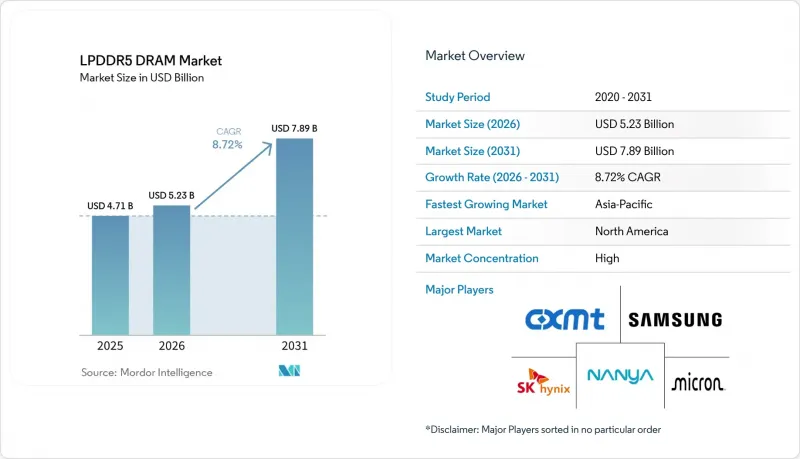
본 보고서는 세대별(LPDDR5 및 LPDDR5X), 제품 구성별(디스크리트/기판 실장형 LPDDR DRAM 부품, 패키지 온 패키지/온 패키지형 LPDDR DRAM, MCP/UMCP 기반 LPDDR DRAM, LPDDR5/LPDDR5X 모듈형 메모리 형식), 최종 사용자 산업(소비자용 전자기기, 자동차, 산업용 및 임베디드 기기 등), 그리고 지역별로 분류되어 있습니다. 시장 전망은 금액(달러) 기준으로 제시되어 있습니다.
전 세계 LPDDR5 DRAM 시장 동향 및 인사이트
디바이스 내 AI에 따른 스마트폰 DRAM 탑재량 증가
LPDDR5 DRAM 시장은 온디바이스 AI 덕분에 강력한 성장세를 보이고 있습니다. 이는 최신 플래그십 스마트폰에서 로컬 언어 처리, 비전 및 이미지 처리 워크로드를 지원하기 위해 더 높은 처리량과 낮은 전력 소비가 요구되기 때문입니다. 마이크론은 2026년 플래그십 스마트폰을 목표로 2025년 6월부터 1Y LPDDR5X 인증용 샘플 출하를 시작했습니다. 이 제품은 10.7 Gbps의 전송 속도를 실현하고, 1B DRAM에 비해 20%의 전력 절감을 달성했으며, 패키지 두께는 0.61 mm입니다. 또한 마이크론은 모바일 하드웨어에서 Llama 2 모델을 실행했을 때, 이 공정 노드를 통해 LLM의 쿼리 응답 시간이 30% 개선되고 번역 지연 시간이 50% 감소했다고 밝혔으며, 이는 메모리 성능의 향상이 사용자가 체감할 수 있는 AI 성능으로 직결됨을 보여줍니다. Samsung Electronics는 2024년 8월, 두께 0.65 mm의 12nm급 12 GB 및 16GB LPDDR5X 패키지의 양산을 시작했습니다. 이는 이전 세대에 비해 두께가 9% 얇아지고 내열성이 21% 향상되어, 스마트폰 제조업체들이 성능과 열 설계의 균형을 맞추는 데 도움이 되었습니다. 이러한 발전이 맞물리면서 LPDDR5 동적 랜덤 액세스 메모리(DRAM) 시장은 일반적인 세대 교체 주기에서는 상상할 수 없는 속도로 AI에 중점을 둔 모바일 애플리케이션에 더욱 깊이 침투하고 있습니다.
LPDDR4X 공급 부족이 LPDDR5X로의 전환을 가속화
또한, LPDDR5 DRAM 시장이 확대되고 있는 배경에는 디바이스 제조업체들이 소비자 제품의 장기적인 신규 설계 주기에서 LPDDR4X에 의존할 수 있는 선택지를 점차 잃어가고 있다는 사정도 있습니다. Samsung Electronics와 마이크론은 모두 현재 모바일용 저전력 DRAM 제품 라인업의 중심을 LPDDR5X에 두고 있으며, 이는 공급업체의 로드맵에서 이 새로운 규격이 더 이상 프리미엄 수요의 주변부가 아니라 제품 계획의 핵심으로 자리 잡고 있음을 보여줍니다. 이러한 변화가 중요한 이유는 LPDDR4X와 LPDDR5X 간의 가격 및 조달 측면에서의 격차가, 중저가 브랜드가 처음 전환을 검토했을 당시만큼 크지 않기 때문입니다. CXMT는 2025년 5월, 8,533 Mbps 및 9,600 Mbps 제품으로 LPDDR5X 양산을 시작했으며, 2026년에는 10,667 Mbps 버전의 고객용 샘플 제공으로 전환했습니다. 이로 인해 중국 OEM 제조업체들에게 새로운 공급 옵션이 추가되면서, 미드티어 시장에서의 경쟁 압력이 높아지고 있습니다. 그 결과, LPDDR5 DRAM 시장은 업그레이드 선택지가 좁아지는 국면으로 접어들고 있으며, 플랫폼 교체 시기나 공급업체공급 상황이 순수한 부품 가격만큼이나 중요하게 여겨지고 있습니다.
엔트리 및 미드티어 단말기에서의 SoC 호환성 제약
LPDDR5 DRAM 시장의 단기적인 최대 제약 요인은 여전히 엔트리급 및 저가형 스마트폰의 SoC 호환성입니다. JEDEC 문서에서는 LPDDR5X가 새로운 메모리 규격 스택의 일부임이 명확히 명시되어 있으며, 호환되는 메모리 컨트롤러를 탑재하지 않은 디바이스는 단순히 메모리만 교체하는 것만으로는 LPDDR5X로 전환할 수 없습니다. 따라서 LPDDR5X와의 가격 차이가 좁혀지더라도, LPDDR4X나 기본 사양의 LPDDR5를 채택한 4G 및 저비용 5G 설계의 방대한 도입 기반이 남아 있게 됩니다. 이러한 영향이 가장 두드러지는 곳은 남아시아, 동남아시아, 남미, 중동 및 아프리카이며, 이들 지역에서는 100달러 미만 및 150-250달러 가격대의 휴대전화가 여전히 상당한 판매량을 차지하고 있습니다. 호환 가능한 5G 플랫폼이 이러한 가격대에 더욱 보급되기 전까지는 LPDDR5 DRAM 시장은 프리미엄 및 상위 중급 기기 중심으로 편중된 상태가 지속될 것입니다.
부문 분석
LPDDR5X는 2025년에 LPDDR5 DRAM 시장 점유율의 68.42%를 차지할 것으로 예상되며, 2031년까지 연평균 성장률(CAGR) 9.12%로 확대될 것으로 전망되어, 최첨단 세대이자 가장 빠르게 성장하는 세대가 될 것입니다. 이러한 위상은 플래그십 스마트폰, AI PC 및 중앙 집중형 자동차 컴퓨팅 플랫폼이 현재 AI 지원 워크로드를 위해 고대역폭 메모리 인터페이스를 우선시하고 있기 때문입니다. 마이크론은 2025년 6월, 패키지 두께 0.61mm, 10.7Gbps의 1Y LPDDR5X 인증용 샘플 출하를 시작했습니다. 이는 2026년에 출시될 더욱 얇아진 모바일 기기 및 노트북의 설계를 직접 지원하는 것입니다. 한편, LPDDR5는 LPDDR5X로의 전환이 아직 인증이나 컨트롤러 지원을 완전히 완료하지 못한 미드티어 시스템, 개발 주기가 긴 자동차용 프로그램에서 계속해서 중요한 역할을 수행하고 있습니다.
SK하이닉스는 2026년 3월, 기본 속도가 10.7 Gbps를 넘고 LPDDR5X보다 20% 뛰어난 전력 효율을 가진 1c 노드의 LPDDR6를 개발했다고 발표했으며, 2026년 하반기부터 공급을 시작할 예정입니다. 이 로드맵은 중요하지만, 2026년부터 2028년에 걸친 출하 기간 동안에는 LPDDR5X가 여전히 생산의 표준 규격이므로 현재의 대량 수요를 대체하지는 않을 것입니다. LPDDR5 DRAM 업계에서는 이로 인해 가치가 프리미엄 계층에 계속 집중될 것입니다. 이 부문에서는 대역폭, 열 특성 및 패키지 두께가 디바이스의 포지셔닝에 가장 큰 영향을 미칩니다. 또한 이는 LPDDR5가 LPDDR5 DRAM 시장에서 본격적인 경쟁 제품이라기보다는 계속해서 ‘가교’ 역할을 하는 규격으로 기능할 것임을 의미합니다.
지역별 분석
2025년, 아시아태평양은 LPDDR5 DRAM 시장의 67.08%를 차지하며, 이 지역은 생산 및 하류 디바이스 조립 양면에서 명실상부한 중심지가 되고 있습니다. 이 지역에는 한국의 삼성과 SK하이닉스공급, 중국의 CXMT의 생산 능력, 그리고 대만 및 아시아태평양 전반에 걸친 주요 패키징 및 전자기기 제조 활동이 집약되어 있습니다. 중국은 여전히 전략적으로 가장 중요한 하위 시장으로 남아 있습니다. 이는 CXMT가 2025년 10월, 자사의 8,533 Mbps 및 9,600 Mbps LPDDR5X 제품이 2025년 5월에 양산에 들어갔음을 확인한 반면, 10,667 Mbps 버전은 2026년에 고객용 샘플 제공 단계에 들어갔기 때문입니다. 한국은 삼성과 SK하이닉스가 패키지 얇아지기, 자동차용 인증, 그리고 LPDDR6를 향한 첫 번째 공식적인 노력을 통해 로드맵을 지속적으로 추진하고 있기 때문에 LPDDR5 DRAM 시장에서 여전히 중심적인 위치를 차지하고 있습니다. 일본 및 기타 아시아태평양은 자동차용 전자기기, 산업용 시스템, 수탁 제조를 통해 수요를 견인하고 있으며, 이들은 동일 지역공급 기반에서 부품을 조달하고 있습니다.
유럽은 2031년까지 연평균 성장률(CAGR) 9.47%로 확대될 것으로 예측되며, LPDDR5 동적 랜덤 액세스 메모리(DRAM) 시장에서 지역별 가장 빠른 성장 속도를 보일 것으로 전망됩니다. 이러한 성장은 중앙 집중형 E/E 시스템으로 전환되는 프리미엄 자동차 플랫폼, 기업용 AI PC 도입 확대, 그리고 프랑크푸르트, 암스테르담, 더블린의 하이퍼스케일 데이터센터 확장에 기인합니다. 또한, 이 지역은 ASIL-D 인증 메모리를 중시하는 견고한 자동차 전자기기 기반의 혜택을 받고 있으며, 이에 따라 LPDDR5X는 프리미엄 차량의 컴퓨팅 플랫폼에서 계속해서 중요한 역할을 수행하고 있습니다. 단기적으로는 국내 LPDDR 생산량이 여전히 제한적이지만, 공공 및 민간 반도체 투자가 유럽의 전략적 목표를 뒷받침하고 있습니다.
북미는 LPDDR5 DRAM 시장의 주요 사양 수립 거점으로 자리매김하고 있습니다. 이는 해당 지역의 칩 설계 기업들이 AI 네이티브 시스템에서 LPDDR5X에 대한 수요가 점점 더 높아지는 프로세서 플랫폼을 구축하고 있기 때문입니다. 미국 내 AI PC 수요가 조달을 뒷받침하고 있으며, 주요 플랫폼 벤더의 노트북 설계에 저전력 메모리가 상용 리프레시 주기에 점차 통합되고 있습니다. 남미, 중동 및 아프리카를 포함한 기타 지역은 수익 기반이 비교적 작으며, 엔트리 레벨 기기에서는 여전히 LPDDR4X가 주류를 이루고 있어 LPDDR5X의 채택은 5G 플랫폼의 더 광범위한 보급에 달려 있습니다. 이러한 지역적 추세로 인해 생산은 아시아태평양에 계속 집중되는 반면, 설계 측면에서의 영향력과 향후 기업용 도입은 북미 및 유럽 전역으로 널리 확산되고 있습니다.
기타 혜택:
- 엑셀 형식 시장 예측(ME) 시트
- 3개월간의 애널리스트 지원
자주 묻는 질문
목차
제1장 서론
제2장 조사 방법
제3장 주요 요약
제4장 시장 구도
제5장 시장 규모와 성장 예측
제6장 경쟁 구도
제7장 시장 기회와 향후 전망
KTH 26.08.06According to Mordor Intelligence, the LPDDR5 DRAM market size is expected to increase from USD 4.71 billion in 2025 to USD 5.23 billion in 2026 and reach USD 7.89 billion by 2031, growing at a CAGR of 8.72% over 2026-2031.
This report is Segmented by Generation (LPDDR5, and LPDDR5X), Product Configuration (Discrete/Board-Mounted LPDDR DRAM Components, Package-on-Package/On-Package LPDDR DRAM, MCP/UMCP-Based LPDDR DRAM, and LPDDR5/LPDDR5X Modular Memory Formats), End-User Industry (Consumer Electronics, Automotive, Industrial and Embedded, and More), and Geography. The Market Forecasts are Provided in Terms of Value (USD).
Global LPDDR5 DRAM Market Trends and Insights
On-Device AI Smartphone DRAM Content Uplift
The LPDDR5 DRAM market is gaining strong momentum from on-device AI, because newer flagship phones now need higher throughput and lower power draw for local language, vision, and imaging workloads. Micron began shipping qualification samples of its 1Y LPDDR5X in June 2025 at 10.7 Gbps, with 20% power savings over 1B DRAM and a 0.61 mm package thickness, aimed at 2026 flagship smartphones. Micron also said the node delivered a 30% improvement in LLM query response time and a 50% reduction in translation latency when running the Llama 2 model on mobile hardware, which directly links memory gains to user-visible AI performance. Samsung started mass production of 12nm-class 12 GB and 16 GB LPDDR5X packages in August 2024 at 0.65 mm, with 9% lower thickness and 21% better heat resistance than the prior generation, which helped smartphone vendors balance performance and thermal design. These combined advances are pushing the LPDDR5 dynamic random access memory (DRAM) market deeper into AI-focused handset programs faster than a typical replacement cycle would allow.
LPDDR4X Supply Squeeze Accelerating LPDDR5X Migration
The LPDDR5 DRAM market is also moving ahead because device makers are losing the option to rely on LPDDR4X for long new design cycles in consumer products. Samsung and Micron both center their current mobile low-power DRAM offerings on LPDDR5X, indicating that supplier roadmaps now position the newer standard at the core of product planning rather than at the edge of premium demand. That shift matters because the earlier price and sourcing gap between LPDDR4X and LPDDR5X is no longer as wide as it was when mid-range brands first evaluated migration. CXMT entered LPDDR5X mass production in May 2025 with 8,533 Mbps and 9,600 Mbps products, and it moved a 10,667 Mbps version into customer sampling in 2026, adding a new supply option for Chinese OEMs and raising competitive pressure in the mid-tier. As a result, the LPDDR5 DRAM market is shifting into a narrower upgrade window where platform refresh timing and supplier availability now matter as much as pure component pricing.
SoC Compatibility Limits in Entry and Mid-Tier Devices
The biggest near-term limit on the LPDDR5 DRAM market remains SoC compatibility in entry-tier and low-cost smartphones. JEDEC documentation makes clear that LPDDR5X is part of a newer memory standard stack, so devices without compatible memory controllers cannot migrate to it through simple memory substitution. This leaves a large installed base of 4G and lower-cost 5G designs on LPDDR4X or base LPDDR5, even when the pricing gap to LPDDR5X narrows. The effect is strongest in South and Southeast Asia, South America, and the Middle East and Africa, where the sub-USD 100 and USD 150-250 handset bands still account for meaningful unit volumes. Until compatible 5G platforms spread deeper into those price tiers, the LPDDR5 DRAM market will stay weighted toward premium and upper-mid devices.
Other drivers and restraints analyzed in the detailed report include:
- AI PC and Thin-And-Light Notebook Adoption
- Automotive Centralized E/E and ADAS Memory Demand
- HBM-Led Wafer Reallocation and Price Inflation
For complete list of drivers and restraints, kindly check the Table Of Contents.
Segment Analysis
LPDDR5X held 68.42% of the LPDDR5 DRAM market share in 2025 and is projected to expand at a 9.12% CAGR through 2031, making it the leading generation and the fastest-growing one. That position stems from the way flagship smartphones, AI PCs, and centralized automotive compute platforms now favor higher-bandwidth memory interfaces for AI-capable workloads. Micron began shipping qualification samples of its 1Y LPDDR5X in June 2025 at 10.7 Gbps with a 0.61 mm package thickness, directly supporting thinner 2026 mobile and notebook designs. LPDDR5 remained relevant in mid-tier systems and longer-cycle automotive programs where migration to LPDDR5X has not yet fully passed through qualification and controller support.
SK hynix announced in March 2026 that it had developed 1c-node LPDDR6 with a base speed above 10.7 Gbps and 20% better power efficiency than LPDDR5X, with supply scheduled to begin in the second half of 2026. That roadmap matters, but it does not displace current volume demand because LPDDR5X remains the production standard for the 2026-2028 shipping window. In the LPDDR5 DRAM industry, this keeps value concentrated in the premium layer, where bandwidth, thermal behavior, and package thickness most strongly influence device positioning. It also means LPDDR5 continues to function as a bridge standard rather than a full-fledged competitor in the LPDDR5 DRAM market.
Complete Report Scope:
- By Generation
- LPDDR5
- LPDDR5X
- By Product Configuration
- Discrete / Board-Mounted LPDDR DRAM Components
- Package-on-Package / On-Package LPDDR DRAM
- MCP / uMCP-Based LPDDR DRAM
- LPDDR5 / LPDDR5X Modular Memory Formats
- By End-user Industry
- Consumer Electronics
- Automotive
- Industrial and Embedded
- IT and Telecommunications
- Data Center and Cloud Infrastructure
- By Geography
- North America
- Europe
- Asia-Pacific
- China
- Japan
- South Korea
- Taiwan
- Rest of Asia-Pacific
- Rest of the World
Geography Analysis
Asia-Pacific accounted for 67.08% of the LPDDR5 DRAM market in 2025, making the region the clear center of both production and downstream device assembly. The region combines Samsung and SK hynix supply in South Korea, CXMT capacity in China, and major packaging and electronics manufacturing activity across Taiwan and wider Asia-Pacific. China remains the most strategically sensitive sub-market because CXMT confirmed in October 2025 that its 8,533 Mbps and 9,600 Mbps LPDDR5X products had entered mass production in May 2025, while a 10,667 Mbps version moved into customer sampling in 2026. South Korea remains central to the LPDDR5 DRAM market because Samsung and SK Hynix continue to push the roadmap through thinner packages, automotive certification, and the first public steps toward LPDDR6. Japan and the rest of Asia-Pacific add demand through automotive electronics, industrial systems, and contract manufacturing, which pull components from the same regional supply base.
Europe is projected to expand at a 9.47% CAGR through 2031, giving it the fastest regional pace in the LPDDR5 dynamic random access memory (DRAM) market. Growth comes from premium automotive platforms moving toward centralized E/E systems, rising enterprise AI PC deployments, and hyperscale data center expansion in Frankfurt, Amsterdam, and Dublin. The region also benefits from a strong automotive electronics base that values ASIL-D-qualified memory, keeping LPDDR5X relevant in premium vehicle compute platforms. Public and private semiconductor investment supports Europe's strategic ambitions, even though meaningful domestic LPDDR output remains limited in the near term.
North America remains a major specification center for the LPDDR5 DRAM market, as regional chip designers are shaping processor platforms that increasingly require LPDDR5X in AI-native systems. AI PC demand in the United States supports procurement as notebook designs from leading platform vendors move low-power memory into commercial refresh cycles. The rest of the world, including South America, the Middle East, and Africa, contributes a smaller revenue base where LPDDR4X still dominates entry-tier devices and LPDDR5X adoption depends on broader 5G platform diffusion. This regional pattern keeps production concentrated in Asia-Pacific while design influence and future enterprise uptake spread more broadly across North America and Europe.
- Samsung Electronics Co., Ltd.
- SK hynix Inc.
- Micron Technology, Inc.
- ChangXin Memory Technologies, Inc.
- Nanya Technology Corporation
- BIWIN Storage Technology Co., Ltd.
- Innodisk Corporation
- ADATA Technology Co., Ltd.
- Team Group Inc.
- Apacer Technology Inc.
- Windbond Electronics Corporation
- Integrated Silicon Solution Inc. (ISSI)
- ATP Electronics
Additional Benefits:
- The market estimate (ME) sheet in Excel format
- 3 months of analyst support
TABLE OF CONTENTS
1 INTRODUCTION
- 1.1 Study Assumptions and Market Definition
- 1.2 Scope of the Study
2 RESEARCH METHODOLOGY
3 EXECUTIVE SUMMARY
4 MARKET LANDSCAPE
- 4.1 Market Overview
- 4.2 Market Drivers
- 4.2.1 On-Device AI Smartphone DRAM Content Uplift
- 4.2.2 LPDDR4X Supply Squeeze Accelerating LPDDR5X Migration
- 4.2.3 AI PC and Thin-and-Light Notebook Adoption
- 4.2.4 Automotive Centralized E/E and ADAS Memory Demand
- 4.2.5 LPDDR5X Use in AI Inference Accelerators
- 4.2.6 Thinner High-Density Packages Enabling Ultra-Slim Devices
- 4.3 Market Restraints
- 4.3.1 SoC Compatibility Limits in Entry and Mid-Tier Devices
- 4.3.2 HBM-Led Wafer Reallocation and Price Inflation
- 4.3.3 Real-World Bandwidth Shortfall Versus Headline Specs
- 4.3.4 Automotive Qualification and Long-Lifecycle Validation Drag
- 4.4 Industry Supply Chain Analysis
- 4.5 Regulatory Landscape
- 4.6 Technological Outlook
- 4.7 Impact of Macroeconomic Factors
- 4.8 Porter's Five Forces Analysis
- 4.8.1 Bargaining Power of Suppliers
- 4.8.2 Bargaining Power of Buyers
- 4.8.3 Threat of New Entrants
- 4.8.4 Threat of Substitutes
- 4.8.5 Intensity of Competitive Rivalry
5 MARKET SIZE AND GROWTH FORECASTS (VALUE)
- 5.1 By Generation
- 5.1.1 LPDDR5
- 5.1.2 LPDDR5X
- 5.2 By Product Configuration
- 5.2.1 Discrete / Board-Mounted LPDDR DRAM Components
- 5.2.2 Package-on-Package / On-Package LPDDR DRAM
- 5.2.3 MCP / uMCP-Based LPDDR DRAM
- 5.2.4 LPDDR5 / LPDDR5X Modular Memory Formats
- 5.3 By End-user Industry
- 5.3.1 Consumer Electronics
- 5.3.2 Automotive
- 5.3.3 Industrial and Embedded
- 5.3.4 IT and Telecommunications
- 5.3.5 Data Center and Cloud Infrastructure
- 5.4 By Geography
- 5.4.1 North America
- 5.4.2 Europe
- 5.4.3 Asia-Pacific
- 5.4.3.1 China
- 5.4.3.2 Japan
- 5.4.3.3 South Korea
- 5.4.3.4 Taiwan
- 5.4.3.5 Rest of Asia-Pacific
- 5.4.4 Rest of the World
6 COMPETITIVE LANDSCAPE
- 6.1 Market Concentration
- 6.2 Strategic Moves
- 6.3 Market Share Analysis
- 6.4 Company Profiles (includes Global Level Overview, Market Level Overview, Core Segments, Financials as available, Strategic Information, Market Rank/Share, Products and Services, Recent Developments)
- 6.4.1 Samsung Electronics Co., Ltd.
- 6.4.2 SK hynix Inc.
- 6.4.3 Micron Technology, Inc.
- 6.4.4 ChangXin Memory Technologies, Inc.
- 6.4.5 Nanya Technology Corporation
- 6.4.6 BIWIN Storage Technology Co., Ltd.
- 6.4.7 Innodisk Corporation
- 6.4.8 ADATA Technology Co., Ltd.
- 6.4.9 Team Group Inc.
- 6.4.10 Apacer Technology Inc.
- 6.4.11 Windbond Electronics Corporation
- 6.4.12 Integrated Silicon Solution Inc. (ISSI)
- 6.4.13 ATP Electronics
7 MARKET OPPORTUNITIES AND FUTURE OUTLOOK
- 7.1 White-Space and Unmet-Need Assessment


