

|
시장보고서
상품코드
2097470
자동차용 LPDDR5 DRAM 시장 : 시장 점유율 분석, 업계 동향 및 통계, 성장 예측(2026-2031년)Automotive LPDDR5 DRAM - Market Share Analysis, Industry Trends & Statistics, Growth Forecasts (2026 - 2031) |
||||||
 Mordor Intelligence
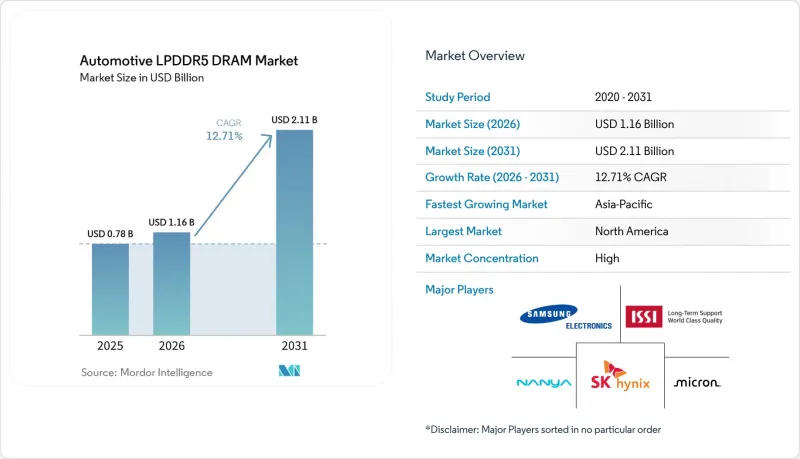
Mordor Intelligence에 의하면, 자동차용 LPDDR5 DRAM 시장 규모는 2025년 7억 8,000만 달러로 평가되었고, 2026년에는 11억 6,000만 달러로 확대될 것으로 추정되고, 2026-2031년 CAGR 12.71%로 성장을 지속할 전망이며, 2031년에는 21억 1,000만 달러에 이를 것으로 예측됩니다.
본 보고서는 AEC-Q100 온도 등급별(등급 1(-40℃-+125℃), 등급 2(-40℃-+105℃), 기타), 용도별(ADAS 및 자율주행용 컴퓨팅 등), 컨트롤러 아키텍처별(도메인 컨트롤러 등), 차량 등급별(승용차 등), 그리고 지역별로 분류되어 있습니다. 시장 전망은 금액(달러) 기준으로 제시되어 있습니다.
세계의 자동차용 LPDDR5 DRAM 시장 동향 및 인사이트
ADAS 및 레벨 2+/3용 연산 처리 확대
자동차용 LPDDR5 DRAM 시장에서는 지각, 센서 융합 및 운전 판단 워크로드에 높은 대역폭과 대용량 작업 메모리 풀이 모두 필요하기 때문에 프로세서 성능 향상을 능가하는 속도로 메모리 수요가 증가하고 있습니다. 카메라, 레이더, 운전자 모니터링 기능의 동시 실행이 증가함에 따라 메모리 서브시스템은 단순한 배경 구성 요소가 아닌, 직접적인 성능 제약 요인이 되고 있습니다. 마이크론은 차량용 멀티모달 AI를 수 기가바이트 규모의 모델, 고속 콜드 부팅, 실시간 추론을 핵심으로 하는 워크로드로 정의하고 있으며, 이는 첨단 연산 플랫폼에서 고성능 차량용 메모리로의 전환을 촉진하고 있습니다. 르네사스는 2025년 12월, 덴소가 토요타의 신형 RAV4에 자사의 R-Car V4H ADAS SoC를 채택한 사례를 구체적인 실용 사례로 제시했습니다. 이 플랫폼은 카메라와 레이더의 융합, 운전자 모니터링, 고급 주차 지원, 파노라마 뷰 기능을 중심으로 구성되어 있으며, 이러한 기능에는 인증된 워킹 메모리가 필수적입니다. 동시에 기능 안전 요건도 인증 기준을 높이고 있습니다. ASIL-D 수준의 워크로드에서는 일반 소비자용 전자기기보다 오류 처리, 신뢰성 및 열적 안정성에 대해 더 엄격한 요건이 부과되기 때문입니다. 이에 따라 LPDDR5는 새로운 ADAS 도메인 컨트롤러 및 향후 자율주행용 컴퓨팅 스택을 위한 실용적인 메모리 솔루션으로서, 자동차용 LPDDR5 DRAM 시장에서 확고한 입지를 계속해서 다지고 있습니다.
집중형 및 구역형 E/E 아키텍처
자동차용 LPDDR5 DRAM 시장은 다수의 독립적인 ECU에서 도메인, 구역 및 집중형 컴퓨팅 레이아웃으로의 전환을 통해 재편되고 있습니다. 분산형 설계에서는 메모리가 여러 개의 소규모 컨트롤러에 분산되는 반면, 집중형 설계에서는 더 대규모의 메모리 풀이 여러 워크로드를 동시에 관리해야 하는 소수의 고성능 노드에 배치됩니다. 이러한 전환으로 인해 차량당 메모리의 가치가 높아집니다. 통합으로 인해 연산 부하가 경감되는 것이 아니라, 오히려 더 많은 소프트웨어, 데이터 트래픽 및 동시 실행 처리가 더 적은 수의 위치에 집중되기 때문입니다. JEDEC의 자동차용 AI 용도를 위한 LPDDR 메모리 관련 노력은 고도의 연산 처리와 대역폭을 대량으로 소비하는 자동차 시스템을 뒷받침하는 데 있어 고속·저전력 메모리가 수행하는 역할을 부각시키고 있으며, 이는 이번 아키텍처 전환과 일치합니다. ECARX는 CES 2026에서 퀄컴의 Snapdragon Elite 자동차용 플랫폼을 기반으로 한 ‘Zenith’ 컴퓨팅 플랫폼을 통해 이러한 방향성을 재확인하고, 콕핏 기능과 ADAS 기능이 어떻게 통합된 하드웨어 스택에 융합되어 있는지를 보여주었습니다. 이 모델이 보급됨에 따라 컨트롤러 수가 감소하더라도, 자동차용 LPDDR5 DRAM 시장에서는 차량당 탑재량이 계속 증가할 것입니다.
AI 서버용 HBM 할당이 자동차용 DRAM 공급을 압박
자동차용 LPDDR5 DRAM 시장은 여전히 기본적인 할당 문제로 인해 제약을 받고 있습니다. 이는 자동차 수요가 LPDDR5로 전환되는 한편, 대용량 메모리가 고수익률의 AI 관련 제품으로 흡수되고 있기 때문입니다. 업계가 동시에 DDR4 및 LPDDR4에서 전환을 추진하고 있기 때문에 이 문제는 현재 더욱 중요해지고 있습니다. 그 결과, 자동차 제조업체들이 새로운 플랫폼 주기를 위해 구형 메모리 옵션을 확보할 여지는 거의 남아 있지 않습니다. 마이크론은 차량용 AI 용도의 고도화로 인해 발생하는 메모리 부하 증가에 대해 설명하며, 자동차 업계 수요 증가가 주요 제조업체들이 다른 프리미엄 메모리 카테고리를 우선시하는 공급 환경과 충돌하고 있다고 지적합니다. 자동차 제조업체나 Tier 1 공급업체에게 있어 이 문제는 더 이상 계약 가격 상승에 그치지 않습니다. 왜냐하면 설계가 확정되고 나면, 인증을 받은 차량용 메모리를 신속하게 교체할 수 없기 때문입니다. 따라서 기존 메모리에서 LPDDR5로의 강제적인 전환은 이미 수년 단위의 출시 일정이 확정된 프로그램에 있어 비용 측면뿐만 아니라 생산 라인의 리스크 측면에서도 영향을 미칩니다. 인증된 생산 능력이 대폭 확대되기 전까지는 자동차용 LPDDR5 DRAM 시장은 할당량 부족이나 조달 유연성 저하 등의 영향을 계속 받을 것입니다.
부문 분석
그레이드 1은 2025년에 자동차용 LPDDR5 DRAM 시장 점유율의 63.08%를 차지할 것으로 예상되며, 2026-2031년 연평균 성장률(CAGR) 12.98%로 확대될 것으로 전망되어, 이로 인해 온도 등급 중 가장 크고 성장 속도가 가장 빠른 등급이 되었습니다. 이러한 선도적 지위는 새로운 컴퓨팅 하드웨어가 도입되고 있는 분야, 특히 ADAS 컨트롤러, 존 게이트웨이, 그리고 차량 내 전용 전자기기보다 더 엄격한 열 부하에 직면하는 차량용 중앙 컴퓨터를 반영합니다. 2등급은 HVAC 관리를 통해 주변 환경이 보다 엄격한 범위 내로 유지되고, 일상적인 주행 주기에서 열 부하의 예측 가능성이 비교적 높은 많은 기존 조종석 및 인포테인먼트 프로그램에서 계속해서 채택되고 있습니다. 등급 3은 비중요 디스플레이, 기본 계기판 및 후방 구역의 텔레매틱스 유닛에서 여전히 중요했지만, 새로운 차량용 전자 기기가 고성능화와 소프트웨어 워크로드의 고밀도화를 향해 나아가고 있기 때문에 그 적용 범위는 여전히 제한적이었습니다.
자동차용 LPDDR5 DRAM 시장에서는 집중형 컴퓨팅으로 인해 메모리 서브시스템의 대부분이 더 높은 작동 온도 환경이나 더 긴 듀티 사이클에 가까운 위치에 배치되게 되었기 때문에 콕핏이나 텔레매틱스용 메모리조차도 점차 등급 1의 요구 사항에 가까워지고 있습니다. 자동차용 AI 용도를 위한 JEDEC의 LPDDR 관련 노력에서는 첨단 차량용 컴퓨팅에서 스위칭 활동과 열 스트레스가 동시에 증가함에 따라 고속 메모리와 온다이 보정 기능이 점점 더 중요해질 것임을 강조했습니다. 자동차용 LPDDR5 DRAM 업계에서는 리프레시 전략의 중요성도 높아지고 있습니다. 이는 설계자가 다양한 온도 등급에 걸쳐 대기 전력, 레이턴시 안정성, 안전 인증 요건의 균형을 맞추어야 하기 때문입니다. 마이크론의 직접 링크 ECC 접근 방식은 대역폭 향상과 안전성을 중시한 강력한 보호 기능이 프리미엄 설계에서의 선택적 기능 강화가 아니라, 그레이드 1 디바이스의 핵심 차별화 요소가 될 수 있음을 보여주었습니다.
2025년 자동차용 LPDDR5 DRAM 시장 규모 중 디지털 콕핏 및 차량용 디스플레이 시스템이 36.52%를 차지한 반면, 텔레매틱스, 커넥티비티, 그리고 V2X 시스템은 2026년부터 2031년에 걸쳐 연평균 성장률(CAGR) 13.01%로 확대될 것으로 예측됩니다. 이러한 구성은 콕핏 분야 수요가 대상 차량 기반이 훨씬 넓기 때문에 탑재 대수 측면에서 여전히 주도적인 위치를 차지하고 있음을 보여줍니다. 반면, 커넥티비티 및 V2X는 규모는 작지만 성장 속도가 빠른 기반에서 확대되고 있습니다. 콕핏 분야는 가격대에 관계없이 폭넓게 채택되고 있다는 장점이 있습니다. 이는 대중차라 하더라도 이전 플랫폼에 비해 더 고해상도의 그래픽, 고속 인터페이스, 디지털 계기판, 그리고 더 많은 디스플레이 면적을 채택하고 있기 때문입니다. 텔레매틱스와 V2X의 확대 속도가 빠른 이유는 5G 연결을 통한 통신, 안전한 데이터 교환, 위치 정보, 지속적인 연결성 등 모든 기능에서 기존 텔레매틱스보다 차량 에지 측에서 더 많은 메모리가 필요하기 때문입니다.
스프링거 네이처(Springer Nature)의 ‘V2X(Vehicle-to-Everything) 통신’에 관한 조사에 따르면, 커넥티드카 시스템을 저지연 통신, 센싱, 위치 파악, 보안을 동시에 처리하는 병렬 데이터 환경으로 설명하고 있으며, 이것이 해당 모듈에서 작업 메모리 요구 사항이 높아지고 있는 이유를 설명하고 있습니다. 또한, 자동차용 LPDDR5 DRAM 시장은 ADAS(첨단 운전자 지원 시스템) 및 자율 주행을 위한 연산 처리의 영향을 여전히 강하게 받고 있습니다. 이는 출하 대수 기준으로는 콕핏용 용도이 선두를 달리고 있지만, 시스템 단위로 볼 때 이 용도이 가장 높은 메모리 집약도를 가지고 있기 때문입니다. 자동차용 LPDDR5 DRAM 업계에서 중앙 연산 플랫폼이 이러한 기능을 공유 하드웨어 및 통합 소프트웨어 스택에 더욱 통합해 나감에 따라, 콕핏, ADAS, 텔레매틱스의 경계는 더욱 모호해질 것입니다. 이러한 융합이 중요한 이유는 향후 플랫폼에서는 각 용도를 개별적인 구매 결정으로 다루기보다는 중앙 연산 아키텍처의 일부로서 메모리를 구매하게 될 가능성이 높기 때문입니다.
지역별 분석
아시아태평양은 2025년에 자동차용 LPDDR5 DRAM 시장 점유율의 60.97%를 차지한 것으로 평가되었으며, 2026-2031년 연평균 성장률(CAGR) 13.66%로 성장할 것으로 전망됩니다. 이 지역은 최대 규모의 신에너지차(NEV) 보유 대수와 가장 탄탄한 메모리 제조거점을 모두 갖추고 있어, 수요 및 공급 양면에서 영향력이 이 지역에 계속 집중되고 있습니다. 한국은 국내 주요 공급업체들이 안전 인증을 획득한 자동차용 메모리에 대한 투자를 지속하고 있어 여전히 특히 중요한 위치를 차지하고 있습니다. 또한, SK하이닉스가 2026년 1월에 획득한 ASIL-D 인증은 이 인증이 전 세계 자동차 프로그램에서 얼마나 중요해지고 있는지를 보여줍니다. 중국에서는 전기차(EV) 및 소프트웨어 정의 차량의 보급이 가속화되면서 수요의 모멘텀이 강화되고 있으며, 이에 따라 집중형 컴퓨팅의 조기 도입이 촉진되어 차량 1대당 LPDDR5 탑재량이 증가하고 있습니다. 일본은 자동차 부품 공급업체와 전자기기 제조업체 간의 긴밀한 협력을 통해 공급망의 깊이를 더하고 있으며, 이를 통해 장기적인 자동차 프로그램 주기 전반에 걸친 조정 및 인증이 원활하게 이루어지고 있습니다.
북미는 수량 점유율은 작지만, 자동차용 LPDDR5 DRAM 시장에서 전략적으로 중요한 위치를 계속 차지하고 있습니다. 이는 미국의 여러 OEM이 차량의 집중형 컴퓨팅 및 소프트웨어 비율 향상을 위해 빠르게 움직이고 있기 때문입니다. 이러한 아키텍처 선호로 인해, 여전히 도메인 기반 레이아웃이 주를 이루는 다른 지역에 비해 제품 주기의 초기 단계에서 고밀도 작업 메모리에 대한 수요가 발생하고 있습니다. 르네사스와 전 세계 파운드리 업체들은 2026년 2월 제휴 관계를 확대하여 미국 내 차세대 자동차용 반도체 제조를 지원했습니다. 이는 해당 지역이 국내 공급의 회복탄력성 강화와 자동차용 칩의 현지화 지원을 추진하고 있는 움직임과 부합합니다. 또한 마이크론도 차량용 멀티모달 AI의 메모리 수요 증가를 강조하고 있어, 미래 차량 플랫폼을 위한 고성능 자동차용 메모리 로드맵 수립에서 북미가 수행하는 역할을 더욱 강화하고 있습니다.
유럽에서는 더 많은 플랫폼에서 광범위한 존형 아키텍처로의 전환이 표준화되기 전에, 많은 자동차 제조업체가 여전히 도메인 컨트롤러 전략을 채택하고 있어 보다 안정적인 성장 추세를 보이고 있습니다. 그럼에도 불구하고, EU의 ‘일반 안전 규정(General Safety Regulation)’에서 의무화한 안전 기능 덕분에 신차 프로그램 전반에 걸친 ADAS 관련 메모리 수요는 견고한 하방 지지력을 유지하고 있습니다. 세계 기타 지역에는 인도 등 시장이 포함됩니다. 인도에서는 2026년 2월 Mobileye가 마힌드라사와 계약을 체결함에 따라, 2027년 이후 출시될 최소 6개의 신차 모델에 고성능 ADAS 컴퓨팅이 탑재될 예정입니다. 이러한 지역별 구성을 통해, 자동차용 LPDDR5 DRAM 시장에서는 아시아태평양이 주도적인 입지를 차지하고 있으며, 북미는 아키텍처의 조기 추진자, 유럽은 규제 준수를 주도하는 도입 지역, 그리고 신흥 시장이 컴퓨팅 성능이 높은 차량의 다음 도입 물결이 될 것으로 나타났습니다.
기타 혜택 :
- 엑셀 형식 시장 예측(ME) 시트
- 3개월간의 애널리스트 지원
자주 묻는 질문
목차
제1장 서론
제2장 조사 방법
제3장 주요 요약
제4장 시장 구도
제5장 시장 규모 및 성장 예측
제6장 경쟁 구도
제7장 시장 기회 및 향후 전망
AJY 26.08.07According to Mordor Intelligence, the automotive LPDDR5 DRAM market size is expected to grow from USD 0.78 billion in 2025 to USD 1.16 billion in 2026 and is forecast to reach USD 2.11 billion by 2031 at 12.71% CAGR over 2026-2031.
This report is Segmented by AEC-Q100 Temperature Grade (Grade 1 (-40 Degree Celsius To +125 Degree Celsius), Grade 2 (-40 Degree Celsius To +105 Degree Celsius), and More), Application (ADAS and Automated Driving Compute, and More), Controller Architecture (Domain Controller, and More), Vehicle Class (Passenger Cars, and More), and Geography. The Market Forecasts are Provided in Terms of Value (USD).
Global Automotive LPDDR5 DRAM Market Trends and Insights
ADAS And Level 2+/3 Compute Expansion
The automotive LPDDR5 DRAM market is seeing memory demand rise faster than processor gains, because perception, sensor fusion, and driving decision workloads require both high bandwidth and large working memory pools. As more camera, radar, and driver monitoring functions run together, the memory subsystem becomes a direct performance constraint instead of a background component. Micron has described in-car multimodal AI as a workload built around multi-gigabyte models, fast cold boot, and real-time inference, which supports the ongoing move to higher-performance automotive memory in advanced compute platforms. Renesas provided a clear production example in December 2025 when Denso selected its R-Car V4H ADAS SoC for Toyota's new RAV4, a platform built around camera-radar fusion, driver monitoring, advanced parking, and panoramic view functions that depend on qualified working memory. Functional safety is raising the qualification bar at the same time, because ASIL-D workloads place stricter demands on error handling, reliability, and thermal consistency than consumer electronics do. This keeps LPDDR5 firmly positioned in the automotive LPDDR5 DRAM market as the practical memory path for new ADAS domain controllers and future autonomous compute stacks.
Centralized And Zonal E/E Architectures
The automotive LPDDR5 DRAM market is also being reshaped by the move away from many separate ECUs and toward domain, zonal, and central compute layouts. In a distributed design, memory is spread across several smaller controllers, but in a centralized design, larger memory pools sit at a few high-performance nodes that must manage multiple workloads at once. That shift raises memory value per vehicle, because consolidation does not reduce compute pressure and instead concentrates more software, more data traffic, and more concurrency into fewer locations. JEDEC's LPDDR memory work for automotive AI applications highlighted the role of high-speed low-power memory in supporting advanced compute and bandwidth-heavy automotive systems, which aligns with this architecture shift. ECARX reinforced the same direction at CES 2026 with its Zenith computing platform built on Qualcomm's Snapdragon Elite automotive platform, showing how cockpit and ADAS functions are being fused into a unified hardware stack. As this model spreads, the automotive LPDDR5 DRAM market will continue to see higher content per vehicle even when controller counts decline.
AI-Server HBM Allocation Crowding Out Automotive DRAM Supply
The automotive LPDDR5 DRAM market remains constrained by a basic allocation problem, because advanced memory capacity is being pulled toward higher-margin AI-linked products at the same time vehicle demand is shifting up to LPDDR5. This matters more now because the industry is moving away from DDR4 and LPDDR4 during the same period, which leaves little room for automakers to hold older memory choices for new platform cycles. Micron has described the growing memory load created by advanced in-car AI applications, and that rising automotive demand is colliding with a supply environment where leading manufacturers are prioritizing other premium memory categories. For automakers and tier 1 suppliers, the issue is no longer limited to higher contract prices, because qualified automotive memory cannot be replaced quickly once a design is frozen. The forced migration from legacy memory to LPDDR5, therefore, carries both cost and line-risk implications for programs already tied to multi-year launch schedules. Until certified capacity expands meaningfully, the automotive LPDDR5 DRAM market will continue to feel the effect of tight allocation and delayed sourcing flexibility.
Other drivers and restraints analyzed in the detailed report include:
- Premium Digital Cockpit And Multi-Display Infotainment Growth
- EV And Software-Defined Vehicle Platform Proliferation
- Long Automotive Qualification And Second-Source Cycles
For complete list of drivers and restraints, kindly check the Table Of Contents.
Segment Analysis
Grade 1 held 63.08% of the automotive LPDDR5 DRAM market share in 2025 and is projected to expand at 12.98% CAGR through 2026-2031, which made it both the largest and fastest-growing temperature class. That leadership reflects where new compute hardware is being deployed, especially in ADAS controllers, zonal gateways, and central vehicle computers that face tougher thermal loads than cabin-only electronics. Grade 2 continued to serve many legacy cockpit and infotainment programs where HVAC management keeps ambient conditions within tighter boundaries and where thermal exposure remains more predictable over daily driving cycles. Grade 3 still mattered for non-critical displays, basic clusters, and rear-zone telematics units, but its addressable role stayed narrower because newer vehicle electronics are moving toward higher performance and denser software workloads.
The automotive LPDDR5 DRAM market is gradually pulling even cockpit and telematics memory toward Grade 1 requirements, because centralized compute places larger portions of the memory subsystem closer to hotter operating environments and longer duty cycles. JEDEC's LPDDR work for automotive AI applications highlighted how higher-speed memory and on-die correction features become more important as switching activity and thermal stress rise together in advanced vehicle compute. Within the automotive LPDDR5 DRAM industry, refresh strategy is also becoming more important, because designers must balance standby power, latency stability, and safety certification demands across different temperature classes. Micron's direct link ECC approach showed how bandwidth uplift and stronger safety-oriented protection can become core differentiators for Grade 1 devices rather than optional enhancements in premium designs.
Digital Cockpit and In-Vehicle Display Systems accounted for 36.52% of the automotive LPDDR5 DRAM market size in 2025, while Telematics, Connectivity, and V2X Systems are projected to expand at 13.01% CAGR through 2026-2031. This split shows that cockpit demand still leads on installed volume because it reaches a much wider vehicle base, while connectivity and V2X are growing from a smaller but faster-moving foundation. The cockpit side benefits from broad adoption across price bands, since even mass-market vehicles now use richer graphics, faster interfaces, digital clusters, and more display surfaces than earlier platforms. Telematics and V2X are scaling faster because 5G-linked communication, secure data exchange, positioning, and continuous connectivity all require more memory at the vehicle edge than legacy telematics did.
Springer Nature's survey of vehicle-to-everything communication described connected vehicle systems as parallel data environments that handle low-latency communication, sensing, positioning, and security at the same time, which explains why working memory requirements are rising in these modules. The automotive LPDDR5 DRAM market also remains heavily influenced by ADAS and automated driving compute, because this application carries the highest memory intensity on a per-system basis even when cockpit programs lead by shipment volume. Within the automotive LPDDR5 DRAM industry, the line between cockpit, ADAS, and telematics is likely to blur further as central compute platforms absorb more of these functions into shared hardware and unified software stacks. That convergence matters because future platforms are likely to buy memory as part of a central compute architecture instead of treating each application as a separate purchasing decision.
Complete Report Scope:
- By AEC-Q100 Temperature Grade
- Grade 1 (-40 Degree Celsius to +125 Degree Celsius)
- Grade 2 (-40 Degree Celsius to +105 Degree Celsius)
- Grade 3 (-40 Degree Celsius to +85 Degree Celsius)
- By Application
- ADAS and Automated Driving Compute
- Digital Cockpit and In-Vehicle Display Systems
- Telematics, Connectivity and V2X Systems
- By Controller Architecture
- Dedicated ECU / Distributed Controller
- Domain Controller
- Zonal Controller
- Central Vehicle Computer
- By Vehicle Class
- Passenger Cars
- Commercial Vehicles
- By Geography
- North America
- Europe
- Asia-Pacific
- China
- Japan
- South Korea
- Taiwan
- Rest of Asia-Pacific
- Rest of the World
Geography Analysis
Asia-Pacific held 60.97% of the automotive LPDDR5 DRAM market share in 2025 and is projected to grow at 13.66% CAGR through 2026-2031. The region combines the largest new energy vehicle base with the deepest memory manufacturing footprint, which keeps both consumption and supply influence centered there. South Korea remains especially important because leading suppliers there continue to invest in safety-qualified automotive memory, and SK hynix's January 2026 ASIL-D certification showed how central that credential has become for global vehicle programs. China adds strong demand momentum through faster EV and software-defined vehicle adoption, which supports earlier uptake of centralized compute and lifts LPDDR5 content per vehicle. Japan adds supply-chain depth through close links between automotive suppliers and electronics manufacturing, which helps with coordination and qualification across long vehicle program cycles.
North America holds a smaller volume share, but it remains strategically important in the automotive LPDDR5 DRAM market because several U.S. OEMs are among the earlier movers toward central vehicle compute and higher software content. That architecture preference creates demand for high-density working memory earlier in the product cycle than in regions that are still more centered on domain-based layouts. Renesas and GlobalFoundries expanded their partnership in February 2026 to support next-generation automotive semiconductor manufacturing in the United States, which aligns with the region's push for stronger domestic supply resilience and more localized automotive chip support. Micron has also emphasized the growing memory demands of in-car multimodal AI, reinforcing North America's role in shaping higher-performance automotive memory roadmaps for future vehicle platforms.
Europe presents a steadier growth profile because many automakers there are still moving through domain-controller strategies before broader zonal transitions become standard on more platforms. Even so, mandatory safety features under the EU's General Safety Regulation keep a durable floor under ADAS-related memory demand across new vehicle programs. Rest of the World includes markets such as India, where Mobileye's February 2026 win with Mahindra will bring high-performance ADAS compute into at least 6 upcoming models from 2027. This regional mix leaves Asia-Pacific in the lead, North America as an early architecture driver, Europe as a compliance-led adopter, and emerging markets as the next wave of compute-rich vehicle launches in the automotive LPDDR5 DRAM market.
- Micron Technology, Inc.
- Samsung Electronics Co., Ltd.
- SK hynix Inc.
- Nanya Technology Corporation
- Integrated Silicon Solution, Inc.
- ChangXin Memory Technologies, Inc.
- Winbond Electronics Corporation
- Etron Technology, Inc.
- Elite Semiconductor Microelectronics Technology Inc.
- Alliance Memory, Inc.
- Qualcomm Technologies, Inc.
- NVIDIA Corporation
- Renesas Electronics Corporation
- Mobileye Global Inc.
- ECARX Holdings Inc.
Additional Benefits:
- The market estimate (ME) sheet in Excel format
- 3 months of analyst support
TABLE OF CONTENTS
1 INTRODUCTION
- 1.1 Study Assumptions and Market Definition
- 1.2 Scope of the Study
2 RESEARCH METHODOLOGY
3 EXECUTIVE SUMMARY
4 MARKET LANDSCAPE
- 4.1 Market Overview
- 4.2 Market Drivers
- 4.2.1 ADAS and Level 2+/3 Compute Expansion
- 4.2.2 Centralized and Zonal E/E Architectures
- 4.2.3 Premium Digital Cockpit and Multi-Display Infotainment Growth
- 4.2.4 EV and Software-Defined Vehicle Platform Proliferation
- 4.2.5 Functional-Safety-Qualified Working Memory Adoption
- 4.2.6 In-Cabin AI and Multimodal Sensing Bandwidth Demand
- 4.3 Market Restraints
- 4.3.1 AI-Server HBM Allocation Crowding Out Automotive DRAM Supply
- 4.3.2 Long Automotive Qualification and Second-Source Cycles
- 4.3.3 Automotive LPDDR5 ASP Premium Versus Consumer-Grade Memory
- 4.3.4 Thermal, Refresh, and Power-Density Limits in High-Capacity Modules
- 4.4 Industry Supply Chain Analysis
- 4.5 Regulatory Landscape
- 4.6 Technological Outlook
- 4.7 Impact of Macroeconomic Factors
- 4.8 Porter's Five Forces Analysis
- 4.8.1 Bargaining Power of Suppliers
- 4.8.2 Bargaining Power of Buyers
- 4.8.3 Threat of New Entrants
- 4.8.4 Threat of Substitutes
- 4.8.5 Intensity of Rivalry
5 MARKET SIZE AND GROWTH FORECASTS (VALUE)
- 5.1 By AEC-Q100 Temperature Grade
- 5.1.1 Grade 1 (-40 Degree Celsius to +125 Degree Celsius)
- 5.1.2 Grade 2 (-40 Degree Celsius to +105 Degree Celsius)
- 5.1.3 Grade 3 (-40 Degree Celsius to +85 Degree Celsius)
- 5.2 By Application
- 5.2.1 ADAS and Automated Driving Compute
- 5.2.2 Digital Cockpit and In-Vehicle Display Systems
- 5.2.3 Telematics, Connectivity and V2X Systems
- 5.3 By Controller Architecture
- 5.3.1 Dedicated ECU / Distributed Controller
- 5.3.2 Domain Controller
- 5.3.3 Zonal Controller
- 5.3.4 Central Vehicle Computer
- 5.4 By Vehicle Class
- 5.4.1 Passenger Cars
- 5.4.2 Commercial Vehicles
- 5.5 By Geography
- 5.5.1 North America
- 5.5.2 Europe
- 5.5.3 Asia-Pacific
- 5.5.3.1 China
- 5.5.3.2 Japan
- 5.5.3.3 South Korea
- 5.5.3.4 Taiwan
- 5.5.3.5 Rest of Asia-Pacific
- 5.5.4 Rest of the World
6 COMPETITIVE LANDSCAPE
- 6.1 Market Concentration
- 6.2 Strategic Moves
- 6.3 Market Share Analysis
- 6.4 Company Profiles (includes Global level Overview, Market level overview, Core Segments, Financials as available, Strategic Information, Market Rank/Share for key companies, Products and Services, and Recent Developments)
- 6.4.1 Micron Technology, Inc.
- 6.4.2 Samsung Electronics Co., Ltd.
- 6.4.3 SK hynix Inc.
- 6.4.4 Nanya Technology Corporation
- 6.4.5 Integrated Silicon Solution, Inc.
- 6.4.6 ChangXin Memory Technologies, Inc.
- 6.4.7 Winbond Electronics Corporation
- 6.4.8 Etron Technology, Inc.
- 6.4.9 Elite Semiconductor Microelectronics Technology Inc.
- 6.4.10 Alliance Memory, Inc.
- 6.4.11 Qualcomm Technologies, Inc.
- 6.4.12 NVIDIA Corporation
- 6.4.13 Renesas Electronics Corporation
- 6.4.14 Mobileye Global Inc.
- 6.4.15 ECARX Holdings Inc.
7 MARKET OPPORTUNITIES AND FUTURE OUTLOOK
- 7.1 White-space and unmet-need assessment


