

|
시장보고서
상품코드
2098587
사이버 위협 인텔리전스 공유 플랫폼 : 시장 점유율 분석, 업계 동향과 통계, 성장 예측(2026-2031년)Cyber Threat Intelligence Sharing Platforms - Market Share Analysis, Industry Trends & Statistics, Growth Forecasts (2026 - 2031) |
||||||
 Mordor Intelligence
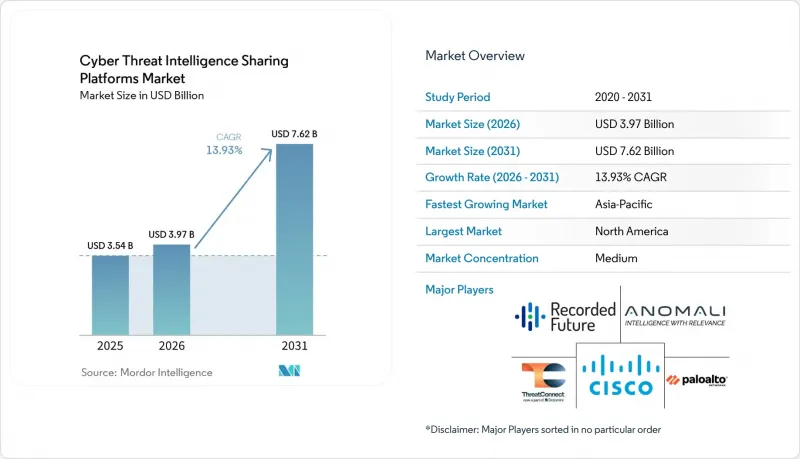
Mordor Intelligence에 의하면, 사이버 위협 인텔리전스 공유 플랫폼 시장 규모는 2025년에 35억 4,000만 달러, 2026년에 39억 7,000만 달러에서 2031년까지 76억 2,000만 달러에 이를 것으로 예측되며, 2026-2031년 CAGR 13.93%를 기록할 전망입니다.
본 보고서는 구성 요소(소프트웨어 및 서비스), 도입 형태(클라우드, On-Premise, 하이브리드), 기업 규모(대기업 및 중소기업), 위협 인텔리전스 유형(전략적 인텔리전스 등), 최종 사용자 산업(은행, 금융서비스 및 보험(BFSI), 헬스케어 및 생명과학 등), 지역별로 분류되어 있습니다. 시장 전망은 금액(달러)으로 표시되어 있습니다.
세계 사이버 위협 인텔리전스 공유 플랫폼 시장 동향 및 인사이트
사고의 적시 공개 및 정보 공유에 대한 규제적 압력
규제 의무는 사이버 위협 인텔리전스 공유 플랫폼 시장에 있어 가장 명확한 단기 성장 동력으로 작용하고 있습니다. 이는 인텔리전스 공유를 재량적인 보안 대책이 아닌 문서화된 관리 조치로 전환하기 위함입니다. DORA(디지털 운영 위험법)에 따르면, 2025년 1월 17일 이후 금융 기관 및 해당 ICT 제3자 공급업체는 공식적인 사이버 복원력 및 보고 프로세스를 유지해야 할 의무가 있으며, 이로 인해 구조화된 증거와 재현 가능한 인텔리전스 워크플로우에 대한 필요성이 높아지고 있습니다. 초안에서는 또한 NIS2에 따라 사이버 보고 및 정보 공유에 대한 기대가 유럽의 더 광범위한 조직으로 확대되었습니다는 점도 지적하고 있습니다. 이로 인해 정보의 수집, 분류, 배포를 자동화할 수 있는 플랫폼의 잠재적 고객 기반이 크게 확대되었습니다. 이러한 규제 변화가 중요한 이유는 일반적인 보안 로그로는 공식 CTI 플랫폼이 검토나 사고 후속 조치 시 제공할 수 있는 교환 구조, 정보 보강을 위한 맥락, 또는 문서화 기록을 제공할 수 없기 때문입니다. 또한, 유럽 고객을 지원하는 공급업체 및 서비스 파트너들이 이러한 규정 준수 요건을 충족하는 공통 워크플로우를 점점 더 필요로 하고 있기 때문에 유럽 외의 다국적 기업에도 영향을 미치고 있습니다. 실제로 사이버 위협 인텔리전스 공유 플랫폼 시장에서 규제는 제품 설계와 구매의 시급성 모두에 영향을 미치고 있습니다.
다자간 위협 인텔리전스 협업 빈도 증가
사이버 위협 인텔리전스 공유 플랫폼 시장은 협업형 공유 모델이 이전보다 더 많은 데이터, 더 많은 참여자, 그리고 더 많은 산업별 이용 사례를 처리할 수 있게 됨에 따라 계속 확대되고 있습니다. RH-ISAC은 2025년 말 기준 333개의 핵심 회원 조직을 보유하고 있으며, 연간 52개의 신규 회원을 확보했고, 회원 참여율은 96%에 달했으며, 플랫폼 전체에서 총 2만 건에 가까운 인텔리전스 공유를 기록했습니다. FS-ISAC의 보고서에 따르면, 2025년 활동은 75개국에 걸친 5,000개 이상의 금융 기업 회원의 요구를 반영한 것이며, 생성형 AI를 활용한 사기 및 공급망 공격이 해당 부문이 직면한 가장 중요한 위협 중 하나로 꼽혔습니다. 정보 제공업체의 수와 공유되는 지표의 양이 증가함에 따라, 구매자들은 커뮤니티의 피드와 상용 인텔리전스를 단일 운영 뷰로 통합할 수 있는 플랫폼을 더욱 높이 평가했습니다. 이로 인해 사이버 위협 인텔리전스 공유 플랫폼 시장에서 정보 수집, 보강, 신뢰도 평가 및 워크플로 라우팅의 중요성이 더욱 커지고 있습니다. 공유 인텔리전스는 운영에 쉽게 적용될 때만 가치를 창출하므로, 협업에 수반되는 수작업 부담을 줄일 수 있는 공급업체가 유리한 입장에 있습니다.
정보 과잉과 낮은 신호 대 잡음비
사이버 위협 인텔리전스 공유 플랫폼 시장의 주요 제약 요인은 피드의 양이 이를 확인·보강·대응하기 위한 인적 역량을 능가하는 속도로 증가하고 있다는 점입니다. Google Cloud의 조사에 따르면, 보안 담당자의 82%가 경보의 양으로 인해 중요한 위협을 놓칠까 우려하고 있으며, 61%는 위협 인텔리전스의 효과적인 운영에 있어 주요 장애물로 피드의 양을 꼽았고, 60%는 분석가 인력 부족을 지적했습니다. 이는 구매자들이 더 많은 인텔리전스를 요구할 뿐만 아니라, 더 우수한 필터링, 순위 지정 및 워크플로 자동화도 요구하고 있음을 의미합니다. 커뮤니티를 통한 정보 공유가 확대되면 이 문제는 더욱 심각해집니다. 게시되는 정보의 양이 조직이 지표를 평가하고 어떤 정보가 중요한지 판단하는 능력을 능가하는 속도로 증가할 가능성이 있기 때문입니다. 그 결과, 사이버 위협 인텔리전스 공유 플랫폼 시장은 원시 데이터 양 증가로부터 균등하게 혜택을 받는 것은 아닙니다. 품질이 낮거나 우선순위가 제대로 매겨지지 않은 신호는 실질적인 가치를 떨어뜨릴 가능성이 있기 때문입니다. 따라서 사전 조사, 중복 제거, 경보 축소 기능을 제공하는 벤더는 주로 새로운 피드만 추가하는 벤더보다 구매자의 요구에 더 부합한다고 할 수 있습니다.
부문 분석
2025년, 사이버 위협 인텔리전스 공유 플랫폼 시장에서 소프트웨어는 59.84%의 점유율을 차지하며 시장을 주도했습니다. 이는 구매자들이 여전히 피드 수집, 스코어링, 보강 및 배포를 일원화하는 라이선스 기반 플랫폼을 선호하고 있음을 보여줍니다. 이러한 주도적 지위는 새로운 사일로를 형성하지 않으면서 인텔리전스를 기존 보안 워크플로우에 연결하는 공통 시스템에 대한 실질적인 필요성에서 기인합니다. 사이버 위협 인텔리전스 공유 플랫폼 시장에서 소프트웨어는 기업의 감지 및 대응 도구와의 더 깊은 통합을 통해 이점을 얻고 있습니다. 이러한 통합 덕분에 소프트웨어는 광범위한 가시성, 표준화된 워크플로우, 그리고 내부 및 외부 데이터의 일관된 처리가 필요한 조직을 위한 기본 인프라로 자리 잡고 있습니다.
서비스 부문은 2026년부터 2031년까지 연평균 성장률(CAGR) 14.98%를 나타낼 것으로 예측되며, 사이버 위협 인텔리전스 공유 플랫폼 시장에서 가장 빠르게 성장하는 분야가 될 전망입니다. 서비스 부문의 성장은 많은 조직이 인텔리전스 결과를 신속하게 필요로 하는 반면, 전체 프로세스를 사내에서 관리할 전담 분석가가 여전히 부족하다는 사실을 반영합니다. 이 초안에서는 벤더가 모듈형 제공 모델을 통해 피싱 감지, 다크웹 모니터링, 브랜드 악용 방지 등의 작업을 자동화하고 있는 사례로 SOCRadar의 ‘AI Agent 마켓플레이스’를 꼽고 있습니다. 따라서 사이버 위협 인텔리전스 공유 플랫폼 시장에서 소프트웨어는 핵심 계층으로서의 지위를 유지하는 한편, 서비스 부문은 보다 신속한 도입과 인력 부담 경감을 원하는 구매자층에 대한 접근성을 확대되고 있습니다.
2025년에는 On-Premise에서 모든 것을 관리하기를 원하지 않는 팀을 대상으로, 확장성, 피드 업데이트 속도 향상, 인프라 오버헤드 감소와 같은 이점에 힘입어 클라우드가 위협 인텔리전스 공유 플랫폼 시장의 52.91%를 차지했습니다. 많은 구매자가 이 모델을 선호하는 이유는 설정 시간이 단축되고, 다수의 사용자나 거점에 위협 인텔리전스를 손쉽게 배포할 수 있기 때문입니다. 사이버 위협 인텔리전스 공유 플랫폼 시장에서 클라우드 도입은 대규모 On-Premise 운영 없이도 폭넓은 기능을 원하는 중규모 조직에게도 효과적입니다. 이로 인해 현재 매출 점유율 측면에서 클라우드는 주요 도입 모델로서의 입지를 유지하고 있습니다.
하이브리드 도입은 2026-2031년 연평균 성장률(CAGR) 15.09%를 나타낼 것으로 예측되며, 사이버 위협 인텔리전스 공유 플랫폼 시장에서 가장 빠르게 성장하는 도입 유형이 될 전망입니다. 이러한 성장 추세가 가장 두드러지는 분야는 기밀성이 높은 텔레메트리 데이터나 현장 증거를 직접 관리하되, 기밀성이 낮은 지표에 대해서는 클라우드 규모의 데이터 보강 및 협업을 활용하고자 하는 규제 대상 부문입니다. DORA(데이터 관리 요건) 및 관련 거버넌스상의 압박으로 인해 문서화된 처리 절차, 복원력 있는 워크플로우, 필요에 따른 기밀 프로세스의 명확한 분리에 대한 수요가 증가하고 있으며, 이것이 해당 아키텍처를 뒷받침하고 있습니다. 사이버 위협 인텔리전스 공유 플랫폼 시장은 클라우드를 벗어나는 방향으로 나아가고 있지는 않지만, 보다 체계적인 운영 모델을 필요로 하는 구매자의 요구에 적응해 가고 있습니다.
지역별 분석
2025년, 북미는 사이버 위협 인텔리전스 공유 플랫폼 시장의 31.09%를 차지하며, 본 보고서에서 가장 규모가 큰 지역 부문으로 나타났습니다. 이 지역은 대규모 기업 보안 운영 기반, 성숙한 ISAC 생태계, 그리고 BFSI(은행 및 금융 및 보험), 에너지, 의료, 소매 업계에서의 확고한 활용 실적을 강점으로 가지고 있습니다. 사이버 위협 인텔리전스 공유 플랫폼 시장에서 이러한 조건들은 사내 팀과 커뮤니티 공유 기관 및 상용 인텔리전스 정보원을 연결할 수 있는 플랫폼에 대한 강력한 수요를 뒷받침하고 있습니다. 미국은 기업의 막대한 지출과 광범위한 산업별 협력 모델을 모두 갖추고 있어, 계속해서 해당 지역 수요를 견인하는 주요 동력이 되고 있습니다. 이에 따라 벤더 입장에서는 교차 판매 기회, 워크플로우 통합, 그리고 관리형 인텔리전스 제공을 위한 성숙한 환경이 조성되어 있습니다.
유럽은 NIS2 시행 단계 및 DORA 운영 단계에 이어 규제 의무가 급격히 확대됨에 따라, 2025년에도 사이버 위협 인텔리전스 공유 플랫폼 시장의 주요 부분을 계속 차지했습니다. 초안에 따르면, NIS2로 인해 규정 준수 대상 범위가 유럽 내 약 2만 개에서 30만 개 사업체로 확대되었으며, 이에 따라 구조화된 공유 및 보고 워크플로우의 잠재적 사용자 기반이 대폭 확대되었습니다. DORA는 2026년에 추가적인 압박을 가했습니다. 이는 금융 기관 및 관련 ICT 제공업체에 대해 더욱 엄격한 문서화 및 복원력 절차가 요구되기 시작했기 때문입니다. 따라서 유럽은 사이버 위협 인텔리전스 공유 플랫폼 시장에서 구매 결정이 감사 대응 체계 및 공식적인 운영 관리와 점점 더 밀접하게 연계되어 있는 지역으로 두드러지고 있습니다.
아시아태평양은 2026년부터 2031년까지 연평균 성장률(CAGR) 15.53%를 기록하며, 모든 지역 중 가장 높은 성장이 예상됩니다. 이 초안에 따르면, 이러한 상승세는 일본, 인도, 한국에서 국가 주도의 활동이 활발해지고 규제가 지속적으로 현대화되고 있기 때문인 것으로 분석됩니다. 이러한 요인들이 복합적으로 작용함에 따라, 현지 운영을 보다 광범위한 위협 상황 및 협력적인 방어 워크플로우와 연계할 수 있는 도구에 대한 수요가 증가하고 있습니다. 또한, 사이버 위협 인텔리전스 공유 플랫폼 시장은 디지털 금융 시스템의 확대와 공식적인 정보 공유 체계의 성숙에 따라 남미, 중동 및 아프리카에서도 성장 여지가 있습니다.
기타 혜택:
- 엑셀 형식 시장 예측(ME) 시트
- 3개월간의 애널리스트 지원
자주 묻는 질문
목차
제1장 서론
제2장 조사 방법
제3장 주요 요약
제4장 시장 구도
제5장 시장 규모와 성장 예측
제6장 경쟁 구도
제7장 시장 기회와 향후 전망
KTH 26.08.06According to Mordor Intelligence, the cyber threat intelligence sharing platforms market size is projected to be USD 3.54 billion in 2025, USD 3.97 billion in 2026, and reach USD 7.62 billion by 2031, growing at a CAGR of 13.93% from 2026 to 2031.
This report is Segmented by Component (Software and Services), Deployment (Cloud, On-Premises, and Hybrid), Enterprise Size (Large Enterprises and Small and Medium Enterprises), Threat Intelligence Type (Strategic Intelligence, and More), End-User Industry (BFSI, Healthcare and Life Sciences, and More), and Geography. The Market Forecasts are Provided in Terms of Value (USD).
Global Cyber Threat Intelligence Sharing Platforms Market Trends and Insights
Regulatory Pressure for Timely Incident Disclosure and Information Sharing
Regulatory mandates are the clearest near-term growth engine for the cyber threat intelligence sharing platforms market because they turn intelligence sharing into a documented control rather than a discretionary security practice. DORA has required financial entities and their ICT third-party providers to maintain formal cyber resilience and reporting processes since January 17, 2025, which raises the need for structured evidence and repeatable intelligence workflows. The source draft also notes that NIS2 expanded cyber reporting and information-sharing expectations across a much broader set of European organizations, which materially widened the addressable base for platforms that can automate intake, classification, and distribution. This regulatory shift matters because generic security logs do not provide the same exchange structure, enrichment context, or documentation trail that formal CTI platforms can provide during reviews and incident follow-up. It also affects multinational enterprises outside Europe, as suppliers and service partners supporting European customers increasingly need common workflows that meet these compliance expectations. In practice, the cyber threat intelligence sharing platforms market is seeing regulation shape both product design and purchasing urgency.
Rising Frequency of Multi-Party Threat Intelligence Collaboration
The cyber threat intelligence sharing platforms market is also expanding as collaborative sharing models handle more data, more participants, and more sector-specific use cases than before. RH-ISAC closed 2025 with 333 core member organizations, added 52 new members during the year, reached 96% member engagement, and recorded nearly 20,000 total intelligence shares across platforms. FS-ISAC reported that its 2025 work reflected the needs of more than 5,000 financial firm members across 75 countries, with GenAI-enabled fraud and supply chain attacks ranking among the most important threats facing the sector. As the number of contributors and the volume of shared indicators rise, buyers place greater value on platforms that can merge community feeds with commercial intelligence into a single operating view. This is raising the relevance of ingestion, enrichment, confidence scoring, and workflow routing in the cyber threat intelligence sharing platforms market. Vendors that reduce the manual burden of collaboration are better placed because shared intelligence only creates value when it is easy to operationalize.
Intelligence Overload and Low Signal-to-Noise Ratio
A major restraint in the cyber threat intelligence sharing platforms market is that feed volume is rising faster than the human capacity to review, enrich, and act on it. Google Cloud found that 82% of security practitioners worried about missing critical threats due to alert volume, 61% cited too many feeds as the main obstacle to effective operationalization of threat intelligence, and 60% pointed to insufficient analyst capacity. This means buyers are not only asking for more intelligence, but also for better filtering, ranking, and workflow automation. The problem becomes more serious when community sharing expands, because contribution volume can rise faster than an organization's ability to score indicators and decide which ones matter. As a result, the cyber threat intelligence sharing platforms market does not benefit equally from raw volume growth, since low-quality or poorly prioritized signals can reduce practical value. Vendors that offer pre-investigation, deduplication, and alert reduction are therefore better aligned with buyer needs than vendors that mainly add new feeds.
Other drivers and restraints analyzed in the detailed report include:
- Automation of IOC Normalization Across Disparate Security Stacks
- Expansion of Sectoral ISAC and ISAO Participation
- Trust Deficits Around Data Sensitivity and Source Attribution
For complete list of drivers and restraints, kindly check the Table Of Contents.
Segment Analysis
Software dominated the cyber threat intelligence sharing platforms market with a 59.84% share in 2025, which shows that buyers still prefer licensed platforms that centralize feed ingestion, scoring, enrichment, and dissemination. This leadership stems from the practical need for a common system that connects intelligence to existing security workflows without creating new silos. In the cyber threat intelligence sharing platforms market, software also benefits from deeper integration with enterprise detection and response tools. Those integrations make software the default foundation for organizations that need broad visibility, standardized workflows, and consistent handling of internal and external data.
Services is projected to grow at a 14.98% CAGR from 2026 to 2031, making it the fastest-growing component in the cyber threat intelligence sharing platforms market. Growth in services reflects the fact that many organizations need intelligence outcomes quickly but still lack enough dedicated analysts to manage the entire process in-house. The source draft points to SOCRadar's AI Agent Marketplace as an example of how vendors are automating tasks such as phishing detection, dark web monitoring, and brand abuse protection through modular delivery models. The cyber threat intelligence sharing platforms market is, therefore, keeping software as the core layer while services expand access for buyers that want faster deployment and lower staffing pressure.
Cloud captured 52.91% of the cyber threat intelligence sharing platforms market in 2025, supported by scalability, faster feed updates, and lower infrastructure overhead for teams that do not want to manage everything on premises. Many buyers prefer this model because it shortens setup time and makes it easier to distribute intelligence across many users and locations. In the cyber threat intelligence sharing platforms market, cloud deployment also works well for mid-sized organizations that want broad functionality without a large local operations footprint. This keeps cloud as the leading deployment model by current revenue share.
Hybrid deployment is projected to grow at a 15.09% CAGR from 2026 to 2031, making it the fastest-growing deployment type in the cyber threat intelligence sharing platforms market. The growth case is strongest in regulated sectors that want to keep sensitive telemetry or local evidence under direct control while still using cloud-scale enrichment and collaboration for less sensitive indicators. DORA and related governance pressures support this architecture by increasing the need for documented handling, resilient workflows, and clear separation of sensitive processes where needed. The cyber threat intelligence sharing platforms market is not moving away from cloud, but it is adapting to buyers who need more controlled operating models.
Complete Report Scope:
- By Component
- Software
- Services
- By Deployment
- Cloud
- On-Premises
- Hybrid
- By Enterprise Size
- Large Enterprises
- Small and Medium Enterprises
- By Threat Intelligence Type
- Strategic Intelligence
- Tactical Intelligence
- Operational Intelligence
- Technical Intelligence
- By End-user Industry
- BFSI
- Healthcare and Life Sciences
- Information Technology and Telecom
- Retail and E-commerce
- Industrial Manufacturing
- Government and Public Sector
- Other End-user Industries
- By Geography
- North America
- United States
- Canada
- Mexico
- South America
- Brazil
- Argentina
- Rest of South America
- Europe
- Germany
- United Kingdom
- France
- Italy
- Spain
- Russia
- Rest of Europe
- Asia-Pacific
- China
- India
- Japan
- South Korea
- Australia
- Rest of Asia-Pacific
- Middle East and Africa
- Middle East
- Saudi Arabia
- United Arab Emirates
- Rest of Middle East
- Africa
- South Africa
- Nigeria
- Rest of Africa
- Middle East
- North America
Geography Analysis
North America commanded 31.09% of the cyber threat intelligence sharing platforms market in 2025, making it the largest regional segment in the source draft. The region benefits from a large base of enterprise security operations, a mature ISAC ecosystem, and established usage across BFSI, energy, healthcare, and retail. In the cyber threat intelligence sharing platforms market, these conditions support strong demand for platforms that can connect internal teams with community sharing bodies and commercial intelligence sources. The United States remains the main engine of regional demand because it combines deep enterprise spending with a broad set of sector-specific collaboration models. This gives vendors a mature environment for cross-sell opportunities, workflow integration, and managed intelligence delivery.
Europe remained a major part of the cyber threat intelligence sharing platforms market in 2025, as regulatory obligations expanded sharply following the implementation phase of NIS2 and the operational phase of DORA. The source draft states that NIS2 widened the relevant compliance coverage from approximately 20,000 to 300,000 European entities, thereby materially expanding the potential user base for structured sharing and reporting workflows. DORA has added further pressure in 2026 because financial entities and related ICT providers now need stronger documentation and resilience procedures. Europe, therefore, stands out in the cyber threat intelligence sharing platforms market as a region where buying decisions are increasingly tied to audit readiness and formal operating controls.
Asia-Pacific leads all regions in projected growth with a 15.53% CAGR from 2026 to 2031. The source draft attributes this rise to stronger nation-state activity and continued regulatory modernization across Japan, India, and South Korea. That combination is lifting demand for tools that can connect local operations with broader threat context and collaborative defense workflows. The cyber threat intelligence sharing platforms market also has room to expand across South America, the Middle East, and Africa as digital financial systems scale and formal sharing frameworks mature.
- Anomali, Inc.
- Recorded Future, Inc.
- ThreatConnect, Inc.
- Cisco Systems, Inc.
- Palo Alto Networks, Inc.
- CrowdStrike Holdings, Inc.
- Google LLC
- ZeroFox Holdings, Inc.
- KELA Group
- ReliaQuest, LLC
- Flashpoint, Inc.
- Intel 471, Inc.
- EclecticIQ B.V.
- SOCRadar Teknoloji A.S.
- Securonix, Inc.
- Cyble, Inc.
- Check Point Software Technologies Ltd.
- Fortinet, Inc.
- IBM Corporation
- Microsoft Corporation
Additional Benefits:
- The market estimate (ME) sheet in Excel format
- 3 months of analyst support
TABLE OF CONTENTS
1 INTRODUCTION
- 1.1 Study Assumptions and Market Definition
- 1.2 Scope of the Study
2 RESEARCH METHODOLOGY
3 EXECUTIVE SUMMARY
4 MARKET LANDSCAPE
- 4.1 Market Overview
- 4.2 Market Drivers
- 4.2.1 Rising Frequency of Multi-Party Threat Intelligence Collaboration
- 4.2.2 Regulatory Pressure for Timely Incident Disclosure and Information Sharing
- 4.2.3 Automation of IOC Normalization Across Disparate Security Stacks
- 4.2.4 Expansion of Sectoral ISAC and ISAO Participation
- 4.2.5 Cross-Enterprise Exposure From Third-Party and Fourth-Party Risk
- 4.2.6 Demand for Shared Detection Content in Cloud and Identity-Centric Environments
- 4.3 Market Restraints
- 4.3.1 Intelligence Overload and Low Signal-to-Noise Ratio
- 4.3.2 Trust Deficits Around Data Sensitivity and Source Attribution
- 4.3.3 Integration Complexity With Legacy SIEM, SOAR, and EDR Workflows
- 4.3.4 Uneven Monetization of Shared Intelligence Across Smaller Buyers
- 4.4 Industry Value-Chain Analysis
- 4.5 Regulatory Landscape
- 4.6 Technological Outlook
- 4.7 Porter's Five Forces Analysis
- 4.7.1 Bargaining Power of Buyers
- 4.7.2 Bargaining Power of Suppliers
- 4.7.3 Threat of New Entrants
- 4.7.4 Threat of Substitutes
- 4.7.5 Intensity of Competitive Rivalry
5 MARKET SIZE AND GROWTH FORECASTS (VALUE)
- 5.1 By Component
- 5.1.1 Software
- 5.1.2 Services
- 5.2 By Deployment
- 5.2.1 Cloud
- 5.2.2 On-Premises
- 5.2.3 Hybrid
- 5.3 By Enterprise Size
- 5.3.1 Large Enterprises
- 5.3.2 Small and Medium Enterprises
- 5.4 By Threat Intelligence Type
- 5.4.1 Strategic Intelligence
- 5.4.2 Tactical Intelligence
- 5.4.3 Operational Intelligence
- 5.4.4 Technical Intelligence
- 5.5 By End-user Industry
- 5.5.1 BFSI
- 5.5.2 Healthcare and Life Sciences
- 5.5.3 Information Technology and Telecom
- 5.5.4 Retail and E-commerce
- 5.5.5 Industrial Manufacturing
- 5.5.6 Government and Public Sector
- 5.5.7 Other End-user Industries
- 5.6 By Geography
- 5.6.1 North America
- 5.6.1.1 United States
- 5.6.1.2 Canada
- 5.6.1.3 Mexico
- 5.6.2 South America
- 5.6.2.1 Brazil
- 5.6.2.2 Argentina
- 5.6.2.3 Rest of South America
- 5.6.3 Europe
- 5.6.3.1 Germany
- 5.6.3.2 United Kingdom
- 5.6.3.3 France
- 5.6.3.4 Italy
- 5.6.3.5 Spain
- 5.6.3.6 Russia
- 5.6.3.7 Rest of Europe
- 5.6.4 Asia-Pacific
- 5.6.4.1 China
- 5.6.4.2 India
- 5.6.4.3 Japan
- 5.6.4.4 South Korea
- 5.6.4.5 Australia
- 5.6.4.6 Rest of Asia-Pacific
- 5.6.5 Middle East and Africa
- 5.6.5.1 Middle East
- 5.6.5.1.1 Saudi Arabia
- 5.6.5.1.2 United Arab Emirates
- 5.6.5.1.3 Rest of Middle East
- 5.6.5.2 Africa
- 5.6.5.2.1 South Africa
- 5.6.5.2.2 Nigeria
- 5.6.5.2.3 Rest of Africa
- 5.6.5.1 Middle East
- 5.6.1 North America
6 COMPETITIVE LANDSCAPE
- 6.1 Market Concentration
- 6.2 Strategic Moves
- 6.3 Market Share Analysis
- 6.4 Company Profiles (includes Global Level Overview, Market Level Overview, Core Segments, Financials as available, Strategic Information, Market Rank/Share, Products and Services, Recent Developments)
- 6.4.1 Anomali, Inc.
- 6.4.2 Recorded Future, Inc.
- 6.4.3 ThreatConnect, Inc.
- 6.4.4 Cisco Systems, Inc.
- 6.4.5 Palo Alto Networks, Inc.
- 6.4.6 CrowdStrike Holdings, Inc.
- 6.4.7 Google LLC
- 6.4.8 ZeroFox Holdings, Inc.
- 6.4.9 KELA Group
- 6.4.10 ReliaQuest, LLC
- 6.4.11 Flashpoint, Inc.
- 6.4.12 Intel 471, Inc.
- 6.4.13 EclecticIQ B.V.
- 6.4.14 SOCRadar Teknoloji A.S.
- 6.4.15 Securonix, Inc.
- 6.4.16 Cyble, Inc.
- 6.4.17 Check Point Software Technologies Ltd.
- 6.4.18 Fortinet, Inc.
- 6.4.19 IBM Corporation
- 6.4.20 Microsoft Corporation
7 MARKET OPPORTUNITIES AND FUTURE OUTLOOK
- 7.1 White-Space and Unmet-Need Assessment


