

|
시장보고서
상품코드
2098591
AI 기반 이메일 보안 및 피싱 탐지 : 시장 점유율 분석, 업계 동향 및 통계, 성장 예측(2026-2031년)AI-Driven Email Security and Phishing Detection - Market Share Analysis, Industry Trends & Statistics, Growth Forecasts (2026 - 2031) |
||||||
 Mordor Intelligence
Mordor Intelligence에 의하면, AI 기반 이메일 보안 및 피싱 탐지 시장 규모는 2025년 62억 3,000만 달러로 평가되었습니다. 2026년에는 72억 5,000만 달러로 확대되어 2026년부터 2031년에 걸쳐 CAGR 16.68%로 성장을 지속하여, 2031년에는 123억 1,000만 달러에 이를 것으로 예측됩니다.
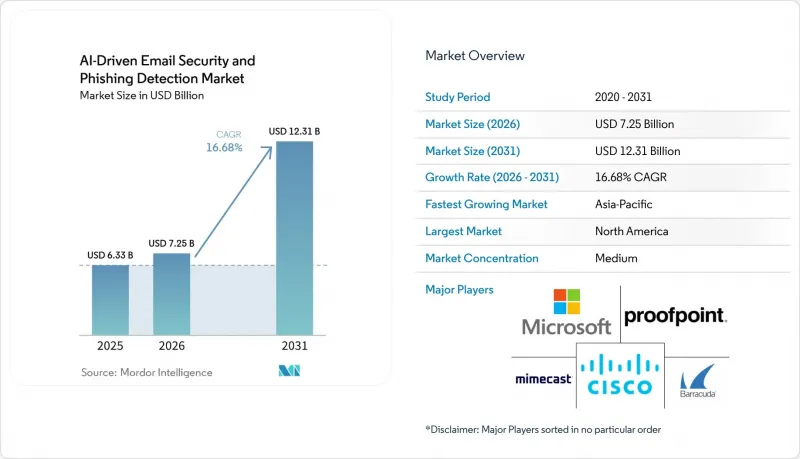
본 보고서는 구성 요소(소프트웨어, 서비스), 도입 방식(클라우드, On-Premise, 하이브리드), 기업 규모(대기업 등), 솔루션 유형(AI 보안 이메일 게이트웨이 등), 용도(피싱 탐지 등), 최종 사용자 산업(BFSI 등) 및 지역별로 분류되어 있습니다. 시장 전망은 금액(달러)으로 표시됩니다.
세계의 AI 기반 이메일 보안 및 피싱 탐지 시장 동향과 인사이트
증가하는 피싱 및 비즈니스 이메일 사기(BEC) 공격
이러한 공격의 규모 확대가 AI 기반 이메일 보안 및 피싱 탐지 시장을 견인하고 있으며, 기업 환경 전반에서 피싱 및 비즈니스 이메일 사기(BEC) 공격으로 인한 비용도 증가하고 있습니다. FBI 기록에 따르면, 2025년에는 2만 4,768건의 신고를 통해 30억 5,000만 미 달러 규모의 비즈니스 이메일 사기 손실이 보고되었으며, 비교적 소수의 사건이라도 여전히 막대한 경제적 손실을 초래할 수 있음을 보여줍니다. 또한, 마이크로소프트의 조사에 따르면 비즈니스 이메일 사기는 관측된 전체 위협의 불과 2%에 불과하지만, 공격으로 인한 피해의 21%를 차지하고 있어, 기업의 방어에 있어서는 공격의 양뿐만 아니라 공격의 질도 중요해지고 있음을 보여줍니다. 2026년 1분기, Microsoft Threat Intelligence는 1,070만 건의 비즈니스 이메일 사기 공격을 추적했으며, 3월 한 달 동안만도 26% 증가세가 나타나 위협 환경이 여전히 심각해지고 있음을 알 수 있습니다. 이러한 압박으로 인해 구매 행동에 변화가 생기고 있습니다. 보안 팀은 주로 알려진 위협을 필터링하는 도구에서 의심스러운 행동을 격리하고, 사칭을 감지하며, 대규모 메일박스 그룹 전체에 대한 트리아지를 자동화할 수 있는 플랫폼으로 전환하고 있기 때문입니다. AI 기반 이메일 보안 및 피싱 탐지 시장에서 이러한 추세는 AI 네이티브 벤더와 여전히 정적 규칙이나 시그니처 기반 검사에 지나치게 의존하고 있는 기존 게이트웨이 제공업체 간의 격차를 확대시키고 있습니다.
클라우드 이메일 및 하이브리드 업무 환경으로의 급속한 전환
AI 기반 이메일 보안 및 피싱 탐지 시장은 On-Premise 이메일 시스템에서 클라우드 이메일 및 하이브리드 업무 모델로의 전환에 의해서도 형성되고 있습니다. 바라쿠다(Barracuda)의 보고서에 따르면, 2025년 2월에 분석된 약 6억 7,000만 통의 이메일 샘플 중 4통 중 1통이 악성 이메일이나 원치 않는 스팸이었다고 합니다. 이는 클라우드 기반 비즈니스 커뮤니케이션이 여전히 막대한 위협에 노출되어 있음을 뒷받침합니다. Fortra의 조사에 따르면, 2025년 2분기 피싱 리디렉션 페이지의 60%가 정상적인 로그인 인프라를 가리키고 있으며, 클라우드 퍼스트 환경에서는 기본적인 평판 기반 필터링의 유효성이 크게 저하되고 있습니다. 이는 Microsoft 365 및 Google Workspace에서 이메일 보안이 경계 어플라이언스 문제에서 내부 이메일 흐름, 파일 공유 링크, 계정 부정 사용, 전송 후 활동 등을 포괄하는 플랫폼 문제로 전환되었기 때문에 중요한 의미를 지닙니다. 따라서 AI 기반 이메일 보안 및 피싱 탐지 시장에서는 이메일 라우팅에 혼란을 초래하는 변경을 강요하지 않으면서도 전송 후 위협을 검사할 수 있는 API 주도형 및 하이브리드 아키텍처가 지지를 받고 있습니다. 게이트웨이 제어와 클라우드 네이티브 검사 기능을 결합한 벤더가 더 유리한 입장에 있습니다. 이는 구매자들이 현재 기존의 경계형 제품으로는 완전히 모니터링할 수 없는 전송 전 필터링과 수신함 내 동작을 모두 포괄하는 솔루션을 원하고 있기 때문입니다.
고급 이메일 보안 스택의 총 소유 비용(TCO)이 높음
AI 기반 이메일 보안 및 피싱 탐지 시장에서는 기능이 중복되는 다층적인 이메일 보안 도구를 이미 관리하고 있는 구매자들의 저항이 여전히 존재합니다. 고급 도입 환경에서는 보안 이메일 게이트웨이, 통합형 클라우드 이메일 보안, 암호화, 아카이빙, 교육, 위협 대응 도구 등이 결합되는 경우가 많아, 그 결과 많은 조달 팀이 당초 예상했던 것보다 지출이 늘어날 가능성이 있습니다. 동일한 환경에 여러 제품이 중복되어 쌓일 경우, 메일함의 연간 라이선스 비용을 정당화하기 어려워지므로 중견 기업에게는 그 부담이 더욱 커집니다. 또한, 사내에 대규모 보안 부서를 갖추지 않은 팀의 경우, 통합 작업 발생, 계약의 복잡화, 운영상의 마찰도 발생합니다. AI 기반 이메일 보안 및 피싱 탐지 시장에서 기능을 단일 플랫폼으로 통합할 수 있는 벤더는 이러한 장벽을 극복하고 예산 확보를 더 용이하게 하는 데 유리한 입장에 있습니다. 구매자들은 여전히 더 강력한 보호에 관심을 가지고 있지만, 많은 구매자들은 대규모 도입을 확대하기 전에 사용하는 도구를 줄이고, 조정 비용을 절감하며, 더 예측 가능한 운영 모델을 원하고 있습니다.
부문 분석
2025년, AI 기반 이메일 보안 및 피싱 탐지 시장에서 소프트웨어가 60.14%의 점유율을 차지했습니다. 이는 어플라이언스 중심의 이메일 보호에서 구독 모델을 통해 제공되는 클라우드 네이티브 감지 엔진으로의 전환을 반영한 것입니다. 소프트웨어 계층이 중심적인 역할을 맡게 된 배경에는 조직이 단일 운영 환경 내에서 지속적인 모델 업데이트, 신속한 도입, 그리고 피싱 탐지, 배포 후 시정 조치, 규정 준수 관리에 이르는 공유된 가시성을 추구하고 있다는 점이 있습니다. 이러한 입장은 소프트웨어가 물리적 인프라가 아닌 API나 SaaS 콘솔을 통해 도입될 수 있다는 사실에 의해 더욱 강화되고 있으며, 이미 클라우드 기반 생산성 제품군을 운영 중인 기업의 경우 도입 장벽을 낮추고 있습니다. 또한, 필터링, 조사, 정책 제어를 위한 개별 도구는 라이선싱과 운영 양면에서 중복을 초래하기 때문에 구매자들은 통합 플랫폼을 선호하는 경향이 있습니다. 프루프포인트(Proofpoint)가 2026년 3월에 발표한 게이트웨이 및 API 기반 보호 기능을 통합하는 계획은 이러한 시장 동향을 반영한 것입니다. 구매자들은 서로 연동되지 않은 여러 제어 수단이 아닌, 단일하고 연동된 플랫폼을 점점 더 원하고 있기 때문입니다.
서비스 시장은 2031년까지 연평균 성장률(CAGR) 17.92%를 나타낼 것으로 예측되며, 이는 수요가 소프트웨어 라이선스에 그치지 않고 지원, 관리형 감지, 교육, 전문적인 위협 대응 운영으로 확대되고 있음을 보여줍니다. 이러한 성장은 많은 고객이 더 강력한 보호를 원하면서도, 이메일 모니터링을 위한 자체 보안 운영 센터(SOC)를 구축하거나 확장하기를 원치 않는다는 명확한 운영상의 현실에 기반을 두고 있습니다. 관리형 서비스 제공업체는 AI 네이티브 플랫폼을 활용하여 지속적인 모니터링과 시정 조치를 제공하고 있으며, 이를 통해 소규모 조직도 대규모 사내 팀을 구성하지 않고도 엔터프라이즈급 기능을 이용할 수 있게 되었습니다. 또한, 도입 후 지속적인 튜닝, 정책 업데이트, 보고서 작성, 예외 관리의 필요성도 서비스 시장의 기회를 더욱 강화하고 있습니다. AI 기반 이메일 보안 및 피싱 탐지 시장에서 소프트웨어는 여전히 수익의 주축을 이루고 있지만, 구매자들이 이메일 보안을 단일 제품 구매가 아닌 지속적인 운영 기능으로 인식하는 경향이 강해짐에 따라 서비스 부문은 급속히 성장하고 있습니다.
2025년에는 클라우드 도입이 53.18%를 차지하며, 기업의 이메일 인프라가 Microsoft 365나 Google Workspace로 대거 전환되고 있음이 부각되었습니다. AI 기반 이메일 보안 및 피싱 탐지 시장에서 이 분야가 여전히 최대 규모를 유지하고 있는 이유는 클라우드 도입을 통해 많은 On-Premise형 이메일 시스템에 수반되는 운영 부담이 해소되고, 분산된 사용자 전체에 대한 신속한 도입이 가능하기 때문입니다. 또한, 조직이 대규모 인프라 변경 없이 도입할 수 있는 솔루션을 선호하는 경향이 있어, 이는 현재의 예산 및 인력 배치 모델에도 부합합니다. 클라우드 우선 도입은 표준 피싱 필터링, 기준선 위협 모니터링, 그리고 대규모 메일박스 환경 전반에 걸친 중앙 집중식 관리에 특히 효과적입니다. 하지만 구매자들은 특히 내부 이메일, 계정 도용, 전송 후 행동이 공격 경로의 핵심 요소가 되는 경우, 클라우드만으로는 모든 문제를 해결할 수 없습니다는 점을 인식하고 있습니다.
하이브리드 도입은 2031년까지 연평균 성장률(CAGR) 18.03%로 확대될 것으로 예측되며, 이 부문에서 가장 빠르게 성장하는 모델이 될 전망입니다. 하이브리드 아키텍처가 중요시되는 이유는 보안 메일 게이트웨이가 전송 전 파일 기반 페이로드나 대량 공격을 차단하는 데 여전히 탁월한 반면, API 기반 시스템은 전송 후 비즈니스 이메일 사기, 내부 부정 사용 및 측면 이동(lateral movement) 감지에 탁월하기 때문입니다. 조직이 단일 통합 운영 모델로 외부 경계 트래픽과 내부 테넌트 트래픽을 모두 포괄하려고 함에 따라, 이러한 조합의 매력은 점점 더 커지고 있습니다. 또한, Mimecast가 2026년 3월에 추진한 API 지원 도입 전략은 상세한 검사 기능을 희생하지 않으면서도 더 신속한 배포를 원하는 구매자에 대해 벤더들이 적응하고 있음을 보여줍니다. 데이터 거주지 및 주권에 관한 규제가 여전히 엄격한 정부, 국방, 금융 분야에서는 On-Premise 배포의 중요성이 여전히 남아 있지만, 하이브리드 모델이 레거시 제어와 클라우드 네이티브 가시성 사이에 보다 실용적인 가교 역할을 제공함에 따라 그 역할은 점차 축소되고 있습니다.
지역별 분석
2025년, 북미는 AI 기반 이메일 보안 및 피싱 탐지 시장 점유율의 31.14%를 차지하며, 지역별로는 가장 큰 기여도를 보였습니다. 이 지역이 1위를 차지한 배경으로는 미국에서 보고된 사이버 범죄로 인한 피해액이 극히 높을 뿐만 아니라, 기업의 보안 지출이 충실하고 클라우드 생산성 도구의 도입 기반이 광범위하게 확산되어 있다는 점을 들 수 있습니다. FBI 기록에 따르면, 2025년에는 19만 1,561건의 피싱 및 스푸핑 관련 민원이 접수되었으며, 비즈니스 이메일 사기로 인한 손실은 30억 5,000만 달러에 달했습니다. 이로 인해 이메일 사기는 기업 보안 계획에서 여전히 핵심 과제로 자리 잡고 있습니다. 또한 북미에는 수많은 유명 벤더가 존재하여, 이를 통해 제품의 신속한 테스트, 새로운 아키텍처의 조기 도입, 그리고 구매자와 공급자 간의 긴밀한 피드백이 촉진되고 있습니다. 캐나다와 멕시코는 클라우드 도입 확대와 미국의 사이버 보안 관행에 대한 부합이 진전됨에 따라 대상 시장이 확대되어 지역 성장에 기여했습니다.
유럽은 계속해서 두 번째로 큰 성장 지역이며, 독일, 영국, 프랑스가 주요 수요 거점입니다. 이 지역의 성장은 규제에 크게 좌우되고 있으며, 특히 NIS2에서는 인증된 이메일 제어 및 보다 광범위한 사이버 위생 관리가 시급한 운영 요건으로 요구되고 있습니다. 독일이 2025년 12월에 NIS2를 국내법에 반영하겠다는 방침을 밝힘에 따라, 영향을 받는 사업체들에게는 이메일 보안, 보고 체계 및 규정 준수 문서의 강화를 요구하는 시급한 압박이 가해지고 있습니다. DORA는 금융 서비스 업계에서 이러한 압박을 더욱 가중시키고 있으며, 위협 감지 및 정책 준수 현황 입증을 모두 지원하는 도구에 대한 지출이 증가하고 있습니다. 영국은 EU의 조화와는 다른 독자적인 길을 걷고 있지만, DMARC 적용 및 이메일 관리 강화는 여전히 국내 지침에서 핵심적인 권장 사항으로 남아 있습니다.
아시아태평양은 2031년까지 연평균 성장률(CAGR) 18.58%로 확대될 것으로 예상되며, AI 기반 이메일 보안 및 피싱 탐지 시장에서 가장 빠르게 성장하는 지역이 될 것입니다. 이 지역에서는 대기업 및 중견 기업의 클라우드 도입이 가속화되는 한편, 데이터 보호 및 디지털 보안에 관한 규제 체계가 더욱 활성화되면서 급격한 변화가 진행되고 있습니다. 인도, 중국, 일본, 호주 및 동남아시아의 기업들은 클라우드 기반 통신 환경을 더욱 정비하고 있으며, 이에 따라 확장성이 뛰어난 SaaS 주도형 이메일 보안 관리에 대한 수요가 높아지고 있습니다. 중동 및 아프리카는 여전히 초기 단계 시장이지만, 각국의 디지털 전환 프로그램과 개인정보 보호 규정 마련이, 특히 걸프 국가 시장에서 단계적인 도입을 뒷받침하고 있습니다.
기타 혜택 :
- 엑셀 형식 시장 예측(ME) 시트
- 3개월간의 애널리스트 지원
자주 묻는 질문
목차
제1장 서론
제2장 조사 방법
제3장 주요 요약
제4장 시장 구도
제5장 시장 규모 및 성장 예측
제6장 경쟁 구도
제7장 시장 기회 및 향후 전망
KTH 26.08.10According to Mordor Intelligence, the AI-Driven email security and Phishing Detection Market size is expected to grow from USD 6.23 billion in 2025 to USD 7.25 billion in 2026 and is forecast to reach USD 12.31 billion by 2031 at 16.68% CAGR over 2026-2031.
This report is Segmented by Component (Software and Services), Deployment (Cloud, On-Premises, and Hybrid), Enterprise Size (Large Enterprises, and Mor), Solution Type (AI Secure Email Gateway, and More), Application (Phishing Detection, and More), End-User Industry (BFSI, and More), and Geography. The Market Forecasts are Provided in Terms of Value (USD).
Global AI-Driven Email Security and Phishing Detection Market Trends and Insights
Rising Phishing and Business Email Compromise Attacks
The scale is pushing forward the AI-Driven Email Security and Phishing Detection Market, and the cost of phishing and business email compromise attacks across enterprise environments. The FBI recorded USD 3.05 billion in business email compromise losses from 24,768 complaints in 2025, demonstrating that a relatively limited number of incidents can still cause significant financial damage. Microsoft also showed that business email compromise accounted for only 2% of observed threats but 21% of attack outcomes, indicating that attack quality now matters as much as attack volume for enterprise defenses. In Q1 2026, Microsoft Threat Intelligence tracked 10.7 million business email compromise attacks, and March alone saw a 26% increase, pointing to a threat environment that is still intensifying. That pressure is changing buying behavior because security teams are moving away from tools that mainly filter known threats and toward platforms that can isolate suspicious behavior, detect impersonation, and automate triage across large mailbox populations. In the AI-Driven Email Security and Phishing Detection Market, this has widened the gap between AI-native vendors and older gateway providers that still depend too heavily on static rules and signature-led inspection.
Rapid Shift to Cloud Email and Hybrid Work Environments
The AI-Driven Email Security and Phishing Detection Market is also being shaped by the move from on-premises mail systems to cloud email and hybrid work models. Barracuda reported that 1 in 4 emails analyzed in February 2025 were malicious or unwanted spam, based on a sample of nearly 670 million emails, confirming that cloud-based business communication still carries a heavy threat load. Fortra found that 60% of phishing redirect pages in Q2 2025 pointed to legitimate login infrastructure, making basic reputation-based filtering much less effective in cloud-first environments. This matters because Microsoft 365 and Google Workspace have shifted email security from a perimeter-appliance issue to a platform issue that encompasses internal mail flows, file-sharing links, account misuse, and post-delivery activity. The AI-Driven Email Security and Phishing Detection Market is therefore favoring API-led and hybrid architectures that can inspect threats after delivery, without forcing a disruptive change to mail routing. Vendors that combine gateway controls with cloud-native inspection are better positioned, as buyers now want coverage across both pre-delivery filtering and inbox behavior that older perimeter products cannot fully observe.
High Total Cost of Ownership for Advanced Email Security Stacks
The AI-Driven Email Security and Phishing Detection Market still faces resistance from buyers who are already managing layered email security tools with overlapping functions. Advanced deployments often combine secure email gateways, integrated cloud email security, encryption, archiving, training, and threat response tools, which can push spending higher than many procurement teams initially expect. The burden is greater for midsize organizations because annual mailbox licensing can become difficult to justify when multiple products are stacked in the same environment. This also creates integration work, contract complexity, and operational friction for teams without large internal security staffs. In the AI-Driven Email Security and Phishing Detection Market, vendors that can consolidate capabilities into a single platform are better positioned to overcome this barrier and make budgets easier to defend. Buyers are still interested in stronger protection, but many want fewer tools, lower coordination cost, and a more predictable operating model before expanding adoption at scale.
Other drivers and restraints analyzed in the detailed report include:
- Compliance Pressure from Data Protection and Cybersecurity Rules
- AI-Enabled Threat Detection to Reduce False Positives
- Security Team Skills Shortage for Tuning AI Detection Models
For complete list of drivers and restraints, kindly check the Table Of Contents.
Segment Analysis
Software held 60.14% of the AI-Driven Email Security and Phishing Detection Market share in 2025, reflecting the move away from appliance-led email protection toward cloud-native detection engines delivered through subscription models. The software layer has become central because organizations want continuous model updates, faster deployment, and shared visibility across phishing detection, post-delivery remediation, and compliance controls in a single operating environment. That position is reinforced by the fact that software can be deployed via APIs and SaaS consoles rather than physical infrastructure, reducing implementation friction for enterprises that already run cloud productivity suites. Buyers are also favoring integrated platforms because separate tools for filtering, investigation, and policy control create duplication in both licensing and operations. Proofpoint's March 2026 plan to unify gateway and API-based protection reflected this market trend, as buyers increasingly want a single, coordinated platform rather than multiple disconnected controls.
Services are projected to grow at a 17.92% CAGR through 2031, indicating that demand is expanding beyond software licenses into support, managed detection, training, and specialist threat operations. This growth follows a clear operating reality, because many customers want stronger protection but do not want to build or expand their own security operations center for email monitoring. Managed service providers are using AI-native platforms to deliver continuous monitoring and remediation, enabling smaller organizations to access enterprise-grade capabilities without staffing large internal teams. The service opportunity is also strengthened by the need for ongoing tuning, policy updates, reporting, and exception management after deployment. In the AI-Driven Email Security and Phishing Detection Market, software remains the revenue anchor, but services are growing rapidly as buyers increasingly treat email security as an ongoing operational function rather than a standalone product purchase.
Cloud-only deployment accounted for 53.18% in 2025, underscoring the strong shift of enterprise email infrastructure to Microsoft 365 and Google Workspace. This part of the AI-Driven Email Security and Phishing Detection Market remained the largest because cloud deployment eliminates the operational burden of many on-premises mail systems and enables faster activation across distributed users. It also aligns with the current budget and staffing model, as organizations prefer solutions that can be activated without major infrastructure changes. Cloud-first deployment works especially well for standard phishing filtering, baseline threat monitoring, and centralized administration across large mailbox estates. Even so, buyers have recognized that cloud-only coverage does not solve every problem, especially when internal mail, account misuse, and post-delivery behavior become central parts of the attack path.
Hybrid deployment is projected to expand at an 18.03% CAGR through 2031, making it the fastest-growing model in this segment. Hybrid architecture matters because secure email gateways remain strong at stopping file-based payloads and bulk attacks before delivery, while API-based systems are better at spotting business email compromise, internal abuse, and lateral movement after delivery. That combination is becoming increasingly attractive as organizations seek to cover both external perimeter traffic and internal tenant traffic with a single, coordinated operating model. Mimecast's March 2026 API-compatible deployment push also showed that vendors are adapting to buyers who want faster rollout without abandoning deeper inspection capability. On-premises deployment still retains relevance in government, defense, and financial settings where data residency and sovereignty rules remain strict, but its role is becoming narrower as hybrid models offer a more practical bridge between legacy controls and cloud-native visibility.
Complete Report Scope:
- By Component
- Software
- Services
- By Deployment
- Cloud
- On-Premises
- Hybrid
- By Enterprise Size
- Large Enterprises
- Small and Medium Enterprises
- By Solution Type
- AI Secure Email Gateway
- Integrated Cloud Email Security
- Business Email Compromise Protection
- API-based Email Security
- Email Encryption
- Email Archiving and Compliance
- By Application
- Phishing Detection
- Business Email Compromise Detection
- Spam and Malware Filtering
- URL and Attachment Analysis
- Insider Threat Detection
- Brand Impersonation Detection
- Email Fraud Prevention
- Compliance Monitoring
- By End-user Industry
- BFSI
- Healthcare and Life Sciences
- Information Technology and Telecom
- Retail and E-commerce
- Industrial Manufacturing
- Government and Public Sector
- Other End-user Industries
- By Geography
- North America
- United States
- Canada
- Mexico
- South America
- Brazil
- Argentina
- Rest of South America
- Europe
- Germany
- United Kingdom
- France
- Italy
- Spain
- Russia
- Rest of Europe
- Asia-Pacific
- China
- India
- Japan
- South Korea
- Australia
- Rest of Asia-Pacific
- Middle East and Africa
- Middle East
- Saudi Arabia
- United Arab Emirates
- Rest of Middle East
- Africa
- South Africa
- Nigeria
- Rest of Africa
- Middle East
- North America
Geography Analysis
North America held 31.14% of the AI-Driven Email Security and Phishing Detection Market share in 2025, making it the largest regional contributor. The region led because the United States combines very high reported cybercrime losses with deep enterprise security spending and a large installed base of cloud productivity tools. The FBI recorded 191,561 phishing and spoofing complaints in 2025, alongside USD 3.05 billion in business email compromise losses, which kept email fraud near the center of corporate security planning. North America also benefits from the presence of several well-known vendors, which supports faster product testing, earlier adoption of new architectures, and tighter feedback between buyers and providers. Canada and Mexico added to regional growth as cloud adoption and alignment with U.S. cybersecurity practices widened the addressable base.
Europe remained the second-largest regional contributor, with Germany, the United Kingdom, and France acting as major demand centers. Regional growth is being heavily shaped by regulation, especially with NIS2 requiring authenticated email controls and broader cyber hygiene as urgent operating requirements. Germany's move to transpose NIS2 into national law in December 2025 added immediate pressure on affected entities to strengthen email security, reporting discipline, and compliance documentation. DORA is reinforcing that pressure in financial services, which is raising spending on tools that support both threat detection and policy evidence. The United Kingdom is following its own path outside EU harmonization, but DMARC enforcement and stronger email controls remain central recommendations in national guidance.
Asia-Pacific is projected to expand at an 18.58% CAGR through 2031, making it the fastest-growing region in the AI-Driven Email Security and Phishing Detection Market. The region is moving quickly as cloud adoption accelerates across large and mid-sized enterprises, while regulatory frameworks are becoming more active in data protection and digital security. Enterprises in India, China, Japan, Australia, and Southeast Asia are building more cloud-based communication environments, which creates a stronger need for scalable SaaS-led email security controls. The Middle East and Africa remain early-stage contributors, but national digital transformation programs and developing privacy rules are supporting gradual adoption, especially in the Gulf markets.
- Proofpoint, Inc.
- Mimecast Limited
- Barracuda Networks, Inc.
- Abnormal Security Corporation
- IRONSCALES Ltd.
- SlashNext, Inc.
- Cofense, Inc.
- Hornetsecurity GmbH
- Darktrace plc
- Trend Micro Incorporated
- Check Point Software Technologies Ltd.
- Fortinet, Inc.
- Sophos Ltd.
- Fortra, LLC
- Egress Software Technologies Ltd.
- Vade SAS
- KnowBe4, Inc.
- GreatHorn, Inc.
- Paubox, Inc.
- ZeroFox Holdings, Inc.
Additional Benefits:
- The market estimate (ME) sheet in Excel format
- 3 months of analyst support
TABLE OF CONTENTS
1 INTRODUCTION
- 1.1 Study Assumptions and Market Definition
- 1.2 Scope of the Study
2 RESEARCH METHODOLOGY
3 EXECUTIVE SUMMARY
4 MARKET LANDSCAPE
- 4.1 Market Overview
- 4.2 Market Drivers
- 4.2.1 Rising Phishing and Business Email Compromise Attacks
- 4.2.2 Rapid Shift to Cloud Email and Hybrid Work Environments
- 4.2.3 Compliance Pressure From Data Protection and Cybersecurity Rules
- 4.2.4 AI-Enabled Threat Detection To Reduce False Positives
- 4.2.5 Identity-Centric Security Convergence With Zero-Trust Email Controls
- 4.2.6 Deepfake and GenAI-Driven Impersonation of Executives and Suppliers
- 4.3 Market Restraints
- 4.3.1 High Total Cost of Ownership for Advanced Email Security Stacks
- 4.3.2 Security Team Skills Shortage For Tuning AI Detection Models
- 4.3.3 User Privacy Concerns Over Deep Content and Behavioral Inspection
- 4.3.4 Bundled Native Email Security Features From Major Productivity Suites
- 4.4 Industry Value-Chain Analysis
- 4.5 Regulatory Landscape
- 4.6 Technological Outlook
- 4.7 Porter's Five Forces Analysis
- 4.7.1 Bargaining Power of Buyers
- 4.7.2 Bargaining Power of Suppliers
- 4.7.3 Threat of New Entrants
- 4.7.4 Threat of Substitutes
- 4.7.5 Intensity of Competitive Rivalry
5 MARKET SIZE AND GROWTH FORECASTS (VALUE)
- 5.1 By Component
- 5.1.1 Software
- 5.1.2 Services
- 5.2 By Deployment
- 5.2.1 Cloud
- 5.2.2 On-Premises
- 5.2.3 Hybrid
- 5.3 By Enterprise Size
- 5.3.1 Large Enterprises
- 5.3.2 Small and Medium Enterprises
- 5.4 By Solution Type
- 5.4.1 AI Secure Email Gateway
- 5.4.2 Integrated Cloud Email Security
- 5.4.3 Business Email Compromise Protection
- 5.4.4 API-based Email Security
- 5.4.5 Email Encryption
- 5.4.6 Email Archiving and Compliance
- 5.5 By Application
- 5.5.1 Phishing Detection
- 5.5.2 Business Email Compromise Detection
- 5.5.3 Spam and Malware Filtering
- 5.5.4 URL and Attachment Analysis
- 5.5.5 Insider Threat Detection
- 5.5.6 Brand Impersonation Detection
- 5.5.7 Email Fraud Prevention
- 5.5.8 Compliance Monitoring
- 5.6 By End-user Industry
- 5.6.1 BFSI
- 5.6.2 Healthcare and Life Sciences
- 5.6.3 Information Technology and Telecom
- 5.6.4 Retail and E-commerce
- 5.6.5 Industrial Manufacturing
- 5.6.6 Government and Public Sector
- 5.6.7 Other End-user Industries
- 5.7 By Geography
- 5.7.1 North America
- 5.7.1.1 United States
- 5.7.1.2 Canada
- 5.7.1.3 Mexico
- 5.7.2 South America
- 5.7.2.1 Brazil
- 5.7.2.2 Argentina
- 5.7.2.3 Rest of South America
- 5.7.3 Europe
- 5.7.3.1 Germany
- 5.7.3.2 United Kingdom
- 5.7.3.3 France
- 5.7.3.4 Italy
- 5.7.3.5 Spain
- 5.7.3.6 Russia
- 5.7.3.7 Rest of Europe
- 5.7.4 Asia-Pacific
- 5.7.4.1 China
- 5.7.4.2 India
- 5.7.4.3 Japan
- 5.7.4.4 South Korea
- 5.7.4.5 Australia
- 5.7.4.6 Rest of Asia-Pacific
- 5.7.5 Middle East and Africa
- 5.7.5.1 Middle East
- 5.7.5.1.1 Saudi Arabia
- 5.7.5.1.2 United Arab Emirates
- 5.7.5.1.3 Rest of Middle East
- 5.7.5.2 Africa
- 5.7.5.2.1 South Africa
- 5.7.5.2.2 Nigeria
- 5.7.5.2.3 Rest of Africa
- 5.7.5.1 Middle East
- 5.7.1 North America
6 COMPETITIVE LANDSCAPE
- 6.1 Market Concentration
- 6.2 Strategic Moves
- 6.3 Market Share Analysis
- 6.4 Company Profiles (includes Global Level Overview, Market Level Overview, Core Segments, Financials as available, Strategic Information, Market Rank/Share, Products and Services, Recent Developments)
- 6.4.1 Proofpoint, Inc.
- 6.4.2 Mimecast Limited
- 6.4.3 Barracuda Networks, Inc.
- 6.4.4 Abnormal Security Corporation
- 6.4.5 IRONSCALES Ltd.
- 6.4.6 SlashNext, Inc.
- 6.4.7 Cofense, Inc.
- 6.4.8 Hornetsecurity GmbH
- 6.4.9 Darktrace plc
- 6.4.10 Trend Micro Incorporated
- 6.4.11 Check Point Software Technologies Ltd.
- 6.4.12 Fortinet, Inc.
- 6.4.13 Sophos Ltd.
- 6.4.14 Fortra, LLC
- 6.4.15 Egress Software Technologies Ltd.
- 6.4.16 Vade SAS
- 6.4.17 KnowBe4, Inc.
- 6.4.18 GreatHorn, Inc.
- 6.4.19 Paubox, Inc.
- 6.4.20 ZeroFox Holdings, Inc.
7 MARKET OPPORTUNITIES AND FUTURE OUTLOOK
- 7.1 White-Space and Unmet-Need Assessment


