

|
시장보고서
상품코드
2099060
기업용 ID 및 액세스 관리(IAM) 시장 : 시장 점유율 분석, 업계 동향 및 통계, 성장 예측(2026-2031년)Enterprise Identity and Access Management (IAM) - Market Share Analysis, Industry Trends & Statistics, Growth Forecasts (2026 - 2031) |
||||||
 Mordor Intelligence
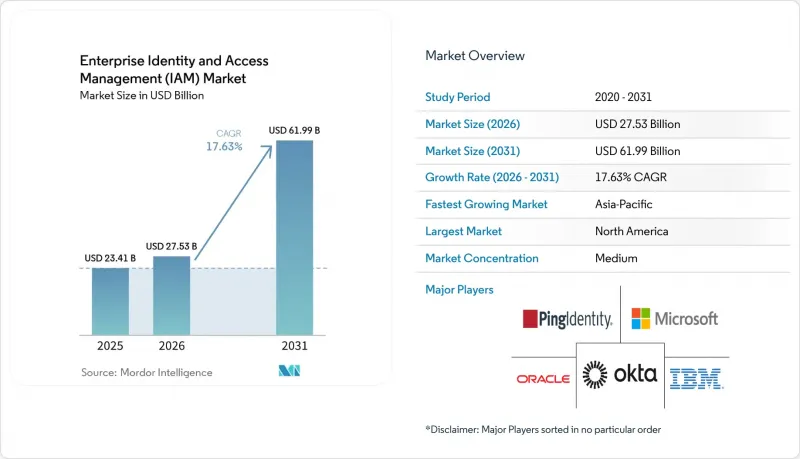
Mordor Intelligence에 의하면, 기업용 ID 및 액세스 관리(IAM) 시장 규모는 2025년 234억 1,000만 달러로 평가되었고, 2026년에는 275억 3,000만 달러로 확대될 것으로 추정되고, 2031년까지 619억 9,000만 달러에 이를 것으로 예상되며, 2026-2031년 CAGR 17.63%로 성장할 전망입니다.
본 보고서는 컴포넌트별(솔루션 및 서비스), 기술별(직원 ID 등), 배포 모드별(클라우드, 온프레미스, 하이브리드), 조직 규모별(대기업 및 중소기업), 최종 이용 산업별(은행 및 금융 서비스·보험 등), 지역별로 분류되어 있습니다. 시장 전망은 금액(달러) 기준으로 제시되어 있습니다.
세계의 기업용 ID 및 액세스 관리(IAM) 시장 동향 및 인사이트
증가하는 신원 사기 및 계정 탈취 시도
신원 악용 공격은 고객 채널, 직원 접근, 복구 워크플로우에 동시에 영향을 미치기 때문에 기업용 ID 및 액세스 관리(IAM) 시장에서 가장 명확한 구매 동인 중 하나가 되고 있습니다. FBI의 인터넷 범죄 신고 센터(IC3)에 따르면, 2025년에는 4,700건 이상의 신고를 통해 계정 탈취로 인한 피해액이 3억 5,970만 달러로 기록되었으며, 같은 해 사이버 범죄로 인한 총 피해액은 209억 달러에 달했습니다. LexisNexis Risk Solutions는 2025년에 1,160억 건 이상의 온라인 거래를 분석한 결과, 전 세계 사기 공격률이 8% 상승했음을 밝혔습니다. 특히 EMEA 지역에서는 전년 대비 27% 증가율을 기록했습니다. 또한 마이크로소프트는 2025년에 전 세계적으로 초당 7,000건 이상의 비밀번호 공격이 발생했다고 보고했는데, 이는 공격자들에게 인증 정보 악용이 얼마나 저비용화되었는지를 보여줍니다. 거래 관리가 강화됨에 따라 공격자들은 사용자 여정의 더 초기 단계로 이동하고 있으며, 많은 기업이 여전히 일관성 없는 프로세스로 관리하고 있는 계정 생성, 인증 정보 재설정 및 복구 절차를 악용하고 있습니다. 이러한 변화로 인해 기업용 IAM 시장은 단순히 로그인 제어에만 의존하는 것이 아니라, 더욱 강력한 신원 확인, 보다 광범위한 다단계 인증(MFA), 적응형 액세스 정책, 그리고 더욱 엄격한 라이프사이클 거버넌스로 나아가고 있습니다.
제로 트러스트 액세스 아키텍처의 확대
기업용 ID 및 액세스 관리(IAM) 시장은 경계 제어에서 신원을 주요 정책 엔진으로 삼는 지속적인 검증 모델로의 전환에 힘입어 성장하고 있습니다. NIST는 2025년 6월 특별 간행물 1800-35를 발행하여, 24개의 업계 파트너와 공동으로 검증된 19가지 실용적인 제로 트러스트 아키텍처 구현 모델을 발표했습니다. NSA는 2026년 4월에 업데이트된 지침을 발표하여, 사용자 부문별 단계별 제로 트러스트 성숙도 요건을 정의했습니다. 이를 통해 국방 기관은 ID 업그레이드를 위한 체계적인 로드맵을 확보할 수 있습니다. 이러한 프레임워크가 중요한 이유는 규제 대상 공급망에서 활동하는 정부 기관, 계약업체 및 기업에게 ID 제어를 측정 가능한 프로그램 요건으로 전환해 주기 때문입니다. NIS2 및 관련 부문 규제는 유럽에서도 유사한 방향성을 강화하고 있으며, 액세스 거버넌스와 특권 액세스 제어는 현재 법적 책임 및 조달 기준과 더욱 직접적으로 연계되어 있습니다. 그 결과, 많은 조직이 처음부터 시작하는 대신 기존의 엔터프라이즈 IAM 환경을 지속적인 신뢰 모델로 재구축하고 있으며, 이는 이미 기업의 ID 환경에 통합되어 있는 벤더들에게 유리한 상황이 되고 있습니다.
레거시 디렉터리 환경과의 통합에 따른 복잡성
기업용 ID 및 액세스 관리(IAM) 시장은 많은 기업이 15년에서 20년에 걸쳐 구축해 온 레거시 디렉터리 환경의 복잡성으로 인한 마찰에 여전히 직면해 있습니다. Active Directory 환경에는 종종 사용자 정의 그룹 구조, 맞춤형 커넥터, 문서화되지 않은 종속성, 그리고 마이그레이션 계획이 시작된 후에야 발견되는 ‘섀도 통합’이 포함되어 있습니다. 이로 인해 프로그램 범위를 설정하기 어려워지고, 도입 일정이 장기화됩니다. 이는 연결된 각 용도이 개별적인 테스트 및 권한 부여 문제를 야기할 가능성이 있기 때문입니다. 현대화를 추진하는 기업에서는 긴 마이그레이션 기간 동안 여러 ID 시스템을 병행하여 운영하는 경우가 많으며, 이로 인해 지원 비용이 증가하고 추가적인 통제가 필요한 일시적인 정책 공백이 발생합니다. 이 문제는 디렉터리의 역사가 긴 반면, 전용 IAM 아키텍처의 용량이 제한적인 산업 분야나 중견 기업 시장에서 특히 두드러집니다. 그 결과, 엔터프라이즈 IAM 시장에는 강력한 수요가 존재하지만, 현대화 프로그램의 실행에는 당초 구매 계획에서 예상했던 것보다 더 오랜 시간이 소요되기 때문에 그 일부가 인식된 수익으로 전환되는 속도는 완만합니다.
부문 분석
2025년, 솔루션은 기업용 ID 및 액세스 관리(IAM) 시장 규모의 71.35%를 차지했습니다. 이는 기업들이 지원 범위를 확대하기 전에 여전히 핵심 플랫폼을 최우선으로 여기고 있음을 보여줍니다. 이 부문이 지배적인 위치를 유지하는 이유는 인증, 액세스 제어, ID 라이프사이클 자동화, 특권 액세스 관리 및 위험 분석이 그 이후의 모든 거버넌스 활동의 기반을 형성하기 때문입니다. 구매자는 일반적으로 정책을 표준화하거나, 인증을 자동화하거나, 새로운 디지털 채널로 제어를 확장하기 전에 이러한 소프트웨어 계층을 구축해야 합니다. 또한, 직원용 ID 프로그램과 고객용 ID 프로그램 모두 공통의 정책 엔진, 인증 정보 제어 및 관리 워크플로우에 의존하고 있기 때문에 솔루션의 기반도 광범위하게 확장됩니다. 따라서 도입 모델과 조달 경향이 변화하고 있음에도 불구하고, 기업용 ID 및 액세스 관리 시장에서는 소프트웨어가 계속해서 매출의 기반을 이루고 있습니다.
서비스 부문은 2031년까지 연평균 성장률(CAGR) 19.53%를 나타낼 것으로 예측되며, 예측 기간 동안 기업용 ID 및 액세스 관리(IAM) 시장에서 가장 빠르게 성장하는 분야가 될 전망입니다. 많은 기업이 IAM에 관한 전문성이 높은 엔지니어링 팀을 보유하고 있지 않아, 마이그레이션 계획, 커넥터 도입, 정책 조정 및 지속적인 거버넌스 운영에 있어 외부 지원이 필요하기 때문에 수요가 증가하고 있습니다. ENISA의 2025년 조사 결과에 따르면, EU 조직의 34%가 IAM 역량 부족을 보고하고 있으며, 이는 플랫폼에 대한 관심이 이미 확립된 경우에도 매니지드 서비스에 대한 수요가 여전히 견조한 이유를 설명하는 한 요인이 되고 있습니다. 하이브리드 환경에서는 정기적인 도입 마일스톤보다 지속적인 모니터링, 액세스 검토, 라이프사이클 관리가 요구되기 때문에 매니지드 서비스는 기존의 프로젝트형 업무보다 빠르게 발전하고 있습니다. 2026년 5월 IBM이 ‘AskIAM’을 출시한 것은 서비스 제공업체들이 IBM Verify, Microsoft Entra, Saviynt, CyberArk, SailPoint 등 다양한 환경을 아우르는 에이전트형 오케스트레이션을 통해 서비스 제공 방식을 재구축하고 있음을 보여줍니다.
2025년, 액세스 관리는 기술 매출의 36.79%를 차지했으며, 이는 기업용 ID 및 액세스 관리(IAM) 시장에서 직원 및 고객 환경 전반에 걸쳐 광범위하게 도입되고 있음을 반영합니다. 싱글 사인온(SSO), 적응형 다단계 인증(MFA), 세션 제어, 조건부 액세스는 대부분의 기업에게 단순한 선택적 업그레이드가 아닌 핵심 운영 요건이 되었습니다. 이러한 규모가 해당 부문의 최고 점유율을 뒷받침하는 이유는 거의 모든 IAM 프로그램이 보다 세분화된 권한 거버넌스로 확장되기 전에 액세스 오케스트레이션에서 시작되기 때문입니다. 현재 이 부문에서 경쟁사와의 차별화는 기본적인 로그인 기능보다는 정책의 정밀도, ID 오케스트레이션, 그리고 클라우드와 온프레미스 시스템 전반에 걸쳐 액세스 신호를 일관되게 조정하는 능력에 더 많이 의존하고 있습니다. 이로 인해 구매자들이 더 광범위한 거버넌스 기능을 요구하고 있음에도 불구하고, 액세스 관리는 기업용 ID 및 액세스 관리(IAM) 시장에서 여전히 중심적인 위치를 차지하고 있습니다.
비인간 신원 관리는 2031년까지 연평균 성장률(CAGR) 22.28%를 나타낼 것으로 예측되며, 이로 인해 엔터프라이즈 IAM 시장에서 가장 빠르게 성장하는 기술 부문이 되고 있습니다. 이 부문이 확대되고 있는 이유는 기업들이 현재 인간의 신원뿐만 아니라 서비스 계정, API 키, 봇, 컨테이너, 인증서, AI 에이전트 등을 관리하고 있으며, 이러한 자산 각각에 대해 개별적인 접근 및 책임 요구 사항이 있기 때문입니다. 또한, 공급업체나 시스템에 대한 접근이 운영 위험 및 공급망 위험과 더욱 밀접하게 연관되게 되면서, 특권 ID 및 제3자 ID 관리 프로그램도 병행하여 확대되고 있습니다. Okta는 2026년 4월 ‘Okta for AI Agents’의 일반 제공을 시작하며, Universal Directory 내 AI 에이전트를 위해 라이프사이클 관리, 단기 유효 토큰 인증 및 만료 제어 기능을 추가했습니다. 이에 이어 SailPoint는 2026년 3월 ‘Agentic Fabric’을 발표하며, AI 에이전트의 ID 거버넌스가 기업용 ID 및 액세스 관리(IAM) 시장에서 독자적인 제어 계층으로 자리 잡고 있다는 인식을 강화했습니다.
지역별 분석
2025년, 북미는 기업용 ID 및 액세스 관리(IAM) 시장 점유율의 39.27%를 차지했으며, 매출 측면에서 지역별 최대 기여도를 기록했습니다. 이 지역은 IAM 벤더의 집중도가 가장 높고, 기업용 소프트웨어에 대한 예산이 풍부하며, ID 현대화가 연방 정부의 사이버 보안 프로그램과 직접 연계되는 경우가 많은 조달 환경의 혜택을 받고 있습니다. 미국 국방부의 제로 트러스트 전략과 성숙도 로드맵은 국방 생태계 전반에 걸쳐 기대감을 지속적으로 형성하고 있으며, 이로 인해 최소 권한, 지속적인 검증, 감사 가능한 접근 거버넌스를 지원하는 신원 제어에 대한 수요가 증가하고 있습니다. 캐나다 역시 디지털 신원 및 사이버 보안 프로그램을 추진하고 있는 반면, 미국의 금융 서비스 및 핀테크 업계는 이 지역에서 여전히 가장 활발한 구매자층 중 하나로 남아 있습니다.
아시아태평양은 2026-2031년 연평균 성장률(CAGR) 23.61%를 나타낼 것으로 예측되며, 기업용 ID 및 액세스 관리 시장에서 가장 빠르게 성장하는 지역이 될 전망입니다. 이러한 성장은 정부의 디지털 ID 프로그램, 모바일 우선 서비스 모델, 사기 위험 증가, 주요 경제권에서의 클라우드 도입 가속화 등이 복합적으로 작용하여 추진되고 있습니다. 인도에서는 디지털 결제 및 핀테크의 확대, 사고 보고에 대한 기대가 높아짐에 따라 실시간 신원 확인 및 액세스 거버넌스의 필요성이 증가하고 있어, IAM에 대한 수요가 더욱 강해지고 있습니다. 중국은 디지털 경제의 규모와 산업 기반에 따라 인력, 기계, 용도의 ID와 관련된 대규모 요구 사항이 발생하고 있어 여전히 중요한 시장입니다. 일본, 한국, 동남아시아에서도 기업들이 클라우드 활용을 확대하고, 고객 ID, 직원 접근, 비인간 계정에 대한 보다 강력한 관리를 요구함에 따라 시장의 성장세가 가속화되고 있습니다.
유럽은 현재 규모 면에서 북미에 이어 두 번째로 큰 시장이지만, 기업용 ID 및 액세스 관리(IAM) 시장의 지출 동향은 NIS2 및 DORA와 관련된 의무 사항에 의해 크게 좌우되고 있습니다. ENISA의 2025년 평가에 따르면, EU 조직의 34%가 IAM 기능 부족을 보고하고 있으며, 이는 현대화에 대한 수요가 매우 크고 많은 환경에서 여전히 그 요구가 충분히 충족되지 않고 있음을 보여줍니다. 남미는 오픈 뱅킹, 디지털 결제, BFSI(은행 및 금융 및 보험) 분야의 디지털화가 진행됨에 따라 고객 및 직원의 신원 관리 강화가 중요시되면서, 의미 있는 성장 지역으로 부상하고 있습니다. 중동 및 아프리카도 사우디아라비아와 UAE가 디지털 전환 프로그램 및 정부 주도의 디지털 ID 서비스를 확대함에 따라 성장세가 가속화되고 있습니다.
기타 혜택 :
- 엑셀 형식 시장 예측(ME) 시트
- 3개월간의 애널리스트 지원
자주 묻는 질문
목차
제1장 서론
제2장 조사 방법
제3장 주요 요약
제4장 시장 구도
제5장 시장 규모 및 성장 예측
제6장 경쟁 구도
제7장 시장 기회 및 향후 전망
AJY 26.08.07According to Mordor Intelligence, the enterprise identity and access management (IAM) market size is expected to increase from USD 23.41 billion in 2025 to USD 27.53 billion in 2026 and reach USD 61.99 billion by 2031, growing at a CAGR of 17.63% over 2026-2031.
This report is Segmented by Component (Solutions, and Services), Technology (Workforce Identity, and More), Deployment Mode (Cloud, On-Premises, and Hybrid), Organization Size (Large Enterprises, and Small and Medium Enterprises), End-Use Industry (Banking, Financial Services, and Insurance, and More), and Geography. The Market Forecasts are Provided in Terms of Value (USD).
Global Enterprise Identity and Access Management (IAM) Market Trends and Insights
Rising Identity Fraud and Account Takeover Attempts
Identity-based attacks have become one of the clearest buying triggers in the enterprise identity and access management (IAM) market because they affect customer channels, workforce access, and recovery workflows at the same time. The FBI Internet Crime Complaint Center recorded USD 359.7 million in account takeover losses from more than 4,700 complaints in 2025, while total cybercrime losses reached USD 20.9 billion in the same year. LexisNexis Risk Solutions reviewed more than 116 billion online transactions in 2025 and found an 8% rise in global fraud attack rates, with EMEA recording a 27% year-over-year increase. Microsoft also reported that password attacks exceeded 7,000 per second globally in 2025, which shows how inexpensive credential abuse has become for attackers. As transaction controls improve, attackers are moving earlier in the user journey and exploiting account creation, credential reset, and recovery steps that many enterprises still manage through inconsistent processes. That shift is pushing the enterprise IAM market toward stronger identity proofing, broader MFA, adaptive access policies, and tighter lifecycle governance rather than relying only on sign-in controls.
Expansion of Zero Trust Access Architectures
The enterprise identity and access management (IAM) market is also being lifted by the shift from perimeter controls to continuous verification models that rely on identity as the main policy engine. NIST published Special Publication 1800-35 in June 2025 and presented 19 practical zero trust architecture implementation builds validated with 24 industry collaborators. The NSA released updated guidance in April 2026 that defined phase-based zero trust maturity expectations for the user pillar, which gives defense organizations a structured path for identity upgrades. These frameworks matter because they turn identity controls into measurable program requirements for agencies, contractors, and enterprises working in regulated supply chains. NIS2 and related sector rules are reinforcing the same direction in Europe, where access governance and privileged access control are now tied more directly to legal accountability and procurement standards. The result is that many organizations are not starting from scratch; they are rebuilding existing enterprise IAM estates into continuous trust models, which favors vendors already embedded in enterprise identity environments.
Integration Complexity With Legacy Directory Environments
The enterprise identity and access management (IAM) market still faces friction from the depth of legacy directory environments that many enterprises built over 15 to 20 years. Active Directory estates often include custom group structures, one-off connectors, undocumented dependencies, and shadow integrations that are only discovered after migration planning begins. This makes program scoping difficult and stretches deployment timelines because each connected application can create a separate testing and entitlement challenge. Enterprises that proceed with modernization often run parallel identity systems for long transition windows, which increase support costs and create temporary policy gaps that require additional controls. The problem is most visible in industrial and mid-market environments where directory history is deep but dedicated IAM architecture capacity is limited. As a result, strong demand exists in the enterprise IAM market, but a part of it converts slowly into recognized revenue because modernization programs take longer to execute than initial buying plans suggest.
Other drivers and restraints analyzed in the detailed report include:
- Cloud and SaaS Sprawl Across Hybrid Enterprises
- Regulatory Pressure for Stronger Access Governance
- High Cost of Enterprise-Scale IAM Modernization
For complete list of drivers and restraints, kindly check the Table Of Contents.
Segment Analysis
Solutions captured 71.35% of the enterprise identity and access management (IAM) market size in 2025, which shows how strongly enterprises still prioritize core platforms before expanding delivery support. This segment remained dominant because authentication, access control, identity lifecycle automation, privileged access management, and risk analytics form the foundation on which all later governance activity depends. Buyers usually need these software layers in place before they can standardize policy, automate certifications, or extend controls across new digital channels. The solutions base is also broad because both workforce identity and customer identity programs depend on common policy engines, credential controls, and administrative workflows. For that reason, the enterprise identity and access management market continues to anchor revenue in software even while deployment models and procurement preferences evolve.
Services are projected to grow at a 19.53% CAGR through 2031, which makes them the faster-moving part of the enterprise identity and access management (IAM) market over the forecast period. Demand is rising because many enterprises do not have deep IAM engineering teams and need outside support for migration planning, connector deployment, policy tuning, and ongoing governance operations. ENISA's 2025 finding that 34% of EU organizations reported IAM capability gaps helps explain why managed service demand remains strong even when platform interest is already established. Managed services are advancing faster than traditional project work because hybrid environments require continuous monitoring, access review, and lifecycle administration rather than periodic implementation milestones. IBM's AskIAM launch in May 2026 showed how service providers are repositioning delivery through agentic orchestration that works across IBM Verify, Microsoft Entra, Saviynt, CyberArk, and SailPoint environments.
Access management held 36.79% of technology revenue in 2025, which reflects its broad deployment base across workforce and customer-facing environments in the enterprise identity and access management (IAM) market. Single sign-on, adaptive MFA, session controls, and conditional access have become core operating requirements rather than optional upgrades for most enterprises. That scale supports the segment's leading share because nearly every IAM program starts with access orchestration before it expands into deeper entitlement governance. Competitive separation in this segment now depends less on basic sign-in features and more on policy precision, identity orchestration, and the ability to align access signals across cloud and on-premises systems. This keeps access management at the center of the enterprise identity and access management (IAM) market even as buyers ask for wider governance capability.
Non-human identity management is projected to grow at a 22.28% CAGR through 2031, which makes it the fastest-growing technology segment in the enterprise IAM market. The category is widening because enterprises now manage service accounts, API keys, bots, containers, certificates, and AI agents alongside human identities, and each of those assets carries separate access and accountability needs. Privileged identity and third-party identity programs are growing in parallel because supplier access and machine access are now linked more closely to operational and supply chain risk. Okta made Okta for AI Agents generally available in April 2026, adding lifecycle management, short-lived token authentication, and revocation controls for AI agents inside Universal Directory. SailPoint followed with Agentic Fabric in March 2026, which reinforced the idea that AI agent identity governance is becoming a distinct control layer inside the enterprise identity and access management (IAM) market.
Complete Report Scope:
- By Component
- Solutions
- Identity Lifecycle Automation
- Authentication and Access Control
- Identity Governance and Administration
- Privileged Access Management
- Fraud and Risk Analytics
- Passwordless and Biometric Authentication
- Services
- Professional Services
- Managed Services
- Solutions
- By Technology
- Workforce Identity
- Customer Identity
- Privileged Identity
- Machine and Non-Human Identity
- Third-Party Identity
- By Deployment Mode
- Cloud
- On-Premises
- Hybrid
- By Organization Size
- Large Enterprises
- Small and Medium Enterprises
- By End-Use Industry
- Banking, Financial Services, and Insurance (BFSI)
- Government and Public Administration
- Healthcare and Life Sciences
- IT and Telecommunication
- Retail and E-Commerce
- Energy and Utilities
- Industrial Manufacturing
- Education and Research Institutions
- Transportation and Logistics
- Other End-User Industries
- By Geography
- North America
- United States
- Canada
- Mexico
- South America
- Brazil
- Argentina
- Rest of South America
- Europe
- Germany
- United Kingdom
- France
- Italy
- Spain
- Russia
- Rest of Europe
- Asia-Pacific
- China
- India
- Japan
- South Korea
- Australia
- Rest of Asia-Pacific
- Middle East
- Saudi Arabia
- United Arab Emirates
- Turkey
- Rest of the Middle East
- Africa
- South Africa
- Nigeria
- Rest of Africa
- North America
Geography Analysis
North America held 39.27% of the enterprise identity and access management (IAM) market share in 2025, which made it the leading regional contributor by revenue. The region benefits from the highest concentration of IAM vendors, deep enterprise software budgets, and a procurement environment where identity modernization is often tied directly to federal cybersecurity programs. The U.S. Department of Defense's zero trust strategy and maturity roadmap continue to shape expectations across the defense ecosystem, which strengthens demand for identity controls that support least privilege, continuous verification, and auditable access governance. Canada is also advancing digital identity and cybersecurity programs, while U.S. financial services and fintech remain among the most active buyers in the region.
Asia-Pacific is projected to grow at a 23.61% CAGR from 2026 to 2031, which makes it the fastest-growing region in the enterprise identity and access management market. Growth is being driven by a mix of government digital identity programs, mobile-first service models, rising fraud exposure, and faster cloud adoption across major economies. India is seeing stronger IAM demand as digital payments, fintech expansion, and incident reporting expectations increase the need for real-time identity verification and access governance. China remains important because the size of its digital economy and industrial base creates large-scale workforce, machine, and application identity requirements. Japan, South Korea, and Southeast Asia are also adding momentum as enterprises broaden cloud usage and look for stronger controls over customer identity, workforce access, and non-human accounts.
Europe ranks behind North America in current scale, but its spending path in the enterprise identity and access management (IAM) market is being shaped strongly by NIS2 and DORA-related obligations. ENISA's 2025 assessment that 34% of EU organizations reported IAM capability gaps shows that modernization demand is substantial and still under-served in many environments. South America is emerging as a meaningful growth area as open banking, digital payments, and BFSI digitization increase the value of stronger customer and workforce identity controls. The Middle East and Africa are also gaining momentum as Saudi Arabia and the UAE expand digital transformation programs and government-backed digital identity services.
- Microsoft Corporation
- Okta, Inc.
- IBM Corporation
- Oracle Corporation
- Ping Identity Corporation
- CyberArk Software Ltd.
- SailPoint Technologies Holdings, Inc.
- Broadcom Inc.
- Thales Group
- SAP SE
- ForgeRock, Inc.
- One Identity LLC
- SecureAuth Corporation
- HID Global Corporation
- RSA Security LLC
- OpenText Corporation
- Akamai Technologies, Inc.
- BeyondTrust Corporation
- Avatier Corporation
- ManageEngine
Additional Benefits:
- The market estimate (ME) sheet in Excel format
- 3 months of analyst support
TABLE OF CONTENTS
1 INTRODUCTION
- 1.1 Study Assumptions and Market Definition
- 1.2 Scope of the Study
2 RESEARCH METHODOLOGY
3 EXECUTIVE SUMMARY
4 MARKET LANDSCAPE
- 4.1 Market Overview
- 4.2 Market Drivers
- 4.2.1 Rising Identity Fraud and Account Takeover Attempts
- 4.2.2 Expansion of Zero Trust Access Architectures
- 4.2.3 Cloud and SaaS Sprawl Across Hybrid Enterprises
- 4.2.4 Regulatory Pressure for Stronger Access Governance
- 4.2.5 Non-Human Identity Growth From Machine-to-Machine Access
- 4.2.6 Identity Security Convergence With Broader Cyber Platforms
- 4.3 Market Restraints
- 4.3.1 Integration Complexity With Legacy Directory Environments
- 4.3.2 High Cost of Enterprise-Scale IAM Modernization
- 4.3.3 Identity Data Fragmentation Across Cloud Platforms
- 4.3.4 Skilled Identity Governance Talent Shortage
- 4.4 Industry Value-Chain Analysis
- 4.5 Regulatory Landscape
- 4.6 Technological Outlook
- 4.7 Pricing Analysis
- 4.8 Patent Landscape
- 4.9 Porter's Five Forces Analysis
- 4.9.1 Threat of New Entrants
- 4.9.2 Bargaining Power of Suppliers
- 4.9.3 Bargaining Power of Buyers
- 4.9.4 Threat of Substitutes
- 4.9.5 Intensity of Competitive Rivalry
- 4.10 Impact of Macroeconomic Factors on the Market
5 MARKET SIZE AND GROWTH FORECASTS
- 5.1 By Component
- 5.1.1 Solutions
- 5.1.1.1 Identity Lifecycle Automation
- 5.1.1.2 Authentication and Access Control
- 5.1.1.3 Identity Governance and Administration
- 5.1.1.4 Privileged Access Management
- 5.1.1.5 Fraud and Risk Analytics
- 5.1.1.6 Passwordless and Biometric Authentication
- 5.1.2 Services
- 5.1.2.1 Professional Services
- 5.1.2.2 Managed Services
- 5.1.1 Solutions
- 5.2 By Technology
- 5.2.1 Workforce Identity
- 5.2.2 Customer Identity
- 5.2.3 Privileged Identity
- 5.2.4 Machine and Non-Human Identity
- 5.2.5 Third-Party Identity
- 5.3 By Deployment Mode
- 5.3.1 Cloud
- 5.3.2 On-Premises
- 5.3.3 Hybrid
- 5.4 By Organization Size
- 5.4.1 Large Enterprises
- 5.4.2 Small and Medium Enterprises
- 5.5 By End-Use Industry
- 5.5.1 Banking, Financial Services, and Insurance (BFSI)
- 5.5.2 Government and Public Administration
- 5.5.3 Healthcare and Life Sciences
- 5.5.4 IT and Telecommunication
- 5.5.5 Retail and E-Commerce
- 5.5.6 Energy and Utilities
- 5.5.7 Industrial Manufacturing
- 5.5.8 Education and Research Institutions
- 5.5.9 Transportation and Logistics
- 5.5.10 Other End-User Industries
- 5.6 By Geography
- 5.6.1 North America
- 5.6.1.1 United States
- 5.6.1.2 Canada
- 5.6.1.3 Mexico
- 5.6.2 South America
- 5.6.2.1 Brazil
- 5.6.2.2 Argentina
- 5.6.2.3 Rest of South America
- 5.6.3 Europe
- 5.6.3.1 Germany
- 5.6.3.2 United Kingdom
- 5.6.3.3 France
- 5.6.3.4 Italy
- 5.6.3.5 Spain
- 5.6.3.6 Russia
- 5.6.3.7 Rest of Europe
- 5.6.4 Asia-Pacific
- 5.6.4.1 China
- 5.6.4.2 India
- 5.6.4.3 Japan
- 5.6.4.4 South Korea
- 5.6.4.5 Australia
- 5.6.4.6 Rest of Asia-Pacific
- 5.6.5 Middle East
- 5.6.5.1 Saudi Arabia
- 5.6.5.2 United Arab Emirates
- 5.6.5.3 Turkey
- 5.6.5.4 Rest of the Middle East
- 5.6.6 Africa
- 5.6.6.1 South Africa
- 5.6.6.2 Nigeria
- 5.6.6.3 Rest of Africa
- 5.6.1 North America
6 COMPETITIVE LANDSCAPE
- 6.1 Market Concentration
- 6.2 Strategic Moves
- 6.3 Market Share Analysis
- 6.4 Company Profiles (includes Global Level Overview, Market Level Overview, Core Segments, Financials as available, Strategic Information, Market Rank/Share, Products and Services, Recent Developments)
- 6.4.1 Microsoft Corporation
- 6.4.2 Okta, Inc.
- 6.4.3 IBM Corporation
- 6.4.4 Oracle Corporation
- 6.4.5 Ping Identity Corporation
- 6.4.6 CyberArk Software Ltd.
- 6.4.7 SailPoint Technologies Holdings, Inc.
- 6.4.8 Broadcom Inc.
- 6.4.9 Thales Group
- 6.4.10 SAP SE
- 6.4.11 ForgeRock, Inc.
- 6.4.12 One Identity LLC
- 6.4.13 SecureAuth Corporation
- 6.4.14 HID Global Corporation
- 6.4.15 RSA Security LLC
- 6.4.16 OpenText Corporation
- 6.4.17 Akamai Technologies, Inc.
- 6.4.18 BeyondTrust Corporation
- 6.4.19 Avatier Corporation
- 6.4.20 ManageEngine
7 MARKET OPPORTUNITIES AND FUTURE OUTLOOK
- 7.1 White-Space and Unmet-Need Assessment


