

|
시장보고서
상품코드
2099075
모바일 뱅킹 시장 : 점유율 분석, 업계 동향 및 통계, 성장 예측(2022-2031년)Mobile Banking - Market Share Analysis, Industry Trends & Statistics, Growth Forecasts (2022 - 2031) |
||||||
 Mordor Intelligence
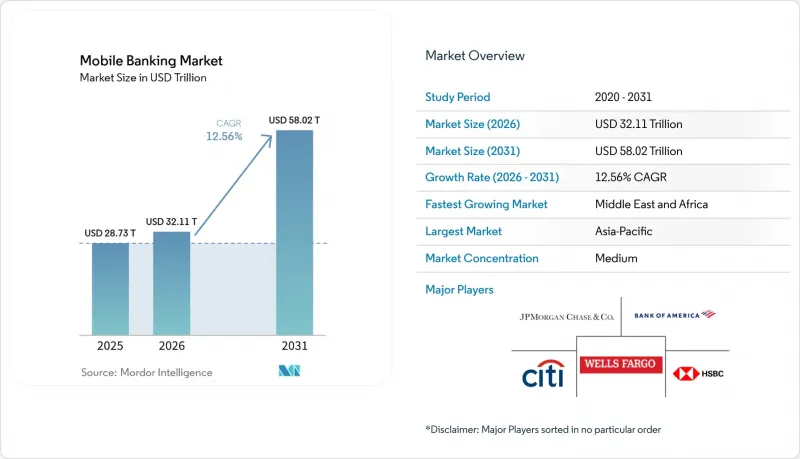
Mordor Intelligence에 의하면, 모바일 뱅킹 시장 규모는 2025년에 28조 7,300억 달러로 평가되었고 2026년 32조 1,100억 달러에서 2031년까지 58조 200억 달러에 이를 것으로 예측되며, 예측 기간(2026-2031년) CAGR은 12.56%를 나타낼 전망입니다.
본 보고서는 서비스 유형별(자금 송금, 청구서 결제 등), 거래 유형별(개인 간 거래, 개인에서 기업으로의 거래 등), 최종 사용자별(개인·소비자, 중소기업(SME) 등), 지역별(북미, 남미 등)로 분류되어 있습니다. 시장 전망은 금액(달러) 기준으로 제시되어 있습니다.
세계 모바일 뱅킹 시장 동향 및 인사이트
'모바일 퍼스트' 주요 은행 서비스가 기본 채널로 자리 잡음
현재 많은 대형 금융 기관에서 모바일이 일상적인 은행 거래의 주요 접근 수단으로 자리 잡고 있습니다. 뱅크 오브 아메리카는 2025년에 5,900만 명의 인증된 디지털 사용자를 보유하며, 166억 건의 디지털 로그인 및 소비자 및 소규모 사업자 가구의 81%에 달하는 디지털 참여율을 기록했다고 보고했습니다. JP모건 체이스는 자사의 모바일 플랫폼이 약 6,300만 명의 활성 사용자에게 서비스를 제공하고 있다고 밝혔으며, 2026년 앱 재설계에서는 디지털 지갑 'Zelle'에 대한 더 빠른 접근과 젊은 층 고객을 위한 저축 촉진 기능에 중점을 두었습니다. 이러한 이용 수준 증가에 따라 앱의 역할은 변화하여 고객 서비스, 결제, 상품 탐색을 위한 주요 창구로 자리 잡았습니다. 그 결과, 모바일 이용 경험을 더욱 단순하고 신뢰할 수 있게 만드는 은행은 고객 참여도를 높이고, 모바일 뱅킹 시장에서 고객과의 관계를 더욱 공고히 유지할 수 있을 것입니다.
실시간 P2P 결제 및 청구서 납부에 대한 수요 증가
모바일 뱅킹 시장에서 실시간 결제는 고객의 기본적인 기대 사항이 되었습니다. 뱅크 오브 아메리카에 따르면, 2025년 Zelle 사용자의 거래 건수는 18억 건, 거래 총액은 5,560억 달러에 달했으며, 중소기업을 대상으로 한 Zelle 결제는 1,260억 달러에 이르러 전년 대비 23% 증가했습니다. 또한 GSMA 보고서에 따르면, 2025년 모바일 머니 거래액은 2조 달러에 달하고, 지난 30일간의 활성 계정 수는 15% 증가한 5억 9,300만 건을 기록하여 신흥 시장 전반에 걸쳐 모바일 주도형 거래 습관이 확산되고 있음을 보여줍니다. 잦은 결제 활동으로 인해 사용자는 동일한 앱을 반복적으로 이용하게 되며, 그 결과 은행 및 금융 플랫폼에게 모바일 채널의 가치가 높아집니다. 이러한 결제 행동이 정착되면 고객은 동일한 모바일 뱅킹 환경 내에서 저축, 대출, 투자 도구 등의 관련 기능을 이용할 가능성이 높아집니다.
소셜 엔지니어링 및 계정 탈취로 인한 지속적인 사기 피해
휴대폰이 수백만 명의 사용자에게 핵심적인 금융 기기로 자리 잡으면서, 부정 사용은 여전히 모바일 뱅킹 시장에 대한 신뢰를 심각하게 훼손하는 요인으로 작용하고 있습니다. FBI 보고서에 따르면, 2025년 1월 이후 5,100건 이상의 계좌 탈취 사기 관련 민원이 접수되었으며, 피해액은 2억 6,200만 달러를 초과했습니다. 또한 주요 수법으로 전화, 문자 메시지, 이메일을 통해 금융 기관의 지원 직원을 사칭하는 방식이 확인되었습니다. 앱 외부에서도 고객이 조작당할 가능성이 있으므로, 이 위험을 인터페이스 설계만으로 해결하기는 어렵습니다. 따라서 은행은 편의성을 유지하면서 더 강력한 인증, 더 명확한 알림, 더 엄격한 거래 감시에 투자해야 합니다. 신뢰가 훼손되면 일부 사용자는 고액 거래를 미루거나 이용을 제한하게 되므로, 모바일 뱅킹 시장의 성장 속도가 둔화될 것입니다.
부문 분석
2025년 모바일 뱅킹 시장 점유율의 29.8%를 차지한 ‘자금 이체’는 모바일 세션에서 가장 빈번하게 이루어지는 은행 업무가 여전히 자금 이체라는 점 때문에 계속해서 1위를 유지했습니다. 이어 ‘청구서 결제’와 ‘대출’이 주요 이용 사례로 꼽힙니다. 이는 사용자들이 동일한 앱 내에서 정기적인 결제를 원터치로 처리하거나 신속한 대출 심사를 받을 수 있기를 점점 더 기대하고 있기 때문입니다. ‘투자·자산 운용’은 가장 빠르게 성장하는 하위 부문으로, 2026년부터 2031년까지 연평균 성장률(CAGR) 16.2%로 확대될 것으로 예측됩니다. 이러한 변화는 은행들이 보다 복잡한 금융 의사결정을 모바일 환경에 도입하고 있다는 점에서 모바일 뱅킹 시장이 더 이상 단순한 거래의 편의성만으로 정의되는 것이 아님을 보여줍니다. 금융 기관들이 단일 용도 내에서 보다 종합적인 금융 경험을 구축함에 따라, ‘보험’ 및 ‘예금 관련 서비스’도 계속해서 서비스 구성의 일부를 차지하고 있습니다.
모바일 사용자가 은행 앱을 벗어나지 않고도 더 큰 규모의 금융 결정을 내리는 데 익숙해짐에 따라, ‘투자·자산 운용’ 분야는 탄력을 받고 있습니다. TD 은행은 2026년 1분기에 전면적으로 재설계된 ‘모바일 퍼스트’ 방식의 ‘TD Easy Trade’ 앱을 출시했습니다. 이는 유서 깊은 금융 기관이 이제 투자를 단순한 독립적인 디지털 부가 기능이 아닌 핵심 모바일 경험으로 자리매김하고 있음을 보여줍니다. 이 제품 전략이 중요한 이유는 투자 활동이 고객 유지율을 높이고, 단순한 결제 업무에 그치지 않는 관계의 가치를 향상시킬 수 있기 때문입니다. 또한 이는 모바일 뱅킹 업계의 광범위한 변화를 반영하며, 은행과 디지털 기업들이 자문 서비스, 자율 거래, 그리고 더 광범위한 개인 자산 관리로 사업을 확장하고 있음을 보여줍니다. 시간이 지남에 따라, 이로 인해 자산 운용 활동이 틈새 확장 기능이 아닌 모바일 뱅킹 이용 행동에서 보다 일상적인 요소가 됨에 따라 서비스 구성이 변화해 나갈 것입니다.
지역별 분석
2025년, 아시아태평양은 모바일 뱅킹 시장 점유율의 46.6%를 차지하며, 다른 지역을 크게 앞지르고 최대 지역 시장이 되었습니다. 이 지역은 매우 방대한 사용자 인구에 더해 모바일 중심의 결제 행태가 정착되어 있으며, 앱 기반 계좌 이용으로의 전환이 급속히 진행되고 있습니다. 세계은행 보고서에 따르면, 휴대전화 기술은 개발도상국에서의 정규 저축 확대를 뒷받침하고 있으며, 이것이 아시아태평양 광범위한 지역에서 모바일 금융 활동이 계속해서 깊이와 규모를 더해가는 이유 중 하나입니다. 아시아태평양은 성숙한 디지털 행동 양식과 새로 진입한 대규모 사용자층을 모두 갖추고 있어 모바일 뱅킹 시장의 중심적 위치를 계속 차지하고 있습니다. 그 결과, 이 지역에서는 일상적인 거래 이용, 폭넓은 상품의 보급, 그리고 금융 포용이 동시에 진전되고 있습니다.
북미와 유럽은 많은 고객이 이미 앱을 주요 은행 거래 인터페이스로 활용하고 있어, 모바일 뱅킹 시장에서 여전히 가장 성숙한 지역으로 남아 있습니다. 뱅크 오브 아메리카는 2025년에 5,900만 명의 인증된 디지털 사용자를 보고했으며, JP모건 체이스는 자사의 모바일 플랫폼이 6,300만 명에 가까운 활성 사용자에게 서비스를 제공하고 있다고 밝혔는데, 이는 미국 주요 금융 기관이 현재 보유한 규모를 여실히 보여줍니다. Chime은 2026년 1분기에 활성 회원 수 1,020만 명을 달성하며 연간 매출 전망치를 상향 조정했습니다. 이는 성숙한 시장에서도 ‘디지털 퍼스트’를 내세우는 신생 기업들이 여전히 성장 여지가 있음을 보여줍니다. 유럽에서는 ING가 2025 회계연도에 모바일을 주된 이용 수단으로 하는 1,540만 명의 고객 기반을 보고했으며, 이는 확립된 은행 시스템에서도 모바일 주도 성장이 여전히 중요함을 뒷받침합니다. 이러한 상황이 맞물려 북미와 유럽은 앱의 정교함, 상품의 다양성, 그리고 치열한 경쟁 측면에서 모바일 뱅킹 시장에 있어 중요한 거점으로 계속 자리 잡고 있습니다.
중동 및 아프리카는 모바일 뱅킹 시장에서 가장 빠르게 성장하는 지역 부문으로, 2026년부터 2031년까지 연평균 성장률(CAGR) 15.0%로 확대될 것으로 예측됩니다. GSMA 보고서에 따르면, 2025년 모바일 머니 거래액은 2조 달러에 달하고, 지난 30일 동안의 활성 계좌 수는 5억 9,300만 건으로 증가했으며, 이러한 성장세의 상당 부분은 사하라 이남 아프리카에서 비롯되고 있습니다. 이 지역에서는 지점 인프라가 고르지 않은 반면, 휴대전화를 활용한 금융 서비스가 실질적인 접근 격차를 해소함에 따라 ‘모바일 퍼스트’ 방식의 접근에 대한 수요가 활발합니다. 또한, 모바일 채널은 소액·고빈도 거래를 대규모로 처리할 수 있어 이 지역 많은 고객의 요구에 부합하며, 이것이 성장을 뒷받침하고 있습니다. 이러한 이유로 중동 및 아프리카는 예측 기간 동안 모바일 뱅킹 시장에 있어 중요한 성장 지역이 될 것입니다.
기타 혜택:
- 엑셀 형식 시장 예측(ME) 시트
- 3개월간의 애널리스트 지원
자주 묻는 질문
목차
제1장 서론
제2장 조사 방법
제3장 주요 요약
제4장 시장 구도
제5장 시장 규모와 성장 예측
제6장 경쟁 구도
제7장 시장 기회와 향후 전망
JHS 26.08.05According to Mordor Intelligence, the mobile banking market size was valued at USD 28.73 trillion in 2025 and is estimated to grow from USD 32.11 trillion in 2026 to reach USD 58.02 trillion by 2031, at a CAGR of 12.56% during the forecast period (2026-2031).
This report is Segmented by Service Type (Fund Transfers, Bill Payments, and More), by Transaction Type (Consumer-To-Consumer, Consumer-To-Business, and More), by End-User (Retail Individuals / Consumers, Small and Medium Enterprises (SMEs), and More), and by Geography (North America, South America, and More). The Market Forecasts are Provided in Terms of Value (USD).
Global Mobile Banking Market Trends and Insights
Mobile-First Primary Banking Becomes the Default Channel
Mobile is now the primary access point for routine banking activity across many large institutions. Bank of America reported 59 million verified digital users in 2025, along with 16.6 billion digital logins and digital engagement across 81% of its consumer and small business households. JPMorgan Chase said its mobile platform serves nearly 63 million active users, and its 2026 app redesign focused on faster access to Zelle, the digital wallet, and savings prompts for younger customers. This level of usage changes the app's role, making it the primary surface for customer service, payments, and product discovery. As a result, banks that make the mobile journey simpler and more reliable can deepen engagement and retain a greater share of the customer relationship in the mobile banking market.
Rising Demand for Real-Time P2P and Bill Payment Journeys
Real-time settlement has become a basic customer expectation in the mobile banking market. Bank of America said Zelle users completed 1.8 billion transactions worth USD 556 billion in 2025, while small business Zelle payments reached USD 126 billion and grew 23% year over year. GSMA also reported that mobile money transactions reached USD 2 trillion in 2025 and that active 30-day accounts rose 15% to 593 million, indicating that mobile-led transaction habits are widening across emerging markets. Frequent payment activity keeps users returning to the same app, thereby increasing the value of the mobile channel for banks and financial platforms. Once that payment behavior is established, customers are more likely to adopt adjacent features, such as savings, borrowing, and investment tools, within the same mobile banking environment.
Persistent Fraud Losses from Social Engineering and Account Takeover
Fraud remains a meaningful drag on confidence in the mobile banking market because the phone has become a central financial device for millions of users. The FBI reported more than 5,100 account takeover fraud complaints since January 2025, with losses exceeding USD 262 million, and it identified impersonation of financial institution support staff through calls, texts, and emails as the primary method. This makes the risk difficult to solve through interface design alone because customers can still be manipulated outside the app. Banks, therefore, have to invest in stronger authentication, clearer alerts, and tighter transaction monitoring while still keeping the experience usable. If trust weakens, some users delay higher-value transactions or limit their activity, slowing the pace of expansion in the mobile banking market.
Other drivers and restraints analyzed in the detailed report include:
- Biometric and Passkey Authentication Reduces Friction
- Embedded Finance Expands In-App Banking Frequency
- Legacy Core Integration Slows Feature Rollout
For complete list of drivers and restraints, kindly check the Table Of Contents.
Segment Analysis
Fund Transfers held 29.8% of the mobile banking market share in 2025, keeping this category in the lead, as payment movement remains the most frequent banking task in a mobile session. Bill Payments and Lending followed as large use cases because users increasingly expect one-touch access to recurring obligations and fast credit decisions inside the same app. Investments and Wealth Management is the fastest-growing sub-segment, projected to expand at a 16.2% CAGR between 2026 and 2031. This shift shows that the mobile banking market is no longer defined solely by transaction utility, as banks are increasingly bringing more complex financial decisions into the mobile environment. Insurance and deposit-related services also remain part of the service mix as institutions build more complete financial journeys within a single application.
Investments and Wealth Management is gaining momentum as mobile users become more comfortable making higher-value financial decisions without leaving the banking app. TD Bank launched a fully redesigned mobile-first TD Easy Trade app in Q1 2026, which shows how established institutions are now treating investing as a core mobile experience rather than a separate digital add-on. That product direction matters because investment activity can deepen customer retention and raise the value of the relationship beyond payments alone. It also reflects a wider change in the mobile banking industry, where banks and digital players are expanding into advisory, self-directed trading, and broader personal finance management. Over time, this changes the service mix by making wealth activity a more regular part of mobile banking behavior instead of a niche extension.
Complete Report Scope:
- By Service Type
- Fund Transfers
- Bill Payments
- Lending
- Deposits and Withdrawals
- Investments and Wealth Management
- Insurance
- Others
- By Transaction Type
- Consumer-to-Consumer
- Consumer-to-Business
- Business-to-Business
- By End User
- Retail Individuals / Consumers
- Small and Medium Enterprises (SMEs)
- Large Corporates and Businesses
- By Geography
- North America
- United States
- Canada
- Mexico
- South America
- Brazil
- Argentina
- Rest of South America
- Europe
- United Kingdom
- Germany
- France
- Italy
- Spain
- Rest of Europe
- Asia-Pacific
- India
- China
- Japan
- Australia
- South Korea
- South East Asia (Singapore, Malaysia, Thailand, Indonesia, Vietnam, and Philippines)
- Rest of Asia-Pacific
- Middle East and Africa
- United Arab Emirates
- Saudi Arabia
- South Africa
- Nigeria
- Rest of Middle East and Africa
- North America
Geography Analysis
Asia-Pacific held 46.6% of the mobile banking market share in 2025, which made it the largest regional base by a wide margin. The region combines very large user populations with strong mobile-led payment behavior and a fast transition toward app-based account use. The World Bank reported that mobile-phone technology is supporting greater formal savings in developing economies, which helps explain why large parts of Asia continue to add depth and scale to mobile financial activity. This keeps Asia-Pacific at the center of the mobile banking market, as the region encompasses both mature digital behavior and large pools of newly engaged users. The result is a geography where daily transaction use, broader product adoption, and financial inclusion are advancing simultaneously.
North America and Europe remain the most mature parts of the mobile banking market, as many customers already rely on apps as their primary banking interface. Bank of America reported 59 million verified digital users in 2025, while JPMorgan Chase said its mobile platform serves nearly 63 million active users, which shows the scale now present among major United States institutions. Chime reached 10.2 million active members in Q1 2026 and raised its full-year revenue guidance, indicating that digital-first challengers still have room to expand in a mature market. In Europe, ING reported a mobile primary customer base of 15.4 million in FY2025, which confirms that mobile-led growth remains relevant even in established banking systems. Together, these conditions keep North America and Europe important to the mobile banking market as centers of app refinement, product depth, and competitive intensity.
The Middle East and Africa is the fastest-growing regional segment in the mobile banking market and is forecast to expand at 15.0% CAGR between 2026 and 2031. GSMA reported that mobile money transactions reached USD 2 trillion in 2025 and active 30-day accounts rose to 593 million, with much of the momentum coming from Sub-Saharan Africa. This region benefits from strong demand for mobile-first access because branch infrastructure is uneven and handset-based finance solves a real access gap. Growth is also supported by the fact that mobile channels can handle low-value, high-frequency activity at large scale, which fits many customer needs in the region. That makes the Middle East and Africa a key expansion zone for the mobile banking market over the forecast period.
- JPMorgan Chase and Co.
- Bank of America Corporation
- Wells Fargo and Company
- Citigroup Inc.
- Banco Santander S.A.
- HSBC Holdings plc
- State Bank of India
- BBVA Group
- Barclays plc
- PayPal Holdings Inc.
- ING Group
- HDFC Bank Limited
- ICICI Bank Limited
- Standard Chartered plc
- DBS Bank Ltd
- Nu Holdings Ltd
- Revolut Ltd
- Chime Financial Inc.
- Monzo Bank Ltd
- KakaoBank Corp.
Additional Benefits:
- The market estimate (ME) sheet in Excel format
- 3 months of analyst support
TABLE OF CONTENTS
1 INTRODUCTION
- 1.1 Study Assumptions and Market Definition
- 1.2 Scope of the Study
2 RESEARCH METHODOLOGY
3 EXECUTIVE SUMMARY
4 MARKET LANDSCAPE
- 4.1 Market Overview
- 4.2 Market Drivers
- 4.2.1 Rising Demand for Real-Time P2P and Bill Payment Journeys
- 4.2.2 Mobile-First Primary Banking Becomes the Default Channel
- 4.2.3 Biometric and Passkey Authentication Reduces Friction
- 4.2.4 Embedded Finance Expands In-App Banking Frequency
- 4.2.5 AI-Personalized Financial Guidance Improves Retention
- 4.2.6 Rural and Underserved Access via Lightweight and USSD-Enabled Experiences
- 4.3 Market Restraints
- 4.3.1 Persistent Fraud Losses from Social Engineering and Account Takeover
- 4.3.2 Legacy Core Integration Slows Feature Rollout
- 4.3.3 Fragmented Data-Residency and App Store Compliance Burdens
- 4.3.4 Low-Trust User Segments Limit Migration to Full App Banking
- 4.4 Value Chain Analysis
- 4.5 Regulatory Landscape
- 4.6 Technological Outlook
- 4.7 Porter's Five Forces Analysis
- 4.7.1 Threat of New Entrants
- 4.7.2 Bargaining Power of Suppliers
- 4.7.3 Bargaining Power of Buyers
- 4.7.4 Threat of Substitutes
- 4.7.5 Competitive Rivalry
5 MARKET SIZE AND GROWTH FORECASTS
- 5.1 By Service Type
- 5.1.1 Fund Transfers
- 5.1.2 Bill Payments
- 5.1.3 Lending
- 5.1.4 Deposits and Withdrawals
- 5.1.5 Investments and Wealth Management
- 5.1.6 Insurance
- 5.1.7 Others
- 5.2 By Transaction Type
- 5.2.1 Consumer-to-Consumer
- 5.2.2 Consumer-to-Business
- 5.2.3 Business-to-Business
- 5.3 By End User
- 5.3.1 Retail Individuals / Consumers
- 5.3.2 Small and Medium Enterprises (SMEs)
- 5.3.3 Large Corporates and Businesses
- 5.4 By Geography
- 5.4.1 North America
- 5.4.1.1 United States
- 5.4.1.2 Canada
- 5.4.1.3 Mexico
- 5.4.2 South America
- 5.4.2.1 Brazil
- 5.4.2.2 Argentina
- 5.4.2.3 Rest of South America
- 5.4.3 Europe
- 5.4.3.1 United Kingdom
- 5.4.3.2 Germany
- 5.4.3.3 France
- 5.4.3.4 Italy
- 5.4.3.5 Spain
- 5.4.3.6 Rest of Europe
- 5.4.4 Asia-Pacific
- 5.4.4.1 India
- 5.4.4.2 China
- 5.4.4.3 Japan
- 5.4.4.4 Australia
- 5.4.4.5 South Korea
- 5.4.4.6 South East Asia (Singapore, Malaysia, Thailand, Indonesia, Vietnam, and Philippines)
- 5.4.4.7 Rest of Asia-Pacific
- 5.4.5 Middle East and Africa
- 5.4.5.1 United Arab Emirates
- 5.4.5.2 Saudi Arabia
- 5.4.5.3 South Africa
- 5.4.5.4 Nigeria
- 5.4.5.5 Rest of Middle East and Africa
- 5.4.1 North America
6 COMPETITIVE LANDSCAPE
- 6.1 Market Concentration
- 6.2 Strategic Moves
- 6.3 Market Share Analysis
- 6.4 Company Profiles (includes Global Level Overview, Market Level Overview, Core Segments, Financials as available, Strategic Information, Market Rank/Share, Products and Services, Recent Developments)
- 6.4.1 JPMorgan Chase and Co.
- 6.4.2 Bank of America Corporation
- 6.4.3 Wells Fargo and Company
- 6.4.4 Citigroup Inc.
- 6.4.5 Banco Santander S.A.
- 6.4.6 HSBC Holdings plc
- 6.4.7 State Bank of India
- 6.4.8 BBVA Group
- 6.4.9 Barclays plc
- 6.4.10 PayPal Holdings Inc.
- 6.4.11 ING Group
- 6.4.12 HDFC Bank Limited
- 6.4.13 ICICI Bank Limited
- 6.4.14 Standard Chartered plc
- 6.4.15 DBS Bank Ltd
- 6.4.16 Nu Holdings Ltd
- 6.4.17 Revolut Ltd
- 6.4.18 Chime Financial Inc.
- 6.4.19 Monzo Bank Ltd
- 6.4.20 KakaoBank Corp.
7 MARKET OPPORTUNITIES AND FUTURE OUTLOOK
- 7.1 White-Space and Unmet-Need Assessment


