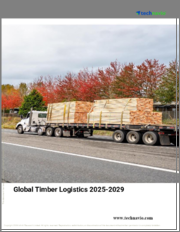
|
시장보고서
상품코드
2099093
미국의 목재 물류 시장 : 점유율 분석, 업계 동향 및 통계, 성장 예측(2026-2031년)United States Timber Logistics - Market Share Analysis, Industry Trends & Statistics, Growth Forecasts (2026 - 2031) |
||||||
 Mordor Intelligence
Mordor Intelligence에 의하면, 미국 목재 물류 시장 규모는 2025년에 176억 7,000만 달러로 평가되었고 2026년 183억 1,000만 달러에서 2031년까지 215억 6,000만 달러에 이를 것으로 예측되며, 2026년부터 2031년까지 예측 기간 CAGR은 3.32%를 나타낼 전망입니다.
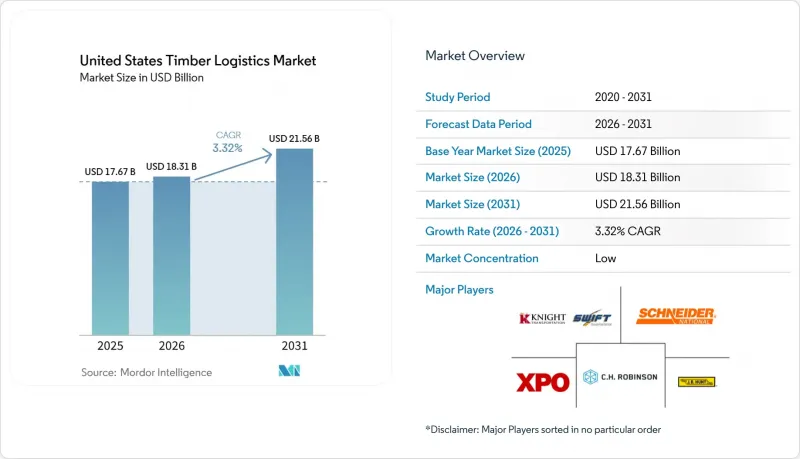
미국 목재 물류 시장은 적층재 및 대형 목재(마스티머)로의 용도 전환이라는 구조적 변화, 산림 관리 확대를 위한 연방 정부의 광범위한 노력, 그리고 주요 목재 수송 회랑에서의 복합 운송 수단 이용 확대에 힘입어 성장하고 있습니다. 본 보고서는 서비스별(운송, 창고·보관, 부가가치 서비스), 목재 제품 유형별(산업용 통나무/원목, 장작·바이오매스, 기타), 최종 이용 산업별(건설 및 인프라, 펄프·제지 산업, 기타), 지역별(북동부, 남서부, 서부, 남동부, 중서부)로 분류되어 있습니다. 시장 전망은 금액(달러) 기준으로 제시되어 있습니다.
미국 목재 물류 시장 동향과 인사이트
비주거용 건설 분야에서 매스 팀버 및 엔지니어드 우드에 대한 수요 증가
매스 팀버는 비주거용 건설 분야에서 틈새 건축자재에서 보다 일반적인 구조재로 전환되고 있으며, 이러한 변화가 미국 목재 물류 시장의 화물 계획에 변화를 가져오고 있습니다. CLT 및 접합재 패널은 표준 제재목 묶음과는 운송 방식이 다르기 때문에 운송업체는 다른 플랫베드 적재 구성, 보다 엄격한 적재 순서, 그리고 현장에서의 보다 정확한 하역 시간대 설정이 필요합니다. 또한, 이러한 제품을 사용하는 건설 프로젝트에서는 대형 패널을 현장에서 보관하기 어렵고, 지연이 발생하면 시공 팀의 작업이 급격히 늦어지기 때문에 배송 조정이 필수적입니다. 따라서 기존 목재 운송에 비해 일정 엄수, 화물 보호, 그리고 라스트 마일 이행이 더욱 중요해지고 있습니다. 합성목재 취급량이 증가함에 따라, 전문적인 취급 능력을 갖춘 운송업체들은 미국 목재 물류 시장에서 더 높은 부가가치를 지닌 운송 경로에 대한 접근성을 확대되고 있습니다.
공차 주행 거리 및 제품 손상을 줄이기 위한 인터모달 환적 증가
미국 목재 물류 시장에서 인터모달 환적은 단순한 제한적인 비용 절감책이 아니라, 목재 공급망의 구조적인 일부가 되어가고 있습니다. C.H. 로빈슨사는 2025년 4월 화물 동향 보고서에서 인터모달 계약 가격이 전년 대비 3.5% 상승했다고 보고했으며, 이는 자산을 보다 효율적으로 활용하기 위한 운송 경로 재설계를 뒷받침하고 있습니다. 목재 운송 사업자들은 내륙 항구 허브를 경유하여 장거리 제재목 및 펄프 운송을 수행하는 사례가 증가하고 있으며, 이를 통해 드레이지 비용 절감과 트럭 구간에서의 공차 주행 거리 단축을 도모하고 있습니다. 또한, 이 모델은 화물의 품질 보호에도 기여합니다. 철도와의 연계 운송을 통해 수일에 걸친 운송 중 화물의 모서리 손상이나 습기에의 노출을 줄일 수 있기 때문입니다. 철도 운송과 라스트 마일 도로 운송을 단일 예약 및 가시화 흐름 내에서 통합할 수 있는 운송업체는 트럭만 운영하는 업체보다 서비스 면에서 유리한 입장에 있습니다.
목재 전문 운송 분야의 운전기사 부족
목재 운송 트럭 운전기사 부족은 경기 순환적인 문제라기보다 구조적인 문제이며, 미국 목재 물류 시장의 일반적인 운송 능력 불균형보다 해결이 더 어렵습니다. 조지아 대학교 산림 비즈니스 센터와 미국 농무부 산림청이 2025년에 실시한 조사에 따르면, 목재 운송 트럭 운전자의 대다수는 40세 이상이며, 30세 미만의 근로자가 이 분야에 진입하는 사례는 극히 드문 것으로 나타났습니다. 같은 조사에서는 많은 사업자가 소규모로 노후화된 차량을 운영하고 있으며, 이것이 보험료와 연료비 증가로 이어져 임금 측면에서 일반 화물 운송업체와의 경쟁력을 제한하고 있다는 점도 지적되었습니다. 미국 남부에서는 목재 배송 비용 중 운송비가 최대 40%를 차지하기 때문에 운전기사 확보가 어려워지면 제재소의 조달 비용이나 운송업체의 이익률에 즉각적인 영향을 미칩니다. 산림자원협회(Forest Resources Association)는 2025년 9월, 2025년 면허법에 따른 상업용 운전 면허(CDL) 간소화가 해당 업계에 도움이 될 가능성이 있다고 밝혔으나, 훈련 및 차량 교체에는 시간이 소요되므로 상황 개선에는 여전히 시간이 걸릴 것이라고 전했습니다. 수송량이 많은 화물의 일부를 복합 운송으로 전환할 수 있는 운송업체는 화물 1건당 운전자에게 가해지는 직접적인 부담을 줄이기 쉬운 입장에 있습니다.
부문 분석
2025년 미국 목재 물류 시장 규모 중 운송 서비스가 73.87%를 차지하고 있으며, 전체 서비스 구성에서 핵심인 간선 운송 업무가 여전히 최대 수익원임이 확인되었습니다. 전국적으로 벌채지에서 제재소로, 또 제재소에서 유통 거점으로의 운송 대부분을 여전히 원목 운송 트럭이 담당하고 있기 때문에 도로 화물 운송이 주요 운송 수단으로 남아 있습니다. 철도는 장거리 노선, 특히 남동부에서 북동부로 향하는 목재 운송 경로와 태평양 연안 북서부의 수출 회랑에서 더 큰 역할을 수행하고 있습니다. 수상 운송은 멕시코만 및 대서양 관문을 통해 벌크 바이오매스, 우드칩, 원목의 수출 활동을 뒷받침하고 있습니다. 미국 목재 물류 시장에서 내륙 터미널 및 항만과 연결된 철도 거점이 목재 화주에게 더욱 유용해짐에 따라, 복합 운송 서비스의 제공 범위는 확대되고 있습니다.
부가가치 서비스는 2026년부터 2031년까지 연평균 성장률(CAGR) 4.52%를 나타낼 것으로 예측되며, 미국 목재 물류 업계에서 가장 빠르게 성장하는 서비스 부문이 될 전망입니다. 이러한 성장은 건조로 건조 조정, 재제조 공정 관리, 디지털 추적·추적 시스템, 크로스도킹, 그리고 현재보다 더욱 복잡해지고 있는 목재 흐름에 필요한 기타 취급 공정에 대한 수요 증가를 반영하고 있습니다. 또한, 미국 농무부 산림청의 ‘전국 산림 관리 전략(National Active Forest Management Strategy)’ 역시 단순한 지점 간 운송이 아닌, 맞춤형 취급이 필요한 관리 벌채 목재 및 재해 벌채 목재의 안정적인 공급을 뒷받침하고 있습니다. 이로 인해 부가가치 서비스 제공업체는 주로 가격 경쟁을 펼치는 순수 운송업체보다 이익을 확보할 기회를 더 쉽게 얻을 수 있습니다.
기타 혜택:
- 엑셀 형식 시장 예측(ME) 시트
- 3개월간의 애널리스트 지원
자주 묻는 질문
목차
제1장 서론
제2장 조사 방법
제3장 주요 요약
제4장 시장 구도
제5장 시장 규모와 성장 예측
제6장 경쟁 구도
제7장 시장 기회와 향후 전망
JHS 26.08.05According to Mordor Intelligence, the United States timber logistics market size was valued at USD 17.67 billion in 2025 and estimated to grow from USD 18.31 billion in 2026 to reach USD 21.56 billion by 2031, at a CAGR of 3.32% during the forecast period 2026-2031.
The United States timber logistics market is supported by a structural shift toward engineered wood and mass timber applications, a broader federal push to expand forest management, and the rising use of intermodal freight options in major timber corridors. This report is Segmented by Service (Transportation, Warehousing and Storage, and Value-Added Services), by Timber Product Type (Industrial Roundwood / Logs, Fuelwood & Biomass, and More), by End-Use Industry (Construction & Infrastructure, Pulp & Paper Industry, and More), and by Geography (Northeast, Southwest, West, Southeast, and Midwest). The Market Forecasts are Provided in Terms of Value (USD).
United States Timber Logistics Market Trends and Insights
Growing Demand for Mass Timber and Engineered Wood in Nonresidential Construction
Mass timber is moving from a niche building choice to a more regular structural option in nonresidential construction, and that shift is changing freight planning in the United States timber logistics market. CLT and glulam panels do not travel like standard bundles of sawn lumber, so carriers need different flatbed setups, tighter load sequencing, and more precise unloading windows at jobsites. Construction projects using these products also depend on coordinated deliveries because oversized panels are harder to store on site, and delays can slow installation crews quickly. That makes scheduling discipline, cargo protection, and final-mile execution more important than in conventional timber hauling. As engineered wood volumes rise, carriers with specialized handling capability are gaining access to higher-value freight lanes within the United States timber logistics market.
Higher Intermodal Reloading to Reduce Empty Miles and Product Damage
Intermodal reloading is becoming a structural part of timber supply chains rather than a narrow cost tactic in the United States timber logistics market. C.H. Robinson reported that intermodal contract prices were up 3.5% year over year in its April 2025 freight update, reinforcing the push to redesign lanes to better utilize assets. Timber operators are increasingly routing long-haul lumber and pulp traffic through inland port nodes to reduce drayage expense and cut empty miles on truck legs. The model also helps protect payload quality because rail-linked moves can reduce edge damage and moisture exposure over multi-day trips. Carriers that can combine rail and final-mile road movements within a single booking and visibility flow hold a stronger service position than truck-only operators.
Driver Shortages in Specialized Timber Haulage
The shortage of log truck drivers is more structural than cyclical, making it harder to fix than a typical freight capacity imbalance in the United States timber logistics market. A 2025 review from the University of Georgia Center for Forest Business and the USDA Forest Service found that most log truck drivers were over 40 and that very few workers under 30 were entering the field. The same review noted that many operators run smaller, older fleets, which increases insurance and fuel costs and limits their ability to compete with general freight employers on pay. Transportation can account for up to 40% of delivered wood cost in the United States South, so any tightening in driver availability quickly affects mill procurement economics and carrier margins. The Forest Resources Association stated in September 2025 that CDL streamlining under the License Act of 2025 could help the sector, but relief would still take time because training and fleet renewal do not happen quickly. Carriers that can move some higher-volume freight into intermodal patterns are better positioned to reduce the direct driver pressure per load.
Other drivers and restraints analyzed in the detailed report include:
- Digital Chain-of-Custody Pressure From ESG-Sensitive Buyers and Public Procurement
- Wildfire-Driven Salvage Logging and Distressed Timber Recovery
- Seasonal Road Weight Restrictions and Weather Disruptions
For complete list of drivers and restraints, kindly check the Table Of Contents.
Segment Analysis
Transportation services accounted for 73.87% of the United States timber logistics market size in 2025, confirming that core line-haul activity remains the largest revenue driver across the service mix. Road freight remains the dominant transport mode because log trucks still handle most harvest-to-mill and mill-to-distribution movements across the country. Rail has a larger role on long-distance lanes, especially on Southeast-to-Northeast lumber routes and Pacific Northwest export corridors. Waterway freight supports bulk biomass, wood chip, and log export activity through Gulf and Atlantic gateways. Multimodal offerings are expanding as inland terminals and port-linked rail nodes become more useful to timber shippers in the United States timber logistics market.
Value-added services are forecast to grow at a 4.52% CAGR from 2026 to 2031, making them the fastest-moving service category in the United States timber logistics industry. Growth reflects rising demand for kiln-drying coordination, remanufacturing sequencing, digital track-and-trace, cross-docking, and other handling steps that more complex timber flows now require. The USDA Forest Service's National Active Forest Management Strategy also supports a steadier pipeline of managed and salvage volumes that need customized handling rather than simple point-to-point hauling. That gives value-added providers a better chance to capture margin than pure-haul carriers that compete mainly on price.
Complete Report Scope:
- By Service
- Transportation
- Road
- Rail
- Waterway
- Multimodal
- Warehousing and Storage
- Value-Added Services
- Transportation
- By Timber Product Type
- Industrial roundwood / logs
- Fuelwood & biomass
- Sawn timber & lumber
- Engineered wood products
- Pulpwood, chips, and fibre
- Pellets and briquettes
- Other Timber Types
- By End-Use Industry
- Construction & Infrastructure
- Pulp & Paper Industry
- Furniture Manufacturing
- Packaging Industry
- Energy & Biomass Industry
- Other End-Use Industries
- By Geography
- Northeast
- Southwest
- West
- Southeast
- Midwest
List of Companies Covered in this Report:
- J.B. Hunt Transport Services Inc.
- Schneider National, Inc.
- Knight-Swift Transportation Holdings Inc.
- C.H. Robinson Worldwide, Inc.
- XPO, Inc.
- FedEx Corporation
- Old Dominion Freight Line, Inc.
- Landstar System, Inc.
- Werner Enterprises, Inc.
- ArcBest Corporation
- Hub Group, Inc.
- Ryder System, Inc.
- Estes Express Lines
- Saia, Inc.
- TFI International Inc.
- Universal Logistics Holdings, Inc.
- Maverick Transportation, LLC
- Anderson Trucking Service, Inc.
- Melton Truck Lines, Inc.
- PS Logistics, LLC
- PGT Trucking, Inc.
Additional Benefits:
- The market estimate (ME) sheet in Excel format
- 3 months of analyst support
TABLE OF CONTENTS
1 Introduction
- 1.1 Study Assumptions and Market Definition
- 1.2 Scope of the Study
2 Research Methodology
3 Executive Summary
4 Market Landscape
- 4.1 Market Overview
- 4.2 Market Drivers
- 4.2.1 Growing Demand for Mass Timber and Engineered Wood in Nonresidential Construction
- 4.2.2 Higher Intermodal Reloading to Reduce Empty Miles and Product Damage
- 4.2.3 Digital Chain-of-Custody Pressure from ESG-Sensitive Buyers and Public Procurement
- 4.2.4 Wildfire-Driven Salvage Logging and Distressed Timber Recovery
- 4.2.5 Rail and Port Slot Optimization for Longer-Distance Inbound and Export Flows
- 4.2.6 Shorter Lead Times from Regionalized Sawmill and Distribution Networks
- 4.3 Market Restraints
- 4.3.1 Driver Shortages in Specialized Timber Haulage
- 4.3.2 Seasonal Road Weight Restrictions and Weather Disruptions
- 4.3.3 Tight Chain-of-Custody and Emissions Compliance Costs
- 4.3.4 Fragmented Forest Access Roads and Loading Infrastructure
- 4.4 Value / Supply-Chain Analysis
- 4.5 Regulatory Landscape
- 4.6 Technological Outlook
- 4.7 Porter's Five Forces Analysis
- 4.7.1 Bargaining Power of Suppliers
- 4.7.2 Bargaining Power of Buyers
- 4.7.3 Threat of New Entrants
- 4.7.4 Threat of Substitutes
- 4.7.5 Industry Rivalry
- 4.8 Impact of Geopolitical Events on the Market
5 Market Size & Growth Forecasts (Value in USD)
- 5.1 By Service
- 5.1.1 Transportation
- 5.1.1.1 Road
- 5.1.1.2 Rail
- 5.1.1.3 Waterway
- 5.1.1.4 Multimodal
- 5.1.2 Warehousing and Storage
- 5.1.3 Value-Added Services
- 5.1.1 Transportation
- 5.2 By Timber Product Type
- 5.2.1 Industrial roundwood / logs
- 5.2.2 Fuelwood & biomass
- 5.2.3 Sawn timber & lumber
- 5.2.4 Engineered wood products
- 5.2.5 Pulpwood, chips, and fibre
- 5.2.6 Pellets and briquettes
- 5.2.7 Other Timber Types
- 5.3 By End-Use Industry
- 5.3.1 Construction & Infrastructure
- 5.3.2 Pulp & Paper Industry
- 5.3.3 Furniture Manufacturing
- 5.3.4 Packaging Industry
- 5.3.5 Energy & Biomass Industry
- 5.3.6 Other End-Use Industries
- 5.4 By Geography
- 5.4.1 Northeast
- 5.4.2 Southwest
- 5.4.3 West
- 5.4.4 Southeast
- 5.4.5 Midwest
6 Competitive Landscape
- 6.1 Market Concentration
- 6.2 Strategic Moves
- 6.3 Market Share Analysis
- 6.4 Company Profiles (includes Global Level Overview, Market Level Overview, Core Segments, Financials as available, Strategic Information, Market Rank/Share, Products and Services, Recent Developments)
- 6.4.1 J.B. Hunt Transport Services Inc.
- 6.4.2 Schneider National, Inc.
- 6.4.3 Knight-Swift Transportation Holdings Inc.
- 6.4.4 C.H. Robinson Worldwide, Inc.
- 6.4.5 XPO, Inc.
- 6.4.6 FedEx Corporation
- 6.4.7 Old Dominion Freight Line, Inc.
- 6.4.8 Landstar System, Inc.
- 6.4.9 Werner Enterprises, Inc.
- 6.4.10 ArcBest Corporation
- 6.4.11 Hub Group, Inc.
- 6.4.12 Ryder System, Inc.
- 6.4.13 Estes Express Lines
- 6.4.14 Saia, Inc.
- 6.4.15 TFI International Inc.
- 6.4.16 Universal Logistics Holdings, Inc.
- 6.4.17 Maverick Transportation, LLC
- 6.4.18 Anderson Trucking Service, Inc.
- 6.4.19 Melton Truck Lines, Inc.
- 6.4.20 PS Logistics, LLC
- 6.4.21 PGT Trucking, Inc.
7 Market Opportunities & Future Outlook
- 7.1 White-Space and Unmet-Need Assessment