

|
시장보고서
상품코드
2099100
고령 인구용 가구 시장 : 시장 점유율 분석, 업계 동향 및 통계, 성장 예측(2026-2031년)Furniture For The Aging Population - Market Share Analysis, Industry Trends & Statistics, Growth Forecasts (2026 - 2031) |
||||||
 Mordor Intelligence
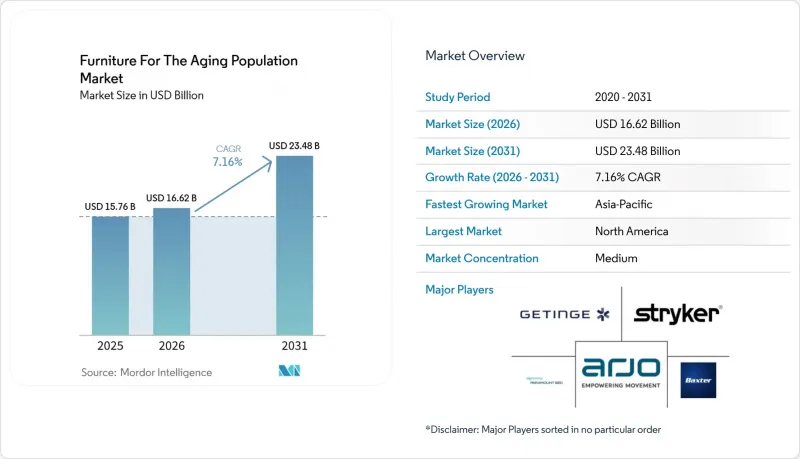
Mordor Intelligence에 의하면, 고령 인구용 가구 시장은 2025년에 157억 6,000만 달러로 평가되었고, 2026년 166억 2,000만 달러에서 2031년까지 234억 8,000만 달러에 이를 것으로 예측되며, 2026-2031년 CAGR 7.16%로 성장할 전망입니다.
본 보고서는 제품 유형별(침대 및 수면 보조 기구, 의자 및 리클라이닝 의자, 테이블 및 상판, 수납 가구, 욕실용 안전 가구), 최종 사용자별(주택, 요양 주택, 특별양로원, 병원, 시니어 주택), 유통 채널별(B2C/소매 채널, B2B/직접 판매), 지역별로 분류되어 있습니다. 시장 전망은 금액(달러) 기준으로 제시되어 있습니다.
세계의 고령 인구용 가구 시장 동향 및 인사이트
'자택에서의 노후 생활(에이징 인 플레이스)'을 위한 리모델링 수요 증가
고령 인구용 가구 시장은 '자택에서의 노후 생활'을 중시하는 경향에 힘입어 크게 성장하고 있습니다. 이는 가구주들이 시설 입소보다는 익숙한 환경에서 계속 생활하기를 선호하기 때문입니다. AARP에 따르면, 65세 이상 성인의 87%가 고령이 되어도 현재 자택에 머물고 싶어 하며, 이로 인해 고령 인구용 가구 시장 구매 결정 시 접근성 향상이 계속해서 중요한 요소 중 하나로 자리 잡고 있습니다. 만약 주택이 이미 고령자를 배려한 상태라면, 이러한 경향은 그리 중요하지 않을 것입니다. 그러나 미국 인구조사국에 따르면, 미국 주택 중 고령자에게 적합한 설계가 적용된 곳은 고작 10%에 불과하며, 이러한 대규모 개조 격차가 보조 의자, 높이 조절이 가능한 침대, 욕실 안전 용품에 대한 수요를 지속적으로 뒷받침하고 있습니다. 그 결과, 고령 인구용 가구 시장은 단순히 의료적 필요와 연결될 뿐만 아니라, 리모델링 주기, 간병 계획, 퇴원 준비와도 밀접하게 연관되어 있습니다. 이로 인해 구매층은 고령자 본인에 그치지 않고 가족, 치료사, 주택 전문가도 의사결정 과정에 참여하게 되어, 공급업체의 제품 포지셔닝 및 판매 채널 관리 방식에도 변화가 생기고 있습니다.
간병 서비스가 제공되는 주택 및 장기 요양 시설의 수용 능력 확대
고령 인구용 가구 시장은 어시스트 리빙 및 장기 요양 시설의 운영상 압박에 의해서도 뒷받침되고 있습니다. 이러한 시설에서는 높은 입주율로 인해 소유주가 개보수를 미루기보다는 입주자의 거주 공간 개선을 서둘러야 하는 상황에 처해 있습니다. NIC 보고서에 따르면, 2026년 1분기 고령자용 주택의 입주율은 89.5%에 달했으며, 건설 중인 유닛 수는 16,400호로 감소했는데, 이는 기존 재고의 불과 2.3%에 불과합니다. 이러한 상황은 고령 인구용 가구 시장이 공급 부족과 인구 동향의 성장에 힘입어 호황을 누리고 있는 이유를 여실히 보여줍니다. 또한 NIC는 조사 대상 시장에서 입주 완료된 지원형 생활 시설 및 치매 케어 시설의 재고가 2021년 3분기부터 2025년 3분기에 걸쳐 21% 증가한 반면, 2026년 3월 지원형 생활 시설의 모집 임대료는 전년 동월 대비 7.2% 상승했다고 밝혔으며, 이에 따라 운영 사업자에게는 인재 채용 및 정착을 지원하는 가구에 대한 투자 여지가 더욱 확대되고 있습니다. 이러한 상황에서 고령 인구용 가구 시장은 저비용 교체보다는 ‘가치’에 의해 형성되고 있습니다. 더 나은 침대나 의자, 공용 공간이 입소자의 경험을 향상시킨다면 운영 사업자는 그 지출을 정당화할 수 있기 때문입니다. 따라서 가구 선택을 쾌적성, 직원의 안전, 돌봄 성과와 연결시킬 수 있는 공급업체는 시설 측의 입찰 조건이 더욱 엄격해지는 가운데 더 유리한 입장에 서게 될 것입니다.
기존 가구에 비해 높은 비용
고령 인구용 가구 시장은 여전히 뚜렷한 가격 장벽에 직면해 있습니다. 이는 전용 설계 제품에는 일반 가정용 가구에는 없는 설계, 시험 및 재료 요건이 수반되기 때문입니다. 또한, 규정 준수 기준도 더욱 엄격해지고 있으며, EN ISO 20342-4, 2026 등의 규격에 따라 조직 보호 제품의 내구성 시험에 대한 기대치가 높아지고 있습니다. 이로 인해 고령 인구용 가구 시장 전반에서 공급업체의 개발 및 검증 비용이 증가할 가능성이 있습니다. 이러한 비용 압박은 주거 환경이나 가격에 민감한 지역에서는 흡수하기 어려우며, 이러한 지역에서는 전문 가구가 구매 초기에는 허용 범위 내로 보이는 저렴한 기존 대체품과 경쟁하는 경우가 많습니다. 고령 인구용 가구 시장은 보상 제도나 공공 요양 프로그램이 조달을 지원하는 환경에서는 어느 정도 보호받고 있지만, 제품이 일반 가정용 가구와 규제 대상인 의료기기 사이에 위치하는 경우 보상 범위의 공백이 남게 됩니다. 그 결과, 도입 현황에 편차가 발생하며, 본래라면 더 빠르게 확대되었을 시장의 일부에서 교체 주기가 장기화되고 있습니다.
부문 분석
2025년, 고령 인구용 가구 시장 점유율의 34.15%를 의자와 리클라이닝 의자가 차지했으며, 가정과 요양 시설 모두에서 널리 이용되고 있어 주도적인 위치를 유지했습니다. 리프트식 리클라이닝 의자, 인체공학에 기반한 암체어, 이동 지원용 좌석은 방을 전면적으로 개조할 필요 없이 편안함, 이동 지원, 일상적인 사용 편의성을 충족시키기 때문에 많은 구매자에게 여전히 가장 친숙한 진입점으로 자리 잡고 있습니다. 또한, 이 부문은 판매 채널의 유연성이라는 이점도 누리고 있습니다. 과거에는 주로 의료용품 도매업체를 통해 유통되던 제품이, 현재는 전문 소매점이나 전자상거래 플랫폼을 통해 다양한 가격대로 판매되고 있기 때문입니다. 이동 지원용 의자와 인체공학에 기반한 안락의자는 내구성, 하중 지지력, 세척 용이성, 커버 소재 선택의 폭 등의 측면에서 경쟁하고 있습니다. 동시에, 시설에서의 구매 시에는 일반 가정의 교체 구매에 비해 해외 좌석 기준 준수가 더욱 중요하게 여겨집니다.
침대 및 수면 지원 시스템을 포함한 고령 인구용 가구 시장은 2026-2031년 연평균 성장률(CAGR) 7.75%로 확대될 것으로 예측되며, 이는 가장 빠르게 성장하는 제품군입니다. 이러한 성장을 뒷받침하는 요인으로는 체압 분포 측정, 낙상 감지 기능, 센서를 활용한 모니터링 등이 있으며, 이를 통해 침대는 입소자의 돌봄과 간병인의 업무 흐름 모두에서 더욱 중심적인 역할을 수행하게 되었습니다. 또한, EN ISO 20342-4,2026의 시행으로 매트리스 및 오버레이와 같은 조직 보호 제품의 기술적 기준이 상향 조정되었으며, 이에 따라 더 강력한 효능과 내구성이 보장된 새로운 시스템으로의 교체 수요가 촉진되고 있습니다. 조절 가능한 침대나 이송 지원 침대가 주목을 받고 있는 것은 의료 제공업체들이 낙상 위험과 간병인의 부담을 동시에 줄일 수 있는 제품을 원하고 있기 때문입니다. 체압 분산 매트리스도 성장 요인 중 하나로, 임상 성능과 자동화를 결합하여 병원에서 재택 요양 환경으로 더 쉽게 전환할 수 있게 된 것이 배경에 있습니다.
지역별 분석
2025년, 북미는 고령 인구용 가구 시장 점유율의 35.15%를 차지하며 지역별 시장 1위를 기록했습니다. 이 지역은 고령 인구가 많고, 일부 의료 제공 시스템에서 풍부한 보험 환급 지원을 받으며, 다양한 소득 계층에서 주택 개조 수요를 유지하는 ‘재택 고령화’의 활발한 환경과 같은 혜택을 누리고 있습니다. 미국 인구조사국은 2026년 4월, 2025년 시점에서 베이비붐 세대 전원이 61세에서 79세에 도달했다고 발표했습니다. 이는 이동성, 쾌적성 및 주거 안전성에 대한 요구와 연동된 첫 구매 및 추가 구매의 큰 물결을 뒷받침하는 것입니다. 또한 북미는 의료시설의 퇴원 계획과 재택 요양 수요 간의 연관성에서도 혜택을 받고 있으며, 이로 인해 침대, 보조 의자, 그리고 이동에 중점을 둔 가구의 채널 간 유통이 촉진되고 있습니다.
유럽은 고령 인구용 가구 시장에서 여전히 성숙한 지역으로, 시설을 통한 조달, 엄격한 규제, 그리고 고령화가 진행 중인 인구가 안정적인 수요 기반을 형성하고 있습니다. WHO 유럽 사무소에 따르면, 이 지역에서는 65세 이상 성인의 수가 아동 및 청소년의 수를 초과하고 있으며, 60세 이상 인구의 비율은 2050년까지 32.2%를 나타낼 것으로 예측됩니다. 이는 고령 인구용 가구 시장의 장기적인 수요 증가를 뒷받침하는 것입니다. 이러한 환경은 간병용 침대, 이동 보조 시스템, 욕창 예방 제품에 강점을 가진 공급업체에게 유리하며, 특히 내구성과 검증된 성능이 입찰 과정에서 평가되는 경우 그 경향이 두드러집니다. 남미는 여전히 고령 인구용 가구 시장에서 비교적 작은 비중을 차지하고 있지만, 초안에 따르면 공식 소매 채널 및 기관용 채널이 지속적으로 정비되는 가운데 브라질이 지역 발전을 주도하고 있는 것으로 나타났습니다.
아시아태평양의 고령 인구용 가구 시장 규모는 2026-2031년 연평균 성장률(CAGR) 7.82%로 확대될 것으로 예측되며, 지역별 부문 중 가장 높은 성장률을 보일 것으로 전망됩니다. 이 지역에서는 성숙한 고령화 경제국들의 인구 통계학적 압력과 중국 및 인도의 대규모 시장 기회가 맞물려 있으며, 동남아시아에서는 병원 및 노인 요양 시설의 확장에 따라 공급 역량이 강화되고 있습니다. 또한, 아시아태평양의 고령 인구용 가구 시장에서는 현지화 움직임도 활발해지고 있습니다. 그 예로, 2025년 4월 Wellell이 태국의 idsMED Group과 판매 제휴를 맺은 것과, 2026년 2월 Linet이 idsMED Vietnam을 통해 베트남 박마이 병원 제2캠퍼스에 고급 전동 침대를 납품한 것을 들 수 있습니다. 중동 및 아프리카 시장 점유율은 여전히 작지만, 의료 분야에 대한 투자와 정책 도입으로 인해 요양 지원 제품의 장기적인 기반이 확대되고 있습니다. 세계보건기구(WHO)는 2026년 6월, 이란이 ‘노인 통합 돌봄’ 체계를 채택했다고 보고했습니다. 이는 해당 지역 일부에서 향후 돌봄 인프라와 제품 수요를 강화할 수 있는 보다 광범위한 정책 전환을 시사하는 것입니다.
기타 혜택 :
- 엑셀 형식 시장 예측(ME) 시트
- 3개월간의 애널리스트 지원
자주 묻는 질문
목차
제1장 서론
제2장 조사 방법
제3장 주요 요약
제4장 시장 구도
제5장 시장 규모 및 성장 예측
제6장 경쟁 구도
제7장 시장 기회 및 향후 전망
AJY 26.08.07According to Mordor Intelligence, the furniture market for the aging population is projected to be USD 15.76 billion in 2025, USD 16.62 billion in 2026, and USD 23.48 billion by 2031, growing at a CAGR of 7.16% from 2026 to 2031.
This report is Segmented by Product Type (Beds and Sleep Support, Chairs and Recliners, Tables and Surfaces, Storage, Bathroom Safety Furniture), End-User (Residential, Assisted Living, Nursing Homes, Hospitals, Senior Living), Distribution Channel (B2C/Retail Channels, B2B/Direct), and Geography. The Market Forecasts are Provided in Terms of Value (USD).
Global Furniture For The Aging Population Market Trends and Insights
Rising Aging-In-Place Renovation Demand
The furniture for the aging population market is seeing strong support from aging-in-place preferences, as households prefer to stay in familiar settings rather than move into institutions. AARP states that 87% of adults aged 65 and older prefer to remain in their current homes as they age, which keeps accessibility upgrades close to the center of purchase decisions for the furniture for the aging population market. That preference would matter less if homes were already prepared, yet the United States Census Bureau states that only 10% of U.S. homes are adequately designed for aging populations, leaving a large retrofit gap that continues to feed demand for supportive seating, adjustable beds, and bathroom safety items. The result is that furniture for the aging population market is not tied solely to medical needs; it also aligns with renovation cycles, caregiver planning, and discharge preparation. This widens the buyer base beyond older residents and brings family members, therapists, and housing professionals into the same decision-making chain, which changes how suppliers position products and manage channels.
Growth of Assisted Living and Long-Term Care Capacity
The furniture market for the aging population is also being boosted by operating pressure in assisted living and long-term care properties, where high occupancy is pushing owners to improve resident spaces rather than delay upgrades. NIC reports that senior housing occupancy reached 89.5% in Q1 2026 and that units under construction fell to 16,400, or only 2.3% of existing inventory, underscoring why the furniture for the aging population market is benefiting from supply tightness and demographic growth. NIC also states that occupied assisted living and memory care inventory in tracked markets grew 21% between Q3 2021 and Q3 2025, while assisted living asking rent increased 7.2% year over year in March 2026, giving operators more room to invest in furnishings that support recruitment and retention. In this setting, the furniture for the aging population market is shaped less by low-cost replacement and more by value, since operators can justify spending when better beds, chairs, and common areas strengthen the resident experience. Suppliers that can link furniture choices to comfort, staff safety, and care outcomes are therefore better positioned as institutional tenders become more selective.
Higher Cost Versus Conventional Furniture
The furniture for the aging population market still faces a clear pricing barrier because purpose-built products entail engineering, testing, and material requirements that ordinary household furniture does not. Compliance benchmarks are also becoming more demanding, with standards such as EN ISO 20342-4:2026 raising expectations for durability testing of tissue-integrity products, which can add development and validation costs for suppliers across the furniture market serving the aging population. This cost pressure is harder to absorb in residential settings and in price-sensitive regions, where specialized furniture often competes against cheaper conventional substitutes that appear acceptable at first purchase. The furniture market for the aging population is somewhat protected in settings where reimbursement or formal care programs support procurement, but coverage gaps remain when products fall between consumer furniture and regulated medical equipment. That keeps adoption uneven and stretches replacement cycles in parts of the market that would otherwise expand more quickly.
Other drivers and restraints analyzed in the detailed report include:
- Hospital-To-Home Care Shift for Mobility-Supportive Furniture
- Universal Design Adoption in Mainstream Home Furnishings
- Limited Awareness of Age-Friendly Design Benefits
For complete list of drivers and restraints, kindly check the Table Of Contents.
Segment Analysis
Chairs and recliners accounted for 34.15% of the furniture market share for the aging population in 2025, maintaining their leading position because they are widely used in both homes and care settings. Lift recliners, ergonomic armchairs, and mobility-support seating remain the most familiar entry point for many buyers, since they address comfort, transfer support, and everyday usability without requiring a full room redesign. The segment also benefits from channel flexibility, because products that once moved mainly through medical supply distributors are now sold through specialist retailers and e-commerce platforms at several price points. Mobility-support chairs and ergonomic armchairs compete on durability, weight capacity, cleanability, and upholstery options. At the same time, compliance with non-domestic seating standards matters more in institutional purchases than in ordinary household replacements.
The furniture market for the aging population, including beds and sleep support systems, is projected to expand at a 7.75% CAGR from 2026 to 2031, making this the fastest-growing product group. Growth is being supported by pressure mapping, fall-detection functions, and sensor-enabled monitoring that are making beds more central to both resident care and caregiver workflow. EN ISO 20342-4:2026 is also raising the technical bar for tissue-integrity products such as mattresses and overlays, which supports replacement demand for newer systems with stronger validation and durability claims. Adjustable beds and transfer-assistance beds are gaining traction because providers want products that reduce fall risk and caregiver strain simultaneously. Pressure-relief mattresses add another layer of growth, as they tie clinical performance to automation and can now be moved more easily from hospitals into home recovery settings.
Complete Report Scope:
- By Product Type
- Beds and Sleep Support Systems
- Adjustable Beds
- Hospital-Grade Beds
- Pressure-Relief Mattresses
- Transfer and Rise Assistance Beds
- Chairs and Recliners
- Lift Recliners
- Ergonomic Armchairs
- Mobility-Support Chairs
- Tables and Surfaces
- Adjustable Overbed Tables
- Height-Adjustable Dining Tables
- Bedside Tables
- Storage and Support Furniture
- Accessible Wardrobes
- Grab-Aid Furniture Units
- Low-Threshold Storage Units
- Bathroom Safety Furniture
- Shower Chairs
- Raised Toilet Support Systems
- Bathroom Transfer Aids
- Beds and Sleep Support Systems
- By End-User
- Residential Households
- Assisted Living Facilities
- Nursing Homes
- Hospitals and Rehabilitation Centers
- Senior Living Communities
- By Distribution Channel
- B2C/Retail Channels
- Specialty Furniture Stores
- Medical Supply Stores
- Home Improvement Stores
- Online
- Other Distribution Channels
- B2B/Direct from the Manufacturers
- B2C/Retail Channels
- By Geography
- North America
- Canada
- United States
- Mexico
- South America
- Brazil
- Peru
- Chile
- Argentina
- Rest of South America
- Europe
- United Kingdom
- Germany
- France
- Spain
- Italy
- BENELUX (Belgium, Netherlands, and Luxembourg)
- NORDICS (Denmark, Finland, Iceland, Norway, and Sweden)
- Rest of Europe
- Asia-Pacific
- India
- China
- Japan
- Australia
- South Korea
- South East Asia (Singapore, Malaysia, Thailand, Indonesia, Vietnam, and the Philippines)
- Rest of Asia-Pacific
- Middle East and Africa
- United Arab Emirates
- Saudi Arabia
- South Africa
- Nigeria
- Rest of the Middle East and Africa
- North America
Geography Analysis
North America held 35.15% of the furniture market share for the aging population in 2025, making it the leading regional market. The region benefits from a large older population, stronger reimbursement support in parts of the care delivery system, and an active aging-in-place environment that keeps home adaptation relevant across multiple income tiers. The U.S. Census Bureau stated in April 2026 that all baby boomers had reached ages 61 to 79 in 2025, which supports a large wave of first-time and follow-on purchase activity tied to mobility, comfort, and home safety needs. North America also gains from the link between healthcare discharge planning and residential recovery needs, which supports more cross-channel movement of beds, supportive seating, and transfer-focused furniture.
Europe remains a mature region in the furniture for the aging population market, with institutional procurement, regulatory discipline, and an aging population providing a stable demand base. WHO Europe states that adults aged 65 and above have now outnumbered children and adolescents in the region, and it also notes that the share of people aged 60 and older is expected to reach 32.2% by 2050, which supports a long demand runway for furniture for the aging population market. This environment favors suppliers that are strong in care beds, transfer systems, and pressure-relief products, especially when tender processes reward durability and documented performance. South America is still a smaller part of the furniture for the aging population market, yet the draft indicates that Brazil is leading regional development as formal retail and institutional channels continue to take shape.
The furniture for the aging population market size in Asia-Pacific is projected to grow at a 7.82% CAGR from 2026 to 2031, making it the fastest-growing regional segment. The region combines demographic pressure in mature aging economies with large-volume opportunity in China and India, while Southeast Asia is adding capacity through hospital and eldercare expansion. The furniture for the aging population market in Asia-Pacific is also drawing more localization activity, shown by Wellell's April 2025 distribution partnership with idsMED Group in Thailand and Linet's February 2026 delivery of premium electric beds to Bach Mai Hospital Campus 2 in Vietnam through idsMED Vietnam. The Middle East and Africa region remains smaller in share, but healthcare investment and policy adoption are widening the long-term base for supportive care products. WHO reported in June 2026 that Iran adopted the Integrated Care for Older People framework, which points to a broader policy shift that can strengthen future care infrastructure and product demand across parts of the region.
- Stryker
- Getinge AB
- Invacare Corporation
- Drive DeVilbiss Healthcare
- Hillrom, now part of Baxter International Inc.
- Arjo
- Joerns Healthcare LLC
- GF Health Products, Inc.
- Paramount Bed Co., Ltd.
- Linet spol. s r.o.
- Stiegelmeyer GmbH and Co. KG
- Direct Healthcare Group
- Permobil AB
- K Care Healthcare Equipment
- Medline Industries, LP
- CHEROKEE FURNITURE LTD
- Wellell Inc.
- Merivaara Corp.
- BraunAbility
- Invicta Health and Social Care Products Ltd.
Additional Benefits:
- The market estimate (ME) sheet in Excel format
- 3 months of analyst support
TABLE OF CONTENTS
1 Introduction
- 1.1 Study Assumptions & Market Definition
- 1.2 Scope of the Study
2 Research Methodology
3 Executive Summary
4 Market Landscape
- 4.1 Market Overview
- 4.2 Market Drivers
- 4.2.1 Rising Aging-In-Place Renovation Demand
- 4.2.2 Growth of Assisted Living and Long-Term Care Capacity
- 4.2.3 Hospital-To-Home Care Shift for Mobility-Supportive Furniture
- 4.2.4 Universal Design Adoption in Mainstream Home Furnishings
- 4.2.5 Rising Demand for Pressure-Relief and Fall-Prevention Features
- 4.2.6 Smart Monitoring Integration in Senior Living Furniture
- 4.3 Market Restraints
- 4.3.1 Higher Cost Versus Conventional Furniture
- 4.3.2 Limited Awareness of Age-Friendly Design Benefits
- 4.3.3 Fragmented Standards Across Care and Residential Channels
- 4.3.4 Customization Complexity for Different Mobility Needs
- 4.4 Industry Value Chain Analysis
- 4.5 Porter's Five Forces Analysis
- 4.5.1 Bargaining Power of Suppliers
- 4.5.2 Bargaining Power of Buyers
- 4.5.3 Threat of New Entrants
- 4.5.4 Threat of Substitutes
- 4.5.5 Intensity of Competitive Rivalry
- 4.6 Insights into the Latest Trends and Innovations in the Industry
- 4.7 Insights into the Recent Developments (New Product Launches, Strategic Initiatives, Investments, Partnerships, JVs, Expansion, M&As, etc.) in the Industry
5 Market Size & Growth Forecasts (Value in USD Billion)
- 5.1 By Product Type
- 5.1.1 Beds and Sleep Support Systems
- 5.1.1.1 Adjustable Beds
- 5.1.1.2 Hospital-Grade Beds
- 5.1.1.3 Pressure-Relief Mattresses
- 5.1.1.4 Transfer and Rise Assistance Beds
- 5.1.2 Chairs and Recliners
- 5.1.2.1 Lift Recliners
- 5.1.2.2 Ergonomic Armchairs
- 5.1.2.3 Mobility-Support Chairs
- 5.1.3 Tables and Surfaces
- 5.1.3.1 Adjustable Overbed Tables
- 5.1.3.2 Height-Adjustable Dining Tables
- 5.1.3.3 Bedside Tables
- 5.1.4 Storage and Support Furniture
- 5.1.4.1 Accessible Wardrobes
- 5.1.4.2 Grab-Aid Furniture Units
- 5.1.4.3 Low-Threshold Storage Units
- 5.1.5 Bathroom Safety Furniture
- 5.1.5.1 Shower Chairs
- 5.1.5.2 Raised Toilet Support Systems
- 5.1.5.3 Bathroom Transfer Aids
- 5.1.1 Beds and Sleep Support Systems
- 5.2 By End-User
- 5.2.1 Residential Households
- 5.2.2 Assisted Living Facilities
- 5.2.3 Nursing Homes
- 5.2.4 Hospitals and Rehabilitation Centers
- 5.2.5 Senior Living Communities
- 5.3 By Distribution Channel
- 5.3.1 B2C/Retail Channels
- 5.3.1.1 Specialty Furniture Stores
- 5.3.1.2 Medical Supply Stores
- 5.3.1.3 Home Improvement Stores
- 5.3.1.4 Online
- 5.3.1.5 Other Distribution Channels
- 5.3.2 B2B/Direct from the Manufacturers
- 5.3.1 B2C/Retail Channels
- 5.4 By Geography
- 5.4.1 North America
- 5.4.1.1 Canada
- 5.4.1.2 United States
- 5.4.1.3 Mexico
- 5.4.2 South America
- 5.4.2.1 Brazil
- 5.4.2.2 Peru
- 5.4.2.3 Chile
- 5.4.2.4 Argentina
- 5.4.2.5 Rest of South America
- 5.4.3 Europe
- 5.4.3.1 United Kingdom
- 5.4.3.2 Germany
- 5.4.3.3 France
- 5.4.3.4 Spain
- 5.4.3.5 Italy
- 5.4.3.6 BENELUX (Belgium, Netherlands, and Luxembourg)
- 5.4.3.7 NORDICS (Denmark, Finland, Iceland, Norway, and Sweden)
- 5.4.3.8 Rest of Europe
- 5.4.4 Asia-Pacific
- 5.4.4.1 India
- 5.4.4.2 China
- 5.4.4.3 Japan
- 5.4.4.4 Australia
- 5.4.4.5 South Korea
- 5.4.4.6 South East Asia (Singapore, Malaysia, Thailand, Indonesia, Vietnam, and the Philippines)
- 5.4.4.7 Rest of Asia-Pacific
- 5.4.5 Middle East and Africa
- 5.4.5.1 United Arab Emirates
- 5.4.5.2 Saudi Arabia
- 5.4.5.3 South Africa
- 5.4.5.4 Nigeria
- 5.4.5.5 Rest of the Middle East and Africa
- 5.4.1 North America
6 Competitive Landscape
- 6.1 Market Concentration
- 6.2 Strategic Moves
- 6.3 Market Share Analysis
- 6.4 Company Profiles {(includes Global level Overview, Market level overview, Core Segments, Financials as available, Strategic Information, Market Rank/Share for key companies, Products & Services, and Recent Developments)}
- 6.4.1 Stryker
- 6.4.2 Getinge AB
- 6.4.3 Invacare Corporation
- 6.4.4 Drive DeVilbiss Healthcare
- 6.4.5 Hillrom, now part of Baxter International Inc.
- 6.4.6 Arjo
- 6.4.7 Joerns Healthcare LLC
- 6.4.8 GF Health Products, Inc.
- 6.4.9 Paramount Bed Co., Ltd.
- 6.4.10 Linet spol. s r.o.
- 6.4.11 Stiegelmeyer GmbH and Co. KG
- 6.4.12 Direct Healthcare Group
- 6.4.13 Permobil AB
- 6.4.14 K Care Healthcare Equipment
- 6.4.15 Medline Industries, LP
- 6.4.16 CHEROKEE FURNITURE LTD
- 6.4.17 Wellell Inc.
- 6.4.18 Merivaara Corp.
- 6.4.19 BraunAbility
- 6.4.20 Invicta Health and Social Care Products Ltd.
7 Market Opportunities & Future Outlook
- 7.1 Expansion of Senior-Friendly Furniture in Urban Small-Space Housing
- 7.2 Growing Demand for Premium and Customized Senior Furniture Solutions


