
|
시장보고서
상품코드
2099120
GPU CoWoS 패키징 시장 : 점유율 분석, 업계 동향 및 통계, 성장 예측(2026-2031년)GPU CoWoS Packaging - Market Share Analysis, Industry Trends & Statistics, Growth Forecasts (2026 - 2031) |
||||||
 Mordor Intelligence
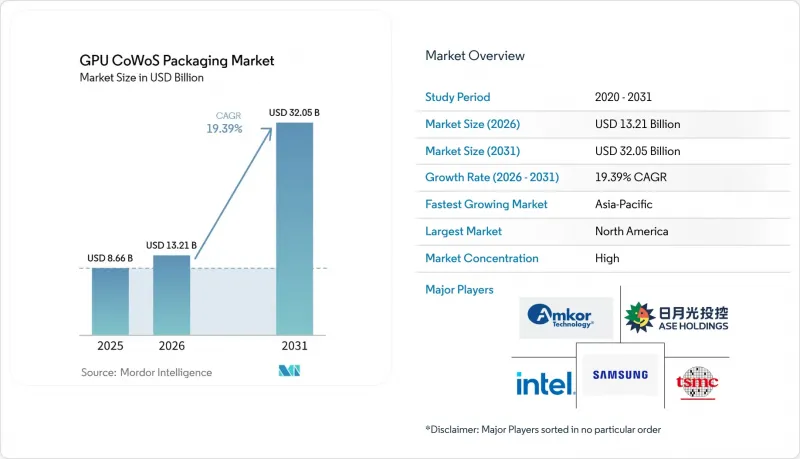
Mordor Intelligence에 의하면, GPU CoWoS 패키징 시장 규모는 2025년 86억 6,000만 달러에서 2026년에는 132억 1,000만 달러로 확대되어 2031년까지 320억 5,000만 달러에 이를 것으로 예상되고 있어 2026년부터 2031년까지 CAGR 19.39%로 성장할 전망입니다.
본 보고서는 CoWoS 패키징 플랫폼(CoWoS-S 등), GPU 워크로드(AI 훈련용 GPU, AI 추론용 GPU 등), GPU 통합 아키텍처(HBM 탑재 싱글 다이 GPU, HBM 탑재 멀티 다이/칩렛 GPU, 기타), 최종 사용자(하이퍼스케일러 및 클라우드 제공업체, 엔터프라이즈 및 프라이빗 클라우드 데이터센터, 기타), 그리고 지역별로 분류되어 있습니다. 시장 전망은 금액(달러) 기준으로 제시되어 있습니다.
세계 GPU CoWoS 패키징 시장 동향 및 인사이트
생성형 AI 워크로드의 급속한 확대
생성형 AI 모델 개발은 메모리 대역폭 및 시스템 수준의 통합이 순수한 연산 처리량만큼이나 중요해지는 규모로 확대되고 있으며, 이것이 바로 GPU CoWoS 패키징 시장이 최첨단 AI 하드웨어의 전개와 밀접하게 연결되어 있는 이유입니다. NVIDIA는 2026년 3월 Vera Rubin 플랫폼을 발표하며, CoWoS-L 패키징을 채택한 7개의 칩을 핵심으로 하는 생산 시스템에 대해 설명했습니다. 이를 통해 대규모 AI 랙은 더 이상 백엔드 조립 공정의 선택지가 아니라, 핵심 아키텍처 계층으로서 첨단 패키징 기술을 도입해 설계되게 되었음을 보여주었습니다. 그 후, NVIDIA는 2026년 6월, 대만을 거점으로 하는 약 150개공급망 파트너의 지원을 받아 ‘Vera Rubin’이 본격 생산 단계에 접어들었음을 확인했습니다. 이는 단일 AI 플랫폼 세대를 둘러싸고 제조 거점이 얼마나 광범위하게 분포되어 있는지를 보여줍니다. 또한 2026년 6월의 해당 발표에서는 이 플랫폼이 전 세계 AI 팩토리 구축과 연계되어 있으며, 하이퍼스케일러 및 클라우드 수요가 더 이상 칩 출시뿐만 아니라 랙 규모의 복잡한 패키징 시스템에 의존하고 있다는 점에서 GPU CoWoS 패키징 시장이 확대되고 있음을 뒷받침하고 있습니다. 그 결과, 새로운 AI 인프라의 상용화 시기는 패키징 준비 상황, 공급업체 간의 협력, 그리고 패키지 수준의 제조 심도에 점점 더 좌우되고 있으며, 이로 인해 선진적인 패키징 공급업체들은 과거의 반도체 수요 파동에 비해 납기 주기에 더 큰 영향력을 행사하게 되었습니다.
GPU 패키지당 HBM 스택 수 증가
GPU CoWoS 패키징 시장은 패키지당 HBM 탑재량의 뚜렷한 증가에 힘입어 성장하고 있습니다. 스택이 하나 늘어날 때마다 패키지의 복잡성, 인터포저 사용량, 그리고 가속기 1대당 조립 비용이 증가하기 때문입니다. AMD는 'Advancing AI 2025' 행사에서 MI400 제품군이 CoWoS-L 패키징과 더욱 진보된 랙 스케일 구성을 채택할 것이라고 발표했습니다. 한편, NVIDIA와 SK하이닉스는 2026년을 목표로 한 HBM4 지원 플랫폼 계획을 제시했으며, 이는 메모리와 패키징 로드맵이 밸류체인 전반에 걸쳐 밀접하게 연결되어 있음을 시사합니다. SK하이닉스는 2026년에도 HBM이 여전히 메모리 시장 호황의 중심이 될 것이라고 밝혔으며, 2026년 2월 HBM4 양산 개시는 고대역폭 메모리가 단순한 개별 부품의 동향이 아니라 첨단 패키징 수요의 직접적인 원동력이 되고 있다는 관점을 뒷받침합니다. TSMC의 CoWoS 플랫폼은 고밀도 2.5D 통합을 통해 로직 다이와 HBM을 연결하도록 설계되었기 때문에 메모리의 적층 수가 증가하면 당연히 최종 부품표(BOM)에서 패키징의 상업적 비중과 플랫폼 전체 성능에서의 중요도가 높아집니다. 이는 GPU CoWoS 패키징 시장이 GPU 생산 대수 증가뿐만 아니라, 출하되는 각 가속기 패키지에 통합되는 패키징의 양이 증가하고 있다는 점에서도 혜택을 받고 있음을 의미합니다. 또한, 메모리의 양산 속도, 베이스 다이공급 상황, 패키지의 인증 상황이 차세대 AI 시스템의 광범위한 전개 속도에 영향을 미치게 되면서, 일정상의 의존성이 더욱 깊어지고 있음을 시사합니다.
초대형 인터포저에 대한 파운드리 생산 능력의 제약
GPU CoWoS 패키징 시장은 AI 시스템 구축에 현재 요구되는 속도 속에서 초대형 인터포저나 대형 패키지 포맷을 확장하는 데 따르는 어려움으로 인해 여전히 제약을 받고 있습니다. TSMC의 공식 CoWoS 문서에 따르면, 이 플랫폼은 고성능 통합을 목적으로 설계되었지만, 그 가치를 높이는 고밀도 배선 및 대면적 조립과 같은 특징으로 인해 표준 패키징 라인에 비해 확장이 어렵습니다. TSMC의 '3DFabric' 고성능 컴퓨팅 플랫폼은 첨단 웨이퍼 레벨 및 시스템 레벨 통합 공정의 필요성을 부각시키고 있습니다. 즉, 공급량 확대에는 백엔드 생산 능력을 단계적으로 증강하는 것만으로는 불충분하며, 전문화된 패키징 생태계에 의존해야 합니다. 인텔이 경쟁하는 2.5D 및 3D 패키징에 관한 개요 자료 역시 업계 전반에서 대형 다이와 고대역폭 메모리의 통합이 기술적으로 얼마나 어려워지고 있는지를 부각시키고 있으며, 이는 단일 기업의 문제가 아니라 구조적인 제약임을 보여줍니다. 따라서 단기적으로는 GPU CoWoS 패키징 시장이 공급 주도적인 상태가 지속될 것으로 보입니다. 새로운 플랫폼 세대가 도래할 때마다 이전 세대보다 더 높은 면적 효율, 더 엄격한 공차, 그리고 더 정교하게 조정된 제조 공정이 요구되기 때문입니다. 또한, 주요 수요가 이미 최첨단 생산 능력을 점유하고 있는 상황에서는 소규모 고객이 최첨단 패키징 공정에 얼마나 신속하게 접근할 수 있는지에 대한 제한도 발생합니다.
부문 분석
2025년 시점에서 CoWoS-S는 GPU CoWoS 패키징 시장 점유율의 58.78%를 차지했으나, CoWoS-L은 2031년까지 연평균 성장률(CAGR) 19.71%로 확대될 것으로 예측됩니다. CoWoS-S는 NVIDIA H100 및 AMD MI300 시대의 도입 과정에서 이미 자리 잡았기 때문에 앵커 플랫폼으로서의 지위를 유지하며, 2026년을 향해 GPU CoWoS 패키징 시장에 대규모 도입 기반을 마련했습니다. 이 도입 기반이 중요한 이유는 새로운 패키지가 대형화되고 있음에도 불구하고 기존 생산 프로그램, 검증된 기판 설계, 그리고 알려진 열적 거동 덕분에 CoWoS-S가 많은 현재의 클라우드 및 가속기 도입 사례에서 여전히 실용적인 선택지로 남아 있기 때문입니다. TSMC의 CoWoS 기술 문서에 따르면, 이 플랫폼은 고성능 용도를 위한 고밀도 ‘칩 온 웨이퍼 온 서브스트레이트(CoWS)’ 통합을 지원하도록 설계되었으며, 이것이 GPU CoWoS 패키징 시장이 여전히 CoWoS-S에 의존하고 활발한 수요의 상당 부분을 충족하고 있는 이유를 설명해 줍니다. TSMC의 보다 광범위한 고성능 컴퓨팅용 패키징 관련 자료 역시, 단일 ‘범용형’ 접근 방식이 아닌 여러 통합 옵션을 포함하는 현재의 생태계에서 CoWoS-S가 계속해서 중요한 역할을 하고 있음을 뒷받침합니다.
CoWoS-L은 2031년까지 연평균 성장률(CAGR) 19.71%로 확대될 것으로 예측되며, 이는 GPU CoWoS 패키징 시장에서 향후 패키지 스케일링이 어떤 방향으로 나아가고 있는지를 보여줍니다. NVIDIA의 Rubin 플랫폼과 Broadcom의 3.5D XDSiP 출하 현황은 모두, 기존의 실리콘 인터포저 형식으로는 항상 경제적으로 지원할 수 있는 범위를 넘어서는 더 대규모의 집적, 더 높은 HBM 밀도, 그리고 더 유연한 패키지 레이아웃에 의존하는 설계 방향을 시사하고 있습니다. TSMC의 IEDM 2024 발표에서는 훨씬 더 대규모의 CoWoS 패키지 구성을 향한 로드맵이 제시되었습니다. 이는 GPU CoWoS 패키지 시장에서 미래의 규모의 경제가, 더 대규모의 멀티다이 시스템을 효율적으로 처리할 수 있는 패키지 변형에서 비롯될 것이라는 견해를 뒷받침합니다. 그 실질적인 이점은 면적 확대에 그치지 않고, AI GPU가 현재 연산 다이, I/O 구조, HBM 연결부 등에 걸쳐 분할되어 있는 방식과의 일관성이 향상된다는 점에도 있습니다. 이 설계 접근 방식이 표준화됨에 따라, CoWoS-S가 여전히 중요한 도입 기반을 지탱하는 한편, CoWoS-L이 향후 수요에서 더 큰 점유율을 확보할 가능성이 높을 것으로 보입니다.
2025년 GPU CoWoS 패키징 시장 규모에서 AI 훈련용 GPU가 60.19%를 차지한 반면, AI 추론용 GPU는 2031년까지 연평균 성장률(CAGR) 19.88%로 확대될 것으로 예측됩니다. 각 하이퍼스케일러 기업들이 대규모 모델의 사전 학습 클러스터에 대한 투자를 지속하고 있으며, 현재의 도입 환경에서 이러한 시스템이 여전히 최고의 메모리 대역폭과 패키지의 복잡성을 요구하고 있기 때문에 훈련용 GPU가 GPU CoWoS 패키징 시장을 주도했습니다. NVIDIA가 2026년 3월 및 6월에 발표한 ‘Rubin’ 관련 정보에 따르면, 첨단 CoWoS-L 패키징 시스템은 AWS, Google Cloud, Microsoft, CoreWeave에서의 초기 도입과 연계되어 있으며, 이는 훈련용 및 대규모 AI 인프라가 여전히 현재 수요의 주요 원동력임을 뒷받침합니다. 이러한 집중으로 인해 패키징 공급업체들은 생산량, 검증의 깊이, 제품 인지도가 가장 높은 고처리량 클라우드 프로그램에 계속 주력하고 있습니다. 또한, 최첨단 GPU 로드맵은 GPU CoWoS 패키징 시장이 최첨단 생산 능력을 어떻게 배분할지 결정하는 데 있어 그 역할이 더욱 강화되고 있습니다.
AI 추론용 GPU는 2031년까지 연평균 성장률(CAGR) 19.88%라는 가장 높은 성장률을 보일 것으로 예측되며, 이는 GPU CoWoS 패키징 시장에서 모델 구축에만 국한되던 것에서 실제 운영 규모의 모델 배포로 더 광범위한 전환이 진행되고 있음을 시사합니다. AMD가 2025년 행사에서 MI400 랙 제품군에 대해 공개한 내용에 따르면, 미래의 AI 시스템은 훨씬 더 대규모의 메모리 용량과 시스템 밀도로 훈련과 추론 모두를 처리할 수 있도록 설계되어 있으며, 이로 인해 훈련 지향형 제품과 추론 지향형 제품 사이에 기존에 존재하던 패키징 격차가 줄어들고 있습니다. 추론 모델이 더욱 대규모화되고 더 많은 사용자에게 실시간 서비스를 제공함에 따라, 특히 대규모 배포에서 메모리 대역폭이나 레이턴시의 일관성이 중요해지는 경우, 패키징에 대한 요구 사항은 훈련 등급의 요구 사항에 가까워집니다. 이는 첨단 패키징의 적용 범위를 제한된 플래그십급 훈련 클러스터를 넘어 확대한다는 점에서 중요합니다. 또한 이는 여전히 대규모 HBM 실적와 하이엔드 통합 포맷을 필요로 하는 기업 및 서비스 제공업체의 추론 시스템으로부터 GPU CoWoS 패키징 시장에 대한 수요가 더욱 높아질 가능성이 있음을 의미합니다. 시간이 지남에 따라 워크로드 구성은 훈련이 주류를 이루던 상태에서 추론이 프리미엄 패키징 수요에서 더 큰 비중을 차지하는 보다 균형 잡힌 패턴으로 변화할 것입니다.
지역별 분석
2025년, 북미는 GPU CoWoS 패키징 시장 규모의 59.27%를 차지하고 있으며, 이는 해당 지역의 하이퍼스케일러들의 AI 인프라 투자가 집중되고 있음을 반영합니다. NVIDIA는 Vera Rubin 시스템의 첫 도입 파트너로 AWS, Google Cloud, Microsoft, CoreWeave를 지정했습니다. 이 기업들은 여전히 하이엔드 AI 연산 능력의 주요 구매자이므로, 이러한 지정은 북미의 주도적 지위를 뒷받침하는 것입니다. 미국 상무부는 2025년 1월, 차세대 첨단 패키징 지원을 위해 14억 달러 규모의 최종 보조금을 발표했습니다. 이를 통해 해당 지역은 미래의 국내 역량 구축을 위한 더욱 견고한 제도적 기반을 확보하게 되었습니다. 또한, NIST는 첨단 패키징 기술을 위해 최대 16억 달러 규모의 자금 지원 공모를 시작했습니다. 이는 공공 지원이 정책적 언급에 그치지 않고 적극적인 프로그램 설계 단계로 넘어갔음을 보여줍니다. TSMC와 Amkor는 2026년 6월, 애리조나주에서의 장기적인 제휴를 발표했습니다. 이 합의에 따라 GPU CoWoS 패키징 시장은 향후 몇 년 동안 더욱 통합된 미국의 패키징 체인을 향한 확실한 로드맵을 확보하게 될 것입니다.
아시아태평양은 2031년까지 연평균 성장률(CAGR) 20.16%로 확대될 것으로 예상되며, GPU CoWoS 패키징 시장에서 가장 빠르게 성장하는 지역 블록이 될 것입니다. 대만은 계속해서 생산의 중심지 역할을 하고 있습니다. 이는 TSMC가 핵심 CoWoS 플랫폼을 보유하고 있으며, 자사의 3D 패브릭 스택을 첨단 로직과 메모리의 조합을 위한 고성능 컴퓨팅 통합 기반으로 포지셔닝하고 있기 때문입니다. 한국은 HBM4의 양산 확대를 통해 큰 추진력을 얻고 있으며, SK하이닉스의 2026년 전망 및 생산 진행 상황을 고려할 때, 메모리 분야의 리더십이 이제 첨단 패키징 수요 측면에서 이 지역의 직접적인 강점으로 작용하고 있음이 분명합니다. 이 지역의 강점은 파운드리, 메모리, 조립 및 부품 생태계가 인접해 있다는 점에 있으며, 이를 통해 엔드투엔드 역량을 아직 구축 중인 지역에 비해 GPU CoWoS 패키징 시장이 이 지역에서 더 빠르게 확대될 수 있습니다.
유럽, 남미, 중동 및 아프리카가 GPU CoWoS 패키징 시장의 나머지 점유율을 차지하고 있으며, 각 지역은 AI 인프라 성숙도 측면에서 서로 다른 단계에 있습니다. 유럽은 CoWoS 제조 역량 면에서 아직 주도적인 입장은 아니지만, 연구용 컴퓨팅 수요, 기업의 도입 필요성, 하이퍼스케일러에 의한 데이터센터 확장으로부터 계속해서 혜택을 받고 있습니다. 남미는 여전히 시장 규모가 작지만, 클라우드의 확대로 인해 세계 조달 네트워크를 통해 첨단 패키징 GPU 하드웨어가 현지 데이터센터에 도입될 수 있는 길이 열리고 있습니다. 중동 및 아프리카는 현재 시장 규모가 작지만, 국가 주도의 AI 구축 및 정부 지원에 의한 컴퓨팅 역량 강화 노력으로 인해 프로젝트가 진행됨에 따라 예측 기간 후반에는 수요가 더욱 증가할 가능성이 있습니다.
기타 혜택:
- 엑셀 형식 시장 예측(ME) 시트
- 3개월간의 애널리스트 지원
자주 묻는 질문
목차
제1장 서론
제2장 조사 방법
제3장 주요 요약
제4장 시장 구도
제5장 시장 규모와 성장 예측
제6장 경쟁 구도
제7장 시장 기회와 향후 전망
JHS 26.08.05According to Mordor Intelligence, the GPU coWoS packaging market size is expected to increase from USD 8.66 billion in 2025 to USD 13.21 billion in 2026 and reach USD 32.05 billion by 2031, growing at a CAGR of 19.39% over 2026-2031.
This report is Segmented by CoWoS Packaging Platform (CoWoS-S, and More), GPU Workload (AI Training GPUs, AI Inference GPUs, and More), GPU Integration Architecture (Single-Die GPU With HBM, Multi-Die/Chiplet GPU With HBM, and More), End User (Hyperscalers and Cloud Providers, Enterprise and Private-Cloud Data Centers, and More), and Geography. The Market Forecasts are Provided in Terms of Value (USD).
Global GPU CoWoS Packaging Market Trends and Insights
Rapid Proliferation Of Generative AI Workloads
Generative AI model development has moved to a scale where memory bandwidth and system-level integration now matter as much as raw compute throughput, which is why the GPU CoWoS packaging market is tied so closely to frontier AI hardware rollouts. NVIDIA announced the Vera Rubin platform in March 2026 and described a production system built around seven chips with CoWoS-L packaging, which showed that large AI racks are now designed with advanced packaging as a core architectural layer rather than a back-end assembly choice. NVIDIA then confirmed in June 2026 that Vera Rubin had ramped into full production with support from around 150 Taiwan-based supply-chain partners, which points to how broad the manufacturing footprint has become around a single AI platform generation. The same June 2026 disclosure also linked the platform to global AI factory deployments, which reinforces that the GPU CoWoS packaging market is expanding because hyperscaler and cloud demand now depends on complex packaged systems at rack scale rather than only on chip launches. As a result, the commercial timing of new AI infrastructure is increasingly shaped by packaging readiness, supplier coordination, and package-level manufacturing depth, which gives advanced packaging providers more influence over delivery cycles than they held in earlier semiconductor demand waves.
Escalating HBM Stack Counts Per GPU Package
The GPU CoWoS packaging market is also being boosted by a clear rise in HBM content per package, as each additional stack increases package complexity, interposer usage, and assembly value per accelerator. AMD stated at its Advancing AI 2025 event that the MI400 family uses CoWoS-L packaging and a more advanced rack-scale configuration, while NVIDIA and SK Hynix outlined HBM4-linked platform plans for 2026, indicating that memory and packaging roadmaps are now tightly connected across the value chain. SK Hynix said in 2026 that HBM remains the center of the memory upcycle, and its February 2026 HBM4 mass production start supports the view that high-bandwidth memory is becoming a direct driver of advanced packaging demand rather than a separate component trend. TSMC's CoWoS platform is designed to connect logic die and HBM through dense 2.5D integration, so rising memory stack counts naturally increase the commercial weight of packaging in the final bill of materials and in total platform performance. This means the GPU CoWoS packaging market is benefiting not only from more GPUs being built, but also from more packaging content being embedded in each shipped accelerator package. It also means that scheduling dependencies are becoming deeper, because the pace of memory ramp, base-die availability, and package qualification now affects how quickly next-generation AI systems can move into wide deployment.
Limited Foundry Capacity For Very Large Interposers
The GPU CoWoS packaging market remains constrained by the difficulty of scaling very large interposers and large package formats at the speed now demanded by AI system launches. TSMC's official CoWoS documentation shows that the platform is designed for high-performance integration, but the same high-density routing and large-area assembly features that make it valuable also make expansion more difficult than in standard packaging lines. TSMC's 3DFabric high-performance computing platform highlights the need for advanced wafer-level and system-level integration steps, which means supply growth requires more than incremental backend capacity and depends on specialized packaging ecosystems. Intel's competing 2.5D and 3D packaging briefs also underline how technically demanding large-die and high-bandwidth memory integration has become across the wider industry, which shows that this is a structural constraint rather than a single-company issue. This keeps the GPU CoWoS packaging market supply-led in the near term, because each new platform generation requires more advanced area, tighter tolerances, and more coordinated manufacturing steps than the last one. It also limits how quickly smaller customers can access frontier packaging flows when anchor demand already occupies the most advanced capacity.
Other drivers and restraints analyzed in the detailed report include:
- Transition Toward Chiplet-Based GPU Architectures
- Mainstream Adoption Of 2.5D Packages In Networking ASICs
- High Build-Up Substrate Costs Offsetting Savings
For complete list of drivers and restraints, kindly check the Table Of Contents.
Segment Analysis
CoWoS-S held 58.78% of the GPU CoWoS packaging market share in 2025, while CoWoS-L is projected to expand at a 19.71% CAGR through 2031. CoWoS-S remained the anchor platform because it was already established across NVIDIA H100- and AMD MI300-era deployments, giving the GPU CoWoS packaging market a large installed base entering 2026. That installed base matters because existing production programs, validated board designs, and known thermal behavior still make CoWoS-S practical for many current cloud and accelerator deployments even as new packages become larger. TSMC's CoWoS technology documentation shows that the platform was designed to support dense chip-on-wafer-on-substrate integration for high-performance applications, which explains why the GPU CoWoS packaging market still relies on CoWoS-S to meet a broad portion of active demand. TSMC's broader high-performance computing packaging documentation also supports the continued role of CoWoS-S within an ecosystem that now includes several integration options rather than a single one-size-fits-all route.
CoWoS-L is projected to expand at a 19.71% CAGR through 2031, which shows where future package scaling is moving inside the GPU CoWoS packaging market. NVIDIA's Rubin platform and Broadcom's 3.5D XDSiP shipments both point to a design direction that depends on larger integration scale, higher HBM density, and more flexible package layouts than classic silicon interposer formats can always support economically. TSMC's IEDM 2024 presentation outlined a path toward much larger CoWoS package configurations, which supports the case that future scale gains in the GPU CoWoS packaging market will come from packaging variants that can handle larger multi-die systems more efficiently. The practical advantage is not only more area, it is also better alignment with the way AI GPUs are now being partitioned across compute dies, I/O structures, and HBM attachments. As that design approach becomes standard, CoWoS-L is likely to capture a larger share of forward demand even while CoWoS-S continues to serve a meaningful installed base.
AI Training GPUs accounted for 60.19% of the GPU CoWoS packaging market size in 2025, while AI Inference GPUs are projected to expand at a 19.88% CAGR through 2031. Training led the GPU CoWoS packaging market because hyperscalers continued to fund large-model pretraining clusters, and those systems still demand the highest memory bandwidth and package complexity in current deployments. NVIDIA's March 2026 and June 2026 Rubin disclosures tied advanced CoWoS-L packaged systems to early deployments at AWS, Google Cloud, Microsoft, and CoreWeave, which confirms that training-class and large-scale AI infrastructure remain the main engine of current demand. That concentration has kept packaging suppliers focused on high-throughput cloud programs where volume, validation depth, and product visibility are strongest. It has also reinforced the role of frontier GPU roadmaps in determining how the GPU CoWoS packaging market allocates its most advanced capacity.
AI Inference GPUs are projected to grow at the fastest 19.88% CAGR through 2031, which signals a broader shift in the GPU CoWoS packaging market from model creation alone toward model deployment at production scale. AMD's 2025 event disclosures around the MI400 rack family show that future AI systems are being designed for both training and inference at much larger memory capacity and system density, which narrows the old packaging gap between training-oriented and inference-oriented products. As inference models become larger and serve more users in real time, packaging demands move closer to training-class requirements, especially when memory bandwidth and latency consistency matter across large deployments. This is important because it expands the addressable base for advanced packaging beyond a narrow set of flagship training clusters. It also means the GPU CoWoS packaging market may see more demand from enterprise and service-provider inference systems that still require large HBM footprints and high-end integration formats. Over time, that changes the workload mix from a training-dominant profile to a more balanced pattern where inference contributes a larger share of premium package demand.
Complete Report Scope:
- By CoWoS Packaging Platform
- CoWoS-S
- CoWoS-L
- CoWoS-R
- By GPU Workload
- AI Training GPUs
- AI Inference GPUs
- HPC and Scientific Computing GPUs
- Other Data Center GPU Workloads
- By GPU Integration Architecture
- Single-Die GPU with HBM
- Multi-Die/Chiplet GPU with HBM
- 3D-Enhanced GPU Systems Using CoWoS and SoIC
- By End User
- Hyperscalers and Cloud Providers
- Enterprise and Private-Cloud Data Centers
- Research, Academic, and Government AI/HPC Centers
- By Geography
- North America
- United States
- Canada
- Mexico
- Europe
- Germany
- United Kingdom
- France
- Italy
- Russia
- Rest of Europe
- Asia-Pacific
- China
- Japan
- South Korea
- India
- Southeast Asia
- Australia
- Rest of Asia-Pacific
- South America
- Middle East and Africa
- North America
Geography Analysis
North America held 59.27% share of the GPU CoWoS packaging market size in 2025, which reflected the concentration of hyperscaler AI infrastructure spending in the region. NVIDIA identified AWS, Google Cloud, Microsoft, and CoreWeave as first deployment partners for Vera Rubin systems, which supports North America's lead because those companies remain central buyers of high-end AI compute capacity. The U.S. Department of Commerce announced USD 1.4 billion in final awards in January 2025 for next-generation advanced packaging support, which gave the region a stronger institutional base for future domestic capability. NIST also opened a funding competition of up to USD 1.6 billion for advanced packaging technologies, which shows that public support has moved beyond policy language into active program design. TSMC and Amkor announced a long-term partnership in Arizona in June 2026, and that agreement gives the GPU CoWoS packaging market a credible path toward a more integrated U.S. packaging chain over the next several years.
Asia-Pacific is projected to expand at a 20.16% CAGR through 2031, which makes it the fastest-growing regional block in the GPU CoWoS packaging market. Taiwan remains the production center because TSMC owns the core CoWoS platform and positions its 3DFabric stack as a high-performance computing integration base for advanced logic and memory combinations. South Korea adds major support through HBM4 ramp activity, and SK Hynix's 2026 outlook and production progress make clear that memory leadership is now a direct regional advantage for advanced package demand. The region's strength comes from how foundry, memory, assembly, and component ecosystems sit close together, which lets the GPU CoWoS packaging market scale faster there than in regions still building end-to-end capability.
Europe, South America, and the Middle East and Africa make up the remaining share of the GPU CoWoS packaging market, and each region sits at a different stage of AI infrastructure maturity. Europe continues to benefit from research computing demand, enterprise deployment needs, and hyperscaler data center expansion, even though the region does not yet lead in CoWoS manufacturing capacity. South America remains smaller, but cloud expansion is still creating a route for advanced packaged GPU hardware to enter local data center footprints through global procurement networks. The Middle East and Africa is smaller today, but sovereign AI buildouts and state-backed compute ambitions could support stronger demand later in the forecast period as project execution deepens.
- Taiwan Semiconductor Manufacturing Company Limited
- Samsung Electronics Co., Ltd.
- ASE Technology Holding Co., Ltd.
- Amkor Technology, Inc.
- Intel Corporation
- NVIDIA Corporation
- Advanced Micro Devices, Inc.
- Broadcom Inc.
- Marvell Technology, Inc.
- SK hynix Inc.
- Micron Technology, Inc.
- Powertech Technology Inc.
- United Microelectronics Corporation
- Chipbond Technology Corporation
- JCET Group Co., Ltd.
- Tongfu Microelectronics Co., Ltd.
- Jiangsu Changjiang Electronics Technology Co., Ltd.
- Siliconware Precision Industries Co., Ltd.
- Ibiden Co., Ltd.
- Unimicron Technology Corp.
- Deca Technologies, Inc.
- Nepes Corporation
Additional Benefits:
- The market estimate (ME) sheet in Excel format
- 3 months of analyst support
TABLE OF CONTENTS
1 INTRODUCTION
- 1.1 Study Assumptions and Market Definition
- 1.2 Scope of the Study
2 RESEARCH METHODOLOGY
3 EXECUTIVE SUMMARY
4 MARKET LANDSCAPE
- 4.1 Market Overview
- 4.2 Market Drivers
- 4.2.1 Rapid Proliferation of Generative AI Workloads
- 4.2.2 Escalating HBM Stack Counts per GPU Package
- 4.2.3 Transition Toward Chiplet-Based GPU Architectures
- 4.2.4 Mainstream Adoption of 2.5D Packages in Networking ASICs
- 4.2.5 Government Funding for Advanced Packaging Capacity Expansion
- 4.2.6 Yield Improvements in Wafer-Level Interconnect Formation
- 4.3 Market Restraints
- 4.3.1 Limited Foundry Capacity for Very Large Interposers
- 4.3.2 High Build-Up Substrate Costs Offsetting Savings
- 4.3.3 Reliability Concerns in Large-Area Passive Silicon
- 4.3.4 Complex Thermal Management for Tiled GPU Dies
- 4.4 Industry Value Chain Analysis
- 4.5 Regulatory Landscape
- 4.6 Technological Outlook
- 4.7 Impact of Macroeconomic Factors on the Market
- 4.8 Porter's Five Forces Analysis
- 4.8.1 Bargaining Power of Buyers
- 4.8.2 Bargaining Power of Suppliers
- 4.8.3 Threat of New Entrants
- 4.8.4 Threat of Substitutes
- 4.8.5 Intensity of Competitive Rivalry
5 MARKET SIZE AND GROWTH FORECASTS (VALUE)
- 5.1 By CoWoS Packaging Platform
- 5.1.1 CoWoS-S
- 5.1.2 CoWoS-L
- 5.1.3 CoWoS-R
- 5.2 By GPU Workload
- 5.2.1 AI Training GPUs
- 5.2.2 AI Inference GPUs
- 5.2.3 HPC and Scientific Computing GPUs
- 5.2.4 Other Data Center GPU Workloads
- 5.3 By GPU Integration Architecture
- 5.3.1 Single-Die GPU with HBM
- 5.3.2 Multi-Die/Chiplet GPU with HBM
- 5.3.3 3D-Enhanced GPU Systems Using CoWoS and SoIC
- 5.4 By End User
- 5.4.1 Hyperscalers and Cloud Providers
- 5.4.2 Enterprise and Private-Cloud Data Centers
- 5.4.3 Research, Academic, and Government AI/HPC Centers
- 5.5 By Geography
- 5.5.1 North America
- 5.5.1.1 United States
- 5.5.1.2 Canada
- 5.5.1.3 Mexico
- 5.5.2 Europe
- 5.5.2.1 Germany
- 5.5.2.2 United Kingdom
- 5.5.2.3 France
- 5.5.2.4 Italy
- 5.5.2.5 Russia
- 5.5.2.6 Rest of Europe
- 5.5.3 Asia-Pacific
- 5.5.3.1 China
- 5.5.3.2 Japan
- 5.5.3.3 South Korea
- 5.5.3.4 India
- 5.5.3.5 Southeast Asia
- 5.5.3.6 Australia
- 5.5.3.7 Rest of Asia-Pacific
- 5.5.4 South America
- 5.5.5 Middle East and Africa
- 5.5.1 North America
6 COMPETITIVE LANDSCAPE
- 6.1 Market Concentration
- 6.2 Strategic Moves
- 6.3 Market Share Analysis
- 6.4 Company Profiles (includes Global Level Overview, Market Level Overview, Core Segments, Financials as available, Strategic Information, Market Rank/Share, Products and Services, Recent Developments)
- 6.4.1 Taiwan Semiconductor Manufacturing Company Limited
- 6.4.2 Samsung Electronics Co., Ltd.
- 6.4.3 ASE Technology Holding Co., Ltd.
- 6.4.4 Amkor Technology, Inc.
- 6.4.5 Intel Corporation
- 6.4.6 NVIDIA Corporation
- 6.4.7 Advanced Micro Devices, Inc.
- 6.4.8 Broadcom Inc.
- 6.4.9 Marvell Technology, Inc.
- 6.4.10 SK hynix Inc.
- 6.4.11 Micron Technology, Inc.
- 6.4.12 Powertech Technology Inc.
- 6.4.13 United Microelectronics Corporation
- 6.4.14 Chipbond Technology Corporation
- 6.4.15 JCET Group Co., Ltd.
- 6.4.16 Tongfu Microelectronics Co., Ltd.
- 6.4.17 Jiangsu Changjiang Electronics Technology Co., Ltd.
- 6.4.18 Siliconware Precision Industries Co., Ltd.
- 6.4.19 Ibiden Co., Ltd.
- 6.4.20 Unimicron Technology Corp.
- 6.4.21 Deca Technologies, Inc.
- 6.4.22 Nepes Corporation
7 MARKET OPPORTUNITIES AND FUTURE OUTLOOK
- 7.1 White-Space and Unmet-Need Assessment