

|
시장보고서
상품코드
2099413
AI GPU 칩 시장 : 점유율 분석, 업계 동향 및 통계, 성장 예측(2026-2031년)AI GPU Chip - Market Share Analysis, Industry Trends & Statistics, Growth Forecasts (2026 - 2031) |
||||||
 Mordor Intelligence
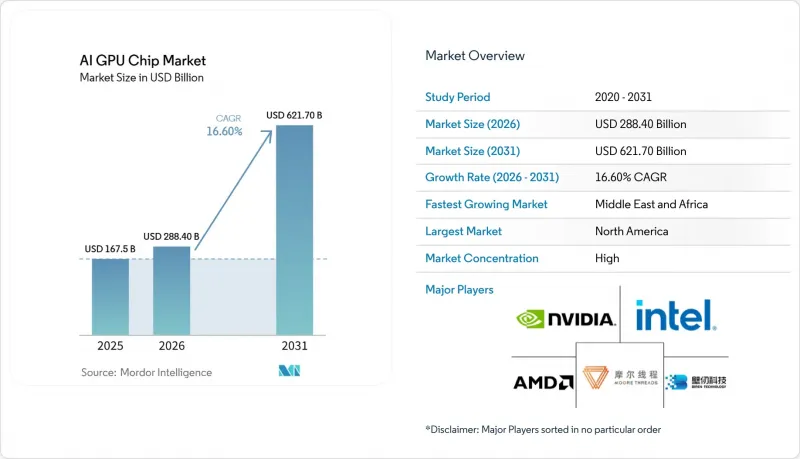
Mordor Intelligence에 의하면, AI GPU 칩 시장 규모는 2025년 1,675억 달러에서 2026년에는 2,884억 달러로 확대되어 2026년부터 2031년까지 CAGR 16.60%로 성장을 지속하여, 2031년에는 6,217억 달러에 이를 것으로 예측됩니다.
본 보고서는 제품 유형(데이터센터용 AI GPU, 엣지용 AI GPU, 클라이언트용 AI GPU), 연산 기능(훈련 및 추론을 병행하는 GPU 등), 도입 환경(하이퍼스케일 및 클라우드, 엔터프라이즈 데이터센터 등), 워크로드(생성형 AI 및 대규모 언어 모델, 컴퓨터 비전 및 로보틱스 등), 지역별로 분류되어 있습니다. 시장 전망은 금액(달러) 기준으로 제시되어 있습니다.
전 세계 AI GPU 칩 시장 동향 및 인사이트
기업용 독자 모델 미세 조정 확대
기업에 의한 독자 모델의 미세 조정은 일회성 파일럿 프로젝트 단계를 넘어, 독자 데이터로 훈련된 모델을 원하는 기업들에게 지속적인 운영 관행으로 자리 잡고 있습니다. 이러한 변화는 AI GPU 칩 시장에 중요한 의미를 지닙니다. 왜냐하면 반복되는 재훈련, 평가, 그리고 도입은 일회성 구매 주기가 아니라 지속적인 하드웨어 수요를 창출하기 때문입니다. 또한, 많은 기업이 미세 조정과 추론을 모두 지원하는 혼합 클러스터를 원하고 있어, 이로 인해 용도가 제한된 고정 목적의 시스템이 아닌 범용성이 높은 GPU 구성의 가치가 높아지고 있습니다. 이용률이 높은 AI 워크로드의 경우, On-Premise 도입의 경제성이 더욱 설득력을 얻고 있으며, 레노버의 보고서에 따르면 지속적인 워크로드에서 On-Premise 기반 생성형 AI 도입은 클라우드에 비해 4개월도 채 되지 않아 손익분기점에 도달한다고 합니다. 또한, 규제가 엄격한 업계의 데이터 관리 요건으로 인해 일부 모델 맞춤화는 사내 인프라와 가까운 곳에서 수행되는 경향이 있으며, 이로 인해 AI GPU 칩 시장의 구매자층은 하이퍼스케일러 외에도 확대되고 있습니다.
하이퍼스케일 AI 훈련 클러스터의 급속한 확장
AI GPU 칩 시장은 여전히 긴밀하게 통합된 랙, 고밀도 네트워크 및 더욱 정교한 냉각 기능을 필요로 하는 대규모 하이퍼스케일 훈련 클러스터에 의해 형성되고 있습니다. 모델 배포 후에도 서빙 플릿의 확장이 필요하기 때문에 이러한 구매는 더 이상 단일 학습 주기에 국한되지 않으며, 학습 환경과 추론 환경 모두에서 조달 주기가 활발하게 유지되고 있습니다. 최신 랙 스케일 시스템은 대규모 프론티어 워크로드를 위해 주문되고 있으며, 이로 인해 동일한 구축 주기 내에서 하이엔드 가속기, 스위칭, 전원 공급 및 메모리에 대한 수요가 증가하고 있습니다. AMD는 2026년 2월, Meta와 Meta의 전체 AI 데이터센터에 AMD Instinct GPU를 도입하기 위한 다년간의 6기가와트 규모 파트너십을 발표함으로써 이러한 추세를 더욱 공고히 했습니다. 각 하이퍼스케일러 기업들이 최첨단 훈련용 플릿과 대규모 추론용 플릿을 계속 분리해 나가는 한, AI GPU 칩 시장에서는 기존의 컴퓨팅 업그레이드 주기보다 더 지속적인 구매가 예상됩니다.
첨단 패키징 생산 능력의 병목 현상
첨단 패키징은 AI GPU 칩 시장이 설계 수요를 출하된 시스템으로 전환할 수 있는 속도에 대한 현실적인 제약으로 남아 있습니다. 현대 AI 가속기는 로직 다이와 적층형 고대역폭 메모리의 복잡한 통합에 의존하고 있기 때문에 패키징 수율과 처리량은 웨이퍼 공급만큼이나 중요합니다. 지멘스는 HBM4의 통합이 점점 더 복잡해지고 있다고 지적하며, 더 높은 대역폭과 고밀도 적층 구조로의 전환이 패키징 라인에 가하는 부담을 가중시키고 있습니다. 벤더의 제품 수요가 견조하더라도 메모리, 패키징, 백엔드 조립이 모두 연동되어 규모를 확대해야 하기 때문에 납기 기간이 길어질 가능성이 있습니다. 이러한 제약으로 인해 생산량 증가세가 둔화되고, 공급망 내에서 관계가 더욱 공고한 공급업체가 유리해지며, 당분간 AI GPU 칩 시장은 제한된 제조거점에 계속 의존하게 될 것입니다.
부문 분석
2025년, 데이터센터용 AI GPU는 AI GPU 칩 시장 점유율의 93.11%를 차지하고 있으며, 이러한 집중도는 최신 하드웨어를 대규모로 도입할 수 있는 분야를 반영한 것입니다. 주요 제품은 고밀도 랙, 고속 상호 연결 및 특수 냉각 시스템을 전제로 설계되어 있어, 대규모 데이터센터 환경이 현재의 플래그십 플랫폼에 가장 적합한 도입처가 되고 있습니다. 또한, 도입의 성패는 메모리, 네트워크, 열 관리가 유기적으로 연계되어 기능하는지에 달려 있으므로, 벤더 간의 경쟁은 칩 단위가 아닌 시스템 전체의 설계에 초점이 맞추어져 있습니다. 따라서 새로운 수요 거점이 등장하기 시작했음에도 불구하고, AI GPU 칩 시장은 여전히 집중형 컴퓨팅 환경에 크게 치우쳐 있습니다.
엣지 AI GPU는 2031년까지 연평균 성장률(CAGR) 17.44%로 확대될 것으로 예측되며, 이러한 성장은 로봇 공학, 산업 자동화 및 로컬 추론 수요와 밀접하게 연관되어 있습니다. 훈련용 DGX 시스템, 시뮬레이션용 RTX PRO 서버, 기기 내 추론용 Jetson 하드웨어를 연계하는 NVIDIA의 로봇 공학 플랫폼 설계는 엣지 스택이 보다 광범위한 AI 도입 모델의 일부가 되어가고 있음을 보여줍니다. 클라이언트용 AI GPU는 AI GPU 칩 업계 전체에서 여전히 작은 비중을 차지하고 있지만, 기기 제조업체들이 워크스테이션과 노트북에 AI 네이티브 기능을 추가함에 따라 그 중요성이 커지고 있습니다. 2026년 NVIDIA가 발표한 ‘RTX Spark’는 특히 로컬 모델 실행, 설계 워크플로우 및 소형 추론이 중요한 분야에서 클라이언트 기기가 AI GPU 도입의 새로운 진입점이 되고 있음을 보여주었습니다.
2025년 AI GPU 칩 시장 규모 중 훈련용 GPU가 52.33%를 차지하고 있으며, 이러한 우위는 최첨단 모델 개발과 대규모 퍼블릭 컴퓨팅 프로그램에서 비롯된 것입니다. 훈련 플랫폼에는 여전히 최고 수준의 상호 연결 밀도와 가장 적극적인 확장 성능이 요구되고 있으며, 이것이 프리미엄 랙 아키텍처에 대한 지속적인 수요를 뒷받침하고 있습니다. 한편, 추론용 GPU는 2031년까지 연평균 성장률(CAGR) 17.62%로 확대될 것으로 예측되며, 이러한 차이는 훈련 완료 후 모델 서빙이 더욱 대규모의 정기적인 컴퓨팅 작업으로 자리 잡고 있음을 보여줍니다. 따라서 AI GPU 칩 시장은 ‘훈련 우선’이라는 구도에서 모델 구축과 마찬가지로 배포 밀도도 중요시되는 보다 균형 잡힌 모델로 전환되고 있습니다.
각 워크로드마다 별도의 시스템 군을 구축하는 것이 현실적이지 않은 기업 환경에서 훈련과 추론을 병행하는 플랫폼이 실용적인 역할을 수행하고 있습니다. 이러한 구매 기업들은 대개 동일한 도입 기반 위에서 모델 미세 조정, 평가 주기 실행, 용도 제공이 가능한 공유 클러스터를 필요로 합니다. 이러한 운영 패턴은 시장의 중간층을 확대시켜, 수요가 가장 고가의 훈련용 하드웨어에만 집중되는 것을 방지하고 있습니다. 또한, AI GPU 칩 업계에서 피크 시의 특화 성능을 다소 희생하더라도 전반적인 활용률을 높이는 메모리 용량이 풍부하고 유연한 구성에 대한 관심이 높아지고 있는 이유도 바로 이 점에 기인합니다.
지역별 분석
2025년, 북미는 전 세계 AI GPU 칩 시장의 38.44%를 차지했으며, 하이퍼스케일 투자와 가장 잘 갖춰진 개발자 생태계를 모두 갖추고 있어 이 지역은 계속해서 최대 구매 지역으로 자리매김했습니다. 미국은 클라우드 플랫폼에 대한 투자, 소프트웨어 호환성, 그리고 CUDA 및 NVLink를 중심으로 한 시스템 수준의 통합을 통해 여전히 수요의 상당 부분을 뒷받침하고 있습니다. 캐나다는 ‘소버린 컴퓨팅’ 분야에서 활동을 활발히 펼치고 있으며, 2026년 6월에는 Bell사와 Cohere사가 브리티시컬럼비아주에 2,304대의 NVIDIA Grace Blackwell GB200 NVL72 시스템을 도입하는 2억 2,000만 달러 규모의 계약을 체결했습니다. 멕시코는 현 단계에서 국내 대규모 AI GPU 도입보다는 미국과의 제조 및 조립 분야 협력을 통해 더 큰 혜택을 보고 있습니다. 이로 인해 더 많은 지역이 독자적인 컴퓨팅 전략을 구축해 나가고 있음에도 불구하고, 북미는 AI GPU 칩 시장의 단기 판매량 중심지로 계속 자리 잡고 있습니다.
유럽은 AI GPU 칩 시장에서 주권 컴퓨팅의 역할을 확대하고 있으며, 정책, 공공 자금, 규정 준수가 모두 수요를 국내 인프라로 유도하고 있습니다. 퍼블릭 클라우드 컴퓨팅 가용성에 관한 OECD의 노력은 공공 부문의 AI 역량이 회복탄력성과 주권 기준을 통해 점점 더 높이 평가받고 있다는 관점을 뒷받침하고 있습니다. 아시아태평양은 한국의 14억 달러 규모 국가 GPU 프로그램부터, 국내 모델 개발이 확대됨에 따라 수요가 증가하고 있는 인도 및 동남아시아에 이르기까지 더 폭넓은 구성을 보이고 있습니다. 프랑스 역시 주권 시스템을 위한 공급업체를 다각화할 의향을 보이고 있으며, 이는 조달이 성숙해짐에 따라 해당 지역이 여러 소프트웨어 및 하드웨어 스택을 지원할 가능성이 있음을 시사합니다.
중동 및 아프리카는 2031년까지 연평균 성장률(CAGR) 17.42%로 확대될 것으로 예측되며, AI GPU 칩 시장에서 지역별 가장 높은 성장률을 보이고 있습니다. 아랍에미리트(UAE)는 조직적인 AI 역량 구축을 지속적으로 추진하고 있으며, 기술 혁신연구소(TII)와 NVIDIA의 제휴를 통해 해당 지역에 로봇공학 및 첨단 AI 시스템에 관한 공식 연구 거점이 설립되었습니다. 아프리카에서도 학술용 컴퓨팅 인프라가 확충되고 있으며, 케이프타운 대학교는 2026년에 ‘아프리카 컴퓨트 이니셔티브’를 출범시켜 하이엔드 AI 시스템에 대한 연구 접근성을 확대되고 있습니다. 남미는 현재로서는 규모가 여전히 작지만, 브라질이 2027년 가동을 예정하고 있는 3억 6,000만 달러 규모의 AI 슈퍼컴퓨터 계획은 이 지역이 보다 명확한 공공 목표를 내걸고 조달 주기에 진입하고 있음을 보여줍니다.
기타 혜택:
- 엑셀 형식 시장 예측(ME) 시트
- 3개월간의 애널리스트 지원
자주 묻는 질문
목차
제1장 서론
제2장 조사 방법
제3장 주요 요약
제4장 시장 구도
제5장 시장 규모와 성장 예측
제6장 경쟁 구도
제7장 시장 기회와 향후 전망
JHS 26.08.05According to Mordor Intelligence, the AI GPU chip market size is expected to grow from USD 167.5 billion in 2025 to USD 288.4 billion in 2026 and is forecast to reach USD 621.7 billion by 2031 at 16.60% CAGR over 2026-2031.
This report is Segmented by Product Type (Data Center AI GPUs, Edge AI GPUs, and Client AI GPUs), Compute Function (Mixed Training and Inference GPUs, and More), Deployment Environment (Hyperscale and Cloud, Enterprise Data Centers, and More), Workload (Generative AI and Large Language Models, Computer Vision and Robotics, and More), and Geography. The Market Forecasts are Provided in Terms of Value (USD).
Global AI GPU Chip Market Trends and Insights
Expanding Enterprise Fine-Tuning of Proprietary Models
Enterprise fine-tuning has moved beyond one-off pilot work and is becoming a recurring operating practice for companies that want models trained on proprietary data. That shift matters for the AI GPU chip market because repeated retraining, evaluation, and deployment create ongoing hardware demand rather than a single purchase cycle. Many enterprises also want mixed clusters that support both fine-tuning and inference, which increases the value of versatile GPU configurations instead of narrow, fixed-purpose systems. On-premise economics are becoming easier to justify for high-utilization AI work, and Lenovo reported that on-premise generative AI deployments can reach breakeven against cloud in under 4 months for sustained workloads. Data control requirements in regulated sectors are also keeping some model customization closer to internal infrastructure, which broadens the buyer base of the AI GPU chip market beyond hyperscalers.
Rapid Scale-Up of Hyperscale AI Training Clusters
The AI GPU chip market is still being shaped by larger hyperscale training clusters that need tightly integrated racks, dense networking, and more advanced cooling. These purchases are no longer limited to one training wave because serving fleets also need to grow after model deployment, which keeps procurement cycles active across both training and inference estates. The newest rack-scale systems are being ordered for large frontier workloads, and that raises demand for high-end accelerators, switching, power delivery, and memory in the same build cycle. AMD reinforced this pattern in February 2026 when it announced a multi-year 6-gigawatt partnership with Meta to deploy AMD Instinct GPUs across Meta's AI data centers. As long as hyperscalers continue to separate frontier training fleets from large inference fleets, the AI GPU chip market is likely to see more continuous buying than in earlier compute upgrade cycles.
Advanced Packaging Capacity Bottlenecks
Advanced packaging remains a practical limit on how fast the AI GPU chip market can convert design demand into shipped systems. Modern AI accelerators depend on complex integration of logic dies and stacked high-bandwidth memory, and that makes packaging yield and throughput as important as wafer supply. Siemens highlighted the growing complexity of HBM4 integration, and the move to higher bandwidth and denser stack configurations increases the burden on packaging lines. Even when vendors have strong product demand, delivery schedules can still stretch because memory, packaging, and backend assembly must all scale together. This restraint slows volume growth, favors vendors with stronger supply relationships, and keeps the AI GPU chip market dependent on a narrow manufacturing base in the near term.
Other drivers and restraints analyzed in the detailed report include:
- HBM4 Readiness and Advanced Packaging Upgrade Cycle
- Sovereign AI Procurement and Domestic Compute Security
- Rising Total Cost of Ownership for Cluster-Scale Deployments
For complete list of drivers and restraints, kindly check the Table Of Contents.
Segment Analysis
Data center AI GPUs held 93.11% of the AI GPU chip market share in 2025, and that concentration reflected where the newest hardware could be deployed at scale. The leading products are designed around dense racks, high-speed interconnects, and specialized cooling, which makes large data center environments the natural fit for current flagship platforms. This also keeps vendor competition centered on full system design rather than on the chip alone, because deployment success depends on memory, networking, and thermal management working together. The AI GPU chip market therefore still leans heavily toward centralized compute environments even as new demand pockets begin to appear.
Edge AI GPUs are projected to expand at a 17.44% CAGR through 2031, and that growth is tied to robotics, industrial automation, and localized inference needs. NVIDIA's robotics platform design, which links DGX systems for training with RTX PRO servers for simulation and Jetson hardware for on-device inference, shows how the edge stack is becoming part of a broader AI deployment model. Client AI GPUs remain a smaller part of the AI GPU chip industry, but they are gaining relevance as device makers add AI-native features to workstations and laptops. NVIDIA's RTX Spark announcement in 2026 showed that client devices are becoming another entry point for AI GPU adoption, especially where local model execution, design workflows, and compact inferencing are important.
Training GPUs accounted for 52.33% of the AI GPU chip market size in 2025, and that lead came from frontier model development and large public compute programs. Training platforms still need the highest interconnect density and the most aggressive scaling behavior, which supports continued demand for premium rack architectures. Inference GPUs, however, are projected to expand at a 17.62% CAGR through 2031, and that difference shows how model serving is becoming the larger recurring compute task after training is complete. The AI GPU chip market is therefore shifting from a training-first narrative to a more balanced model where deployment intensity matters as much as model creation.
Mixed training and inference platforms are gaining a practical role in enterprise environments that cannot justify separate fleets for each workload. These buyers often need a shared cluster that can fine-tune models, run evaluation cycles, and serve applications from the same installed base. That operating pattern broadens the middle of the market and keeps demand from concentrating only in the most expensive training hardware. It also explains why the AI GPU chip industry is seeing more interest in memory-rich and flexible configurations that trade some peak specialization for higher overall utilization.
Complete Report Scope:
- By Product Type
- Data Center AI GPUs
- Edge AI GPUs
- Client AI GPUs
- By Compute Function
- Training GPUs
- Inference GPUs
- Mixed Training and Inference GPUs
- By Deployment Environment
- Hyperscale and Cloud
- Enterprise Data Centers
- Government and Research Institutions
- Edge and Endpoint Deployments
- By Workload
- Generative AI and Large Language Models
- Computer Vision and Robotics
- Speech and Natural Language Processing
- Recommendation, Search, and Graph Analytics
- Scientific Computing and Other AI Workloads
- By Geography
- North America
- United States
- Canada
- Mexico
- Europe
- Germany
- United Kingdom
- France
- Italy
- Rest of Europe
- Asia-Pacific
- China
- Japan
- South Korea
- India
- Southeast Asia
- Rest of Asia-Pacific
- South America
- Middle East and Africa
- North America
Geography Analysis
North America held 38.44% of the global AI GPU chip market in 2025, and the region remained the largest buyer because it combines hyperscale spending with the deepest developer ecosystem. The United States still anchors most of that demand through cloud platform investment, software compatibility, and system-level integration around CUDA and NVLink. Canada is becoming more active in sovereign compute, and Bell and Cohere signed a USD 220 million agreement in June 2026 to deploy 2,304 NVIDIA Grace Blackwell GB200 NVL72 systems in British Columbia. Mexico benefits more through manufacturing and assembly ties to the United States than through large domestic AI GPU deployments at this stage. This keeps North America at the center of near-term volume for the AI GPU chip market even as more regions build local compute agendas.
Europe is building a larger sovereign compute role in the AI GPU chip market, with policy, public funding, and compliance all pushing demand toward domestic infrastructure. OECD work on public cloud compute availability supports the view that public-sector AI capacity is increasingly being evaluated through resilience and sovereignty criteria. Asia-Pacific presents a broader mix, from South Korea's USD 1.4 billion national GPU program to growing demand in India and Southeast Asia as domestic model development expands. France also signaled willingness to diversify vendors for sovereign systems, which suggests the region may support more than one software and hardware stack as procurement matures.
The Middle East and Africa is projected to expand at a 17.42% CAGR through 2031, which gives it the fastest regional growth rate in the AI GPU chip market. The UAE continues to build institutional AI capacity, and the Technology Innovation Institute's partnership with NVIDIA gives the region a formal research base in robotics and advanced AI systems. Africa is also adding academic compute infrastructure, and the University of Cape Town launched the African Compute Initiative in 2026 to expand research access to high-end AI systems. South America remains smaller in current scale, but Brazil's plan for a USD 360 million AI supercomputer due in 2027 shows that the region is entering the procurement cycle with more visible public ambition.
- NVIDIA Corporation
- Advanced Micro Devices, Inc.
- Intel Corporation
- Moore Threads Technology Co., Ltd.
- Biren Technology Co., Ltd.
- Huawei Technologies Co., Ltd.
- Google LLC
- Amazon.com, Inc.
- Microsoft Corporation
- Alibaba Group Holding Limited
- Meta Platforms, Inc.
- Cerebras Systems, Inc.
- Graphcore Limited
- SambaNova Systems, Inc.
- Qualcomm Incorporated
- Tenstorrent Inc.
- Shanghai Iluvatar CoreX Semiconductor Co., Ltd.
- Shanghai Denglin Technology Co., Ltd.
- Hygon Information Technology Co., Ltd.
- Glenfly Tech Co., Ltd.
Additional Benefits:
- The market estimate (ME) sheet in Excel format
- 3 months of analyst support
TABLE OF CONTENTS
1 INTRODUCTION
- 1.1 Study Assumptions and Market Definition
- 1.2 Scope of the Study
2 RESEARCH METHODOLOGY
3 EXECUTIVE SUMMARY
4 MARKET LANDSCAPE
- 4.1 Market Overview
- 4.2 Market Drivers
- 4.2.1 Expanding Enterprise Fine-Tuning of Proprietary Models
- 4.2.2 Rapid Scale-Up of Hyperscale AI Training Clusters
- 4.2.3 HBM4 Readiness and Advanced Packaging Upgrade Cycle
- 4.2.4 Sovereign AI Procurement and Domestic Compute Security
- 4.2.5 NVLink-CXL and UALink Pooling of Accelerator Capacity
- 4.2.6 Liquid Cooling Standardization for High-TDP GPU Racks
- 4.3 Market Restraints
- 4.3.1 Advanced Packaging Capacity Bottlenecks
- 4.3.2 Rising Total Cost of Ownership for Cluster-Scale Deployments
- 4.3.3 Export Controls and Geopolitical Supply Friction
- 4.3.4 Competition From Custom ASICs and Proprietary Accelerators
- 4.4 Industry Value Chain Analysis
- 4.5 Regulatory Landscape
- 4.6 Technological Outlook
- 4.7 Impact of Macroeconomic Factors on the Market
- 4.8 Porter's Five Forces Analysis
- 4.8.1 Bargaining Power of Suppliers
- 4.8.2 Bargaining Power of Buyers
- 4.8.3 Threat of New Entrants
- 4.8.4 Threat of Substitutes
- 4.8.5 Industry Rivalry
5 MARKET SIZE AND GROWTH FORECASTS (VALUE)
- 5.1 By Product Type
- 5.1.1 Data Center AI GPUs
- 5.1.2 Edge AI GPUs
- 5.1.3 Client AI GPUs
- 5.2 By Compute Function
- 5.2.1 Training GPUs
- 5.2.2 Inference GPUs
- 5.2.3 Mixed Training and Inference GPUs
- 5.3 By Deployment Environment
- 5.3.1 Hyperscale and Cloud
- 5.3.2 Enterprise Data Centers
- 5.3.3 Government and Research Institutions
- 5.3.4 Edge and Endpoint Deployments
- 5.4 By Workload
- 5.4.1 Generative AI and Large Language Models
- 5.4.2 Computer Vision and Robotics
- 5.4.3 Speech and Natural Language Processing
- 5.4.4 Recommendation, Search, and Graph Analytics
- 5.4.5 Scientific Computing and Other AI Workloads
- 5.5 By Geography
- 5.5.1 North America
- 5.5.1.1 United States
- 5.5.1.2 Canada
- 5.5.1.3 Mexico
- 5.5.2 Europe
- 5.5.2.1 Germany
- 5.5.2.2 United Kingdom
- 5.5.2.3 France
- 5.5.2.4 Italy
- 5.5.2.5 Rest of Europe
- 5.5.3 Asia-Pacific
- 5.5.3.1 China
- 5.5.3.2 Japan
- 5.5.3.3 South Korea
- 5.5.3.4 India
- 5.5.3.5 Southeast Asia
- 5.5.3.6 Rest of Asia-Pacific
- 5.5.4 South America
- 5.5.5 Middle East and Africa
- 5.5.1 North America
6 COMPETITIVE LANDSCAPE
- 6.1 Market Concentration
- 6.2 Strategic Moves
- 6.3 Market Positioning Analysis
- 6.4 Company Profiles (includes Global Level Overview, Market Level Overview, Core Segments, Financials as available, Strategic Information, Market Rank/Share, Products and Services, Recent Developments)
- 6.4.1 NVIDIA Corporation
- 6.4.2 Advanced Micro Devices, Inc.
- 6.4.3 Intel Corporation
- 6.4.4 Moore Threads Technology Co., Ltd.
- 6.4.5 Biren Technology Co., Ltd.
- 6.4.6 Huawei Technologies Co., Ltd.
- 6.4.7 Google LLC
- 6.4.8 Amazon.com, Inc.
- 6.4.9 Microsoft Corporation
- 6.4.10 Alibaba Group Holding Limited
- 6.4.11 Meta Platforms, Inc.
- 6.4.12 Cerebras Systems, Inc.
- 6.4.13 Graphcore Limited
- 6.4.14 SambaNova Systems, Inc.
- 6.4.15 Qualcomm Incorporated
- 6.4.16 Tenstorrent Inc.
- 6.4.17 Shanghai Iluvatar CoreX Semiconductor Co., Ltd.
- 6.4.18 Shanghai Denglin Technology Co., Ltd.
- 6.4.19 Hygon Information Technology Co., Ltd.
- 6.4.20 Glenfly Tech Co., Ltd.
7 MARKET OPPORTUNITIES AND FUTURE OUTLOOK
- 7.1 White Space and Unmet-Need Assessment


