

|
시장보고서
상품코드
2099122
LLM 인프라 GPU 시장 : 점유율 분석, 업계 동향 및 통계, 성장 예측(2026-2031년)LLM Infrastructure GPU - Market Share Analysis, Industry Trends & Statistics, Growth Forecasts (2026 - 2031) |
||||||
 Mordor Intelligence
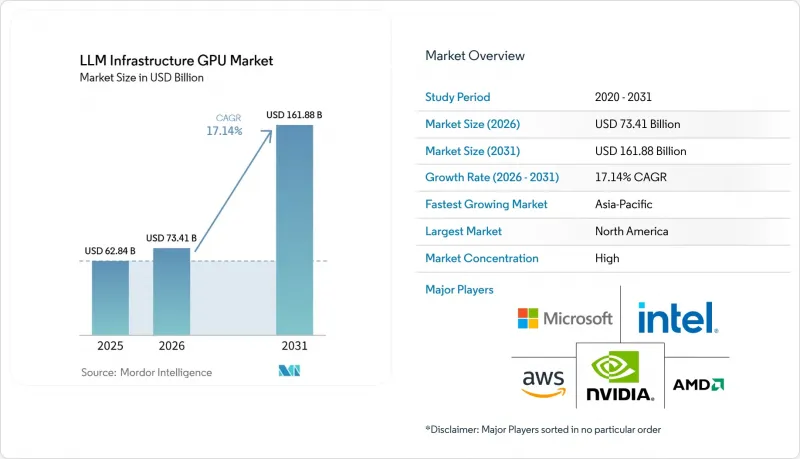
Mordor Intelligence에 의하면, LLM 인프라 GPU 시장 규모는 2025년 628억 4,000만 달러에서 2026년에는 734억 1,000만 달러로 확대되어 2031년까지 1,618억 8,000만 달러에 이를 것으로 예상되고 있어 2026년부터 2031년까지 CAGR 17.14%로 성장할 전망입니다.
본 보고서는 도입 모델(클라우드 데이터센터, 기업 및 프라이빗 데이터센터 등), 워크로드 유형(훈련용 GPU 등), 최종 사용자(하이퍼스케일러 및 클라우드 서비스 제공업체, 기업 등), GPU 통합 방식(PCIe 기반 GPU 등), 냉각 방식(공랭식 GPU, 수랭식 GPU), 지역별로 분류되어 있습니다. 시장 전망은 금액(달러) 기준으로 제시되어 있습니다.
전 세계 LLM 인프라 GPU 시장 동향 및 인사이트
파운데이션 모델 학습을 위한 고밀도 GPU 클러스터에 대한 수요 증가
LLM 인프라 GPU 시장은 파운데이션 모델 훈련이 수천 대 규모의 가속기 클러스터에서 수만 대 규모의 플릿으로 급속히 확대되고 있는 데 힘입어 성장하고 있습니다. NVIDIA는 Vera Rubin NVL72가 2026년 5월에 본격 양산에 들어갔으며, 1개의 랙에 72장의 GPU를 통합한 통합 컴퓨팅 도메인으로 구성되어 있음을 밝혔습니다. 이는 LLM 인프라 GPU 시장에서 랙 밀도에 대한 기대가 얼마나 빠르게 변화했는지를 보여줍니다. 또한 NVIDIA는 CoreWeave, IBM 및 NVIDIA가 MLPerf Training v6.0 제출 결과를 8,192개의 Blackwell GPU 규모로 확대했다고 보고했습니다. 이는 MLCommons의 피어 리뷰 프레임워크에서 검증된 최대 규모의 클러스터입니다(NVIDIA.COM). 이와 병행하여 엔비디아는 2026년 1월 SEC 제출 서류를 통해 2030년까지 5기가와트를 초과하는 AI 공장 건설을 가속화하기 위해 코어위브에 20억 달러를 투자했다고 밝혔습니다. 이는 용량 계획이 현재 수년 후를 내다보며 계약되고 있음을 보여줍니다. 이러한 변화로 인해 LLM 인프라 GPU 시장은 단순한 하드웨어 조달 주기에서 미래의 자본 투자가 접근 권한을 결정하는 장기적인 인프라 시장으로 변모하고 있습니다. 또한, 조기에 용량을 확보한 조직은 훈련 규모 확대, 서비스의 신속한 출시, 모델 세대를 초월한 인프라 재사용 측면에서 유리한 입장에 있기 때문에 하이퍼스케일 규모의 구매자와 소규모 사업자 간의 격차도 확대되고 있습니다.
LLM 개발 및 서비스 제공에서 GPU 가속형 클라우드 서비스 채택 확대
LLM 인프라 GPU 시장은 GPU 클라우드 이용이 급증하고 있는 점에서도 혜택을 받고 있습니다. 많은 구매자는 우선 완전한 사설 데이터센터를 구축하지 않고도 현행 세대의 하드웨어에 신속하게 접근할 필요가 있기 때문입니다. AMD와 OpenAI는 2025년 10월, 6기가와트 규모의 전략적 제휴를 발표했습니다. 첫 번째 1기가와트 분량의 AMD Instinct MI450 도입은 2026년 하반기로 예정되어 있으며, 이는 클라우드 용량이 현재 인프라 규모로 계약되고 있음을 보여줍니다. IBM과 NVIDIA는 2026년 3월 제휴를 확대했으며, IBM Cloud는 2026년 2분기에 대규모 훈련 및 추론을 위해 NVIDIA Blackwell Ultra GPU를 제공할 것이라고 발표했습니다. 이는 관리되고 규정 준수를 지원하는 GPU 접근에 대한 수요가 증가하고 있음을 반영합니다. 이어 CoreWeave는 2026년 4월 Meta와 210억 달러 규모의 장기 AI 클라우드 계약을 확대했으며, Jane Street와는 별도로 60억 달러 규모의 AI 클라우드 계약을 체결했습니다. 이는 약정형 용량 계약이 LLM 인프라 GPU 시장에서 클라우드의 경제성을 어떻게 형성하고 있는지를 여실히 보여줍니다. 이러한 움직임은 구매자들이 단순한 시간 단위 가격 책정보다 하드웨어 접근, 워크로드 튜닝, 운영 지원을 점점 더 중요하게 여기고 있음을 나타냅니다. 또한, 전용 GPU 클라우드는 범용 클라우드 환경보다 플랫폼 오버헤드를 줄이면서 LLM 워크로드를 처리할 수 있기 때문에 네오 클라우드 제공업체의 역할도 확대되고 있습니다.
부문 분석
2025년, 클라우드 데이터센터는 71.22%의 점유율을 차지하며 LLM 인프라 GPU 시장에서 가장 큰 도입 기반이 되었습니다. 이러한 주도적 지위는 고밀도 수냉 랙, 대규모 훈련 작업, 그리고 광범위한 개발자 접근을 지원할 수 있는 하이퍼스케일러 캠퍼스 및 네오클라우드 시설의 역할을 반영하고 있습니다. 현재 LLM 인프라 GPU 시장의 구조에서 클라우드 도입은 GPU, 네트워크, 오케스트레이션을 한곳에 통합하고 있기 때문에 여전히 대규모 훈련을 위한 가장 빠른 경로를 제공합니다. 또한 구매자는 토지, 전력, 냉각에 드는 전체 비용을 자사의 대차대조표에 계상하지 않고도 단기 이용이나 약정형 용량 모델을 이용할 수 있습니다. 하지만 데이터 관리, 지연 시간 요구 사항, 추론의 경제성 등의 요인으로 인해 더 많은 조직이 하이브리드형이나 프라이빗형 배포를 고려하게 되면서, 중앙 집중형 클라우드 용량이 유일한 선택지가 아니게 되었습니다.
엣지 데이터센터는 LLM 인프라 GPU 시장에서 여전히 가장 작은 규모의 도입 형태이지만, 10밀리초 미만의 응답 시간이나 로컬 처리가 요구되는 상황에서는 그 중요성이 커지고 있습니다. 엔터프라이즈 및 프라이빗 데이터센터는 2031년까지 연평균 성장률(CAGR) 17.57%를 나타낼 것으로 예측되며, 조직들이 파일럿 프로젝트에서 지속적인 AI 운영으로 전환함에 따라 이 부문의 LLM 인프라 GPU 시장 규모는 더욱 빠르게 확대되고 있습니다. Cloudian이 2026년 3월에 실시한 설문조사에 따르면, 응답자의 73%가 향후 24개월 이내에 AI 워크로드를 On-Premise 또는 하이브리드 인프라로 이전할 계획이라고 답했습니다. 이러한 전환은 기업이 클라우드를 포기한다는 것을 의미하지는 않지만, 버스트 트레이닝을 위해 퍼블릭 클라우드 용량을 확보하는 한편, 추론, 규정 준수가 필요한 워크로드 및 사내 도구를 자사가 관리하는 인프라에 배치한다는 것을 의미합니다. 실용적인 관점에서 볼 때, LLM 인프라의 GPU 시장은 클라우드가 규모의 경제를 주도하는 원동력으로 남아 있는 한편, 상시적인 서비스 제공이나 규제 대상 데이터 워크로드에 있어서는 사설 환경의 중요성이 높아지는 혼합형 도입 모델로 전환되고 있습니다.
2025년에는 훈련용 GPU가 66.59%의 점유율을 차지하고 있어, LLM 인프라 GPU 시장 지출의 대부분을 여전히 모델 개발이 차지하고 있음을 알 수 있습니다. 대규모 훈련 실행은 고밀도 클러스터, 고대역폭 패브릭, 그리고 수천 대의 가속기에 걸친 협업형 소프트웨어 환경에 대한 장기적인 접근이 필요하기 때문에 여전히 비용이 많이 듭니다. 따라서 LLM 인프라 GPU 시장에서는 대규모 사전 학습 및 모델 업데이트 주기에 최적화된 플랫폼을 위해 계속해서 막대한 자본이 투입되고 있습니다. 한편, 많은 기업이 기초 모델을 처음부터 구축하기보다는 기존 체크포인트를 미세 조정하거나 도메인별 용도를 배포하는 방식으로 전환함에 따라 구성 비율에 변화가 나타나기 시작했습니다. 그 결과, 훈련 전용으로 할당된 연산 리소스의 비율은 서서히 감소하고 있으며, 훈련과 배포 워크로드 간에 보다 광범위한 균형이 잡혀가고 있습니다.
추론용 GPU는 2031년까지 연평균 성장률(CAGR) 17.88%를 나타낼 것으로 예측되며, LLM 인프라 GPU 시장에서 가장 빠르게 성장하는 워크로드 부문이 될 전망입니다. NVIDIA의 보고서에 따르면, DFlash를 통한 추측적 디코딩으로 Blackwell GPU의 추론 성능이 최대 15배 향상된다고 합니다. 이는 소프트웨어의 효율성이 하드웨어 구매 결정의 한 요소가 되고 있는 이유를 보여줍니다. 또한, PyTorch는 2026년 6월, SGLang이 탑재된 NVIDIA GB300에서 DeepSeek-V4를 실행했을 때, 동등한 대화형 성능에서 5배 더 높은 처리량을 달성했다고 발표했는데, 이는 훈련이 아닌 추론에 특화된 서빙 스택에 대한 수요를 뒷받침하는 것입니다. 이는 중요한 점입니다. 왜냐하면 LLM 인프라 GPU 업계는 더 이상 모든 워크로드에 대해 단일 클러스터 설계에 의존하지 않으며, 구매자들은 고밀도 훈련 시스템과 지리적으로 분산된 추론 시스템을 구분하기 시작했기 때문입니다. 이러한 변화로 인해 LLM 인프라 GPU 시장은 더욱 세분화되고 있으며, 메모리 대역폭, 레이턴시 특성, 소프트웨어 스케줄링, 지역적 배치가 순수한 연산 규모와 마찬가지로 중요하게 여겨지고 있습니다.
지역별 분석
2025년, 북미는 47.12%의 점유율을 차지하며 LLM 인프라 GPU 시장에서 지역별 1위를 기록하고 있습니다. 이 지역은 하이퍼스케일러의 조달, 네오클라우드의 확대, 그리고 벤더 주도의 AI 팩토리 제휴의 주요 거점으로 계속 자리 잡고 있습니다. NVIDIA는 2026년 1월, 2030년까지 5기가와트를 초과하는 AI 팩토리 건설을 지원하기 위해 CoreWeave에 20억 달러를 투자했다고 밝혔습니다. 또한, 엔비디아와 IREN은 2026년 5월, 최대 5기가와트 규모의 AI 인프라 구축을 목표로 하는 새로운 전략적 제휴를 발표했습니다. 이는 자본 및 공급에 대한 투자가 북미 확장에 집중되고 있음을 보여줍니다. 이에 따라 북미의 LLM 인프라 GPU 시장은 대규모 클라우드 확충, 장기적인 하드웨어 조달 계약, 그리고 수냉식 용량의 급속한 도입과 밀접하게 연결되어 있습니다. 남미는 여전히 초기 단계에 있으며, 도입은 주요 클라우드 지역을 중심으로 전개되고 있고, 각국 정부나 기업이 소유한 AI 인프라 기반은 소규모에 그치고 있습니다.
유럽에서는 공공 정책과 기업의 데이터 관리 요건이 현지 도입을 뒷받침하고 있어, LLM 인프라 GPU 시장에서 유럽의 중요성이 점점 더 커지고 있습니다. 영국 정부의 ‘AI 하드웨어 계획’에서는 7억 5,000만 파운드(9억 5,200만 달러 상당)의 예산이 확보되었으며, 차세대 하드웨어 조달 예산으로 4억 파운드가 포함되어 있어, 이를 통해 해당 지역의 공공 투자 방향이 더욱 명확해졌습니다. 또한, 유럽 수요는 지역 내 호스팅, 모델 거버넌스, 운영상의 설명 책임에 관한 요건의 강화에 의해서도 형성되고 있으며, 이로 인해 사설 데이터센터나 주권형 클라우드 환경의 중요성이 높아지고 있습니다. 즉, 유럽의 LLM 인프라 GPU 시장은 단순한 하드웨어 문제를 넘어, 순수한 성능뿐만 아니라 호스팅 위치와 거버넌스 구조가 조달 결정에 점점 더 큰 영향을 미치고 있습니다.
아시아태평양은 2031년까지 연평균 성장률(CAGR) 18.22%로 확대될 것으로 예측되며, LLM 인프라 GPU 시장에서 가장 빠르게 성장하는 지역이 될 전망입니다. 일본과 한국에서는 이미 뚜렷한 성장세가 나타나고 있습니다. 리켄(RIKEN)은 2026년 6월 ‘Riku’ 도입을 발표했으며, 네이버와 엔비디아는 네이버의 GAK 세종 시설에서 55MW 규모로 시작하는 기가와트급 세계 AI 팩토리에 관한 합의를 발표했습니다. 이 지역의 LLM 인프라 GPU 시장은 국내 가속기 프로그램, 기업들의 인프라 구축 확대, 그리고 국가 차원의 연산 능력 강화 노력에 의해 형성되고 있습니다. 중국 내 최상위급 수입 하드웨어에 대한 접근 제한은 국산 대체품의 보급을 촉진하고 있으며, 최첨단 GPU 공급이 여전히 제약받는 상황에서도 공급업체 구도에 변화를 가져오고 있습니다. 중동 및 아프리카도 국가 주도의 컴퓨팅 인프라 구축에 적극적으로 나서고 있으며, 이에 따라 LLM 인프라 GPU 시장의 향후 지리적 확장 범위는 오랫동안 핵심을 차지해 온 북미를 넘어 확대될 것입니다.
기타 혜택:
- 엑셀 형식 시장 예측(ME) 시트
- 3개월간의 애널리스트 지원
자주 묻는 질문
목차
제1장 서론
제2장 조사 방법
제3장 주요 요약
제4장 시장 구도
제5장 시장 규모와 성장 예측
제6장 경쟁 구도
제7장 시장 기회와 향후 전망
JHS 26.08.05According to Mordor Intelligence, the LLM infrastructure GPU market size is expected to increase from USD 62.84 billion in 2025 to USD 73.41 billion in 2026 and reach USD 161.88 billion by 2031, growing at a CAGR of 17.14% over 2026-2031.
This report is Segmented by Deployment Model (Cloud Data Centers, Enterprise and Private Data Centers, and More), Workload Type (Training GPUs, and More), End User (Hyperscalers and Cloud Service Providers, Enterprises, and More), GPU Integration (PCIe-Based GPUs, and More), Cooling (Air-Cooled GPUs, and Liquid-Cooled GPUs), and Geography. The Market Forecasts are Provided in Terms of Value (USD).
Global LLM Infrastructure GPU Market Trends and Insights
Growing Demand for High-Density GPU Clusters for Foundation Model Training
The LLM infrastructure GPU market is being pushed upward by the rapid scaling of foundation model training from clusters measured in thousands of accelerators to fleets measured in tens of thousands. NVIDIA stated that Vera Rubin NVL72 ramped into full production in May 2026 and that one rack integrates 72 GPUs as a unified compute domain, which shows how quickly rack density expectations have shifted in the LLM infrastructure GPU market. NVIDIA also reported that CoreWeave, IBM, and NVIDIA scaled MLPerf Training v6.0 submissions to 8,192 Blackwell GPUs, which marked the largest validated cluster under the MLCommons peer-reviewed framework NVIDIA.COM. In parallel, NVIDIA disclosed through an SEC filing in January 2026 that it invested USD 2 billion in CoreWeave to help accelerate more than 5 gigawatts of AI factory buildout by 2030, which shows that capacity planning is now being contracted years ahead. This shift is changing the LLM infrastructure GPU market from a hardware procurement cycle into a long-horizon infrastructure market where forward capital commitments determine access. It also increases the gap between hyperscale buyers and smaller operators, because the organizations that secure early capacity are better positioned to scale training, launch services faster, and reuse infrastructure across model generations.
Rising Adoption of GPU-Accelerated Cloud Services for LLM Development and Serving
The LLM infrastructure GPU market is also benefiting from a sharp rise in GPU cloud consumption, because many buyers need fast access to current-generation hardware without building a full private data center first. AMD and OpenAI announced a 6-gigawatt strategic partnership in October 2025, with the first 1-gigawatt AMD Instinct MI450 deployment scheduled for the second half of 2026, which shows how cloud capacity is now being contracted at infrastructure scale. IBM and NVIDIA expanded their collaboration in March 2026, and IBM Cloud said it would offer NVIDIA Blackwell Ultra GPUs for large-scale training and inferencing in the second quarter of 2026, which reflects rising demand for managed and compliant GPU access. CoreWeave then expanded a USD 21 billion long-term AI cloud agreement with Meta in April 2026 and signed a separate USD 6 billion AI cloud agreement with Jane Street, which highlights how committed-capacity contracts are shaping cloud economics in the LLM infrastructure GPU market. These moves show that buyers increasingly value hardware access, workload tuning, and operational support over simple hourly pricing. They also widen the role of neocloud providers, because dedicated GPU clouds can target LLM workloads with less platform overhead than general-purpose cloud environments.
Other drivers and restraints analyzed in the detailed report include:
- Expansion of Sovereign AI and In-Country Model Hosting Programs
- Increasing Shift Toward Inference Optimization and Low-Latency Serving
For complete list of drivers and restraints, kindly check the Table Of Contents.
Segment Analysis
Cloud data centers held 71.22% share in 2025, which made them the largest deployment base in the LLM infrastructure GPU market. That leadership reflects the role of hyperscaler campuses and neocloud facilities that can support dense liquid-cooled racks, large training jobs, and broad developer access. In the current structure of the LLM infrastructure GPU market, cloud deployment still offers the fastest route to large-scale training because it concentrates GPUs, networking, and orchestration in one location. It also lets buyers use short-term and committed-capacity models without carrying the full cost of land, power, and cooling on their own balance sheets. Even so, centralized cloud capacity is no longer the only default, because data control, latency requirements, and inference economics are pushing more organizations to look at hybrid and private footprints.
Edge data centers remain the smallest deployment path in the LLM infrastructure GPU market, but they are gaining relevance where sub-10-millisecond response times or local processing requirements matter. Enterprise and private data centers are projected to grow at a 17.57% CAGR through 2031, and the LLM infrastructure GPU market size for this segment is expanding faster as organizations move from pilot projects into sustained AI operations. Cloudian's March 2026 survey said that 73% of respondents planned to shift AI workloads toward on-premises or hybrid infrastructure over the next 24 months. That shift does not mean enterprises are abandoning cloud, but it does mean they are reserving public capacity for burst training while placing inference, compliance-sensitive workloads, and internal tooling on infrastructure they control. In practical terms, the LLM infrastructure GPU market is moving toward a mixed deployment model where cloud remains the scale engine, while private environments become more important for steady-state serving and regulated data workloads.
Training GPUs held a 66.59% share in 2025, which shows that model development still accounted for the largest portion of spending in the LLM infrastructure GPU market. Large training runs remain expensive because they require extended access to dense clusters, high-bandwidth fabrics, and coordinated software environments across thousands of accelerators. That is why the LLM infrastructure GPU market continued to direct significant capital toward platforms optimized for large-scale pretraining and model refresh cycles. At the same time, the mix is beginning to shift because more enterprises now fine-tune existing checkpoints and deploy domain-specific applications instead of building foundation models from scratch. As a result, the share of compute dedicated only to training is gradually giving way to a broader balance between training and deployment workloads.
Inference GPUs are projected to grow at a 17.88% CAGR through 2031, making them the fastest-growing workload segment in the LLM infrastructure GPU market. NVIDIA reported that DFlash speculative decoding can improve inference performance by up to 15x on Blackwell GPUs, which shows why software efficiency is becoming part of hardware buying decisions. PyTorch said in June 2026 that DeepSeek-V4 on NVIDIA GB300 with SGLang delivered 5x higher throughput at the same interactivity, which reinforces the demand for serving stacks tailored to inference rather than training. This is important because the LLM infrastructure GPU industry is no longer relying on one cluster design for every workload, and buyers are separating dense training systems from geographically distributed inference systems. That change is creating a more segmented LLM infrastructure GPU market where memory bandwidth, latency behavior, software scheduling, and regional placement matter just as much as raw compute scale.
Complete Report Scope:
- By Deployment Model
- Cloud Data Centers
- Enterprise and Private Data Centers
- Edge Data Centers
- By Workload Type
- Training GPUs
- Inference GPUs
- By End User
- Hyperscalers and Cloud Service Providers
- Enterprises
- Government and Research Institutions
- By GPU Integration And Interconnect
- PCIe-Based GPUs
- High-Bandwidth Interconnect GPUs
- By Cooling Technology
- Air-Cooled GPUs
- Liquid-Cooled GPUs
- By Geography
- North America
- United States
- Canada
- Mexico
- Europe
- Germany
- United Kingdom
- France
- Italy
- Rest of Europe
- Asia-Pacific
- China
- Japan
- South Korea
- India
- Southeast Asia
- Rest of Asia-Pacific
- South America
- Middle East and Africa
- North America
Geography Analysis
North America held 47.12% share in 2025, giving it the leading regional position in the LLM infrastructure GPU market. The region remains the main center for hyperscaler procurement, neocloud expansion, and vendor-led AI factory partnerships. NVIDIA disclosed in January 2026 that it invested USD 2 billion in CoreWeave to support more than 5 gigawatts of AI factory buildout by 2030, and NVIDIA and IREN announced another strategic partnership in May 2026 targeting up to 5 gigawatts of AI infrastructure deployment, which shows how capital and supply commitments are clustering around North American expansion. This keeps the LLM infrastructure GPU market in North America closely tied to large-scale cloud buildouts, long-term hardware commitments, and rapid adoption of liquid-cooled capacity. South America remains at an earlier stage, with deployments still centered on major cloud regions and a smaller base of sovereign or enterprise-owned AI infrastructure.
Europe is becoming more important to the LLM infrastructure GPU market as public policy and enterprise data control requirements support local deployment choices. The UK government's AI Hardware Plan committed GBP 750 million, equal to USD 952 million, and included a GBP 400 million procurement opportunity for next-generation hardware, which gives the region a clearer public investment path. European demand is also shaped by stronger requirements around regional hosting, model governance, and operational accountability, which make private data centers and sovereign-style cloud environments more relevant. That means the LLM infrastructure GPU market in Europe is not only a hardware story, because hosting location and governance structure increasingly influence procurement choices alongside raw performance.
Asia-Pacific is projected to expand at an 18.22% CAGR through 2031, making it the fastest-growing geography in the LLM infrastructure GPU market. Japan and South Korea already show visible momentum, as RIKEN announced its "Riku" deployment in June 2026 and NAVER and NVIDIA announced a gigawatt-scale global AI factory agreement beginning at 55 MW at NAVER's GAK Sejong facility. The regional LLM infrastructure GPU market is also being shaped by domestic accelerator programs, rising enterprise buildout, and a stronger focus on national compute capacity. China's access restrictions on top-end imported hardware are encouraging domestic substitution, which changes the supplier mix even when frontier GPU availability remains constrained. The Middle East and Africa are also moving more actively into sovereign compute buildout, and that broadens the future geographic footprint of the LLM infrastructure GPU market beyond the long-established North American core.
- NVIDIA Corporation
- Advanced Micro Devices, Inc.
- Intel Corporation
- Microsoft Corporation
- Amazon Web Services, Inc.
- Google LLC
- Meta Platforms, Inc.
- Oracle Corporation
- Tencent Holdings Limited
- Alibaba Group Holding Limited
- Huawei Technologies Co., Ltd.
- Super Micro Computer, Inc.
- Dell Technologies Inc.
- Hewlett Packard Enterprise Company
- Lenovo Group Limited
- Cisco Systems, Inc.
- IBM Corporation
- CoreWeave, Inc.
- Cerebras Systems, Inc.
- SambaNova Systems, Inc.
- Lambda Labs
- Tenstorrent Inc.
- Marvell Technology Group
- Giga Computing Technology Co., Ltd.
- ASUSTeK Computer Inc.
Additional Benefits:
- The market estimate (ME) sheet in Excel format
- 3 months of analyst support
TABLE OF CONTENTS
1 INTRODUCTION
- 1.1 Study Assumptions and Market Definition
- 1.2 Scope of the Study
2 RESEARCH METHODOLOGY
3 EXECUTIVE SUMMARY
4 MARKET LANDSCAPE
- 4.1 Market Overview
- 4.2 Market Drivers
- 4.2.1 Growing Demand for High-Density GPU Clusters for Foundation Model Training
- 4.2.2 Rising Adoption of GPU-Accelerated Cloud Services for LLM Development and Serving
- 4.2.3 Expansion of Sovereign AI and In-Country Model Hosting Programs
- 4.2.4 Increasing Shift toward Inference Optimization and Low-Latency Serving
- 4.2.5 Power-Efficient Liquid-Cooled Rack Designs Improving Deployable Compute Density
- 4.2.6 Standardization of LLM Benchmarking and Cluster Procurement Frameworks
- 4.3 Market Restraints
- 4.3.1 HBM and Advanced Packaging Supply Constraints
- 4.3.2 High Total Cost of Ownership for Large GPU Fleets
- 4.3.3 Export Controls and Cross-Border Availability Restrictions
- 4.3.4 Vendor Lock-In Across Software, Interconnect, and Cluster Stacks
- 4.4 Industry Value Chain Analysis
- 4.5 Regulatory Landscape
- 4.6 Technological Outlook
- 4.7 Impact of Macroeconomic Factors on the Market
- 4.8 Porter's Five Forces Analysis
- 4.8.1 Threat of New Entrants
- 4.8.2 Bargaining Power of Buyers
- 4.8.3 Bargaining Power of Suppliers
- 4.8.4 Threat of Substitutes
- 4.8.5 Industry Rivalry
5 MARKET SIZE AND GROWTH FORECASTS (VALUE)
- 5.1 By Deployment Model
- 5.1.1 Cloud Data Centers
- 5.1.2 Enterprise and Private Data Centers
- 5.1.3 Edge Data Centers
- 5.2 By Workload Type
- 5.2.1 Training GPUs
- 5.2.2 Inference GPUs
- 5.3 By End User
- 5.3.1 Hyperscalers and Cloud Service Providers
- 5.3.2 Enterprises
- 5.3.3 Government and Research Institutions
- 5.4 By GPU Integration And Interconnect
- 5.4.1 PCIe-Based GPUs
- 5.4.2 High-Bandwidth Interconnect GPUs
- 5.5 By Cooling Technology
- 5.5.1 Air-Cooled GPUs
- 5.5.2 Liquid-Cooled GPUs
- 5.6 By Geography
- 5.6.1 North America
- 5.6.1.1 United States
- 5.6.1.2 Canada
- 5.6.1.3 Mexico
- 5.6.2 Europe
- 5.6.2.1 Germany
- 5.6.2.2 United Kingdom
- 5.6.2.3 France
- 5.6.2.4 Italy
- 5.6.2.5 Rest of Europe
- 5.6.3 Asia-Pacific
- 5.6.3.1 China
- 5.6.3.2 Japan
- 5.6.3.3 South Korea
- 5.6.3.4 India
- 5.6.3.5 Southeast Asia
- 5.6.3.6 Rest of Asia-Pacific
- 5.6.4 South America
- 5.6.5 Middle East and Africa
- 5.6.1 North America
6 COMPETITIVE LANDSCAPE
- 6.1 Market Concentration
- 6.2 Strategic Moves
- 6.3 Market Positioning Analysis
- 6.4 Company Profiles (includes Global Level Overview, Market Level Overview, Core Segments, Financials as available, Strategic Information, Market Rank/Share, Products and Services, Recent Developments)
- 6.4.1 NVIDIA Corporation
- 6.4.2 Advanced Micro Devices, Inc.
- 6.4.3 Intel Corporation
- 6.4.4 Microsoft Corporation
- 6.4.5 Amazon Web Services, Inc.
- 6.4.6 Google LLC
- 6.4.7 Meta Platforms, Inc.
- 6.4.8 Oracle Corporation
- 6.4.9 Tencent Holdings Limited
- 6.4.10 Alibaba Group Holding Limited
- 6.4.11 Huawei Technologies Co., Ltd.
- 6.4.12 Super Micro Computer, Inc.
- 6.4.13 Dell Technologies Inc.
- 6.4.14 Hewlett Packard Enterprise Company
- 6.4.15 Lenovo Group Limited
- 6.4.16 Cisco Systems, Inc.
- 6.4.17 IBM Corporation
- 6.4.18 CoreWeave, Inc.
- 6.4.19 Cerebras Systems, Inc.
- 6.4.20 SambaNova Systems, Inc.
- 6.4.21 Lambda Labs
- 6.4.22 Tenstorrent Inc.
- 6.4.23 Marvell Technology Group
- 6.4.24 Giga Computing Technology Co., Ltd.
- 6.4.25 ASUSTeK Computer Inc.
7 MARKET OPPORTUNITIES AND FUTURE OUTLOOK
- 7.1 White-Space and Unmet-Need Assessment


