

|
시장보고서
상품코드
2099127
AI 활용 응급실 최적화 시장 : 점유율 분석, 업계 동향 및 통계, 성장 예측(2026-2031년)AI-powered Emergency Department Optimization - Market Share Analysis, Industry Trends & Statistics, Growth Forecasts (2026 - 2031) |
||||||
 Mordor Intelligence
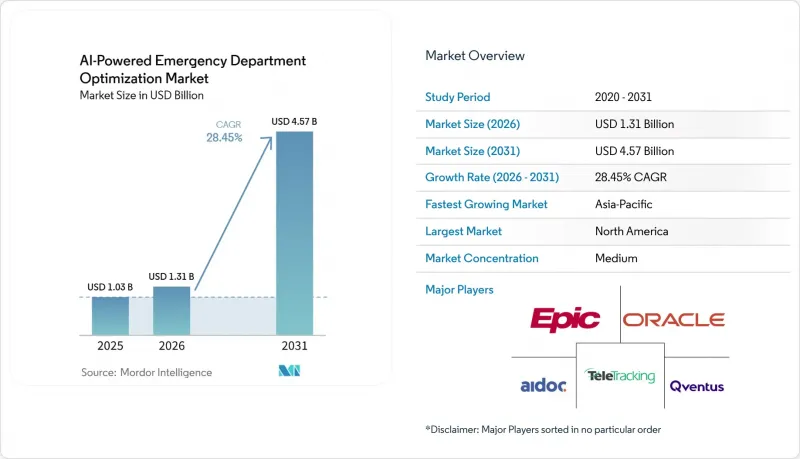
Mordor Intelligence에 의하면, AI 활용 응급실 최적화 시장은 2025년 10억 3,000만 달러에서 2026년에는 13억 1,000만 달러로 확대되어 2026년부터 2031년까지 CAGR 28.45%로 성장을 지속하여, 2031년에는 45억 7,000만 달러에 이를 것으로 예측됩니다.
본 보고서는 구성 요소(소프트웨어, 서비스), 도입 형태(클라우드 기반, On-Premise형, 하이브리드형), 용도(환자 분류 최적화, 환자 흐름 및 처리 능력 최적화, 기타), 최종 사용자(병원 및 의료 시스템, 기타), 지역(북미, 유럽, 아시아태평양, 기타)별로 분류되어 있습니다. 시장 전망은 금액(달러) 기준으로 제시되어 있습니다.
전 세계 AI 활용 응급실 최적화 시장 동향 및 인사이트
응급실 혼잡 및 대기 환자 증가라는 압박 심화
AI 활용 응급실 최적화 시장은 현재 응급의료 시스템 전반에서 나타나는 구조적인 과밀 상태와 밀접한 관련이 있습니다. 2024년, 미국에서는 1억 3,980만 건의 응급실 내원 사례가 있었습니다. 또한, 75세에서 84세 연령층만으로도 향후 10년 동안 응급실 내원 건수가 45% 증가할 것으로 예측되고 있으며, 이는 수동적인 인력 배치 모델만으로는 도저히 감당할 수 없는 규모입니다. 2019년부터 2022년 사이 미국에서 3만 병상 가까이 감축됨에 따라 수용 능력이 감소하는 추세를 보이고 있어, 이러한 압박은 더욱 심화되고 있습니다. 『BMC Emergency Medicine』지에 게재된 2025년의 후향적 코호트 연구에 따르면, 전날의 혼잡은 다음 날의 혼잡 위험을 독립적으로 높이는 것으로 밝혀졌으며, 이는 예측에 기반한 개입이 없다면 혼잡이 얼마나 급속히 자기 증폭적으로 진행될 수 있는지를 보여줍니다. 정신건강 환자는 내원 환자 수의 5%에서 6%를 차지하며 평균 체류 시간이 9시간에서 10시간인 반면, 일반 응급 환자의 평균 체류 시간은 4시간에서 5시간에 불과하기 때문에 수요에 더욱 복합적인 양상을 더하고 있습니다. 이 때문에 이들은 AI 활용 처리 능력 향상 도구의 중요한 대상이 됩니다.
고도 급성기 의료에서 AI 활용 트리아지 및 처리 능력 향상
AI 활용 응급실 최적화 시장도 발전하고 있습니다. 이는 AI 트리아지의 임상적 유효성이 불과 몇년전과 비교해 비약적으로 높아졌기 때문입니다. 2024년 『BMC Emergency Medicine』지에 발표된 체계적 문헌 고찰에 따르면, 머신러닝 및 자연어 처리 모델은 특히 클래스 불균형 보정 및 특징량 엔지니어링이 적절히 수행된 경우, 정확도와 일관성 양면에서 인간에 의한 트리아지 기법을 일관되게 능가하는 것으로 나타났습니다. 2026년 1월, Aidoc사는 단일 워크플로우로 14가지 급성기 CT 적응증을 포괄하는 ‘CARE’ 기반 모델에 대해 FDA의 510(k) 승인을 획득했습니다. 이 모델의 평균 민감도는 97%, 특이도는 98%이며, 주요 단일 질환용 도구와 비교하여 오경보를 10분의 1 가까이 줄였습니다. 보다 광범위한 승인이 일반화됨에 따라, AI 활용 응급실 최적화 시장은 파편화된 단발성 제품에서 병원 구매자의 통합 업무를 경감하고 공급업체 관리를 간소화하는 플랫폼으로 전환되고 있습니다.
AI에 의한 우선순위 결정과 관련된 임상적 책임 문제
응급의료에서는 책임 소재에 대한 불확실성을 용인할 여지가 거의 없기 때문에 임상적 책임 문제는 AI 활용 응급실 최적화 시장에서 여전히 가장 명확한 제약 요소 중 하나로 남아 있습니다. AI의 권고가 진단이나 트리아지에 영향을 미친 경우, 책임은 임상의, 공급업체 및 도입 기관 사이에 분산될 가능성이 있지만, 대부분의 관할 구역에서는 여전히 통일된 책임 배분 기준이 부족합니다. 이 문제는 단일 승인으로 여러 적응증을 포괄하는 기반 모델(파운데이션 모델) 도구에서 더욱 심각합니다. 광범위한 출력이 유해한 결정에 영향을 미쳤을 경우, 책임 소재가 불분명해지는 경우가 많기 때문입니다. '의료기기로서의 소프트웨어(Software as a Medical Device)' 규정에 따른 시판 후 조사 요건이나 EU AI법 제9조의 위험 관리 요건이 조달 계약의 형태를 형성하기 시작하고 있지만, 소규모 의료 시스템의 경우 이러한 조항을 효과적으로 협상할 법적 역량이 부족한 경우가 많습니다.
부문 분석
2025년에는 소프트웨어가 매출의 61.13%를 차지하며, 같은 해 AI 활용 응급실 최적화 시장 규모에서 가장 큰 비중을 차지했습니다. 병원에서는 핵심 인프라를 전면적으로 교체할 필요 없이 기존 임상 시스템에 단계적으로 추가할 수 있기 때문에 모듈식이며 전자의무기록(EHR)과 통합된 소프트웨어가 선호되고 있습니다. 이 계층에는 앰비언트 문서화 엔진, 트리아지 시스템, 환자 흐름 대시보드, 커맨드 센터 도구, 의사결정 지원 용도 등이 포함되며, 이러한 각 카테고리는 모델이 시간이 지남에 따라 대규모 운영 데이터셋으로부터 학습함에 따라 그 가치가 높아지는 경향을 보입니다. 또한 소프트웨어는 가장 빠르게 성장하는 구성 요소로, 2031년까지 연평균 성장률(CAGR)이 28.54%를 나타낼 것으로 예측되며, 이는 AI 활용 응급실 최적화 시장 전체에서 소프트웨어 주도형 플랫폼이 중심적인 역할을 하고 있음을 뒷받침합니다.
AI 활용 응급실 최적화 업계에서 서비스는 여전히 중요한 역할을 하고 있습니다. 이는 도입, 교육, 임상정보학 지원 및 관리형 분석이 소프트웨어 도입과 병행하여 확대되고 있기 때문입니다. 조달 팀은 현재 HL7 FHIR R4와의 호환성과 HIPAA 비즈니스 어소시에이트 계약 준수를 표준 요건으로 삼고 있으며, 이로 인해 규제 대응 능력과 통합 능력이 더 뛰어난 벤더에게 우위가 생기고 있습니다. 또한, 의료 기관들은 기존처럼 단일 질환용 도구를 개별적으로 구매하는 방식을 재검토하고, 계약 건수를 줄여 보다 광범위한 워크플로우 플랫폼으로의 전환을 추진하고 있습니다.
클라우드 기반 도입은 2025년에 매출의 50.27%를 차지하고, 2031년까지 연평균 성장률(CAGR)이 28.81%를 나타낼 것으로 전망되는 가장 빠르게 성장하는 도입 형태이기도 합니다. 병원이 클라우드 아키텍처를 선호하는 이유는 혼잡한 응급 현장에서의 실시간 추론에는 막대한 초기 하드웨어 투자 없이도 수요의 급격한 증가에 대응할 수 있는 탄력적인 용량이 필요하기 때문입니다. 환자 수가 급증할 때는 몇 시간 만에 추론 부하가 평소 수준의 3-4배에 달할 수 있지만, 고정된 On-Premise 용량만으로는 이러한 패턴을 경제적으로 감당하기 어렵습니다.
On-Premise 구축은 AI 활용 응급실 최적화 업계에서 여전히 일정한 역할을 수행하고 있으며, 특히 엄격한 데이터 주권 규정에 따라 운영되는 대규모 대학병원이나 공립병원 시스템에서는 이러한 경향이 두드러집니다. 독일과 중국의 데이터 보호 요건으로 인해 전반적인 추세로는 클라우드 도입이 주류를 이루고 있음에도 불구하고, 일부 환경에서는 로컬 추론이 여전히 선호되고 있습니다. 따라서 하이브리드 아키텍처의 중요성이 커지고 있습니다. 이는 지연 시간에 민감한 트라이아지 추론을 기관 경계 내에 유지하면서, 훈련, 업데이트 및 시간 경과에 따른 분석을 클라우드 파이프라인을 통해 수행할 수 있게 하기 때문입니다. 이에 따라 AI 활용 응급실 최적화 시장에서 예측 기간 동안 하이브리드 및 엣지 구성의 성장이 지속될 것으로 전망됩니다.
지역별 분석
2025년, 북미는 45.36%의 점유율을 차지하며 AI 활용 응급실 최적화 시장에서 가장 큰 비중을 차지했습니다. 미국은 대규모 통합 의료 시스템, FDA 승인을 받은 임상 AI 도구, 그리고 환자 처리 능력 및 가치 기반 의료와 연계된 강력한 재정적 인센티브를 모두 갖추고 있어 여전히 주요 도입 및 혁신의 중심지입니다. 캐나다는 보다 광범위한 디지털 헬스 투자 계획 하에서 지속적인 성장 기회가 예상되는 반면, 멕시코의 민간 병원 그룹은 대도시권에서 클라우드 기반 트리아지 플랫폼의 시범 운영을 진행하고 있습니다.
유럽은 독일, 영국, 프랑스가 주도하는 AI 활용 응급실 최적화 시장에서 여전히 2위 지역 클러스터로 자리 잡고 있습니다. 영국은 응급 현장에서 앰비언트 문서화(ambient documentation)가 활발히 시험되고 있는 곳으로, NHS(국민보건서비스)를 기반으로 한 도입 사례에서는 단기 체류형 응급 환경에서 진료 1건당 문서 작성 시간이 85.8% 감소한 것으로 보고되었습니다. 독일은 병원 디지털화에 대한 강력한 지원의 혜택을 받고 있지만, EU AI 법 및 보다 광범위한 전자건강기록(EHR) 관련 규정이 벤더의 제품 진입, 규정 준수, 리스크 관리의 틀을 형성하기 시작하고 있습니다. 이탈리아, 프랑스, 스페인에서는 상업적 확장이 아직 초기 단계에 있으며, 이 지역에서의 성장은 응급 부문에 특화된 대규모 조달 붐이라기보다는 보다 광범위한 디지털 헬스 정책의 지원에 의존하고 있습니다. GCC 국가들, 특히 사우디아라비아와 UAE는 스마트 병원에 대한 투자를 통해 공급업체들의 주목을 받고 있는 반면, 브라질과 아르헨티나는 AI 활용 자원 배분 및 운영 도구에 관한 남미 지역의 초기 시범 사례로 부상하고 있습니다.
아시아태평양은 AI 활용 응급실 최적화 시장에서 지역별 가장 빠른 성장률을 나타낼 것으로 예상되며, 시장 규모는 2031년까지 연평균 성장률(CAGR) 30.24%로 성장할 전망입니다. 중국은 도입이 급속히 진행되고 있는 가장 두드러진 사례로, 2025년까지 90개의 3차 병원이 임상 용도로 DeepSeek 대규모 언어 모델을 도입할 예정이며, 국내 기업들은 이미 50개 이상의 의료 분야 특화 AI 모델을 출시했습니다. 한국에서는 보다 체계적인 검증 프로세스가 구축되어 있으며, 길의료센터의 시범 운영 결과, 응급 의료 현장에서 AI와 전문의의 진단 결과 일치율이 94%에 달한 것으로 보고되었습니다.
기타 혜택:
- 엑셀 형식 시장 예측(ME) 시트
- 3개월간의 애널리스트 지원
자주 묻는 질문
목차
제1장 서론
제2장 조사 방법
제3장 주요 요약
제4장 시장 구도
제5장 시장 규모와 성장 예측
제6장 경쟁 구도
제7장 시장 기회와 향후 전망
JHS 26.08.05According to Mordor Intelligence, the AI-powered emergency department optimization market is expected to grow from USD 1.03 billion in 2025 to USD 1.31 billion in 2026 and is forecasted to reach USD 4.57 billion by 2031 at 28.45% CAGR over 2026-2031.
This report is Segmented by Component (Software, Services), Deployment Mode (Cloud-Based, On-Premises, Hybrid), Application (Patient Triage Optimization, Patient Flow and Throughput Optimization, and Others), End-User (Hospitals and Health Systems, and Others), Geography (North America, Europe, Asia-Pacific, and Others). The Market Forecasts are Provided in Terms of Value (USD).
Global AI-powered Emergency Department Optimization Market Trends and Insights
Rising Emergency Department Crowd-ing and Boarding Pressure
The AI-powered Emergency Department Optimization Market is tied closely to the structural overcrowding now seen across emergency systems. Americans made 139.8 million emergency department visits in 2024, and the 75 to 84 age cohort alone is projected to drive a 45% increase in emergent visits over the next decade, which is far beyond what manual staffing models can absorb on their own.The pressure is stronger because capacity has moved in the opposite direction, with nearly 30,000 hospital beds eliminated in the United States between 2019 and 2022. A 2025 retrospective cohort study in BMC Emergency Medicine found that prior-day overcrowding independently raised the risk of next-day crowding, which shows how quickly congestion can become self-reinforcing without predictive intervention. Behavioral health patients add another layer of demand because they represent 5% to 6% of visits while averaging 9 to 10 hours of length of stay, compared with 4 to 5 hours for the broader emergency population, which makes them a high-value target for AI-based throughput tools.
AI-Enabled Triage and Throughput Gains in High-Acuity Care
The AI-powered Emergency Department Optimization Market is also moving forward because the clinical support case for AI triage is much stronger than it was even a few years ago. A 2024 systematic review in BMC Emergency Medicine showed that machine learning and natural language processing models consistently outperformed human-only triage methods in both accuracy and consistency, especially when class imbalance correction and feature engineering were handled well. In January 2026, Aidoc received FDA 510(k) clearance for its CARE foundation model covering 14 acute CT indications in one workflow, with mean sensitivity of 97% and specificity of 98%, while also reducing false alerts by nearly tenfold against leading single-condition tools. As broader clearances become more common, the AI-powered Emergency Department Optimization Market is shifting away from fragmented one-off products toward platforms that reduce integration work and simplify vendor management for hospital buyers.
Clinical Liability Concerns Over AI-Driven Prioritization
Clinical liability remains one of the clearest constraints on the AI-powered Emergency Department Optimization Market because emergency medicine leaves little room for uncertainty around accountability. When an AI-assisted recommendation influences diagnosis or triage, liability can be spread across the clinician, the vendor, and the deploying institution, but most jurisdictions still lack a uniform allocation standard. The problem is sharper for foundation-model tools that cover many indications under one clearance, because it is often unclear where responsibility sits when broad output influences a harmful decision. Post-market surveillance expectations under Software as a Medical Device rules and Article 9 risk management requirements under the EU AI Act are starting to shape procurement contracts, but smaller health systems often lack the legal capacity to negotiate these provisions effectively.
Other drivers and restraints analyzed in the detailed report include:
- Ambient Documentation Automation Reducing Clinician Burnout
- Growing Shortage of Emergency Care Clinicians and Staff
- Poor Data Standardization Across Emergency Department Workflows
For complete list of drivers and restraints, kindly check the Table Of Contents.
Segment Analysis
Software captured 61.13% of revenue in 2025, which means it accounted for the largest portion of the AI-powered Emergency Department Optimization Market size in that year. Hospitals have favored modular, EHR-integrated software because it can be added to existing clinical systems in stages instead of forcing full replacement of core infrastructure. This layer includes ambient documentation engines, triage systems, patient flow dashboards, command center tools, and decision support applications, and each of these categories tends to gain more value as models learn from larger operating datasets over time. Software is also the fastest-growing component, with a projected 28.54% CAGR through 2031, which reinforces the central role of software-led platforms across the AI-powered Emergency Department Optimization Market.
Services still matter in the AI-powered emergency department optimization industry, because implementation, training, clinical informatics support, and managed analytics grow alongside software deployments. Procurement teams now treat HL7 FHIR R4 compatibility and HIPAA business associate agreement readiness as standard requirements, which gives an advantage to vendors with deeper regulatory and integration capacity. Health systems are also rationalizing earlier purchases of single-condition tools and moving toward broader workflow platforms under fewer contracts.
Cloud-based deployment held 50.27% of revenue in 2025 and is also the fastest-growing deployment mode, with a projected 28.81% CAGR through 2031. Hospitals prefer cloud architecture because real-time inference in busy emergency settings requires elastic capacity that can handle sudden spikes in demand without large up-front hardware spending. Surge events can raise inference loads by 3 to 4 times normal levels within hours, and that pattern is difficult to support economically with fixed on-premises capacity alone.
On-premises deployment still has a place in the AI-powered emergency department optimization industry, especially at large academic medical centers and public hospital systems operating under strict data sovereignty rules. Germany's and China's data protection requirements continue to support local inference in some settings, even as the wider model still favors cloud adoption. Hybrid architecture is therefore becoming more relevant, because it allows latency-sensitive triage inference to remain inside institutional boundaries while training, updates, and longitudinal analytics move through cloud pipelines. This is likely to keep hybrid and edge configurations growing through the forecast period across the AI-powered Emergency Department Optimization Market.
Complete Report Scope:
- By Component
- Software
- Services
- By Deployment Mode
- Cloud-Based
- On-Premises
- Hybrid
- By Application
- Patient Triage Optimization
- Patient Flow and Throughput Optimization
- Resource Allocation and Staffing Optimization
- Clinical Documentation Automation
- Discharge Planning and Bed Management
- Other Applications
- By End-User
- Hospitals and Health Systems
- Urgent Care Centers
- Ambulatory Surgery Centers
- Telehealth and Virtual Care Networks
- By Geography
- North America
- United States
- Canada
- Mexico
- Europe
- Germany
- United Kingdom
- France
- Italy
- Spain
- Rest of Europe
- Asia-Pacific
- China
- Japan
- India
- Australia
- South Korea
- Rest of Asia-Pacific
- Middle East and Africa
- GCC
- South Africa
- Rest of Middle East and Africa
- South America
- Brazil
- Argentina
- Rest of South America
- North America
Geography Analysis
North America held 45.36% share in 2025, which gave the region the largest position in the AI-powered Emergency Department Optimization Market. The United States remains the main deployment and innovation center because it combines large integrated health systems, FDA-cleared clinical AI tools, and stronger financial incentives tied to throughput and value-based care. Canada remains a follow-on opportunity under broader digital health investment plans, while Mexico's private hospital groups are testing cloud-based triage platforms in larger urban centers.
Europe remains the second-largest regional cluster in the AI-powered Emergency Department Optimization Market, led by Germany, the United Kingdom, and France. The United Kingdom has become an active testing ground for ambient documentation in emergency settings, and NHS-based deployments reported an 85.8% reduction in documentation time per encounter in short-stay emergency environments. Germany benefits from strong hospital digitalization support, while the EU AI Act and wider electronic health record rules are beginning to shape how vendors structure product entry, compliance, and risk management. Italy, France, and Spain are still earlier in commercial scaling, and most growth there depends on broader digital health policy support rather than large emergency-specific procurement waves. GCC countries, especially Saudi Arabia and the UAE, are attracting more vendor attention through smart hospital investment, while Brazil and Argentina are emerging as early South American pilots for AI resource allocation and operational tools.
Asia-Pacific is projected to post the fastest regional growth in the regional AI-powered Emergency Department Optimization Market size is projected to expand at a 30.24% CAGR through 2031. China is the clearest example of compressed adoption, because by 2025, 90 tertiary hospitals had deployed the DeepSeek large language model for clinical use and domestic enterprises had already released more than 50 healthcare vertical AI models. South Korea has built a more structured validation path, and Gil Medical Center's pilot reported 94% concordance between AI and specialist diagnosis in emergency use.
- Abridge AI, Inc.
- Aidoc
- Amazon Web Services, Inc.
- Dedalus S.p.A.
- eClinicalWorks
- Epic Systems
- GE Healthcare
- Health Catalyst, Inc.
- IBM
- Intersystems
- Koninklijke Philips
- Kontakt.io, Inc.
- LeanTaaS, Inc.
- Mednition, Inc.
- Microsoft
- Oracle
- Qventus, Inc.
- Siemens Healthineers
- TeleTracking Technologies, Inc.
- Viz.AI, Inc.
Additional Benefits:
- The market estimate (ME) sheet in Excel format
- 3 months of analyst support
TABLE OF CONTENTS
1 Introduction
- 1.1 Study Assumptions and Market Definition
- 1.2 Scope of the Study
2 Research Methodology
3 Executive Summary
4 Market Landscape
- 4.1 Market Overview
- 4.2 Market Drivers
- 4.2.1 Rising Emergency Department Crowd-ing and Boarding Pressure
- 4.2.2 AI-Enabled Triage and Throughput Gains in High-Acuity Care
- 4.2.3 Interoperable EHR, PACS, and Command-Center Integration Demand
- 4.2.4 Ambient Documentation Automation Reducing Clinician Burnout
- 4.2.5 Growing Shortage of Emergency Care Clinicians and Staff
- 4.2.6 Increasing Adoption of Predictive Analytics for Emergency Preparedness
- 4.3 Market Restraints
- 4.3.1 Clinical Liability Concerns Over AI-Driven Prioritization
- 4.3.2 Poor Data Standardization Across Emergency Department Workflows
- 4.3.3 High Implementation and Integration Costs
- 4.3.4 Limited Clinical Validation and Trust in AI Recommendations
- 4.4 Supply/Value Chain Analysis
- 4.5 Regulatory Landscape
- 4.6 Technological Outlook
- 4.7 Porter's Five Forces Analysis
- 4.7.1 Threat of New Entrants
- 4.7.2 Bargaining Power of Suppliers
- 4.7.3 Bargaining Power of Buyers
- 4.7.4 Threat of Substitutes
- 4.7.5 Competitive Rivalry
5 Market Size & Growth Forecasts (Value, USD)
- 5.1 By Component
- 5.1.1 Software
- 5.1.2 Services
- 5.2 By Deployment Mode
- 5.2.1 Cloud-Based
- 5.2.2 On-Premises
- 5.2.3 Hybrid
- 5.3 By Application
- 5.3.1 Patient Triage Optimization
- 5.3.2 Patient Flow and Throughput Optimization
- 5.3.3 Resource Allocation and Staffing Optimization
- 5.3.4 Clinical Documentation Automation
- 5.3.5 Discharge Planning and Bed Management
- 5.3.6 Other Applications
- 5.4 By End-User
- 5.4.1 Hospitals and Health Systems
- 5.4.2 Urgent Care Centers
- 5.4.3 Ambulatory Surgery Centers
- 5.4.4 Telehealth and Virtual Care Networks
- 5.5 By Geography
- 5.5.1 North America
- 5.5.1.1 United States
- 5.5.1.2 Canada
- 5.5.1.3 Mexico
- 5.5.2 Europe
- 5.5.2.1 Germany
- 5.5.2.2 United Kingdom
- 5.5.2.3 France
- 5.5.2.4 Italy
- 5.5.2.5 Spain
- 5.5.2.6 Rest of Europe
- 5.5.3 Asia-Pacific
- 5.5.3.1 China
- 5.5.3.2 Japan
- 5.5.3.3 India
- 5.5.3.4 Australia
- 5.5.3.5 South Korea
- 5.5.3.6 Rest of Asia-Pacific
- 5.5.4 Middle East and Africa
- 5.5.4.1 GCC
- 5.5.4.2 South Africa
- 5.5.4.3 Rest of Middle East and Africa
- 5.5.5 South America
- 5.5.5.1 Brazil
- 5.5.5.2 Argentina
- 5.5.5.3 Rest of South America
- 5.5.1 North America
6 Competitive Landscape
- 6.1 Market Concentration
- 6.2 Market Share Analysis
- 6.3 Company Profiles (includes Global level Overview, Market level overview, Core Segments, Financials as available, Strategic Information, Market Rank/Share for key companies, Products & Services, Recent Developments)
- 6.3.1 Abridge AI, Inc.
- 6.3.2 Aidoc
- 6.3.3 Amazon Web Services, Inc.
- 6.3.4 Dedalus S.p.A.
- 6.3.5 eClinicalWorks, LLC
- 6.3.6 Epic Systems Corporation
- 6.3.7 GE HealthCare
- 6.3.8 Health Catalyst, Inc.
- 6.3.9 IBM
- 6.3.10 InterSystems Corporation
- 6.3.11 Koninklijke Philips N.V.
- 6.3.12 Kontakt.io, Inc.
- 6.3.13 LeanTaaS, Inc.
- 6.3.14 Mednition, Inc.
- 6.3.15 Microsoft Corporation
- 6.3.16 Oracle Corporation
- 6.3.17 Qventus, Inc.
- 6.3.18 Siemens Healthineers AG
- 6.3.19 TeleTracking Technologies, Inc.
- 6.3.20 Viz.ai, Inc.
7 Market Opportunities & Future Outlook
- 7.1 White-space & Unmet-need Assessment


