

|
시장보고서
상품코드
2099128
모바일 심장 텔레메트리 시스템 시장 : 시장 점유율 분석, 업계 동향 및 통계, 성장 예측(2026-2031년)Mobile Cardiac Telemetry Systems - Market Share Analysis, Industry Trends & Statistics, Growth Forecasts (2026 - 2031) |
||||||
 Mordor Intelligence
Mordor Intelligence에 의하면, 모바일 심장 텔레메트리 시스템 시장은 2025년 18억 4,000만 달러로 평가되었고, 2026년 20억 7,000만 달러에서 2031년까지 38억 4,000만 달러로 확대될 것으로 전망되며, 2026-2031년 CAGR 13.17%를 나타낼 것으로 예측됩니다.
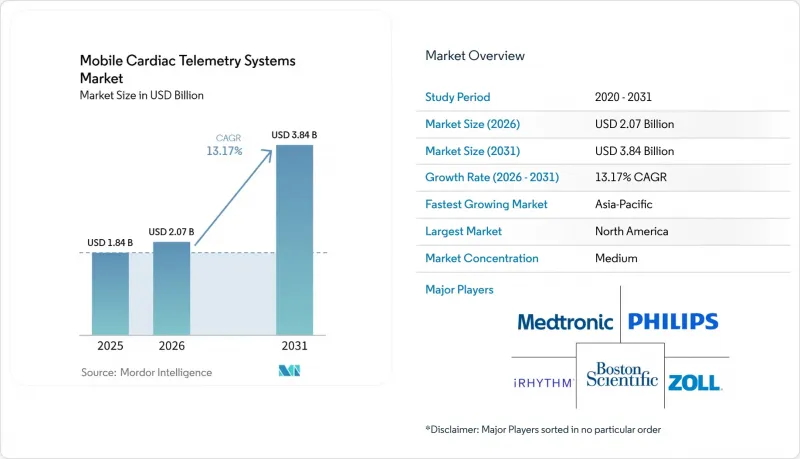
본 보고서는 제품 유형별(리드형 시스템, 패치형 시스템), 컴포넌트별(하드웨어, 소프트웨어, 서비스), 용도별(부정맥 모니터링, 심장 질환 진단, 기타), 최종 사용자별(병원 및 진료소, 기타), 지역별(북미, 유럽, 아시아태평양, 중동 및 아프리카, 남미)로 분류되어 있습니다. 시장 전망은 금액(달러) 기준으로 제시되어 있습니다.
세계의 모바일 심장 텔레메트리 시스템 시장 동향 및 인사이트
심장 질환 부담 증가와 부정맥 감지 수요 증가
모바일 심장 텔레메트리 시스템 시장은 심혈관 질환이 여전히 전 세계 사망 원인 1위를 차지하고 있다는 사실로 인해 계속해서 혜택을 받고 있습니다. 또한, 저·중소득 국가가 심혈관 질환으로 인한 사망의 4분의 3 이상을 차지하고 있으며, 전문의 수가 제한적인 경우가 많기 때문에 질병 부담의 불균형도 해당 시장을 뒷받침하고 있습니다. 이러한 불균형으로 인해, 특히 전문의 인력이 제한적이고 병원 수용 능력에도 제약이 있는 지역에서 지속적인 원격 모니터링은 효율성을 높이는 도구로서 더욱 유용해지고 있습니다. 따라서 모바일 심장 텔레메트리 시스템 시장은 이미 발전된 지역에서 확대되고 있을 뿐만 아니라, 확장 가능한 심장 모니터링 모델이 필요한 의료 시스템에서도 그 중요성이 커지고 있습니다. 이러한 광범위한 질환의 배경으로 인해 수요는 단기적인 기기 교체 주기가 아닌 장기적인 임상적 필요와 연결되어 있습니다. 또한, 모바일 심장 텔레메트리 시스템 시장 전반에 걸쳐 만성 질환 관리, 2차 예방, 퇴원 후 관리에서의 지속적인 모니터링의 중요성이 더욱 높아지고 있습니다.
지속적이고 실시간인 원격 환자 모니터링으로의 전환
모바일 심장 텔레메트리 시스템 시장은 간헐적인 홀터 검사에서 더 장기간에 걸친 지속적인 심박 리듬 모니터링으로의 꾸준한 전환에 의해 주도되고 있습니다. CMS(미국 의료보험센터)의 급여 규정에 따르면 최대 30일간의 지속적인 모니터링이 허용되며, 이를 통해 단기간 모니터링에서는 간과되기 쉬운 간헐적인 병태를 감지하는 능력이 향상됩니다. 2025년에 실시된 다기관 공동 뇌졸중 하위 연구에서는 웨어러블 심전도 모니터링을 통해 심방세동(AF) 병력이 없는 환자에서도 심방세동이 확인되었으며, 이를 통해 원격 심장 모니터링의 임상적 역할이 일반적인 순환기 진료의 범위를 넘어 확대되고 있습니다. 그 결과, 모바일 심장 텔레메트리 시스템 시장에서는 경과 관찰 차원의 심박 리듬 모니터링이 임상적으로 중요성이 커지고 있는 신경내과 및 내과로 처방 의사의 범위가 확대되고 있습니다. 이에 따라 모바일 심장 텔레메트리 시스템 시장은 전문적인 진단 도구에서 지속적인 모니터링 및 예방과 연계된, 보다 예측 가능한 서비스 라인으로 전환되고 있습니다.
기기 및 모니터링 서비스의 높은 비용
모바일 심장 텔레메트리 시스템 시장은 구독형, 번들형 또는 명확하게 정의된 보상 모델을 지원하지 않는 의료 제도 하에서 여전히 비용 장벽에 직면해 있습니다. 지속적인 모니터링에는 장비, 통신 환경, 의사의 소견, 그리고 24시간 상주하는 직원 배치가 필요하며, 이로 인해 총 서비스 비용은 보험 미가입자나 비용에 민감한 많은 환자가 감당할 수 있는 수준을 훨씬 초과하게 됩니다. 또한, 모바일 심장 텔레메트리 시스템 시장에는 구조적인 비용 하한선이 존재합니다. 이는 유인 감시가 필수적이기 때문에 인건비나 모니터링 센터의 제반 비용을 절감하기 어렵기 때문입니다. 이로 인해 대규모 사업자가 유리한 반면, 소규모 검사 시설은 수익성이 낮아 경쟁력 있는 가격을 책정할 여지도 제한적입니다. 실제로 모바일 심장 텔레메트리 시스템 시장에 진입하는 것은 조달 예산이 엄격한 공공 의료 시스템보다 보험 가입자를 대상으로 하는 환경에서 더 용이합니다. 임상적 수요가 명확한 경우에도 청구 및 서비스 업무 흐름에 익숙하지 않은 1차 진료나 지역 의료 현장에서는 비용이 도입 지연으로 이어질 가능성이 있습니다.
부문 분석
2025년에는 리드식 시스템이 62.22%의 점유율을 차지했으며, 모바일 심장 텔레메트리 시스템 시장의 중심적인 위치를 유지했습니다. 이는 다중 리드 구성이 여전히 부정맥 분류에 있어 더 높은 진단 분해능을 제공하기 때문입니다. 또한, 리드식 시스템은 기존의 소견 판정 워크플로우나 병원의 텔레메트리 업무에 쉽게 적응할 수 있어, 그 도입 실적 또한 여전히 중요한 요소로 작용하고 있습니다. 모바일 심장 텔레메트리 시스템 시장에서 이러한 임상적 친숙함과 워크플로우와의 호환성이 결합되어, 전기생리학자 및 병원 심장 의료팀 수요를 지속적으로 뒷받침하고 있습니다. 즉, 모바일 심장 텔레메트리 시스템 시장의 현재 수익 기반의 대부분은 여전히 리드식 기기에 의존하고 있다는 것입니다.
한편, 패치형 시스템은 2031년까지 연평균 성장률(CAGR) 13.45%를 나타낼 것으로 예측되며, 모바일 심장 텔레메트리 시스템 시장에서 가장 빠르게 성장하는 제품 라인입니다. 이 시스템의 매력은 착용의 간편함, 신체에 잘 눈에 띄지 않는 점, 그리고 장시간 사용 시의 편의성에 있습니다. 이 모든 요소가 임상 현장 밖에서의 치료 순응도를 높이는 데 기여합니다. 향후 모바일 심장 텔레메트리 시스템 시장은 패치형이 외래 환자 점유율을 확대하는 한편, 리드식 시스템은 복잡하고 긴급성이 높은 이용 사례에서 여전히 중요한 역할을 수행하는 혼합형 제품 구조로 전환될 것으로 보입니다.
2025년에는 모바일 심장 텔레메트리 시스템 시장 규모의 53.33%를 소프트웨어가 차지한 것으로 평가되었으며, 이는 가치의 중심이 하드웨어에서 분석, 워크플로우 조정, 의사결정 지원으로 얼마나 이동했는지를 보여줍니다. 데이터 검토, 분류, 보고서 작성이 센서와 마찬가지로 임상 효율을 좌우하게 되었기 때문에 모바일 심장 텔레메트리 시스템 업계에서 이 분야는 전략적으로 매우 중요한 위치를 차지하고 있습니다. 그 결과, 모바일 심장 텔레메트리 시스템 시장에서 소프트웨어는 여전히 수익성과 차별화의 가장 명확한 기반이 되고 있습니다.
서비스 분야는 2031년까지 연평균 성장률(CAGR) 13.74%를 나타낼 것으로 예측되며, 이는 관리형 모니터링, 판독 센터 지원 및 원격 치료 경로에 대한 통합 작업에 대한 수요 증가를 반영합니다. 미국 심부전 학회(Heart Failure Society of America)도 더 나은 치료 성과를 얻기 위해서는 의료기기, 전자 건강 기록(EHR), 케어 팀 간의 원활한 데이터 흐름이 필수적이라고 강조하고 있으며, 이는 모바일 심장 텔레메트리 시스템 시장에서 서비스 및 통합 계층의 역할을 뒷받침하는 것입니다. 이러한 상황에서 모바일 심장 텔레메트리 시스템 업계는 일회성 기기 판매보다 지속적인 플랫폼 서비스가 더 중요해지는 비즈니스 모델로 전환되고 있습니다.
지역별 분석
2025년, 북미는 모바일 심장 텔레메트리 시스템 시장 점유율의 50.27%를 차지했으며, 계속해서 최대 지역 기여자로서의 지위를 유지했습니다. 미국에서는 확립된 CPT 청구 경로와 장기 휴대형 모니터링에 이미 익숙한 독립 진단 검사 시설의 밀집된 네트워크 덕분에 이러한 우위가 뒷받침되고 있습니다. 2026년 CMS(미국 의료보험서비스센터)의 지역별 적용 결정에 따라, 일시적인 비치료용 모바일 심장 모니터링 기기에 대한 적용 규칙이 명확해졌습니다. 이를 통해 행정 절차상의 마찰이 완화되고, 보다 광범위한 처방 패턴이 촉진될 가능성이 있습니다. 그 결과, 북미의 모바일 심장 텔레메트리 시스템 시장은 다른 대부분의 지역에 비해 보상 제도, 분석 능력, 워크플로우 표준화가 더욱 성숙해 있어 견고한 사업 기반을 구축하고 있습니다. 캐나다와 멕시코의 기여도는 낮지만, 이 지역의 구조상 보험 급여, 모니터링 업무, 의료 제공업체와의 연계 측면에서 대규모로 사업을 전개할 수 있는 기업이 여전히 유리한 입장에 있습니다.
유럽은 확립된 의료 제도와 모바일 심장 텔레메트리 시스템에 대한 지속적인 수요에 힘입어, 해당 시장에서 여전히 2위의 규모를 유지하고 있습니다. 독일, 영국, 프랑스, 이탈리아, 스페인이 계속해서 지역 판매량을 주도하고 있지만, 요금 체계의 차이로 인해 국가 간 도입 상황에 일관성이 부족한 상황이 지속되고 있습니다. 또한, 바이오트로닉(Biotronic)사가 샤리테(Charite) 및 독일 심장 센터 재단과 체결한 2025년까지의 연구 제휴도, AI를 활용한 디지털 심장학의 혁신 거점으로서 유럽의 중요성을 시사하고 있습니다.
아시아태평양은 2031년까지 연평균 성장률(CAGR) 15.36%를 기록하며, 모바일 심장 텔레메트리 시스템 시장에서 가장 빠르게 성장하는 지역이 될 것으로 예측됩니다. 이러한 성장은 일본과 한국의 고령화, 인도와 중국의 심혈관 질환 부담 확대, 그리고 디지털 및 재택 모니터링 기법에 대한 의료 시스템의 지속적인 관심에 힘입은 것입니다. 이 지역의 모바일 심장 텔레메트리 시스템 시장은 북미에 비해 아직 성숙도가 낮은 편이지만, 그 성장 속도는 원격 의료 및 외래 진단 분야 시장이 더욱 확대되고 있음을 반영하고 있습니다. 주요 시장마다 승인 기준과 현지 운영 요건이 다르기 때문에 시장 진입 조건은 여전히 엄격하며, 기업이 효과적으로 사업을 확장하기 위해서는 규제 대응 능력과 서비스 적응력 모두를 갖추어야 합니다.
기타 혜택 :
- 엑셀 형식 시장 예측(ME) 시트
- 3개월간의 애널리스트 지원
자주 묻는 질문
목차
제1장 서론
제2장 조사 방법
제3장 주요 요약
제4장 시장 구도
제5장 시장 규모 및 성장 예측
제6장 경쟁 구도
제7장 시장 기회 및 향후 전망
AJY 26.08.07According to Mordor Intelligence, the mobile cardiac telemetry systems market is projected to expand from USD 1.84 billion in 2025 and USD 2.07 billion in 2026 to USD 3.84 billion by 2031, registering a CAGR of 13.17% between 2026 to 2031.
This report is Segmented by Product Type (Lead-Based Systems, Patch-Based Systems), Component (Hardware, Software, Services), Application (Arrhythmia Monitoring, Heart Disease Diagnosis, and Others), End-User (Hospitals and Clinics, and Others), and Geography (North America, Europe, Asia-Pacific, Middle East and Africa, South America). The Market Forecasts are Provided in Terms of Value (USD).
Global Mobile Cardiac Telemetry Systems Market Trends and Insights
Increasing Burden of Cardiac Disease and Arrhythmia Detection Needs
The mobile cardiac telemetry systems market continues to benefit from the fact that cardiovascular disease remains the leading cause of death worldwide. The mobile cardiac telemetry systems market is also supported by the uneven distribution of disease burden, because low- and middle-income countries account for more than three-quarters of cardiovascular deaths and often have limited specialist capacity. That imbalance makes continuous remote monitoring more useful as an efficiency tool, especially where specialist staffing is limited and hospital capacity is constrained. The mobile cardiac telemetry systems market is therefore not only expanding in already developed settings, but is also becoming relevant in healthcare systems that need scalable cardiac surveillance models. This broad disease backdrop keeps demand tied to long-cycle clinical need rather than to short-term device replacement patterns. It also strengthens the case for continuous monitoring in chronic disease management, secondary prevention, and post-discharge care across the mobile cardiac telemetry systems market.
Shift to Continuous, Real-Time Remote Patient Monitoring
The mobile cardiac telemetry systems market is being lifted by a steady move away from episodic Holter testing toward longer and continuous rhythm surveillance. CMS coverage rules support up to 30 days of continuous monitoring, which improves the ability to detect intermittent conditions that are often missed during short monitoring windows. A 2025 multicenter stroke substudy showed that wearable ECG monitoring identified atrial fibrillation in patients with no prior AF history, which expands the clinical role of remote cardiac monitoring beyond routine cardiology use.The mobile cardiac telemetry systems market is therefore seeing its prescriber base widen into neurology and internal medicine, where follow-up rhythm surveillance is gaining clinical importance. This is helping the mobile cardiac telemetry systems market shift from a specialized diagnostic tool toward a more predictable service line linked to ongoing surveillance and prevention.
High Device and Monitoring Service Costs
The mobile cardiac telemetry systems market still faces a cost barrier in healthcare systems that do not support subscription, bundled, or well-defined reimbursement models. Continuous monitoring requires devices, connectivity, physician interpretation, and round-the-clock staffing, which pushes the total service cost well above the level that many uninsured or cost-sensitive patients can absorb. The mobile cardiac telemetry systems market also carries a structural cost floor because attended surveillance requirements make labor and monitoring center overhead difficult to remove. This favors larger operators with scale, while smaller testing facilities face weaker economics and less room to price competitively. In practical terms, the mobile cardiac telemetry systems market remains easier to penetrate in insured settings than in public systems with tight procurement budgets. Even where clinical demand is clear, cost can delay adoption in primary care and community settings that are less familiar with billing and service workflows.
Other drivers and restraints analyzed in the detailed report include:
- AI-Assisted Signal Review and Workflow Automation
- Reimbursement Expansion for Ambulatory and Home-Based Cardiac Monitoring
- Clinical Training Gaps for Interpretation and Device Workflow
For complete list of drivers and restraints, kindly check the Table Of Contents.
Segment Analysis
Lead-based systems held 62.22% share in 2025, which kept them at the center of the mobile cardiac telemetry systems market because multi-lead configurations still offer stronger diagnostic resolution for arrhythmia classification. Their installed base also remains important, since lead-based systems fit more easily into existing interpretation workflows and hospital telemetry practices. In the mobile cardiac telemetry systems market, that combination of clinical familiarity and workflow compatibility continues to support demand from electrophysiologists and hospital-based cardiac teams. This means the mobile cardiac telemetry systems market still relies on lead-based devices for much of its current revenue base.
Patch-based systems, however, are projected to grow at a 13.45% CAGR through 2031, which makes them the faster-moving product line in the mobile cardiac telemetry systems market. Their appeal comes from simpler wearability, lower visibility on the body, and extended-use convenience, all of which can support adherence outside clinical settings. Over time, the mobile cardiac telemetry systems market is likely to move toward a mixed product structure, with patch formats taking more outpatient volume while lead-based systems remain important in complex and higher-acuity use cases.
Software accounted for 53.33% of the mobile cardiac telemetry systems market size in 2025, which shows how much value has shifted from hardware into analytics, workflow orchestration, and decision support. This part of the mobile cardiac telemetry systems industry carries strong strategic weight because data review, triage, and reporting now shape clinical efficiency as much as sensors do. As a result, software remains the clearest anchor for margin and differentiation in the mobile cardiac telemetry systems market.
Services are forecasted to grow at a 13.74% CAGR through 2031, which reflects rising demand for managed monitoring, reading-center support, and integration work around remote care pathways. The Heart Failure Society of America also emphasized that better outcomes depend on seamless data flow among devices, EHRs, and care teams, which supports the role of service and integration layers in the mobile cardiac telemetry systems market. In this setting, the mobile cardiac telemetry systems industry is moving toward business models where recurring platform services matter more than one-time device sales.
Complete Report Scope:
- By Product Type
- Lead-Based Systems
- Patch-Based Systems
- By Component
- Hardware
- Software
- Services
- By Application
- Arrhythmia Monitoring
- Heart Disease Diagnosis
- Post-Surgical Monitoring
- Remote Patient Monitoring
- Preventive Healthcare
- By End-User
- Hospitals and Clinics
- Home Healthcare
- Ambulatory Surgical Centers
- Diagnostic Laboratories
- By Geography
- North America
- United States
- Canada
- Mexico
- Europe
- Germany
- United Kingdom
- France
- Italy
- Spain
- Rest of Europe
- Asia-Pacific
- China
- Japan
- India
- Australia
- South Korea
- Rest of Asia-Pacific
- Middle East and Africa
- GCC
- South Africa
- Rest of Middle East and Africa
- South America
- Brazil
- Argentina
- Rest of South America
- North America
Geography Analysis
North America accounted for 50.27% of the mobile cardiac telemetry systems market share in 2025, which kept it as the largest regional contributor. The United States supports this lead through established CPT billing pathways and a dense independent diagnostic testing facility structure that is already familiar with extended ambulatory monitoring. The 2026 CMS local coverage determination provides clearer coverage rules for temporary nontherapeutic ambulatory cardiac monitoring devices, which can reduce administrative friction and support broader prescribing patterns. That gives the mobile cardiac telemetry systems market a strong operating base in North America, where reimbursement, interpretation capacity, and workflow standardization are more mature than in most other regions. Canada and Mexico contribute less, but the regional structure still favors companies that can work at scale across reimbursement, monitoring operations, and provider integration.
Europe remained the second-largest geography in the mobile cardiac telemetry systems market, supported by established healthcare systems and ongoing demand for ambulatory cardiac surveillance. Germany, the United Kingdom, France, Italy, and Spain continue to shape regional volume, while tariff variation still limits consistency in adoption across countries. Biotronik's 2025 research partnership with Charite and the German Heart Center Foundation also points to Europe's importance as an innovation base for AI-supported digital cardiology.
Asia-Pacific is projected to be the fastest-growing region in the mobile cardiac telemetry systems market at a 15.36% CAGR through 2031. Growth is being supported by aging populations in Japan and South Korea, expanding cardiovascular disease burden in India and China, and continued health system interest in digital and home-based monitoring pathways. The mobile cardiac telemetry systems market in this region is still less mature than in North America, but the growth pace reflects a wider opening for remote care and ambulatory diagnostics. Entry conditions remain selective because approval standards and local operating requirements differ across major markets, which means companies need both regulatory readiness and service adaptability to scale effectively.
- Abbott Laboratories
- AliveCor
- Applied Cardiac Systems, Inc.
- BioTelemetry
- Biotricity, Inc.
- BIOTRONIK
- Boston Scientific
- Cardiosense, Inc.
- Infobionic, Inc.
- iRhythm Technologies
- Koninklijke Philips
- Medicalgorithmics S.A.
- Medicomp, Inc.
- Medtronic
- Preventice Solutions, Inc.
- ScottCare Cardiovascular Solutions, Inc.
- Spacelabs Healthcare
- Telerhythmics LLC
- VitalConnect, Inc.
- Zoll Medical
Additional Benefits:
- The market estimate (ME) sheet in Excel format
- 3 months of analyst support
TABLE OF CONTENTS
1 Introduction
- 1.1 Study Assumptions and Market Definition
- 1.2 Scope of the Study
2 Research Methodology
3 Executive Summary
4 Market Landscape
- 4.1 Market Overview
- 4.2 Market Drivers
- 4.2.1 Increasing Burden of Cardiac Disease and Arrhythmia Detection Needs
- 4.2.2 Shift to Continuous, Real-Time Remote Patient Monitoring
- 4.2.3 AI-Assisted Signal Review and Workflow Automation
- 4.2.4 Reimbursement Expansion for Ambulatory and Home-Based Cardiac Monitoring
- 4.2.5 Integration With EHR, RPM, and Cloud Care Platforms
- 4.2.6 Underused Primary Care and Post-Discharge Screening Pathways
- 4.3 Market Restraints
- 4.3.1 High Device and Monitoring Service Costs
- 4.3.2 Clinical Training Gaps for Interpretation and Device Workflow
- 4.3.3 Patient Adherence Issues in Wearable Monitoring
- 4.3.4 Integration Friction with Legacy Hospital IT and Data Governance Requirements
- 4.4 Supply/Value Chain Analysis
- 4.5 Regulatory Landscape
- 4.6 Technological Outlook
- 4.7 Porter's Five Forces Analysis
- 4.7.1 Threat of New Entrants
- 4.7.2 Bargaining Power of Suppliers
- 4.7.3 Bargaining Power of Buyers
- 4.7.4 Threat of Substitutes
- 4.7.5 Competitive Rivalry
5 Market Size & Growth Forecasts (Value, USD)
- 5.1 By Product Type
- 5.1.1 Lead-Based Systems
- 5.1.2 Patch-Based Systems
- 5.2 By Component
- 5.2.1 Hardware
- 5.2.2 Software
- 5.2.3 Services
- 5.3 By Application
- 5.3.1 Arrhythmia Monitoring
- 5.3.2 Heart Disease Diagnosis
- 5.3.3 Post-Surgical Monitoring
- 5.3.4 Remote Patient Monitoring
- 5.3.5 Preventive Healthcare
- 5.4 By End-User
- 5.4.1 Hospitals and Clinics
- 5.4.2 Home Healthcare
- 5.4.3 Ambulatory Surgical Centers
- 5.4.4 Diagnostic Laboratories
- 5.5 By Geography
- 5.5.1 North America
- 5.5.1.1 United States
- 5.5.1.2 Canada
- 5.5.1.3 Mexico
- 5.5.2 Europe
- 5.5.2.1 Germany
- 5.5.2.2 United Kingdom
- 5.5.2.3 France
- 5.5.2.4 Italy
- 5.5.2.5 Spain
- 5.5.2.6 Rest of Europe
- 5.5.3 Asia-Pacific
- 5.5.3.1 China
- 5.5.3.2 Japan
- 5.5.3.3 India
- 5.5.3.4 Australia
- 5.5.3.5 South Korea
- 5.5.3.6 Rest of Asia-Pacific
- 5.5.4 Middle East and Africa
- 5.5.4.1 GCC
- 5.5.4.2 South Africa
- 5.5.4.3 Rest of Middle East and Africa
- 5.5.5 South America
- 5.5.5.1 Brazil
- 5.5.5.2 Argentina
- 5.5.5.3 Rest of South America
- 5.5.1 North America
6 Competitive Landscape
- 6.1 Market Concentration
- 6.2 Market Share Analysis
- 6.3 Company Profiles (includes Global level Overview, Market level overview, Core Segments, Financials as available, Strategic Information, Market Rank/Share for key companies, Products & Services, Recent Developments)
- 6.3.1 Abbott Laboratories
- 6.3.2 AliveCor, Inc.
- 6.3.3 Applied Cardiac Systems, Inc.
- 6.3.4 BioTelemetry, Inc.
- 6.3.5 Biotricity, Inc.
- 6.3.6 Biotronik SE and Co. KG
- 6.3.7 Boston Scientific Corporation
- 6.3.8 Cardiosense, Inc.
- 6.3.9 Infobionic, Inc.
- 6.3.10 iRhythm Technologies, Inc.
- 6.3.11 Koninklijke Philips N.V.
- 6.3.12 Medicalgorithmics S.A.
- 6.3.13 Medicomp, Inc.
- 6.3.14 Medtronic plc
- 6.3.15 Preventice Solutions, Inc.
- 6.3.16 ScottCare Cardiovascular Solutions, Inc.
- 6.3.17 Spacelabs Healthcare
- 6.3.18 Telerhythmics LLC
- 6.3.19 VitalConnect, Inc.
- 6.3.20 ZOLL Medical Corporation
7 Market Opportunities & Future Outlook
- 7.1 White-space & Unmet-need Assessment


