

|
시장보고서
상품코드
2099130
정부 및 공공 부문 ITSM 시장 : 점유율 분석, 업계 동향 및 통계, 성장 예측(2026-2031년)ITSM In Government and Public Sector - Market Share Analysis, Industry Trends & Statistics, Growth Forecasts (2026 - 2031) |
||||||
 Mordor Intelligence
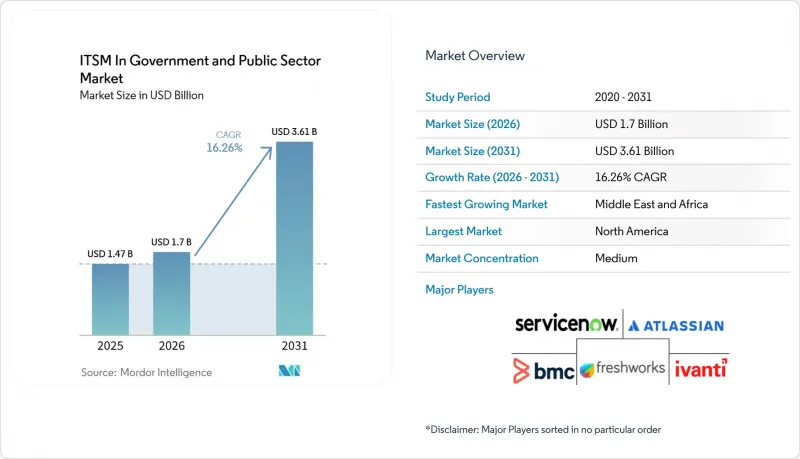
Mordor Intelligence에 의하면, 정부 및 공공 부문 ITSM 시장 규모는 2025년 14억 7,000만 달러에서 2026년에는 17억 달러로 확대되어 2031년까지 36억 1,000만 달러에 이를 것으로 예상되고 있어 2026년부터 2031년까지 CAGR 16.26%로 성장할 전망입니다.
본 보고서는 구성 요소(솔루션 및 서비스), 도입 형태(클라우드, On-Premise, 하이브리드), 용도(서비스 데스크 및 인시던트 관리, 자산 및 구성 관리 등), 기업 규모(대기업 및 중소기업(SME)), 지역별로 분류되어 있습니다. 시장 전망은 금액(달러) 기준으로 제시되어 있습니다.
정부 및 공공 부문 ITSM 시장 동향 및 인사이트
'클라우드 퍼스트'를 통한 공공 부문의 현대화
정부의 클라우드 도입은 정책적 선언에서 실질적인 조달 방침으로 전환되고 있으며, 서비스 관리 플랫폼이 일상적인 IT 운영 및 워크플로우 관리의 중심에 위치하고 있기 때문에 정부 및 공공 부문의 ITSM 시장은 조기에 혜택을 보고 있습니다. 셰어드 서비스 캐나다(Shared Services Canada)는 2025-26 회계연도 부문 계획에서 2026-27 회계연도까지 나머지 서비스 파트너의 엔터프라이즈 ITSM 도구 통합을 완료할 계획이라고 밝혔으며, 티켓 데이터의 자동 실시간 동기화가 서비스 제공의 핵심 이정표로 지정되었습니다. 이러한 프로그램은 ‘클라우드 우선’ 현대화가 더 이상 좁은 의미의 인프라 결정에 그치지 않음을 보여줍니다. 각 기관은 부서 간에 서비스 요청, 인시던트, 운영 보고서를 일원화하여 관리할 수 있는 단일 운영 계층을 원하고 있기 때문입니다. 독일도 2026년 5월, BMDS가 2억 5,000만 유로(2억 7,800만 달러) 상당의 ‘주권 AI 클라우드’ 계약을 체결했을 때, 연방 정부 내 활용을 위한 아키텍처에 제로 트러스트, 오픈소스, 키 주권 요건을 반영함으로써 유사한 방향성을 강화했습니다. 실질적인 영향으로, 규정 준수 위험과 현대화를 위한 투자 사이에서 직접적인 상충 관계에 직면함에 따라, 지원 대상에서 제외된 On-Premise 도구의 지속적 사용을 정당화하기가 점점 더 어려워지고 있습니다. 이러한 강제적인 교체 주기가야말로, 전반적인 예산 승인이 여전히 신중한 환경 속에서도 정부 및 공공 부문 시장에서 ITSM이 지속적으로 확대되고 있는 주된 이유입니다.
AI를 활용한 서비스 데스크 문의 이관 및 셀프 서비스 자동화
공공 부문의 티켓 처리량은 반복적이고 규칙에 기반하며, 기본적인 서비스 모델을 변경하지 않고도 의미 있는 자동화 효과를 얻을 수 있을 만큼 충분한 규모이기 때문에 AI는 정부 서비스 데스크에 빠르게 도입되고 있습니다. 아틀라시안(Atlassian)은 2025년에 93%의 조직이 AI를 통해 효율성 향상을 체감하고 있으며, 98%가 이미 어떤 형태로든 AI를 활용하고 있다고 보고했는데, 이는 서비스 워크플로우 및 지식 관리 분야에서 더 광범위한 도입 추세를 뒷받침합니다. ServiceNow의 공공 부문용 포트폴리오는 이미 디지털 서비스, 사례 관리, 워크플로우 자동화 및 안전한 서비스 제공을 중심으로 구성되어 있으며, 이를 통해 AI를 통한 문의 이관은 독립적인 프로그램이 아닌 기존 운영 모델의 직접적인 확장으로 이루어지고 있습니다. 2026년 2월, ServiceNow의 Moveworks는 FedRAMP Moderate 인증을 획득하여, 관리형 클라우드 환경에 있는 연방 정부 및 공공 부문 기관이 이용할 수 있는 안전한 대화형 AI 도구의 선택지가 확대되었습니다. 각 기관이 해결된 인시던트를 검색 가능한 지식, 안내형 응답, 재사용 가능한 워크플로로 전환함에 따라, 정부 및 공공 부문 ITSM 시장에서 전반에 걸친 셀프 서비스의 확대가 용이해집니다. 이것이 바로 많은 공공 환경에서 지식 기반 자동화가 단순한 실험적 시도에서 실용적인 운영 요건으로 전환되고 있는 이유입니다.
기존 조달 주기가 플랫폼 교체를 지연시키고 있습니다.
정부 조달 업무는 여전히 수년에 걸친 예산 승인 및 입찰 절차에 따라 진행되며, 이러한 일정이 현대화 방침이 이미 수립된 경우라 하더라도 실제 도입을 지연시키는 경우가 많습니다. GAO(미국 정부감사원)는 2025년 2월, 2019년에 확인된 주요 연방 레거시 시스템 10건 중 현대화가 완료된 것은 불과 3건이며, 나머지 7건 중 2건에 대해서는 여전히 완료 예정일이 설정되지 않았다고 보고했습니다. 이러한 격차는 정부 및 공공 부문 ITSM 시장에 중요한 의미를 지닙니다. 왜냐하면 가장 오래된 플랫폼을 사용하는 기관일수록 신속한 교체를 수행하지 못하는 경우가 많기 때문입니다. 많은 공공 프로그램에서 연간 예산 배정, 의무화된 경쟁 입찰, 그리고 신중한 변경 관리가 프로젝트 승인부터 실제 가동까지의 기간을 길게 만들고 있습니다. 자금이 승인된 경우에도 시스템 업데이트 주기는 공급업체의 출시 일정이나 AI 기능 개발에 뒤처지는 경우가 많으며, 이는 수요 수준 때문이 아니라 도입 속도를 둔화시키고 있습니다. 따라서 이러한 제약은 각 기관이 현대적인 ITSM을 원하느냐의 문제라기보다는 많은 기관이 정책 의도에서 실제 운영으로 전환하는 속도가 얼마나 느린지에 기인합니다.
부문 분석
2025년, 정부 및 공공 부문 ITSM 시장 점유율에서 솔루션이 64.40%를 차지했습니다. 이는 인시던트 관리, CMDB, 변경 오케스트레이션, 셀프 서비스를 단일 라이선싱 체계 하에 통합한 플랫폼에 대한 강한 선호도를 반영합니다. 이러한 선호로 인해 소프트웨어 매출은 집중된 상태를 유지하고 있습니다. 각 기관은 일반적으로 핵심 워크플로우부터 도입을 시작하고, 부서 전체에서 사용자 채택이 진행됨에 따라 인접한 모듈로 확장해 나가기 때문입니다. 많은 공공 기관에서 특히 보고, 승인, 감사 추적 및 서비스 정의의 일관성을 유지해야 하는 경우, 개별 도구를 조합한 것보다 단일 통합 플랫폼이 관리하기 더 쉽습니다. 솔루션 계층 또한 긴 구성 수명 주기의 이점을 누리고 있습니다. 이는 도입이 완료되면 프로세스 모델, 서비스 카탈로그, 자산 기록이 일상 업무에 깊이 통합되기 때문입니다. 이러한 통합된 역할이야말로, 예산이 신중하게 단계적으로 배분되는 경우에도 정부 및 공공 부문 ITSM 시장에서 플랫폼 주도형 구매 행태가 계속해서 선호되는 이유를 설명하는 요인 중 하나입니다.
서비스는 가장 빠르게 성장하는 구성 요소이며, 정부 및 공공 부문 ITSM 시장 서비스 시장 규모는 2026년부터 2031년까지 연평균 성장률(CAGR) 15.70%로 확대될 것으로 예측됩니다. 각 기관은 도입 계획, 인력 역량 강화, 거버넌스 철저 이행, 정기적인 최적화를 통해 뒷받침되지 않는다면 소프트웨어만으로는 성과를 낼 수 없습니다는 사실을 점점 더 인식하고 있습니다. AI 기능이 보급됨에 따라 서비스 업무의 중요성은 더욱 높아지고 있습니다. 이는 가동 개시 후에도 자동화 규칙, 데이터 품질 관리, 통합 로직, 지식 설계에 대한 적극적인 관리가 필요하기 때문입니다. 또한, 공공기관에서는 부서별로 프로세스의 편차가 나타나기 때문에 일회성 도입 작업이 아닌 지속적인 자문 및 관리형 지원에 대한 수요가 발생하고 있습니다. 이러한 이유로, 특히 정부 및 공공 부문의 ITSM 업계에서 시스템 통합사업자와 전문 파트너는 여전히 중요한 역할을 수행하고 있으며, 각 기관이 서비스 운영을 안정화하면서 현대화를 도모하는 데 있어 필수적인 존재가 되고 있습니다.
2025년 시점에서 클라우드는 정부 및 공공 부문 ITSM 시장의 63.10%를 차지하고 있으며, 클라우드 도입에 따른 해당 시장 규모는 2031년까지 연평균 성장률(CAGR) 16.10%로 확대될 것으로 예측됩니다. 이러한 이중적인 추세는 On-Premise에서 클라우드로의 전환이 이미 완료된 것이 아니라, 많은 기관에서 여전히 진행 중임을 보여줍니다. 정부 기관들은 대규모 로컬 스택을 유지하지 않으면서도 보다 신속한 업그레이드, 워크플로우의 간소화된 확장, AI 지원 기능에 대한 폭넓은 접근을 원하고 있기 때문에 ‘클라우드 퍼스트’ 조달 방침이 이 부문을 뒷받침하고 있습니다. 셰어드 서비스 캐나다(Shared Services Canada)의 엔터프라이즈 도입 계획 또한 공통 서비스 도구를 통해 보다 광범위한 관리적 협업과 더욱 통합된 티켓 데이터 흐름을 지원할 수 있는 모델을 시사하고 있습니다. BMDS의 주권 클라우드 계약 수주는 관리 및 주권 관련 요건이 직접적으로 충족되는 경우, 행정 부문의 클라우드 도입이 현재 미션 크리티컬 워크로드까지 확대되고 있음을 더욱 잘 보여줍니다.
On-Premise 및 하이브리드 배포는 공유 SaaS 모델이 정책 요건을 충족하지 못하는 기밀 처리, 국방 관련 또는 주권상 민감한 환경에서 여전히 가치를 지닙니다. 이는 배포 결정이 더 이상 단순한 ‘클라우드 대 On-Premise’의 이분법적 선택이 아님을 의미합니다. 각 기관은 기밀성, 관리, 감사 요구 사항에 따라 서로 다른 워크로드를 서로 다른 환경에 배치하는 경우가 많기 때문입니다. 많은 입찰에서 기능의 차이보다 인증 여부가 더 중요하게 여겨집니다. 각 기관은 워크플로우의 깊이나 인터페이스 설계를 비교하기 전에, 인증된 운영 조건을 필요로 하기 때문입니다. 따라서 클라우드의 유연성과 안전한 분리를 동시에 제공할 수 있는 벤더는 더 광범위한 공공 부문 이용 사례에서 수주에 유리한 입장에 있습니다. 정부 및 공공 부문의 ITSM 시장에서는 앞으로도 클라우드 성장이 가속화될 전망이지만, 성공적인 모델은 순수하게 기능 주도형이라기보다는 규정 준수 주도형으로 계속될 것입니다.
지역별 분석
2025년, 북미는 정부 및 공공 부문 ITSM 시장 점유율의 40.20%를 차지했습니다. 이는 연방 정부의 대규모 현대화 예산, 다수의 인증 벤더 존재, 그리고 각 기관 수요를 통합할 수 있는 조달 체제에 힘입은 결과입니다. 미국이 이러한 주도적 지위를 유지하고 있는 주된 이유는 인증된 클라우드 환경과 임무별 규정 준수 기준 덕분에 다른 많은 지역에 비해 기업 조달 체제가 더욱 체계화되어 있기 때문입니다. GSA(미국 연방조달청)는 2025년 9월, ServiceNow와의 ‘OneGov’ 계약을 통해 이러한 입지를 강화했으며, 2028년 9월까지 대상 연방 정부 고객에게 ITSM Pro 및 Pro Plus 번들을 최대 70% 할인된 가격으로 제공합니다. 캐나다 역시 협력적인 서비스 및 도구 도입 프로그램을 추진하고 있으며, Shared Services Canada는 2026-27 회계연도까지 나머지 파트너 기관을 자사의 엔터프라이즈 ITSM 도구로 통합하는 것을 목표로 하고 있습니다. 이러한 움직임에 더해 예산 규모, 조달에 대한 영향력, 규정 준수 대응을 위한 도입 옵션이 결합되면서 북미는 정부 및 공공 부문 ITSM 시장의 최전선에 계속해서 서 있습니다.
유럽은 정부 및 공공 부문 ITSM 시장에서 여전히 주요 지역 블록이며, 그 성장은 단일한 공통 패턴이라기보다는 각국의 주권 관련 규정, 조달 아키텍처, 그리고 퍼블릭 클라우드 설계상의 선택에 의해 형성되고 있습니다. 독일은 그 가장 명확한 사례 중 하나이며, 이 나라에서는 주권형 클라우드의 개발이 연방 정부의 디지털 현대화 및 키, 인프라, 플랫폼 설계에 대한 공공 통제와 직접적으로 연계되어 있습니다. IT-Planungsrat(IT 계획 위원회)가 수립한 ‘Deutsche Verwaltungscloud(독일 행정 클라우드)’의 목표 아키텍처 역시 보다 광범위한 국가 클라우드 프레임워크 내에 서비스 관리 기능을 통합하고 있으며, 이를 통해 아키텍처 수준에서의 표준화가 공식적으로 확립되었습니다. 즉, 유럽 수요는 견조하지만, 각 기관이 제품의 폭이나 인터페이스 품질을 평가하기 전에 플랫폼 선택은 데이터 소재지, 규정 준수 및 공공 관리 요건을 통해 선별되는 경우가 많아지고 있습니다. 따라서 이 지역은 정부 및 공공 부문 ITSM 시장에서 여전히 중요하지만, 단순한 속도뿐만 아니라 현대화와 주권을 양립시킬 수 있는 벤더가 높이 평가되는 추세입니다.
중동 및 아프리카는 가장 빠르게 성장하는 지역이며, 이 지역의 정부 및 공공 부문 ITSM 시장 규모는 2026년부터 2031년까지 연평균 성장률(CAGR) 16.05%로 확대될 것으로 예측됩니다. 『European Scientific Journal』에 게재된 조사에 따르면, ITSM 성숙도가 높은 사우디아라비아 정부 기관에서는 시스템 가동 시간과 시민 만족도가 현저히 향상되어, 이 지역에 대한 지속적인 투자를 뒷받침하는 명확한 운영상의 근거가 되고 있습니다. 에티오피아에서는 2026년 6월, 아프리카 최초의 통합 디지털 서비스 용도인 MESOB가 출시되어, 여러 정부 기관의 서비스를 단일 플랫폼으로 통합함으로써 가시적인 공공 참고 사례가 추가되었습니다. 아시아태평양은 정부 및 공공 부문의 ITSM 시장에서 두 번째로 성장하는 영역이며, 정부의 클라우드 프로그램과 중국의 ‘제15차 5개년 계획’이 요구하는 행정 계층을 초월한 통합형이자 AI를 활용한 디지털 거버넌스 요건에 힘입고 있습니다. 중국이 부서 간 데이터 공유와 통합된 디지털 플랫폼을 중시하고 있다는 점은 다른 지역에서 현대화를 추진하는 것과 동일한 서비스 관리 논리를 뒷받침하고 있습니다. 두 지역 모두에서 정부는 통합된 디지털 서비스 계층을 구축하고 있으며, 이로 인해 구조화된 서비스 관리가 일상적인 공공 업무에서 더욱 중요한 역할을 수행하게 되었습니다. 이러한 공통된 방향성 덕분에, 조달 성숙도에는 국가별로 여전히 큰 차이가 있지만, 정부 및 공공 부문의 ITSM 시장은 계속해서 호조를 유지할 것으로 보입니다.
기타 혜택:
- 엑셀 형식 시장 예측(ME) 시트
- 3개월간의 애널리스트 지원
자주 묻는 질문
목차
제1장 서론
제2장 조사 방법
제3장 주요 요약
제4장 시장 구도
제5장 시장 규모와 성장 예측
제6장 경쟁 구도
제7장 시장 기회와 향후 전망
JHS 26.08.05According to Mordor Intelligence, the ITSM in government and public sector market size is expected to increase from USD 1.47 billion in 2025 to USD 1.7 billion in 2026 and reach USD 3.61 billion by 2031, growing at a CAGR of 16.26% over 2026-2031.
This report is Segmented by Component (Solutions and Services), Deployment (Cloud, On-Premise, and Hybrid), Application (Service Desk and Incident Management, Asset and Configuration Management, and More), Enterprise Size (Large Enterprises and Small and Mid-Size Enterprises (SME)), and Geography. The Market Forecasts are Provided in Terms of Value (USD).
Global ITSM In Government and Public Sector Market Trends and Insights
Cloud-First Public Sector Modernization
Government cloud adoption has shifted from policy language to practical procurement direction, and the ITSM in the government and public sector market benefits early because service management platforms sit at the center of daily IT operations and workflow control. Shared Services Canada stated in its 2025-26 Departmental Plan that it plans to complete onboarding of remaining service partners to its enterprise ITSM tool by 2026-27, with automated real-time synchronization of ticketing data identified as a core delivery milestone. That kind of program shows that cloud-first modernization is no longer a narrow infrastructure decision, because agencies want one operating layer for service requests, incidents, and operational reporting across departments. Germany reinforced the same direction in May 2026 when the BMDS awarded a sovereign AI cloud contract worth EUR 250 million (USD 278 million), with zero-trust, open-source, and key-sovereignty requirements built into the architecture for federal use. The practical effect is that unsupported on-premise tools are becoming harder to justify, because agencies face a direct tradeoff between compliance exposure and modernization spending. This forced replacement cycle is a major reason the ITSM in government and public sector market continues to expand even in environments where overall budget approval remains cautious.
AI-Powered Service Desk Deflection and Self-Service Automation
AI is moving quickly into government service desks because public-sector ticket volumes are repetitive, rules-based, and large enough to support meaningful automation gains without changing the basic service model. Atlassian reported in 2025 that 93% of organizations saw higher efficiency from AI, and 98% were already using AI in some capacity, which supports broader adoption patterns around service workflows and knowledge handling. ServiceNow's public-sector portfolio is already structured around digital services, case management, workflow automation, and secure service delivery, which makes AI deflection a direct extension of the existing operating model rather than a separate program. In February 2026, Moveworks from ServiceNow achieved FedRAMP Moderate authorization, widening the pool of secure conversational AI tools available to federal and public-sector organizations in controlled cloud environments. As agencies turn resolved incidents into searchable knowledge, guided responses, and reusable workflows, self-service becomes easier to scale across the ITSM in the government and public sector market. This is why knowledge-based automation is moving from optional experimentation to a practical operating requirement in many public environments.
Legacy Procurement Cycles Slow Platform Replacement
Government procurement still runs on multiyear budget approvals and tender processes, and that timing often slows real deployment even when modernization policy is already in place. GAO reported in February 2025 that only 3 of 10 critical federal legacy systems identified in 2019 had been modernized, while 2 of the remaining 7 still had no planned completion date. This gap matters for the ITSM in the government and public sector market because the agencies with the oldest platforms are often the ones least able to execute a fast replacement. Annual appropriations, mandatory competition, and cautious change control extend the period between project approval and operational go-live in many public programs. Even when funding is approved, replacement cycles frequently lag vendor release schedules and AI feature development, which weakens the pace of implementation rather than the level of demand. The restraint is therefore less about whether agencies want modern ITSM, and more about how slowly many of them can move from policy intent to production use.
Other drivers and restraints analyzed in the detailed report include:
- Cybersecurity and Compliance Pressure on Service Operations
- Shared Services and Cross-Agency Workflow Standardization
- Data Residency and Sovereignty Constraints Limit Cloud Adoption
For complete list of drivers and restraints, kindly check the Table Of Contents.
Segment Analysis
Solutions held 64.40% of the ITSM in the government and public sector market share in 2025, reflecting the strong preference for one platform that combines incident management, CMDB, change orchestration, and self-service under a single licensing framework. That preference keeps software revenue concentrated because agencies usually begin with core workflows and then expand into adjacent modules as user adoption grows across departments. In many public organizations, a single integrated platform is easier to govern than a collection of separate tools, especially when reporting, approvals, audit trails, and service definitions need to stay consistent. The solutions layer also benefits from long configuration life cycles, since process models, service catalogs, and asset records become deeply embedded in day-to-day operations once implementation is complete. This embedded role helps explain why the ITSM in the government and public sector market continues to favor platform-led buying behavior even when budgets are carefully staged.
Services are the fastest-growing component, with the ITSM in the government and public sector market size for services projected to expand at a 15.70% CAGR between 2026 and 2031. Agencies increasingly recognize that software alone does not deliver outcomes unless it is supported by implementation planning, workforce enablement, governance discipline, and regular optimization. As AI functions become more common, services work becomes even more important because automation rules, data quality controls, integration logic, and knowledge design need active management after go-live. Public bodies also face process variation across departments, which creates a continuing need for advisory and managed support rather than a one-time deployment exercise. This is why system integrators and specialist partners remain important to the ITSM in government and public sector industry, especially where agencies need to stabilize service operations while modernizing them.
Cloud held 63.10% of the ITSM in the government and public sector market in 2025, and the ITSM in the government and public sector market size for cloud deployment is projected to expand at a 16.10% CAGR through 2031. This dual position shows that the move from on-premise to cloud is still active across many agencies rather than already complete. Cloud-first procurement policies are helping the segment because governments want faster upgrades, simpler workflow scaling, and broader access to AI-enabled features without maintaining large local stacks. Shared Services Canada's enterprise onboarding plan also points to a model in which common service tooling can support wider administrative coordination and more unified ticket data flows. The BMDS sovereign cloud award further shows that cloud adoption in public administration now reaches mission-critical workloads when control and sovereignty requirements are addressed directly.
On-premise and hybrid deployments still hold value in classified, defense-linked, or sovereignty-sensitive environments where shared SaaS models do not meet policy requirements. This means deployment is no longer a simple cloud-versus-on-premise decision, because agencies often place different workloads in different environments according to sensitivity, control, and audit needs. In many tenders, authorization status matters more than feature differences, since agencies need certified operating conditions before they compare workflow depth or interface design. Vendors that can offer cloud flexibility together with secure isolation are therefore better positioned to win across a wider range of public use cases. The ITSM in government and public sector market is likely to keep favoring cloud growth, but the winning model will remain compliance-shaped rather than purely feature-led.
Complete Report Scope:
- By Component
- Solutions
- Services
- By Deployment
- Cloud
- On-premise
- Hybrid
- By Application
- Service Desk and Incident Management
- Asset and Configuration Management
- Change and Release Management
- Service Request Management
- Knowledge Management
- Other Applications
- By Enterprise Size
- Large Enterprises
- Small and Mid-size Enterprises (SME)
- By Geography
- North America
- United States
- Canada
- Mexico
- South America
- Brazil
- Argentina
- Rest of South America
- Europe
- Germany
- United Kingdom
- France
- Russia
- Spain
- Rest of Europe
- Asia-Pacific
- China
- Japan
- India
- South Korea
- Southeast Asia
- Rest of Asia-Pacific
- Middle East and Africa
- Middle East
- Saudi Arabia
- United Arab Emirates
- Turkey
- Rest of Middle East
- Africa
- South Africa
- Nigeria
- Egypt
- Rest of Africa
- Middle East
- North America
Geography Analysis
North America held 40.20% of the ITSM in the government and public sector market share in 2025, supported by large federal modernization budgets, a dense pool of authorized vendors, and procurement structures that can aggregate demand across agencies. The United States remains central to this lead because certified cloud environments and mission-specific compliance standards make enterprise procurement more structured than in many other regions. The GSA strengthened that position in September 2025 through its OneGov agreement with ServiceNow, offering eligible federal customers discounts of up to 70% on ITSM Pro and Pro Plus bundles through September 2028. Canada is also moving through a coordinated service tooling program, with Shared Services Canada working to complete onboarding of remaining partner agencies to its enterprise ITSM tool by 2026-27. Together, these moves keep North America at the front of the ITSM in the government and public sector market by combining budget scale, procurement leverage, and compliance-ready deployment options.
Europe remains a major regional block in the ITSM in government and public sector market, with growth shaped less by one common pattern and more by national sovereignty rules, procurement architecture, and public cloud design choices. Germany is one of the clearest examples, where sovereign cloud development has been tied directly to federal digital modernization and public control of keys, infrastructure, and platform design. The IT-Planungsrat's Deutsche Verwaltungscloud target architecture also embeds service management functions within a broader national cloud framework, which helps formalize standardization at the architecture level. This means European demand is positive, but platform choice is often filtered through residency, compliance, and public-control requirements before agencies assess product breadth or interface quality. The region therefore remains important to the ITSM in government and public sector market, but it rewards vendors that can align modernization with sovereignty rather than speed alone.
The Middle East and Africa is the fastest-growing geography, with the ITSM in government and public sector market size for the region projected to expand at a 16.05% CAGR from 2026 to 2031. Research published in the European Scientific Journal found that Saudi government agencies with stronger ITSM maturity showed materially better system uptime and citizen satisfaction, giving the region a clear operational case for continued investment. Ethiopia added a visible public reference point in June 2026 when MESOB was launched as Africa's first unified digital service application, bringing services from multiple government institutions onto one platform. Asia-Pacific is a secondary growth area in the ITSM in government and public sector market, supported by government cloud programs and by China's 15th Five-Year Plan requirement for integrated, AI-enabled digital governance across administrative layers. China's emphasis on cross-departmental data sharing and unified digital platforms supports the same service-management logic that is shaping modernization elsewhere. Across both regions, governments are building unified digital service layers that make structured service management more relevant to daily public operations. That common direction should keep the ITSM in government and public sector market on a positive path even though procurement maturity still differs widely by country.
- ServiceNow, Inc.
- BMC Software, Inc.
- Atlassian Corporation Plc
- Ivanti, Inc.
- Freshworks Inc.
- Open Text Corporation
- ManageEngine
- IBM Corporation
- Broadcom Inc.
- SolarWinds Corporation
- TOPdesk Nederland B.V.
- SysAid Technologies Ltd.
- EasyVista, Inc.
- Matrix42 AG
- TeamDynamix
- Halo Service Solutions
- Hornbill
- SAP
- Unisys
Additional Benefits:
- The market estimate (ME) sheet in Excel format
- 3 months of analyst support
TABLE OF CONTENTS
1 INTRODUCTION
- 1.1 Study Assumptions and Market Definition
- 1.2 Scope of the Study
2 RESEARCH METHODOLOGY
3 EXECUTIVE SUMMARY
4 MARKET LANDSCAPE
- 4.1 Market Overview
- 4.2 Market Drivers
- 4.2.1 Cloud-First Public Sector Modernization
- 4.2.2 Cybersecurity and Compliance Pressure on Service Operations
- 4.2.3 Shared Services and Cross-Agency Workflow Standardization
- 4.2.4 Zero-Touch Request Fulfillment for Citizen-Facing and Employee-Facing Services
- 4.2.5 Lifecycle Management of Public Sector Hardware and Software Assets
- 4.2.6 AI-Powered Service Desk Deflection and Self-Service Automation
- 4.3 Market Restraints
- 4.3.1 Legacy Procurement Cycles Slow Platform Replacement
- 4.3.2 Data Residency and Sovereignty Constraints Limit Cloud Adoption
- 4.3.3 Fragmented Agency Operating Models Reduce Process Standardization
- 4.3.4 Skills Gaps in ITSM Automation and CMDB Governance
- 4.4 Industry Value Chain Analysis
- 4.5 Regulatory Landscape
- 4.6 Technological Outlook
- 4.7 Porter's Five Forces Analysis
- 4.7.1 Bargaining Power of Suppliers
- 4.7.2 Bargaining Power of Buyers
- 4.7.3 Threat of New Entrants
- 4.7.4 Threat of Substitutes
- 4.7.5 Intensity of Competitive Rivalry
- 4.8 Impact of Macroeconomic Factors on the Market
5 MARKET SIZE AND GROWTH FORECASTS (VALUE)
- 5.1 By Component
- 5.1.1 Solutions
- 5.1.2 Services
- 5.2 By Deployment
- 5.2.1 Cloud
- 5.2.2 On-premise
- 5.2.3 Hybrid
- 5.3 By Application
- 5.3.1 Service Desk and Incident Management
- 5.3.2 Asset and Configuration Management
- 5.3.3 Change and Release Management
- 5.3.4 Service Request Management
- 5.3.5 Knowledge Management
- 5.3.6 Other Applications
- 5.4 By Enterprise Size
- 5.4.1 Large Enterprises
- 5.4.2 Small and Mid-size Enterprises (SME)
- 5.5 By Geography
- 5.5.1 North America
- 5.5.1.1 United States
- 5.5.1.2 Canada
- 5.5.1.3 Mexico
- 5.5.2 South America
- 5.5.2.1 Brazil
- 5.5.2.2 Argentina
- 5.5.2.3 Rest of South America
- 5.5.3 Europe
- 5.5.3.1 Germany
- 5.5.3.2 United Kingdom
- 5.5.3.3 France
- 5.5.3.4 Russia
- 5.5.3.5 Spain
- 5.5.3.6 Rest of Europe
- 5.5.4 Asia-Pacific
- 5.5.4.1 China
- 5.5.4.2 Japan
- 5.5.4.3 India
- 5.5.4.4 South Korea
- 5.5.4.5 Southeast Asia
- 5.5.4.6 Rest of Asia-Pacific
- 5.5.5 Middle East and Africa
- 5.5.5.1 Middle East
- 5.5.5.1.1 Saudi Arabia
- 5.5.5.1.2 United Arab Emirates
- 5.5.5.1.3 Turkey
- 5.5.5.1.4 Rest of Middle East
- 5.5.5.2 Africa
- 5.5.5.2.1 South Africa
- 5.5.5.2.2 Nigeria
- 5.5.5.2.3 Egypt
- 5.5.5.2.4 Rest of Africa
- 5.5.5.1 Middle East
- 5.5.1 North America
6 COMPETITIVE LANDSCAPE
- 6.1 Market Concentration
- 6.2 Strategic Moves
- 6.3 Market Share Analysis
- 6.4 Company Profiles (includes Global Level Overview, Market Level Overview, Core Segments, Financials as available, Strategic Information, Market Rank/Share, Products and Services, Recent Developments)
- 6.4.1 ServiceNow, Inc.
- 6.4.2 BMC Software, Inc.
- 6.4.3 Atlassian Corporation Plc
- 6.4.4 Ivanti, Inc.
- 6.4.5 Freshworks Inc.
- 6.4.6 Open Text Corporation
- 6.4.7 ManageEngine
- 6.4.8 IBM Corporation
- 6.4.9 Broadcom Inc.
- 6.4.10 SolarWinds Corporation
- 6.4.11 TOPdesk Nederland B.V.
- 6.4.12 SysAid Technologies Ltd.
- 6.4.13 EasyVista, Inc.
- 6.4.14 Matrix42 AG
- 6.4.15 TeamDynamix
- 6.4.16 Halo Service Solutions
- 6.4.17 Hornbill
- 6.4.18 SAP
- 6.4.19 Unisys
7 MARKET OPPORTUNITIES AND FUTURE OUTLOOK
- 7.1 White-Space and Unmet-Need Assessment


