

|
시장보고서
상품코드
2118892
컨텐츠 전략 서비스 시장 : 시장 점유율 분석, 업계 동향 및 통계, 성장 예측(2026-2031년)Content Strategy Services - Market Share Analysis, Industry Trends & Statistics, Growth Forecasts (2026 - 2031) |
||||||
 Mordor Intelligence
Mordor Intelligence에 의하면, 컨텐츠 전략 서비스 시장 규모는 2025년 106억 3,000만 달러로 평가되었고, 2026년 118억 5,000만 달러에서 2031년까지 208억 3,000만 달러로 확대될 것으로 예측되며, 2026-2031년 연평균 성장률(CAGR)은 11.94%를 나타낼 전망입니다.
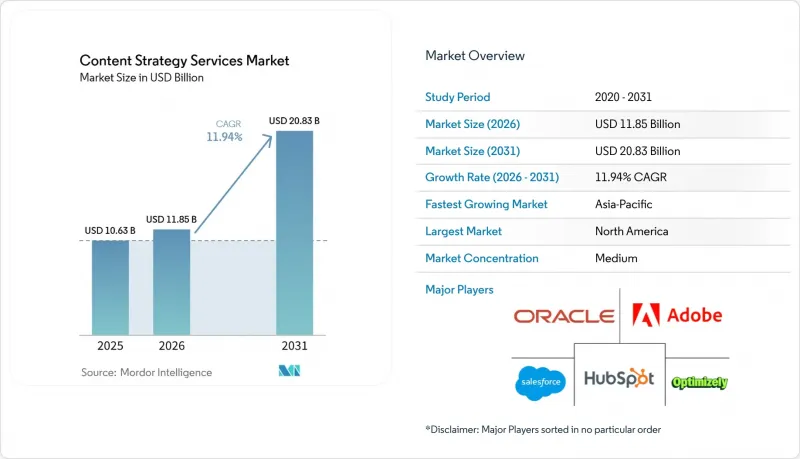
본 보고서는 구성 요소별(플랫폼 및 소프트웨어 등), 도입 모델별(클라우드, 온프레미스, 하이브리드), 조직 규모별(대기업 등), 용도별(컨텐츠 기획 및 편집 워크플로우, 대상 고객 조사 및 세분화 등), 산업 분야별(소매 및 전자상거래 등), 그리고 지역별로 분류되어 있습니다. 시장 전망은 금액(달러) 기준으로 제시되어 있습니다.
세계의 컨텐츠 전략 서비스 시장 동향 및 인사이트
개인화된 옴니채널 컨텐츠에 대한 수요 증가
기업들은 이전보다 더 많은 채널에 도달할 수 있게 되었지만, 많은 기업에서 각 채널별로 대상 고객에 특화된 컨텐츠를 필요한 속도로 충분히 제작하지 못하고 있습니다. 세일즈포스의 보고서에 따르면, 2025년에는 마케팅 조직의 75%가 컨텐츠 개인화에 적어도 하나의 AI 기술을 활용하고 있었습니다. 5개 이상의 채널에 걸쳐 개인화된 메시지를 조정하는 능력은 여전히 제한적이며, 서비스 제공업체에는 운영상의 격차가 남아 있습니다. 컨텐츠 마케팅 인스티튜트(Content Marketing Institute)의 조사에 따르면, B2B 구매 담당자는 영업 부서에 연락하기 전에 평균 13.4건의 컨텐츠를 열람하는 것으로 나타났습니다. 이러한 요구 사항은 컨텐츠 전략 서비스 시장에서 제작, 배포 및 성과 워크플로우를 연계해야 할 필요성을 뒷받침하고 있습니다. 채널별 맞춤형 컨텐츠를 유지하지 못하는 브랜드는 잠재 고객이 공급업체와 직접 대화를 시작하기도 전에 존재감을 잃을 가능성이 있습니다. 요구되는 것은 단순히 컨텐츠의 양을 늘리는 것이 아닙니다. 모순된 메시지를 생성하지 않으면서, 승인된 정보를 각 대상 고객 및 채널에 맞게 조정하는 재현 가능한 방법입니다. 이러한 요구 사항으로 인해 컨텐츠 기획, 워크플로우 설계 및 성과 데이터 공유의 중요성이 높아지고 있습니다. 또한, 캠페인의 속도와 브랜드 일관성을 동시에 달성할 수 있는 제공업체에게는 새로운 기회도 생겨나고 있습니다.
컨텐츠 계획 및 최적화를 위한 생성형 AI
세일즈포스의 보고서에 따르면, 2026년에는 마케팅 분야에서 기업의 생성형 AI 도입률이 94%에 달했습니다. 그러나 컨텐츠 프로세스에 검토나 거버넌스 관리가 부족할 경우, 널리 활용된다고 해서 더 나은 성과가 보장되는 것은 아닙니다. 어도비는 2026년 4월, AI를 활용한 컨텐츠 생성 과정에서 승인 이력과 피드백을 활용하는 ‘Brand Intelligence’를 도입했습니다. 이러한 접근 방식은 공급업체들이 생성 도구 외에도 거버넌스 기능을 추가하고 있는 이유를 보여줍니다. 거버넌스가 적용되지 않은 자료는 규제가 엄격한 업계에서 브랜드 리스크를 유발할 수 있으며, 경쟁이 치열한 분야에서는 컨텐츠의 독창성을 훼손할 우려가 있습니다. EU AI법 제50조에 규정된 투명성 관련 의무는 2026년 8월 2일에 발효되므로, 유럽에서는 규정 준수를 충족하는 AI 컨텐츠 프로세스의 필요성이 높아지고 있습니다.
도입 및 워크플로우 재설계에 소요되는 막대한 비용
기업의 도입 비용에는 라이선스 비용 외에도 워크플로우 재설계, 변경 관리, 통합 작업 및 직원 교육이 포함됩니다. 이러한 활동은 플랫폼에 대한 직접 투자액을 초과할 가능성이 있으며, 가시적인 운영상의 이점을 실현하는 데 지장을 줄 우려가 있습니다. LeanData의 보고서에 따르면, 시장 출시를 담당하는 리더의 51%가 통합의 복잡성과 워크플로우 혁신을 기술 성숙도의 주요 제약 요인으로 꼽았습니다. 전담 컨텐츠 운영 팀이 없는 조직의 경우, 편집 프로세스 변경 기간 동안 12-18개월에 걸쳐 생산성 저하를 겪을 가능성이 있습니다. 이러한 부담은 중견/중소기업에 더 크게 작용하지만, 이들 기업은 컨텐츠 전략 서비스 시장의 성장 분야이기도 합니다. 벤더는 소프트웨어에 도입 지원을 포함하거나 검증된 워크플로우 템플릿을 제공함으로써 이러한 마찰을 완화할 수 있습니다. 단계적인 도입을 통해 조직은 비즈니스 요구가 가장 명확한 프로세스부터 우선적으로 처리한 후, 더 많은 팀으로 확대해 나갈 수 있습니다. 또한, 도입 과정에서 컨텐츠 담당자의 역할이나 검토 흐름이 변경되는 경우가 많기 때문에 교육과 사내 추진 담당자 확보도 중요합니다. 이러한 실무상의 과제가 새로운 시스템이 일상 업무에 정착할지 여부를 좌우합니다. 전문 인력이 제한적인 구매자에게는 특히 중요한 포인트가 됩니다.
부문 분석
2025년, 플랫폼 및 소프트웨어는 컨텐츠 전략 서비스 시장의 57.62%를 차지했습니다. 이 점유율은 채널 전반에 걸친 컨텐츠 제작, 거버넌스, 배포, 측정을 관리하는 데 있어 기술이 수행하는 역할을 반영한 것입니다. 플랫폼은 승인된 컨텐츠를 대량으로 관리하는 팀에게 기록 관리 시스템으로서의 역할을 수행할 수 있습니다. 또한, 많은 그룹이 컨텐츠 프로그램에 기여하는 데 필요한 공유 워크플로우도 제공합니다. 서비스 부문은 2031년까지 연평균 성장률(CAGR) 12.54%를 기록할 전망이며, 구성 요소 중 가장 빠른 성장을 보일 것으로 예측됩니다. 이는 구현, 거버넌스, 지속적인 최적화 없이는 소프트웨어 기능만으로는 성과를 창출할 수 없음을 보여줍니다. Bloomreach는 2026년 6월 ‘Loomi 마케팅 에이전트’를 일반에 공개하여, 단일 브리프를 개인화된 캠페인 워크플로로 변환할 수 있게 했습니다.
이번 출시는 벤더들이 기존 서비스 업무에 가까운 기능을 어떻게 추가하고 있는지를 보여줍니다. 이러한 도구는 수작업의 부담을 줄일 수는 있지만, 컨텐츠 규칙 설정이나 성과 분석이 더 이상 필요 없어지는 것은 아닙니다. 조직은 플랫폼을 자사의 운영 모델에 연동하기 위한 지원을 여전히 필요로 합니다. 플랫폼만 계약할 경우, 측정이나 거버넌스에 미비한 점이 발생할 가능성이 있습니다. 따라서 컨텐츠 전략 서비스 시장에서는 구성 요소의 조합을 통해 지속적인 소프트웨어 지출과 전문 서비스 수요 모두가 뒷받침되고 있습니다. 서비스 팀은 광범위한 플랫폼 기능을 고객의 우선순위에 맞춘 편집 규칙,측정 계획, 운영 루틴으로 전환할 수 있습니다. 또한, 도입을 단일한 완료된 프로젝트로 취급하는 것이 아니라, 도입 후 발생하는 프로세스상의 미비점을 해결하는 것도 가능합니다. 이러한 지속적인 지원은 AI 도구에 의해 새로운 검토, 교육, 거버넌스 요구 사항이 발생할 때 특히 중요합니다.
2025년 기준, 컨텐츠 전략 서비스 시장 규모의 61.72%를 클라우드 도입이 차지했습니다. 또한 2031년까지 연평균 12.63%라는 가장 높은 성장률로 확대될 것으로 예측됩니다. 이러한 조합은 레거시 컨텐츠 시스템에서의 전환이 여전히 완료되지 않았음을 시사합니다. 클라우드 네이티브 시스템은 모놀리식 환경에서는 실행하기 어려운 지속적 배포, 분산형 협업 및 AI 기능을 지원합니다. 이러한 기능은 최신 데이터나 지역을 초월한 공유 액세스가 필요한 팀에게 중요합니다. 따라서 클라우드 도입은 플랫폼 선정에 있어 여전히 핵심 요소로 남아 있습니다. 데이터 주권에 관한 엄격한 요건이 있는 업계에서는 온프레미스 도입이 계속되고 있습니다. 유럽의 금융 서비스 및 공공기관은 개인정보 보호 및 데이터 거주 요건을 충족하기 위해 기밀성이 높은 자산을 관리된 환경 하에 보관할 수 있습니다.
하이브리드 배포를 통해 기밀성이 높은 컨텐츠를 내부 관리 하에 두면서, 분석 및 AI 처리에는 클라우드 서비스를 활용할 수 있습니다. EU의 AI법 및 GDPR(EU 개인정보보호규정)로 인해 유럽 구매자들에게 있어 명확한 데이터 관리의 중요성이 더욱 커지고 있습니다. 구매자는 컨텐츠, 시청자 데이터, AI 출력이 어디에 저장·처리되는지 평가해야 합니다. 이러한 제약으로 인해 컨텐츠 전략 서비스 시장에서 하이브리드 구성의 역할은 계속해서 유지될 것입니다. 하이브리드 모델을 채택하면 모든 정보를 기존 관리 체계 밖으로 옮기지 않고도 팀이 클라우드 기반의 오케스트레이션을 활용할 수 있게 됩니다. 또한, 조직이 레거시 시스템을 일괄적으로 교체할 수 없는 경우, 단계적인 현대화를 지원할 수도 있습니다. 이는 컨텐츠 기능을 향상시키면서 동시에 사업 연속성을 유지해야 하는 구매자에게 중요한 사항입니다. 따라서 도입 방식의 선택은 기술적 선호도뿐만 아니라 프로세스, 거버넌스 및 데이터 요구 사항에도 크게 좌우됩니다. 명확한 통합 및 보안 옵션을 제공하는 공급자는 이러한 요구 사항을 보다 적절하게 충족시킬 수 있습니다.
지역별 분석
2025년, 북미는 컨텐츠 전략 서비스 시장 점유율의 37.62%를 차지했습니다. 이 지역에는 엔터프라이즈 기술을 도입한 기업, 플랫폼 벤더, 그리고 성숙한 컨텐츠 운영 팀이 집중되어 있습니다. HubSpot의 보고서에 따르면, 2026년 4월 해당 기업의 고객사 유기적 트래픽은 전년 대비 27% 감소한 반면, AI를 통한 추천 트래픽은 3배 증가했습니다. 이러한 변화로 인해 답변 엔진 최적화 및 생성형 엔진 최적화에 대한 관심이 높아지고 있습니다. CCPA 시행과 제3자 추적 감소에 따라 퍼스트파티 데이터 거버넌스의 중요성이 커지고 있습니다. 멕시코는 디지털 커머스의 성장과 국경을 초월한 현지화 수요 증가에 따라 수요가 확대되고 있는 지역입니다. 이 지역에서 사업을 전개하는 기업은 각 시장에 맞추어 언어, 제품 정보, 캠페인 자산을 조정해야 할 수도 있습니다. 이로 인해 재사용 가능한 컨텐츠 구성 요소와 중앙 집중식으로 관리되는 브랜드 표준의 가치가 높아집니다. 북미의 구매자들도 AI 기반 검색의 중요성이 높아지고 있는 점에 반응하고 있으며, 구조화된 정보와 보다 명확한 성과 데이터가 중시되고 있습니다. 따라서 이 지역의 비즈니스 기회는 성숙한 기업 변혁과 현지화된 중견 시장에서의 도입을 모두 포함합니다. 이 두 가지 패턴이 광범위한 컨텐츠 운영 역량에 대한 수요를 뒷받침하고 있습니다.
아시아태평양은 2031년까지 연평균 성장률(CAGR) 13.54%를 나타낼 것으로 예측됩니다. 이러한 성장은 크리에이터 커머스, 모바일 우선 소비, 그리고 확대되는 디지털 소매에 의해 뒷받침되고 있습니다. 이 지역에는 짧은 동영상, 라이브 스트리밍, 소셜 쇼핑을 단일 플랫폼 환경에서 결합한 컨텐츠 커머스 모델이 존재합니다. 따라서 지역에 최적화된 ‘모바일 퍼스트’ 컨텐츠 운영은 해당 지역의 컨텐츠 전략 서비스 시장 전체에서 큰 수요를 형성하고 있습니다. 컨텐츠 팀은 언어, 플랫폼, 구매 행동, 크리에이터의 포맷 차이에 따라 컨텐츠를 조정해야 합니다. 데스크톱 중심의 유럽 및 미국 채널 구성을 위해 설계된 프로그램은 이러한 시장에 그대로 적용하기 어려울 수 있습니다. 따라서 제공업체는 재사용 가능한 중앙 기준과 지역별 전개 시의 유연성을 결합해야 합니다. 가장 큰 비즈니스 기회는 브랜드 및 성과에 대한 관리 능력을 저해하지 않으면서 조직이 이러한 차이점을 조정할 수 있도록 지원하는 데 있습니다. 이것이 해당 지역이 다른 지역 부문보다 더 높은 성장을 보일 것으로 예상되는 이유 중 하나입니다. 또한, 해당 지역의 성장은 제공업체가 모든 시장에 동일한 제작 프로세스를 강요하지 않으면서 현지 팀을 지원할 수 있는지에 달려 있습니다.
일관된 메타데이터, 승인 규칙, 측정 기준을 확립함으로써 시장별 실행을 가능하게 하면서도 공통된 관리 체제를 유지할 수 있습니다. 이는 컨텐츠가 커머스 및 소셜 플랫폼 간에 빠르게 이동하는 크리에이터 주도형 환경에서 특히 중요합니다. 팀이 이러한 운영 규칙을 구축하도록 지원하는 서비스는 이 지역의 구매자 기반이 확대됨에 따라 소프트웨어 도입을 촉진할 것입니다. 컨텐츠 전략 서비스 시장에서 유럽은 2위의 점유율을 차지하고 있습니다. GDPR(EU 개인정보보호규정) 및 EU AI법은 AI 도입을 지연시키는 한편, 거버넌스가 잘 갖춰진 컨텐츠 플랫폼에 대한 수요를 높일 가능성이 있습니다. EU AI법 제50조에 규정된 투명성 확보 의무는 2026년 8월 2일에 발효되었습니다. 이는 금융 서비스, 의료, 행정 분야의 조달 활동을 촉진할 것입니다. 브라질과 아르헨티나를 필두로 한 남미는 수요가 아직 초기 단계에 있는 지역입니다. 사우디아라비아의 ‘비전 2030’ 프로그램에 부합하는 중동 시장과 아프리카의 기업용 디지털 인프라 구축도 주로 소매, 금융 서비스, 정부 기관의 디지털화 분야에서 조기 도입이 진행되고 있습니다.
기타 혜택 :
- 엑셀 형식 시장 예측(ME) 시트
- 3개월간의 애널리스트 지원
자주 묻는 질문
목차
제1장 서론
제2장 조사 방법
제3장 개요
제4장 시장 구도
제5장 시장 규모 및 성장 예측
제6장 경쟁 구도
제7장 시장 기회 및 향후 전망
AJY 26.09.01According to Mordor Intelligence, the content strategy services market size is projected to expand from USD 10.63 billion in 2025 and USD 11.85 billion in 2026 to USD 20.83 billion by 2031, registering a CAGR of 11.94% between 2026 and 2031.
This report is Segmented by Component (Platforms and Software, and More), Deployment Model (Cloud, On-Premises, and Hybrid), Organization Size (Large Enterprises, and More), Application (Content Planning and Editorial Workflow, Audience Research and Segmentation, and More), Industry Verticals (Retail and E-Commerce, and More), and Geography. The Market Forecasts are Provided in Terms of Value (USD).
Global Content Strategy Services Market Trends and Insights
Rising Demand for Personalized Omnichannel Content
Organizations can reach more channels than before, but many cannot produce enough audience-specific material for each channel at the needed pace. Salesforce reported that 75% of marketing organizations used at least 1 form of AI for content personalization in 2025. Coordinating personalized messages across 5 or more channels remains a limited capability, leaving service providers with an operational gap. The Content Marketing Institute found that the average B2B buyer consumed 13.4 pieces of content before contacting sales. That requirement supports demand for connected production, distribution, and performance workflows in the content strategy services market. Brands that cannot maintain channel-specific content may lose visibility before a prospect begins a direct vendor conversation. The requirement is not simply more material. It is a repeatable method for adapting approved information to each audience and channel without creating conflicting messages. That requirement raises the importance of content planning, workflow design, and shared performance data. It also creates opportunities for providers that can coordinate campaign speed with brand consistency.
Generative AI for Content Planning and Optimization
Salesforce reported that enterprise generative AI adoption in marketing reached 94% in 2026. Broad use does not guarantee better outcomes when content processes lack review and governance controls. Adobe introduced Brand Intelligence in April 2026 to use approval history and feedback within AI-assisted content generation. This approach shows why vendors are adding governance functions alongside generation tools. Ungoverned material can create brand risk in regulated sectors and can make content less distinct in crowded categories. The EU AI Act's Article 50 transparency obligations take effect on August 2, 2026, which increases the need for compliant AI content processes in Europe.
High Implementation and Workflow Redesign Costs
Enterprise deployment costs include workflow redesign, change management, integration work, and employee training in addition to licensing. These activities can exceed the direct platform investment and can delay visible operating gains. LeanData reported that 51% of go-to-market leaders identified integration complexity and workflow transformation as primary limits on technology maturity. Organizations without a dedicated content operations team can face a 12-18-month productivity trough during changes to editorial processes. This burden is heavier for mid-market and smaller organizations, even though they are a growth area for the content strategy services market. Vendors can reduce friction by bundling implementation support with software and offering tested workflow templates. A phased implementation can help an organization prioritize the processes with the clearest business need before expanding to more teams. Training and internal sponsorship also matter because content roles and review paths often change during deployment. These practical issues can determine whether a new system becomes part of daily work. They are especially important for buyers with limited specialist resources.
Other drivers and restraints analyzed in the detailed report include:
- Need for Measurable Content ROI and Attribution
- Expansion of Structured and Modular Content Operations
- Integration Complexity Across Fragmented Martech Stacks
For complete list of drivers and restraints, kindly check the Table Of Contents.
Segment Analysis
Platforms and software held 57.62% of the content strategy services market in 2025. Their position reflected the role of technology in controlling creation, governance, distribution, and measurement across channels. A platform can act as the system of record for teams that manage large volumes of approved material. It also provides the shared workflows needed when many groups contribute to a content program. Services are projected to record the fastest component growth at a 12.54% CAGR through 2031. This shows that software capability alone does not produce results without implementation, governance, and continuous optimization. Bloomreach made Loomi marketing agent generally available in June 2026, enabling a single brief to be turned into a personalized campaign workflow.
The release illustrates how vendors are adding functions that sit close to traditional service work. These tools can reduce manual effort, but they do not remove the need to set content rules or interpret performance. Organizations still need support to connect a platform to their operating model. Platform-only engagements can leave gaps in measurement and governance. The component mix therefore supports both recurring software spending and specialist service demand in the content strategy services market. Service teams can translate broad platform functions into editorial rules, measurement plans, and operating routines that fit a buyer's priorities. They can also resolve process gaps that emerge after implementation, rather than treating deployment as a single completed project. This continued support is particularly relevant where AI tools create new review, training, and governance requirements.
Cloud deployment accounted for 61.72% of the content strategy services market size in 2025. It is also projected to grow at the highest rate of 12.63% through 2031. This combination indicates that migration from legacy content systems remains incomplete. Cloud-native systems support continuous delivery, distributed collaboration, and AI functions that are harder to run in monolithic environments. These capabilities are important for teams that require current data and shared access across regions. Cloud adoption, therefore, remains central to platform decisions. On-premises deployments continue in sectors that have strict data sovereignty requirements. European financial services and public organizations can keep sensitive assets in controlled environments to meet privacy and data-residency requirements.
Hybrid deployment can keep sensitive content under internal control while using cloud services for analytics and AI processing. The EU AI Act and GDPR strengthen the importance of clear data controls for European buyers. Buyers must assess where content, audience data, and AI outputs are stored and processed. These constraints preserve a role for hybrid configurations in the content strategy services market. A hybrid model can give teams access to cloud-based orchestration without requiring all information to move outside established controls. It can also support phased modernization when organizations cannot replace legacy systems at once. This is relevant to buyers that must maintain business continuity while improving content capabilities. Deployment selection consequently depends on process, governance, and data requirements as much as on technical preference. Providers that offer clear integration and security options can better address these requirements.
Complete Report Scope:
- By Component
- Platforms and Software
- Services
- By Deployment Model
- Cloud
- On-Premises
- Hybrid
- By Organization Size
- Large Enterprises
- Small and Medium-Sized Enterprises
- By Application
- Content Planning and Editorial Workflow
- Audience Research and Segmentation
- Messaging and Brand Governance
- Omnichannel Distribution and Activation
- Personalization and Performance Optimization
- By Industry Verticals
- Retail and E-commerce
- Media and Entertainment
- Healthcare and Life Sciences
- Travel and Hospitality
- Consumer Goods
- Other Industry Verticals
- By Geography
- North America
- United States
- Canada
- Mexico
- South America
- Brazil
- Argentina
- Rest of South America
- Europe
- Germany
- United Kingdom
- France
- Italy
- Spain
- Russia
- Rest of Europe
- Asia-Pacific
- China
- Japan
- India
- South Korea
- Australia and New Zealand
- Rest of Asia-Pacific
- Middle East
- Saudi Arabia
- United Arab Emirates
- Turkey
- Rest of Middle East
- Africa
- South Africa
- Nigeria
- Egypt
- Rest of Africa
- North America
Geography Analysis
North America held 37.62% of the content strategy services market share in 2025. The region has a high concentration of enterprise technology adopters, platform vendors, and mature content operations teams. HubSpot reported that its customers saw a 27% year-over-year decline in organic traffic while AI referral traffic tripled in April 2026. This change is shifting attention toward answer engine optimization and generative engine optimization. First-party data governance is important because of CCPA enforcement and the decline of third-party tracking. Mexico is an emerging demand area as digital commerce grows and cross-border localization needs increase. Organizations serving the region may need to adapt language, product information, and campaign assets for each market. This raises the value of reusable content components and centrally managed brand standards. North American buyers are also responding to the growing importance of AI discovery, which favors structured information and clearer performance data. The regional opportunity, therefore, includes both mature enterprise transformation and localized mid-market adoption. These two patterns sustain demand for a range of content operating capabilities.
Asia-Pacific is projected to grow at a 13.54% CAGR through 2031. Its development is supported by creator commerce, mobile-first consumption, and expanding digital retail. The region has content-commerce models that combine short video, live streaming, and social shopping in single-platform environments. Localized, mobile-first content operations are therefore a major need across the content strategy services market in the region. Content teams must adapt material for different languages, platforms, shopping behaviors, and creator formats. A program designed for a desktop-led Western channel mix may not transfer directly to these markets. Providers must therefore combine reusable central standards with flexibility for local activation. The strongest opportunity lies in helping organizations coordinate these differences without losing control over brand and performance. This helps explain why the region is forecast to outpace other geographic segments. Regional growth also depends on whether providers can support local teams without forcing every market into the same production process.
Consistent metadata, approval rules, and measurement definitions can provide shared control while allowing market-specific execution. This is particularly relevant in creator-led environments where content moves rapidly across commerce and social platforms. Services that help teams build those operating rules can support software adoption as the regional buyer base develops. Europe held the second-largest position in the content strategy services market. GDPR and the EU AI Act can slow AI deployment, while also increasing demand for governed content platforms. The EU AI Act's Article 50 transparency obligations took effect on August 2, 2026. This supports procurement in financial services, healthcare, and public administration. South America, led by Brazil and Argentina, is an earlier-stage demand area. Middle East markets aligned with Saudi Arabia's Vision 2030 program and Africa's developing enterprise digital infrastructure also show early adoption, primarily in retail, financial services, and government digitization.
- Adobe Inc.
- HubSpot, Inc.
- Optimizely, Inc.
- Salesforce, Inc.
- Oracle Corporation
- Acquia, Inc.
- Sitecore Corporation A/S
- Contentful GmbH
- Bloomreach, Inc.
- Progress Software Corporation
- Sprinklr, Inc.
- Acrolinx GmbH
- Aprimo US LLC
- Contently, Inc.
- CoSchedule LLC
- Automattic Inc.
- Open Text Corporation
- Papirfly AS
Additional Benefits:
- The market estimate (ME) sheet in Excel format
- 3 months of analyst support
TABLE OF CONTENTS
1 INTRODUCTION
- 1.1 Study Assumptions and Market Definition
- 1.2 Scope of the Study
2 RESEARCH METHODOLOGY
3 EXECUTIVE SUMMARY
4 MARKET LANDSCAPE
- 4.1 Market Overview
- 4.2 Market Drivers
- 4.2.1 Rising Demand for Personalized Omnichannel Content
- 4.2.2 Generative AI for Content Planning and Optimization
- 4.2.3 Need for Measurable Content ROI and Attribution
- 4.2.4 Expansion of Structured and Modular Content Operations
- 4.2.5 Answer Engine Optimization and LLM Citation Readiness
- 4.2.6 First-Party Data-Led Audience Research Workflows
- 4.3 Market Restraints
- 4.3.1 High Implementation and Workflow Redesign Costs
- 4.3.2 Integration Complexity Across Fragmented Martech Stacks
- 4.3.3 AI Search Measurement Gaps and Attribution Blind Spots
- 4.3.4 Brand-Liability Risks from Ungoverned AI Content
- 4.4 Industry Value Chain Analysis
- 4.5 Impact of Macroeconomic Factors on the Market
- 4.6 Regulatory Landscape
- 4.7 Technological Outlook
- 4.8 Porter's Five Forces Analysis
- 4.8.1 Threat of New Entrants
- 4.8.2 Bargaining Power of Suppliers
- 4.8.3 Bargaining Power of Buyers
- 4.8.4 Threat of Substitutes
- 4.8.5 Competitive Rivalry
5 MARKET SIZE AND GROWTH FORECASTS (VALUE)
- 5.1 By Component
- 5.1.1 Platforms and Software
- 5.1.2 Services
- 5.2 By Deployment Model
- 5.2.1 Cloud
- 5.2.2 On-Premises
- 5.2.3 Hybrid
- 5.3 By Organization Size
- 5.3.1 Large Enterprises
- 5.3.2 Small and Medium-Sized Enterprises
- 5.4 By Application
- 5.4.1 Content Planning and Editorial Workflow
- 5.4.2 Audience Research and Segmentation
- 5.4.3 Messaging and Brand Governance
- 5.4.4 Omnichannel Distribution and Activation
- 5.4.5 Personalization and Performance Optimization
- 5.5 By Industry Verticals
- 5.5.1 Retail and E-commerce
- 5.5.2 Media and Entertainment
- 5.5.3 Healthcare and Life Sciences
- 5.5.4 Travel and Hospitality
- 5.5.5 Consumer Goods
- 5.5.6 Other Industry Verticals
- 5.6 By Geography
- 5.6.1 North America
- 5.6.1.1 United States
- 5.6.1.2 Canada
- 5.6.1.3 Mexico
- 5.6.2 South America
- 5.6.2.1 Brazil
- 5.6.2.2 Argentina
- 5.6.2.3 Rest of South America
- 5.6.3 Europe
- 5.6.3.1 Germany
- 5.6.3.2 United Kingdom
- 5.6.3.3 France
- 5.6.3.4 Italy
- 5.6.3.5 Spain
- 5.6.3.6 Russia
- 5.6.3.7 Rest of Europe
- 5.6.4 Asia-Pacific
- 5.6.4.1 China
- 5.6.4.2 Japan
- 5.6.4.3 India
- 5.6.4.4 South Korea
- 5.6.4.5 Australia and New Zealand
- 5.6.4.6 Rest of Asia-Pacific
- 5.6.5 Middle East
- 5.6.5.1 Saudi Arabia
- 5.6.5.2 United Arab Emirates
- 5.6.5.3 Turkey
- 5.6.5.4 Rest of Middle East
- 5.6.6 Africa
- 5.6.6.1 South Africa
- 5.6.6.2 Nigeria
- 5.6.6.3 Egypt
- 5.6.6.4 Rest of Africa
- 5.6.1 North America
6 COMPETITIVE LANDSCAPE
- 6.1 Market Concentration
- 6.2 Strategic Moves
- 6.3 Market Share Analysis
- 6.4 Company Profiles (includes Global Level Overview, Market Level Overview, Core Segments, Financials as available, Strategic Information, Market Rank/Share, Products and Services, Recent Developments)
- 6.4.1 Adobe Inc.
- 6.4.2 HubSpot, Inc.
- 6.4.3 Optimizely, Inc.
- 6.4.4 Salesforce, Inc.
- 6.4.5 Oracle Corporation
- 6.4.6 Acquia, Inc.
- 6.4.7 Sitecore Corporation A/S
- 6.4.8 Contentful GmbH
- 6.4.9 Bloomreach, Inc.
- 6.4.10 Progress Software Corporation
- 6.4.11 Sprinklr, Inc.
- 6.4.12 Acrolinx GmbH
- 6.4.13 Aprimo US LLC
- 6.4.14 Contently, Inc.
- 6.4.15 CoSchedule LLC
- 6.4.16 Automattic Inc.
- 6.4.17 Open Text Corporation
- 6.4.18 Papirfly AS
7 MARKET OPPORTUNITIES AND FUTURE OUTLOOK
- 7.1 White-Space and Unmet-Need Assessment


