|
시장보고서
상품코드
2099158
의료 자동화 시장 : 점유율 분석, 업계 동향 및 통계, 성장 예측(2026-2031년)Medical Automation - Market Share Analysis, Industry Trends & Statistics, Growth Forecasts (2026 - 2031) |
||||||
 Mordor Intelligence
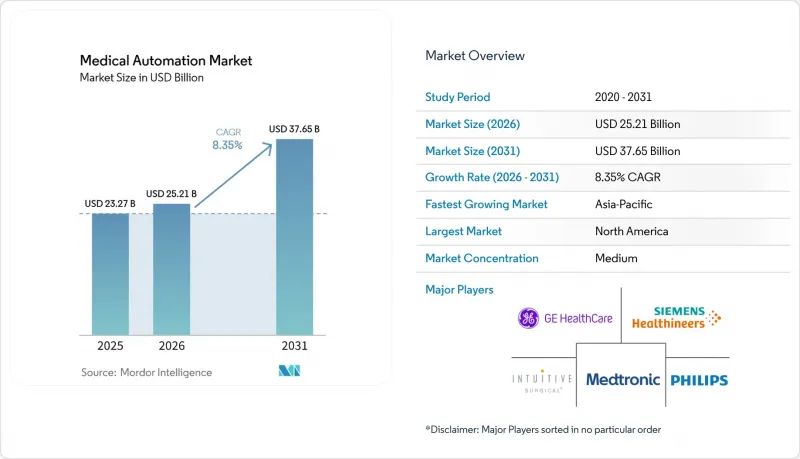
Mordor Intelligence에 의하면, 의료 자동화 시장 규모는 2025년 232억 7,000만 달러에서 2026년에는 252억 1,000만 달러로 확대되어 2031년까지 376억 5,000만 달러에 이를 것으로 예상되고 있어 2026년부터 2031년까지 CAGR 8.35%로 성장할 전망입니다.
본 보고서는 구성 요소(하드웨어, 소프트웨어, 서비스), 용도 유형별(영상 진단 자동화, 치료 자동화, 검사·조제 자동화), 최종 용도(병원 및 진단센터, 연구소, 약국), 지역별(북미, 유럽, 아시아태평양, 중동 및 아프리카, 남미)로 분류되어 있습니다. 시장 전망은 금액(달러) 기준으로 제시되어 있습니다.
세계 의료 자동화 시장 동향 및 인사이트
임상 업무의 인력 부족
인력 부족은 의료 자동화 시장의 구조적 수요 기반이 되고 있으며, 특히 이용 가능한 임상의가 감소하는 가운데 안정적인 의료 제공이 필요한 병원에서 두드러집니다. 현재 의료 시스템에서는 자동화 시스템 도입을 단순한 효율화를 위한 선택적 프로젝트가 아닌, 인력 부족 위험에 대한 방어책으로 인식하고 있습니다. 미국에서는 향후 10년 동안 의사 및 간호사 인력 부족이 지속될 것으로 예측되고 있으며, 이에 따라 자동화는 경영진의 우선 과제로 자리 잡고 있습니다. 이러한 변화로 인해 예산에 관한 논의 방식도 바뀌고 있으며, 자동화는 회복탄력성 및 서비스 연속성에 대한 요구와 함께 검토되는 사례가 늘고 있습니다. 자사의 플랫폼을 단순한 생산성 향상 수단이 아닌, 인력 배치를 지원하는 도구로 포지셔닝하는 벤더는 의료 자동화 시장에서 생산성 향상만을 내세우는 벤더보다 더 높은 지지를 얻고 있습니다.
영상 진단, 검사, 수술에 걸친 AI를 활용한 워크플로우 오케스트레이션
AI를 통한 오케스트레이션으로 인해 의료 자동화 시장은 단일 기능의 도구에서 여러 임상 워크플로우를 통합적으로 관리하는 시스템으로 전환되고 있습니다. 각 벤더는 이러한 변화를 활용하여 장비 판매에만 의존하지 않고, 소프트웨어, 분석 및 엔터프라이즈 워크플로우 관리를 통해 지속적인 수익을 창출하고자 하고 있습니다. 로슈(Roche)는 자사의 ‘navify’ 디지털 생태계가 2025년까지 1,500건 이상의 임상 도입을 달성했다고 발표했으며, 한편 GE 헬스케어의 ‘Edison AI Orchestrator’는 방사선과 워크플로우 전반에 걸쳐 AI 용도를 통합하도록 설계되었습니다. 2026년 『Nature』지에 게재된 논문에서는 FHIR 표준을 통해 EHR 환경과 연동하여 일정 관리, 진단, 기록 작성을 조정할 수 있는 자율형 의료 AI 에이전트에 대해 설명하고 있습니다. 영상 진단, 임상 검사, 외과 각 분야에서 이미 사업을 전개하고 있는 벤더들은 통합의 폭이 넓어질수록 오케스트레이션의 가치가 높아지기 때문에 의료 자동화 시장에서 이러한 수요를 확보하는 데 유리한 입장에 있습니다.
통합형 자동화 제품군의 높은 자본 집약도
높은 자본 집약도는 의료 자동화 시장에서 가장 명백한 단기적 제약 요인으로 남아 있으며, 특히 지역 병원, 지방 병원, 중규모 병원에서 두드러집니다. 미국병원협회(AHA) 보고서에 따르면, 2024년 병원 경비는 5.1% 증가한 반면, 일반 인플레이션율은 2.9%에 그쳤습니다. 또한, 병원 시설 인프라의 평균 사용 연한이 지난 2년 동안 10% 이상 증가했다는 점도 지적되고 있습니다. 이러한 압박은 임상적 필요성이 명백하더라도 대규모 자동화 도입의 여지를 좁히고 있습니다. 또한 소규모 의료 기관의 경우, 완전한 통합 솔루션 도입 대신 단계적 도입, 도입 범위 축소, 혹은 결정 연기를 불가피하게 만드는 요인이 되고 있습니다. 각 벤더사는 구독형 또는 관리형 서비스 모델로 대응하고 있지만, 의료 자동화 시장에서는 여전히 엄격한 조달 규정과 자금 조달의 어려움 속에서 의사결정 주기가 둔화되고 있다는 과제에 직면해 있습니다.
부문 분석
2025년, 의료 자동화 시장에서 하드웨어의 점유율은 52.31%를 차지했습니다. 이는 다양한 의료 현장에 도입된 로봇 수술 시스템, 자동 조제 캐비닛 및 고처리량 검사 장비의 높은 가치를 반영한 것입니다. 인튜이티브 서지컬(Intuitive Surgical)은 2025년에 1,721대의 '다빈치(da Vinci)' 시스템을 도입하여, 연말 기준 도입 대수는 1만 1,100대를 넘어섰습니다. 이는 의료 자동화 시장에서 하드웨어가 여전히 수익 규모를 좌우하고 있음을 보여줍니다. 이러한 도입은 향후 소프트웨어, 유지보수 및 분석 관련 수익을 뒷받침할 기반을 구축하는 것입니다. 의료 서비스 제공업체들은 여러 거점으로 구성된 네트워크 전반에 걸친 자동화를 관리할 수 있는 상호 운용 가능한 제어 계층을 원하고 있으므로, 소프트웨어의 중요성은 여전히 높습니다.
서비스 부문은 의료 자동화 시장에서 가장 빠르게 성장하는 분야로, 2026년부터 2031년까지 연평균 성장률(CAGR) 10.38%로 성장을 지속하고, 있으며, 도입 후 수익이 가장 빠르게 확대되고 있는 분야임을 알 수 있습니다. 매니지드 서비스, 원격 모니터링, AI 분석, 플랫폼 구독이 성장하고 있는 이유는 벤더들이 이러한 서비스를 이미 도입된 하드웨어 기반에 연계하여 제공하고 있기 때문입니다. 이 모델은 공급업체의 고객 유지율과 이익률을 향상시키는 동시에, 의료 기관에 초기 도입 후 기능 확장을 위한 수단을 제공합니다. 의료 시스템이 하드웨어 계층을 넘어선 지원을 요구하는 가운데, 이를 통해 서비스는 의료 자동화 업계에서 미래 가치 창출의 중심적인 역할을 계속해서 수행하고 있습니다.
지역별 분석
2025년, 북미는 의료 자동화 시장 점유율의 42.62%를 차지했으며, 병원의 설비 투자 능력, 확립된 보험 급여 제도, 그리고 풍부한 도입 실적을 바탕으로 계속해서 최대 지역 기여자로서의 지위를 유지했습니다. 미국은 여전히 이 지역의 주요 견인차 역할을 하고 있습니다. 이는 소규모 병원이 보다 선택적인 태도를 유지하는 반면, 대규모 의료 시스템이 로봇 수술, 영상 진단 자동화 및 약국 자동화에 대한 자금 지원을 지속하고 있기 때문입니다. 연결된 기기에는 품질, 소프트웨어 및 수명 주기에 관한 보다 엄격한 문서화가 요구됨에 따라, FDA의 사이버 보안 지침 및 QMSR이 조달에 그 어느 때보다 직접적인 영향을 미치고 있습니다. 유럽은 여전히 선진적이지만 지역 간 격차가 있는 지역이며, 서유럽은 남유럽이나 동유럽에 비해 도입 환경이 잘 갖춰져 있습니다. BD의 2026년 4월 ‘Pyxis Pro’ 출시, 2026년 3월 BD와 Sinteco의 제휴, 2026년 3월 스트라스부르에서 열린 IMARA 이니셔티브, 그리고 아일랜드 전역에서의 ‘CareFlow Pharmacy’ 도입은 모두 약제, 물류, 수술실 자동화가 유럽 전역에서 계속해서 기관들의 지지를 얻고 있음을 보여줍니다.
아시아태평양은 의료 자동화 시장에서 가장 빠르게 성장하고 있는 지역으로, 2026년부터 2031년까지 연평균 성장률(CAGR) 11.15%를 기록할 전망입니다. 이 지역은 신규 병원 건설에 대한 투자, 정부 주도의 현대화 프로그램, 그리고 국내 의료 기술 역량 확대의 혜택을 받고 있습니다. 2025년에는 스마트 병원 투자, AI를 활용한 진단 이니셔티브, 현지 로봇 제조에 힘입어 중국이 이 지역 내에서 가장 큰 점유율을 차지했습니다. 한편, 인도는 이 지역 내에서 가장 빠르게 성장하는 국가 시장입니다. 이러한 상황에 따라 도입 범위는 수입된 수술 시스템에 그치지 않고, 현대화가 진행 중인 병원 네트워크 전반에 걸친 광범위한 자동화 솔루션으로 확대되고 있습니다. 일본은 검사실 및 약국 자동화 분야에서 성숙한 고부가가치 시장으로 자리매김하고 있으며, 다른 지역에서 새로운 시스템이 확대되는 가운데 지역 수요에 안정성을 제공합니다.
중동 및 아프리카은 의료 자동화 시장에서 여전히 초기 단계에 있지만, GCC 국가들은 병원 자동화 투자를 보다 광범위한 의료 시스템 혁신 노력과 적극적으로 연계하고 있습니다. 사우디아라비아와 UAE가 이 지역의 노력을 주도하고 있는 반면, 남아프리카공화국은 사하라 이남 아프리카의 검사 및 영상 진단 자동화 수요에서 여전히 중요한 거점 역할을 하고 있습니다. 남미에서는 브라질이 주도하고 있으며, 아르헨티나가 그 뒤를 잇고 있습니다. 아르헨티나에서는 통화 및 보험 환급에 대한 압박이 있음에도 불구하고, 고급 사립 병원 네트워크가 로봇 수술 및 검사실 자동화를 경쟁 우위로 활용하고 있습니다. 이러한 지역들은 현재 규모는 작지만, 인프라와 자금 조달 환경이 개선됨에 따라 의료 자동화 시장의 장기적인 잠재 고객 기반을 확대해 나갈 것입니다.
기타 혜택:
- 엑셀 형식 시장 예측(ME) 시트
- 3개월간의 애널리스트 지원
자주 묻는 질문
목차
제1장 서론
제2장 조사 방법
제3장 주요 요약
제4장 시장 구도
제5장 시장 규모와 성장 예측
제6장 경쟁 구도
제7장 시장 기회와 향후 전망
JHS 26.08.07According to Mordor Intelligence, the medical automation market size is expected to increase from USD 23.27 billion in 2025 to USD 25.21 billion in 2026 and reach USD 37.65 billion by 2031, growing at a CAGR of 8.35% over 2026-2031.
This report is Segmented by Component (Hardware, Software, Services), Application Type (Imaging Automation, Therapeutic Automation, Laboratory and Pharmacy Automation), End Use (Hospitals and Diagnostic Centers, Research Laboratories, Pharmacies), and Geography (North America, Europe, Asia-Pacific, Middle East and Africa, South America). The Market Forecasts are Provided in Terms of Value (USD).
Global Medical Automation Market Trends and Insights
Workforce Shortages in Clinical Operations
Workforce shortages have become a structural demand base for the medical automation market, especially where hospitals need stable care delivery with fewer available clinicians. Health systems are now treating automation purchases as protection against staffing risk rather than as optional efficiency projects. In the United States, workforce projections continue to point to physician and nursing shortfalls through the next decade, which keeps automation high on executive agendas. That shift changes the budget conversation because automation is increasingly reviewed alongside resilience and service continuity needs. Vendors that present their platforms as staffing support tools are gaining better traction in the medical automation market than vendors that position them only as productivity upgrades.
AI-Enabled Workflow Orchestration Across Imaging, Lab, and Surgery
AI orchestration is moving the medical automation market beyond single-use tools and toward systems that manage multiple clinical workflows together. Vendors are using this shift to build recurring revenue through software, analytics, and enterprise workflow management rather than relying only on device sales. Roche stated that its navify digital ecosystem exceeded 1,500 clinical placements by 2025, while GE HealthCare's Edison AI Orchestrator is designed to unify AI applications across radiology workflows. A 2026 Nature paper described autonomous medical AI agents that can interface with EHR environments through FHIR standards to coordinate scheduling, diagnostics, and documentation. Vendors already present across imaging, laboratory, and surgical settings are better placed to capture this demand in the medical automation market because orchestration value rises with integration breadth.
High Capital Intensity for Integrated Automation Suites
High capital intensity remains the clearest near-term limit on the medical automation market, especially for community, rural, and mid-tier hospitals. The American Hospital Association reported that hospital expenses rose 5.1% in 2024 while general inflation was 2.9%, and it also noted that the average age of hospital plant infrastructure increased more than 10% over the prior 2 years. That pressure reduces the room for large automation purchases even when clinical need is clear. It also pushes smaller providers toward phased deployments, narrower scopes, or deferred decisions instead of full integrated suites. Vendors are responding with subscription and managed service models, but the medical automation market still faces slower decision cycles where procurement rules are strict and capital availability is weak.
Other drivers and restraints analyzed in the detailed report include:
- Expansion of Surgical and Laboratory Automation
- Rising Error Sensitivity in Medication and Procedure Workflows
- Interoperability Friction With Legacy Hospital Systems
For complete list of drivers and restraints, kindly check the Table Of Contents.
Segment Analysis
Hardware held 52.31% of the medical automation market share in 2025, reflecting the high value of robotic surgical systems, automated dispensing cabinets, and high-throughput laboratory instruments being installed across care settings. Intuitive Surgical placed 1,721 da Vinci systems in 2025, and its installed base exceeded 11,100 systems by year-end, which shows how hardware continues to define revenue scale in the medical automation market. These placements build the installed foundation that supports later software, maintenance, and analytics revenue. Software remains important because providers want interoperable control layers that can manage automation across multi-site networks.
Services is the fastest-growing component of the medical automation market at a CAGR of 10.38% through 2026 to 2031, showing where post-deployment revenue is expanding fastest. Managed services, remote monitoring, AI analytics, and platform subscriptions are growing because vendors are attaching these offerings to installed hardware bases. This model improves retention and margin quality for suppliers while giving providers a way to expand functionality after initial deployment. That keeps services central to future value capture in the medical automation industry as health systems look for support beyond the hardware layer.
Complete Report Scope:
- By Component
- Hardware
- Software
- Services
- By Application Type
- Imaging Automation
- Therapeutic Automation
- Laboratory and Pharmacy Automation
- Other Application Types
- By End Use
- Hospitals and Diagnostic Centers
- Research Laboratories and Institutes
- Pharmacies
- Other End Uses
- By Geography
- North America
- United States
- Canada
- Mexico
- Europe
- Germany
- United Kingdom
- France
- Italy
- Spain
- Rest of Europe
- Asia-Pacific
- China
- Japan
- India
- Australia
- South Korea
- Rest of Asia-Pacific
- Middle East and Africa
- GCC
- South Africa
- Rest of Middle East and Africa
- South America
- Brazil
- Argentina
- Rest of South America
- North America
Geography Analysis
North America held 42.62% of the medical automation market share in 2025, which kept it as the largest regional contributor on the strength of hospital capital capacity, established reimbursement, and a deep installed base. The United States remains the main regional driver because large health systems continue to fund robotic surgery, imaging automation, and pharmacy automation even as smaller hospitals stay more selective. FDA cybersecurity guidance and the QMSR now shape procurement more directly because connected devices need stronger quality, software, and lifecycle documentation. Europe remains an advanced but uneven region, with Western Europe showing stronger adoption conditions than Southern and Eastern Europe. BD's April 2026 Pyxis Pro launch, the March 2026 BD and Sinteco partnership, the March 2026 IMARA initiative in Strasbourg, and Ireland's national CareFlow Pharmacy rollout all show that medication, logistics, and operating room automation continue to gain institutional backing across Europe.
Asia-Pacific is the fastest-growing regional slice of the medical automation market, with a CAGR of 11.15% through 2026 to 2031. The region benefits from greenfield hospital investment, state-backed modernization programs, and expanding domestic medical technology capabilities. China held the largest regional share in 2025, supported by smart hospital spending, AI-enabled diagnostics initiatives, and local robotics manufacturing, while India is the fastest-growing country market within the region. Those conditions are widening adoption beyond imported surgical systems and toward broader automation stacks across modernizing hospital networks. Japan remains a mature high-value market for laboratory and pharmacy automation, which adds stability to regional demand while newer systems scale elsewhere.
The Middle East and Africa remains earlier stage in the medical automation market, but GCC countries are actively linking hospital automation spending to wider health system transformation agendas. Saudi Arabia and the UAE are leading that regional activity, while South Africa remains a key anchor in sub-Saharan demand for laboratory and imaging automation. South America is led by Brazil and followed by Argentina, where premium private hospital networks are using robotic surgery and laboratory automation as competitive tools despite currency and reimbursement pressure. These regions are smaller today, but they extend the long-run addressable base of the medical automation market as infrastructure and capital access improve.
- Accuray
- Baxter
- Beckton Dickinson
- Boston Scientific
- Danaher
- GE HealthCare Technologies Inc.
- Intuitive Surgical, Inc.
- Johnson & Johnson
- Koninklijke Philips
- Medtronic
- Olympus
- Omnicell
- Oracle Health
- Roche
- Siemens Healthineers
- Stryker
- Swisslog Healthcare
- Tecan Group
- Terumo
Additional Benefits:
- The market estimate (ME) sheet in Excel format
- 3 months of analyst support
TABLE OF CONTENTS
1 Introduction
- 1.1 Study Assumptions & Market Definition
- 1.2 Scope of the Study
2 Research Methodology
3 Executive Summary
4 Market Landscape
- 4.1 Market Overview
- 4.2 Market Drivers
- 4.2.1 Workforce Shortages in Clinical Operations
- 4.2.2 Rising Error Sensitivity in Medication and Procedure Workflows
- 4.2.3 AI-Enabled Workflow Orchestration Across Imaging, Lab, and Surgery
- 4.2.4 Unplanned Automation Retrofit Demand in Aging Hospital Infrastructure
- 4.2.5 Expansion of Surgical and Laboratory Automation
- 4.2.6 Cost Pressure on Healthcare Providers
- 4.3 Market Restraints
- 4.3.1 High Capital Intensity for Integrated Automation Suites
- 4.3.2 Interoperability Friction With Legacy Hospital Systems
- 4.3.3 Clinical Validation and Medico-Legal Approval Lag
- 4.3.4 Data Privacy, Cybersecurity, and Liability Concerns
- 4.4 Value Chain Analysis
- 4.5 Regulatory Landscape
- 4.6 Technological Outlook
- 4.7 Porter's Five Forces Analysis
- 4.7.1 Bargaining Power of Suppliers
- 4.7.2 Bargaining Power of Buyers
- 4.7.3 Threat of New Entrants
- 4.7.4 Threat of Substitutes
- 4.7.5 Industry Rivalry
5 Market Size & Growth Forecasts (Value, USD)
- 5.1 By Component
- 5.1.1 Hardware
- 5.1.2 Software
- 5.1.3 Services
- 5.2 By Application Type
- 5.2.1 Imaging Automation
- 5.2.2 Therapeutic Automation
- 5.2.3 Laboratory and Pharmacy Automation
- 5.2.4 Other Application Types
- 5.3 By End Use
- 5.3.1 Hospitals and Diagnostic Centers
- 5.3.2 Research Laboratories and Institutes
- 5.3.3 Pharmacies
- 5.3.4 Other End Uses
- 5.4 By Geography
- 5.4.1 North America
- 5.4.1.1 United States
- 5.4.1.2 Canada
- 5.4.1.3 Mexico
- 5.4.2 Europe
- 5.4.2.1 Germany
- 5.4.2.2 United Kingdom
- 5.4.2.3 France
- 5.4.2.4 Italy
- 5.4.2.5 Spain
- 5.4.2.6 Rest of Europe
- 5.4.3 Asia-Pacific
- 5.4.3.1 China
- 5.4.3.2 Japan
- 5.4.3.3 India
- 5.4.3.4 Australia
- 5.4.3.5 South Korea
- 5.4.3.6 Rest of Asia-Pacific
- 5.4.4 Middle East and Africa
- 5.4.4.1 GCC
- 5.4.4.2 South Africa
- 5.4.4.3 Rest of Middle East and Africa
- 5.4.5 South America
- 5.4.5.1 Brazil
- 5.4.5.2 Argentina
- 5.4.5.3 Rest of South America
- 5.4.1 North America
6 Competitive Landscape
- 6.1 Market Concentration
- 6.2 Market Share Analysis
- 6.3 Company Profiles (includes Global Level Overview, Market Level Overview, Core Segments, Financials as available, Strategic Information, Market Rank/Share, Products and Services, Recent Developments)
- 6.3.1 Accuray Incorporated
- 6.3.2 Baxter International Inc.
- 6.3.3 Becton, Dickinson and Company
- 6.3.4 Boston Scientific Corporation
- 6.3.5 Danaher Corporation
- 6.3.6 GE HealthCare Technologies Inc.
- 6.3.7 Intuitive Surgical, Inc.
- 6.3.8 Johnson and Johnson
- 6.3.9 Koninklijke Philips N.V.
- 6.3.10 Medtronic plc
- 6.3.11 Olympus Corporation
- 6.3.12 Omnicell, Inc.
- 6.3.13 Oracle Health
- 6.3.14 Roche Diagnostics
- 6.3.15 Siemens Healthineers AG
- 6.3.16 Stryker Corporation
- 6.3.17 Swisslog Healthcare
- 6.3.18 Tecan Group Ltd.
- 6.3.19 Terumo Corporation
7 Market Opportunities & Future Outlook
- 7.1 White-Space and Unmet-Need Assessment