

|
시장보고서
상품코드
2099190
지속가능성 운영 소프트웨어용 에이전트형 AI시장 : 점유율 분석, 업계 동향 및 통계, 성장 예측(2026-2031년)Agentic AI For Sustainability Operations Software - Market Share Analysis, Industry Trends & Statistics, Growth Forecasts (2026 - 2031) |
||||||
 Mordor Intelligence
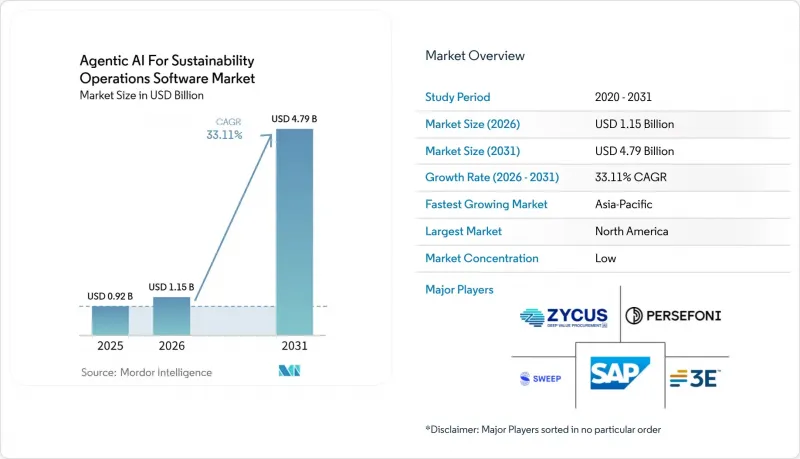
Mordor Intelligence에 의하면, 지속가능성 운영 소프트웨어용 에이전트형 AI 시장 규모는 2025년 9억 2,000만 달러에서 2026년에는 11억 5,000만 달러로 확대되어 2026년부터 2031년까지 CAGR 33.11%로 성장을 지속하여, 2031년에는 47억 9,000만 달러에 이를 것으로 예측됩니다.
본 보고서는 제공 형태(소프트웨어 플랫폼, 서비스), 배포 방식(클라우드, 기타), 용도(ESG 데이터 수집·오케스트레이션, 기타), 조직 규모(대기업, 중소기업), 최종 사용자(금융 및 보험·증권(BFSI), 산업 및 제조, 소비재 및 소매, 기타), 지역별로 분류되어 있습니다. 시장 전망은 금액(달러) 기준으로 제시되어 있습니다.
세계 지속가능성 운영 소프트웨어용 에이전트형 AI 시장 동향 및 인사이트
규제상 기한이 워크플로우 수준의 AI 도입을 촉구하고 있습니다.
지속가능성 운영 소프트웨어용 에이전트형 AI 시장은 시범 운영 단계에서 전사적 본격 도입 단계로 전환되고 있습니다. 이는 공시 의무로 인해 재현 가능하고 검증 가능한 워크플로우가 요구되기 시작했기 때문입니다. 유럽, 일본, 미국의 규제 압력으로 인해 지속가능성 보고는 재무 보고와 유사한 양상을 띠고 있으며, 첫 제출 주기부터 문서화, 추적 가능성 및 보증 기준이 중요시되고 있습니다. 이러한 변화에 따라 구매자들은 대시보드에서 벗어나, 요구 사항을 데이터 필드에 매핑하고, 기록을 유지하며, 여러 업무 기능에 걸쳐 타당성을 입증할 수 있는 감사 추적을 생성할 수 있는 플랫폼으로 전환하고 있습니다. 일본에서는 NEC가 AI를 활용한 기후 변화 공시 프로세스를 통해 수작업에 비해 업무 부담을 93% 줄였다고 보고했는데, 이는 규제 대상 기업들이 자동화를 미래의 선택지가 아닌 운영상의 필수 요건으로 인식하고 있는 이유를 보여줍니다. 이와 유사한 압력으로 인해, 지속가능성 운영 소프트웨어용 에이전트형 AI 시장에서도 공시 업무를 증권 보고, 내부 통제 및 이사회 수준의 검토 주기와 연계할 수 있는 시스템에 대한 수요가 증가하고 있습니다. 규제 요건이 정착되고 제출 일정이 엄격해지는 가운데, 법적 의무를 구조화된 워크플로로 전환할 수 있는 소프트웨어는 지속가능성 운영 소프트웨어용 에이전트형 AI 시장에서의 도입 핵심 요소로 계속 자리매김할 것입니다.
감사 대응이 가능한 스코프 3 자동화에 대한 수요 증가
지속가능성 운영 소프트웨어용 에이전트형 AI 시장이 탄력을 받고 있는 이유는 스코프 3 데이터가 여전히 많은 기업에게 가장 큰 미해결 보고 과제이기 때문입니다. 기업은 대개 직접적인 사업 활동에 대해서는 적절한 관리 하에 측정할 수 있지만, 공급망에서 발생하는 배출량은 여전히 단편적인 공급업체의 입력 데이터, 조달 기록, 그리고 일관성 없는 배출 계수 라이브러리에 의존하고 있습니다. Meta는 구성 요소 수준의 하드웨어 조달 데이터에 AI를 적용함으로써 지출 기반 방법과 비교해 스코프 3 데이터의 품질과 포괄성이 향상되었음을 보여주었으며, 이는 거래 수준에서의 더 심층적인 자동화의 필요성을 뒷받침합니다. Watershed사는 자사의 에이전트를 통해 데이터 정제 시간을 80% 단축할 수 있었다고 밝혔으며, 한 테스트 고객의 경우 5시간이 걸리던 작업을 20분으로 단축했습니다. 한편, SAP사는 자사의 ‘Footprint Optimization Agent’를 통해 시나리오 시뮬레이션 시간을 1일에서 20분으로 단축할 수 있었다고 발표했습니다. 이러한 사례가 중요한 이유는 지속가능성 운영 소프트웨어용 에이전트형 AI 시장이 더 이상 단순한 편의성만을 내세우는 것이 아니라, 추정치를 감사 가능한 활동 데이터로 대체하는 능력을 강점으로 내세우고 있기 때문입니다. ERP 및 조달 시스템과의 연동이 더욱 견고한 벤더는 지속가능성 운영 소프트웨어용 에이전트형 AI 시장에서 구조적인 우위를 계속 유지할 것입니다. 원거래 데이터에 대한 접근성이 개선됨에 따라 데이터 품질과 보증 대응 준비 태세 모두 향상되기 때문입니다.
스코프 1, 2, 3 입력 데이터의 데이터 품질 격차
지속가능성 운영 소프트웨어용 에이전트형 AI 시장은 여전히 큰 제약에 직면해 있습니다. 그 이유는 AI 시스템이 불충분한 소스 데이터로부터 신뢰할 수 있는 결과를 생성할 수 없기 때문입니다. 기업의 지속가능성 데이터는 일반적으로 공과금 청구서, ERP 조달 기록, 공급업체 설문조사, 업무 시스템, 외부 배출 계수 라이브러리 등에 분산되어 존재하며, 단일하고 체계적인 기록 시스템이 존재하는 경우는 거의 없습니다. 이러한 입력 데이터가 불완전하거나 불일치할 경우, 배출 계수가 잘못 적용되거나, 이상 징후가 오감지되거나, 감사 추적이 원본 소스 문서와 연관성을 잃을 가능성이 있습니다. IBM의 'Envizi Emissions API'에는 전 세계적으로 인정받은 14만 건 이상의 배출 데이터 세트 라이브러리가 포함되어 있으며, 이는 각 벤더들이 하류 분석이 시작되기 전에 배출 계수의 선정을 표준화하고 일관성을 높이려 하고 있음을 보여줍니다. Watershed의 발표에서도 분석 전 데이터 정제 과정이 강조되었습니다. 이는 더욱 자동화된 환경에서도 전처리가 여전히 필수적이라는 단순한 사실을 반영합니다. 지속가능성 운영 소프트웨어용 에이전트형 AI 시장은 앞으로도 성장을 이어갈 것이지만, 데이터 수집 단계에서 데이터 준비 상태를 개선하지 못하는 벤더는 자동화를 신뢰할 수 있는 보고 결과로 연결하는 데 어려움을 겪게 될 것입니다.
부문 분석
2025년에는 소프트웨어 플랫폼이 시장의 72.10%를 차지하고, 이는 구매자들이 일회성 서비스 계약 모델보다 상시 운영되는 인프라를 선호했음을 보여줍니다. 지속가능성 운영 소프트웨어용 에이전트형 AI 시장에서 이러한 우위는 과거 기록을 보관하고, 버전 관리를 수행하며, 매년 감사에 대응할 수 있는 워크플로를 유지할 수 있는 시스템에 대한 수요를 반영합니다. 정기적인 공시 의무를 이행해야 하는 기업들은 일반적으로 단발성 프로젝트가 아닌, 연계된 소프트웨어 환경을 필요로 합니다. 이는 여러 보고 주기에 걸쳐 제출 서류가 심사될 때 연속성이 중요하기 때문입니다. 플랫폼 중심의 구조는 고객 관계의 초기 단계에서 전환 비용을 높이는 요인이 되기도 합니다. 따라서 지속가능성 운영 소프트웨어용 에이전트형 AI 시장에서는 업계 재편이 본격화되기 전에 장기적인 기업 고객을 확보하기 위한 치열한 경쟁이 이미 벌어지고 있습니다. 이러한 플랫폼에 대한 선호는 지속가능성 업무가 재무, 조달, 운영, 법무, 내부 감사 등 각 부서로 확대되고 있는 상황과도 관련이 있습니다.
나머지 시장 점유율을 차지하는 서비스 부문은 2031년까지 연평균 성장률(CAGR) 34.16%로 확대될 것으로 예측되며, 플랫폼이 시장을 독점하는 상황 속에서도 지속가능성 운영 소프트웨어용 에이전트형 AI 시장에서 그 중요성을 유지하고 있습니다. 많은 기업 환경에서 도입, 규제 대응 준비, 워크플로우 재설계, 데이터 검증 및 결과물 검토에는 여전히 전문가의 판단이 필요하기 때문에 서비스는 계속해서 필수적인 존재로 남아 있습니다. 에이전트형 AI의 기능이 향상됨에 따라 서비스 업무는 수작업에 의한 스프레드시트 작성에서 통제, 조사 기법 선택, 도입 설계에 관한 자문 서비스로 전환되고 있습니다. 이러한 전환이 중요한 이유는 클라이언트가 소프트웨어와 운영 모델 모두에 대한 지원을 단일한 책임 있는 파트너에게 요구하는 경향이 강해지고 있기 때문입니다. 따라서 지속가능성 운영 소프트웨어용 에이전트형 AI 업계는 단순히 소프트웨어만으로 구성된 미래로 향하고 있는 것은 아닙니다. 왜냐하면 가장 어려운 과제는 많은 경우 코딩뿐만 아니라 부서 간 프로세스 변경을 수반하기 때문입니다.
2025년에는 클라우드가 시장의 71.40%를 차지하고, 2031년까지 연평균 성장률(CAGR) 35.00%로 성장할 것으로 전망됩니다. 지속가능성 운영 소프트웨어용 에이전트형 AI 시장의 구성 비율에서 이러한 우위는 ERP 시스템, 유틸리티 피드, 공급업체 네트워크 및 공시 워크플로우 전반에 걸친 지속적인 API 연결의 필요성을 반영합니다. 클라우드 아키텍처는 에이전트형 시스템이 적절하게 작동하는 데 필요한 데이터 소스에 대한 더 신속한 통합, 더 정기적인 업데이트, 그리고 더 광범위한 접근을 지원합니다. 따라서 구매자가 클라우드를 선택하는 것은 단순한 브랜드 선호 때문이 아니라, 보고서 작성 워크플로우 자체가 수많은 사내외 시스템을 아우르는 연결된 데이터 마이그레이션에 의존하기 때문입니다. 마이크로소프트의 ‘Sustainability Manager’ 2025 Wave 2 릴리스에서는 마이크로소프트 클라우드 환경 내에서 제품의 탄소 발자국 계산 및 지속가능성 데이터 할당 기능이 추가되었습니다. 이는 하이퍼스케일러 생태계가 이 분야에서 어떻게 가치를 심화시키고 있는지를 보여줍니다.
On-Premise 배포는 주권 원칙, 엄격한 데이터 상주 요건, 또는 플랜트 수준의 운영 시스템으로 인해 클라우드 도입이 제한되는 지속가능성 운영 소프트웨어용 에이전트형 AI 시장에서 여전히 실용적인 역할을 수행하고 있습니다. 방위 프로그램, 기밀성이 높은 공공 부문 환경, 그리고 일부 금융 및 산업 분야의 도입에 있어서는 데이터 마이그레이션이나 시스템 접근에 대한 보다 엄격한 현지 관리가 계속해서 중요시되고 있습니다. 또한, 대형 제조업체의 경우 배출원이 되는 자산 근처에 설치된 운영 기술(OT) 환경이 있어, 실시간 산업 데이터 수집에 있어서는 On-Premise 배포가 더 실용적인 경우가 있습니다. 하지만 시장 전체적으로는 더 빠른 연결성과 통합 부담 경감이 계속해서 중요시되고 있으므로, On-Premise 배포는 틈새 수익원에 그칠 가능성이 높습니다. 주요 전략적 과제는 On-Premise가 사라질지 여부가 아니라, 벤더가 제어 불일치나 데이터 로직의 중복을 초래하지 않으면서 하이브리드 모델을 지원할 수 있는지 여부에 있습니다. 지속가능성 운영 소프트웨어용 에이전트형 AI 업계에서 두 아키텍처를 모두 적절히 다룰 수 있는 벤더는 규제 대상이며 많은 자산을 보유한 구매자에게 우위를 점하게 될 것입니다.
지역별 분석
2025년, 북미는 지속가능성 운영 소프트웨어용 에이전트형 AI 시장 점유율의 32.90%를 차지하며 최대 지역 시장이 되었습니다. 이 지역은 기술의 조기 도입자, 대규모 다국적 기업, 그리고 이미 복잡한 ERP 및 클라우드 환경을 운영하고 있는 기업 환경이 고도로 집중되어 있다는 이점이 있습니다. 또한, 미국의 주 차원 기후 정보 공시 요건, 특히 기업이 내부 보고를 공식적인 거버넌스 및 투자자의 기대에 부합시켜야 하는 상황도 수요를 뒷받침하고 있습니다. 캐나다에서는 ISSB에 부합하는 공시 활동을 통해 시장의 깊이가 더해지고 있습니다. 한편, 남미는 규모는 작지만 2026년 COP30을 둘러싼 브라질의 역할로 인해 기업의 기후 변화 공시 및 공급망 준비 상황에 대한 관심이 높아지고 있어 전략적으로 중요한 지역이 되고 있습니다. 아르헨티나의 투자 환경은 여전히 불안정하지만, 수출 지향 기업들은 해외 고객으로부터 검증된 보고 자료 제출을 요구받을 때 여전히 압박에 직면해 있습니다. 이를 종합해 보면, 북미·남미 지역에서는 지속가능성 운영 소프트웨어용 에이전트형 AI 시장이 북미 대기업 수요에 힘입어 성장하고 있는 한편, 무역과 관련된 공시 압력을 통해 남미 지역에서도 선택적인 기회가 열리고 있음을 알 수 있습니다.
유럽은 공식적인 공시 요건이 여전히 기업의 구매 결정을 좌우하고 있기 때문에 지속가능성 운영 소프트웨어용 에이전트형 AI 시장에서 여전히 가장 강력한 수요 거점 중 하나입니다. 개정된 유럽의 프레임워크에서 적용 범위가 좁아졌다고는 하지만, 대상에 남아 있는 기업은 보다 고도화된 관리 기능과 통합 요구 사항을 갖춘 풀 스위트형 플랫폼을 도입할 가능성이 가장 높은 대기업입니다. 독일의 산업 기반, 영국의 금융 부문, 프랑스의 보고 환경은 각각 고유한 수요 패턴을 만들어내고 있으며, 이로 인해 이 지역은 이용 사례와 구매자 프로파일 양면에서 폭넓은 특징을 유지하고 있습니다. 또한, 이 지역에는 현지 규정 준수 해석에 특화된 전문 공급업체도 존재하여, 세계 소프트웨어 벤더에 더해 또 다른 경쟁 계층이 형성되고 있습니다. 이는 중요한 점입니다. 왜냐하면 유럽의 지속가능성 운영 소프트웨어용 에이전트형 AI 시장은 단일하고 획일적인 구매 패턴에 의해 주도되는 것이 아니라, 제조, 금융, 공급망 규정 준수를 아우르는 여러 중복된 요구 사항에 의해 뒷받침되고 있기 때문입니다. 이 지역의 다국적 대형 보고 기업들은 국경을 초월한 보고 논리, 보증 서류 작성, 그리고 기존 기업 시스템과의 통합을 지원할 수 있는 플랫폼을 계속해서 선호할 것으로 보입니다.
아시아태평양은 2031년까지 연평균 성장률(CAGR) 35.00%를 나타낼 것으로 예측되며, 지속가능성 운영 소프트웨어용 에이전트형 AI 시장 규모 전망에서 가장 두드러진 성장을 보일 지역이 될 것입니다. 특히 일본이 중요한 견인차 역할을 하고 있습니다. 이는 유가증권 보고와 관련된 공시 의무로 인해 상장 기업에게 워크플로우 자동화의 가치가 높아지고 있기 때문입니다. NEC는 AI를 활용한 기후 변화 공시 프로세스를 통해 업무 부담을 93% 줄였다고 발표했으며, 후지쯔도 2026년 5월에 AI를 활용한 비재무 정보 공시 분석 서비스를 상용화했습니다. 이를 통해 일본에서는 이미 기업 차원의 실질적인 도입이 진행되고 있음을 알 수 있습니다. 중국, 인도, 한국도 그린 파이낸스, 기업의 사회적 책임, ESG 공시 프레임워크를 통해 수요를 끌어올리고 있으며, 이는 대형 상장 기업 및 공급망 전반에 걸쳐 보고의 복잡성을 가중시키고 있습니다. 중동 시장, 특히 아랍에미리트(UAE)와 사우디아라비아에서는 보다 광범위한 탈탄소화 및 포트폴리오 거버넌스 노력의 일환으로 지속가능성 관련 소프트웨어에 대한 투자가 진행되고 있습니다. 아프리카는 아직 발전 단계에 있으며, 남아프리카공화국과 이집트가 초기 주도국으로 부상하고 있지만, 도입 진전은 인프라 구축 현황과 기업용 소프트웨어의 성숙도에 크게 좌우될 것입니다. 지역별 상황을 살펴보면, 규제, 수출 의존도, 기업의 디지털화가 복합적으로 작용하여 발전하고 있는 지역에서 지속가능성 운영 소프트웨어용 에이전트형 AI 시장의 확대가 가장 빠르게 진행되고 있습니다.
기타 혜택:
- 엑셀 형식 시장 예측(ME) 시트
- 3개월간의 애널리스트 지원
자주 묻는 질문
목차
제1장 서론
제2장 조사 방법
제3장 주요 요약
제4장 시장 구도
제5장 시장 규모와 성장 예측
제6장 경쟁 구도
제7장 시장 기회와 향후 전망
JHS 26.08.07According to Mordor Intelligence, the agentic AI for sustainability operations software market size is expected to grow from USD 0.92 billion in 2025 to USD 1.15 billion in 2026 and is forecast to reach USD 4.79 billion by 2031 at 33.11% CAGR over 2026-2031.
This report is Segmented by Offering (Software Platform, and Services), Deployment Mode (Cloud, and More), Application (ESG Data Collection and Orchestration, and More), Organization Size (Large Enterprises, and SMEs), End User (BFSI, Industrial and Manufacturing, Consumer Goods and Retail, and More), and Geography. The Market Forecasts are Provided in Terms of Value (USD).
Global Agentic AI For Sustainability Operations Software Market Trends and Insights
Regulatory Deadlines are Forcing Workflow-Level AI Adoption
The agentic AI for sustainability operations software market is moving from pilot activity to full enterprise deployment because disclosure obligations now demand repeatable and reviewable workflows. European, Japanese, and U.S. regulatory pressure is making sustainability reporting look more like financial reporting, where documentation, traceability, and assurance standards matter from the first filing cycle. That shift is pushing buyers away from dashboards and toward platforms that can map requirements to data fields, maintain records, and generate defensible audit trails across multiple business functions. In Japan, NEC reported that its AI-supported climate disclosure process reduced workload by 93% against manual preparation, which shows why regulated companies are treating automation as an operating requirement rather than a future option. The same pressure is lifting demand in the agentic AI for sustainability operations software market for systems that can align disclosure tasks with securities filings, internal controls, and board-level review cycles. As rulebooks stabilize and filing timetables tighten, software that can convert legal obligations into structured workflows will remain central to adoption in the agentic AI for sustainability operations software market.
Rising Need for Audit-Ready Scope 3 Automation
The agentic AI for sustainability operations software market is gaining momentum because Scope 3 data remains the largest unresolved reporting problem for most enterprises. Companies can often measure direct operations with reasonable control, but supply-chain emissions still depend on fragmented supplier inputs, procurement records, and inconsistent factor libraries. Meta showed that AI applied to component-level hardware procurement data improved Scope 3 data quality and coverage compared with spend-based methods, which supports the case for deeper transaction-level automation. Watershed stated that its agents cut data cleaning time by 80%, and one test customer reduced a five-hour project to 20 minutes, while SAP said its Footprint Optimization Agent reduced scenario simulation time from 1 day to 20 minutes. These examples matter because the agentic AI for sustainability operations software market is no longer selling convenience alone; it is selling the ability to replace estimates with more auditable activity data. Vendors with stronger ERP and procurement connections will keep a structural advantage in the agentic AI for sustainability operations software market because better access to source transactions improves both data quality and assurance readiness.
Data Quality Gaps in Scope 1, 2, And 3 Inputs
The agentic AI for sustainability operations software market still faces a major limit because AI systems cannot produce reliable output from weak source data. Enterprise sustainability data usually sits across utility bills, ERP procurement records, supplier questionnaires, operational systems, and external factor libraries, which means there is rarely one clean system of record. When those inputs are incomplete or inconsistent, emissions factors can be misapplied, anomaly flags can become false positives, and audit trails can lose their link to the original source document. IBM's Envizi Emissions API includes a library of more than 140,000 globally recognized emission datasets, which shows how vendors are trying to standardize factor selection and improve consistency before downstream analysis begins. Watershed's launch also emphasized data cleaning before analysis, which reflects the simple fact that preprocessing remains essential even in more automated environments. The agentic AI for sustainability operations software market will continue to grow, but vendors that cannot improve data readiness at the ingestion stage will struggle to convert automation into trusted reporting outcomes.
Other drivers and restraints analyzed in the detailed report include:
- Enterprise Demand for Hyper-Automation Across ESG Workflows
- Sustainability Teams are Understaffed Relative to Reporting Burden
- Trust, Explainability, and Governance Concerns
For complete list of drivers and restraints, kindly check the Table Of Contents.
Segment Analysis
Software platforms held 72.10% of the market in 2025, which shows that buyers preferred standing infrastructure over one-off service engagement models. Within the agentic AI for sustainability operations software market, that lead reflects demand for systems that can preserve historical records, manage version control, and maintain audit-ready workflows year after year. Enterprises facing recurring disclosure obligations generally need connected software environments, not isolated projects, because continuity matters when filings are reviewed across multiple reporting cycles. The platform-heavy structure also raises switching costs early in the customer relationship, which is why the agentic AI for sustainability operations software market is already seeing intense competition to secure long-term enterprise accounts before consolidation becomes more visible. This preference for platforms is also tied to the way sustainability work is spreading across finance, procurement, operations, legal, and internal audit functions.
Services held the remaining share and are projected to expand at a 34.16% CAGR through 2031, which keeps them relevant in the agentic AI for sustainability operations software market even as platforms dominate. Services remain necessary because implementation, regulatory readiness, workflow redesign, data validation, and output review still require specialist judgment in many enterprise environments. As agentic capabilities improve, service work is shifting away from manual spreadsheet preparation and toward advisory services around controls, methodology choices, and deployment design. That transition matters because clients increasingly want a single accountable partner for both software and operating model support. The agentic AI for sustainability operations software industry is therefore not moving toward a simple software-only future, because the hardest problems often involve process change across functions rather than coding alone.
Cloud held 71.40% of the market in 2025, and cloud is also projected to grow at a 35.00% CAGR through 2031. In the agentic AI for sustainability operations software market size mix, that lead reflects the need for constant API connectivity across ERP systems, utility feeds, supplier networks, and disclosure workflows. Cloud architecture supports faster integration, more regular updates, and broader access to the data sources that agentic systems need in order to function well. Buyers are therefore choosing cloud not as a branding preference, but because the reporting workflow itself depends on connected data movement across many internal and external systems. Microsoft's 2025 Wave 2 release for Sustainability Manager added product carbon footprint calculation and sustainability data allocation capabilities inside the Microsoft cloud environment, which shows how hyperscaler ecosystems are deepening their value in this category.
On-premises deployment still retains a practical role in the agentic AI for sustainability operations software market, where sovereignty rules, strict residency needs, or plant-level operational systems limit cloud adoption. Defense programs, sensitive public-sector environments, and some financial or industrial deployments continue to value tighter local control over data movement and system access. Large manufacturers also have operational technology environments that sit close to emissions-generating assets, which can make local deployment more workable for real-time industrial data capture. Even so, on-premises deployments are likely to remain a niche revenue stream because the broader market continues to favor faster connectivity and lower integration effort. The main strategic question is not whether on-premises disappears, but whether vendors can support hybrid models without creating inconsistent controls or duplicate data logic. In the agentic AI for sustainability operations software industry, vendors that handle both architectures well will have an edge with regulated and asset-heavy buyers.
Complete Report Scope:
- By Offering
- Software Platform
- Services
- By Deployment Mode
- Cloud
- On-Premises
- By Application
- ESG Data Collection and Orchestration
- Carbon Accounting and Scope 3 Management
- Regulatory Reporting and Disclosure Automation
- Sustainability Analytics and Scenario Planning
- Supplier and Value Chain Engagement
- By Organization Size
- Large Enterprises
- SMEs
- By End User
- BFSI
- Industrial and Manufacturing
- Consumer Goods and Retail
- Energy and utilities
- IT and Telecom
- Healthcare and life sciences
- Other End Users
- By Geography
- North America
- United States
- Canada
- Mexico
- South America
- Brazil
- Argentina
- Rest of South America
- Europe
- Germany
- United Kingdom
- France
- Spain
- Italy
- Russia
- Rest of Europe
- Asia-Pacific
- China
- India
- Japan
- South Korea
- Australia and New Zealand
- Rest of Asia-Pacific
- Middle East
- Saudi Arabia
- United Arab Emirates
- Turkey
- Rest of Middle East
- Africa
- South Africa
- Nigeria
- Egypt
- Rest of Africa
- North America
Geography Analysis
North America held 32.90% of the agentic AI for sustainability operations software market share in 2025, making it the largest regional market. The region benefits from a high concentration of early technology adopters, large multinational enterprises, and corporate environments that already operate complex ERP and cloud estates. Demand has also been supported by state-level climate disclosure requirements in the United States, especially where companies must align internal reporting with formal governance and investor expectations. Canada adds depth through ISSB-aligned disclosure activity, while South America remains smaller but strategically important because Brazil's role around COP30 in 2026 is increasing attention on corporate climate disclosure and supply-chain readiness. Argentina's investment climate remains less stable, but export-oriented firms still face pressure when global customers ask for verified reporting inputs. Taken together, the Americas show how the agentic AI for sustainability operations software market can be led by large enterprise demand in the north while still opening selective opportunities further south through trade-linked disclosure pressure.
Europe remains one of the strongest demand centers in the agentic AI for sustainability operations software market because formal disclosure requirements continue to shape enterprise buying decisions. Even with narrower scope in the revised European framework, the remaining in-scope companies are large enterprises that are most likely to deploy full-suite platforms with deeper controls and integration needs. Germany's industrial base, the United Kingdom's financial sector, and France's reporting environment each create distinct demand patterns, which keeps the region broad in both use case and buyer profile. The region also supports specialist providers that focus on local compliance interpretation, which adds another layer of competition alongside global software vendors. This matters because the agentic AI for sustainability operations software market in Europe is not driven by one uniform buying pattern, but by several overlapping needs across manufacturing, finance, and supply-chain compliance. Large multinational filers in the region are likely to keep favoring platforms that can handle cross-border reporting logic, assurance preparation, and integration with existing enterprise systems.
Asia-Pacific is projected to grow at a 35.00% CAGR through 2031, which makes it the fastest-growing geography in the agentic AI for sustainability operations software market size outlook. Japan is an especially important driver because disclosure obligations tied to securities reporting are raising the value of workflow automation for listed companies. NEC said its AI-supported climate disclosure process cut workload by 93%, while Fujitsu launched a commercial AI-powered non-financial disclosure analysis service in May 2026, which shows that practical enterprise deployment is already moving ahead in Japan. China, India, and South Korea also add demand through green finance, business responsibility, and ESG disclosure frameworks that increase reporting complexity across large listed companies and supply chains. Middle East markets, particularly the United Arab Emirates and Saudi Arabia, are investing in sustainability software as part of broader decarbonization and portfolio-governance agendas. Africa remains nascent, with South Africa and Egypt serving as early anchors, but adoption will depend more heavily on infrastructure readiness and enterprise software maturity. The regional picture shows that the agentic AI for sustainability operations software market is broadening fastest, where regulation, export exposure, and enterprise digitization are moving together.
- Sweep
- SAP SE
- 3E Company Environmental, Ecological and Engineering, LLC
- Zycus Inc.
- Persefoni AI, Inc.
- Watershed Technology, Inc.
- Workiva Inc.
- Salesforce, Inc.
- Microsoft Corporation
- IBM Corporation
- Schneider Electric SE
- Sphera Solutions, Inc.
- Normative AB
- Enablon SA
- Intelex Technologies ULC
- ESG Book AG
- Greenly SAS
- Novisto Inc.
- Plan A Earth GmbH
- KEY ESG Limited
- Farseer AS
Additional Benefits:
- The market estimate (ME) sheet in Excel format
- 3 months of analyst support
TABLE OF CONTENTS
1 INTRODUCTION
- 1.1 Study Assumptions and Market Definition
- 1.2 Scope of the Study
2 RESEARCH METHODOLOGY
3 EXECUTIVE SUMMARY
4 MARKET LANDSCAPE
- 4.1 Market Overview
- 4.2 Market Drivers
- 4.2.1 Rising Need for Audit-Ready Scope 3 Automation
- 4.2.2 Regulatory Deadlines Are Forcing Workflow-Level AI Adoption
- 4.2.3 Sustainability Teams Are Understaffed Relative to Reporting Burden
- 4.2.4 Enterprise Demand for Hyper-Automation Across ESG Workflows
- 4.2.5 Agentic AI Improves Cross-Functional Data Orchestration
- 4.2.6 Integration of Sustainability Data With Core ERP and Finance Systems
- 4.3 Market Restraints
- 4.3.1 Data Quality Gaps In Scope 1, 2, and 3 Inputs
- 4.3.2 Trust, Explainability, and Governance Concerns
- 4.3.3 High Integration Cost With Legacy Enterprise Systems
- 4.3.4 Fragmented Standards Across Jurisdictions
- 4.4 Impact of Macroeconomic Factors on the Market
- 4.5 Industry Value Chain Analysis
- 4.6 Technology Outlook
- 4.7 Regulatory Landscape
- 4.8 Porter's Five Forces Analysis
- 4.8.1 Bargaining Power of Buyers
- 4.8.2 Bargaining Power of Suppliers
- 4.8.3 Threat of New Entrants
- 4.8.4 Threat of Substitutes
- 4.8.5 Intensity of Competitive Rivalry
5 MARKET SIZE AND GROWTH FORECASTS (VALUE)
- 5.1 By Offering
- 5.1.1 Software Platform
- 5.1.2 Services
- 5.2 By Deployment Mode
- 5.2.1 Cloud
- 5.2.2 On-Premises
- 5.3 By Application
- 5.3.1 ESG Data Collection and Orchestration
- 5.3.2 Carbon Accounting and Scope 3 Management
- 5.3.3 Regulatory Reporting and Disclosure Automation
- 5.3.4 Sustainability Analytics and Scenario Planning
- 5.3.5 Supplier and Value Chain Engagement
- 5.4 By Organization Size
- 5.4.1 Large Enterprises
- 5.4.2 SMEs
- 5.5 By End User
- 5.5.1 BFSI
- 5.5.2 Industrial and Manufacturing
- 5.5.3 Consumer Goods and Retail
- 5.5.4 Energy and utilities
- 5.5.5 IT and Telecom
- 5.5.6 Healthcare and life sciences
- 5.5.7 Other End Users
- 5.6 By Geography
- 5.6.1 North America
- 5.6.1.1 United States
- 5.6.1.2 Canada
- 5.6.1.3 Mexico
- 5.6.2 South America
- 5.6.2.1 Brazil
- 5.6.2.2 Argentina
- 5.6.2.3 Rest of South America
- 5.6.3 Europe
- 5.6.3.1 Germany
- 5.6.3.2 United Kingdom
- 5.6.3.3 France
- 5.6.3.4 Spain
- 5.6.3.5 Italy
- 5.6.3.6 Russia
- 5.6.3.7 Rest of Europe
- 5.6.4 Asia-Pacific
- 5.6.4.1 China
- 5.6.4.2 India
- 5.6.4.3 Japan
- 5.6.4.4 South Korea
- 5.6.4.5 Australia and New Zealand
- 5.6.4.6 Rest of Asia-Pacific
- 5.6.5 Middle East
- 5.6.5.1 Saudi Arabia
- 5.6.5.2 United Arab Emirates
- 5.6.5.3 Turkey
- 5.6.5.4 Rest of Middle East
- 5.6.6 Africa
- 5.6.6.1 South Africa
- 5.6.6.2 Nigeria
- 5.6.6.3 Egypt
- 5.6.6.4 Rest of Africa
- 5.6.1 North America
6 COMPETITIVE LANDSCAPE
- 6.1 Market Concentration
- 6.2 Strategic Moves
- 6.3 Market Share Analysis
- 6.4 Company Profiles (includes Global Level Overview, Market Level Overview, Core Segments, Financials as available, Strategic Information, Market Rank/Share, Products and Services, Recent Developments)
- 6.4.1 Sweep
- 6.4.2 SAP SE
- 6.4.3 3E Company Environmental, Ecological and Engineering, LLC
- 6.4.4 Zycus Inc.
- 6.4.5 Persefoni AI, Inc.
- 6.4.6 Watershed Technology, Inc.
- 6.4.7 Workiva Inc.
- 6.4.8 Salesforce, Inc.
- 6.4.9 Microsoft Corporation
- 6.4.10 IBM Corporation
- 6.4.11 Schneider Electric SE
- 6.4.12 Sphera Solutions, Inc.
- 6.4.13 Normative AB
- 6.4.14 Enablon SA
- 6.4.15 Intelex Technologies ULC
- 6.4.16 ESG Book AG
- 6.4.17 Greenly SAS
- 6.4.18 Novisto Inc.
- 6.4.19 Plan A Earth GmbH
- 6.4.20 KEY ESG Limited
- 6.4.21 Farseer AS
7 MARKET OPPORTUNITIES AND FUTURE OUTLOOK
- 7.1 White-Space and Unmet-Need Assessment


