
|
시장보고서
상품코드
2099199
디지털 마케팅 시장 : 점유율 분석, 업계 동향 및 통계, 성장 예측(2026-2031년)Digital Marketing Market - Market Share Analysis, Industry Trends & Statistics, Growth Forecasts (2026 - 2031) |
||||||
 Mordor Intelligence
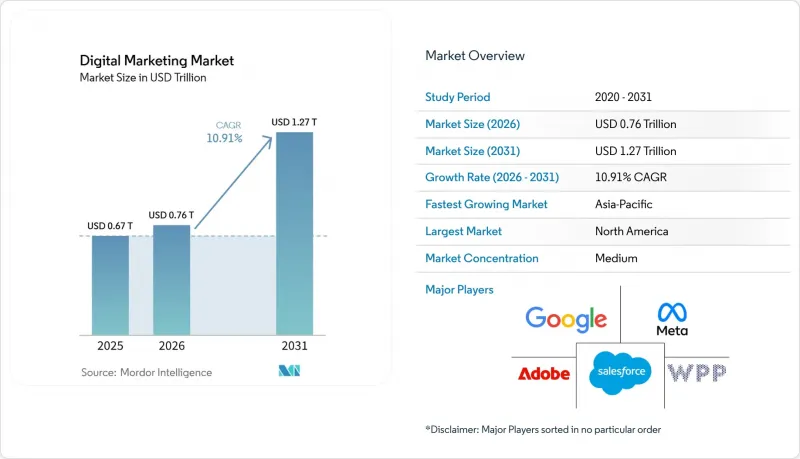
Mordor Intelligence에 의하면, 디지털 마케팅 시장 규모는 2025년 6,700억 달러, 2026년 7,600억 달러에서 2031년까지 1조 2,700억 달러로 확대한다고 예측되고 있어 2026년부터 2031년까지 연평균 복합 성장률(CAGR)은 10.91%를 나타낼 전망입니다.
본 보고서는 디지털 채널(SEO, 소셜 미디어 마케팅, 온라인 광고(검색·디스플레이), 컨텐츠 마케팅, 이메일 마케팅 등), 기업 규모(대기업, 중소기업), 최종 사용자 산업(소매 및 전자상거래, IT 및 통신, BFSI 등) 및 지역별로 분류되어 있습니다. 시장 전망은 달러 기준 금액으로 제시되어 있습니다.
세계 디지털 마케팅 시장 동향 및 인사이트
AI를 활용한 캠페인 기획 및 최적화로의 급속한 전환
AI를 활용한 캠페인 서비스는 대행사가 수작업 부담을 줄이면서 기획, 테스트, 최적화를 수행할 수 있게 됨에 따라 디지털 마케팅 시장의 운영 방식을 혁신하고 있습니다. 대형 지주 그룹들은 자사의 운영 시스템과 클라이언트의 전체 워크플로우에 이러한 변화를 확대하기 위해 조기에 움직이기 시작했습니다. WPP는 2025년 10월, 구글과 5년간 4억 달러 규모의 파트너십 계약을 체결하고, 생성형 AI 및 에이전트형 AI 도구를 ‘WPP Open’에 통합함으로써 크리에이티브 및 캠페인 배포 분야의 자동화를 강화했습니다. 퍼블리시스 그룹은 2026년 4월, 마이크로소프트와의 제휴를 확대하여 11만 4,000명 이상의 직원에게 Microsoft 365 Copilot을 도입하는 한편, Azure를 우선적인 클라우드 인프라로 지정했습니다. 이러한 변화가 디지털 마케팅 시장에서 중요하게 여겨지는 이유는 서비스 속도, 워크플로우의 일관성, 데이터 연동성이 기존의 크리에이티브 제작과 동등한 수준으로 중요해지고 있기 때문입니다. 또한, 소규모 기업은 도구를 도입할 수는 있더라도 엔터프라이즈급 인프라, 모델 거버넌스, 통합된 클라이언트 데이터 환경을 따라잡는 것은 여전히 어렵기 때문에 진입 장벽이 높아지는 결과로 이어집니다.
'월드 가든' 내 퍼스트 파티 데이터 채택 확대
디지털 마케팅 시장에서는 브랜드가 타겟팅, 측정, 고객 인사이트에 대해 더 강력한 통제권을 요구함에 따라 퍼스트 파티 데이터 활용에 대한 수요가 높아지고 있습니다. 이러한 수요는 미디어 지출의 상당 부분이 폐쇄형 플랫폼으로 이동함에 따라 더욱 커지고 있습니다. 이러한 플랫폼 내에서의 측정 능력은 강력하지만, 채널 간 측정은 불충분하기 때문입니다. IAB 보고서에 따르면, 2025년 전 세계 디지털 광고 매출은 3,000억 달러에 육박할 전망이며, 프로그래매틱 광고 카테고리 중 가장 빠르게 성장하고 있는 커머스 미디어는 전년 대비 18.0% 증가한 634억 달러에 달했습니다. 이러한 환경에서는 고객 데이터 플랫폼, 클린룸 워크플로우, 서버사이드 데이터 파이프라인을 실용적인 캠페인 시스템에 통합할 수 있는 디지털 마케팅 시장의 에이전시가 우위를 점하고 있습니다. 또한, 데이터 소유권에 관한 자문 업무가 기존의 미디어 운영보다 예산 결정에 더 밀접하게 관여하게 되면서 클라이언트와의 관계도 변화하고 있습니다. 그 결과, 디지털 마케팅 시장에서는 데이터 아키텍처, 신원 확인 솔루션, 클로즈드 루프 리포팅에 대한 서비스 수요가 확대되고 있습니다.
쿠키 폐지와 모바일 개인정보 제어에 따른 신호 손실
신호 손실은 고객 여정 전반에 걸친 가시성을 저하시키고 표준 어트리뷰션 설정을 약화시키기 때문에 디지털 마케팅 시장에서 가장 명백한 운영상의 제약 중 하나로 남아 있습니다. 브라우저, 모바일 OS 및 동의 프레임워크 전반에 걸친 개인정보 제어 기능으로 인해, 대규모로 확정적 추적을 유지하기가 어려워지고 있습니다. 실질적인 영향으로, 디지털 마케팅 시장에서는 보고서의 신뢰성을 유지하기 위해서만이라도 서버 측 통합, 아이덴티티 스티칭 및 실험적 측정에 더 많은 비용을 지출할 수밖에 없게 되었습니다. 이는 대행사 및 클라이언트에게 비용 증가로 이어지며, 데이터 흐름이 불완전하거나 지연될 경우 최적화 진행을 늦출 가능성이 있습니다. 또한, 규정 준수 요건과 동의 획득 현황이 시장마다 다르기 때문에 지역 간 성과에 편차가 발생합니다. 개인정보 보호에 강건한 측정 기법이 더 널리 표준화될 때까지, 디지털 마케팅 시장은 기존 추적 기법을 사용하여 캠페인 효과를 입증하는 데 계속해서 어려움을 겪게 될 것입니다.
부문 분석
2025년, 온라인 광고(검색 광고 및 디스플레이 광고)는 디지털 마케팅 시장 규모의 33.32%를 차지하며, 해당 시장에서 가장 큰 채널로서의 지위를 유지했습니다. 이 부문은 직접 리스폰스, 오디언스 타겟팅 및 측정 가능한 전환 활동과 가장 밀접하게 연관되어 있어 디지털 마케팅 시장의 중심적인 위치를 계속 차지하고 있습니다. 이러한 위상은 리테일 미디어 네트워크와 노출 및 구매 의도를 연결하는 프로그래매틱 바이잉 시스템의 지속적인 부상에 힘입어 공고해지고 있습니다. IAB에 따르면, 커머스 미디어는 2026년에 620억 달러에 달하며, 프로그래매틱 하위 부문 중 가장 빠른 성장세를 유지했습니다. 이러한 추세는 검색 관리, 디스플레이 광고 최적화, 리테일 미디어 활용 및 클로즈드 루프 보고에 대한 광고 대행사 수요를 촉진하고 있습니다. 소셜 미디어 마케팅과 SEO는 지속적인 트래픽 확보와 컨텐츠 가시성을 통해 유료 고객 유치를 보완하기 때문에 디지털 마케팅 시장에서 여전히 중요한 비중을 차지하고 있습니다.
또한, 디지털 마케팅 시장에서 SEO도 변화하고 있습니다. 이는 답변 엔진의 작동 방식에 따라 대행사가 AI 주도형 검색 환경에 적응한 컨텐츠 전략을 수립해야 하기 때문입니다. HubSpot은 2026년 4월, 고객으로부터의 유기적 트래픽이 전년 대비 27% 감소한 반면, AI를 통한 참조 트래픽은 3배 증가했다고 발표했습니다. 이러한 추세를 반영하여 HubSpot은 독자적인 서비스 기능으로 ‘HubSpot AEO’ 제공을 시작했습니다. 인플루언서 마케팅은 2031년까지 연평균 성장률(CAGR) 15.13%로 확대될 것으로 예측되며, 디지털 마케팅 시장에서 가장 빠르게 성장하는 디지털 채널이 될 전망입니다. IAB는 2026년 미국 크리에이터 경제의 광고 지출을 439억 달러로 예측하고 있으며, 이는 이 채널이 얼마나 빠르게 미디어 기획의 핵심으로 자리 잡고 있는지를 보여줍니다. CreatorIQ는 또한 크리에이터가 제작한 컨텐츠가 이미 유료 미디어 크리에이티브 자산의 평균 44%를 차지하고 있다고 덧붙였습니다. 이는 크리에이터가 현재 미디어 믹스와 자산 제작 모두에 영향을 미치고 있음을 시사합니다. 그 결과, 디지털 마케팅 업계에서는 크리에이터 선정, 컨텐츠 테스트, 그리고 어트리뷰션 대응 파트너십 모델에 더 많은 자원을 할당하고 있습니다.
지역별 분석
2025년, 북미는 디지털 마케팅 시장 규모의 36.68%를 차지하며, 지역별로는 여전히 가장 큰 기여 지역이 되었습니다. 이 지역이 디지털 마케팅 시장의 최대 점유율을 유지하고 있는 것은 플랫폼 도입이 성숙 단계에 접어들었으며, 대기업의 예산 규모가 크고, AI를 활용한 캠페인 시스템에 대한 조기 투자가 이루어지고 있는 점이 복합적으로 작용한 결과입니다. 인터랙티브 광고 협회(IAB) 보고서에 따르면, 2025년 미국의 디지털 광고 수익은 3,000억 달러에 육박했으며, 커머스 미디어는 634억 달러에 달했습니다. 캐나다와 멕시코가 이 지역 시장에 깊이를 더하고 있으며, 특히 멕시코는 디지털 네이티브 소비자층의 확대와 중소기업의 소셜 미디어 및 검색 채널 이용 증가의 혜택을 받고 있습니다.
아시아태평양은 2031년까지 연평균 성장률(CAGR) 16.12%를 나타낼 것으로 예측되며, 디지털 마케팅 시장에서 가장 빠르게 성장하는 지역이 될 전망입니다. 덴츠의 보고서에 따르면, 디지털 미디어는 아시아태평양 광고비 총액의 70%를 차지했으며, 프로그래매틱 광고는 24% 성장하여 세계 평균을 상회했습니다. 또한 덴츠는 2025년 인도의 디지털 미디어 광고가 20% 성장한 반면, 중국의 주요 6개 플랫폼은 전년 대비 6.7%의 성장을 기록했으며, 그중에서도 Douyin(TikTok)이 11%의 성장률로 성장을 주도했다고 지적했습니다. 이러한 동향은 플랫폼 통합이 진행된 ‘모바일 퍼스트’ 상거래 환경에서 디지털 마케팅 시장이 급속히 확대되고 있는 이유를 보여줍니다. 중동에서는 IAB MENA의 보고서에 따르면, 2025년 디지털 광고 시장 규모는 전년 대비 17.8% 증가한 81억 8,500만 달러에 달했으며, 이집트에서는 23.1%의 성장률을 기록했습니다.
유럽은 여전히 디지털 마케팅 시장에서 큰 점유율을 차지하고 있지만, 그 성장은 다른 대부분의 지역보다 엄격한 규정 준수 요건에 의해 좌우되고 있습니다. GDPR(EU 개인정보보호규정) 시행과 EU AI법으로 인해 광고 대행사 및 브랜드는 개인정보 보호를 고려한 캠페인 설계, 동의 관리, 측정 프레임워크 구축을 요구받고 있습니다. 남미는 브라질이 중심을 이루고 있으며, 이 나라에서는 디지털 커머스 및 모바일 주도형 광고 활동이 전체 퍼포먼스 채널의 확산을 뒷받침하고 있습니다. 아프리카는 여전히 규모는 작지만, 남아프리카공화국과 나이지리아가 해당 지역의 디지털 광고 투자의 대부분을 계속 차지하고 있어 디지털 마케팅 시장이 탄력을 받고 있습니다.
기타 혜택:
- 엑셀 형식 시장 예측(ME) 시트
- 3개월간의 애널리스트 지원
자주 묻는 질문
목차
제1장 서론
제2장 조사 방법
제3장 주요 요약
제4장 시장 구도
제5장 시장 규모와 성장 예측
제6장 경쟁 구도
JHS 26.08.05According to Mordor Intelligence, the digital marketing market size is projected to expand from USD 0.67 trillion in 2025 and USD 0.76 trillion in 2026 to USD 1.27 trillion by 2031, registering a CAGR of 10.91% between 2026 and 2031.
This report is Segmented by Digital Channel (SEO, Social Media Marketing, Online Advertising Search and Display, Content Marketing, Email Marketing, and More), Enterprise Size (Large Enterprises, and Small and Medium Enterprises), End-User Industry (Retail and E-Commerce, IT and Telecommunications, BFSI, and More), and Geography. The Market Forecasts are Provided in Terms of Value in USD.
Global Digital Marketing Market Trends and Insights
Rapid Shift to AI-Assisted Campaign Planning and Optimization
AI-assisted campaign services are changing how the digital marketing market operates because agencies can now deliver planning, testing, and optimization with less manual effort. Large holding groups moved early to scale this shift across their operating systems and client workflows. WPP signed a five-year USD 400 million partnership with Google in October 2025 to integrate generative and agentic AI tools into WPP Open, which strengthened automation across creative and campaign delivery. Publicis Groupe expanded its partnership with Microsoft in April 2026 and deployed Microsoft 365 Copilot across more than 114,000 employees while naming Azure as its preferred cloud infrastructure. This shift matters in the digital marketing market because service speed, workflow consistency, and data connectivity are becoming as important as traditional creative execution. It also raises entry barriers, since smaller firms can adopt tools, but they still struggle to match enterprise-grade infrastructure, model governance, and integrated client data environments.
Rising First-Party Data Adoption across Walled Gardens
The digital marketing market is seeing stronger demand for first-party data work because brands want more control over targeting, measurement, and customer intelligence. This need has grown as more media spend moves into closed platforms where measurement is strong inside the platform but weaker across channels. IAB reported that digital advertising revenue approached USD 300 billion globally in 2025, and commerce media, the fastest-growing programmatic category, rose 18.0% year over year to USD 63.4 billion. That environment rewards agencies in the digital marketing market that can connect customer data platforms, clean-room workflows, and server-side data pipelines into usable campaign systems. It also changes the client relationship, because advisory work around data ownership now sits closer to budget decisions than standard media execution. As a result, the digital marketing market is capturing more service demand in data architecture, identity resolution, and closed-loop reporting.
Signal Loss From Cookie Deprecation and Mobile Privacy Controls
Signal loss remains one of the clearest operational limits on the digital marketing market because it reduces visibility across customer journeys and weakens standard attribution setups. Privacy controls across browsers, mobile operating systems, and consent frameworks have made deterministic tracking harder to maintain at scale. The practical effect is that the digital marketing market must spend more on server-side integration, identity stitching, and experimental measurement just to preserve reporting confidence. This adds cost for agencies and clients, and it can slow optimization when data flows are incomplete or delayed. It also creates uneven performance across regions, since compliance requirements and consent behaviors differ by market. Until privacy-resilient measurement becomes more widely standardized, the digital marketing market will continue to face friction in proving campaign impact with older tracking methods.
Other drivers and restraints analyzed in the detailed report include:
- Expansion Of Commerce-Led Social and Creator Marketing
- Growth Of Privacy-Resilient Measurement and Incrementality Testing
- MarTech Stack Fragmentation and Integration Debt
For complete list of drivers and restraints, kindly check the Table Of Contents.
Segment Analysis
Online Advertising, Search and Display accounted for 33.32% share of the digital marketing market size in 2025, which kept it as the largest channel in this market. The segment remains central to the digital marketing market because it sits closest to direct response, audience targeting, and measurable conversion activity. Its position is supported by the continued rise of retail media networks and programmatic buying systems that tie exposure to purchase intent. IAB noted that commerce media reached USD 62 billion in 2026 and remained the fastest-growing programmatic subsegment. That pattern supports agency demand in search management, display optimization, retail media activation, and closed-loop reporting. Social Media Marketing and SEO still carry meaningful weight in the digital marketing market because they complement paid acquisition with ongoing traffic capture and content visibility.
SEO is also changing within the digital marketing market as answer-engine behavior pushes agencies to adapt content strategies for AI-led discovery environments. HubSpot stated in April 2026 that customer organic traffic had declined 27% year over year while AI referral traffic tripled, which supported the launch of HubSpot AEO as a distinct service capability. Influencer Marketing is projected to expand at a 15.13% CAGR through 2031, making it the fastest-growing digital channel in the digital marketing market. IAB projected U.S. creator economy ad spend at USD 43.9 billion in 2026, which shows how quickly this channel is moving into core media planning. CreatorIQ added that creator content already represented 44% of paid media creative assets on average, which suggests that creators now influence both media mix and asset production. As a result, the digital marketing industry is allocating more resources to creator sourcing, content testing, and attribution-ready partnership models.
Complete Report Scope:
- By Digital Channel
- Search Engine Optimization (SEO)
- Social Media Marketing
- Online Advertising, Search and Display
- Content Marketing
- Email Marketing
- Influencer Marketing
- Marketing Automation
- Digital Customer Engagement Solutions
- Analytics and Reporting Tools
- Other Digital Channels
- By Enterprise Size
- Large Enterprises
- Small and Medium Enterprises
- By End-User Industry
- Retail and E-Commerce
- IT and Telecommunications
- BFSI
- Healthcare and Life Sciences
- Media and Entertainment
- Travel and Hospitality
- Manufacturing and Industrials
- Other End-User Industries
- By Geography
- North America
- United States
- Canada
- Mexico
- South America
- Brazil
- Argentina
- Chile
- Rest of South America
- Europe
- Germany
- United Kingdom
- France
- Italy
- Spain
- Rest of Europe
- Asia-Pacific
- China
- Japan
- India
- South Korea
- Australia
- Rest of Asia-Pacific
- Middle East
- Saudi Arabia
- United Arab Emirates
- Qatar
- Rest of Middle East
- Africa
- South Africa
- Egypt
- Nigeria
- Rest of Africa
- North America
Geography Analysis
North America held 36.68% share of the digital marketing market size in 2025, which kept it as the leading regional contributor. The region remains the largest part of the digital marketing market because it combines mature platform adoption, large enterprise budgets, and early investment in AI-enabled campaign systems. The Interactive Advertising Bureau reported that U.S. digital advertising revenue approached USD 300 billion in 2025, while commerce media reached USD 63.4 billion. Canada and Mexico add regional depth, with Mexico benefiting from a growing digitally native consumer base and rising SME use of social and search channels.
Asia-Pacific is projected to grow at a 16.12% CAGR through 2031, making it the fastest-growing geography in the digital marketing market. Dentsu reported that digital media represented 70% of total APAC ad spend, while programmatic grew 24% and outpaced global benchmarks. Dentsu also noted that India's digital media advertising grew 20% in 2025, while China's top six platforms posted 6.7% year-over-year growth, led by Douyin or TikTok at 11%. These trends show why the digital marketing market is scaling quickly in mobile-first commerce environments with strong platform integration. In the Middle East, IAB MENA reported that digital advertising reached USD 8.185 billion in 2025, up 17.8% year over year, and that Egypt recorded 23.1% growth.
Europe continues to contribute a material share to the digital marketing market, but growth is shaped by stricter compliance requirements than in most other regions. GDPR enforcement and the EU AI Act are pushing agencies and brands toward more privacy-aware campaign design, consent management, and measurement frameworks. South America is anchored by Brazil, where digital commerce and mobile-led ad activity are supporting broader adoption across performance channels. Africa remains smaller in scale, but the digital marketing market is gaining momentum there as South Africa and Nigeria continue to attract most of the region's digital advertising investment.
- Google LLC
- Meta Platforms, Inc.
- Adobe Inc.
- Salesforce, Inc.
- WPP plc
- Publicis Groupe S.A.
- Interpublic Group of Companies, Inc.
- Dentsu Group Inc.
- Accenture plc
- HubSpot, Inc.
- SAP SE
- Microsoft Corporation
- Oracle Corporation
- IBM Corporation
- Hootsuite Inc.
- Sprinklr, Inc.
- Braze, Inc.
- Criteo S.A.
- Klaviyo, Inc.
- The Trade Desk, Inc.
Additional Benefits:
- The market estimate (ME) sheet in Excel format
- 3 months of analyst support
TABLE OF CONTENTS
1 INTRODUCTION
- 1.1 Study Assumptions and Market Definition
- 1.2 Scope of the Study
2 RESEARCH METHODOLOGY
3 EXECUTIVE SUMMARY
4 MARKET LANDSCAPE
- 4.1 Market Overview
- 4.2 Market Drivers
- 4.2.1 Rising First-Party Data Adoption Across Walled Gardens
- 4.2.2 Rapid Shift To AI-Assisted Campaign Planning And Optimization
- 4.2.3 Expansion Of Commerce-Led Social And Creator Marketing
- 4.2.4 Growth Of Privacy-Resilient Measurement And Incrementality Testing
- 4.2.5 Increasing Demand For Vertical-Specific MarTech Workflows
- 4.2.6 Convergence Of Marketing Automation With CRM And Customer Data Platforms
- 4.3 Market Restraints
- 4.3.1 Signal Loss From Cookie Deprecation And Mobile Privacy Controls
- 4.3.2 Martech Stack Fragmentation And Integration Debt
- 4.3.3 Rising Content, Talent, And Paid Media Costs
- 4.3.4 Measurement Complexity Across Cross-Device And Multi-Touch Journeys
- 4.4 Industry Supply-Chain Analysis
- 4.5 Value Chain Analysis
- 4.6 Industry Value Chain Analysis
- 4.7 Regulatory Landscape
- 4.8 Technological Outlook
- 4.9 Impact of Macroeconomic Factors on the Market
- 4.10 Porter's Five Forces Analysis
- 4.10.1 Threat of New Entrants
- 4.10.2 Bargaining Power of Suppliers
- 4.10.3 Bargaining Power of Buyers
- 4.10.4 Threat of Substitutes
- 4.10.5 Industry Rivalry
5 MARKET SIZE AND GROWTH FORECASTS (VALUE)
- 5.1 By Digital Channel
- 5.1.1 Search Engine Optimization (SEO)
- 5.1.2 Social Media Marketing
- 5.1.3 Online Advertising, Search and Display
- 5.1.4 Content Marketing
- 5.1.5 Email Marketing
- 5.1.6 Influencer Marketing
- 5.1.7 Marketing Automation
- 5.1.8 Digital Customer Engagement Solutions
- 5.1.9 Analytics and Reporting Tools
- 5.1.10 Other Digital Channels
- 5.2 By Enterprise Size
- 5.2.1 Large Enterprises
- 5.2.2 Small and Medium Enterprises
- 5.3 By End-User Industry
- 5.3.1 Retail and E-Commerce
- 5.3.2 IT and Telecommunications
- 5.3.3 BFSI
- 5.3.4 Healthcare and Life Sciences
- 5.3.5 Media and Entertainment
- 5.3.6 Travel and Hospitality
- 5.3.7 Manufacturing and Industrials
- 5.3.8 Other End-User Industries
- 5.4 By Geography
- 5.4.1 North America
- 5.4.1.1 United States
- 5.4.1.2 Canada
- 5.4.1.3 Mexico
- 5.4.2 South America
- 5.4.2.1 Brazil
- 5.4.2.2 Argentina
- 5.4.2.3 Chile
- 5.4.2.4 Rest of South America
- 5.4.3 Europe
- 5.4.3.1 Germany
- 5.4.3.2 United Kingdom
- 5.4.3.3 France
- 5.4.3.4 Italy
- 5.4.3.5 Spain
- 5.4.3.6 Rest of Europe
- 5.4.4 Asia-Pacific
- 5.4.4.1 China
- 5.4.4.2 Japan
- 5.4.4.3 India
- 5.4.4.4 South Korea
- 5.4.4.5 Australia
- 5.4.4.6 Rest of Asia-Pacific
- 5.4.5 Middle East
- 5.4.5.1 Saudi Arabia
- 5.4.5.2 United Arab Emirates
- 5.4.5.3 Qatar
- 5.4.5.4 Rest of Middle East
- 5.4.6 Africa
- 5.4.6.1 South Africa
- 5.4.6.2 Egypt
- 5.4.6.3 Nigeria
- 5.4.6.4 Rest of Africa
- 5.4.1 North America
6 COMPETITIVE LANDSCAPE
- 6.1 Market Concentration
- 6.2 Strategic Moves
- 6.3 Vendor Positioning Analysis
- 6.4 Company Profiles (includes Global Level Overview, Market Level Overview, Core Segments, Financials as available, Strategic Information, Products and Services, Recent Developments)
- 6.4.1 Google LLC
- 6.4.2 Meta Platforms, Inc.
- 6.4.3 Adobe Inc.
- 6.4.4 Salesforce, Inc.
- 6.4.5 WPP plc
- 6.4.6 Publicis Groupe S.A.
- 6.4.7 Interpublic Group of Companies, Inc.
- 6.4.8 Dentsu Group Inc.
- 6.4.9 Accenture plc
- 6.4.10 HubSpot, Inc.
- 6.4.11 SAP SE
- 6.4.12 Microsoft Corporation
- 6.4.13 Oracle Corporation
- 6.4.14 IBM Corporation
- 6.4.15 Hootsuite Inc.
- 6.4.16 Sprinklr, Inc.
- 6.4.17 Braze, Inc.
- 6.4.18 Criteo S.A.
- 6.4.19 Klaviyo, Inc.
- 6.4.20 The Trade Desk, Inc.
- 6.5 MARKET OPPORTUNITIES AND FUTURE OUTLOOK
- 6.6 White-Space and Unmet-Need Assessment