

|
시장보고서
상품코드
2099276
각막 교차결합 기기 : 시장 점유율 분석, 업계 동향 및 통계, 성장 예측(2026-2031년)Corneal Cross-Linking Devices - Market Share Analysis, Industry Trends & Statistics, Growth Forecasts (2026 - 2031) |
||||||
 Mordor Intelligence
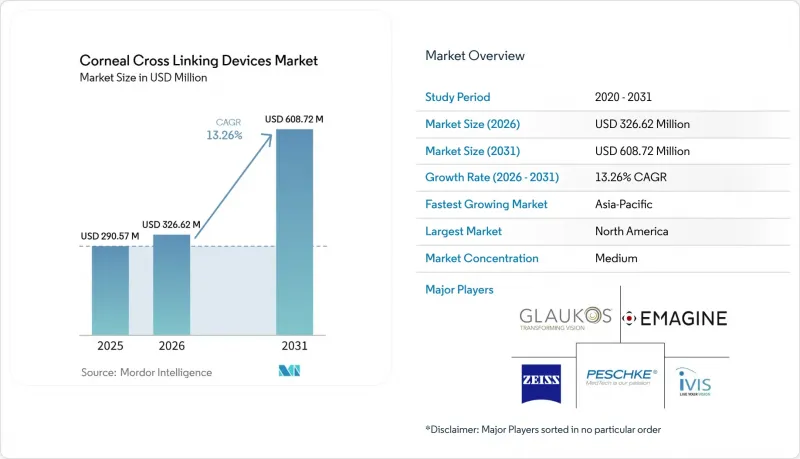
Mordor Intelligence에 의하면, 각막 교차결합 기기 시장은 2025년에 2억 9,057만 달러 규모로 평가되었고, 2026년에는 3억 2,662만 달러에 이를 것으로 예측됩니다.
본 보고서는 제품 유형(UV 장치, 리보플라빈 용액, 기타), 용도(원추각막, 각막확장증, 기타), 기술(상피 제거형 크로스링킹, 기타), 최종 사용자(병원, 안과 클리닉, 기타), 지역(북미, 유럽, 아시아태평양, 중동 및 아프리카, 남미)별로 분류되어 있습니다. 시장 전망은 금액(달러) 기준으로 제시되어 있습니다.
세계의 각막 교차결합 기기 시장 동향 및 인사이트
각막 원추증 진단율 상승
각막 토포그래피가 일상적인 안과 검사나 굴절 교정 수술 전 선별 검사에서 더욱 빈번하게 활용됨에 따라 진단 대상이 확대되고 있으며, 각막 교차결합 기기 시장은 이에 따른 혜택을 보고 있습니다. 2025년 다기관 공동 검토에 따르면, 전 세계 원추각막 유병률은 10만 명당 289.1명으로 추정되며, 전 세계적으로 2,370만 명 이상이 이 질환을 앓은 것으로 추산됩니다. 이에 따라 각막 교차결합 기기 시장의 잠재적 치료 대상자 수가 크게 증가하고 있습니다. 또한, 2025년 인도에서 실시된 다기관 공동 연구에 따르면, 진단받은 환자 중 가장 많은 연령대는 20-29세였으며, 증상 발현부터 진단까지의 평균 지연 기간은 2.7년인 것으로 나타났습니다. 이는 이전보다 더 조기에 치료가 가능한 환자가 다수 존재함을 시사합니다. 조기 발견이 중요한 이유는 각막의 얇아짐이나 시력 저하가 진행되기 전에 크로스링킹을 시행하는 것이 가장 효과적이기 때문입니다. 이러한 임상 경과가 의사나 가족에게 더욱 명확해짐에 따라, 각막 교차결합 기기 시장에서는 전문 의료기관 및 의뢰 의료기관 모두에서 치료로의 전환이 더욱 가속화될 것으로 전망됩니다. 또한, 치료 건수는 ‘누가 가장 먼저 병세 진행을 파악할 수 있는가’에 점점 더 좌우될 것이므로, 이러한 동향은 진단의 통합을 통한 상업적 가치도 높일 것입니다.
보다 신속하고 개인화된 프로토콜로의 전환
각막 교차결합 기기 시장은 수술실 중심의 긴 워크플로우에서 진료소에서의 치료에 적합한 더 짧은 프로토콜로 전환되고 있습니다. 2026년 『Journal of Refractive Surgery』지에 게재된 연구에 따르면, 새로운 에피온(epi-on) 프로토콜과 널리 사용되고 있는 가속형 에피오프(epi-off) 프로토콜 간에 통계적으로 유의미한 생체역학적 차이는 확인되지 않았습니다. 이는 침습성이 낮고 편의성이 높은 치료 경로의 임상적 근거를 뒷받침하는 것입니다. EMAGine사는 자사의 C-eye 플랫폼이 11가지 사전 설정 프로토콜을 지원하며, 그 중에는 10분 미만에 드레스덴 기준과 동등한 치료 성과를 제공하는 것을 목표로 한 옵션도 포함되어 있다고 밝혔습니다. 이는 각막 교차결합 기기 시장이 치료 효과뿐만 아니라 워크플로우의 효율성 측면에서도 경쟁이 치열함을 보여줍니다. 시술 시간 단축은 하루당 치료 건수를 늘리고, 환자의 부담을 줄이며, 안과 클리닉이 전용 수술실을 갖추지 않아도 치료를 도입하기 쉽게 만듭니다. 더 신속한 시술 프로토콜은 1회당 비용을 절감하고 치료를 제공할 수 있는 시설의 범위를 넓혀주므로 상업적인 효과가 중요합니다. 따라서 각막 교차결합 기기 시장은 유효성, 휴대성, 시술 부담 경감을 모두 갖춘 플랫폼으로 전환되고 있습니다.
높은 장비 도입 비용
각막 교차결합 기기 시장은 치료에 자본 설비와 지속적인 일회용 소모품이 모두 필요하기 때문에 여전히 도입에 있어 실질적인 장벽에 직면해 있습니다. 이러한 비용 구조는 자금력이 있는 시설이라면 흡수하기 쉬운 반면, 자금 사정이 어려운 소규모 안과 클리닉이나 신흥 시장의 의료 제공업체에게는 큰 부담이 됩니다. 2026년, 의사들은 UnitedHealthcare나 메디케이드(Medicaid)와 같은 주요 보험사들이 ‘Photrexa’라는 약제 성분에 대한 보험 급여가 불충분하다고 지적했습니다. 이는 각막 크로스링킹 장비 시장의 확립된 분야라 하더라도, 의료기관 차원에서는 이익률 압박에 직면할 수 있음을 보여줍니다. 중국에서는 환자의 본인 부담 치료비가 5,000위안(688달러)에서 1만 위안(1,376달러)으로 추정되며, 국가 차원의 환급 제도가 존재하지 않아 고소득 도시 지역을 제외한 곳에서의 보급이 제한되고 있습니다. 또한, Epioxa에 대해 현재 ‘미분류’ 청구가 이루어지고 있는 점도 의료기관 입장에서는 청구 불확실성과 행정 업무 부담을 가중시키고 있습니다.
부문 분석
2025년, UV 광 장치는 각막 크로스링킹 장치 시장의 60.84% 점유율을 차지했으며, 이는 모든 크로스링킹 시술에서 UV 광 장치가 핵심 하드웨어 계층으로서의 역할을 수행하고 있음을 반영합니다. 각막 크로스링킹 장치 시장은 여전히 이러한 시스템에 크게 의존하고 있습니다. 이는 이러한 시스템이 치료 프로토콜과 투여 로직을 담당하며, 많은 경우 독자적인 리보플라빈 제품과의 연동 기능도 갖추고 있기 때문입니다. 이러한 ‘설치 기반 효과’로 인해 기존 플랫폼은 안정적인 우위를 유지하고 있습니다. 훈련, 서비스, 약제 사용이 한 번 정립되면 진료소가 하드웨어를 쉽게 교체하지 않기 때문입니다. 또한 이는 새로운 치료 프로토콜이 등장하고 있음에도 불구하고, 주요 하드웨어 플랫폼이 여전히 각막 교차결합 기기 시장의 상업적 기반으로 남아 있는 이유를 설명해 줍니다.
복합형 장치는 2031년까지 연평균 성장률(CAGR) 14.58%를 나타낼 것으로 예측되며, 이는 제품 유형 중 가장 높은 성장률입니다. 이 제품의 매력은 토포그래피 유도 PRK와 크로스링킹을 한 번의 내원만으로 결합할 수 있다는 점에 있으며, 이를 통해 의사와 환자 모두의 편의성이 향상됩니다. 리보플라빈 용액은 각 시술에서 지속적인 수익을 창출하고 고객을 플랫폼 제품군에 더욱 강력하게 묶어두기 때문에 전략적으로 중요한 위치를 계속 차지하고 있습니다. 공초점 현미경 및 관련 영상 진단 도구는 매출 규모는 아직 작지만, 깊이 제어와 시술 후 평가가 더욱 중요시되는 3차 의료 기관에서 그 중요성이 높아지고 있습니다.
2025년에는 각막 원추증이 매출의 52.67%를 차지하며, 각막 교차결합 기기 시장의 주요 적용 분야로서의 지위를 유지했습니다. 이러한 주도적인 지위는 각막 원추증이 미국에서 승인된 치료법의 주요 적응증이며, 가장 강력한 임상적 근거를 갖춘 질환이라는 사실을 반영합니다. 각막 교차결합 기기 업계는 이 질환의 연령 분포에서도 혜택을 받고 있습니다. 이 질환은 종종 조기에 발병하며, 10대나 젊은 성인에서는 진행 속도가 빠를 수 있기 때문입니다. 따라서 13세 이상 환자를 대상으로 하는 ‘에피옥사(Epioxa)’의 적응증은 각막의 안정성을 유지함으로써 평생에 걸친 시력 저하를 예방할 수 있는 연령층에 해당하므로 상업적으로 중요합니다.
각막 확장증 시장은 2031년까지 연평균 성장률(CAGR) 14.82%를 나타낼 것으로 예측되며, 가장 빠르게 성장하는 적응증 부문이 될 것입니다. 그 이유는 간단명료합니다. LASIK, PRK, SMILE의 누적 시술 건수가 계속 증가함에 따라, 수술 후 확장증 위험이 있는 환자층이 지속적으로 확대되고 있기 때문입니다. 임상의들이 이 환자군을 기존의 원추각막 치료의 단순한 연장이 아닌 독립적인 치료 기회로 인식함에 따라, 각막 교차결합 기기 시장도 이에 부응하고 있습니다. 투명연변성, 감염성 각막염, 수포성 각막증 등 다른 적응증은 여전히 규모가 작고 전문성이 높은 편이지만, 단일 질환 시장보다는 장기적으로 적응 범위를 넓혀가고 있습니다.
지역별 분석
2025년, 북미는 각막 교차결합 기기 시장 규모의 48.95%를 차지하며, 해당 시장에서 가장 규모가 큰 지역 블록이 되었습니다. 이 지역은 미국 내 ‘epi-off’ 플랫폼에 대한 10년에 걸친 높은 인지도와, 진행성 원추각막 진단이 확인된 사례에 대해 많은 민간 보험사에서 이미 확대되어 온 보험 환급 경로의 혜택을 받았습니다. 2026년 3월, Glaukos사가 ‘Epioxa’를 시판함에 따라 미국은 새로운 단계에 접어들었습니다. 이를 통해 의사들에게는 FDA 승인을 받은 최초의 ‘에피온(epi-on)’ 치료 옵션이 제공되었으며, 각막 교차결합 기기 시장에는 더 조기적이고 저침습적인 치료로 나아가는 새로운 길이 열렸습니다. 이 회사의 초기 논평에서는 의료진의 관심이 유망하다고 언급되었으나, 이 지역의 향후 전개는 ‘에피온’ 치료에 대한 영구적인 보험 환급 제도가 얼마나 신속하게 마련되느냐에 달려 있습니다.
유럽은 확립된 안과 의료 인프라와 의료기기 제조업체 및 각막 전문의의 풍부한 기반을 바탕으로 계속해서 2위 지역 시장을 유지하고 있습니다. 독일, 영국, 프랑스, 이탈리아, 스페인이 이 지역의 매출의 대부분을 차지하고 있으며, 특히 독일과 영국은 근거 기반의 도입 패턴에서 중요한 역할을 하고 있습니다. 또한, iVis Technologies나 IROMED와 같은 국내 기업들이 오랫동안 이 지역의 기술 기반에 기여해 온 덕분에 이탈리아도 중요한 위치를 차지하고 있습니다.
아시아태평양은 2031년까지 연평균 성장률(CAGR) 16.28%를 나타낼 것으로 예측되며, 각막 교차결합 기기 시장에서 가장 빠르게 성장하는 지역이 될 것입니다. 그 주된 요인은 질병 부담에 있으며, 2025년 조사에 따르면 남아시아의 유병률은 인구 10만 명당 1,374.5명으로 추정되어 전 세계 평균치를 크게 상회했습니다. 또한, 2025년 연구에 따르면 인도에서는 진단까지의 지연 기간이 2.7년에 달하며, 이는 치료받지 못한 환자층이 방대함을 시사합니다. 선별 검사가 확대됨에 따라 향후 시술 건수가 대폭 증가할 것으로 예측됩니다. 중국에서는 여전히 국가 차원의 보험 적용이 이루어지지 않고 있지만, 저장성과 장쑤성에서 진행 중인 지역별 시범 사업은 향후 보다 광범위한 보험 적용을 향한 길을 제시하고 있습니다. 일본, 호주, 한국에서는 첨단 의료 시술 건수가 안정적으로 유지되고 있는 반면, 인도와 한국은 중요한 도입 기회로 두드러지고 있습니다. 중동 및 아프리카에서는 역학적 수요는 높지만 인프라가 취약하며, 남미에서는 브라질과 아르헨티나의 민간 병원에 의한 도입이 주도적이지만, 경제적 부담 능력으로 인해 성장은 여전히 제한되고 있습니다.
기타 혜택 :
- 엑셀 형식 시장 예측(ME) 시트
- 3개월간의 애널리스트 지원
자주 묻는 질문
목차
제1장 서론
제2장 조사 방법
제3장 주요 요약
제4장 시장 구도
제5장 시장 규모 및 성장 예측
제6장 경쟁 구도
제7장 시장 기회 및 향후 전망
KTH 26.08.10According to Mordor Intelligence, the corneal cross-linking devices market was valued at USD 290.57 million in 2025 and is projected to be valued at USD 326.62 million in 2026. This report is Segmented by Product Type (UV Devices, Riboflavin Solutions, and Others), Application (Keratoconus, Corneal Ectasia, and Others), Technology (Epithelium-Off Cross-Linking, and Others), End-User (Hospitals, Eye Clinics, and Others), and Geography (North America, Europe, Asia-Pacific, Middle East and Africa, South America). The Market Forecasts are Provided in Terms of Value (USD).
Global Corneal Cross-Linking Devices Market Trends and Insights
Rising Keratoconus Diagnosis Rates
The corneal cross-linking devices market is gaining from a broader diagnostic funnel as corneal topography is being used more often in routine ophthalmic workups and pre-refractive surgery screening. A 2025 multicenter review placed pooled global keratoconus prevalence at 289.1 per 100,000 persons and estimated more than 23.7 million affected people worldwide, which materially raises the addressable treatment pool for the corneal cross-linking devices market. A 2025 multicentric study from India also showed that the largest diagnosed group was 20 to 29 years old and that the mean delay from symptom onset to diagnosis was 2.7 years, which points to a large backlog of patients who can still be treated earlier than before. Earlier identification matters because cross-linking is most valuable before corneal thinning and visual loss become advanced. As that clinical pattern becomes more visible to physicians and families, the corneal cross-linking devices market is likely to see stronger procedural conversion in both specialty and referral settings. The same trend also improves the commercial value of diagnostic integration, because treatment volumes increasingly depend on who can identify progression first.
Shift Toward Faster, Customized Protocols
The corneal cross-linking devices market is moving away from long, operating-room-oriented workflows and toward shorter protocols that fit office-based care. A 2026 Journal of Refractive Surgery study found no statistically significant biomechanical difference between a new epi-on protocol and a widely used accelerated epi-off protocol, which supports the clinical case for less invasive and more convenient treatment pathways. EMAGine stated that its C-eye platform supports 11 preset protocols, including options intended to deliver Dresden-equivalent outcomes in less than 10 minutes, which shows how the corneal cross-linking devices market is competing on workflow efficiency as much as on treatment effect. Shorter sessions improve daily throughput, reduce patient burden, and make it easier for eye clinics to adopt treatment without dedicated operating room capacity. The commercial effect is important because faster protocols improve cost per visit and widen the range of sites that can offer care. The corneal cross-linking devices market is therefore shifting toward platforms that combine efficacy, portability, and lower procedural friction.
High Device Acquisition Costs
The corneal cross-linking devices market still faces a real adoption barrier because treatment requires both capital equipment and recurring single-use materials. That cost structure is easier to absorb in well-funded centers, but it is harder for smaller eye clinics and emerging-market providers with tighter cash flow. In 2026, physicians cited inadequate reimbursement for the Photrexa drug component from major payers such as UnitedHealthcare and Medicaid, which shows that even established parts of the corneal cross-linking devices market can face margin pressure at the provider level. In China, patient out-of-pocket treatment costs were listed at CNY 5,000 (USD 688) to CNY 10,000 (USD 1,376), and federal reimbursement was absent, which limits uptake outside higher-income urban settings. The present use of unclassified billing for Epioxa also adds claim uncertainty and administrative work for providers.
Other drivers and restraints analyzed in the detailed report include:
- Broader Adoption of Therapeutic Cross-Linking
- AI-Guided Treatment Planning Integration
- Limited Reimbursement Coverage
For complete list of drivers and restraints, kindly check the Table Of Contents.
Segment Analysis
UV light devices held 60.84% of corneal cross-linking devices market share in 2025, which reflects their role as the central hardware layer in every cross-linking procedure. The corneal cross-linking devices market still leans heavily on these systems because they carry the treatment protocol, the dosing logic, and, in many cases, the link to proprietary riboflavin products. That installed-base effect gives incumbent platforms a stable advantage because clinics do not switch hardware easily once training, service, and drug use are aligned. It also explains why the leading hardware platforms remain the commercial anchor of the corneal cross-linking devices market even as newer treatment protocols emerge.
Combination devices are projected to grow at 14.58% CAGR through 2031, which is the fastest rate within product type. The appeal comes from the ability to combine topography-guided PRK and cross-linking in one visit, which improves convenience for both physicians and patients. Riboflavin solutions remain strategically important because they create recurring revenue from each procedure and tie customers more closely to the platform family. Confocal microscopes and related imaging tools are still smaller in revenue, but they are gaining importance in tertiary settings where depth control and post-procedure assessment matter more.
Keratoconus accounted for 52.67% of revenue in 2025, which keeps it as the main application area in the corneal cross-linking devices market. This leading position reflects the fact that keratoconus is the core labeled indication for approved U.S. therapy and the condition with the strongest clinical evidence base. The corneal cross-linking devices industry also benefits from the age profile of the disease, because onset often occurs early and progression can be aggressive in teenagers and young adults. The Epioxa label for patients aged 13 years and older is therefore commercially important because it addresses an age group where preserving corneal stability can prevent lifelong visual decline.
Corneal ectasia is forecasted to grow at 14.82% CAGR through 2031, which makes it the fastest-rising application segment. The reason is straightforward because cumulative LASIK, PRK, and SMILE volumes continue to expand the pool of patients at risk of post-surgical ectasia. The corneal cross-linking devices market is responding as clinicians recognize this group as a separate treatment opportunity rather than a small extension of classic keratoconus care. Other applications such as pellucid marginal degeneration, infectious keratitis, and bullous keratopathy remain smaller and more specialized, but they keep the long-run indication base broader than a single-disease market.
Complete Report Scope:
- By Product Type
- UV Light Devices
- Riboflavin Solutions
- Combination Devices
- Confocal Microscopes
- Other Product Types
- By Application
- Keratoconus
- Corneal Ectasia
- Refractive Surgery Ectasia
- Pellucid Marginal Degeneration
- Other Applications
- By Technology
- Epithelium-Off Cross-Linking
- Epithelium-On Cross-Linking
- Accelerated Cross-Linking
- Customized and Topography-Guided Cross-Linking
- Other Technologies
- By End-User
- Hospitals
- Eye Clinics
- Ambulatory Surgical Centers
- Other End-Users
- By Geography
- North America
- United States
- Canada
- Mexico
- Europe
- Germany
- United Kingdom
- France
- Italy
- Spain
- Rest of Europe
- Asia-Pacific
- China
- Japan
- India
- Australia
- South Korea
- Rest of Asia-Pacific
- Middle East and Africa
- GCC
- South Africa
- Rest of Middle East and Africa
- South America
- Brazil
- Argentina
- Rest of South America
- North America
Geography Analysis
North America held 48.95% of corneal cross-linking devices market size in 2025, which made it the leading regional block in the corneal cross-linking devices market. The region benefited from a decade of U.S. epi-off platform familiarity and from reimbursement pathways that had already expanded across many commercial payers for documented progressive keratoconus. The United States moved into a new phase in March 2026 when Glaukos made Epioxa commercially available, giving physicians the first FDA-approved epi-on option and giving the corneal cross-linking devices market a new route to earlier and less invasive intervention. Early company commentary described physician interest as encouraging, but the next step for the region will depend on how quickly permanent reimbursement mechanisms develop for epi-on treatment.
Europe remained the second-largest regional market, supported by established ophthalmic infrastructure and a deep base of device manufacturers and corneal specialists. Germany, the United Kingdom, France, Italy, and Spain account for most regional revenue, with Germany and the United Kingdom especially important for evidence-led adoption patterns. Italy also matters because domestic companies such as iVis Technologies and IROMED have long contributed to the regional technology base.
Asia-Pacific is projected to grow at 16.28% CAGR through 2031, which makes it the fastest-growing region in the corneal cross-linking devices market. Disease burden is a major reason, with South Asian prevalence estimated at 1,374.5 per 100,000 persons in the 2025 review, far above the pooled global rate. India also showed a 2.7-year diagnostic delay in a 2025 study, which indicates a large untreated pool that could support strong future procedure growth as screening expands. In China, federal reimbursement is still absent, but regional pilots in Zhejiang and Jiangsu point to a possible pathway for broader inclusion over time. Japan, Australia, and South Korea contribute steady advanced-care volumes, while India and South Korea stand out as important installation opportunities. Middle East and Africa presents strong epidemiological need but weaker infrastructure, and South America remains led by private hospital adoption in Brazil and Argentina with growth still limited by affordability.
- AJL Ophthalmic S.A.
- Alcon
- BVI Medical
- Carl Zeiss
- EMAGine AG
- EssilorLuxottica
- Glaukos
- IROMED GROUP Srl
- iVis Technologies
- Lumenis
- Nidek
- Oculus Optikgerate
- OptoVue, Inc.
- Peschke GmbH
- Santen Pharmaceuticals
- SCHWIND eye-tech-solutions GmbH
- Topcon
- Ziemer Group
Additional Benefits:
- The market estimate (ME) sheet in Excel format
- 3 months of analyst support
TABLE OF CONTENTS
1 Introduction
- 1.1 Study Assumptions and Market Definition
- 1.2 Scope of the Study
2 Research Methodology
3 Executive Summary
4 Market Landscape
- 4.1 Market Overview
- 4.2 Market Drivers
- 4.2.1 Rising Keratoconus Diagnosis and Earlier Intervention
- 4.2.2 Shift Toward Faster, Office-Based Cross-Linking Workflows
- 4.2.3 Broader Adoption of Transepithelial and Accelerated Protocols
- 4.2.4 Expansion of Corneal Screening and Topography-Led Referral Pathways
- 4.2.5 Recurring Riboflavin and Consumables Demand from Installed Base Growth
- 4.2.6 AI-Guided Treatment Planning and Fluence Optimization Integration
- 4.3 Market Restraints
- 4.3.1 High Device Acquisition Cost and Procedure Affordability Pressure
- 4.3.2 Limited Reimbursement and Uneven Insurance Coverage
- 4.3.3 Protocol Variation and Clinical Standardization Gaps
- 4.3.4 Skilled Operator Dependence and Training Bottlenecks
- 4.4 Supply Chain Analysis
- 4.5 Regulatory Landscape
- 4.6 Technological Outlook
- 4.7 Porter's Five Forces Analysis
- 4.7.1 Threat of New Entrants
- 4.7.2 Bargaining Power of Suppliers
- 4.7.3 Bargaining Power of Buyers
- 4.7.4 Threat of Substitutes
- 4.7.5 Competitive Rivalry
5 Market Size & Growth Forecasts (Value, USD)
- 5.1 By Product Type
- 5.1.1 UV Light Devices
- 5.1.2 Riboflavin Solutions
- 5.1.3 Combination Devices
- 5.1.4 Confocal Microscopes
- 5.1.5 Other Product Types
- 5.2 By Application
- 5.2.1 Keratoconus
- 5.2.2 Corneal Ectasia
- 5.2.3 Refractive Surgery Ectasia
- 5.2.4 Pellucid Marginal Degeneration
- 5.2.5 Other Applications
- 5.3 By Technology
- 5.3.1 Epithelium-Off Cross-Linking
- 5.3.2 Epithelium-On Cross-Linking
- 5.3.3 Accelerated Cross-Linking
- 5.3.4 Customized and Topography-Guided Cross-Linking
- 5.3.5 Other Technologies
- 5.4 By End-User
- 5.4.1 Hospitals
- 5.4.2 Eye Clinics
- 5.4.3 Ambulatory Surgical Centers
- 5.4.4 Other End-Users
- 5.5 By Geography
- 5.5.1 North America
- 5.5.1.1 United States
- 5.5.1.2 Canada
- 5.5.1.3 Mexico
- 5.5.2 Europe
- 5.5.2.1 Germany
- 5.5.2.2 United Kingdom
- 5.5.2.3 France
- 5.5.2.4 Italy
- 5.5.2.5 Spain
- 5.5.2.6 Rest of Europe
- 5.5.3 Asia-Pacific
- 5.5.3.1 China
- 5.5.3.2 Japan
- 5.5.3.3 India
- 5.5.3.4 Australia
- 5.5.3.5 South Korea
- 5.5.3.6 Rest of Asia-Pacific
- 5.5.4 Middle East and Africa
- 5.5.4.1 GCC
- 5.5.4.2 South Africa
- 5.5.4.3 Rest of Middle East and Africa
- 5.5.5 South America
- 5.5.5.1 Brazil
- 5.5.5.2 Argentina
- 5.5.5.3 Rest of South America
- 5.5.1 North America
6 Competitive Landscape
- 6.1 Market Concentration
- 6.2 Market Share Analysis
- 6.3 Company Profiles (includes Global level Overview, Market level overview, Core Segments, Financials as available, Strategic Information, Market Rank/Share for key companies, Products & Services, Recent Developments)
- 6.3.1 AJL Ophthalmic S.A.
- 6.3.2 Alcon Inc.
- 6.3.3 BVI Medical
- 6.3.4 Carl Zeiss Meditec AG
- 6.3.5 EMAGine AG
- 6.3.6 EssilorLuxottica
- 6.3.7 Glaukos Corporation
- 6.3.8 IROMED GROUP Srl
- 6.3.9 iVis Technologies
- 6.3.10 Lumenis Be Ltd.
- 6.3.11 NIDEK CO., LTD.
- 6.3.12 Oculus Optikgerate GmbH
- 6.3.13 OptoVue, Inc.
- 6.3.14 Peschke GmbH
- 6.3.15 Santen Pharmaceutical Co., Ltd.
- 6.3.16 SCHWIND eye-tech-solutions GmbH
- 6.3.17 Topcon Corporation
- 6.3.18 Ziemer Ophthalmic Systems AG
7 Market Opportunities & Future Outlook
- 7.1 White-space & Unmet-need Assessment


