

|
시장보고서
상품코드
2099278
혈액 및 장기 은행 시장 : 점유율 분석, 업계 동향 및 통계, 성장 예측(2026-2031년)Blood and Organ Bank - Market Share Analysis, Industry Trends & Statistics, Growth Forecasts (2026 - 2031) |
||||||
 Mordor Intelligence
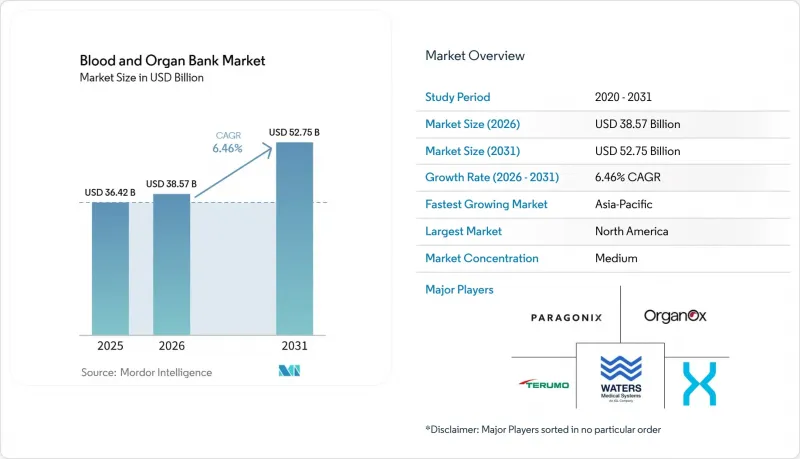
Mordor Intelligence에 의하면, 혈액 및 장기 은행 시장 규모는 2025년에 364억 2,000만 달러로 평가되었고 2026년 385억 7,000만 달러에서 2031년까지 527억 5,000만 달러에 이를 것으로 예측되며, 예측 기간(2026-2031년) CAGR은 6.46%를 나타낼 전망입니다.
본 보고서는 제품 유형(혈액, 장기), 기능(채취, 처리, 검사, 보존, 운송), 최종 사용자(병원, 외래수술센터(ASC), 제약 회사, 진료소 및 요양 시설, 연구·학술 기관), 그리고 지역(북미, 유럽, 아시아태평양, 중동 및 아프리카, 남미)별로 분류되어 있습니다. 시장 전망은 금액(달러) 기준으로 제시되어 있습니다.
전 세계 혈액 및 장기 은행 시장 동향 및 인사이트
이식 건수 및 혈액 수요 증가: 종양학 및 세포 치료가 소비 패턴을 재정의
신장, 간, 심장, 폐 이식 수술에서 전 세계 이식 건수는 꾸준히 증가하고 있으며, 이에 따라 혈액 및 장기 은행 시장에서는 장기 조달 활동과 병행하여 혈액 성분 수요도 높은 수준을 유지하고 있습니다. 각 이식 수술에서는 수술 중 및 수술 전후 관리에 적혈구, 혈소판, 혈장이 필요하기 때문에 이식 건수 증가는 이미 부족한 혈액 재고에 추가적인 부담을 주고 있습니다. 미국 혈액 센터(America’s Blood Centers)는 2026년 2월, 미국 혈액 공급량의 25% 이상이 암 치료에 사용되고 있다고 보고했으며, 이는 종양학이 수혈 수요의 최대 최종 목적지 중 하나임을 보여줍니다. 해당 보도자료에 따르면, 미국 병원에서는 매년 365만 명의 환자에게 적혈구 수혈이 이루어지고 있으며, 1일당 혈소판 사용량은 6,000단위, 혈장 사용량은 5,200단위를 초과하고 있습니다. 세포 치료 프로토콜에 따라 혈소판 및 혈액 성분의 사용이 더욱 확대되고 있으며, 그 수요는 기존의 수술이나 외상 치료의 범위를 넘어 확장되고 있습니다. 더 많은 병원 시스템에서 이식 프로그램이 확대됨에 따라, 혈액 및 장기 은행 시장에서는 여러 임상 경로를 통해 동시에 강력한 수요가 발생하고 있지만, 공급 네트워크는 그 속도를 완전히 따라잡지 못하고 있습니다.
첨단 혈액 성분 분리·보존 시스템의 활용 확대: 자동화가 적용되는 공급원 확대
혈액 성분 분리 과정의 자동화는 수작업으로 인한 편차를 줄이고 수율의 일관성을 향상시켜, 혈액 및 장기 은행 시장에서 혈액 센터가 전혈을 더 신속하게 처리할 수 있도록 지원하고 있습니다. 테르모 블러드 앤 셀 테크놀로지스는 2025년, 카터 블러드케어가 Reveos 시스템과 Lumia 소프트웨어 플랫폼을 활용한 전혈 처리의 완전 자동화 전환을 완료한 미국 최초의 혈액 센터가 되었다고 발표했습니다. 이 전환이 중요한 이유는 한 번의 원심분리 주기로 혈소판, 혈장, 적혈구 농축액을 분리할 수 있어 보다 엄격한 공정 관리 하에 처리 능력 향상을 실현할 수 있기 때문입니다. 장기 분야에서는 특정 이식 경로에서 정적 저온 보존을 대체할 실용적인 대안으로서 기계적 관류가 계속해서 보급되고 있습니다. FDA는 2026년 3월 9일, TransMedics사의 ‘Organ Care System Liver’에 대해 PMA 보완 승인을 부여했습니다. 이로써 미국 내 능동적 장기 보존 시스템의 규제상 지위가 강화되었습니다. 이를 종합해 보면, 혈액은행의 자동화와 장기 보존 분야의 능동적 관류는 이용 가능한 공급 기반을 확대하고 있으며, 이것이 혈액 및 장기은행 시장의 중기적 성장을 뒷받침하고 있습니다.
만성적인 기증자 부족과 높은 기증 포기율: 기술만으로는 쉽게 해소할 수 없는 공급의 한계
혈액 및 장기 은행 시장에서 가장 뿌리 깊은 제약은 여전히 적격 기증자 수와 실제 헌혈·장기 기증량 사이의 격차입니다. 미국 적십자사는 2026년 1월, 독감 유행과 혹독한 겨울 날씨로 인해 약 400건의 헌혈 활동이 중단된 결과, 미국의 혈액 공급량이 한 달 만에 35% 감소했다고 발표했습니다. 이 발표에서는 미국 인구의 62%가 헌혈 적격자임에도 불구하고, 실제로 매년 헌혈을 하는 사람은 고작 3%에 불과하다는 점도 지적되었습니다. 2025년 『Transfusion』지에 게재된 연구에 따르면, 개인별 헌혈 적격성 평가로의 전환은 전국적인 도입 측면에서 여전히 초기 단계에 있으며, 이는 헌혈 적격자 범위의 확대가 광범위한 혈액 부족 추세를 아직 상쇄하지 못하고 있음을 의미합니다. 또한 『Journal of Healthcare and Disease Control』지에 게재된 2025년 연구에 따르면, 감염병 검사의 엄격화는 안전성을 향상시키는 한편, 감염병이 풍토병으로 존재하는 지역에서는 헌혈을 자제해야 한다는 압력이 높아져, 안전성과 공급량 확보 사이에서 어려운 균형 문제가 발생한다는 사실이 밝혀졌습니다. 이로 인해 헌혈자의 참여율이 낮은 상태가 지속되는 한, 혈액 및 장기 은행 시장에는 구조적인 공급 상한선이 존재하게 되며, 기술을 통해 그 상한선을 완화할 수는 있더라도 완전히 해소할 수는 없는 상황입니다.
부문 분석
2025년 시점에서 혈액은 혈액 및 장기 뱅크 시장 점유율의 63.83%를 차지하고 있으며, 2031년까지 연평균 성장률(CAGR) 7.89%로 확대될 것으로 예측됩니다. 이로써 제품 유형 중 최대 점유율과 가장 높은 성장률을 모두 기록하게 됩니다. 이러한 조합은 특히 종양학, 외상, 수술 전후 관리 및 세포 치료 지원 분야에서 수요 기반이 정체되기는커녕 여전히 확대되고 있음을 반영합니다. 미국 혈액 센터(America’s Blood Centers)는 2026년 2월, 암 치료만으로도 미국 혈액 공급량의 25% 이상이 소비되고 있다고 발표했으며, 이는 혈액 이용에서 종양학이 얼마나 큰 비중을 차지하고 있는지를 뒷받침합니다. 또한, 해당 데이터 세트에서는 병원 도착 전 수혈이 혈액 이용에서 두드러지고 확대되는 추세로 기록되어 있으며, 이는 기존의 입원 환자 중심 환경 이외의 분야에서 이용이 확대되고 있음을 시사합니다. AABB 제35판 기준이 2026년 4월에 발효되어, 핵심 기술 모니터링 및 병원체 저감 처리를 거친 동결 침전 피브리노겐 복합체의 조제에 관한 요건이 갱신되었습니다. 이에 따라 인증 혈액 센터 전반에 걸쳐 새로운 장비 재검토 주기가 추진될 것입니다.
2025년 기준, 장기는 제품 기반으로는 비교적 작은 비중을 차지했으나, 혈액 및 장기 은행 업계에서는 이식 1건당 의료기기, 보존, 물류에 대한 부담이 훨씬 크기 때문에 이 부문은 여전히 전략적으로 중요합니다. 주요 상업적 기회는 정적 보존을 통한 결과가 너무 불확실하다는 이유로 기존에는 폐기되던 ‘한계 기증자’의 장기를 활용하는 방안을 개선하는 데 있습니다. 트랜스메딕스(Transmedix)사의 ‘Organ Care System Liver’에 대한 FDA 보충 신청, 테르모(Terumo)사가 2025년 10월에 OrganOx사를 인수한 사례는 모두 대형 의료기기 기업들이 능동적 장기 보존에 자본과 규제 대응 노력을 투입하고 있음을 보여줍니다. 이러한 임상적·상업적 기반이 깊어짐에 따라, 혈액 및 장기 은행 시장에서 장기 은행은 기존의 냉장 보존이라는 기존 방식에서 더욱 벗어나, 더 많은 이식 경로에서 능동적 관류로 전환될 가능성이 높다고 볼 수 있습니다.
지역별 분석
2025년, 북미는 혈액 및 장기 은행 시장 점유율의 38.63%를 차지하며, 인증받은 혈액 은행 네트워크, 확립된 장기 조달 시스템, 그리고 의료기기의 보급이 진행되고 있다는 점을 강점으로 삼아 지역별 1위를 유지했습니다. 미국은 대규모 수혈 기반과 자동화 및 관류 기술에 대한 적극적인 투자를 겸비하고 있어, 해당 지역 내에서 여전히 가장 큰 기여를 하는 국가로 남아 있습니다. 2026년 1월 미국 적십자사가 발령한 혈액 부족 경보는 기상 조건이나 질병으로 인해 헌혈자 참여율이나 헌혈 활동이 저해될 경우, 성숙한 네트워크조차도 취약해질 수 있음을 보여주었습니다. 또한, AABB의 2026년 4월 기준 개정 주기에 따라 인증 사업자 전반에서 규정 준수를 주도하는 장비 갱신이 진행되고 있으며, 이는 모니터링 및 공정 제어에 대한 지속적인 지출을 뒷받침하고 있습니다. 캐나다와 멕시코에서는 디지털 헌혈자 관리 및 콜드체인 역량 확충이 진행되고 있지만, 이 지역의 수익 기반은 여전히 주로 미국의 시스템 규모와 조달 밀도에 의존하고 있습니다.
유럽은 여전히 두 번째로 큰 지역 시장이며, 이 지역은 기존의 지침을 대체하여 인간 유래 물질에 관한 보다 통일된 체계를 규정하는 규정(EU) 2024/1938에 따라 재편되고 있습니다. 혈액 및 장기 은행 시장에서 독일, 영국, 프랑스는 처리 건수와 인프라 완비도 측면에서 계속해서 주도적인 입지를 차지하고 있습니다. 2026년 5월 NHS 로지안이 ‘Kidney Assist Transport’를 최초로 도입한 것은 기계 지원 보존 기술이 해당 지역 일부에서 병원의 일상 진료에 정착되고 있음을 보여줍니다. 또한, 이탈리아의 BILGAI 파트너십은 유럽이 의료기기뿐만 아니라 AI 주도형 혈액 공급망 관리에도 투자하고 있음을 보여주며, 이를 통해 해당 지역의 디지털 인프라 개발에서의 역할이 확대되고 있습니다.
아시아태평양의 혈액 및 장기 은행 시장 규모는 2031년까지 연평균 성장률(CAGR) 8.15%로 확대될 것으로 예측되며, 전 세계 전망에서 가장 빠르게 성장하는 지역이 될 것으로 보입니다. 이러한 성장은 중국의 병원 수용 능력 확대, 일본의 인구 통계학적 압력, 그리고 인도의 혈액 물류 환경 정비 진전에 힘입어 뒷받침되고 있습니다. 중동 및 아프리카 및 남미는 여전히 규모가 작은 지역 시장이지만, GCC 국가들의 국가적 혈액 전략과 브라질의 PBM(의약품 급여 관리)과 관련된 비용 절감 사례는 운영 효율성 개선이 확립된 주요 시장을 넘어 확산되고 있음을 보여줍니다.
기타 혜택:
- 엑셀 형식 시장 예측(ME) 시트
- 3개월간의 애널리스트 지원
자주 묻는 질문
목차
제1장 서론
제2장 조사 방법
제3장 주요 요약
제4장 시장 구도
제5장 시장 규모와 성장 예측
제6장 경쟁 구도
제7장 시장 기회와 향후 전망
JHS 26.08.05According to Mordor Intelligence, the blood and organ bank market size was valued at USD 36.42 billion in 2025 and is estimated to grow from USD 38.57 billion in 2026 to reach USD 52.75 billion by 2031, at a CAGR of 6.46% during the forecast period (2026-2031).
This report is Segmented by Product Type (Blood, Organs), Function (Collection, Processing, Testing, Storage, Transportation), End User (Hospitals, Ambulatory Surgery Centers, Pharmaceutical Companies, Clinics and Nursing Homes, Research and Academic Institutes), and Geography (North America, Europe, Asia-Pacific, Middle East & Africa, South America). The Market Forecasts are Provided in Terms of Value (USD).
Global Blood and Organ Bank Market Trends and Insights
Rising Transplant Volume and Blood Demand: Oncology and Cell Therapy Redefine Consumption Patterns
Global transplant activity continues to rise across kidney, liver, heart, and lung procedures, and that keeps blood component demand elevated alongside organ procurement activity in the blood and organ bank market. Each transplant procedure requires red blood cells, platelets, and plasma during surgery and perioperative care, which means transplant growth adds pressure to already tight blood inventories. America's Blood Centers reported in February 2026 that more than 25% of the U.S. blood supply is used in cancer care, which shows how oncology has become one of the largest endpoints for transfusion demand. The same release stated that U.S. hospitals transfuse red blood cells to 3.65 million patients each year, while daily use exceeds 6,000 units of platelets and 5,200 units of plasma. Cell therapy protocols are adding another layer of platelet and component use, which extends demand beyond traditional surgery and trauma settings. As transplant programs expand in more hospital systems, the blood and organ bank market is seeing stronger demand from multiple clinical pathways at the same time, and supply networks have not fully caught up with that pace.
Rising Use of Advanced Component Separation and Storage Systems: Automation Extends the Addressable Pool
Automation in blood component separation is reducing manual variability, improving yield consistency, and helping blood centers process whole blood faster in the blood and organ bank market. Terumo Blood and Cell Technologies stated in 2025 that Carter BloodCare became the first U.S. blood center to complete a full transition to automated whole blood processing with the Reveos system and Lumia software platform. That transition matters because one centrifugation cycle can separate platelets, plasma, and red blood cell concentrates, which supports higher throughput with tighter process control. On the organ side, machine perfusion continues to gain ground as a practical alternative to static cold storage for selected transplant pathways. The FDA granted a PMA supplement for TransMedics' Organ Care System Liver on March 9, 2026, which reinforces the regulatory standing of active organ preservation systems in the United States. Taken together, automation in blood banking and active perfusion in organ preservation are widening the usable supply base, which supports the medium-term expansion of the blood and organ bank market.
Chronic Donor Shortages and High Deferral Rates: The Supply Ceiling That Technology Cannot Easily Lift
The most persistent limit on the blood and organ bank market is still the gap between eligible donors and actual donation volumes. The American Red Cross stated in January 2026 that the blood supply in the United States fell 35% in one month after flu activity and severe winter weather disrupted nearly 400 blood drives. The same release noted that while 62% of the U.S. population is eligible to give blood, only 3% donate each year. A 2025 study in Transfusion found that the shift to individual donor assessment is still in the early stages of national adoption, which means eligibility broadening has not yet offset the wider shortage pattern. A 2025 study in the Journal of Healthcare and Disease Control also showed that stricter infectious disease testing can improve safety while raising deferral pressure in endemic settings, which creates a difficult balance between safety and availability. This leaves the blood and organ bank market with a structural supply ceiling that technology can soften, but not remove, when donor participation remains weak.
Other drivers and restraints analyzed in the detailed report include:
- Expansion of Patient Blood Management Programs: Analytics Platforms Convert Savings into Systemic Adoption
- Remote-Location Organ Logistics Requiring Extended Preservation Windows: Procurement Geography Expands
- Cold-Chain Compliance Cost Burden: Infrastructure Investment Penalizes Smaller Operators Disproportionately
For complete list of drivers and restraints, kindly check the Table Of Contents.
Segment Analysis
Blood held 63.83% of the blood and organ bank market share in 2025 and is projected to expand at 7.89% CAGR through 2031, which gives it both the largest and the fastest-growing position within product type. That combination reflects a demand base that is still broadening rather than leveling off, especially in oncology, trauma, perioperative care, and cell therapy support. America's Blood Centers stated in February 2026 that cancer care alone uses more than 25% of the U.S. blood supply, which confirms how strongly oncology shapes blood utilization. The same dataset also recorded prehospital transfusion as a visible and growing part of blood use, which points to wider deployment outside traditional inpatient settings. AABB's 35th edition of standards took effect in April 2026 with updated requirements for critical technology monitoring and pathogen-reduced cryoprecipitated fibrinogen complex preparation, which supports another cycle of equipment review across accredited blood centers.
Organs represented the smaller product base in 2025, but this segment remains strategically important because device, preservation, and logistics intensity are much higher per transplant event in the blood and organ bank industry. The key commercial opportunity lies in improving the use of marginal-donor organs that were historically discarded because static preservation outcomes were too uncertain. The FDA supplement for TransMedics' Organ Care System Liver and Terumo's October 2025 acquisition of OrganOx both show that larger medtech companies are committing capital and regulatory effort to active organ preservation. As that clinical and commercial base deepens, organ banking is likely to move further away from cold-storage defaults and closer to active perfusion across more transplant pathways in the blood and organ bank market.
Complete Report Scope:
- By Product Type
- Blood
- Organs
- By Function
- Collection
- Processing
- Testing
- Storage
- Transportation
- By End User
- Hospitals
- Ambulatory Surgery Centers
- Pharmaceutical Companies
- Clinics and Nursing Homes
- Research and Academic Institutes
- By Geography
- North America
- United States
- Canada
- Mexico
- Europe
- Germany
- United Kingdom
- France
- Italy
- Spain
- Rest of Europe
- Asia-Pacific
- China
- Japan
- India
- Australia
- South Korea
- Rest of Asia-Pacific
- Middle East & Africa
- GCC
- South Africa
- Rest of Middle East & Africa
- South America
- Brazil
- Argentina
- Rest of South America
- North America
Geography Analysis
North America held 38.63% of the blood and organ bank market share in 2025, which kept it in the leading regional position on the strength of accredited blood-bank networks, established organ procurement systems, and deeper device adoption. The United States remains the largest contributor within the region because it combines a large transfusion base with active investment in automation and perfusion technology. The American Red Cross shortage alert in January 2026 showed that even mature networks remain vulnerable when weather and illness disrupt donor turnout and blood-drive activity. AABB's April 2026 standards cycle is also reinforcing a compliance-led equipment refresh across accredited operators, which supports continued spending on monitoring and process control. Canada and Mexico are expanding digital donor management and cold-chain capability, but the regional revenue base still rests mainly on U.S. system scale and procurement intensity.
Europe remains the second-largest regional market, and the region is being reshaped by Regulation (EU) 2024/1938, which replaces older directives with a more unified framework for substances of human origin. Germany, the United Kingdom, and France continue to lead on procedure volume and infrastructure depth in the blood and organ bank market. NHS Lothian's first use of Kidney Assist Transport in May 2026 shows that machine-supported preservation is moving into routine hospital practice in parts of the region. Italy's BILGAI partnership also shows that Europe is investing in AI-led blood supply chain management, not only in devices, which broadens the region's role in digital infrastructure development.
The blood and organ bank market size for Asia-Pacific is projected to grow at 8.15% CAGR through 2031, making it the fastest-growing region in the global outlook. Growth is being supported by hospital capacity expansion in China, demographic pressure in Japan, and a more formal blood logistics environment in India. Middle East and Africa and South America remain smaller regional bases, but national blood strategies in the GCC and PBM-linked savings in Brazil show that operational improvement is widening beyond the largest established markets.
- America's Blood Centers
- Artivion, Inc.
- Blood Centers of America
- BMI OrganBank
- Bridge to Life Ltd.
- Canadian Blood Services
- CSL Plasma
- Donate Life America
- LifeCenter Northwest
- New England Donor Services
- New York Blood Center
- NHS Blood and Transplant
- Organox
- Paragonix Technologies
- Preservation Solution
- Sanquin
- Terumo
- The American National Red Cross
- The Living Bank
- Vitalant
- Waters Medical Systems, LLC
- Xvivo Perfusion
Additional Benefits:
- The market estimate (ME) sheet in Excel format
- 3 months of analyst support
TABLE OF CONTENTS
1 Introduction
- 1.1 Study Assumptions & Market Definition
- 1.2 Scope of the Study
2 Research Methodology
3 Executive Summary
4 Market Landscape
- 4.1 Market Overview
- 4.2 Market Drivers
- 4.2.1 Rising Transplant Volume and Blood Demand
- 4.2.2 Expansion of Patient Blood Management Programs
- 4.2.3 Rising Use of Advanced Component Separation and Storage Systems
- 4.2.4 Donor Pool Strain From Deferral and Eligibility Screening
- 4.2.5 Remote-Location Organ Logistics Requiring Extended Preservation Windows
- 4.2.6 Digital Traceability Pressure Across Blood and Organ Chains
- 4.3 Market Restraints
- 4.3.1 Chronic Donor Shortages and High Deferral Rates
- 4.3.2 Cold-Chain Compliance Cost Burden
- 4.3.3 Limited Reimbursement Visibility for Organ Preservation Upgrades
- 4.3.4 Fragmented Regulatory Requirements Across Countries
- 4.4 Value / Supply-Chain Analysis
- 4.5 Regulatory Landscape
- 4.6 Technological Outlook
- 4.7 Porter's Five Forces Analysis
- 4.7.1 Threat of New Entrants
- 4.7.2 Bargaining Power of Suppliers
- 4.7.3 Bargaining Power of Buyers
- 4.7.4 Threat of Substitutes
- 4.7.5 Industry Rivalry
5 Market Size & Growth Forecasts
- 5.1 By Product Type
- 5.1.1 Blood
- 5.1.2 Organs
- 5.2 By Function
- 5.2.1 Collection
- 5.2.2 Processing
- 5.2.3 Testing
- 5.2.4 Storage
- 5.2.5 Transportation
- 5.3 By End User
- 5.3.1 Hospitals
- 5.3.2 Ambulatory Surgery Centers
- 5.3.3 Pharmaceutical Companies
- 5.3.4 Clinics and Nursing Homes
- 5.3.5 Research and Academic Institutes
- 5.4 By Geography
- 5.4.1 North America
- 5.4.1.1 United States
- 5.4.1.2 Canada
- 5.4.1.3 Mexico
- 5.4.2 Europe
- 5.4.2.1 Germany
- 5.4.2.2 United Kingdom
- 5.4.2.3 France
- 5.4.2.4 Italy
- 5.4.2.5 Spain
- 5.4.2.6 Rest of Europe
- 5.4.3 Asia-Pacific
- 5.4.3.1 China
- 5.4.3.2 Japan
- 5.4.3.3 India
- 5.4.3.4 Australia
- 5.4.3.5 South Korea
- 5.4.3.6 Rest of Asia-Pacific
- 5.4.4 Middle East & Africa
- 5.4.4.1 GCC
- 5.4.4.2 South Africa
- 5.4.4.3 Rest of Middle East & Africa
- 5.4.5 South America
- 5.4.5.1 Brazil
- 5.4.5.2 Argentina
- 5.4.5.3 Rest of South America
- 5.4.1 North America
6 Competitive Landscape
- 6.1 Market Concentration
- 6.2 Market Share Analysis
- 6.3 Company Profiles (includes Global Level Overview, Market-level Overview, Core Segments, Financials, Strategic Information, Market Rank/Share, Products & Services, Recent Developments)
- 6.3.1 America's Blood Centers
- 6.3.2 Artivion, Inc.
- 6.3.3 Blood Centers of America
- 6.3.4 BMI OrganBank
- 6.3.5 Bridge to Life Ltd.
- 6.3.6 Canadian Blood Services
- 6.3.7 CSL Plasma
- 6.3.8 Donate Life America
- 6.3.9 LifeCenter Northwest
- 6.3.10 New England Donor Services
- 6.3.11 New York Blood Center
- 6.3.12 NHS Blood and Transplant
- 6.3.13 OrganOx Limited
- 6.3.14 Paragonix Technologies, Inc.
- 6.3.15 Preservation Solutions, Inc.
- 6.3.16 Sanquin
- 6.3.17 Terumo Corporation
- 6.3.18 The American National Red Cross
- 6.3.19 The Living Bank
- 6.3.20 Vitalant
- 6.3.21 Waters Medical Systems, LLC
- 6.3.22 XVIVO Perfusion AB
7 Market Opportunities & Future Outlook
- 7.1 White-space & Unmet-need Assessment


