

|
시장보고서
상품코드
2099282
관상동맥 커팅 풍선 시장 : 점유율 분석, 업계 동향 및 통계, 성장 예측(2026-2031년)Coronary Cutting Balloon - Market Share Analysis, Industry Trends & Statistics, Growth Forecasts (2026 - 2031) |
||||||
 Mordor Intelligence
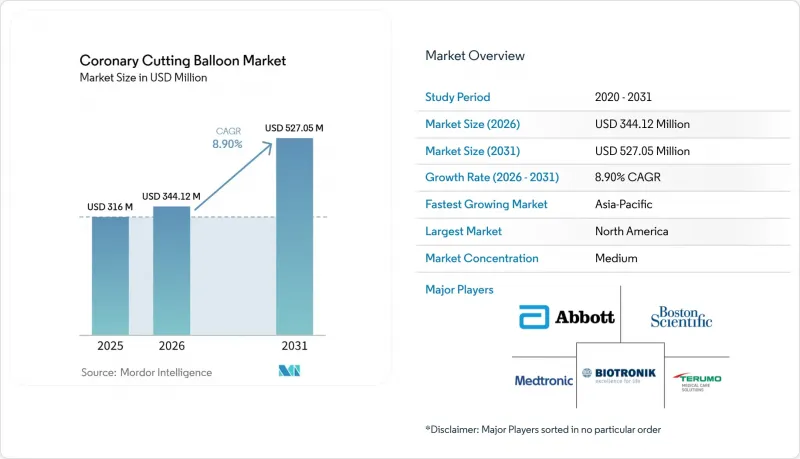
Mordor Intelligence에 의하면, 관상동맥 커팅 풍선 시장 규모는 2025년 3억 1,600만 달러, 2026년 3억 4,412만 달러에서 2031년까지 5억 2,705만 달러로 확대한다고 예측되고 있어 2026년부터 2031년까지 연평균 복합 성장률(CAGR)은 8.90%를 나타낼 전망입니다.
본 보고서는 블레이드 수(3개 블레이드, 4개 블레이드), 용도(석회화 병변 치료, 스텐트 내 재협착, 병변 형성, 기타), 최종 용도(병원, 카테터 검사실, 외래수술센터(ASC), 기타), 지역(북미, 유럽, 아시아태평양, 중동 및 아프리카, 남미)별로 분류되어 있습니다. 시장 전망은 금액(달러) 기준으로 제시되어 있습니다.
전 세계 관상동맥 커팅 풍선 시장 동향 및 인사이트
고도 석회화된 관상동맥 병변의 부담 증가
관상동맥 커팅 풍선 시장 수요는 PCI(경피적 관상동맥 성형술) 대상 환자군에서 관상동맥 석회화가 뚜렷하게 증가함에 따라 뒷받침되고 있습니다. 계획적 PCI를 받는 환자의 18%에서 26%에서 중등도에서 중증의 석회화가 관찰되며, 70세 이상의 환자나 당뇨병, 만성 신장 질환, 이상지질혈증을 앓고 있는 환자에서는 그 부담이 더욱 커집니다. 고도로 석회화된 병변의 1년 후 MACE 발생률은 27.1%인 반면, 석회화가 비교적 적은 코호트에서는 15%에 그치고 있어, 이로 인해 관상동맥 커팅 풍선 시장에서 이러한 병변은 시술 위험 계획의 중심적인 위치를 계속 차지하고 있습니다. 표준 비컴플라이언트 풍선으로는 이러한 상황에서 충분한 확장을 얻지 못하는 경우가 많기 때문에 마이크로블레이드를 이용한 스코어링은 복잡한 병변의 시술에 있어 여전히 명확한 임상적 필요성을 충족시키고 있습니다. 2024년 SCAI의 석회화 관상동맥 병변 관리에 관한 전문가 합의에서는 단계적 병변 수정 프로토콜이 더욱 지지되었습니다. 이에 따라 환자 수가 많은 의료기관에서의 사용이 표준화되었으며, 관상동맥 커팅 풍선 시장은 복잡한 PCI 워크플로우와 밀접하게 연계된 상태를 유지하고 있습니다. 고령자 및 당뇨병 환자층이 확대됨에 따라, 관상동맥 커팅 풍선 시장은 통제된 플라크 교정이 필요한 복잡한 관상동맥 사례가 지속적으로 유입됨에 따라 계속해서 혜택을 볼 것으로 예측됩니다.
복잡한 PCI 및 병변 형성에서의 사용 확대
관상동맥 커팅 풍선 시장은 더 이상 응급 처치 용도로만 구성되지 않습니다. 이는 시술자가 이러한 기기를 복잡한 PCI 프로토콜의 계획된 단계로 점점 더 많이 활용하고 있기 때문입니다. 2025년에 보고된 RODIN-CUT 기법은 IVUS 유도 하의 구조화된 순차 팽창법을 제시하며, 중등도의 석회화가 동반된 혈관에서 용량 의존적인 플라크 변형과 보다 제어된 병변 형성을 실현했습니다. 이 접근법은 기기 사용을 시술자별 즉흥적인 선호도가 아닌 재현 가능한 워크플로우와 더 밀접하게 연결하기 때문에 관상동맥 커팅 풍선 시장에 있어 중요합니다. 유사한 변화는 병용 요법에서도 관찰되었으며, ROTA-CUT 데이터에 따르면, 아테렉토미 후 스텐트 확장률은 커팅 풍선을 사용했을 때 평균 86.1%였던 반면, 비커팅 풍선을 사용했을 때는 78.6%였습니다. 이로 인해, 특히 보조 기술 및 영상 진단의 활용에 이미 익숙한 의료 기관에서 다단계 석회화 관리 전략에 있어 관상동맥 커팅 풍선 시장의 역할이 강화될 것입니다. 더 많은 PCI 팀이 사후적인 응급 대응이 아닌 계획적인 병변 형성을 채택함에 따라, 관상동맥 커팅 풍선 시장에서는 시술에 대한 수요가 더욱 안정화되고, 복잡한 증례당 기기 사용량도 증가할 것으로 예측됩니다.
기존 풍선 플랫폼에 비해 높은 기기 비용
관상동맥 커팅 풍선 시장의 주요 제약 요인은 표준 비준수형 풍선 플랫폼에 비해 단가가 높다는 점입니다. 이러한 가격 차이는 비용에 민감한 의료 시스템에서 조달상의 장벽이 되며, 특히 상환 패키지에서 플라크 수정 도구가 광범위한 PCI 지급 번들에서 분리되어 있지 않은 경우에 두드러집니다. 병원 외래 진료 환경에서는 기기 비용 증가분이 시술 시설의 이익률에 직접 반영되기 때문에 임상 지침에서 커팅 풍선의 사용이 명확히 요구되지 않는 경우 대체품으로 전환하려는 압력이 높아집니다. 이 문제는 남아시아, 남미, 그리고 중동 및 아프리카의 일부 지역에서 더욱 두드러지게 나타납니다. 이러한 지역에서는 의약품 목록 예산이 여전히 빠듯하고, 공립 병원의 조달 활동이 가격을 중시하는 경향이 강하기 때문입니다. 또한, 중국이나 인도의 국내 공급업체가 기본 PTCA 풍선의 최저 가격을 인하할 경우, 관상동맥 커팅 풍선 시장의 상대적 가격 차이는 더욱 확대될 것입니다. 이는 첨단 스코어링 플랫폼과의 가격 차이가 구매자에게 더욱 명확해지기 때문입니다. 프리미엄 시장에서 규제 준수 비용은 가격 경직성을 더욱 강화하는 요인으로 작용하고 있으며, 이로 인해 확고한 입지를 가진 브랜드는 프리미엄 위치를 유지할 수 있는 반면, 가격 중심의 유통 채널에서 관상동맥 커팅 풍선 시장의 광범위한 확장은 둔화되고 있습니다.
부문 분석
2025년, 3날 장치는 관상동맥 커팅 풍선 시장 점유율의 62.2%를 차지했습니다. 이는 일상적인 관상동맥 병변 치료의 대부분을 차지하는 2.00 mm에서 3.25 mm의 혈관 직경 범위를 지원하기 때문입니다. 또한, 관상동맥 커팅 풍선 업계의 이 분야는 오랜 상업적 실적을 바탕으로 한 이점을 누리고 있으며, 이를 통해 확립된 카테터 치료 프로그램에서 의료진의 익숙함과 구매에 대한 신뢰가 뒷받침되고 있습니다. 보스턴 사이언티피크(Boston Scientific)의 ‘WOLVERINE’ 플랫폼은 이러한 크기 설정의 논리를 반영하고 있습니다. 이 회사의 3날 모델은 2.00 mm-3.25 mm 범위를 지원하며, 4날 모델은 3.50 mm-4.00 mm 혈관을 대상으로 포지셔닝되어 있기 때문입니다. 이러한 제품 구성은 관상동맥 커팅 풍선 시장에서 블레이드 구성이 단순한 브랜드 선호가 아니라 혈관의 주위 직경 및 접촉 형태와 직접적으로 연관되어 있음을 보여줍니다.
4날 장치의 관상동맥 커팅 풍선 시장 규모는 2031년까지 연평균 성장률(CAGR) 10.4%로 확대될 것으로 예측되며, 가장 두드러진 성장을 보이는 블레이드 구성입니다. 이러한 성장은 더 굵은 혈관에 대한 중재, 특히 좌전하행지(LAD)의 근위부 및 중부에서의 시술과 관련이 있으며, 해당 부위에서는 플라크와의 접촉 면적이 넓어져 칼슘 플라크를 보다 효율적으로 분쇄할 수 있습니다. 또한, CUPID 임상시험의 IVUS 가이드군에는 4블레이드 커팅 풍선을 이용한 혈관 성형술도 포함되어 있어, 이를 통해 관상동맥 커팅 풍선 시장에서 이 플랫폼의 임상적 인지도가 공식적으로 높아졌습니다. 앞으로 대구경 혈관에서 OCT 측정을 통해 더 깊은 파쇄 깊이와 우수한 시술 제어성을 입증하는 공급업체는 관상동맥 커팅 풍선 시장에서 더욱 명확한 차별화 요소를 제시할 수 있게 될 것입니다.
지역별 분석
2025년, 북미는 관상동맥 커팅 풍선 시장 점유율의 38.2%를 차지하며, 지역별로는 가장 큰 기여를 한 지역이 되었습니다. 미국은 PCI 시술의 높은 시행 빈도, 주요 제조업체의 광범위한 상업적 입지, 그리고 확립된 외래 진료 보상 체계를 통해 그 지위의 상당 부분을 주도하고 있습니다. 또한, 외래 관상동맥 중재술에 대한 투자는 지급률이 상승함에 따라 경제적으로 더욱 실현 가능해지기 때문에 ASC(외래수술센터)에 대한 보험 급여 지원도 해당 지역의 전망을 강화하고 있습니다. 게다가 북미는 석회화 병변 치료에 관한 임상 증거 창출 및 프로토콜 표준화의 주요 거점이기 때문에 관상동맥 커팅 풍선 시장에서도 계속해서 중요한 위치를 차지하고 있습니다. 유럽은 관상동맥 커팅 풍선 시장에서 성숙한 지역 시장이며, 특히 독일이 두드러집니다. 이는 IVUS 도입이 진행됨에 따라, 통제된 플라크 수정이 필요한 병변을 더 많이 식별할 수 있게 되었기 때문입니다.
아시아태평양은 관상동맥 커팅 풍선 시장에서 가장 빠르게 성장하는 지역이며, 2031년까지 연평균 성장률(CAGR)은 10.8%로 예측됩니다. 중국이 주요 성장 동력으로 작용하고 있으며, 카테터 검사 건수는 2024년에 191만 건에 달하고 2030년까지 360만 건을 넘어설 것으로 예측되어, 기기 수요 증가분 측면에서 가장 큰 시장 규모를 형성하고 있습니다. 인도에서는 민간 병원 네트워크 전반에 걸친 PCI 접근성 확대를 통해 추가적인 성장 동력이 더해지고 있습니다. 한편, 일본과 한국에서는 성숙한 OCT 및 IVUS 유도 PCI 프로토콜 덕분에 건당 기기 사용량이 증가하고 있습니다. Lepu Medical과 같은 현지 공급업체들도 현지화된 제품 제공 및 입찰에 폭넓게 참여함으로써 아시아태평양의 관상동맥 커팅 풍선 시장에서 가격 경쟁력을 높이고 있습니다.
남미, 중동 및 아프리카 및 기타 아시아태평양은 현재 시장 점유율이 작지만, 관상동맥 커팅 풍선 시장의 궁극적인 확장 범위에서 여전히 중요한 역할을 하고 있습니다. 브라질과 아르헨티나가 남미 수요를 지탱하고 있지만, 주요 대도시권 이외의 지역에서는 보험 환급 제도의 불일치로 인해 특수 병변 형성 도구의 도입이 여전히 지연되고 있습니다. 중동에서는 GCC 국가들의 심장 카테터 검사 인프라에 대한 투자가, 보다 강력한 임상적 근거를 갖춘 국제 인증 제품의 도입에 적합한 환경을 조성하고 있습니다. 이러한 개발도상 지역 전반에 걸쳐, 교육 프로그램과 지도 의사가 주도하는 사례 토론은 여전히 매우 중요합니다. 이는 관상동맥 커팅 풍선 시장에서 기본적인 임상적 근거보다 시술자의 익숙함이 더 큰 장벽이 되고 있기 때문입니다.
기타 혜택:
- 엑셀 형식 시장 예측(ME) 시트
- 3개월간의 애널리스트 지원
자주 묻는 질문
목차
제1장 서론
제2장 조사 방법
제3장 주요 요약
제4장 시장 구도
제5장 시장 규모와 성장 예측
제6장 경쟁 구도
제7장 시장 기회와 향후 전망
JHS 26.08.05According to Mordor Intelligence, the coronary cutting balloon market size is projected to expand from USD 316 million in 2025 and USD 344.12 million in 2026 to USD 527.05 million by 2031, registering a CAGR of 8.90% between 2026 to 2031.
This report is Segmented by Number of Blades (Three Blades, Four Blades), Application (Calcified Lesion Treatment, In-Stent Restenosis, Lesion Preparation, Others), End Use (Hospitals, Catheterization Labs, Ambulatory Surgery Centers, Others), and Geography (North America, Europe, Asia-Pacific, Middle East and Africa, South America). The Market Forecasts are Provided in Terms of Value (USD).
Global Coronary Cutting Balloon Market Trends and Insights
Rising Burden of Heavily Calcified Coronary Lesions
Demand in the coronary cutting balloon market rests on a clear rise in coronary artery calcification across PCI populations. Moderate-to-severe calcification occurs in 18% to 26% of patients presenting for planned PCI, and the burden rises further in patients older than 70 and in those with diabetes, chronic kidney disease, or dyslipidemia. Heavily calcified lesions carried a 27.1% one-year MACE rate, versus 15% in less calcified cohorts, which keeps these lesions near the center of procedural risk planning in the coronary cutting balloon market. Standard non-compliant balloons often fail to create adequate dilation in this setting, so microblade scoring still fills a defined clinical need in complex lesion preparation. The 2024 SCAI expert consensus on calcified coronary lesion management further supported staged lesion-modification protocols, which help standardize use across high-volume centers and keep the coronary cutting balloon market tied closely to complex PCI workflows. As the elderly and diabetic patient base expands, the coronary cutting balloon market should continue to benefit from a durable flow of complex coronary cases that need controlled plaque modification.
Expanding Use in Complex PCI and Lesion Preparation
The coronary cutting balloon market is no longer shaped only by rescue use, because operators are increasingly using these devices as a planned step in complex PCI protocols. The RODIN-CUT technique, described in 2025, presented a structured IVUS-guided sequential inflation method that showed dose-dependent plaque modification and more controlled lesion preparation in moderately calcified vessels. That approach matters for the coronary cutting balloon market because it links device use more closely to repeatable workflows rather than to one-off operator preference. The same shift is visible in combination therapy, where ROTA-CUT data showed mean stent expansion of 86.1% versus 78.6% with non-cutting balloons after atherectomy. This strengthens the role of the coronary cutting balloon market within multistep calcium-management strategies, especially in centers already comfortable with adjunctive technologies and imaging support. As more PCI teams adopt planned lesion preparation instead of late bailout use, the coronary cutting balloon market should see steadier procedural demand and higher device use per complex case
Higher Device Cost Versus Conventional Balloon Platforms
A core limit on the coronary cutting balloon market is the unit-price premium over standard non-compliant balloon platforms. That premium creates procurement friction in cost-sensitive health systems, especially where reimbursement packages do not isolate plaque-modification tools from the broader PCI payment bundle. In hospital outpatient settings, the incremental device cost can move directly into the performing facility margin, which raises substitution pressure when clinical guidance does not clearly require cutting balloon use. The issue is more visible across South Asia, Latin America, and parts of the Middle East and Africa, where formulary budgets remain tight, and public hospital purchasing is more price-driven. The coronary cutting balloon market also faces a wider relative premium when domestic suppliers in China and India reduce the price floor for basic PTCA balloons, because the gap against advanced scoring platforms becomes easier for buyers to see. Regulatory compliance costs in premium markets add another layer of price stickiness, which helps established brands hold premium positioning but slows broader expansion of the coronary cutting balloon market in value-sensitive channels.
Other drivers and restraints analyzed in the detailed report include:
- Higher Demand for Image-Guided Precision Devices
- Shift Toward Minimally Invasive Coronary Interventions
- Competition From Drug-Coated Balloons and Atherectomy Systems
For complete list of drivers and restraints, kindly check the Table Of Contents.
Segment Analysis
Three-blade devices held 62.2% of the coronary cutting balloon market share in 2025, supported by their fit across the 2.00 mm to 3.25 mm vessel range that covers much of routine coronary lesion treatment. This part of the coronary cutting balloon industry also benefits from a longer commercial track record, which supports physician familiarity and purchasing confidence in established catheterization programs. Boston Scientific's WOLVERINE platform reflects this sizing logic, because its three-atherotome models serve the 2.00 mm to 3.25 mm range while four-atherotome models are positioned for 3.50 mm to 4.00 mm vessels. That product split shows how blade configuration in the coronary cutting balloon market is tied directly to vessel circumference and contact geometry rather than to a simple brand preference.
The coronary cutting balloon market size for four-blade devices is projected to expand at 10.4% CAGR through 2031, making it the fastest-growing blade configuration. Growth is linked to larger vessel interventions, especially in proximal and mid-left anterior descending artery procedures, where broader plaque contact can support more efficient calcium fracture. The CUPID trial also included four-blade cutting balloon angioplasty in its IVUS-guided arm, which adds formal clinical visibility to this platform within the coronary cutting balloon market. Over time, suppliers that show stronger OCT-measured fracture depth and better procedural control in large-caliber vessels should have a clearer differentiation story in the coronary cutting balloon market.
Complete Report Scope:
- By Number of Blades
- Three Blades
- Four Blades
- By Application
- Calcified Lesion Treatment
- In-Stent Restenosis
- Lesion Preparation
- Other Applications
- By End Use
- Hospitals
- Catheterization Laboratories
- Ambulatory Surgery Centers
- Other End Users
- By Geography
- North America
- United States
- Canada
- Mexico
- Europe
- Germany
- United Kingdom
- France
- Italy
- Spain
- Rest of Europe
- Asia-Pacific
- China
- Japan
- India
- Australia
- South Korea
- Rest of Asia-Pacific
- Middle East and Africa
- GCC
- South Africa
- Rest of Middle East and Africa
- South America
- Brazil
- Argentina
- Rest of South America
- North America
Geography Analysis
North America held 38.2% of the coronary cutting balloon market share in 2025, which made it the largest regional contributor. The United States drives most of that position through high PCI procedure intensity, broad commercial presence from leading manufacturers, and well-established outpatient reimbursement structures support for ASC reimbursement also strengthens the regional outlook, because outpatient coronary intervention investment remains more economically viable when payment rates move upward North America also remains important to the coronary cutting balloon market because it is a major source of clinical evidence generation and protocol standardization around calcified lesion treatment. Europe is a mature regional base for the coronary cutting balloon market, with Germany standing out because stronger IVUS adoption helps identify more lesions that need controlled plaque modification.
Asia-Pacific is the fastest-growing region in the coronary cutting balloon market, with a projected CAGR of 10.8% through 2031. China is the main growth engine, because the catheterization procedure volume reached 1.91 million in 2024 and is projected to exceed 3.6 million by 2030, creating the largest incremental device demand pool. India adds another growth layer through wider PCI access across private hospital networks, while Japan and South Korea support higher device use per procedure through mature OCT and IVUS-guided PCI protocols. Domestic suppliers such as Lepu Medical are also making the coronary cutting balloon market more price competitive in Asia-Pacific through localized offerings and broader tender participation.
South America, the Middle East and Africa, and the rest of Asia-Pacific represent smaller shares today, but they still matter to the final expansion range of the coronary cutting balloon market. Brazil and Argentina anchor South American demand, while reimbursement inconsistency outside major urban centers continues to slow adoption of specialized lesion-preparation tools. In the Middle East, GCC investment in cardiac catheterization infrastructure is creating a better environment for internationally certified products with stronger clinical support. Across these developing regions, training programs and proctor-led cases remain critical, because operator familiarity still acts as a larger barrier than basic clinical rationale in the coronary cutting balloon market
- Abbott Laboratories
- Acrostak
- B. Braun
- BIOTRONIK SE and Co. KG
- Boston Scientific
- Cardionovum
- Cook Group
- Hexacath
- Johnson & Johnson
- Lepu Medical
- Medtronic
- Merit Medical Systems
- MicroPort
- Nipro
- Shunqi Medical
- SIS Medical
- Teleflex
- Terumo
Additional Benefits:
- The market estimate (ME) sheet in Excel format
- 3 months of analyst support
TABLE OF CONTENTS
1 Introduction
- 1.1 Study Assumptions & Market Definition
- 1.2 Scope of the Study
2 Research Methodology
3 Executive Summary
4 Market Landscape
- 4.1 Market Overview
- 4.2 Market Drivers
- 4.2.1 Rising Burden of Heavily Calcified Coronary Lesions
- 4.2.2 Expanding Use in Complex PCI and Lesion Preparation
- 4.2.3 Higher Demand for Image-Guided Precision Devices
- 4.2.4 Shift Toward Minimally Invasive Coronary Interventions
- 4.2.5 Local Manufacturing and Price-Optimized Products in Emerging Asia
- 4.2.6 Training-Driven Adoption in High-Volume Cath Labs
- 4.3 Market Restraints
- 4.3.1 Higher Device Cost Versus Conventional Balloon Platforms
- 4.3.2 Competition From Drug-Coated Balloons and Atherectomy Systems
- 4.3.3 Procedure Complexity and Operator Learning Curve
- 4.3.4 Reimbursement Variability Across Cost-Sensitive Markets
- 4.4 Supply Chain Analysis
- 4.5 Regulatory Landscape
- 4.6 Technological Outlook
- 4.7 Porter's Five Forces Analysis
- 4.7.1 Threat of New Entrants
- 4.7.2 Bargaining Power of Suppliers
- 4.7.3 Bargaining Power of Buyers
- 4.7.4 Threat of Substitutes
- 4.7.5 Intensity of Competitive Rivalry
5 Market Size & Growth Forecasts (Value, USD)
- 5.1 By Number of Blades
- 5.1.1 Three Blades
- 5.1.2 Four Blades
- 5.2 By Application
- 5.2.1 Calcified Lesion Treatment
- 5.2.2 In-Stent Restenosis
- 5.2.3 Lesion Preparation
- 5.2.4 Other Applications
- 5.3 By End Use
- 5.3.1 Hospitals
- 5.3.2 Catheterization Laboratories
- 5.3.3 Ambulatory Surgery Centers
- 5.3.4 Other End Users
- 5.4 By Geography
- 5.4.1 North America
- 5.4.1.1 United States
- 5.4.1.2 Canada
- 5.4.1.3 Mexico
- 5.4.2 Europe
- 5.4.2.1 Germany
- 5.4.2.2 United Kingdom
- 5.4.2.3 France
- 5.4.2.4 Italy
- 5.4.2.5 Spain
- 5.4.2.6 Rest of Europe
- 5.4.3 Asia-Pacific
- 5.4.3.1 China
- 5.4.3.2 Japan
- 5.4.3.3 India
- 5.4.3.4 Australia
- 5.4.3.5 South Korea
- 5.4.3.6 Rest of Asia-Pacific
- 5.4.4 Middle East and Africa
- 5.4.4.1 GCC
- 5.4.4.2 South Africa
- 5.4.4.3 Rest of Middle East and Africa
- 5.4.5 South America
- 5.4.5.1 Brazil
- 5.4.5.2 Argentina
- 5.4.5.3 Rest of South America
- 5.4.1 North America
6 Competitive Landscape
- 6.1 Market Concentration
- 6.2 Market Share Analysis
- 6.3 Company Profiles (includes Global Level Overview, Market Level Overview, Core Segments, Financials as available, Strategic Information, Market Rank/Share, Products and Services, Recent Developments)
- 6.3.1 Abbott Laboratories
- 6.3.2 Acrostak
- 6.3.3 B. Braun SE
- 6.3.4 BIOTRONIK SE and Co. KG
- 6.3.5 Boston Scientific
- 6.3.6 Cardionovum GmbH
- 6.3.7 Cook Medical
- 6.3.8 Hexacath
- 6.3.9 Johnson and Johnson
- 6.3.10 Lepu Medical Technology Co., Ltd.
- 6.3.11 Medtronic plc
- 6.3.12 Merit Medical Systems, Inc.
- 6.3.13 MicroPort Scientific Corporation
- 6.3.14 Nipro Corporation
- 6.3.15 Shunqi Medical
- 6.3.16 SIS Medical
- 6.3.17 Teleflex Incorporated
- 6.3.18 Terumo Corporation
7 Market Opportunities & Future Outlook
- 7.1 White-Space and Unmet-Need Assessment


