

|
시장보고서
상품코드
2099294
소셜 미디어 광고 : 시장 점유율 분석, 업계 동향과 통계, 성장 예측(2026-2031년)Social Media Advertising - Market Share Analysis, Industry Trends & Statistics, Growth Forecasts (2026 - 2031) |
||||||
 Mordor Intelligence
Mordor Intelligence에 따르면 소셜 미디어 광고 시장 규모는 2025년에 2,029억 3,000만 달러로 평가되었으며, 2026년 2,278억 8,000만 달러에서 2031년까지 4,225억 8,000만 달러에 달할 것으로 예측되며, 예측 기간(2026-2031년) 동안 CAGR은 13.15%를 기록할 전망입니다.
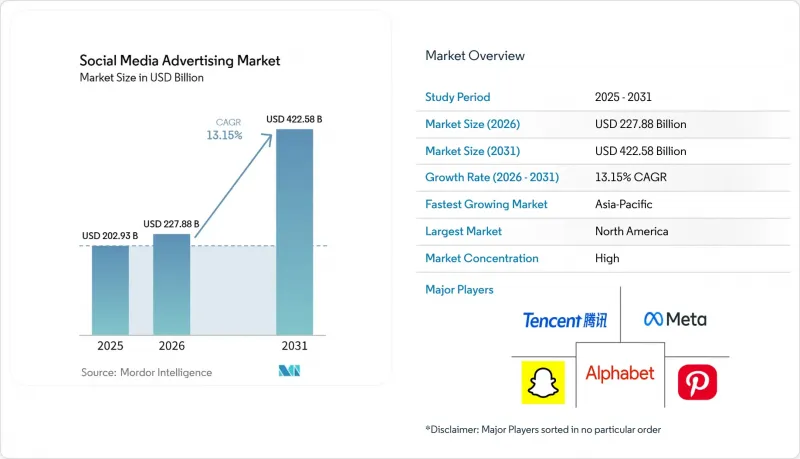
본 보고서는 광고 형식(동영상 광고, 이미지 광고, 캐러셀 광고, 스폰서 콘텐츠 등), 플랫폼(소셜 네트워킹 플랫폼, 동영상 공유 플랫폼, 메시징 플랫폼, 전문 네트워킹 플랫폼 등), 최종사용자(소매, 자동차, 헬스케어, 금융 서비스, 엔터테인먼트·미디어 등) 및 지역별로 분류되어 있습니다. 시장 전망은 금액(달러) 기준으로 제시되어 있습니다.
전 세계 소셜 미디어 광고 시장의 동향과 인사이트
‘모바일 퍼스트’형 소셜 커머스의 점유율 확대
소셜 미디어 광고 시장에서는 광고 발견부터 구매에 이르는 과정이 급속히 통합되고 있으며, 쇼핑의 전 과정을 앱 내에서 완결시키는 플랫폼이 가장 큰 혜택을 보고 있습니다. 이러한 변화로 인해 노출의 가치는 단순한 도달 수보다 성사된 거래와 더 밀접하게 연결되게 되었으며, 이에 따라 광고 지출은 전환율 중시 경향을 더욱 강화하고 있습니다. 또한, 소매업체들은 네이티브 커머스 캠페인에 대한 예산 배분을 확대하고 있으며, 이는 퍼널 다운스트림 단계에서의 소셜 구매가 제한적인 테스트 프로그램이 아닌, 일반적인 계획의 일부가 되었음을 보여줍니다. 강력한 시각적 검색 및 상품 발견 기능을 갖춘 플랫폼은 구매 과정의 초기 단계에서 구매 의도를 포착하고, 사용자를 수익화 가능한 환경 내에 머물게 할 수 있기 때문에 유리한 입장에 있습니다. Pinterest는 2025년 월간 활성 사용자 수 6억 1,900만 명, 월간 검색 횟수 800억 건을 보고했는데, 이는 커머스 연동형 포맷을 통해 수익화할 수 있는 상품 발견 행동의 규모를 보여줍니다. 따라서 소셜 미디어 광고 시장은 소매업체와 플랫폼 간의 협력 강화, 모바일 네이티브 크리에이티브의 제작 주기 단축, 그리고 광고 노출과 매출 성과 간의 연관성 명확화를 통해 성장 동력을 얻고 있습니다.
숏폼 동영상 광고 인벤토리의 확대
소셜 미디어 광고 시장은 주요 플랫폼 전반에 걸친 숏폼 동영상 광고 슬롯의 급속한 확대로 인해 계속해서 성장세를 보이고 있습니다. 동영상은 2025년 시점에서 이미 가장 큰 포맷 점유율을 차지하고 있었으나, Reels나 Shorts와 같은 광고 공간을 통해 광고주는 동일한 구매 환경 내에서 대규모 및 고빈도의 광고 전달과 더 신속한 크리에이티브 테스트가 가능해짐에 따라 그 입지는 더욱 공고해졌습니다. 또한, 이 포맷은 스토리텔링과 명확한 성과 지표를 겸비하고 있어, 과거에는 TV나 정적인 디지털 광고 슬롯에 의존하던 업계에서도 더 많은 예산을 유치하고 있습니다. Meta의 보고서에 따르면, 해당 회사의 ‘Family of Apps’ 전체에서 광고 노출 수는 2025년에 12% 증가했으며, 광고 1건당 평균 단가는 9% 상승했습니다. 이는 가격을 낮추지 않고도 추가 광고 공간이 흡수되고 있음을 보여줍니다. 알파벳은 유튜브의 광고 수익과 구독 수익 합계가 처음으로 600억 달러를 돌파했다고 발표했습니다. 이는 동영상 중심의 플랫폼 생태계가 지닌 상업적 깊이를 여실히 보여줍니다. 이러한 광고 공간의 기반이 계속 확대됨에 따라, 소셜 미디어 광고 시장은 단순한 시청자 수 증가보다는 크리에이티브의 속도, 광고의 관련성, 그리고 순위 결정의 질에 더 의존하게 되고 있습니다.
플랫폼 정책 변동과 경매의 복잡성
소셜 미디어 광고 시장은 여전히 갑작스러운 정책 변경, 콘텐츠 관리 방침의 전환, 소유권 변경, 불안정한 경매 상황 등의 압박에 직면해 있으며, 이는 광고주가 예산 계획을 수립하는 데 어려움을 주고 있습니다. 이러한 혼란은 일반적으로 소셜 플랫폼에서의 대규모 철수로 이어지지는 않지만, 더 많은 채널과 파트너로 지출을 분산시키는 요인이 되고 있습니다. 이러한 추세로 인해 카테고리 전체의 지출이 증가하고 있더라도 개별 플랫폼이 점유율을 확대할 수 있는 여지는 제한됩니다. 또한 경쟁이 격화되는 시기에는 가격이 급변할 가능성이 있어, 중소 규모 광고주에게 경매 환경은 여전히 어려운 상황입니다. 이로 인해 예측의 신뢰성이 떨어지고, 캠페인 진행 속도 조절이 더욱 복잡해집니다. 따라서 광고주 전체의 수요가 견조하더라도, 소셜 미디어 광고 시장은 플랫폼 고유의 평판 변화에 민감한 상태가 지속되고 있습니다. 자동화가 진행되는 시장에서 이러한 제약은 특히 중요한 의미를 지닙니다. 광고주는 예산의 더 큰 비중을 자동 관리에 맡기기 전에, 여전히 플랫폼의 규칙과 노출 조건에 대한 신뢰를 필요로 하기 때문입니다.
부문 분석
동영상 광고는 2025년에 39.11%의 점유율을 차지했으며, 2026년부터 2031년까지 14.52%라는 가장 높은 연평균 성장률(CAGR)을 기록할 것으로 전망되어, 소셜 미디어 광고 시장의 중심적인 위치를 계속 차지할 것으로 보입니다. 이 부문이 주도적인 위치를 차지하는 이유는 주요 앱 전반에 걸쳐 숏폼 동영상 시청 행태가 정착되었으며, 광고주들이 동영상 광고를 도달 확보 수단이자 반응 유도 수단으로 활용하게 되었기 때문입니다. 소셜 미디어 광고 업계에서는 Reels, Shorts 및 유사한 광고 슬롯이 동일한 캠페인 주기 내에서 브랜드 광고 및 성과형 광고 예산을 더 많이 흡수함에 따라, 숏폼 동영상 포맷의 존재감이 더욱 커지고 있습니다. 인스타그램과 페이스북의 Reels를 합친 연간 매출 런레이트는 2025년 10월 500억 달러를 돌파했습니다. 또한 2025년 한 해 동안 인스타그램상의 전체 광고 중 절반 이상이 Reels 광고 슬롯을 통해 게재되었으며, 이는 2024년의 35%에서 증가한 수치입니다. 한편, 사용자가 인스타그램에서 보내는 시간의 46%를 릴스에 할애하고 있으며, 이는 전년도의 37%에서 증가한 수치입니다. 이러한 기세는 배후에서 진행되고 있는 AI 투자 확대를 통해 더욱 가속화되고 있으며, 동영상 생성 도구의 총 수익 연율(run rate)은 2025년 4분기에 100억 달러에 달해, 광고 사업 전체에 비해 약 3배 빠른 속도로 성장했습니다. 또한, 광고 순위 모델의 확충으로 인해 페이스북 및 인스타그램 전체에서 광고 클릭 수와 전환 수가 측정 가능한 수준으로 향상되었으며, 이는 사용자 참여도에 이어 숏폼 환경에서의 수익화가 얼마나 빠르게 진행되고 있는지를 보여줍니다.
광고 형식의 구성은 여전히 동영상에만 국한되지 않고 더욱 다양해지고 있습니다. 크리에이티브 비용, 제품의 깊이, 혹은 연속적인 스토리텔링이 동영상보다 더 중요할 경우, 광고주는 여전히 이미지 광고나 캐러셀 광고를 활용하고 있으므로, 이러한 균형은 소셜 미디어 광고 시장에 있어 중요합니다. 이미지 광고는 특히 대량의 동영상 자산을 제작할 자원이 없는 브랜드의 경우, 퍼널 업스트림에서 효율적인 도달을 확보하는 데 여전히 효과적입니다. 캐러셀 광고 유닛은 하나의 게재 공간에서 여러 제품, 절차 또는 기능을 제시해야 하는 소매 및 금융 서비스 캠페인을 지속적으로 지원하고 있습니다. 스폰서 콘텐츠와 네이티브 포맷 역시 피드 환경에 자연스럽게 녹아들어, 방해형 광고 유닛에 비해 광고 회피 행동의 영향을 덜 받기 때문에 명확한 역할을 계속 수행하고 있습니다. AI를 활용한 크리에이티브 도구를 통해 제작 장벽이 낮아짐에 따라, 소셜 미디어 광고 시장에서 포맷 선택은 예산 제약보다는 각 포맷이 ‘발견’, ‘인지’, ‘전환’ 단계에서 수행하는 역할에 크게 좌우될 것입니다.
지역별 분석
북미는 2025년에도 소셜 미디어 광고 시장에서 40.45%의 점유율을 유지하고 있으며, 이러한 우위는 디지털 광고의 높은 보급률, 광고주의 높은 지식과 경험, 그리고 여러 주요 플랫폼이 본거지를 두고 있다는 홈마켓의 이점에 의해 뒷받침되고 있습니다. 이 지역은 1인당 소셜 광고 수익이 가장 높은데, 이는 소비자의 디지털 성숙도와 성과 중심의 구매 모델이 널리 활용되고 있음을 반영합니다. 미국은 여전히 세계 최대의 소셜 미디어 광고 시장입니다. 미국의 소셜 네트워크 광고 지출은 2026년에 1210억 달러를 넘어설 것으로 예상되며, 이는 중소기업이 대규모 캠페인을 진행할 때의 장벽을 낮추는 자동화 광고 도구의 도입이 계속되고 있음을 반영합니다. Meta는 2026년 1분기에 423억 달러의 매출을 기록하며, 대규모 디지털 광고 수요의 지속적인 강세를 여실히 보여주었습니다.
유럽은 소셜 미디어 광고 분야에서 두 번째로 큰 지역 시장입니다. 이 지역의 광고 환경은 엄격한 개인정보 보호 규정과 디지털 규제에 의해 형성되고 있으며, 독일, 프랑스, 영국 등 주요 시장에서 동의 기반 타겟팅과 퍼스트파티 데이터 전략의 중요성이 점점 더 커지고 있습니다. 규제 요건이 강화되고 있음에도 불구하고, 영국은 여전히 유럽에서 가장 견고한 소셜 광고 시장 중 하나로 자리 잡고 있으며, 광고주들의 지속적인 투자가 이어지고 있습니다.
아시아태평양은 소셜 미디어 광고 분야에서 가장 빠르게 성장하고 있는 지역입니다. 일본에서는 2025년 소셜 미디어 광고 지출이 약 1조 3,100억 엔(87억 달러)에 달했으며, 이 중 39.2%를 동영상 광고가 차지하고 있어 동영상 중심 형식으로의 전환이 지속되고 있음을 알 수 있습니다. 인도 역시 숏폼 동영상, 크리에이터 주도형 마케팅, 그리고 디지털 광고의 보급 확대에 힘입어 급속한 성장을 이루고 있습니다. 중국은 Douyin, WeChat, Weibo, Kuaishou 등 주요 국내 플랫폼에 힘입어 여전히 이 지역 최대의 시장을 차지하고 있습니다.
남미, 중동 및 아프리카는 현재 전 세계 소셜 미디어 광고 지출에서 차지하는 비중은 작지만, 꾸준한 성장을 이어가고 있습니다. 스마트폰 보급률 확대, 모바일 인터넷 이용 비용 감소, 디지털 참여도 향상으로 인해 브라질, 사우디아라비아, 아랍에미리트, 나이지리아, 남아프리카공화국, 이집트 등의 시장에서 광고주의 투자 증가가 촉진되고 있습니다.
기타 혜택:
- 엑셀 형식의 시장 예측(ME) 시트
- 3개월간의 애널리스트 지원
자주 묻는 질문
목차
제1장 소개
제2장 조사 방법
제3장 주요 요약
제4장 시장 구도
제5장 시장 규모와 성장 예측
제6장 경쟁 구도
제7장 시장 기회와 향후 전망
KSM 26.08.06According to Mordor Intelligence, the social media advertising market size was valued at USD 202.93 billion in 2025 and estimated to grow from USD 227.88 billion in 2026 to reach USD 422.58 billion by 2031, at a CAGR of 13.15% during the forecast period (2026-2031).
This report is Segmented by Ad Format (Video Ads, Image Ads, Carousel Ads, Sponsored Content, and More), Platform (Social Networking Platform, Video-Sharing Platforms, Messaging Platforms, Professional Networking Platforms, and More), End User (Retail, Automotive, Healthcare, Financial Services, Entertainment and Media, and More), and Geography. The Market Forecasts are Provided in Terms of Value (USD).
Global Social Media Advertising Market Trends and Insights
Rising Share of Mobile-First Social Commerce
The social media advertising market is seeing faster convergence between ad discovery and purchase activity, and platforms that keep the full shopping journey inside the app are benefiting the most. This shift is making ad spending more conversion-focused because the value of an impression is now tied more closely to a completed transaction than to reach alone. Retailers are also moving more budget into native commerce campaigns, which shows that lower-funnel social buying has become part of regular planning rather than a limited test program. Platforms with strong visual search and product discovery features are in a favorable position because they can capture planning intent earlier in the purchase process and keep users inside a monetizable environment. Pinterest reported 619 million monthly active users and 80 billion monthly searches in 2025, which points to the scale of product discovery behavior that commerce-linked formats can monetize. The social media advertising market is therefore gaining support from stronger retailer-platform alignment, faster mobile-native creative cycles, and a clearer link between ad delivery and sales outcomes.
Short-Form Video Ad Inventory Expansion
The social media advertising market continues to gain momentum from the rapid expansion of short-form video inventory across major platforms. Video already held the largest format share in 2025, and its position is being reinforced because Reels, Shorts, and similar placements give advertisers large scale, high frequency, and faster creative testing in the same buying environment. This format is also attracting more budgets from categories that once relied on television or static digital placements because it combines storytelling with clear performance signals. Meta reported that ad impressions across its Family of Apps grew 12% in 2025 and that average price per ad rose 9%, which shows that additional inventory is being absorbed without weakening pricing. Alphabet stated that YouTube surpassed USD 60 billion in combined advertising and subscription revenue for the first time, which underscores the commercial depth of video-led platform ecosystems. As this inventory base keeps widening, the social media advertising market is becoming more dependent on creative speed, AD relevance, and ranking quality than on pure audience growth.
Platform Policy Volatility and Auction Complexity
The social media advertising market still faces pressure from sudden policy changes, moderation shifts, ownership changes, and unstable auction conditions that make budget planning harder for advertisers. These disruptions do not usually lead to a broad exit from social platforms, but they do encourage spending diversification across more channels and partners. That pattern limits how much any single platform can increase its share even when total category spending is rising. Auction conditions also remain difficult for smaller advertisers because pricing can move quickly during competitive periods, which reduces forecasting confidence and makes campaign pacing more complicated. The social media advertising market therefore remains sensitive to platform-specific reputation changes, even when overall advertiser demand stays intact. This restraint matters most in a market where automation is increasing, because advertisers still need confidence in platform rules and delivery conditions before they allow larger shares of budget to be managed automatically.
Other drivers and restraints analyzed in the detailed report include:
- Expansion of Creator-Led Performance Advertising
- Growth in First-Party Audience Targeting
- Measurement Gaps from Privacy Restrictions
For complete list of drivers and restraints, kindly check the Table Of Contents.
Segment Analysis
Video ads held 39.11% share in 2025, and the segment is also expected to post the fastest 2026-2031 CAGR at 14.52%, which keeps it at the center of the social media advertising market. The segment leads because short-form viewing behavior has become embedded across major apps, and advertisers now treat video as both a reach format and a response format. The social media advertising industry is seeing short-form video formats strengthen further, as Reels, Shorts, and similar placements absorb more brand and performance budgets within the same campaign cycle. Combined Instagram and Facebook Reels crossed a USD 50 billion annual revenue run rate in October 2025, and more than half of all ads on Instagram ran in the Reels placement throughout 2025, up from 35% in 2024, while users spent 46% of their time on Instagram in Reels, up from 37% the previous year. This momentum has been reinforced by heavier AI investment behind the scenes, with video generation tools reaching a combined revenue run-rate of USD 10 billion in Q4 2025, growing nearly three times faster than the overall ads business alongside a scaled-up ads ranking model that drove measurable lifts in ad clicks and conversions across Facebook and Instagram, showing how quickly monetization has followed user engagement into short-form environments.
The format mix remains broader than video alone, and that balance is important for the social media advertising market because advertisers still use image and carousel ads where creative cost, product depth, or sequential storytelling matters more than motion. Image ads remain relevant for efficient upper-funnel reach, especially for brands that do not have the resources to produce large volumes of video assets. Carousel units continue to support retail and financial services campaigns where multiple products, steps, or features need to be presented in one placement. Sponsored content and native formats also keep a clear role because they fit more naturally into feed environments and are often less exposed to AD avoidance behavior than interruptive units. As AI-based creative tools reduce production barriers, format choice in the social media advertising market is likely to depend less on budget constraints and more on the role each format plays across discovery, education, and conversion.
Complete Report Scope:
- By Ad Format
- Video Ads
- Image Ads
- Carousel Ads
- Sponsored Content
- Other Ad Formats
- By Platform
- Social Networking Platforms
- Video-Sharing Platforms
- Messaging Platforms
- Professional Networking Platforms
- Other Platforms
- By End User
- Retail
- Automotive
- Healthcare
- Financial Services
- Entertainment and Media
- Education
- Other End Users
- By Geography
- North America
- United States
- Canada
- Mexico
- South America
- Brazil
- Argentina
- Chile
- Rest of South America
- Europe
- Germany
- United Kingdom
- France
- Italy
- Spain
- Rest of Europe
- Asia-Pacific
- China
- Japan
- India
- South Korea
- Australia
- Rest of Asia-Pacific
- Middle East
- Saudi Arabia
- United Arab Emirates
- Qatar
- Rest of Middle East
- Africa
- South Africa
- Egypt
- Nigeria
- Rest of Africa
- North America
Geography Analysis
North America maintained a 40.45% share of the social media advertising market in 2025, and that lead was supported by high digital advertising penetration, strong advertiser sophistication, and the home-market advantage of several dominant platforms. The region generates the highest social ad revenue per capita, which reflects both consumer digital maturity and the heavy use of performance-oriented buying models. The United States remains the world's largest social media advertising market. U.S. social network advertising spending is projected to exceed USD 121 billion in 2026, reflecting continued adoption of automated advertising tools that lower the barrier for small and medium-sized businesses to run campaigns at scale. Meta reported USD 42.3 billion in revenue in Q1 2026, highlighting the continued strength of large-scale digital advertising demand.
Europe is the second-largest regional market for social media advertising. The region's advertising environment is shaped by stringent privacy and digital regulations, making consent-based targeting and first-party data strategies increasingly important across major markets such as Germany, France, and the United Kingdom. Despite stricter regulatory requirements, the UK continues to rank among Europe's strongest social advertising markets, demonstrating sustained advertiser investment.
Asia-Pacific is the fastest-growing region for social media advertising. In Japan, social media advertising expenditure reached approximately JPY 1.31 trillion (USD 8.7 billion) in 2025, with video advertising accounting for 39.2% of social advertising spending, reflecting the continued shift toward video-first formats. India is also experiencing rapid expansion, driven by short-form video, creator-led marketing, and increasing digital advertising adoption. China remains the region's largest market, supported by major domestic platforms including Douyin, WeChat, Weibo, and Kuaishou.
South America, the Middle East, and Africa currently account for a smaller share of global social media advertising expenditure but continue to record steady growth. Expanding smartphone penetration, improving mobile internet affordability, and rising digital engagement are supporting increased advertiser investment across markets such as Brazil, Saudi Arabia, the United Arab Emirates, Nigeria, South Africa, and Egypt.
- Meta Platforms, Inc.
- Alphabet Inc.
- TikTok Pte. Ltd.
- Snap Inc.
- X Corp.
- Pinterest, Inc.
- Reddit, Inc.
- LinkedIn Corporation
- Tencent Holdings Limited
- Kuaishou Technology
- Kakao Corporation
- Naver Corporation
- LINE Yahoo Corporation
- Weibo Corporation
- Bumble Inc.
- Match Group, Inc.
- Discord Inc.
- Telegram Messenger LLP
- Quora, Inc.
- Nextdoor Holdings, Inc.
Additional Benefits:
- The market estimate (ME) sheet in Excel format
- 3 months of analyst support
TABLE OF CONTENTS
1 INTRODUCTION
- 1.1 Study Assumptions and Market Definition
- 1.2 Scope of the Study
2 RESEARCH METHODOLOGY
3 EXECUTIVE SUMMARY
4 MARKET LANDSCAPE
- 4.1 Market Overview
- 4.2 Market Drivers
- 4.2.1 Rising Share of Mobile-First Social Commerce
- 4.2.2 Expansion of Creator-Led Performance Advertising
- 4.2.3 Growth in First-Party Audience Targeting
- 4.2.4 Better Incrementality Measurement and Attribution Tools
- 4.2.5 Short-Form Video Ad Inventory Expansion
- 4.2.6 Retail Media Spillover Into Social Platforms
- 4.3 Market Restraints
- 4.3.1 Platform Policy Volatility and Auction Complexity
- 4.3.2 Measurement Gaps From Privacy Restrictions
- 4.3.3 Creative Fatigue and Rising Cost Per Outcome
- 4.3.4 Brand Safety and Content Moderation Risk
- 4.4 Industry Value Chain Analysis
- 4.5 Supply Chain Analysis
- 4.7 Regulatory Landscape
- 4.8 Technological Outlook
- 4.9 Impact of Macroeconomic Factors on the Market
- 4.10 Porter's Five Forces Analysis
- 4.10.1 Bargaining Power of Buyers
- 4.10.2 Bargaining Power of Suppliers
- 4.10.3 Threat of New Entrants
- 4.10.4 Threat of Substitutes
- 4.10.5 Competitive Rivalry
5 MARKET SIZE AND GROWTH FORECASTS (VALUE)
- 5.1 By Ad Format
- 5.1.1 Video Ads
- 5.1.2 Image Ads
- 5.1.3 Carousel Ads
- 5.1.4 Sponsored Content
- 5.1.5 Other Ad Formats
- 5.2 By Platform
- 5.2.1 Social Networking Platforms
- 5.2.2 Video-Sharing Platforms
- 5.2.3 Messaging Platforms
- 5.2.4 Professional Networking Platforms
- 5.2.5 Other Platforms
- 5.3 By End User
- 5.3.1 Retail
- 5.3.2 Automotive
- 5.3.3 Healthcare
- 5.3.4 Financial Services
- 5.3.5 Entertainment and Media
- 5.3.6 Education
- 5.3.7 Other End Users
- 5.4 By Geography
- 5.4.1 North America
- 5.4.1.1 United States
- 5.4.1.2 Canada
- 5.4.1.3 Mexico
- 5.4.2 South America
- 5.4.2.1 Brazil
- 5.4.2.2 Argentina
- 5.4.2.3 Chile
- 5.4.2.4 Rest of South America
- 5.4.3 Europe
- 5.4.3.1 Germany
- 5.4.3.2 United Kingdom
- 5.4.3.3 France
- 5.4.3.4 Italy
- 5.4.3.5 Spain
- 5.4.3.6 Rest of Europe
- 5.4.4 Asia-Pacific
- 5.4.4.1 China
- 5.4.4.2 Japan
- 5.4.4.3 India
- 5.4.4.4 South Korea
- 5.4.4.5 Australia
- 5.4.4.6 Rest of Asia-Pacific
- 5.4.5 Middle East
- 5.4.5.1 Saudi Arabia
- 5.4.5.2 United Arab Emirates
- 5.4.5.3 Qatar
- 5.4.5.4 Rest of Middle East
- 5.4.6 Africa
- 5.4.6.1 South Africa
- 5.4.6.2 Egypt
- 5.4.6.3 Nigeria
- 5.4.6.4 Rest of Africa
- 5.4.1 North America
6 COMPETITIVE LANDSCAPE
- 6.1 Market Concentration
- 6.2 Strategic Moves
- 6.3 Vendor Positioning Analysis
- 6.4 Company Profiles (includes Global Level Overview, Market Level Overview, Core Segments, Financials as available, Strategic Information, Products and Services, Recent Developments)
- 6.4.1 Meta Platforms, Inc.
- 6.4.2 Alphabet Inc.
- 6.4.3 TikTok Pte. Ltd.
- 6.4.4 Snap Inc.
- 6.4.5 X Corp.
- 6.4.6 Pinterest, Inc.
- 6.4.7 Reddit, Inc.
- 6.4.8 LinkedIn Corporation
- 6.4.9 Tencent Holdings Limited
- 6.4.10 Kuaishou Technology
- 6.4.11 Kakao Corporation
- 6.4.12 Naver Corporation
- 6.4.13 LINE Yahoo Corporation
- 6.4.14 Weibo Corporation
- 6.4.15 Bumble Inc.
- 6.4.16 Match Group, Inc.
- 6.4.17 Discord Inc.
- 6.4.18 Telegram Messenger LLP
- 6.4.19 Quora, Inc.
- 6.4.20 Nextdoor Holdings, Inc.
7 MARKET OPPORTUNITIES AND FUTURE OUTLOOK
- 7.1 White-Space and Unmet-Need Assessment


