

|
시장보고서
상품코드
2118939
미디어 기획 시장 : 시장 점유율 분석, 업계 동향 및 통계, 성장 예측(2026-2031년)Media Planning - Market Share Analysis, Industry Trends & Statistics, Growth Forecasts (2026 - 2031) |
||||||
 Mordor Intelligence
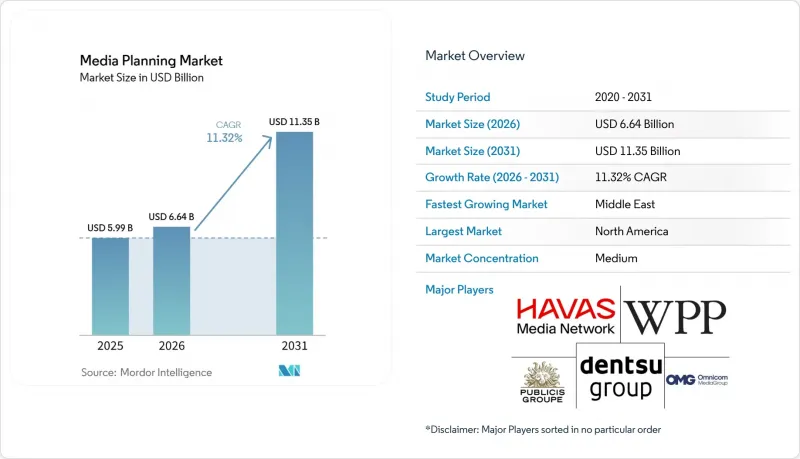
Mordor Intelligence에 의하면, 미디어 기획 시장 규모는 2025년에 59억 9,000만 달러로 평가되었고, 2026년 66억 4,000만 달러에서 2031년까지 113억 5,000만 달러에 이를 것으로 예측되며, 2026-2031년 예측 기간 CAGR은 11.32%를 나타낼 전망입니다.
본 보고서는 조직 규모별(대기업, 중소기업), 기획 목적별(도달 및 빈도 기획, 예산 배분 및 시나리오 기획 등), 최종 사용자 산업별(소매 및 전자상거래, 미디어 및 엔터테인먼트, 헬스케어 및 생명과학, 여행 및 호스피탈리티 등) 및 지역별로 분류되어 있습니다. 시장 예측은 금액(달러)으로 제시되어 있습니다.
세계의 미디어 기획 시장 동향 및 인사이트
알고리즘 및 프로그래매틱 기획으로의 전환
알고리즘에 의한 의사 결정은 제한적인 시험적 기능에 그치지 않고, 미디어 기획의 핵심 요소로 자리 잡았습니다. IAB 보고서에 따르면, 2026년 광고주와 광고 대행사가 중점을 둘 6대 주요 분야 중 5개가 AI 관련이며, 여기에는 인간의 개입을 최소화하여 캠페인의 계획, 실행, 최적화를 수행하는 시스템이 포함됩니다. 이러한 변화로 인해 플래너들은 모델의 산출물을 검증하고, 데이터 품질을 평가하며, 인벤토리 및 어트리뷰션 규칙을 설정하는 데 집중하게 되었습니다. 이는 미디어 기획 시장에 있어 중요한 점입니다. 왜냐하면 기획 소프트웨어의 가치는 단순히 작업을 자동화하는 능력뿐만 아니라, 그 거버넌스에 점점 더 의존하고 있기 때문입니다. 에이전시 그룹은 통합된 기술 아키텍처 내에서 기획, 전략, 타겟층 개발을 통합하는 경향이 강해지고 있습니다. 미디어 바이어들이 에이전트 기반 워크플로우에 점점 더 의존하게 되는 가운데, 자동화된 의사결정을 이해하기 쉽고 통제 가능한 형태로 만들 수 있는 기업은 더 유리한 입지를 차지하게 될 것입니다.
리테일 미디어 및 커머스 미디어 인벤토리의 확대
리테일 미디어는 소비자 데이터, 광고 인벤토리, 구매 신호를 결합한 것이기 때문에 기획의 필수 요소가 되었습니다. 그 확대에 따라 리테일 미디어는 단순한 채널 다각화의 역할에 그치지 않고, 일상적인 기획 의사결정에 통합되기 시작했습니다. 오프사이트 인벤토리의 활용이 확대됨에 따라, 기획자는 커넥티드 TV, 소셜 미디어, 프로그래매틱 채널에 걸친 리테일 미디어를 고려해야 합니다. 따라서 미디어 기획 시장의 기획자들은 리테일 미디어를 단순한 소매업체 웹사이트상의 검색 활동이 아닌, 전체 퍼널에 걸친 채널로 인식해야 합니다. 측정 가능한 리테일 미디어 및 커머스 미디어를 기존의 트레이드 지출과 구분하려는 업계의 노력은 측정 및 보고서 작성을 위한 보다 명확한 기반을 제공합니다. 또한, 네트워크 수가 증가함에 따라 인벤토리의 품질, 오디언스 접근성, 그리고 플랫폼 간 결과 비교 능력에 대해 보다 신중한 평가가 요구되고 있습니다.
개인정보 보호 규정 및 쿠키 폐지에 따른 신호 상실
개인정보 보호 요건으로 인해 타겟팅, 측정 및 노출 빈도 관리에 활용할 수 있는 데이터는 계속해서 제한되고 있습니다. 이러한 영향은 동의 요건으로 인해 타겟층 매칭이나 플랫폼 간 데이터 활용이 제한되는 경우에 가장 두드러집니다. 미디어 기획 시장 진출기업들에게 매칭률의 하락은 타겟 오디언스 추정의 신뢰성을 떨어뜨리고, 노출 빈도 관리의 정확도를 저하시킬 가능성이 있습니다. 퍼스트 파티 데이터나 동의 획득 시스템에 대한 투자는 미디어 운영 예산과 경쟁 관계에 놓일 수도 있습니다. 이러한 과제로 인해, 구매자가 지속 가능한 데이터 권리와 운영 규칙을 확립할 때까지 플랫폼에 대한 투자가 지연될 가능성이 있습니다. 이러한 제약은 여러 규제 환경에 걸쳐 캠페인을 비교해야 하는 기업에게 특히 중요한 문제가 됩니다.
부문 분석
2025년, 대기업은 미디어 기획 시장 점유율의 63.92%를 차지했습니다. 이러한 규모 덕분에 기업용 기획 시스템, 고급 측정 제품군 및 맞춤형 AI 통합에 대한 투자가 가능해졌습니다. 이러한 구매자들은 대개 세계 에이전시 네트워크나 대규모 옴니채널 예산을 관리하는 성숙한 사내 팀을 통해 사업을 전개하고 있습니다. 이러한 집중화로 인해 데이터, 기획, 활성화, 측정을 통합하는 시스템에 대한 수요가 유지되고 있습니다. 옴니콤은 2026년 1월, 데이터, 아이덴티티, AI, 미디어 기획, 커머스 활성화, 측정을 통합하는 차세대 ‘Omni’ 플랫폼을 발표했습니다.
중소기업은 2026-2031년 연평균 성장률(CAGR) 12.41%라는 가장 높은 성장률을 나타낼 것으로 예측됩니다. 셀프 서비스 프로그래매틱 도구와 AI를 활용한 기획 서비스 덕분에 일상적인 캠페인 구축 과정에서 대행사를 통한 중개 필요성이 줄어들고 있습니다. 이로 인해 이전에는 개별 채널 도구에 의존하던 소규모 광고주에게도 체계적인 기획이 더욱 쉽게 이용 가능해졌습니다. 브리프를 기획안으로 변환하고 합리적인 가격을 제공하는 소프트웨어는 이 미디어 기획 시장의 구매자층을 지원합니다. 명확한 워크플로우와 셀프 서비스 접근 방식을 결합한 제공업체는 엔터프라이즈 도입과 같은 비용 구조 없이도 이 광범위한 구매자층을 대응할 수 있습니다.
지역별 분석
2025년, 북미는 미디어 기획 시장의 36.38% 점유율을 차지했습니다. 이 지역은 성숙한 프로그래매틱 생태계를 갖추고 있으며, 전 세계 미디어 지주사가 많이 집중되어 있습니다. 2025년 11월 옴니콤이 인터퍼블릭을 인수함에 따라, 미디어 투자 계획은 더 적은 수의 대규모 조직으로 집중되는 양상을 보였습니다. 캐나다와 멕시코에서는 디지털 광고 활동의 확대를 통해 지역 수요가 증가하고 있지만, 통화 및 관세와 관련된 불확실성으로 인해 시나리오 계획의 중요성이 커지고 있습니다. 데이터, AI 및 커넥티드 TV 측정에 대한 지속적인 투자로 인해 이 지역의 미디어 기획 시장 역할은 강화되고 있습니다.
유럽은 동의 요건이 데이터 가용성에 영향을 미치고, 업계 공동 측정 기관이 여전히 중요한 역할을 수행하고 있어 안정적이면서도 복잡한 지역입니다. 프랑스와 독일에서는 AI를 활용한 기획 인프라 도입이 진행되고 있습니다. MiQ는 2026년 2월, 프랑스에서 선형 TV, 스트리밍 TV, 유튜브, 소셜 미디어를 아우르는 기획을 위한 ‘Sigma AI’ 도구를 도입했습니다. 현지 미디어 기획 시장의 시스템은 정확성과 GDPR(EU 개인정보보호규정)을 준수하는 데이터 관리를 동시에 충족해야 합니다. 브라질을 필두로 한 남미에서는 디지털 광고 측정이 더욱 체계화되고, 세계 에이전시 플랫폼이 현지에서 확대됨에 따라 프로그래매틱 기획의 도입이 확산되고 있습니다.
중동은 2026-2031년 연평균 성장률(CAGR) 12.12%를 나타낼 것으로 예측됩니다. IAB MENA에 따르면, MENA 지역의 디지털 광고 시장은 2025년에 81억 8,500만 달러에 달하고, 전년 대비 17.8% 증가했습니다. 2025년에는 리테일 미디어가 40.5%나 성장하고 커넥티드 TV도 31% 증가함에 따라, 소셜 미디어 주도 캠페인 이외에도 대응할 수 있는 기획 도구의 필요성이 높아지고 있습니다. 사우디아라비아와 아랍에미리트(UAE)에서는 경제 다각화로 인해 석유 관련 사업 이외의 광고주층이 확대되면서 수요를 뒷받침하고 있습니다. 아시아태평양은 큰 기회를 내포하고 있으며, 중국, 일본, 인도, 한국, 호주 각 시장에는 각각 고유한 광고주의 요구 사항이 존재합니다.
기타 혜택 :
- 엑셀 형식 시장 예측(ME) 시트
- 3개월간의 애널리스트 지원
자주 묻는 질문
목차
제1장 서론
제2장 조사 방법
제3장 개요
제4장 시장 구도
제5장 시장 규모 및 성장 예측
제6장 경쟁 구도
제7장 시장 기회 및 향후 전망
AJY 26.09.01According to Mordor Intelligence, the media planning market size was valued at USD 5.99 billion in 2025 and is estimated to grow from USD 6.64 billion in 2026 to reach USD 11.35 billion by 2031, at a CAGR of 11.32% during the forecast period 2026-2031.
This report is Segmented by Organization Size (Large Enterprises, and Small and Medium-Sized Enterprises), Planning Objective (Reach and Frequency Planning, Budget Allocation and Scenario Planning, and More), End-User Industry (Retail and E-Commerce, Media and Entertainment, Healthcare and Life Sciences, Travel and Hospitality, and More), and Geography. The Market Forecasts are Provided in Terms of Value (USD).
Global Media Planning Market Trends and Insights
Shift Toward Algorithmic and Programmatic Planning
Algorithmic decision-making has become a central part of media planning rather than a limited trial capability. The IAB reported that AI-related priorities accounted for 5 of the 6 leading areas of focus for advertisers and agencies in 2026, including systems that can plan, activate, and optimize campaigns with limited human intervention. The change shifts planners toward reviewing model outputs, assessing data quality, and setting inventory and attribution rules. This is important for the Media Planning Market because the value of planning software increasingly depends on its governance rather than just its ability to automate tasks. Agency groups are increasingly combining planning, strategy, and audience development within centralized technology architectures. Companies that can make automated decisions understandable and controllable should be better positioned as media buyers rely more heavily on agent-based workflows.
Expansion of Retail Media and Commerce Media Inventories
Retail media has become a planning requirement because it combines consumer data, advertising inventory, and purchase signals. Its expansion has moved retail media beyond a narrow channel-diversification role and into routine planning decisions. The growing use of off-site inventory requires planners to consider retail media across connected TV, social media, and programmatic channels. Planners in the Media Planning Market, therefore, need to consider retail media as a full-funnel channel rather than just a search activity on a retailer's website. Industry efforts to distinguish measurable retail and commerce media from traditional trade spending provide a clearer basis for measurement and reporting. The growing number of networks also requires more careful evaluation of inventory quality, audience access, and the ability to compare results across platforms.
Signal Loss From Privacy Regulation and Cookie Deprecation
Privacy requirements continue to limit the data available for targeting, measurement, and frequency management. The impact is most visible where consent requirements limit audience matching and the use of data across platforms. For Media Planning Market participants, lower match rates can make audience estimates less certain and make frequency controls less precise. Investment in first-party data and consent systems can also compete with working media budgets. These issues can delay platform investments until buyers establish durable data rights and operating rules. The restraint is especially relevant for businesses that need to compare campaigns across several regulated environments.
Other drivers and restraints analyzed in the detailed report include:
- Fragmentation Across Connected TV, Audio, and Creator Channels
- Need for Unified Reach and Frequency Across Cross-Platform Campaigns
- Measurement Fragmentation Across Walled Gardens
For complete list of drivers and restraints, kindly check the Table Of Contents.
Segment Analysis
Large enterprises held 63.92% of the Media Planning Market share in 2025. Their scale supports investment in enterprise planning systems, advanced measurement suites, and custom AI integrations. These buyers often operate through global agency networks or mature in-house teams that manage extensive omnichannel budgets. This concentration sustains demand for systems that integrate data, planning, activation, and measurement. Omnicom introduced its next-generation Omni platform in January 2026 to integrate data, identity, AI, media planning, commerce activation, and measurement.
Small and medium-sized enterprises are projected to record the highest growth at a 12.41% CAGR from 2026 to 2031. Self-service programmatic tools and AI-supported planning services reduce the need for an agency intermediary for routine campaign construction. This makes structured planning more accessible to smaller advertisers that previously relied on separate channel tools. Software that turns a brief into a draft plan and offers accessible pricing supports this Media Planning Market buyer group. Providers that combine clear workflows with self-service access can address this broader buyer base without requiring the cost structure of an enterprise implementation.
Complete Report Scope:
- By Organization Size
- Large Enterprises
- Small and Medium-Sized Enterprises
- By Planning Objective
- Reach and Frequency Planning
- Budget Allocation and Scenario Planning
- Audience Planning
- Customer Journey Planning
- Share of Voice (SOV) Planning
- By End-User Industry
- Retail and E-commerce
- Media and Entertainment
- Healthcare and Life Sciences
- Travel and Hospitality
- Consumer Goods
- Other End-User Industries (BFSI, Education, Automotive and IT and Telecom amongst Others)
- By Geography
- North America
- United States
- Canada
- Mexico
- South America
- Brazil
- Argentina
- Chile
- Rest of South America
- Europe
- Germany
- United Kingdom
- France
- Italy
- Spain
- Rest of Europe
- Asia-Pacific
- China
- Japan
- India
- South Korea
- Australia
- Rest of Asia-Pacific
- Middle East
- United Arab Emirates
- Saudi Arabia
- Qatar
- Rest of Middle East
- Africa
- South Africa
- Egypt
- Nigeria
- Rest of Africa
- North America
Geography Analysis
North America held 36.38% of the Media Planning Market share in 2025. The region has a mature programmatic ecosystem and a high concentration of global media holding companies. The November 2025 Omnicom acquisition of Interpublic concentrated media investment planning within a smaller number of larger organizations. Canada and Mexico are adding to regional demand through expanding digital advertising activity, though currency and tariff-related uncertainty make scenario planning more relevant. Continuing investment in data, AI, and connected-TV measurement strengthens the Media Planning Market's role in the region.
Europe is a stable but complex region because consent requirements affect data availability, and joint industry measurement bodies remain important. France and Germany are adopting AI-supported planning infrastructure. MiQ deployed its Sigma AI tool in France in February 2026 for planning across linear TV, streaming TV, YouTube, and social media. Local Media Planning Market systems must combine precision with GDPR-compliant data practices. South America, led by Brazil, is seeing wider adoption of programmatic planning as digital advertising measurement becomes more formalized and global agency platforms expand locally.
The Middle East is projected to grow at a 12.12% CAGR from 2026 to 2031. The MENA digital advertising sector reached USD 8.185 billion in 2025, rising 17.8% year over year, according to IAB MENA. Retail media grew by as much as 40.5% in 2025, while connected TV grew 31%, raising the need for planning tools that support more than social-led campaigns. Saudi Arabia and the UAE are supporting demand as economic diversification expands the advertiser base outside oil-related activity. Asia-Pacific presents a major opportunity, with China, Japan, India, South Korea, and Australia each having distinct advertiser needs.
- WPP plc
- Publicis Groupe S.A.
- Omnicom Group Inc.
- Dentsu Group Inc.
- The Interpublic Group of Companies, Inc.
- Havas N.V.
- Stagwell Inc.
- Hakuhodo DY Holdings Inc.
- Horizon Media, Inc.
- Mediaocean LLC
- Nielsen Holdings plc
- Kantar Group Limited
- Comscore, Inc.
- Basis Global Technologies, Inc.
- The Trade Desk, Inc.
- PubMatic, Inc.
- Magnite, Inc.
- GWI Ltd.
- Keen Decision Systems, Inc.
- Genidox Inc.
Additional Benefits:
- The market estimate (ME) sheet in Excel format
- 3 months of analyst support
TABLE OF CONTENTS
1 INTRODUCTION
- 1.1 Study Assumptions and Market Definition
- 1.2 Scope of the Study
2 RESEARCH METHODOLOGY
3 EXECUTIVE SUMMARY
4 MARKET LANDSCAPE
- 4.1 Market Overview
- 4.2 Market Drivers
- 4.2.1 Shift Toward Algorithmic and Programmatic Planning
- 4.2.2 Expansion of Retail Media and Commerce Media Inventories
- 4.2.3 Fragmentation Across Connected TV, Audio, and Creator Channels
- 4.2.4 Need for Unified Reach and Frequency Across Cross-Platform Campaigns
- 4.2.5 Media Brief Compression from Generative AI Co-Pilots
- 4.2.6 Budget Reforecasting Pressure from Tariff-Driven Demand Volatility
- 4.3 Market Restraints
- 4.3.1 Signal Loss From Privacy Regulation and Cookie Deprecation
- 4.3.2 Measurement Fragmentation Across Walled Gardens
- 4.3.3 Planning Talent Shortage in Agentic and Incrementality-Based Workflows
- 4.3.4 Inventory Quality Risk Across Retail Media and Creator Marketplaces
- 4.4 Impact of Macroeconomic Factors on the Market
- 4.5 Industry Value-Chain Analysis
- 4.6 Technology Outlook
- 4.7 Regulatory Landscape
- 4.8 Porter's Five Forces Analysis
- 4.8.1 Threat of New Entrants
- 4.8.2 Bargaining Power of Suppliers
- 4.8.3 Bargaining Power of Buyers
- 4.8.4 Threat of Substitutes
- 4.8.5 Intensity of Competitive Rivalry
5 MARKET SIZE AND GROWTH FORECASTS (VALUE)
- 5.1 By Organization Size
- 5.1.1 Large Enterprises
- 5.1.2 Small and Medium-Sized Enterprises
- 5.2 By Planning Objective
- 5.2.1 Reach and Frequency Planning
- 5.2.2 Budget Allocation and Scenario Planning
- 5.2.3 Audience Planning
- 5.2.4 Customer Journey Planning
- 5.2.5 Share of Voice (SOV) Planning
- 5.3 By End-User Industry
- 5.3.1 Retail and E-commerce
- 5.3.2 Media and Entertainment
- 5.3.3 Healthcare and Life Sciences
- 5.3.4 Travel and Hospitality
- 5.3.5 Consumer Goods
- 5.3.6 Other End-User Industries (BFSI, Education, Automotive and IT and Telecom amongst Others)
- 5.4 By Geography
- 5.4.1 North America
- 5.4.1.1 United States
- 5.4.1.2 Canada
- 5.4.1.3 Mexico
- 5.4.2 South America
- 5.4.2.1 Brazil
- 5.4.2.2 Argentina
- 5.4.2.3 Chile
- 5.4.2.4 Rest of South America
- 5.4.3 Europe
- 5.4.3.1 Germany
- 5.4.3.2 United Kingdom
- 5.4.3.3 France
- 5.4.3.4 Italy
- 5.4.3.5 Spain
- 5.4.3.6 Rest of Europe
- 5.4.4 Asia-Pacific
- 5.4.4.1 China
- 5.4.4.2 Japan
- 5.4.4.3 India
- 5.4.4.4 South Korea
- 5.4.4.5 Australia
- 5.4.4.6 Rest of Asia-Pacific
- 5.4.5 Middle East
- 5.4.5.1 United Arab Emirates
- 5.4.5.2 Saudi Arabia
- 5.4.5.3 Qatar
- 5.4.5.4 Rest of Middle East
- 5.4.6 Africa
- 5.4.6.1 South Africa
- 5.4.6.2 Egypt
- 5.4.6.3 Nigeria
- 5.4.6.4 Rest of Africa
- 5.4.1 North America
6 COMPETITIVE LANDSCAPE
- 6.1 Market Concentration
- 6.2 Strategic Moves
- 6.3 Market Share Analysis
- 6.4 Company Profiles (includes Global Level Overview, Market Level Overview, Core Segments, Financials as available, Strategic Information, Market Rank/Share, Products and Services, Recent Developments)
- 6.4.1 WPP plc
- 6.4.2 Publicis Groupe S.A.
- 6.4.3 Omnicom Group Inc.
- 6.4.4 Dentsu Group Inc.
- 6.4.5 The Interpublic Group of Companies, Inc.
- 6.4.6 Havas N.V.
- 6.4.7 Stagwell Inc.
- 6.4.8 Hakuhodo DY Holdings Inc.
- 6.4.9 Horizon Media, Inc.
- 6.4.10 Mediaocean LLC
- 6.4.11 Nielsen Holdings plc
- 6.4.12 Kantar Group Limited
- 6.4.13 Comscore, Inc.
- 6.4.14 Basis Global Technologies, Inc.
- 6.4.15 The Trade Desk, Inc.
- 6.4.16 PubMatic, Inc.
- 6.4.17 Magnite, Inc.
- 6.4.18 GWI Ltd.
- 6.4.19 Keen Decision Systems, Inc.
- 6.4.20 Genidox Inc.
7 MARKET OPPORTUNITIES AND FUTURE OUTLOOK
- 7.1 White-Space and Unmet-Need Assessment


