

|
시장보고서
상품코드
2099300
AI 기반 광섬유 백본 네트워크 시장 : 점유율 분석, 업계 동향 및 통계, 성장 예측(2026-2031년)AI-Driven Fiber Backbone Network - Market Share Analysis, Industry Trends & Statistics, Growth Forecasts (2026 - 2031) |
||||||
 Mordor Intelligence
Mordor Intelligence에 의하면, AI 기반 광섬유 백본 네트워크 시장 규모는 2025년 149억 3,000만 달러에서 2026년에는 179억 8,000만 달러로 확대되어 2026년부터 2031년까지 CAGR 20.20%로 성장을 지속하여, 2031년에는 451억 2,000만 달러에 이를 것으로 예측됩니다.
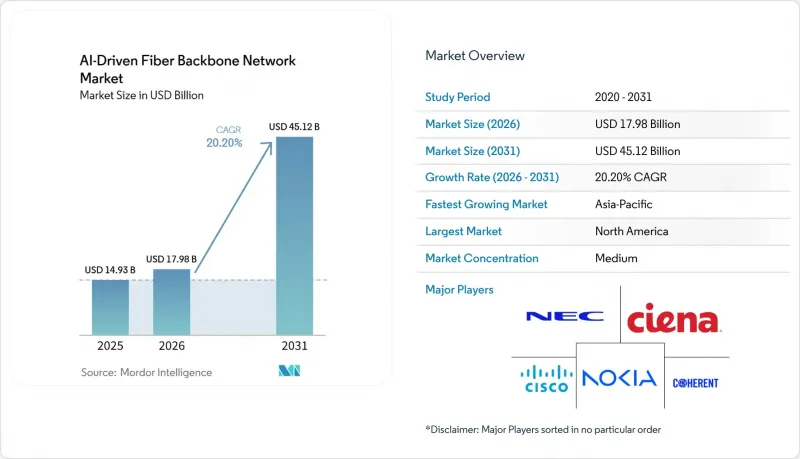
본 보고서는 구성 요소(케이블, 트랜시버, 스위치 등), 네트워크 유형(유선, 무선), 도입 형태(장거리 통신 등), 용도(AI 훈련, 클라우드 DCI, 정부 기관 등), 최종 사용자(통신 서비스 제공업체, 기업 등), 지역(북미, 아시아태평양 등)별로 분류되어 있습니다. 시장 전망은 금액(달러) 기준으로 제시되어 있습니다.
전 세계 AI 기반 광섬유 백본 네트워크 시장 동향 및 인사이트
지연 시간이 중요한 AI 워크로드를 위한 AI 기반 트래픽 엔지니어링
AI 기반 광섬유 백본 네트워크 시장은 기존 통신 흐름과는 크게 다른 트래픽 패턴에 의해 주도되고 있습니다. AI 훈련 클러스터는 버스트 성향이 강한 올-투-올(all-to-all) 통신을 발생시켜 400G 링크를 극히 짧은 시간 내에 포화시킬 가능성이 있으므로, 통신 사업자는 지연, 혼잡, 큐 깊이에 훨씬 더 정밀하게 대응할 수 있는 경로 선택이 필요합니다. 이에 따라 네트워크 제어는 정적 계획에서 소프트웨어 정의 트래픽 엔지니어링으로 전환되고 있으며, 라우팅 정책은 AI 인프라의 성능에 직접적인 영향을 미치는 요소로 취급되고 있습니다. 2026년 6월, 노키아는 인간의 개입 없이 의도 기반의 라우팅 업데이트를 수행하는 에이전트형 AI 기능을 갖춘 ‘Autonomous Networks Agent Library’를 발표했습니다. 이는 통신 사업자들이 AI 네이티브 광 제어에 어떻게 대비하고 있는지를 보여주는 사례입니다. 『Journal of Optical Communications and Networking』지에 게재된 2026년 현장 시험에서는 LLM(대규모 언어 모델)을 활용한 AI 에이전트가 440km의 테스트베드에서 파장 프로비저닝, 장애 관리 및 광 출력 최적화를 1분 미만에 처리했음이 입증되었습니다. 그 결과, AI 기반 광섬유 백본 네트워크 시장에서는 네트워크 엔지니어링상의 의사결정이 GPU 활용도, 서비스 신뢰성, 클러스터 가동 속도와 점점 더 밀접하게 연결되고 있습니다.
하이퍼스케일 캠퍼스 간 광섬유 확장
AI 기반 광섬유 백본 네트워크 시장은 새로운 컴퓨팅 회랑 주변의 캠퍼스 간 광섬유 확장에 힘입어 성장하고 있습니다. AI 시설이 전력 확보, 부지 확보, 확장 능력을 추구하며 내륙 지역이나 2차 시장으로 진출함에 따라, 건설 활동은 기존의 도시 허브를 넘어 확대되고 있습니다. 이에 따라 다크 파이버는 단순한 지연 개선 수단을 넘어 AI 인프라의 핵심 요소로 변모하고 있으며, 전략적 경로를 관리하는 통신 사업자의 가치를 높이고 있습니다. 2026년 1월, 코닝(Corning)과 메타(Meta)는 광섬유 및 연결 솔루션과 관련하여 최대 60억 달러 규모의 다년 계약을 체결했으며, 코닝은 수요에 대응하기 위해 노스캐롤라이나주 히코리에 위치한 시설을 확장했습니다. 2026년 2월, 파이버라이트(FiberLight)는 텍사스주 서부에 1,400 루트마일의 네트워크 구축에 3억 5,000만 달러를 투자하며, AI 회랑의 건설이 새로운 백본 지역으로 얼마나 빠르게 확대되고 있는지를 보여주었습니다. 이러한 확장 추세에 따라 AI 기반 광섬유 백본 네트워크 전반에 걸쳐 케이블 제조업체, 네트워크 구축 업체, 노선 소유주에게 잠재적인 시장이 확대되고 있습니다.
광섬유 백본 업그레이드의 높은 자본 집약도
AI 기반 광섬유 백본 네트워크 시장에서 높은 자본 집약성은 여전히 큰 제약 요인으로 작용하고 있습니다. 국가 및 지역 수준의 백본 업그레이드에는 수익이 완전히 가시화되기 전에 막대한 투자가 필요하기 때문입니다. 프로젝트에는 고밀도 파장 업그레이드, 코히런트 증폭기 교체, 라우터 교체 주기 등이 포함되는 경우가 많아, 투자 회수 기간은 단기적인 범위를 훨씬 초과하게 됩니다. 하이퍼스케일러는 장기적이고 대규모의 구매 계약을 통해 용량 및 부품의 우선 공급을 확보할 수 있기 때문에 중소 통신사들은 더욱 큰 압박에 직면해 있습니다. 2026년 1월에 체결된 코닝과 메타의 계약(최대 60억 달러 규모)은 주요 구매자가 어느 정도의 규모로 공급을 확보하고 제조 할당량을 좌우할 수 있는지를 보여줍니다. 중견 통신 사업자들은 대규모 백본 구축을 진행하기 전에 앵커 계약을 체결해야 하는 경우가 많으며, 그 결과 하이퍼스케일러 수요에 의해 뒷받침되지 않는 AI 기반 광섬유 백본 네트워크 시장의 일부에서는 구축이 지연되고 있습니다. 회선 시스템이 1.6T 시대 설계로 전환됨에 따라 광 인프라 재설계 비용도 상승하고 있으며, 이로 인해 자금력이 있는 건설 사업자와 용량 임대 사업자 간의 격차가 확대되고 있습니다.
부문 분석
광트랜시버는 AI 기반 광섬유 백본 네트워크 시장에서 가장 빠르게 성장하는 구성 요소 부문으로, 2031년까지 연평균 성장률(CAGR)은 21.33%를 나타낼 것으로 전망됩니다. 한편, 광섬유 케이블은 2025년 AI 기반 광섬유 백본 네트워크 시장 규모에서 25.77%의 점유율을 차지했습니다. 이 두 요소의 조합이 중요한 이유는 시장이 물리적 경로 용량 증가와 고속 액티브 옵틱스를 동시에 필요로 하며, 한쪽이 다른 쪽을 대체하는 것이 아니기 때문입니다. 각 하이퍼스케일러 기업들이 400G에서 800G로 전환하고, 캠퍼스 링크 및 분산형 데이터센터 경로를 위해 1.6T 모듈의 조기 도입을 시작함에 따라 트랜시버 수요는 더욱 가속화되고 있습니다. Marvell은 2026년, 자사의 'COLORZ 1600 1.6T ZR 및 ZR+' 플러그인형 모듈의 고객용 샘플 제공을 시작했습니다. 이는 캠퍼스 간 최대 12마일 거리의 링크 및 최대 621마일의 분산 경로를 대상으로 합니다. 이를 통해 AI 기반 광섬유 백본 네트워크 시장의 업그레이드 주기가 단축될 것입니다. 통신 사업자는 지연 시간이 긴 아키텍처의 갱신 주기를 기다릴 필요 없이, 더 고밀도인 AI 워크로드를 대비할 수 있기 때문입니다.
광섬유 케이블은 여전히 도입 기반의 토대가 되고 있습니다. 이는 장기적인 다크 파이버 계약이나 백본 회선 건설이 미래의 장비 수요를 좌우하는 침몰 비용이기 때문입니다. 코닝(Corning)과 메타(Meta) 간에 체결된 다년간공급 계약은 케이블 수요가 더 이상 통신망 확장이나 기업의 접속 수요에만 그치지 않고, AI 데이터센터 구축과 직접적으로 연결되어 있음을 보여줍니다. 또한, 시에나(Ciena)사의 하이퍼레일 포토닉스 플랫폼과 이 회사가 전력 절감을 매우 중시하고 있다는 점에서도 알 수 있듯이, 광 스위치, 라우터, 증폭기도 더 고밀도인 멀티레일 AI 상호 연결을 위해 재설계가 진행되고 있습니다. 패시브 소자나 코패키지형 광학 접근 방식을 포함한 나머지 구성 요소들은 AI 기반 광섬유 백본 네트워크 시장이 광 기술을 컴퓨팅 플랫폼에 더 가깝게 가져감에 따라 그 중요성이 커지고 있습니다. 즉, 구성 요소 간의 경쟁은 더 이상 개별 하드웨어의 출하량에만 국한되지 않고, 각 계층이 고밀도 AI 네트워크 아키텍처에 얼마나 잘 부합하는지도 중요한 요소가 되고 있습니다.
유선 백본 네트워크는 2025년에 AI 기반 광섬유 백본 네트워크 시장 점유율의 78.88%를 차지하고, 2031년까지 연평균 성장률(CAGR) 22.12%로 성장할 것으로 전망됩니다. 이러한 이중적 입장은 구조적인 현실을 반영합니다. 즉, AI 훈련 트래픽에는 결정론적이고 저지연 성능, 극히 낮은 지터, 그리고 대규모로 동기화된 클러스터 전체에 걸쳐 무선 시스템으로는 실현할 수 없는 수준의 처리량이 요구됩니다. GPU의 병렬 처리는 재현 가능한 타이밍에 의존하기 때문에 성능에 민감한 전송 설계에서 광섬유는 여전히 핵심적인 역할을 수행하고 있습니다. 2026년 3월, NTT 동일본은 도쿄와 후쿠오카 간 분산형 AI 추론을 위한 ‘IOWN 올 포토닉스 네트워크’ 실증 실험을 완료하고, 1,000km가 넘는 거리에서 로컬 데이터센터 환경과 동등한 성능을 달성했습니다. 따라서 AI 기반 광섬유 백본 네트워크 시장에서는 유선 전송을 수많은 선택지 중 하나가 아닌, 고부하 AI 워크로드에 대한 기본 백본으로 계속해서 자리매김하고 있습니다.
무선 백본 네트워크는 광섬유의 경제성이 낮은 지역이나 구축 조건이 까다로운 지역에서 여전히 유용한 역할을 수행하고 있습니다. 그 주요 기회는 트레이닝 클러스터를 위한 코어 상호 연결 계층이 아니라, 5G 백홀의 고밀도화, 모바일 엣지 AI 추론, 그리고 라스트 마일 집약에 있습니다. 이를 통해 AI 기반 광섬유 백본 네트워크의 기본 구조를 변경하지 않으면서도, 지방, 도서 지역 및 인구 밀도가 낮은 시장에서 무선 기술의 성장이 계속해서 중요시되고 있습니다. 실질적인 역할 분담은 명확합니다. 광섬유는 AI에 필수적인 동기화 계층을 담당하는 반면, 무선은 이를 보완하는 액세스 및 집약 기능을 지원합니다. 이러한 분리를 통해 두 네트워크 유형 모두에 대한 안정적인 수요가 뒷받침되지만, AI 기반 광섬유 백본 네트워크 시장의 성장 중심은 유선 인프라에 확고하게 자리 잡고 있습니다.
지역별 분석
2025년, 북미는 AI 기반 광섬유 백본 네트워크 시장 점유율의 30.12%를 차지하며 최대 지역 시장이 되었습니다. 이 지역은 하이퍼스케일러 캠퍼스가 가장 집중되어 있을 뿐만 아니라, 백본 투자가 기존의 메트로 코어에서 AI 회랑으로 뚜렷이 전환되고 있는 혜택을 누리고 있습니다. 2026년 1월, 코닝(Corning)과 메타(Meta)는 최대 60억 달러 규모의 다년 계약을 체결하여, 이를 통해 AI 데이터센터 및 광섬유 구축 수요에 대한 미국 내 제조 지원이 확대되었습니다. 2026년 2월, 파이버라이트(FiberLight)는 텍사스주 서부의 신규 인프라에 3억 5,000만 달러를 투자하며, 전력 공급이 풍부한 내륙 지역이 백본의 우선 지역으로 부상하고 있음을 부각시켰습니다. 또한 자요(Zayo)는 2025년에 크라운 캐슬(Crown Castle)의 파이버 솔루션즈(Fiber Solutions) 사업 인수를 완료한 후, 8,000 루트마일에 달하는 새로운 AI 회랑 건설의 주요 고객을 확보했습니다. 이는 자산 통합이 AI 기반 광섬유 백본 네트워크 시장에서 지역적 규모 확장을 어떻게 뒷받침하고 있는지를 보여줍니다.
아시아태평양은 2031년까지 연평균 성장률(CAGR) 21.77%를 나타낼 것으로 예측되며, AI 기반 광섬유 백본 네트워크 시장에서 가장 빠르게 성장하는 지역 블록으로 자리매김하고 있습니다. 이 지역 수요는 정부 주도의 백본 계획, 새로운 데이터센터 개발, 그리고 저지연 도시 간 AI 전송에 대한 관심 증가에 힘입어 뒷받침되고 있습니다. 2026년 3월, NTT는 도쿄와 후쿠오카 간 분산형 AI 추론을 위한 ‘IOWN 올 포토닉스 네트워크’ 실증 시험을 완료하고, 장거리 광 인프라 상에서 로컬 데이터센터 수준의 성능을 입증했습니다. 2026년 6월, KDDI는 ‘디지털 벨트’ 구상의 일환으로 클러스터 라우터의 상용 운영을 시작했습니다. 이를 통해 데이터센터 자산, 해저 케이블, 엣지 노드가 저지연 전국적 컴퓨팅 패브릭으로 통합되었습니다.
유럽은 AI 기반 광섬유 백본 네트워크 시장에서 큰 점유율을 차지하고 있으며, 클라우드 확대와 데이터 주권 관련 요건이 주요 경제권 전반에 걸쳐 백본 투자를 지속적으로 견인하고 있습니다. BT는 2025년에 그 입지를 강화하여, 국내 데이터 상주 요건이 부과되는 규제 대상 워크로드를 위해 종합적인 데이터 주권 서비스 포트폴리오를 제공하는 영국 최초의 제공업체가 되었습니다. 남미는 니어쇼어링 및 지역적 AI 인프라 계획으로 인해 더욱 견고한 국경을 넘는 광섬유 경로와 내륙 광섬유 경로의 필요성이 높아짐에 따라 수요의 중심지로 부상하고 있습니다. 중동 및 아프리카는 여전히 발전의 초기 단계에 있지만, 걸프 국가들의 주권 AI 프로그램과 남아프리카 및 이집트의 육상 백본(육상 기지에 연결된) 수요로 인해 AI 기반 광섬유 백본 네트워크 시장에서 장기적인 역할이 더욱 명확해지고 있습니다.
기타 혜택:
- 엑셀 형식 시장 예측(ME) 시트
- 3개월간의 애널리스트 지원
자주 묻는 질문
목차
제1장 서론
제2장 조사 방법
제3장 주요 요약
제4장 시장 구도
제5장 시장 규모와 성장 예측
제6장 경쟁 구도
제7장 시장 기회와 향후 전망
JHS 26.08.05According to Mordor Intelligence, the AI-driven fiber backbone network market size is expected to grow from USD 14.93 billion in 2025 to USD 17.98 billion in 2026 and is forecast to reach USD 45.12 billion by 2031 at 20.20% CAGR over 2026-2031.
This report is Segmented by Component (Cables, Transceivers, Switches, and More), Network Type (Wired, and Wireless), Deployment Mode (Long Haul, and More), Application (AI Training, Cloud DCI, Government, and More), End User (Telecom Service Providers, Enterprises, and More), and Geography (North America, Asia-Pacific, and More). The Market Forecasts are Provided in Terms of Value (USD).
Global AI-Driven Fiber Backbone Network Market Trends and Insights
AI-Driven Traffic Engineering for Latency-Critical AI Workloads
The AI-driven fiber backbone network market is being driven by traffic patterns that differ significantly from legacy telecom flows. AI training clusters generate bursty, all-to-all exchanges that can fill a 400G link in very little time, so operators need path selection that responds to latency, congestion, and queue depth with far more precision. That is moving network control away from static planning and toward software-defined traffic engineering, treating routing policy as a direct part of AI infrastructure performance. In June 2026, Nokia introduced an Autonomous Networks Agent Library with agentic AI capabilities for intent-based routing updates without human intervention, which showed how operators are preparing for AI-native optical control.A 2026 field trial published in the Journal of Optical Communications and Networking demonstrated an LLM-powered AI agent that handled wavelength provisioning, failure management, and optical power optimization on a 440 km testbed in under 1 minute. As a result, the AI-driven fiber backbone network market is increasingly linking network engineering decisions to GPU utilization, service reliability, and the speed of cluster activation.
Hyperscale Campus-To-Campus Fiber Expansion
The AI-driven fiber backbone network market is also being lifted by campus-to-campus fiber expansion around new compute corridors. Build activity is moving beyond traditional urban hubs as AI facilities are following power availability, land availability, and expansion capacity into inland regions and secondary markets. This is turning dark fiber into a core input for AI infrastructure rather than a simple latency upgrade, raising the value of operators that control strategic routes. In January 2026, Corning and Meta signed a multiyear agreement worth up to USD 6 billion for optical fiber and connectivity solutions, and Corning expanded its Hickory, North Carolina, facility to support that demand. In February 2026, FiberLight committed USD 350 million to 1,400 route miles in West Texas, demonstrating how quickly AI corridor construction is moving into new backbone geographies. This expansion pattern is widening the addressable market for cable makers, network builders, and route owners across the AI-driven fiber backbone network.
High Capital Intensity of Fiber Backbone Upgrades
High capital intensity remains a major restraint on the AI-driven fiber backbone network market, as national and regional backbone upgrades require substantial commitments before revenue becomes fully visible. Projects often involve dense wavelength upgrades, coherent amplifier replacement, and router refresh cycles that stretch payback periods well past the near term. Smaller carriers are under added pressure because hyperscalers can secure capacity and priority for components through longer, larger purchase agreements. The January 2026 Corning and Meta agreement, worth up to USD 6 billion, showed the scale at which top buyers can lock in supply and shape manufacturing allocation. Mid-tier operators often need anchor contracts before they can move ahead with major backbone builds, which slows rollout in parts of the AI-driven fiber backbone network market that are not backed by hyperscaler demand. As line systems move toward 1.6T-era designs, the cost of redesigning optical infrastructure is also rising, which is widening the gap between well-capitalized builders and capacity lessors.
Other drivers and restraints analyzed in the detailed report include:
- Shift Toward Coherent Optics and Higher Line Rates
- Automated Fault Prediction and Self-Healing Backbone Operations
- Legacy Multivendor Integration Complexity
For complete list of drivers and restraints, kindly check the Table Of Contents.
Segment Analysis
Optical transceivers are the fastest-growing component segment in the AI-driven fiber backbone network market, with a 21.33% CAGR through 2031, while fiber optic cables held 25.77% share of the AI-driven fiber backbone network market size in 2025. This pairing matters because the market needs both more physical route capacity and faster active optics simultaneously, rather than one replacing the other. Transceivers are gaining momentum as hyperscalers move from 400G to 800G and begin early adoption of 1.6T modules for campus links and distributed data center routes. Marvell began customer sampling of its COLORZ 1600 1.6T ZR and ZR+ pluggable in 2026, targeting links from campus distances up to 12 miles and distributed routes up to 621 miles. That shortens upgrade cycles in the AI-driven fiber backbone network market, as operators can prepare for denser AI workloads without waiting for slower architectural refresh cycles.
Fiber optic cables still anchor the installed base because long-term dark fiber agreements and backbone route construction are sunk investments that shape future equipment demand. Corning's multiyear supply agreement with Meta showed that cable demand is now directly tied to AI data center buildouts rather than only telecom expansion or enterprise access needs. Optical switches, routers, and amplifiers are also being redesigned for denser multi-rail AI interconnects, as shown by Ciena's hyper-rail photonics platform and its strong emphasis on power reduction. The remaining component pool, including passive elements and co-packaged optical approaches, is becoming more relevant as the AI-driven fiber backbone network market pushes optics closer to compute platforms. That means component competition is no longer only about standalone hardware volume; it is also about how well each layer fits dense AI networking architectures.
Wired backbone networks held 78.88% of the AI-driven fiber backbone network market share in 2025 and are projected to grow at a 22.12% CAGR through 2031. That dual position reflects a structural reality: AI training traffic requires deterministic, low-latency performance, very low jitter, and throughput levels that wireless systems cannot match across large, synchronized clusters. Collective GPU operations depend on repeatable timing, which keeps fiber at the center of performance-sensitive transport design. In March 2026, NTT East Japan completed an IOWN All-Photonics Network trial for distributed AI inference between Tokyo and Fukuoka, achieving performance equivalent to a local data center environment over more than 1,000 km. The AI-driven fiber backbone network market, therefore, continues to treat wired transport not as one option among many, but as the default backbone for high-intensity AI workloads.
Wireless backbone networks still play a useful role in regions where fiber economics are weaker or deployment conditions are more challenging. Their main opportunities are in 5G backhaul densification, mobile edge AI inference, and last-mile aggregation, rather than in the core interconnect layer for training clusters. This keeps wireless growth relevant in rural, island, and lower-density markets without altering the basic structure of the AI-driven fiber backbone network. The practical split is clear: fiber carries the AI-critical synchronization layer, while wireless supports complementary access and aggregation functions. That separation supports stable demand for both network types, but it keeps the growth center of the AI-driven fiber backbone network market firmly on wired infrastructure.
Complete Report Scope:
- By Component
- Fiber Optic Cables
- Optical Transceivers
- Optical Switches and Routers
- Optical Amplifiers
- Other Components
- By Network Type
- Wired Backbone Network
- Wireless Backbone Network
- By Deployment Mode
- Long Haul Backbone
- Metro Backbone
- Campus and Data Center Interconnect
- By Application
- AI Training Cluster Interconnect
- Cloud and Hyperscale Data Center Interconnect
- Telecom Core and Transport
- Government and Sovereign Networks
- Enterprise Wide Area Backbones
- By End User
- Telecom Service Providers
- Cloud and Colocation Providers
- Enterprises
- Government and Defense
- Research and Education Networks
- By Geography
- North America
- United States
- Canada
- Mexico
- South America
- Brazil
- Argentina
- Rest of South America
- Europe
- United Kingdom
- Germany
- France
- Italy
- Rest of Europe
- Asia-Pacific
- China
- Japan
- India
- South Korea
- Rest of Asia-Pacific
- Middle East and Africa
- Middle East
- Saudi Arabia
- United Arab Emirates
- Rest of Middle East
- Africa
- South Africa
- Egypt
- Rest of Africa
- Middle East
- North America
Geography Analysis
North America accounted for 30.12% of the AI-driven fiber backbone network market share in 2025, making it the largest regional market. The region benefits from the highest concentration of hyperscaler campuses and a visible shift in backbone investment toward AI corridors rather than legacy metro cores. In January 2026, Corning and Meta signed a multiyear agreement worth up to USD 6 billion, which expanded US manufacturing support for AI data center and fiber deployment needs. In February 2026, FiberLight committed USD 350 million to new West Texas infrastructure, underscoring how inland, power-rich locations are becoming backbone priorities. Zayo also completed the acquisition of Crown Castle's Fiber Solutions business in 2025 and later secured an anchor customer for 8,000 route miles of new AI-corridor builds, which showed how asset consolidation is supporting regional scale in the AI-driven fiber backbone network market.
Asia-Pacific is projected to grow at a 21.77% CAGR through 2031, which makes it the fastest-growing regional block in the AI-driven fiber backbone network market. Regional demand is being supported by state-backed backbone planning, new data center development, and stronger interest in low-latency intercity AI transport. In March 2026, NTT completed a field trial of its IOWN All-Photonics Network for distributed AI inference between Tokyo and Fukuoka, which demonstrated local-data-center-like performance over long-distance optical infrastructure. In June 2026, KDDI launched commercial cluster router operations as part of its Digital Belt vision, which linked data center assets, submarine cables, and edge nodes into a lower-latency national compute fabric.
Europe holds a significant share of the AI-driven fiber backbone network market, as cloud expansion and sovereign data requirements continue to drive backbone spending across major economies. BT strengthened that position in 2025, becoming the first UK provider to offer a full sovereign service portfolio for regulated workloads requiring domestic data residency. South America is emerging as a demand center as nearshoring and regional AI infrastructure plans raise the need for stronger cross-border and inland fiber routes. The Middle East and Africa remain earlier in their development curve, but sovereign AI programs in the Gulf and landing-station-linked terrestrial backbone demand in South Africa and Egypt are creating a clearer long-term role in the AI-driven fiber backbone network market.
- Ciena Corporation
- Nokia Corporation
- Cisco Systems, Inc.
- Huawei Technologies Co., Ltd.
- Juniper Networks, Inc.
- Fujitsu Limited
- NEC Corporation
- Ericsson
- Coherent Corp.
- Lumentum Holdings Inc.
- ADTRAN Holdings, Inc.
- Ribbon Communications Inc.
- Sterlite Technologies Limited
- Arelion
- AT and T Inc.
- Lumen Technologies, Inc.
- China Telecom Corporation Limited
- China Unicom (Hong Kong) Limited
- KDDI Corporation
- Equinix, Inc.
Additional Benefits:
- The market estimate (ME) sheet in Excel format
- 3 months of analyst support
TABLE OF CONTENTS
1 INTRODUCTION
- 1.1 Study Assumptions and Market Definition
- 1.2 Scope of the Study
2 RESEARCH METHODOLOGY
3 EXECUTIVE SUMMARY
4 MARKET LANDSCAPE
- 4.1 Market Overview
- 4.2 Market Drivers
- 4.2.1 AI-Driven Traffic Engineering for Latency-Critical AI Workloads
- 4.2.2 Hyperscale Campus-to-Campus Fiber Expansion
- 4.2.3 Shift Toward Coherent Optics and Higher Line Rates
- 4.2.4 Automated Fault Prediction and Self-Healing Backbone Operations
- 4.2.5 Rising Need for Power-Efficient Cross-Site AI Interconnects
- 4.2.6 Fiber Buildouts for Sovereign AI and Data Residency Networks
- 4.3 Market Restraints
- 4.3.1 High Capital Intensity of Fiber Backbone Upgrades
- 4.3.2 Legacy Multivendor Integration Complexity
- 4.3.3 Fiber Supply Bottlenecks and Specialized Component Lead Times
- 4.3.4 Cybersecurity Exposure Across Core Routing and Optical Layers
- 4.4 Supply Chain Analysis
- 4.5 Regulatory Landscape
- 4.6 Technological Outlook
- 4.6.1 Coherent Pluggables and 800G to 1.6T Migration
- 4.6.2 Open Optical Line Systems
- 4.6.3 AI-Based Network Assurance and Intent Automation
- 4.7 Porter's Five Forces Analysis
- 4.7.1 Bargaining Power of Suppliers
- 4.7.2 Bargaining Power of Buyers
- 4.7.3 Threat of New Entrants
- 4.7.4 Threat of Substitutes
- 4.7.5 Competitive Rivalry
5 MARKET SIZE AND GROWTH FORECASTS (VALUE)
- 5.1 By Component
- 5.1.1 Fiber Optic Cables
- 5.1.2 Optical Transceivers
- 5.1.3 Optical Switches and Routers
- 5.1.4 Optical Amplifiers
- 5.1.5 Other Components
- 5.2 By Network Type
- 5.2.1 Wired Backbone Network
- 5.2.2 Wireless Backbone Network
- 5.3 By Deployment Mode
- 5.3.1 Long Haul Backbone
- 5.3.2 Metro Backbone
- 5.3.3 Campus and Data Center Interconnect
- 5.4 By Application
- 5.4.1 AI Training Cluster Interconnect
- 5.4.2 Cloud and Hyperscale Data Center Interconnect
- 5.4.3 Telecom Core and Transport
- 5.4.4 Government and Sovereign Networks
- 5.4.5 Enterprise Wide Area Backbones
- 5.5 By End User
- 5.5.1 Telecom Service Providers
- 5.5.2 Cloud and Colocation Providers
- 5.5.3 Enterprises
- 5.5.4 Government and Defense
- 5.5.5 Research and Education Networks
- 5.6 By Geography
- 5.6.1 North America
- 5.6.1.1 United States
- 5.6.1.2 Canada
- 5.6.1.3 Mexico
- 5.6.2 South America
- 5.6.2.1 Brazil
- 5.6.2.2 Argentina
- 5.6.2.3 Rest of South America
- 5.6.3 Europe
- 5.6.3.1 United Kingdom
- 5.6.3.2 Germany
- 5.6.3.3 France
- 5.6.3.4 Italy
- 5.6.3.5 Rest of Europe
- 5.6.4 Asia-Pacific
- 5.6.4.1 China
- 5.6.4.2 Japan
- 5.6.4.3 India
- 5.6.4.4 South Korea
- 5.6.4.5 Rest of Asia-Pacific
- 5.6.5 Middle East and Africa
- 5.6.5.1 Middle East
- 5.6.5.1.1 Saudi Arabia
- 5.6.5.1.2 United Arab Emirates
- 5.6.5.1.3 Rest of Middle East
- 5.6.5.2 Africa
- 5.6.5.2.1 South Africa
- 5.6.5.2.2 Egypt
- 5.6.5.2.3 Rest of Africa
- 5.6.5.1 Middle East
- 5.6.1 North America
6 COMPETITIVE LANDSCAPE
- 6.1 Market Concentration
- 6.2 Strategic Moves
- 6.3 Market Share Analysis
- 6.4 Company Profiles (includes Global Level Overview, Market Level Overview, Core Segments, Financials as available, Strategic Information, Market Rank/Share, Products and Services, Recent Developments)
- 6.4.1 Ciena Corporation
- 6.4.2 Nokia Corporation
- 6.4.3 Cisco Systems, Inc.
- 6.4.4 Huawei Technologies Co., Ltd.
- 6.4.5 Juniper Networks, Inc.
- 6.4.6 Fujitsu Limited
- 6.4.7 NEC Corporation
- 6.4.8 Ericsson
- 6.4.9 Coherent Corp.
- 6.4.10 Lumentum Holdings Inc.
- 6.4.11 ADTRAN Holdings, Inc.
- 6.4.12 Ribbon Communications Inc.
- 6.4.13 Sterlite Technologies Limited
- 6.4.14 Arelion
- 6.4.15 AT and T Inc.
- 6.4.16 Lumen Technologies, Inc.
- 6.4.17 China Telecom Corporation Limited
- 6.4.18 China Unicom (Hong Kong) Limited
- 6.4.19 KDDI Corporation
- 6.4.20 Equinix, Inc.
7 MARKET OPPORTUNITIES AND FUTURE OUTLOOK
- 7.1 White-Space and Unmet-Need Assessment


