|
시장보고서
상품코드
2099312
행동 의료 소프트웨어 및 서비스 : 시장 점유율 분석, 업계 동향 및 통계, 성장 예측(2026-2031년)Behavioral Health Care Software and Services - Market Share Analysis, Industry Trends & Statistics, Growth Forecasts (2026 - 2031) |
||||||
 Mordor Intelligence
소프트웨어는 2025년 행동 의료 소프트웨어 및 서비스 시장 규모에서 56.84%를 차지했으며, 2031년까지 연평균 성장률(CAGR) 14.28%로 성장할 것으로 전망되어, 이 시장에서 가장 큰 비중을 차지할 뿐만 아니라 가장 빠르게 성장하는 부문이 될 것으로 예측됩니다.
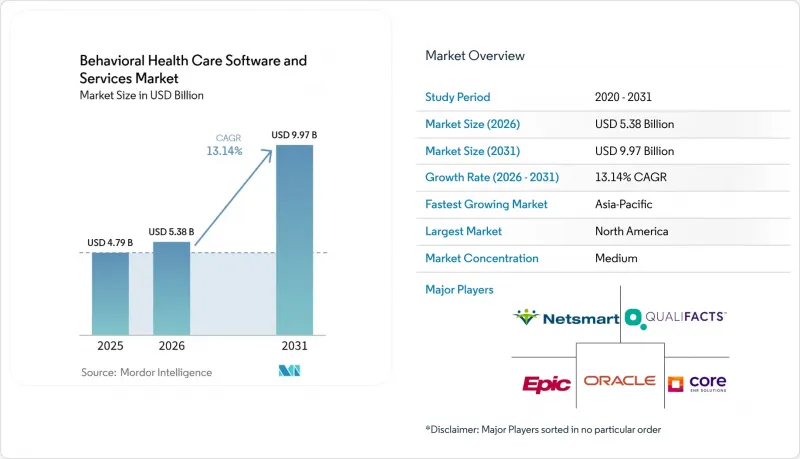
Mordor Intelligence에 따르면, 행동 의료 소프트웨어 및 서비스 시장은 2025년에 47억 9,000만 달러 규모에 달했으며, 2026년에는 53억 8,000만 달러에 이를 것으로 예측됩니다. 본 보고서는 구성 요소(소프트웨어, 지원 서비스), 제공 모델(구독 모델, 소유 모델), 기능성(임상 기능 등), 적용 분야(불안 장애, 외상 후 스트레스 장애 등), 최종 사용자(의료 제공업체 등), 지역(북미, 유럽, 아시아태평양 등)별로 분류되어 있습니다. 시장 전망은 금액(달러)으로 표시되어 있습니다.
세계의 행동 의료 소프트웨어 및 서비스 시장 동향과 인사이트
행동 의료 분야에서의 원격 의료 도입 확대
행동 의료는 여전히 가장 널리 정착된 원격의료 이용 사례 중 하나이며, 이에 따라 가상 진료는 행동 의료 소프트웨어 및 서비스 시장의 중심적인 위치를 계속 차지하고 있습니다. 미국 의학협회(AMA) 보고서에 따르면, 2024년 미국 정신과 의사의 85.9%가 매주 온라인 화상 진료를 제공했습니다. 또한, 미국 보건복지부(HHS)는 2027년 12월 31일까지 지리적 제한이나 사전 대면 진료 요건 없이 환자가 자택에서 메디케어 행동의학 원격의료 서비스를 이용할 수 있도록 하고 있습니다. 이러한 정책 프레임워크를 통해 농촌 지역 및 저소득층이 오랫동안 겪어온 접근성 장벽이 해소되었으며, 일상적인 의료 제공에서 하이브리드형 진료 모델의 중요성이 유지되고 있습니다. 또한, 진료 중 및 진료 종료 후에도 진료 기록 입력, 임상 워크플로우, 청구 처리를 단일 시스템 내에서 완결할 수 있기 때문에 가상 진료를 진료 기록에 직접 통합하는 벤더에게 유리한 환경이 조성되고 있습니다. 그 결과, 원격의료가 일시적인 확장 채널이 아닌 표준적인 치료 경로로 취급됨에 따라, 행동 의료 소프트웨어 및 서비스 시장은 계속해서 혜택을 보고 있습니다.
AI를 활용한 문서 작성 및 임상 생산성
AI를 활용한 기록 작성은 시범 단계를 벗어나, 행동 의료 소프트웨어 및 서비스 시장에서 실용적인 워크플로우의 한 축으로 자리 잡아가고 있습니다. 『Journal of Technology in Behavioral Science』 저널의 2025년 연구에 따르면, AI 기록 작성 도구는 사무 처리 시간을 최대 42% 단축하여 조직당 연간 886시간의 기록 작성 시간을 절약할 수 있는 것으로 밝혀졌습니다. 동 연구에서는 기록 자동화가 도입될 경우, 경과 기록 제출이 55시간 앞당겨졌습니다는 사실도 보고되었습니다. 2026년 『JMIR Formative Research』지에 게재된 조사에서는 1,528명의 정신건강 관리 제공업체를 대상으로 ‘Talkspace Smart Notes’를 평가한 결과, 주 단위 채택률이 94%, 기록 품질에 대한 긍정적 평가가 97.7%에 달한 것으로 밝혀졌습니다. 또한, 이 조사에서는 완료된 세션 수 및 제공업체 1인당 담당 클라이언트 건수에서 통계적으로 유의미한 증가가 관찰되어, 기록 업무의 개선이 단순한 편의성뿐만 아니라 수익성 향상으로도 이어진다는 사실이 밝혀졌습니다. Qualifacts와 같은 벤더들이 다국어 지원 AI 기록 작성 지원을 확대함에 따라, 행동 의료 소프트웨어 및 서비스 시장은 AI를 통한 기록 작성 지원이 플랫폼 평가의 주류에서 당연한 요건으로 여겨지는 단계로 전환되고 있습니다.
행동 보건 인력 및 IT 관리자 부족
임상의 및 IT 담당자의 인력 부족은 여전히 행동 의료 소프트웨어 및 서비스 시장이 처리할 수 있는 치료량을 제한하고 있습니다. HRSA 보고서에 따르면, 2025년 12월 기준으로 1억 3,700만 명의 미국인(인구의 40%)이 ‘정신건강 전문가 부족 지역’에 거주하고 있는 것으로 나타났습니다. 현재 공급 상황을 전제로 할 때, HRSA는 2038년까지 중독 상담사 7만 7,050명, 정신건강 상담사 9만 9,780명, 성인 정신과 의사 3만 6,780명의 부족이 발생할 것으로 예측했습니다. 소프트웨어를 통해 청구 처리 속도나 진료 기록 작성이 개선된다 하더라도, 청구 가능한 진료 활동은 여전히 이용 가능한 임상의의 수에 좌우됩니다. 캘리포니아주에서는 2025년에 58개 카운티 모두 행동 건강 분야의 인력 부족에 직면해 있으며, 해당 주에서는 2033년까지 6,200명 이상의 정신과 의사가 추가로 필요할 것으로 예측됩니다. 원격의료나 AI 도구를 활용하여 처리 능력을 높이는 것은 가능하지만, 행동 의료 소프트웨어 및 서비스 시장은 인력 부족으로 인해 발생하는 구조적인 공급 한계를 완전히 벗어나지는 못할 것입니다.
부문 분석
이 제목은 AI 기반 전자건강기록(EHR)이 문서 작성, 청구 정보 사전 입력, 치료 성과 추적을 단일 운영 계층에서 자동화할 수 있음을 보여줍니다. 이러한 업무가 플랫폼으로 이전되면, 도입 담당 직원이나 사내 IT 인력을 그만큼 늘리지 않고도 임상의 1인당 수익을 향상시킬 수 있습니다. 이러한 운영 논리는 생산성 향상이 필요한 반면, 관리 업무 인력을 늘릴 여지가 제한적인 외래 진료 제공업체에게 특히 중요합니다.
지원 서비스는 여전히 중요한 역할을 담당하고 있으며, 특히 사내에 고도의 IT 역량을 갖추지 못한 대규모 의료 기관이나 공공 자금을 받는 행동 의료 기관의 경우 더욱 그렇습니다. 조직이 주 정부의 보고 규정이나 보험사의 문서화 기준을 충족해야 하는 경우, 도입, 교육, 청구 관리, 분석 지원 및 지속적인 설정 작업은 여전히 중요합니다. 또한, 도입 작업이 시간이 지남에 따라 현장의 워크플로우에 정착해 가기 때문에 이러한 서비스는 고객의 유지율을 높이는 데에도 기여합니다. 따라서 행동 의료 소프트웨어 및 서비스 시장은 이 부문에서 다층적인 구조를 보이고 있으며, 소프트웨어가 성장을 주도하는 한편, 서비스는 도입의 정착성을 높이고 타사로의 전환 장벽을 높이고 있습니다.
2025년에는 구독 모델이 61.37%의 점유율을 차지했으며, 이는 막대한 초기 투자보다 지속적인 운영 비용을 선호하는 소규모 진료소의 구매 실태를 반영합니다. 많은 독립형 및 지역 밀착형 의료 제공업체에게 구독 방식의 도입은 인프라 부담을 줄이고 도입 기간을 단축하기 때문에 디지털 워크플로우로 나아가는 가장 간단한 경로가 됩니다. 또한, 대규모 사내 기술 부서를 유지하지 않으면서도 정기적인 업데이트가 필요한 진료소에게는 간소화된 인력 체계에도 적합합니다. 따라서 구독 방식은 폭넓은 구매자층에게 기본적인 진입 경로가 되어, 행동 의료 소프트웨어 및 서비스 시장에서 SaaS의 지속적인 확장을 뒷받침하고 있습니다. 의료 제공업체가 나중에 기능을 확장하더라도 초기 진입 장벽이 낮기 때문에 대부분의 경우 처음에는 클라우드 기반 구독형 도구를 채택합니다.
소유형 모델은 2031년까지 연평균 성장률(CAGR) 13.89%를 나타낼 것으로 예측되며, 이는 대기업 수요가 소규모 진료소 수요와는 다른 방향으로 향하고 있음을 보여줍니다. 대규모 의료 시스템, 여러 주에 걸쳐 있는 의료 제공업체 그룹, 그리고 인증된 지역 사회 행동 건강 클리닉(Certified Community Behavioral Health Clinics)의 경우, 대개 더 정교한 설정 기능, 맞춤형 보고서, 그리고 주별 규정 준수 워크플로우에 대한 보다 엄격한 관리가 필요합니다. 따라서 행동 건강 소프트웨어 및 서비스 시장에서는 경량형 도입보다 엔터프라이즈 규모, 규제 차이, 워크플로우 관리가 더 중요시되는 상황에서 On-Premise 모델에 대한 강력한 수요가 지속될 것으로 예측됩니다.
지역별 분석
2025년, 북미는 행동 건강 소프트웨어 및 서비스 시장 점유율의 41.63%를 차지했으며, 미국이 이를 주도했습니다. 행동 의료에 관한 메디케어의 영구적인 원격의료 규정, CCBHC 모델의 확대, 그리고 CMS의 '행동 의료 혁신 모델'은 모두 해당 지역에서의 체계적인 소프트웨어 도입을 뒷받침하고 있습니다. 또한, 미국은 전문 벤더들에게 여전히 가장 경쟁이 치열한 시장이며, AI를 활용한 문서화, 상호 운용성 및 규정 준수 수준에 대한 기준을 높이고 있습니다. 캐나다와 멕시코는 정신 건강의 디지털화와 원격의료 인프라 구축이 진행됨에 따라 점유율은 작지만 성장을 지속하고 있습니다. HIPAA, ONC 관련 상호운용성 요건, 42 CFR Part 2 등의 규정 준수 요건 또한 전환 비용을 높이는 요인이 되고 있으며, 이는 행동 의료 소프트웨어 및 서비스 시장에서 기존 공급업체의 입지를 공고히 하고 있습니다.
유럽은 두 번째로 큰 지역으로, 독일, 영국, 프랑스, 스칸디나비아 국가들로부터 큰 수요를 모았습니다. 도입은 각국의 정신건강 계획, 디지털 헬스 프레임워크, 그리고 임상 현장 전반에 걸친 원격 진료의 보급에 힘입어 이루어지고 있습니다. 보상 및 인증 체계가 명확한 시장에서는 정책상의 모호성이 적고, 의료 제공업체가 투자의 정당성을 설명하기 쉬우므로 시장 움직임이 빨라지는 경향이 있습니다. 이탈리아, 스페인 및 기타 유럽 국가들은 여전히 도입 초기 단계에 있지만, 의료 제공에서 디지털 정신건강 지원이 점차 제도화됨에 따라 행동 의료 소프트웨어 및 서비스 시장의 기반은 확대되고 있습니다.
아시아태평양은 2031년까지 연평균 성장률(CAGR) 15.04%로 확대될 것으로 예측되며, 지역별 부문 중 가장 높은 성장률을 보이고 있습니다. 치료받지 못한 환자 수가 많고, 스마트폰 보급률이 상승하고 있으며, 정부 주도의 디지털화 프로그램이 추진되고 있는 점이 중국, 인도, 일본, 호주, 한국에서 수요 증가에 기여하고 있습니다. 일부 국가에서는 전문의 수가 여전히 제한적이고 기존 인프라도 고르지 않아, 디지털을 최우선으로 한 행동 지원으로 직접 전환하고 있습니다. 일본에서도 고령화 진행과 직장 내 정신건강 보고에 대한 관심이 높아짐에 따라, 행동 건강 앱의 도입이 가속화되고 있습니다. 남미, 중동 및 아프리카의 기여도는 여전히 미미하지만, 공공 디지털 헬스 분야에 대한 투자로 인해 행동 의료 소프트웨어 및 서비스 시장의 보급 범위는 서서히 확대되고 있습니다.
기타 혜택 :
- 엑셀 형식 시장 예측(ME) 시트
- 3개월간의 애널리스트 지원
자주 묻는 질문
목차
제1장 서론
제2장 조사 방법
제3장 주요 요약
제4장 시장 구도
제5장 시장 규모 및 성장 예측
제6장 경쟁 구도
제7장 시장 기회 및 향후 전망
KTH 26.08.10Software accounted for 56.84% of behavioral health care software and services market size in 2025 and is projected to expand at 14.28% CAGR through 2031, making it both the largest and fastest-growing component.
According to Mordor Intelligence, the behavioral health care software and services market was valued at USD 4.79 billion in 2025 and is expected to reach USD 5.38 billion in 2026. This report is Segmented by Component (Software, Support Services), Delivery Model (Subscription Model, Ownership Model), Functionality (Clinical Functionality, and More), Application (Anxiety, Post-Traumatic Stress Disorder, and More), End-User (Healthcare Providers, and More), and Geography (North America, Europe, Asia-Pacific, and More). The Market Forecasts are in Value (USD).
Global Behavioral Health Care Software and Services Market Trends and Insights
Rising Telehealth Adoption in Behavioral Care
Behavioral health remains one of the most durable telehealth use cases, which keeps virtual care central to the behavioral health care software and services market. The American Medical Association reported that 85.9% of U.S. psychiatrists were providing weekly virtual video visits in 2024. HHS has also kept Medicare behavioral telehealth available from the patient's home, without geographic restrictions and without a prior in-person visit requirement, through December 31, 2027. That policy structure removes a long-standing access barrier for rural and lower-income populations and keeps hybrid care models relevant in routine delivery. It also favors vendors that embed virtual visits directly into the record, because note capture, clinical workflow, and billing can remain in one system during and after the session. As a result, the behavioral health care software and services market continues to benefit when telehealth is treated as a standard care pathway instead of a temporary extension channel.
AI-Enabled Documentation and Clinical Productivity
AI-assisted documentation has moved beyond pilot activity and is becoming a practical workflow layer inside the behavioral health care software and services market. A 2025 study in the Journal of Technology in Behavioral Science found that AI documentation tools cut administrative time by up to 42% and saved 886 documentation hours per organization each year. The same study reported that progress notes were submitted 55 hours earlier when note automation was in use. A 2026 JMIR Formative Research study that evaluated Talkspace Smart Notes across 1,528 mental health providers found 94% weekly adoption and 97.7% positive note-quality ratings.That study also found statistically significant gains in completed sessions and client caseload per provider, which links documentation improvement to revenue capacity rather than to convenience alone. As vendors such as Qualifacts expand multilingual AI documentation support, the behavioral health care software and services market is moving toward a point where AI note assistance is expected in mainstream platform evaluations.
Shortage of Behavioral Health Staff and IT Administrators
Clinician and IT staffing shortages still limit how much care volume the behavioral health care software and services market can process. HRSA reported that 137 million Americans, or 40% of the population, lived in a Mental Health Professional Shortage Area as of December 2025. Under status quo supply assumptions, HRSA also projected shortfalls of 77,050 addiction counselors, 99,780 mental health counselors, and 36,780 adult psychiatrists by 2038. Even when software improves billing speed and note completion, billable activity still depends on the number of available clinicians. In California, all 58 counties faced behavioral health workforce shortages in 2025, and the state was projected to need more than 6,200 additional psychiatrists by 2033. Telehealth and AI tools can raise throughput, but the behavioral health care software and services market cannot fully escape the structural supply ceiling created by workforce shortages.
Other drivers and restraints analyzed in the detailed report include:
- Expansion of Behavioral Health EHR and Care Coordination Workflows
- Value-Based Contracting for Community and Outpatient Behavioral Care
- 42 CFR Part 2 and Fragmented Consent Workflows
For complete list of drivers and restraints, kindly check the Table Of Contents.
Segment Analysis
This lead reflects the way AI-enabled EHRs can automate documentation, billing pre-population, and outcome tracking in one operating layer. When those tasks move into the platform, revenue per clinician can improve without a matching increase in implementation staff or internal IT headcount. That operating logic is especially important for outpatient providers that need productivity gains but have limited room to add administrative labor.
Support services still retain a meaningful role, especially for enterprise providers and publicly funded behavioral health organizations that lack deep internal IT capacity. Implementation, training, managed billing, analytics support, and ongoing configuration work remain important when organizations must meet state reporting rules and payer documentation standards. These services also strengthen retention because deployment work becomes embedded in local workflows over time. The behavioral health care software and services market therefore shows a layered structure in this segment, with software driving growth while services reinforce adoption durability and raise switching friction.
The subscription model held 61.37% share in 2025, which reflects the purchasing reality of smaller practices that prefer recurring operating expense over large upfront capital commitments. For many independent and community-based providers, subscription deployment is the simplest route into digital workflows because it reduces infrastructure demands and shortens implementation time. It also fits lean staffing models where practices need regular updates without maintaining a large internal technology function. That makes subscription the default entry point for a broad base of buyers and supports continued SaaS expansion in the behavioral health care software and services market. Even when providers later expand functionality, many first adopt through cloud-based subscription tools because the initial barrier is lower.
The ownership model is projected to grow at 13.89% CAGR through 2031, which shows that enterprise demand is moving in a different direction from small-practice demand. Large health systems, multistate provider groups, and Certified Community Behavioral Health Clinics often need deeper configurability, custom reporting, and tighter control over state-specific compliance workflows. For that reason, the behavioral health care software and services market continues to support strong ownership demand wherever enterprise scale, regulatory variation, and workflow control carry more weight than lighter deployment.
Complete Report Scope:
- By Component
- Software
- Support Services
- By Delivery Model
- Subscription Model
- Ownership Model
- By Functionality
- Clinical Functionality
- Electronic Health Records
- Clinical Decision Support
- Telehealth Integration
- Administrative Functionality
- Patient and Client Scheduling
- Workforce Management
- Document Management
- Financial Functionality
- Revenue Cycle Management
- Managed Care
- General Ledger and Payroll
- Clinical Functionality
- By Application
- Anxiety
- Post-Traumatic Stress Disorder
- Substance Abuse
- Bipolar Disorders
- Schizophrenia
- Other Applications
- By End-User
- Healthcare Providers
- Healthcare Payers
- Patients
- By Geography
- North America
- United States
- Canada
- Mexico
- Europe
- Germany
- United Kingdom
- France
- Italy
- Spain
- Rest of Europe
- Asia-Pacific
- China
- Japan
- India
- Australia
- South Korea
- Rest of Asia-Pacific
- Middle East and Africa
- GCC
- South Africa
- Rest of Middle East and Africa
- South America
- Brazil
- Argentina
- Rest of South America
- North America
Geography Analysis
North America held 41.63% of the behavioral health care software and services market share in 2025, led by the United States. Permanent Medicare telehealth provisions for behavioral health, expansion of the CCBHC model, and the CMS Innovation in Behavioral Health Model are all supporting structured software adoption in the region. The United States also remains the densest competitive arena for specialized vendors, which raises the standard for AI documentation, interoperability, and compliance depth. Canada and Mexico contribute smaller but growing shares as mental health digitization and telehealth infrastructure continue to develop. Compliance requirements such as HIPAA, ONC-related interoperability expectations, and 42 CFR Part 2 also create higher switching costs, which helps anchor established suppliers in the behavioral health care software and services market.
Europe was the second-largest region and drew meaningful demand from Germany, the United Kingdom, France, and Scandinavia. Adoption is being supported by national mental health plans, digital health frameworks, and broader use of teleconsultation across clinical settings. Markets with clearer reimbursement and certification structures tend to move faster because providers can justify investment with fewer policy ambiguities. Italy, Spain, and the rest of Europe remain earlier in the curve, but the base for the behavioral health care software and services market is widening as digital mental health support becomes more formalized in care delivery.
Asia-Pacific is projected to expand at 15.04% CAGR through 2031, which makes it the fastest-growing regional segment. Large untreated patient populations, rising smartphone penetration, and government-backed digitization programs are helping demand build across China, India, Japan, Australia, and South Korea. Some countries are moving directly toward digital-first behavioral support because specialist capacity remains limited and traditional infrastructure is uneven. Japan is also seeing stronger behavioral health app adoption alongside an aging population and greater attention to workplace mental health reporting. South America, the Middle East, and Africa remain smaller contributors, but public digital health investment is gradually broadening the reach of the behavioral health care software and services market.
- AdvancedMD
- Athenahealth
- Core Solutions, Inc.
- Credible Behavioral Health, Inc.
- Epic Systems
- Holmusk Pte. Ltd.
- Kareo
- Kipu Health, LLC
- Meditab Software Inc.
- Netsmart Technologies, Inc.
- NextGen Healthcare
- Oracle
- Qualifacts Systems, Inc.
- SimplePractice, LLC
- The Echo Group
- Ensora Health
- TherapyNotes, LLC
- Valant, Inc.
- Welligent, Inc.
- WellSky Corporation
Additional Benefits:
- The market estimate (ME) sheet in Excel format
- 3 months of analyst support
TABLE OF CONTENTS
1 Introduction
- 1.1 Study Assumptions and Market Definition
- 1.2 Scope of the Study
2 Research Methodology
3 Executive Summary
4 Market Landscape
- 4.1 Market Overview
- 4.2 Market Drivers
- 4.2.1 Rising Telehealth Adoption in Behavioral Care
- 4.2.2 Expansion of Behavioral Health EHR and Care Coordination Workflows
- 4.2.3 AI-Enabled Documentation and Clinical Productivity
- 4.2.4 Insurance Parity and Digital Reimbursement Tailwinds
- 4.2.5 Security-First, Consent-Aware Interoperability Demand
- 4.2.6 Value-Based Contracting for Community and Outpatient Behavioral Care
- 4.3 Market Restraints
- 4.3.1 Shortage of Behavioral Health Staff and IT Administrators
- 4.3.2 42 CFR Part 2 and Fragmented Consent Workflows
- 4.3.3 Thin Operating Margins in Small Practices and Community Clinics
- 4.3.4 Vendor Switching Friction from Legacy EHR and Billing Dependencies
- 4.4 Value Chain Analysis
- 4.5 Regulatory Landscape
- 4.6 Technological Outlook
- 4.7 Porter's Five Forces Analysis
- 4.7.1 Threat of New Entrants
- 4.7.2 Bargaining Power of Suppliers
- 4.7.3 Bargaining Power of Buyers
- 4.7.4 Threat of Substitutes
- 4.7.5 Competitive Rivalry
5 Market Size & Growth Forecasts (Value, USD)
- 5.1 By Component
- 5.1.1 Software
- 5.1.2 Support Services
- 5.2 By Delivery Model
- 5.2.1 Subscription Model
- 5.2.2 Ownership Model
- 5.3 By Functionality
- 5.3.1 Clinical Functionality
- 5.3.1.1 Electronic Health Records
- 5.3.1.2 Clinical Decision Support
- 5.3.1.3 Telehealth Integration
- 5.3.2 Administrative Functionality
- 5.3.2.1 Patient and Client Scheduling
- 5.3.2.2 Workforce Management
- 5.3.2.3 Document Management
- 5.3.3 Financial Functionality
- 5.3.3.1 Revenue Cycle Management
- 5.3.3.2 Managed Care
- 5.3.3.3 General Ledger and Payroll
- 5.3.1 Clinical Functionality
- 5.4 By Application
- 5.4.1 Anxiety
- 5.4.2 Post-Traumatic Stress Disorder
- 5.4.3 Substance Abuse
- 5.4.4 Bipolar Disorders
- 5.4.5 Schizophrenia
- 5.4.6 Other Applications
- 5.5 By End-User
- 5.5.1 Healthcare Providers
- 5.5.2 Healthcare Payers
- 5.5.3 Patients
- 5.6 By Geography
- 5.6.1 North America
- 5.6.1.1 United States
- 5.6.1.2 Canada
- 5.6.1.3 Mexico
- 5.6.2 Europe
- 5.6.2.1 Germany
- 5.6.2.2 United Kingdom
- 5.6.2.3 France
- 5.6.2.4 Italy
- 5.6.2.5 Spain
- 5.6.2.6 Rest of Europe
- 5.6.3 Asia-Pacific
- 5.6.3.1 China
- 5.6.3.2 Japan
- 5.6.3.3 India
- 5.6.3.4 Australia
- 5.6.3.5 South Korea
- 5.6.3.6 Rest of Asia-Pacific
- 5.6.4 Middle East and Africa
- 5.6.4.1 GCC
- 5.6.4.2 South Africa
- 5.6.4.3 Rest of Middle East and Africa
- 5.6.5 South America
- 5.6.5.1 Brazil
- 5.6.5.2 Argentina
- 5.6.5.3 Rest of South America
- 5.6.1 North America
6 Competitive Landscape
- 6.1 Market Concentration
- 6.2 Market Share Analysis
- 6.3 Company Profiles (includes Global level Overview, Market level overview, Core Segments, Financials as available, Strategic Information, Market Rank/Share for key companies, Products & Services, Recent Developments)
- 6.3.1 AdvancedMD, Inc.
- 6.3.2 Athenahealth, Inc.
- 6.3.3 Core Solutions, Inc.
- 6.3.4 Credible Behavioral Health, Inc.
- 6.3.5 Epic Systems Corporation
- 6.3.6 Holmusk Pte. Ltd.
- 6.3.7 Kareo, Inc.
- 6.3.8 Kipu Health, LLC
- 6.3.9 Meditab Software Inc.
- 6.3.10 Netsmart Technologies, Inc.
- 6.3.11 NextGen Healthcare, Inc.
- 6.3.12 Oracle
- 6.3.13 Qualifacts Systems, Inc.
- 6.3.14 SimplePractice, LLC
- 6.3.15 The Echo Group
- 6.3.16 Ensora Health
- 6.3.17 TherapyNotes, LLC
- 6.3.18 Valant, Inc.
- 6.3.19 Welligent, Inc.
- 6.3.20 WellSky Corporation
7 Market Opportunities & Future Outlook
- 7.1 White-space & Unmet-need Assessment