|
시장보고서
상품코드
2099953
정신건강 분야 의료기기 소프트웨어(SaMD) 시장 : 시장 점유율 분석, 업계 동향 및 통계, 성장 예측(2026-2031년)Software As A Medical Device (SaMD) For Mental Health - Market Share Analysis, Industry Trends & Statistics, Growth Forecasts (2026 - 2031) |
||||||
 Mordor Intelligence
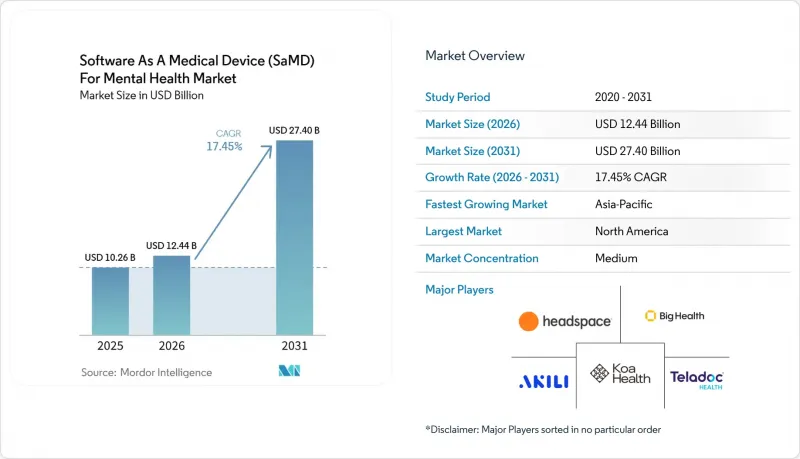
정신건강 분야 의료기기 소프트웨어(SaMD) 시장 규모는 2025년에 102억 6,000만 달러로 평가되었고, 2026년 124억 4,000만 달러에서 2031년까지 274억 달러에 이를 것으로 예측되며, 2026-2031년 CAGR 217.45%로 성장할 전망입니다.
본 보고서는 유형별(PDT, CDSS, 원격 모니터링, 컴패니언 소프트웨어), 치료 분야별(우울증, 불안 장애, 불면증, 약물 사용 장애 등), 제공 형태별(모바일 앱, 웹 기반, 하이브리드, 웨어러블 통합형), 최종 사용자별(환자, 의료 제공업체 등), 지역별(북미, 유럽, 아시아태평양, 중동 및 아프리카, 남미)로 분류되어 있습니다. 예측치는 금액(달러)으로 표시되어 있습니다.
세계의 정신건강 분야 의료기기 소프트웨어(SaMD) 동향 및 인사이트
FDA 및 규제 당국에 의한 임상 검증 확대
정신건강 분야 의료기기 소프트웨어(SaMD) 시장은 몇년전과 비교해 보다 명확한 규제 로드맵이 확립된 혜택을 누리고 있습니다. 2025년 동료 심사 리뷰에서는 디지털 치료, 바이오피드백 도구, 원격 모니터링 시스템, 그리고 소프트웨어 기반 치료 지원 용도에 걸쳐 FDA 승인을 받은 19개의 정신건강 분야 의료기기 소프트웨어(SaMD) 제품이 확인되었습니다. 이러한 확대되는 기반은 개발자에게 명확한 제품 사례를 제공할 뿐만 아니라, 의료 제공업체가 임상 현장에서 이를 도입하는 데 더 큰 자신감을 가질 수 있도록 하고 있습니다.
이 리뷰에서는 후발 제품 중 상당수가 선행하는 데 노보(De Novo) 대상 제품과의 실질적 동등성에 의존하고 있으며, 제품 라인업이 확충됨에 따라 기존 업체들에게 우위가 생기고 있다는 점도 지적되었습니다. 이러한 동향은 경쟁 구도를 변화시키고 있으며, 신규 진출기업은 신뢰를 쌓기 위해 더 높은 수준의 근거와 규정 준수 기준을 충족해야 합니다. 장기적으로는 이를 통해 승인된 자산을 보유한 기업들이 더 높은 품질의 제품, 더 확고한 임상적 수용, 그리고 더 지속 가능한 시장 지위를 확립할 것으로 기대됩니다.
처방전이 필요한 디지털 치료제의 보험 적용 경로 확대
보험 적용은 정신건강 분야 의료기기 소프트웨어(SaMD) 시장에서 여전히 가장 강력한 성장 동력 중 하나입니다. CMS는 2025년 1월 1일부터 G0552부터 G0554까지의 청구 코드를 활성화하여, 메디케어 제공업체가 적격한 디지털 정신건강 치료 기기 및 관련 임상 서비스에 대해 청구할 수 있도록 했습니다. 이러한 정책 전환으로 인해, 특히 처방전 감독이 필요한 제품의 경우 임상적 유효성 입증이 보다 현실적인 수익 창출 경로가 될 것입니다.
또한, ‘2025년 처방 대상 디지털 치료제 접근법’은 제조업체의 보고 의무 및 가격 투명성을 포함하여, 이러한 도구에 대한 연방 정책이 보다 공식적인 급여 구조로 전환되고 있음을 시사합니다. 유럽에서는 독일이 DiGA를 통해 계속해서 중요한 참고 사례가 되고 있으며, 2026년 개정을 통해 환급 가격의 최소 20%가 치료 성과에 연동되도록 되었습니다. 이러한 환급 제도 변경이 맞물려 구매자에게는 가시성이 향상되고, 시장에 대한 투자 매력이 높아지고 있습니다.
신규 디지털 치료제에 대한 보험사의 적용 범위 확대는 완만하고 불균일합니다.
정신건강 분야 의료기기 소프트웨어(SaMD) 시장은 2025년 메디케어의 획기적인 진전 이후에도 보험 적용 범위의 불균일성에 계속 직면해 왔습니다. CMS(미국 의료보험 및 의료서비스 센터)는 적격 디지털 정신건강 치료법에 대한 중요한 길을 열었지만, 각종 보험 플랜 및 의료 현장에서 보험사들의 광범위한 도입은 여전히 진행 중인 단계에 머물러 있었습니다. 의료 제공업체들이 이러한 도구를 처방하고 운영에 도입하려는 의지는 보험 급여의 명확성에 따라 크게 달랐습니다. 이로 인해 상업적 상황은 양극화되는 양상을 보였는데, 고용주가 지원하는 프로그램이나 의료 제공업체가 주도하는 프로그램 중 일부는 빠르게 진전되는 반면, 의료 시스템의 다른 부분에서는 여전히 신중한 태도가 유지되고 있었습니다. 이러한 불균일한 진전 속도로 인해, 처방 지원, 워크플로우 통합 및 의료 제공업체와의 지속적인 참여가 필요한 제품의 확대는 둔화되었습니다. 보험 적용이 보다 일관성을 갖추게 될 때까지는 지불 가시성이 높은 채널에서 시장 도입이 더욱 활발해질 것으로 예측됩니다.
부문 분석
2025년, 처방전이 필요한 디지털 치료제는 유형별 부문의 38.55%를 차지하며, 정신건강 분야 의료기기 소프트웨어(SaMD) 시장에서 가장 큰 수익원이 되었습니다. 이러한 우위는 중증도가 낮은 동반 앱에 비해 더 명확한 임상적 정체성, 의사에게 높은 관련성, 그리고 공식적인 보험 환급 경로와의 뛰어난 일관성을 반영합니다. 2024년, 성인 주요 우울 장애 증상에 대한 보조 요법으로 승인된 최초의 처방전 대상 디지털 치료제인 ‘Rejoyn’은 스마트폰 기반 중재가 임상 사용에 관한 FDA 기준을 충족할 수 있음을 보여주었습니다. 이 획기적인 성과로 인해 의료 제공업체가 확립된 워크플로우 내에서 처방, 모니터링 및 청구를 수행할 수 있는 제품의 비즈니스 타당성이 강화되었습니다.
원격 환자 모니터링 및 디지털 바이오마커 소프트웨어는 2026-2031년 연평균 성장률(CAGR) 18.93%를 나타낼 것으로 예측되며, 정신건강 분야 의료기기 소프트웨어(SaMD) 시장에서 가장 빠르게 성장하는 분야가 될 전망입니다. 2025년 『JMIR』지에 게재된 총설에서는 이동, 수면, 사회적 활동 및 음성 관련 패턴을 포괄하는 42건의 동료 심사 연구에서 수동 감지에 대한 일관된 지지가 확인되었습니다. 이러한 근거를 바탕으로, 정신건강용 소프트웨어의 적용 범위는 치료 제공에서 지속적인 측정 및 추적으로 확대되었습니다. 제품이 증상 관리에서 종단적 모니터링으로 전환됨에 따라, 바이오마커를 활용한 도구는 재발 예방, 치료법 조정 및 임상 감독에서 더 큰 역할을 수행하게 될 것입니다.
2025년에는 우울증이 치료 분야의 매출의 34.22%를 차지하며, 정신건강 분야 의료기기 소프트웨어(SaMD) 시장에서 가장 큰 점유율을 기록했습니다. 이 부문은 진단받은 환자 수가 많고, 인지행동치료의 근거 기반이 더욱 확립되어 있으며, 디지털 치료 모델에 대한 규제적 이해가 명확하다는 점에서 혜택을 받았습니다. 대우울장애 치료용 ‘Rejoyn’과 관련 보험 적용 가능한 행동 치료 경로에서 ‘SleepioRx’ 및 ‘DaylightRx’와 같은 제품의 성공 사례가 상업적 신뢰를 뒷받침했습니다. 불안 장애, 불면증, 수면장애 역시 보험사 및 고용주에서의 수요가 높고, 디지털 행동 변화 모델과 부합한다는 점에서 계속해서 매력적인 분야로 남아 있습니다.
ADHD는 2026-2031년 연평균 성장률(CAGR) 19.67%를 나타낼 것으로 예측되며, 정신건강 분야 의료기기 소프트웨어(SaMD) 시장에서 가장 빠르게 성장하는 치료 분야가 될 전망입니다. APA Services는 2025년 및 2026년 메디케어 의사 보수 일정안에서 CFR §882.5803에 따라 디지털 정신건강 치료의 청구 대상이 ADHD용 기기까지 확대되어 중요한 보험 적용 신호가 나타났습니다고 지적했습니다. 이러한 정책 방향은 EndeavorRx가 확립한 규제적 토대에 기반을 두고 있으며, 구조화된 주의력 관련 중재를 위한 후속 제품들의 등장을 촉진했습니다. 약물 사용 장애 및 PTSD는 계속해서 활발한 중견 카테고리로 자리 잡은 반면, 중증 정신 질환의 경우 승인된 제품이 제한적이고 임상 측정도 복잡하여 미개척 영역으로 남아 있었습니다.
지역별 분석
2025년, 북미는 정신건강 분야 의료기기 소프트웨어(SaMD) 시장 점유율의 40.56%를 차지하며 계속해서 주요 상업 지역으로서의 위상을 유지했습니다. 미국은 강력한 FDA 승인 절차, 보험 급여 제도의 개선, 그리고 의료 제공업체들의 디지털 정신건강 치료 분야에 대한 이해 심화를 통해 이러한 입지를 공고히 했습니다. 해당 의료기기를 위한 CMS 청구 코드는 처방전 연계형 제품에 대해 보다 명확한 길을 마련하여 수익화와 제품 검증을 강화했습니다. 또한, 이 지역은 승인된 제품의 도입 기반이 더욱 깊게 정착되어 있다는 점과 측정 가능한 정신 건강 효과에 대한 고용주들의 강한 관심으로부터도 혜택을 받았습니다.
유럽은 정신 건강용 SaMD 시장에서 여전히 두 번째로 중요한 지역적 축으로 자리매김했습니다. 독일은 DiGA(디지털 헬스 용도) 승인 절차가 디지털 헬스 용도를 위한 국내 처방 경로 중 가장 잘 정비된 것 중 하나로 자리매김하고 있다는 점에서 두드러졌습니다. 2024년 조사에 따르면, 독일의 DiGA 디렉토리에는 25건의 정신건강 용도이 등재되어 가장 큰 카테고리를 차지했습니다. 2026년 DiGA 개정에서는 결과 모니터링이 의무화되고, 환급 가격의 최소 20%가 성과에 연동되도록 규정됨에 따라, 근거 기반 도입 기준이 강화되었습니다.
아시아태평양은 2026-2031년 연평균 성장률(CAGR) 19.56%를 나타낼 것으로 예측되며, 정신건강 분야 의료기기 소프트웨어(SaMD) 시장에서 가장 성장세가 두드러진 지역 부문이 될 전망입니다. 이 지역에서는 의료 접근성 격차가 여전히 큰 반면, 디지털을 통한 서비스 제공으로 모든 사용자가 대면 전문의 진료를 받을 필요 없이 지원을 확대할 수 있으므로, 수요의 잠재력은 매우 높다고 할 수 있습니다. 일본은 PMDA의 체계가 SaMD 심사를 위한 명확한 로드맵을 제시하고, 보험 적용 대상이 되는 디지털 치료제에 대한 관심을 촉진하고 있어 전략적으로 중요한 위치를 계속 차지하고 있습니다. 한국과 호주는 보다 체계적인 디지털 헬스 환경을 갖추고 있는 반면, 중동 및 아프리카는 여전히 초기 단계에 있으며, 남미에서는 규제 기반 강화가 진행되고 있습니다.
기타 혜택 :
- 엑셀 형식 시장 예측(ME) 시트
- 3개월간의 애널리스트 지원
자주 묻는 질문
목차
제1장 서론
제2장 조사 방법
제3장 주요 요약
제4장 시장 구도
제5장 시장 규모 및 성장 예측
제6장 경쟁 구도
제7장 시장 기회 및 향후 전망
AJY 26.08.11According to Mordor Intelligence, the software as a medical device for mental health market size was valued at USD 10.26 billion in 2025 and is estimated to grow from USD 12.44 billion in 2026 to reach USD 27.40 billion by 2031, at a CAGR of 17.45% during the forecast period (2026-2031).
This report is Segmented by Type (PDTs, CDSS, Remote Monitoring, Companion Software), Therapeutic Area (Depression, Anxiety, Insomnia, Substance Use, and More), Delivery Mode (Mobile Apps, Web-Based, Hybrid, Wearable-Integrated), End User (Patients, Providers, and More), and Geography (North America, Europe, Asia-Pacific, MEA, South America). Forecasts in Value (USD).
Global Software As A Medical Device (SaMD) For Mental Health Market Trends and Insights
Rising FDA and Regulator-Backed Clinical Validation
The software as a medical device for mental health market is benefiting from a clearer regulatory pathway than it had a few years ago. A 2025 peer-reviewed review identified 19 FDA-authorized mental health SaMD products across digital therapeutics, biofeedback tools, remote monitoring systems, and software-based care support applications. This expanding base provides developers with visible product precedents and gives providers greater confidence in clinical adoption.
The same review noted that many later products relied on substantial equivalence to earlier De Novo predicates, giving established players an advantage as product lineages deepened. This trend is reshaping competition, as newer entrants must meet a higher evidence and compliance threshold to build trust. Over time, it should support higher-quality products, stronger clinical acceptance, and more durable commercial positions for companies with cleared assets.
Expansion of Reimbursement Pathways for Prescription Digital Therapeutics
Reimbursement remains one of the strongest growth levers in the software as a medical device for mental health market. CMS activated the G0552 to G0554 billing codes on January 1, 2025, allowing Medicare providers to bill for eligible digital mental health treatment devices and related clinical services. This policy shift turns clinical validation into a more viable revenue pathway, especially for products that require prescription oversight.
The Access to Prescription Digital Therapeutics Act of 2025 also indicated that federal policy was moving toward a more formal benefit structure for these tools, including manufacturer reporting obligations and pricing transparency. In Europe, Germany continued to serve as an important reference point through DiGA, and the 2026 update linked at least 20% of reimbursed pricing to outcomes performance. Together, these reimbursement changes improve buyer visibility and make the market more investable.
Slow and Uneven Payer Coverage for Novel Digital Therapeutics
The software as a medical device for mental health market continued to face uneven coverage even after the 2025 Medicare milestone. CMS opened an important route for eligible digital mental health treatments, but broader payer adoption across plans and care settings remained in progress. Provider willingness to prescribe and operationalize these tools varied widely depending on reimbursement clarity. This created a split commercial picture, with some employer-backed or provider-led programs moving ahead quickly while other parts of the care system remained cautious. This uneven pace slowed scale-up for products that required prescription support, workflow integration, and repeat provider engagement. Until coverage becomes more consistent, the market is expected to show stronger adoption in channels where payment visibility is better.
Other drivers and restraints analyzed in the detailed report include:
- Employer and Payer Demand for Scalable Mental Health Solutions
- AI-Enabled Personalization and Measurement-Based Care
- High Clinical Evidence Burden and Long Reimbursement Timelines
For complete list of drivers and restraints, kindly check the Table Of Contents.
Segment Analysis
Prescription digital therapeutics held 38.55% of the type segment in 2025, making them the largest revenue contributor in the software as a medical device for mental health market. Their lead reflected a stronger clinical identity, higher physician relevance, and better alignment with formal reimbursement pathways than lower-acuity companion applications. Rejoyn, cleared in 2024 as the first prescription digital therapeutic authorized for adjunctive treatment of major depressive disorder symptoms in adults, showed that smartphone-based interventions could meet FDA standards for clinical use. This milestone strengthened the business case for products that providers could prescribe, monitor, and bill within established workflows.
Remote patient monitoring and digital biomarker software is projected to grow at an 18.93% CAGR from 2026 to 2031, making it the fastest-moving type in the software as a medical device for mental health market. A 2025 review in JMIR found consistent support for passive sensing across 42 peer-reviewed studies, covering mobility, sleep, social activity, and voice-related patterns. This evidence base expanded mental health software from treatment delivery to continuous measurement and tracking. As products shift from symptom support to longitudinal monitoring, biomarker-driven tools are likely to play a larger role in relapse prevention, therapy adjustment, and clinical oversight.
Depression accounted for 34.22% of therapeutic area revenue in 2025, giving it the largest position in the software as a medical device for mental health market. The segment benefited from a large diagnosed population, a more established cognitive behavioral therapy evidence base, and clearer regulatory familiarity for digital treatment models. Product proof points, including Rejoyn for major depressive disorder and SleepioRx and DaylightRx in related reimbursable behavioral treatment pathways, supported commercial confidence. Anxiety, insomnia, and sleep disorders also remained attractive due to strong payer and employer demand and alignment with digital behavior-change models.
ADHD is projected to grow at a 19.67% CAGR from 2026 to 2031, making it the fastest-growing therapeutic area in the software as a medical device for mental health market. APA Services noted in 2025 that the 2026 Medicare Physician Fee Schedule proposal extended digital mental health treatment billing to ADHD devices under CFR § 882.5803, creating an important reimbursement signal. This policy direction built on the regulatory foundation established by EndeavorRx and supported follow-on products for structured attention-related interventions. Substance use disorder and PTSD remained active middle-tier categories, while severe mental illness presented white space due to limited cleared products and complex clinical measurement.
Complete Report Scope:
- By Type
- Prescription Digital Therapeutics
- Clinical Decision Support Software
- Remote Patient Monitoring and Digital Biomarker Software
- Companion and Adjunct Therapeutic Software
- By Therapeutic Area
- Depression
- Anxiety Disorders
- Insomnia and Sleep Disorders
- Substance Use Disorders
- Attention-Deficit/Hyperactivity Disorder
- Post-Traumatic Stress Disorder
- Schizophrenia and Psychosis
- Other Mental Health Indications
- By Delivery Mode
- Mobile Applications
- Web-Based Platforms
- Hybrid App and Provider Workflow Platforms
- Wearable-Integrated Software
- By End User
- Patients and Consumers
- Healthcare Providers
- Payers and Employers
- Behavioral Health Clinics and Telepsychiatry Networks
- By Geography
- North America
- United States
- Canada
- Mexico
- Europe
- Germany
- United Kingdom
- France
- Italy
- Spain
- Rest of Europe
- Asia-Pacific
- China
- India
- Japan
- Australia
- South Korea
- Rest of Asia-Pacific
- Middle East and Africa
- GCC
- South Africa
- Rest of Middle East and Africa
- South America
- Brazil
- Argentina
- Rest of South America
- North America
Geography Analysis
North America held 40.56% of the software as a medical device for mental health market share in 2025 and remained the leading commercial region. The United States supported this position through strong FDA authorization pathways, improving reimbursement, and provider familiarity with digital mental health treatment categories. CMS billing codes for eligible devices created a clearer route for prescription-linked products, strengthening revenue conversion and product validation. The region also benefited from a deeper installed base of cleared products and strong employer interest in measurable mental health benefits.
Europe remained the second major regional pillar in the software as a medical device for mental health market. Germany stood out as its DiGA pathway remained one of the most developed national prescription routes for digital health applications. A 2024 review found that mental health applications formed the largest category in Germany's DiGA directory, with 25 listed applications. The 2026 DiGA update required outcomes monitoring and linked at least 20% of reimbursed pricing to performance, raising the standard for evidence-backed adoption.
Asia-Pacific is projected to grow at a CAGR of 19.56% from 2026 to 2031, making it the fastest-growing regional segment in the software as a medical device for mental health market. The region offers strong demand potential as care access gaps remain wider, and digital delivery can expand support without requiring every user to consult an in-person specialist. Japan remains strategically important as its PMDA framework provides a defined path for SaMD review and supports interest in reimbursable digital therapeutic use. South Korea and Australia have more structured digital health environments, while the Middle East and Africa remains early-stage and South America is building a stronger regulatory base.
- AbleTo, Inc.
- Akili Interactive Labs, Inc.
- Behavioral Health Tech, LLC
- BetterHelp, Inc.
- Big Health, Inc.
- Calm.com, Inc.
- Curio Digital Therapeutics, Inc.
- Headspace, Inc.
- Headway, Inc.
- Koa Health, S.L.
- Limbix Health, Inc.
- Lyra Health, Inc.
- Otsuka
- Qualifacts Systems, LLC
- Quartet Health, Inc.
- Rejoyn, Inc.
- Spring Health, Inc.
- Talkspace, Inc.
- Teladoc Health
- Wysa Ltd.
Additional Benefits:
- The market estimate (ME) sheet in Excel format
- 3 months of analyst support
TABLE OF CONTENTS
1 INTRODUCTION
- 1.1 Study Assumptions and Market Definition
- 1.2 Scope of the Study
2 RESEARCH METHODOLOGY
3 EXECUTIVE SUMMARY
4 MARKET LANDSCAPE
- 4.1 Market Overview
- 4.2 Market Drivers
- 4.2.1 Rising FDA and Regulator-Backed Clinical Validation for Digital Mental Health Treatments
- 4.2.2 Expansion of Reimbursement Pathways for Prescription Digital Therapeutics
- 4.2.3 Employer and Payer Demand for Scalable Mental Health Access
- 4.2.4 AI-Enabled Personalization and Measurement-Based Care Workflows
- 4.2.5 Under-Served Psychiatric Comorbidities with Low Therapy Adherence
- 4.2.6 Post-Acute and Relapse-Prevention Use Cases That Extend Care Beyond Sessions
- 4.3 Market Restraints
- 4.3.1 Slow and Uneven Payer Coverage for Novel Digital Therapeutics
- 4.3.2 High Clinical Evidence Burden and Long Reimbursement Timelines
- 4.3.3 Patient Retention and Engagement Decay After Initial Use
- 4.3.4 Data Privacy, Cybersecurity, and Algorithm Transparency Concerns
- 4.4 Value/Supply Chain Analysis
- 4.5 Regulatory Landscape
- 4.6 Technological Outlook
- 4.7 Porter's Five Forces Analysis
- 4.7.1 Threat of New Entrants
- 4.7.2 Bargaining Power of Suppliers
- 4.7.3 Bargaining Power of Buyers
- 4.7.4 Threat of Substitutes
- 4.7.5 Intensity of Competitive Rivalry
5 MARKET SIZE AND GROWTH FORECASTS (VALUE, USD)
- 5.1 By Type
- 5.1.1 Prescription Digital Therapeutics
- 5.1.2 Clinical Decision Support Software
- 5.1.3 Remote Patient Monitoring and Digital Biomarker Software
- 5.1.4 Companion and Adjunct Therapeutic Software
- 5.2 By Therapeutic Area
- 5.2.1 Depression
- 5.2.2 Anxiety Disorders
- 5.2.3 Insomnia and Sleep Disorders
- 5.2.4 Substance Use Disorders
- 5.2.5 Attention-Deficit/Hyperactivity Disorder
- 5.2.6 Post-Traumatic Stress Disorder
- 5.2.7 Schizophrenia and Psychosis
- 5.2.8 Other Mental Health Indications
- 5.3 By Delivery Mode
- 5.3.1 Mobile Applications
- 5.3.2 Web-Based Platforms
- 5.3.3 Hybrid App and Provider Workflow Platforms
- 5.3.4 Wearable-Integrated Software
- 5.4 By End User
- 5.4.1 Patients and Consumers
- 5.4.2 Healthcare Providers
- 5.4.3 Payers and Employers
- 5.4.4 Behavioral Health Clinics and Telepsychiatry Networks
- 5.5 By Geography
- 5.5.1 North America
- 5.5.1.1 United States
- 5.5.1.2 Canada
- 5.5.1.3 Mexico
- 5.5.2 Europe
- 5.5.2.1 Germany
- 5.5.2.2 United Kingdom
- 5.5.2.3 France
- 5.5.2.4 Italy
- 5.5.2.5 Spain
- 5.5.2.6 Rest of Europe
- 5.5.3 Asia-Pacific
- 5.5.3.1 China
- 5.5.3.2 India
- 5.5.3.3 Japan
- 5.5.3.4 Australia
- 5.5.3.5 South Korea
- 5.5.3.6 Rest of Asia-Pacific
- 5.5.4 Middle East and Africa
- 5.5.4.1 GCC
- 5.5.4.2 South Africa
- 5.5.4.3 Rest of Middle East and Africa
- 5.5.5 South America
- 5.5.5.1 Brazil
- 5.5.5.2 Argentina
- 5.5.5.3 Rest of South America
- 5.5.1 North America
6 COMPETITIVE LANDSCAPE
- 6.1 Market Concentration
- 6.2 Market Share Analysis
- 6.3 Company Profiles (includes Global Level Overview, Market Level Overview, Core Segments, Financials as available, Strategic Information, Market Rank/Share, Products and Services, Recent Developments)
- 6.3.1 AbleTo, Inc.
- 6.3.2 Akili Interactive Labs, Inc.
- 6.3.3 Behavioral Health Tech, LLC
- 6.3.4 BetterHelp, Inc.
- 6.3.5 Big Health, Inc.
- 6.3.6 Calm.com, Inc.
- 6.3.7 Curio Digital Therapeutics, Inc.
- 6.3.8 Headspace, Inc.
- 6.3.9 Headway, Inc.
- 6.3.10 Koa Health, S.L.
- 6.3.11 Limbix Health, Inc.
- 6.3.12 Lyra Health, Inc.
- 6.3.13 Otsuka America Pharmaceutical, Inc.
- 6.3.14 Qualifacts Systems, LLC
- 6.3.15 Quartet Health, Inc.
- 6.3.16 Rejoyn, Inc.
- 6.3.17 Spring Health, Inc.
- 6.3.18 Talkspace, Inc.
- 6.3.19 Teladoc Health, Inc.
- 6.3.20 Wysa Ltd.
7 MARKET OPPORTUNITIES AND FUTURE OUTLOOK
- 7.1 White-Space and Unmet-Need Assessment