

|
시장보고서
상품코드
2099320
2상 외부 제세동기 : 시장 점유율 분석, 업계 동향 및 통계, 성장 예측(2026-2031년)Biphasic External Defibrillator - Market Share Analysis, Industry Trends & Statistics, Growth Forecasts (2026 - 2031) |
||||||
 Mordor Intelligence
Mordor Intelligence에 의하면, 2상 외부 제세동기 시장은 2025년 15억 달러로 평가되었습니다. 2026년에는 16억 3,000만 달러로 확대되어 2026년부터 2031년에 걸쳐 CAGR 9.45%로 성장을 지속하여, 2031년에는 25억 7,000만 달러에 이를 것으로 예측됩니다.
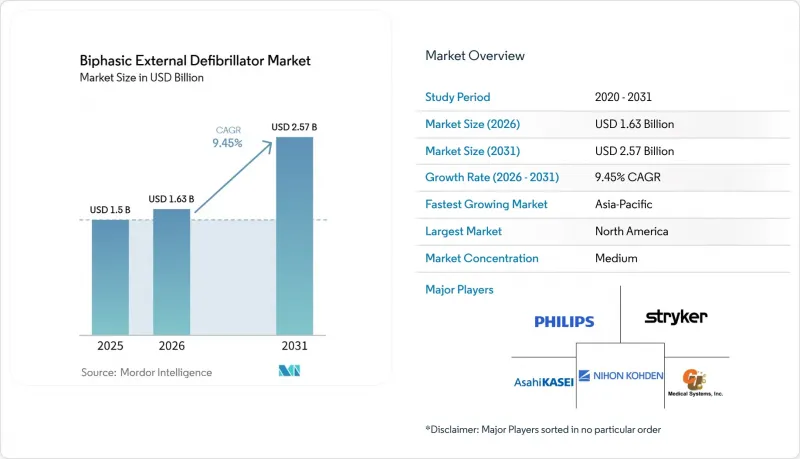
본 보고서는 제품 유형(수동식 외부 제세동기, 자동 외부 제세동기), 기술(2상 절단 지수 함수(BTE) 파형, 선형 2상 파형 등), 최종 사용자(병원 및 진료소, 응급 현장 등), 지역(북미, 유럽, 아시아태평양 등)별로 분류되어 있습니다. 시장 전망은 금액(달러) 기준으로 제시되어 있습니다.
세계의 2상 외부 제세동기 시장 동향과 인사이트
증가하는 돌연 심정지의 부담
돌연 심정지는 급성기 의료 분야에서 여전히 해결하기 가장 어려운 응급 상황 중 하나이며, 임상 현장과 일반 사회 모두에서 신속한 제세동의 필요성이 높아지고 있습니다. 미국에서는 2024년에 응급의료서비스(EMS)가 대응한 병원 외 심정지 사례가 25만 건 이상 기록되었으며, 이는 의료 격차의 규모가 여전히 크다는 것을 보여줍니다. 유럽의 경우, 2025년 소생 지침에 따르면 응급의료서비스(EMS)가 연간 주민 10만 명당 55건의 사례에 대응하고 있으며, 이는 이러한 부담이 특정 의료 시스템에만 국한된 것이 아님을 뒷받침합니다. 제세동 시행이 지연될 때마다 생존 확률은 1분마다 7%에서 10%씩 감소합니다. 또한, 2025년 CARES가 보고한 병원 외 심정지 사례 중 발병 시 현장에 목격자가 있었던 비율은 37.9%에 그쳐, 이로 인해 성공적인 개입의 기회는 더욱 좁아지고 있습니다. 2상 외부 제세동기 시장에서 이러한 부담으로 인해 수요는 짧은 교체 주기가 아닌 지속적인 임상적 필요와 연결되어 있습니다. 또한, 2상 외부 제세동기 시장은 치료 현장이나 쓰러진 현장에서 제세동 수단을 이용할 수 없는 경우, 조직이 더 큰 운영상 및 법적 위험에 직면한다는 사실에 의해서도 뒷받침되고 있습니다.
공공 접근 제세동 프로그램의 확대
2상 외부 제세동기 시장은 자동체외제세동기(AED) 설치를 ‘임의 조치’에서 보다 공식적인 안전 의무로 점진적으로 전환하려는 법규제에 힘입어 성장하고 있습니다. 『JACC, Advances』지의 2024년 분석에 따르면, 일반 시민에 의한 제세동에 관한 법률은 여전히 국가마다 크게 다르며, 보다 공식적인 설치 의무나 프로그램 확대를 위한 여지가 남아 있습니다. 미국에서는 CDC가 2025년에도 계속해서 주 차원의 일반인 대상 제세동 관련 법안을 추적하고 있으며, 이는 정책적 측면에서의 지속적인 관심과 지역별 도입 현황의 편차를 반영하고 있습니다. 캘리포니아주 의회 법안 365호는 전력 사업 시설 내 AED 설치 요건을 확대한 반면, 메릴랜드주는 음식점 시설에 AED 설치를 의무화하고, 법에 이미 정해진 일정에 따라 대상 범위를 기타 공공시설로도 확대했습니다. 미국심장협회(AHA)는 직장 및 지역사회 내 AED 도입을 틈새 개입이 아닌 실용적인 구명 조치로 계속해서 규정하고 있으며, 이는 행정 당국의 폭넓은 지지를 뒷받침하고 있습니다. 2상 제세동기(AED) 시장에 있어 이러한 변화는 중요한 의미를 지닙니다. 법규 준수를 목적으로 한 구매는 순전히 자발적인 설비 투자에 비해 일반적으로 재량권이 적고, 단기적인 예산상의 주저함의 영향을 덜 받기 때문입니다.
높은 도입 비용과 수명 주기 유지 비용
높은 단가는 여전히 이중상 외부 제세동기 시장에서의 도입에 있어 가장 명백한 장벽 중 하나로 남아 있으며, 특히 대규모 병원 시스템이나 자금력이 풍부한 기업 고객을 제외한 곳에서는 더욱 두드러집니다. 주요 공급업체의 단일 AED 가격은 일반적으로 1,200-3,500달러 범위이지만, 패드 교체, 배터리 교체, 규정 준수 활동 등을 포함하면 10년간의 총 소유 비용은 4,000-8,000달러까지 불어날 가능성이 있습니다. 이러한 비용 구조로 인해, 소수의 고가 기종이 아닌 광범위한 커버리지가 필요한 소규모 의료 기관, 지방 자치 단체 및 여러 거점을 보유한 조직의 경우 초기 도입이 어려워지고 있습니다. 문제는 구매 가격뿐만이 아닙니다. 장비 관리가 분산되어 있으면 패드의 유효 기간을 놓치거나, 감사 실시 상황에 편차가 생기거나, 불필요한 서비스 비용이 발생할 우려가 있기 때문입니다. 구독형 모델은 초기 비용 부담을 줄이는 데 도움이 되지만, 그 도입이 가장 활발한 곳은 서비스 인프라가 잘 갖춰져 있고 관리형 안전 조달 모델이 성숙한 시장으로 한정되어 있습니다. 2상 제세동기 시장에서 임상적으로 도입이 정당화되어 있더라도 반드시 적시에 구매로 이어지지 않는 주된 이유 중 하나는 여전히 비용에 있습니다.
부문 분석
2025년에는 자동제세동기(AED)가 매출의 58.64%를 차지했으며, 2상 제세동기 시장에서 이 부문의 규모는 2031년까지 연평균 성장률(CAGR) 10.21%로 확대될 것으로 전망됩니다. 병원 밖에서의 신규 구매의 상당 부분이 의료진이 아닌 응급처치 담당자도 사용할 수 있는 기기에 집중되고 있기 때문에 이 부문은 규모 및 성장률 양면에서 주도적인 위치를 차지하고 있습니다. 학교, 직장, 소매점, 교통 거점, 지역 사회 시설에서는 고도의 조작 훈련 필요성을 줄일 수 있다는 점에서 일반적으로 자동 모델이 선호됩니다. 이러한 추세로 인해 이중상 외부 제세동기 업계의 고객 기반은 기존의 병원이라는 구매자층을 넘어 확대되고 있습니다. 또한, 이 시장 부문에서는 교체 수요보다 초기 도입 수요가 더 중요해지고 있습니다.
수동식 외부 제세동기는 여전히 임상 치료에서 필수적인 역할을 수행하고 있습니다. 이는 병원, 중환자실, 수술실 및 응급 의료팀이 치료 중 심전도 시각화, 동기화된 심장 제세동 및 직접적인 에너지 선택을 필요로 하기 때문입니다. 따라서, 2상 외부 제세동기 시장에는 명확한 제품 구분이 존재하며, 자동식 기기는 사용 편의성, 연결성, 적용 범위의 폭넓음으로 경쟁하는 반면, 수동식 시스템은 임상적 심도 및 워크플로우와의 통합성으로 경쟁하고 있습니다. 이 구분은 두 제품 유형이 모두 소생이라는 핵심적인 목적을 공유하고 있음에도 불구하고, 각각 서로 다른 운영상의 과제를 해결하고 있기 때문에 앞으로도 안정적으로 유지될 전망입니다.
지역별 분석
2025년, 북미는 전 세계 매출의 41.83%를 차지하며, 2상 외부 제세동기 시장에서 가장 규모가 큰 지역 블록이 되었습니다. 이 지역은 확립된 도입 실적, 충실한 응급 의료 예산, 그리고 직장 및 지역 사회에서 AED에 대한 인식이 성숙해 있다는 이점을 누리고 있습니다. 2025년, 미국 질병통제예방센터(CDC)는 주 차원의 일반 시민 대상 제세동 관련 법률 기록을 계속해서 관리했습니다. 이는 법적 체계가 여전히 활발히 기능하고 있으며, 주마다 여전히 큰 차이가 있음을 보여줍니다. 캘리포니아주 주 의회 법안 365호는 전력 회사의 작업 현장에 AED 설치를 새롭게 지원하는 내용을 포함하고 있어, 이를 통해 직장 내 이용 사례가 더욱 확대되었습니다. 또한, 미국심장협회(AHA)의 보고에 따르면, 직장 내 AED의 위치를 파악할 수 있는 근로자는 고작 50%에 불과한 것으로 나타났으며, 이는 가장 발전된 지역 시장이라 하더라도 인식도나 설치 위치와 관련된 과제가 여전히 남아 있음을 의미합니다.
아시아태평양은 2031년까지 11.87%라는 가장 높은 연평균 성장률(CAGR)을 보일 것으로 예측되며, 이에 따라 해당 지역은 이중상 외부 제세동기 시장에서 가장 강력한 성장 궤도에 오를 것으로 전망됩니다. 이 지역 수요는 막대한 미충족 수요, 설치 밀도의 큰 격차, 그리고 공공 및 준공공 장소에서의 첫 설치 여지가 크다는 점에 의해 뒷받침되고 있습니다. 중국의 경우, 심정지로 인한 사망률에 관한 최근의 동료 심사 논문을 통해 질병 부담이 여전히 존재함이 밝혀졌으며, 보다 광범위한 조기 대응 능력의 필요성이 재확인되었습니다. 일본에서는 후생노동성이 자동 충격 AED 유통에 관한 규제를 완화함으로써 중요한 규제적 지원이 더해졌으며, 공공 장소에서의 이용에 있어 운영상의 장벽 중 하나가 제거되었습니다. 아시아태평양 전체적으로 볼 때, 이는 성장이 성숙한 교체 주기뿐만 아니라 접근성 확대와 최초 도입에 기인하는 비중이 더 커질 가능성이 높음을 의미합니다.
유럽은 고령화, 확립된 의료 시스템, 그리고 규제된 조달 경로에 대한 지속적인 의존에 힘입어, 2상 외부 제세동기 시장에서 여전히 중요한 수익 지역으로 남아 있습니다. EU의 MDR(의료기기 규정) 준수 주기로 인해 의료 제공업체들은 인증된 플랫폼을 우선적으로 선택해야 하는 상황에 놓여 있으며, 광범위한 전문 제품을 제공하는 공급업체들 사이에서는 제품 포트폴리오의 합리화가 진행되고 있습니다. 또한, 유럽 응급 전화번호 협회(European Emergency Number Association)는 각국의 공공용 제세동기에 관한 법규의 큰 차이를 지적하고 있으며, 이는 비교적 성숙한 지역 내에서도 설치 밀도에 편차가 발생하는 요인이 되고 있습니다. 중동 및 아프리카 및 남미는 2상 외부 제세동기 시장에서 여전히 초기 단계에 있지만, 심혈관 질환 부담 증가와 의료 인프라 확충에 힘입어 의료 기관에서의 도입이 서서히 진행되고 있습니다.
기타 혜택 :
- 엑셀 형식 시장 예측(ME) 시트
- 3개월간의 애널리스트 지원
자주 묻는 질문
목차
제1장 서론
제2장 조사 방법
제3장 주요 요약
제4장 시장 구도
제5장 시장 규모 및 성장 예측
제6장 경쟁 구도
제7장 시장 기회 및 향후 전망
KTH 26.08.10According to Mordor Intelligence, the biphasic external defibrillator market is expected to grow from USD 1.50 billion in 2025 to USD 1.63 billion in 2026 and is forecast to reach USD 2.57 billion by 2031 at 9.45% CAGR over 2026-2031.
This report is Segmented by Product Type (Manual External Defibrillators, Automated External Defibrillators), Technology (Biphasic Truncated Exponential (BTE) Waveform, Rectilinear Biphasic Waveform, and More), End-User (Hospitals and Clinics, Pre-Hospital, and More), and Geography (North America, Europe, Asia-Pacific, and More). The Market Forecasts are Provided in Terms of Value (USD).
Global Biphasic External Defibrillator Market Trends and Insights
Rising Sudden Cardiac Arrest Burden
Sudden cardiac arrest remains one of the least resolved emergency conditions in acute care, which keeps the need for fast defibrillation high across both clinical and public settings. In the United States, more than 250,000 EMS-treated out-of-hospital cardiac arrest events were recorded in 2024, which shows the continuing scale of the care gap. In Europe, the 2025 resuscitation guidelines reported that EMS services treated 55 cases per 100,000 inhabitants each year, which confirms that the burden is not limited to one health system. Each minute of delayed defibrillation reduces survival probability by 7% to 10%, and only 37.9% of CARES-reported out-of-hospital cardiac arrest events in 2025 were witnessed by bystanders, which narrows the window for successful intervention. In the biphasic external defibrillator market, this burden keeps demand tied to a persistent clinical need rather than a short replacement cycle. The biphasic external defibrillator market is also supported by the fact that organizations face greater operational and legal exposure when no defibrillation option is available at the point of care or at the site of collapse.
Expansion of Public Access Defibrillation Programs
The biphasic external defibrillator market is gaining support from legislation that is steadily moving automated external defibrillator placement from optional practice to a more formal safety obligation. A 2024 analysis in JACC: Advances showed that public access defibrillation laws still vary widely across countries, which leaves room for more formal deployment mandates and program expansion. In the United States, the CDC continued to track state-level public access defibrillation laws in 2025, which reflects ongoing policy attention and uneven local adoption patterns. California Assembly Bill 365 expanded workplace AED availability expectations for electrical utility sites, while Maryland required AED placement in food service facilities and extended coverage to additional public venues on the timelines already set by law. The American Heart Association continues to frame workplace and community AED implementation as a practical survival measure rather than a niche intervention, which supports broader administrative buy-in. For the biphasic external defibrillator market, this shift matters because compliance-led purchases are usually less discretionary and less sensitive to short-term budget hesitation than purely elective capital spending.
High Acquisition and Lifecycle Maintenance Costs
High unit cost remains one of the clearest limits on adoption in the biphasic external defibrillator market, especially outside large hospital systems and well-funded enterprise accounts. A standalone AED from established vendors typically ranges from USD 1,200 to USD 3,500, and total 10-year ownership cost can rise to USD 4,000 to USD 8,000 once pad replacements, battery changes, and compliance activities are included. That cost profile makes first-time placement harder for small institutions, local governments, and multi-site organizations that need broad coverage rather than a small number of premium units. The problem is not only the purchase price, because fragmented fleet oversight can also lead to missed pad expiry dates, uneven audit performance, and extra service spend. Subscription models help reduce the upfront burden, but the strongest uptake has been concentrated in markets with better service infrastructure and more mature managed-safety procurement models. For the biphasic external defibrillator market, cost remains a major reason why clinically justified deployment still does not always translate into timely purchasing.
Other drivers and restraints analyzed in the detailed report include:
- Shift Toward Biphasic, Impedance-Compensated Waveforms
- Connected AED Adoption and Remote Compliance Monitoring
- Limited Reimbursement and Budget Constraints in Emerging Markets
For complete list of drivers and restraints, kindly check the Table Of Contents.
Segment Analysis
Automated external defibrillators accounted for 58.64% of revenue in 2025, and this segment of the biphasic external defibrillator market size is projected to expand at 10.21% CAGR through 2031. The same segment is leading in both scale and growth because most new procurement outside hospitals is centered on devices that can be used by non-clinical responders. Schools, workplaces, retail sites, transit hubs, and community venues generally prefer automated models because those systems reduce the need for advanced operator training. That pattern is widening the commercial base of the biphasic external defibrillator industry beyond the traditional hospital buyer. It also makes first-install demand more important than replacement demand in this part of the market.
Manual external defibrillators still hold an essential role in clinical care because hospitals, intensive care units, operating rooms, and EMS teams require ECG visibility, synchronized cardioversion, and direct energy selection during treatment. The biphasic external defibrillator market, therefore, has a clear product split, where automated devices compete on usability, connectivity, and deployment breadth, while manual systems compete on clinical depth and workflow integration. That split is likely to remain stable because the two product types solve different operational problems even when they share the same core resuscitation purpose.
Complete Report Scope:
- By Product Type
- Manual External Defibrillators
- Automated External Defibrillators
- By Technology
- Biphasic Truncated Exponential (BTE) Waveform
- Rectilinear Biphasic Waveform
- Advanced Smart Energy Optimization Systems
- By End-User
- Hospitals and Clinics
- Pre-Hospital and EMS
- Public Access Settings
- Home Care Settings
- By Geography
- North America
- United States
- Canada
- Mexico
- Europe
- Germany
- United Kingdom
- France
- Italy
- Spain
- Rest of Europe
- Asia-Pacific
- China
- Japan
- India
- Australia
- South Korea
- Rest of Asia-Pacific
- Middle East and Africa
- GCC
- South Africa
- Rest of Middle East and Africa
- South America
- Brazil
- Argentina
- Rest of South America
- North America
Geography Analysis
North America held 41.83% of global revenue in 2025, which made it the largest regional block in the biphasic external defibrillator market. The region benefits from an established installed base, stronger emergency care budgets, and a mature culture of workplace and community AED awareness. In 2025, the CDC continued to document state-level public access defibrillation laws, which shows that the legal framework remains active and still differs meaningfully across states. California's Assembly Bill 365 added new support for AED availability at electrical utility worksites, which broadened the workplace use case further. The American Heart Association also reported that only 50% of workers can locate a workplace AED, which means awareness and placement gaps remain even in the most developed regional market.
Asia-Pacific is projected to post the fastest CAGR at 11.87% through 2031, which gives the region the strongest growth profile in the biphasic external defibrillator market. Regional demand is supported by large unmet need, wide differences in deployment density, and strong room for first-time installation in public and semi-public settings. In China, recent peer-reviewed research on sudden cardiac arrest mortality showed a continuing disease burden and reinforced the need for broader early-response capacity. Japan added an important regulatory catalyst when the Ministry of Health, Labor and Welfare lifted restrictions around auto-shock AED distribution, which lowered one operating barrier for public-space use. Across the Asia-Pacific, this means growth is likely to come more from widening access and first deployment than from mature replacement cycles alone.
Europe remains a significant revenue region in the biphasic external defibrillator market, supported by aging populations, established care systems, and continued reliance on regulated procurement pathways. The EU MDR compliance cycle is pushing healthcare providers to prioritize certified platforms and is encouraging portfolio rationalization among suppliers with broad professional offerings. The European Emergency Number Association has also highlighted wide legislative differences in public access defibrillation across countries, which keeps placement density uneven even within a relatively mature region. The Middle East and Africa and South America remain earlier-stage parts of the biphasic external defibrillator market, but rising cardiovascular burden and health infrastructure expansion are supporting gradual adoption in institutional settings.
- Asahi Kasei
- Avive Solutions, Inc.
- Bexen Cardio
- BPL
- CU Medical Systems, Inc.
- Defibtech, LLC
- Fukuda Denshi
- GE Healthcare
- HeartHero Inc.
- Koninklijke Philips
- Mediana Co., Ltd.
- Medtronic
- Metrax GmbH
- Nihon Kohden
- Progetti S.r.l.
- Schiller
- Shenzhen Comen Medical Instruments Co., Ltd.
- Mindray
- Stryker
Additional Benefits:
- The market estimate (ME) sheet in Excel format
- 3 months of analyst support
TABLE OF CONTENTS
1 Introduction
- 1.1 Study Assumptions and Market Definition
- 1.2 Scope of the Study
2 Research Methodology
3 Executive Summary
4 Market Landscape
- 4.1 Market Overview
- 4.2 Market Drivers
- 4.2.1 Rising Sudden Cardiac Arrest Burden
- 4.2.2 Expansion of Public Access Defibrillation Programs
- 4.2.3 Shift Toward Biphasic, Impedance-Compensated Waveforms
- 4.2.4 Connected AED Adoption and Remote Compliance Monitoring
- 4.2.5 Corporate Workplace AED Mandates and ESG Safety KPIs
- 4.2.6 AED-as-a-Service Models Lowering Upfront Purchase Barriers
- 4.3 Market Restraints
- 4.3.1 High Acquisition and Lifecycle Maintenance Costs
- 4.3.2 Limited Reimbursement and Budget Constraints in Emerging Markets
- 4.3.3 Battery, Pad, and Consumable Waste Compliance Burden
- 4.3.4 Recalls, Documentation Burden, and Post-Market Surveillance Risk
- 4.4 Supply Chain Analysis
- 4.5 Regulatory Landscape
- 4.6 Technological Outlook
- 4.7 Porter's Five Forces Analysis
- 4.7.1 Threat of New Entrants
- 4.7.2 Bargaining Power of Suppliers
- 4.7.3 Bargaining Power of Buyers
- 4.7.4 Threat of Substitutes
- 4.7.5 Competitive Rivalry
5 Market Size & Growth Forecasts (Value, USD)
- 5.1 By Product Type
- 5.1.1 Manual External Defibrillators
- 5.1.2 Automated External Defibrillators
- 5.2 By Technology
- 5.2.1 Biphasic Truncated Exponential (BTE) Waveform
- 5.2.2 Rectilinear Biphasic Waveform
- 5.2.3 Advanced Smart Energy Optimization Systems
- 5.3 By End-User
- 5.3.1 Hospitals and Clinics
- 5.3.2 Pre-Hospital and EMS
- 5.3.3 Public Access Settings
- 5.3.4 Home Care Settings
- 5.4 By Geography
- 5.4.1 North America
- 5.4.1.1 United States
- 5.4.1.2 Canada
- 5.4.1.3 Mexico
- 5.4.2 Europe
- 5.4.2.1 Germany
- 5.4.2.2 United Kingdom
- 5.4.2.3 France
- 5.4.2.4 Italy
- 5.4.2.5 Spain
- 5.4.2.6 Rest of Europe
- 5.4.3 Asia-Pacific
- 5.4.3.1 China
- 5.4.3.2 Japan
- 5.4.3.3 India
- 5.4.3.4 Australia
- 5.4.3.5 South Korea
- 5.4.3.6 Rest of Asia-Pacific
- 5.4.4 Middle East and Africa
- 5.4.4.1 GCC
- 5.4.4.2 South Africa
- 5.4.4.3 Rest of Middle East and Africa
- 5.4.5 South America
- 5.4.5.1 Brazil
- 5.4.5.2 Argentina
- 5.4.5.3 Rest of South America
- 5.4.1 North America
6 Competitive Landscape
- 6.1 Market Concentration
- 6.2 Market Share Analysis
- 6.3 Company Profiles (includes Global level Overview, Market level overview, Core Segments, Financials as available, Strategic Information, Market Rank/Share for key companies, Products & Services, Recent Developments)
- 6.3.1 Asahi Kasei Corporation
- 6.3.2 Avive Solutions, Inc.
- 6.3.3 Bexen Cardio
- 6.3.4 BPL Medical Technologies
- 6.3.5 CU Medical Systems, Inc.
- 6.3.6 Defibtech, LLC
- 6.3.7 Fukuda Denshi
- 6.3.8 GE HealthCare
- 6.3.9 HeartHero Inc.
- 6.3.10 Koninklijke Philips N.V.
- 6.3.11 Mediana Co., Ltd.
- 6.3.12 Medtronic
- 6.3.13 Metrax GmbH
- 6.3.14 Nihon Kohden Corporation
- 6.3.15 Progetti S.r.l.
- 6.3.16 Schiller AG
- 6.3.17 Shenzhen Comen Medical Instruments Co., Ltd.
- 6.3.18 Shenzhen Mindray Bio-Medical Electronics Co., Ltd.
- 6.3.19 Stryker Corporation
7 Market Opportunities & Future Outlook
- 7.1 White-space & Unmet-need Assessment


