

|
시장보고서
상품코드
2099324
AI 기반 약국 관리 시스템 시장 : 점유율 분석, 업계 동향 및 통계, 성장 예측(2026-2031년)AI-Based Pharmacy Management Systems - Market Share Analysis, Industry Trends & Statistics, Growth Forecasts (2026 - 2031) |
||||||
 Mordor Intelligence
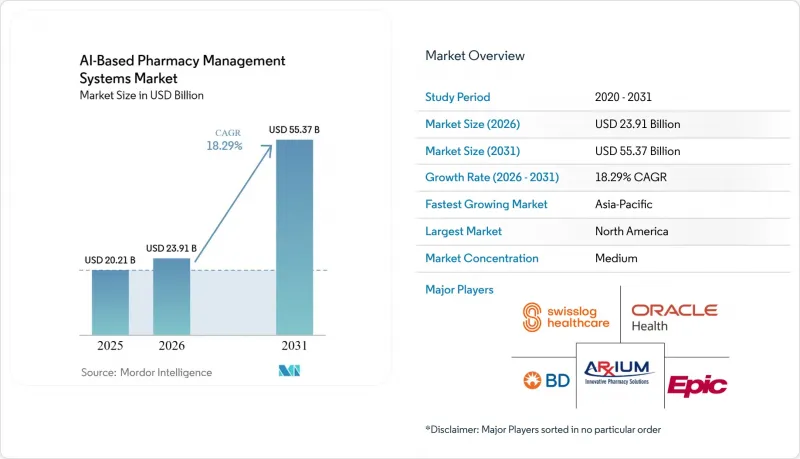
Mordor Intelligence에 의하면, AI 기반 약국 관리 시스템 시장 규모는 2025년 202억 1,000만 달러에서 2026년에는 239억 1,000만 달러로 확대되어 2031년까지 553억 7,000만 달러에 이를 것으로 예상되고 있어 2026년부터 2031년까지 CAGR 18.29%로 성장할 전망입니다.
본 보고서는 구성 요소(소프트웨어 및 서비스), 도입 모델(클라우드 기반/SaaS 및 On-Premise), 용도(처방·조제 자동화, 재고 최적화 등), 최종 사용자(소매 약국, 병원/입원 환자용 약국, 전문 약국 등), 지역(북미, 유럽, 기타)별로 분류되어 있습니다. 시장 전망은 금액(달러)으로 표시되어 있습니다.
전 세계 AI 기반 약국 관리 시스템 시장 동향 및 인사이트
처방전 수 증가와 약사의 업무 부담
AI 기반 약국 관리 시스템 시장은 일시적인 것이 아니라 상시화되고 있는 업무 부담 문제를 배경으로 지지를 확대되고 있습니다. 약국 운영자들은 동일한 인력 체제 하에서 더 많은 처방전을 처리하고, 더 많은 환자 기록을 관리하며, 급여 및 승인 관련 문의에 신속하게 대응해야 하는 압박을 받고 있습니다. 이에 따라 소프트웨어가 본래라면 약사의 시간을 빼앗을 수 있는 반복적인 확인 및 문서 작성 작업을 대행할 수 있기 때문에 자동화의 가치가 높아지고 있습니다. 일본조제는 시범 도입을 통해 기록 작성 부담 경감과 약사 및 환자와의 대화 품질 향상이 확인됨에 따라, 2025년 5월 AI 기반 복약 이력 작성 지원 서비스를 총 763개 점포로 확대했습니다. 구매자가 AI를 ‘선택적 업그레이드’가 아닌 ‘업무 역량을 강화하는 도구’로 인식하게 되면, 계약 기간, 사용자당 가격 및 갱신 안정성이 향상되는 경향이 있습니다.
클라우드 기반 약국 플랫폼으로의 전환
AI 기반 약국 관리 시스템 시장도, 클라우드 도입이 주요 약국 체인에 있어 실용적인 운영 모델이 됨에 따라 진전을 이루고 있습니다. Amazon Pharmacy는 생성형 AI 워크로드를 AWS 클라우드 인프라로 이전한 후, 처방전 처리 시간이 90% 단축되었고 개발 기간도 9개월에서 3개월로 단축되었다고 보고했습니다. 또 다른 클라우드 기반 도입 사례로, 말레이시아 최대의 처방전 약국 네트워크에서는 창고 업무를 AWS 지원 시스템으로 일원화한 결과, 일일 주문 처리 건수를 500건에서 4,000건으로 늘리고, 피킹 담당자의 생산성을 80% 향상시켰습니다. 또한, CGM LAUER사는 2025년 6월부터 독일 전역으로의 확대를 목표로 ‘CGM STELLA’를 도입했습니다. 이를 통해 약국에는 DSGVO 및 BSI C5 보안 요건을 준수하는 브라우저 기반 AI 지원 플랫폼이 제공됩니다.
높은 도입·통합 비용
AI 기반 약국 관리 시스템 시장은 도입 비용의 불균형이라는 형태로 여전히 큰 보급 장벽에 직면해 있습니다. 대규모 의료 시스템이나 전국적으로 사업을 전개하는 소매 체인은 소프트웨어, 통합, 재교육, 하드웨어, 시설 비용을 많은 조제 거점에 분산시킬 수 있지만, 독립 사업자는 대부분의 경우 그렇게 할 수 없습니다. 도입에 드는 총 비용은 라이선스 비용에만 그치지 않고, 약국에서는 전자건강기록(EHR)과의 통합, 워크플로우 재설계, 데이터 마이그레이션, 그리고 가동 시작 후 지속적인 모델 유지보수가 필요하기 때문입니다. 이로 인해 대기업 구매자들은 첨단 플랫폼 기능을 가장 먼저 활용하는 반면, 많은 지역 약국은 기능이 제한된 저비용 도구에 머물러야 하는 양극화된 시장이 형성되고 있습니다. 이러한 격차는 모듈식 SaaS 서비스에 진입할 여지를 남기고 있지만, 이 미개척 분야에 초점을 맞춘 시장을 독점할 대규모 공급자는 아직 등장하지 않았습니다.
부문 분석
2025년 지출 중 소프트웨어가 72.34%를 차지하며, AI 기반 약국 관리 시스템 시장에서 가장 큰 점유율을 기록하고 있습니다. 이는 약국이 일반적으로 핵심 워크플로우를 디지털화한 후, 해당 워크플로우와 관련된 보다 고도화된 서비스를 구매하기 때문입니다. 이러한 경향은 처방전 관리, 의사결정 지원, 재고 관리 도구, 사전 승인 자동화가 이후 최적화를 위한 기반이 된다는 실용적인 구매 순서를 반영하고 있습니다. 소프트웨어 분야에서는 플랫폼 전체를 교체하지 않고도 AI 기능을 추가할 수 있는 모듈식 시스템을 원하는 구매자가 늘어나고 있어 지속적인 개발이 진행되고 있습니다. 옴니셀(OmniCell)은 2024년 12월, 로보틱스, 스마트 기기, AI 분석을 단일 HITRUST 인증 플랫폼 상에서 통합하는 클라우드 네이티브 환경 ‘OmniSphere’를 발표했습니다. 이는 각 벤더들이 의약품 워크플로우 전반에 걸쳐 소프트웨어를 통한 제어를 확대하려 하고 있음을 보여줍니다. AI 기반 약국 관리 시스템 업계에서 이처럼 소프트웨어에 중점을 두게 됨에 따라, 주요 플랫폼 제공업체들은 분석, 관리형 지원, 규정 준수 도구와 같은 관련 수익원에 대한 지배력을 더욱 강화하게 될 것입니다.
서비스 부문은 절대 규모로는 작지만, 2031년까지 연평균 성장률(CAGR) 19.32%로 확대될 것으로 예측되며, AI 기반 약국 관리 시스템 시장에서 가장 빠르게 성장하는 수익 부문으로 자리매김하고 있습니다. 이러한 성장은 많은 약국 IT 팀이 복잡한 AI 시스템을 자체적으로 운영하기 위한 데이터 사이언스, 상호 운용성, 모델 관리에 필요한 사내 자원을 충분히 보유하고 있지 않다는 현실을 반영합니다. 구매자들은 이러한 기능을 사내에서 유지하는 것보다 재훈련, 최적화 및 표준 기반 통합을 위한 관리형 지원을 점점 더 많이 요구하고 있습니다. 이노발론(Inovalon)은 2026년 2월, ScriptMed의 전문 약국 및 정맥주사 약국용 소프트웨어가 Oracle Autonomous AI Database에서 확장되었다고 발표했습니다. 이는 복잡한 약국 환경에서 인프라 아웃소싱 및 성능 제공의 관리형 서비스로의 전환을 보여줍니다. 이 모델이 보급됨에 따라, 지속적인 서비스 계약을 통해 벤더의 수익은 일회성 도입 주기나 정기적인 하드웨어 업데이트에 대한 의존도를 낮추게 될 것입니다.
2025년에는 클라우드 및 SaaS를 통한 도입이 시장의 63.85%를 차지했으며, 도입 형태별로는 AI 기반 약국 관리 시스템 시장에서 1위 점유율을 기록했습니다. 구매자가 클라우드 시스템을 선호하는 이유는 On-Premise형 하드웨어에 대한 의존을 피할 수 있고, 업그레이드를 신속하게 수행할 수 있으며, 중앙 관리 팀이 단일 인터페이스를 통해 여러 거점을 관리할 수 있다는 점에 있습니다. AWS 상의 Amazon Pharmacy AI 스택은 처방전 처리 시간을 90% 단축했으며, 해당 클라우드 계획 도구는 표준 목표치와 비교하여 수요 계획 예측 정확도를 50% 향상시켰습니다. AI 기반 약국 관리 시스템 시장에서는 긴 출시 주기를 거치지 않고도 전체 고객 기반에 걸쳐 모델, 워크플로우, 규정 준수 기능을 업데이트할 수 있는 플랫폼이 높이 평가받고 있기 때문에 이러한 성과는 중요합니다. 또한 클라우드 아키텍처에서는 개선 사항을 지점별로 개별적으로 도입하는 대신 한 번에 많은 지점에 배포할 수 있으므로, 공급업체의 대응 능력도 향상됩니다.
On-Premise 배포는 2031년까지 연평균 20.47% 성장할 것으로 예측되며, 클라우드가 여전히 더 큰 카테고리임에도 불구하고 가장 빠르게 성장하는 배포 하위 부문이 되고 있습니다. 이러한 성장은 데이터 현지화, 개인정보 보호에 대한 기대, 그리고 내부 거버넌스로 인해 기밀성이 높은 환자 정보에 대해 퍼블릭 클라우드의 사용이 용납되기 어려운, 규제가 엄격한 환경에 집중되어 있습니다. 독일에서의 CGM STELLA 도입과 DSGVO 및 BSI C5 요건 준수는 기술적 성능과 마찬가지로 규정 준수 설계가 도입 선정 기준을 좌우하게 된 이유를 보여줍니다. 또한, Wemex는 2025년 9월, 일본 약국을 대상으로 생성형 AI 기반 복약 지도 지원 기능을 발표했습니다. 이는 AI 활용과 건강 데이터 취급에 관한 국내 규제 요건 간의 균형을 모색하려는 시장 동향을 반영한 것입니다. 따라서 AI 기반 약국 관리 시스템 업계에서는 벤더가 확장 가능한 분석 기능과 보호 대상인 환자 데이터에 대한 보다 엄격한 로컬 관리를 결합할 수 있기 때문에 하이브리드 아키텍처가 선호되고 있습니다.
지역별 분석
2025년, 북미는 전 세계 매출의 36.23%를 차지하며, 이 지역은 AI 기반 약국 관리 시스템 시장에서 가장 큰 점유율을 기록했습니다. 이러한 위상의 대부분은 미국이 주도하고 있으며, 이는 처방전 발행량, 보험사 인프라, 그리고 상호 운용성 의무화로 인해 약국 시스템 내 워크플로우 인텔리전스에 대한 수요가 증가하고 있기 때문입니다. 2025년 7월에 확정된 ONC HTI-4 최종 규정에서는 2028년 1월 1일부터 기본 EHR 시스템에서 RTPB 및 FHIR 기반의 전자 사전 승인 기능이 의무화되었습니다. 이 규정이 중요한 이유는 약국 관련 워크플로우를 수동적인 후속 조치에서 실시간 데이터 활용으로 전환하고, 기존 플랫폼에 AI를 더욱 깊이 통합하도록 촉진하기 때문입니다. 따라서 지역별 성장은 최초의 디지털화라기보다는 이미 도입된 시스템 내의 기능 확장에 의해 주도되는 경향이 강해지고 있습니다.
유럽에서는 AI 기반 약국 관리 시스템 시장에서 규정 준수를 중시하는 접근 방식이 추진되고 있습니다. 서유럽에서는 AI 지원 워크플로우 도구가 도입되고 있으나, 그 도입 여부는 성능과 마찬가지로 개인정보 보호, 데이터 소재지, 보안 기준에 의해서도 좌우되고 있습니다. CGM LAUER사는 2025년, 독일 최초의 클라우드 기반 AI 지원 약국 관리 시스템 ‘CGM STELLA’를 출시했습니다. 이 시스템은 전국적인 확대를 염두에 두고 구축되었으며, BSI C5 요건을 준수합니다. 이를 통해 인증된 클라우드, 프라이빗 클라우드 또는 하이브리드 옵션을 제공하는 벤더가 단일 도입 모델만 제공하는 벤더보다 유리한 입장에 있음을 시사합니다. 따라서 유럽 수요는 견조하지만, 계약 수주는 공급업체가 약국의 업무 흐름을 저해하지 않으면서 현지 규정 준수 요건을 충족할 수 있는지 여부에 크게 좌우됩니다.
아시아태평양은 2031년까지 22.54%라는 지역별 최고 연평균 성장률(CAGR)을 보일 것으로 예측되며, AI 기반 약국 관리 시스템 시장에서 가장 강력한 성장 궤도를 그릴 것으로 전망됩니다. 일본에서는 후생노동성이 2025년 7월 ‘의료 분야 AI 활용에 관한 지침’ 제2판을 공표하고, 사업자에게 도입을 위한 보다 명확한 틀을 제시함에 따라 이미 체계적인 도입이 진행되고 있습니다. 2025년 5월, 일본조제가 산하 763개 약국 전 점포에서 AI 기반 복약 이력 작성 지원 시스템을 도입한 것은 이러한 정책 지원이 기업의 도입 결정에 어떻게 연결되고 있는지를 보여줍니다. 또한, 이 지역은 주요 시장의 디지털 헬스 인프라 확충과 로컬 서버에 대한 투자가 매력적이지 않은 상황에서 ‘모바일 퍼스트’ 및 ‘클라우드 퍼스트’ 도입 모델의 매력으로부터도 혜택을 받고 있습니다. 앞으로 이러한 정책 지원, 인프라 구축 및 워크플로우 수요가 맞물리면서 아시아태평양의 향후 수익 점유율은 현재 수치가 시사하는 것보다 더욱 확대될 것으로 전망됩니다.
기타 혜택:
- 엑셀 형식 시장 예측(ME) 시트
- 3개월간의 애널리스트 지원
자주 묻는 질문
목차
제1장 서론
제2장 조사 방법
제3장 주요 요약
제4장 시장 구도
제5장 시장 규모와 성장 예측
제6장 경쟁 구도
제7장 시장 기회와 향후 전망
JHS 26.08.05According to Mordor Intelligence, the AI-Based pharmacy management systems market size is expected to increase from USD 20.21 billion in 2025 to USD 23.91 billion in 2026 and reach USD 55.37 billion by 2031, growing at a CAGR of 18.29% over 2026-2031.
This report is Segmented by Component (Software and Services), Deployment Model (Cloud-Based / SaaS and On-Premise), Application (Prescription & Dispensing Automation, Inventory Optimization, and More), End User (Retail Pharmacies, Hospital / Inpatient Pharmacies, Specialty Pharmacies, and Others), and Geography (North America, Europe, and Other). The Market Forecasts are Provided in Value (USD).
Global AI-Based Pharmacy Management Systems Market Trends and Insights
Rising Prescription Volumes and Pharmacist Workload
The AI-based pharmacy management systems market is gaining support from a workload problem that is becoming permanent rather than temporary. Pharmacy operators are under pressure to process more prescriptions, manage more patient records, and respond faster to benefit and authorization questions on the same staffing base. This makes automation valuable because the software can absorb repetitive verification and documentation steps that would otherwise take a pharmacist's time. Nihon Chouzai expanded its AI medication history creation support service to all 763 stores in May 2025 after a pilot confirmed lower documentation burden and better pharmacist-patient interaction quality. Once buyers treat AI as a capacity tool instead of a discretionary upgrade, contract duration, per-seat pricing, and renewal stability tend to improve.
Shift Toward Cloud-Based Pharmacy Platforms
The AI-based pharmacy management systems market is also advancing because cloud deployment is now a practical operating model for mainstream pharmacy networks. Amazon Pharmacy reported a 90% improvement in prescription processing time and cut development timelines from 9 months to 3 months after moving generative AI workloads onto AWS cloud infrastructure. In another cloud-based implementation, Malaysia's largest prescription pharmacy network increased daily order fulfillment from 500 to 4,000 units and improved picker productivity by 80% after centralizing warehouse operations on AWS-enabled systems. CGM LAUER also introduced CGM STELLA for national rollout in Germany from June 2025, giving pharmacies a browser-based AI-supported platform aligned with DSGVO and BSI C5 security expectations.
High Implementation and Integration Costs
The AI-based pharmacy management systems market still faces a major adoption barrier in the form of uneven implementation economics. Large health systems and national retail chains can spread software, integration, retraining, hardware, and facilities costs across many dispensing locations, while independent operators often cannot. The full cost of adoption also extends beyond licensing because pharmacies need EHR integration, workflow redesign, data migration, and ongoing model maintenance after launch. This creates a bifurcated market in which enterprise buyers access advanced platform capabilities first, while many community pharmacies remain limited to lower-cost tools with narrower functionality. The gap also leaves room for modular SaaS offerings, but the market has not yet produced a dominant, scaled provider focused on that white space.
Other drivers and restraints analyzed in the detailed report include:
- Need for Workflow Automation and Medication-Error Reduction
- AI-Led Inventory Optimization and Shortage Response
- Cybersecurity and Patient-Data Privacy Exposure
For complete list of drivers and restraints, kindly check the Table Of Contents.
Segment Analysis
Software accounted for 72.34% of spending in 2025, giving it the largest share of the AI-based pharmacy management systems market because pharmacies usually digitize core workflows before they purchase deeper services around those workflows. This pattern reflects a practical buying sequence in which prescription management, decision support, inventory tools, and prior authorization automation become the base layer for later optimization. The software category is attracting continued development because buyers want modular systems that can add AI features without a full platform replacement. Omnicell introduced OmniSphere in December 2024 as a cloud-native environment that connects robotics, smart devices, and AI analytics in one HITRUST-certified platform, which shows how vendors are trying to expand software control across the full medication workflow. In the AI-based pharmacy management systems industry, this concentration around software also gives leading platform providers more control over adjacent revenue streams such as analytics, managed support, and compliance tools.
Services are smaller in absolute value, but they are projected to advance at 19.32% CAGR through 2031, which makes them the fastest-growing revenue layer in the AI-based pharmacy management systems market. This growth reflects the reality that many pharmacy IT teams do not have enough internal data science, interoperability, and model management capacity to run complex AI systems on their own. Buyers increasingly want managed support for retraining, optimization, and standards-based integration rather than maintaining those capabilities in-house. Inovalon said in February 2026 that ScriptMed specialty and infusion pharmacy software was scaled on Oracle Autonomous AI Database, which illustrates the move toward outsourced infrastructure and managed performance delivery for complex pharmacy environments. As this model spreads, recurring service contracts will make vendor revenue less dependent on one-time implementation cycles and periodic hardware refreshes.
Cloud and SaaS deployments represented 63.85% of the market in 2025, which means they held the leading AI-based pharmacy management systems market share at the deployment level. Buyers continue to prefer cloud systems because they avoid local hardware dependence, support faster upgrades, and let centralized teams manage multiple sites from one interface. Amazon Pharmacy's AI stack on AWS improved prescription processing time by 90%, and its cloud planning tools also improved demand-planning forecast accuracy by 50% against standard targets. These results matter because the AI-based pharmacy management systems market now rewards platforms that can update models, workflows, and compliance functions across the customer base without long release cycles. Cloud architecture also improves vendor responsiveness because improvements can be pushed across many locations at once instead of being installed site by site.
On-premise deployments are forecast to grow at 20.47% through 2031, which makes them the fastest-growing deployment sub-segment, even though cloud remains the larger category. This growth is concentrated in highly regulated settings where data localization, privacy expectations, and internal governance make public cloud less acceptable for sensitive patient information. CGM STELLA's rollout in Germany and its alignment with DSGVO and BSI C5 requirements show why compliance design now shapes deployment preference as much as technical performance Wemex also announced in September 2025 a generative AI medication guidance support function for pharmacies in Japan, reflecting a market that is trying to balance AI use with domestic regulatory expectations around health data handling. The AI-based pharmacy management systems industry is therefore favoring hybrid architectures because they let vendors combine scalable analytics with stricter local control over protected patient data.
Complete Report Scope:
- By Component
- Software
- Services
- By Deployment Model
- Cloud-Based / SaaS
- On-Premise
- By Application
- Prescription & Dispensing Automation
- Inventory Optimization
- Billing, Claims & Revenue Cycle
- Medication Therapy Management and Adherence
- Others
- By End User
- Retail Pharmacies
- Hospital / Inpatient Pharmacies
- Specialty Pharmacies
- Others
- By Geography
- North America
- United States
- Canada
- Mexico
- Europe
- Germany
- United Kingdom
- France
- Italy
- Spain
- Rest of Europe
- Asia-Pacific
- China
- India
- Japan
- Australia
- South Korea
- Rest of Asia-Pacific
- Middle East and Africa
- GCC
- South Africa
- Rest of Middle East and Africa
- South America
- Brazil
- Argentina
- Rest of South America
- North America
Geography Analysis
North America held 36.23% of global revenue in 2025, which gave the region the largest AI-based pharmacy management systems market share. The United States drives most of that position because its prescription volume, payer infrastructure, and interoperability mandates create stronger demand for workflow intelligence inside pharmacy systems. The ONC HTI-4 Final Rule, finalized in July 2025, requires RTPB and FHIR-based electronic prior authorization capabilities in Base EHR systems from January 1, 2028. That rule matters because it pushes pharmacy-related workflows toward real-time data use rather than manual follow-up, which supports deeper AI integration in existing platforms. Regional growth is therefore coming more from capability expansion inside installed systems than from first-time digitization.
Europe is following a more compliance-centered path in the AI-based pharmacy management systems market. Western Europe is adopting AI-enabled workflow tools, but deployment choices are shaped by privacy, data residency, and security standards as much as by performance. CGM LAUER launched CGM STELLA in 2025 as Germany's first cloud-based AI-supported pharmacy management system built for national rollout and aligned with BSI C5 expectations. This suggests that vendors with certified cloud, private cloud, or hybrid options are better placed than those offering only one deployment model. European demand is therefore steady, but contract wins depend heavily on whether suppliers can satisfy local compliance rules without reducing pharmacy workflow speed.
Asia-Pacific is projected to record the fastest regional CAGR at 22.54% through 2031, giving it the strongest growth profile in the AI-based pharmacy management systems market. Japan is already showing structured adoption because the Ministry of Health, Labour and Welfare issued a second version of AI-in-healthcare guidance in July 2025, which gave providers a clearer framework for deployment. Nihon Chouzai's rollout of AI medication history creation support across all 763 pharmacies in May 2025 shows how that policy support is translating into enterprise deployment decisions. The region also benefits from widening digital health infrastructure in large markets and from the appeal of mobile-first and cloud-first implementation models where local server investment is less attractive. Over time, this combination of policy support, infrastructure buildout, and workflow demand should make Asia-Pacific a larger share of future revenue than current figures suggest.
- ARxIUM Inc.
- Asepha, Inc.
- Athenahealth
- Beckton Dickinson
- Computer-Rx
- Datascan Pharmacy
- Epic Systems
- House Rx
- Keycentrix, LLC
- Liberty Software
- LS Retail ehf.
- Mckesson
- Micro Merchant Systems, Inc.
- Omnicell
- Oracle Health
- RedSail Technologies
- RxSafe, LLC
- ScriptPro
- SoftWriters, Inc.
- Swisslog Healthcare AG
Additional Benefits:
- The market estimate (ME) sheet in Excel format
- 3 months of analyst support
TABLE OF CONTENTS
1 Introduction
- 1.1 Study Assumptions & Market Definition
- 1.2 Scope of the Study
2 Research Methodology
3 Executive Summary
4 Market Landscape
- 4.1 Market Overview
- 4.2 Market Drivers
- 4.2.1 Rising Prescription Volumes and Pharmacist Workload
- 4.2.2 Shift Toward Cloud-Based Pharmacy Platforms
- 4.2.3 Need For Workflow Automation and Medication-Error Reduction
- 4.2.4 AI-Led Inventory Optimization and Shortage Response
- 4.2.5 DSCSA Traceability and EPCIS Readiness
- 4.2.6 ePA, RTPB, and Interoperability-Led Workflow Intelligence
- 4.3 Market Restraints
- 4.3.1 High Implementation and Integration Costs
- 4.3.2 Cybersecurity and Patient-Data Privacy Exposure
- 4.3.3 Legacy Interoperability and Standards-Migration Friction
- 4.3.4 Clearinghouse Concentration and Outage Dependence
- 4.4 Value / Supply-Chain Analysis
- 4.5 Regulatory Landscape
- 4.6 Technological Outlook
- 4.7 Porter's Five Forces Analysis
- 4.7.1 Threat of New Entrants
- 4.7.2 Bargaining Power of Buyers
- 4.7.3 Bargaining Power of Suppliers
- 4.7.4 Threat of Substitutes
- 4.7.5 Competitive Rivalry
5 Market Size & Growth Forecasts (Value, USD)
- 5.1 By Component
- 5.1.1 Software
- 5.1.2 Services
- 5.2 By Deployment Model
- 5.2.1 Cloud-Based / SaaS
- 5.2.2 On-Premise
- 5.3 By Application
- 5.3.1 Prescription & Dispensing Automation
- 5.3.2 Inventory Optimization
- 5.3.3 Billing, Claims & Revenue Cycle
- 5.3.4 Medication Therapy Management and Adherence
- 5.3.5 Others
- 5.4 By End User
- 5.4.1 Retail Pharmacies
- 5.4.2 Hospital / Inpatient Pharmacies
- 5.4.3 Specialty Pharmacies
- 5.4.4 Others
- 5.5 By Geography
- 5.5.1 North America
- 5.5.1.1 United States
- 5.5.1.2 Canada
- 5.5.1.3 Mexico
- 5.5.2 Europe
- 5.5.2.1 Germany
- 5.5.2.2 United Kingdom
- 5.5.2.3 France
- 5.5.2.4 Italy
- 5.5.2.5 Spain
- 5.5.2.6 Rest of Europe
- 5.5.3 Asia-Pacific
- 5.5.3.1 China
- 5.5.3.2 India
- 5.5.3.3 Japan
- 5.5.3.4 Australia
- 5.5.3.5 South Korea
- 5.5.3.6 Rest of Asia-Pacific
- 5.5.4 Middle East and Africa
- 5.5.4.1 GCC
- 5.5.4.2 South Africa
- 5.5.4.3 Rest of Middle East and Africa
- 5.5.5 South America
- 5.5.5.1 Brazil
- 5.5.5.2 Argentina
- 5.5.5.3 Rest of South America
- 5.5.1 North America
6 Competitive Landscape
- 6.1 Market Concentration
- 6.2 Market Share Analysis
- 6.3 Company Profiles (includes Global Level Overview, Market Level Overview, Core Segments, Financials as Available, Strategic Information, Market Rank/Share for Key Companies, Products & Services, and Recent Developments)
- 6.3.1 ARxIUM Inc.
- 6.3.2 Asepha, Inc.
- 6.3.3 Athenahealth, Inc.
- 6.3.4 Becton, Dickinson and Company
- 6.3.5 Computer-Rx
- 6.3.6 Datascan Pharmacy
- 6.3.7 Epic Systems Corporation
- 6.3.8 House Rx
- 6.3.9 Keycentrix, LLC
- 6.3.10 Liberty Software
- 6.3.11 LS Retail ehf.
- 6.3.12 McKesson Corporation
- 6.3.13 Micro Merchant Systems, Inc.
- 6.3.14 Omnicell, Inc.
- 6.3.15 Oracle Health
- 6.3.16 RedSail Technologies
- 6.3.17 RxSafe, LLC
- 6.3.18 ScriptPro LLC
- 6.3.19 SoftWriters, Inc.
- 6.3.20 Swisslog Healthcare AG
7 Market Opportunities & Future Outlook
- 7.1 White-space & Unmet-need Assessment


