

|
시장보고서
상품코드
2099329
커넥티드 헬스 및 웰니스 솔루션 : 시장 점유율 분석, 업계 동향 및 통계, 성장 예측(2026-2031년)Connected Health and Wellness Solutions - Market Share Analysis, Industry Trends & Statistics, Growth Forecasts (2026 - 2031) |
||||||
 Mordor Intelligence
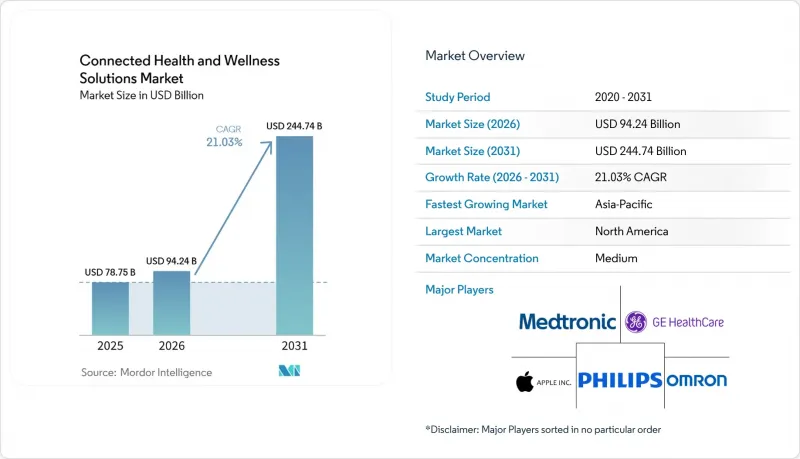
Mordor Intelligence에 의하면, 커넥티드 헬스 및 웰니스 솔루션 시장은 2025년 787억 5,000만 달러로 평가되었습니다. 2026년 942억 4,000만 달러에서 확대해, 2031년까지 2,447억 4,000만 달러에 이를 것으로 예측되며, 2026년부터 2031년에 걸쳐 CAGR 21.03%로 성장할 전망입니다.
본 보고서는 제품 유형(개인용 의료기기, 웰니스 제품, 소프트웨어 및 서비스), 기능(원격 환자 모니터링, 기타), 용도(진단 및 치료, 기타), 최종 사용자(병원 및 진료소, 기타), 지역(북미, 유럽, 아시아태평양, 기타)별로 분류되어 있습니다. 시장 전망은 금액(달러) 기준으로 제시되어 있습니다.
세계의 커넥티드 헬스 및 웰니스 솔루션 시장 동향과 인사이트
만성 질환 모니터링 수요 증가
커넥티드 헬스 및 웰니스 솔루션 시장은 성숙한 의료 시스템과 개발도상국 의료 시스템 모두에 공통적으로 존재하는 질병 부담에 의해 형성되고 있습니다. 비감염성 질환은 전 세계 연간 사망자의 74%를 차지하고 있으며, WHO는 2025년에 대다수의 국가가 여전히 그 감축 목표 달성 궤도에서 벗어나 있다고 보고했습니다. 미국에서는 2025년에 발표된 CDC 데이터에 따르면, 2023년 성인의 74%가 적어도 하나의 만성 질환을 앓았으며, 51%는 여러 질환을 앓은 것으로 보고되었는데, 이는 커넥티드 헬스 및 웰니스 솔루션 시장 전반에 걸친 장기 모니터링 도구에 대한 수요를 뒷받침합니다. 또한, 2026년 『JMIR』지에 게재된 체계적 문헌고찰에서는 만성 질환에 대한 지출이 미국 의료비의 90%를 차지한다는 CDC의 조사 결과가 재차 지적되었으며, 이는 예방 및 모니터링의 비용 대비 효과가 여전히 높음을 의미합니다. 이로 인해 커넥티드 헬스 및 웰니스 솔루션 시장 수요는 단기적인 기술 도입이 아닌 구조적인 의료 수요에 기반을 둔 것으로 유지되고 있으며, 플랫폼 운영자에게는 보다 예측 가능한 수익 계획을 수립할 수 있게 해줍니다.
단편적인 치료에서 지속적인 웰니스 관리로의 전환
커넥티드 헬스 및 웰니스 솔루션 시장은 사후 대응형 진료에서 지속적인 환자 관리로 이어지는 광범위한 치료 모델의 전환에 따라 변화하고 있습니다. 기존의 진료 방식으로는 특정 시점의 상황만 파악할 수 있지만, 커넥티드 기기를 활용하면 종단적 데이터를 생성할 수 있어 의료진이 증상 악화를 조기에 파악하거나 진료 간격 동안에도 환자의 상태를 추적하는 데 도움이 됩니다. 2026년 1월에 시작된 FDA의 TEMPO 시범 프로그램은 일상적인 진료에서 의미 있는 환자 결과를 입증할 수 있는 디지털 도구의 중요성을 규제 당국이 현재 인식하고 있음을 보여줍니다. 이러한 정책적 신호는 모니터링, 가상 접점, 증거 생성을 이미 단일 워크플로우 내에 통합하고 있는 커넥티드 헬스 및 웰니스 시장 부문에 유리하게 작용할 것입니다. 또한 이는 보다 상세한 종단적 데이터 세트를 수집하고 있는 벤더가, 단일 기기 측정값만을 제공하는 벤더에 비해 향후 규제 당국에 대한 신청이나 보험사와의 협의에서 더 견고한 입지를 구축할 수 있음을 의미합니다.
데이터 개인정보 보호, 사이버 보안 및 동의 획득의 장벽
커넥티드 헬스 및 웰니스 솔루션 시장은 생체 데이터와 행동 데이터의 지속적인 흐름에 의존하고 있으므로, 신뢰는 도입의 핵심 요건이 됩니다. 병원이나 진료소 이외의 장소에서 데이터를 수집하는 기기가 늘어남에 따라, 벤더는 여러 의료 현장에 걸쳐 동의, 신원 확인, 저장 및 공유에 대한 기대치를 관리해야 합니다. 의료 제공업체들은 임상적 성과뿐만 아니라, 치료 과정 전반에 걸쳐 플랫폼이 연결된 센서 데이터를 어떻게 처리하는지도 면밀히 검토하기 때문에 이는 도입 지연으로 이어지고 있습니다. 이 문제는 환자에게도 영향을 미칩니다. 데이터 이용 조건이 불명확하거나, 모니터링이 도움이 되기보다는 오히려 사생활을 침해하는 것처럼 느껴진다면, 장기적인 도입이 어려워지기 때문입니다. 따라서 커넥티드 헬스 및 웰니스 솔루션 시장에서 보안 설계가 미흡할 경우, 계약 지연이나 이용률 저하를 초래하며, 대규모 도입에 앞서 공급업체가 종단간 거버넌스를 입증해야 한다는 압박을 가중시킵니다.
부문 분석
2025년, 개인용 의료기기는 커넥티드 헬스 및 웰니스 솔루션 시장 점유율의 52.46%를 차지하며 이 부문이 선두를 유지했습니다. 이는 임상적으로 검증된 하드웨어가 여전히 보험 환급 제도가 뒷받침하는 조달 채널을 통해 유통되고 있어 가격 책정이 더 예측하기 쉽기 때문입니다. 커넥티드 헬스 및 웰니스 솔루션 시장의 이 분야에는 지속형 혈당 모니터, 휴대용 심전도 모니터, 그리고 기존 치료 경로에 이미 통합된 원격 생체 신호 측정 패치 등이 포함됩니다.
웰니스 제품은 연평균 성장률(CAGR) 23.85%를 나타낼 것으로 예측되며, 센서 비용의 하락과 엄격하게 정의된 임상 이용 사례의 범위를 넘어선 활용 확대에 따라 이 부문의 커넥티드 헬스 및 웰니스 솔루션 시장 규모는 확대되고 있습니다. 소프트웨어 및 서비스는 여전히 수익 기반으로는 규모가 작지만, 하드웨어 벤더 간 비교가 용이해짐에 따라 커넥티드 헬스 및 웰니스 솔루션 업계는 이 분야에서 더욱 견고한 경쟁 우위를 구축해 나가고 있습니다. 의료 서비스 제공업체와 보험사는 분석 기능, 의사 결정 지원, 통합 기능을 더욱 중요하게 여기고 있습니다. 이러한 요소들이 기기 판매 후 장기적인 고객 유지율을 좌우하기 때문입니다.
원격 환자 모니터링(RPM)은 2025년에 48.92%의 점유율을 차지했으며, 이는 퇴원 프로토콜, 만성 질환 관리 및 재택 간호를 촉진하는 가치 기반 프로그램에서 RPM이 확고한 역할을 수행하고 있음을 반영합니다. 커넥티드 헬스 및 웰니스 솔루션 시장은 RPM(원격 환자 모니터링)에 견고한 상업적 기반을 제공합니다. 이는 심혈관, 호흡기, 당뇨병 각 분야에서 지속적인 모니터링 모델에 대한 다년간의 임상적 검증이 이미 확립되어 있기 때문입니다. 이로 인해 재입원 감소 및 후속 조치 준수율 향상과의 연관성이 새로운 디지털 분야보다 명확하므로, 의료 제공업체는 예산 주기 내에서 RPM 도입을 정당화하기가 더 쉬워집니다. 또한, 이를 통해 RPM은 비용 절감 효과를 보다 직접적으로 측정할 수 있는 의료 분야와 밀접하게 연결되어 있습니다.
원격의료는 연평균 성장률(CAGR) 24.71%로 확대될 것으로 예측되며, 청구 규정 운영이 용이해짐에 따라 가상 진료 기능과 관련된 커넥티드 헬스 및 웰니스 솔루션 시장 규모도 계속해서 확대될 것으로 전망됩니다. 의료 기관에서의 임상 모니터링은 여전히 중요하지만, ICU(중환자실)에서 확인되고 있는 ‘알람 피로’ 문제로 인해 단순히 경보의 수를 늘리는 것이 아니라, 우선순위를 적절히 설정하고 신호를 필터링하는 것이 더욱 요구되고 있습니다.
지역별 분석
2025년, 북미는 커넥티드 헬스 및 웰니스 솔루션 시장 점유율의 42.84%를 차지했으며, FDA 승인 기기의 높은 집중도와 보다 성숙한 원격의료 보상 체계, 그리고 급속히 진전되는 상호운용성 노력이 맞물려 이 지역은 계속해서 선두 자리를 유지했습니다. 2026년 1월에 발표된 국가조정관실(ONC)의 ‘USCDI 버전 7 초안’은 웨어러블 기기 및 의료기기에서 생성되는 건강 데이터의 표준화를 추진하고 있으며, 이는 앞으로도 커넥티드 헬스 및 웰니스 솔루션 시장의 플랫폼 설계 선택지에 계속 영향을 미칠 것입니다. 미국은 규제 명확성, 보험사와의 협력, 그리고 기업의 헬스 IT 지출 면에서 모두 다른 대부분 시장보다 탄탄하기 때문에 이 지역의 중심적 위치를 계속 유지하고 있습니다.
유럽의 커넥티드 헬스 및 웰니스 솔루션 시장은 다른 길을 걷고 있으며, 도입에 있어서는 보상 제도 설계와 국경을 초월한 데이터 거버넌스가 더 큰 역할을 하고 있습니다. 독일의 DiGA 프레임워크는 이 지역에서 소프트웨어 주도형 케어에 대한 가장 명확한 처방전형 디지털 헬스 보상 모델 중 하나로 자리 잡고 있습니다. 영국에서는 의료 인력 부족으로 인해 진료가 기존 의료 현장을 벗어나 확대되는 가운데, 급성기 이후 심혈관 질환 및 호흡기 질환의 치료 경로에서 원격 환자 모니터링이 계속해서 더욱 적극적으로 활용되고 있습니다. 프랑스, 이탈리아, 스페인은 이러한 플랫폼 도입 동향에서 여전히 주도적이기보다는 추종적인 입장에 있으며, 투자는 각국의 의료 IT 예산 주기에 계속해서 좌우되고 있습니다. 유럽 전역에서 ‘유럽 헬스 데이터 스페이스(European Health Data Space)’ 및 ‘EU 의료기기 규정(EU Medical Device Regulation)’은 분절화를 점진적으로 해소하고, 보다 광범위한 확장을 지원할 것으로 전망됩니다. 한편, 아시아태평양에서는 최근 의료기기 승인이 잇따르고 있습니다.
아시아태평양은 연평균 성장률(CAGR) 27.46%를 나타낼 것으로 예측되며, 이 지역의 커넥티드 헬스 및 웰니스 솔루션 시장 규모는 인구 동향에 기반한 강력한 수요, 공공 디지털 헬스 투자, 그리고 탄탄한 가전 제조거점에 힘입어 확대되고 있습니다. 정부가 지원하는 인프라와 모바일 우선형 서비스에 대한 폭넓은 수용성이 커넥티드 헬스 및 웰니스 솔루션 시장 전반에 걸쳐 원격 모니터링 및 가상 진료의 확대를 위한 유리한 환경을 조성하고 있습니다. 중동 및 아프리카 및 남미는 여전히 초기 단계에 있지만, GCC 국가들과 브라질은 기존 의료 IT 시스템이 통합 비용을 상승시키고 도입 속도를 계속 둔화시키고 있음에도 불구하고, 단기적인 잠재력 면에서 두드러지고 있습니다.
기타 혜택 :
- 엑셀 형식 시장 예측(ME) 시트
- 3개월간의 애널리스트 지원
자주 묻는 질문
목차
제1장 서론
제2장 조사 방법
제3장 주요 요약
제4장 시장 구도
제5장 시장 규모 및 성장 예측
제6장 경쟁 구도
제7장 시장 기회 및 향후 전망
KTH 26.08.10According to Mordor Intelligence, the connected health and wellness solutions market is projected to expand from USD 78.75 billion in 2025, USD 94.24 billion in 2026, and reach USD 244.74 billion by 2031, growing at a CAGR of 21.03% from 2026 to 2031.
This report is Segmented by Product Type (Personal Medical Devices, Wellness Products, Software and Services), Function (Remote Patient Monitoring, and Others), Application (Diagnosis and Treatment, and Others), End-User (Hospitals and Clinics, and Others), and Geography (North America, Europe, Asia-Pacific, and Others). The Market Forecasts are Provided in Terms of Value (USD).
Global Connected Health and Wellness Solutions Market Trends and Insights
Increasing Chronic Disease Monitoring Demand
The connected health and wellness solutions market is being shaped by a disease burden that is persistent across both mature and developing healthcare systems. Noncommunicable diseases accounted for 74% of global annual mortality, and the WHO reported in 2025 that most countries were still off track on their reduction commitments. In the United States, CDC data published in 2025 showed that 74% of adults reported at least 1 chronic condition in 2023, while 51% reported multiple conditions, which reinforces demand for long-duration monitoring tools across the connected health and wellness solutions market.A 2026 systematic review in JMIR also pointed back to the CDC finding that chronic disease spending consumes 90% of U.S. healthcare expenditure, which means the cost case for prevention and monitoring remains intact. This keeps demand in the connected health and wellness solutions market tied to a structural healthcare need rather than a short-cycle technology purchase, which supports more predictable revenue planning for platform operators.
Shift from Episodic Care to Continuous Wellness Management
The connected health and wellness solutions market is moving with a broader care model shift from reactive visits toward continuous patient management. Traditional visits only capture a short point in time, while connected devices can generate longitudinal data that helps teams identify deterioration earlier and follow patients between encounters. The FDA's TEMPO pilot, launched in January 2026, shows that regulators now recognize the importance of digital tools that can demonstrate meaningful patient outcomes in routine care. That policy signal favors the connected health and wellness market segments that already combine monitoring, virtual touchpoints, and evidence generation inside a single workflow. It also means that vendors collecting deeper longitudinal datasets can build a stronger position for future regulatory submissions and payer discussions than vendors that only provide isolated device readings.
Data Privacy, Cybersecurity, and Consent Friction
The connected health and wellness solutions market depends on continuous flows of biometric and behavioral data, and that makes trust a core adoption requirement. As more devices collect data outside hospitals and clinics, vendors must manage consent, identity, storage, and sharing expectations across multiple care settings. This slows deployment because providers do not only evaluate clinical performance, they also examine how a platform handles connected sensor data through the full care process. The same issue affects patients because long term adoption is harder when data use terms are unclear or when monitoring feels more intrusive than supportive. In the connected health and wellness solutions market, weak security design can therefore delay contracts, reduce utilization, and increase pressure on vendors to prove end to end governance before scale deployment.
Other drivers and restraints analyzed in the detailed report include:
- Consumer Adoption of Wearables and Health Apps
- Edge AI and Sensor Miniaturization Improve Clinical Utility
- Uneven Reimbursement and Device Validation Across Markets
For complete list of drivers and restraints, kindly check the Table Of Contents.
Segment Analysis
Personal medical devices held 52.46% of connected health and wellness solutions market share in 2025, which kept this category in the lead because clinically validated hardware still moves through reimbursement backed procurement channels with more predictable pricing. This part of the connected health and wellness solutions market includes continuous glucose monitors, ambulatory cardiac monitors, and remote vital sign patches that already fit into established care pathways.
Wellness products are forecasted to grow at a 23.85% CAGR, and the connected health and wellness solutions market size for this segment is rising as sensor costs fall and access widens beyond tightly defined clinical use cases. Software and services still represent a smaller revenue base, but this is where the connected health and wellness solutions industry is building stronger moats as hardware becomes easier to compare across vendors. Providers and payers are placing more value on analytics, decision support, and integration features because those layers shape long term stickiness after the device sale.
Remote patient monitoring held 48.92% share in 2025, which reflects its established role in discharge protocols, chronic care management, and value-based programs that encourage care at home. The connected health and wellness solutions market has given RPM a strong commercial base because cardiology, pulmonology, and diabetes already have years of clinical validation behind continuous monitoring models. This makes RPM easier for providers to justify in budget cycles because the link to readmission reduction and follow-up adherence is clearer than in newer digital categories. It also keeps RPM closely tied to the parts of healthcare where cost avoidance can be measured more directly.
Telehealth is projected to expand at a 24.71% CAGR, and the connected health and wellness solutions market size tied to virtual care functions should keep rising as billing rules become easier to navigate. Clinical monitoring remains important in institutional settings, but alarm fatigue documented in ICU settings increases the need for better prioritization and signal filtering rather than more alerts alone.
Complete Report Scope:
- By Product Type
- Personal Medical Devices
- Wellness Products
- Software and Services
- By Function
- Remote Patient Monitoring
- Clinical Monitoring
- Telehealth
- By Application
- Diagnosis and Treatment
- Monitoring Applications
- Wellness and Prevention
- Healthcare Management
- By End-User
- Hospitals and Clinics
- Homecare Settings
- Ambulatory and Specialty Clinics
- Other End-Users
- By Geography
- North America
- United States
- Canada
- Mexico
- Europe
- Germany
- United Kingdom
- France
- Italy
- Spain
- Rest of Europe
- Asia-Pacific
- China
- Japan
- India
- Australia
- South Korea
- Rest of Asia-Pacific
- Middle East and Africa
- GCC
- South Africa
- Rest of Middle East and Africa
- South America
- Brazil
- Argentina
- Rest of South America
- North America
Geography Analysis
North America held 42.84% of connected health and wellness solutions market share in 2025, which kept the region in front because it combines a high concentration of FDA cleared devices with a more mature telehealth reimbursement base and a faster moving interoperability agenda. The Office of the National Coordinator's Draft USCDI Version 7, released in January 2026, advances data standardization for wearable and device generated health data, and that will continue shaping platform design choices in the connected health and wellness solutions market. The United States remains the regional anchor because regulatory clarity, payer alignment, and enterprise health IT spending are all stronger than in most other markets.
The connected health and wellness solutions market in Europe is moving on a different path, with reimbursement design and cross border data governance playing a larger role in adoption. Germany's DiGA framework remains one of the clearest prescription digital health reimbursement models for software led care in the region. The United Kingdom is continuing to use remote patient monitoring more actively in post acute cardiovascular and respiratory pathways as workforce pressure pushes care outside traditional settings. France, Italy, and Spain are still following rather than leading these platform adoption patterns, and investment remains linked to national health IT budget cycles. Across the region, the European Health Data Space and the EU Medical Device Regulation should gradually reduce fragmentation and support wider deployment, while recent device approvals.
Asia-Pacific is forecasted to grow at a 27.46% CAGR, and the connected health and wellness solutions market size in the region is being lifted by strong demographic demand, public digital health investment, and a deep consumer electronics manufacturing base. Government backed infrastructure and broader familiarity with mobile first services create a favorable environment for remote monitoring and virtual care expansion across the connected health and wellness solutions market. The Middle East and Africa and South America remain earlier stage, but GCC countries and Brazil stand out for near term potential even as legacy health IT systems continue to raise integration costs and slow rollout speed.
- Abbott Laboratories
- Alphabet Inc.
- Amazon.com
- Apple
- Boston Scientific
- Dexcom
- Garmin
- GE Healthcare
- Hinge Health, Inc.
- iRhythm Technologies
- Koninklijke Philips
- Masimo
- Medtronic
- Omada Health
- OMRON
- Resmed
- Samsung Group
- Siemens Healthineers
- Teladoc Health
- Withings SA
Additional Benefits:
- The market estimate (ME) sheet in Excel format
- 3 months of analyst support
TABLE OF CONTENTS
1 Introduction
- 1.1 Study Assumptions and Market Definition
- 1.2 Scope of the Study
2 Research Methodology
3 Executive Summary
4 Market Landscape
- 4.1 Market Overview
- 4.2 Market Drivers
- 4.2.1 Increasing Chronic Disease Monitoring Demand
- 4.2.2 Expansion of Remote Patient Monitoring Reimbursement
- 4.2.3 Shift from Episodic Care to Continuous Wellness Management
- 4.2.4 Consumer Adoption of Wearables and Health Apps
- 4.2.5 Edge AI and Sensor Miniaturization Improve Clinical Utility
- 4.2.6 Interoperable Telehealth and Consumer Tech Ecosystems
- 4.3 Market Restraints
- 4.3.1 Workflow Integration Complexity Across Clinical Departments
- 4.3.2 Data Privacy, Security, and AI Governance Burden
- 4.3.3 Interoperability Gaps Across Legacy EHR and Practice Management Systems
- 4.3.4 Change Management Friction and Staff Adoption Lag
- 4.4 Value Chain Analysis
- 4.5 Regulatory Landscape
- 4.6 Technological Outlook
- 4.7 Porter's Five Forces Analysis
- 4.7.1 Threat of New Entrants
- 4.7.2 Bargaining Power of Suppliers
- 4.7.3 Bargaining Power of Buyers
- 4.7.4 Threat of Substitutes
- 4.7.5 Competitive Rivalry
5 Market Size & Growth Forecasts (Value, USD)
- 5.1 By Product Type
- 5.1.1 Personal Medical Devices
- 5.1.2 Wellness Products
- 5.1.3 Software and Services
- 5.2 By Function
- 5.2.1 Remote Patient Monitoring
- 5.2.2 Clinical Monitoring
- 5.2.3 Telehealth
- 5.3 By Application
- 5.3.1 Diagnosis and Treatment
- 5.3.2 Monitoring Applications
- 5.3.3 Wellness and Prevention
- 5.3.4 Healthcare Management
- 5.4 By End-User
- 5.4.1 Hospitals and Clinics
- 5.4.2 Homecare Settings
- 5.4.3 Ambulatory and Specialty Clinics
- 5.4.4 Other End-Users
- 5.5 By Geography
- 5.5.1 North America
- 5.5.1.1 United States
- 5.5.1.2 Canada
- 5.5.1.3 Mexico
- 5.5.2 Europe
- 5.5.2.1 Germany
- 5.5.2.2 United Kingdom
- 5.5.2.3 France
- 5.5.2.4 Italy
- 5.5.2.5 Spain
- 5.5.2.6 Rest of Europe
- 5.5.3 Asia-Pacific
- 5.5.3.1 China
- 5.5.3.2 Japan
- 5.5.3.3 India
- 5.5.3.4 Australia
- 5.5.3.5 South Korea
- 5.5.3.6 Rest of Asia-Pacific
- 5.5.4 Middle East and Africa
- 5.5.4.1 GCC
- 5.5.4.2 South Africa
- 5.5.4.3 Rest of Middle East and Africa
- 5.5.5 South America
- 5.5.5.1 Brazil
- 5.5.5.2 Argentina
- 5.5.5.3 Rest of South America
- 5.5.1 North America
6 Competitive Landscape
- 6.1 Market Concentration
- 6.2 Market Share Analysis
- 6.3 Company Profiles (includes Global level Overview, Market level overview, Core Segments, Financials as available, Strategic Information, Market Rank/Share for key companies, Products & Services, Recent Developments)
- 6.3.1 Abbott Laboratories
- 6.3.2 Alphabet Inc.
- 6.3.3 Amazon.com, Inc.
- 6.3.4 Apple Inc.
- 6.3.5 Boston Scientific Corporation
- 6.3.6 Dexcom, Inc.
- 6.3.7 Garmin Ltd.
- 6.3.8 GE HealthCare
- 6.3.9 Hinge Health, Inc.
- 6.3.10 iRhythm Technologies, Inc.
- 6.3.11 Koninklijke Philips N.V.
- 6.3.12 Masimo Corporation
- 6.3.13 Medtronic plc
- 6.3.14 Omada Health, Inc.
- 6.3.15 OMRON Corporation
- 6.3.16 ResMed Inc.
- 6.3.17 Samsung Electronics Co., Ltd.
- 6.3.18 Siemens Healthineers AG
- 6.3.19 Teladoc Health, Inc.
- 6.3.20 Withings SA
7 Market Opportunities & Future Outlook
- 7.1 White-space & Unmet-need Assessment


