
|
시장보고서
상품코드
2119170
브레인 피트니스 시장 : 시장 점유율 분석, 업계 동향 및 통계, 성장 예측(2026-2031년)Brain Fitness - Market Share Analysis, Industry Trends & Statistics, Growth Forecasts (2026 - 2031) |
||||||
 Mordor Intelligence
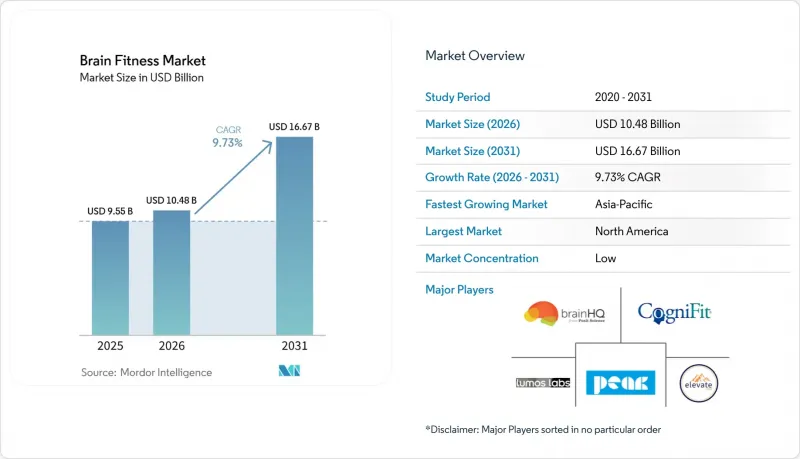
Mordor Intelligence에 의하면, 브레인 피트니스 시장 규모는 2025년에 95억 5,000만 달러로 평가되었고, 2026년에 104억 8,000만 달러로 추정되고, 2031년까지 166억 7,000만 달러에 이를 것으로 예측되며, 2026-2031년 CAGR 9.73%로 성장할 전망입니다.
본 보고서는 제품군별(뇌 트레이닝 소프트웨어 및 모바일 애플리케이션, 기타), 제공 형태별(모바일 애플리케이션, 웹 기반 플랫폼, 기타), 용도별(예방적 인지 웰니스, 인지 재활, 기타), 최종 사용자별(개인 소비자, 기업 조직, 기타), 지역별(북미, 유럽, 아시아태평양, 기타)로 분류되어 있습니다. 예측치는 금액(달러)으로 표시되어 있습니다.
세계의 브레인 피트니스 시장 동향 및 인사이트
고령화와 인지 기능 건강에 대한 인식 제고
브레인 피트니스 시장은 건강한 노화와 인지 기능의 자립과 관련된 공중보건 우선 과제에 힘입어 점점 더 성장하고 있습니다. 세계보건기구(WHO) 보고서에 따르면, 전 세계 60세 이상 인구는 2023년에 11억 명에 달했으며, 2050년까지 21억 명에 이를 것으로 예측됩니다. 2026년 7월 지침에서는 인지 기능이 정상인 성인이나 경도 인지 장애가 있는 성인을 위한 예방 조치로 인지 훈련 및 인지 자극이 제시되었습니다. 이 지침을 통해 의료 제도, 보험사, 공공 프로그램은 체계적인 인지 프로그램을 검토하기 위한 보다 명확한 근거를 얻을 수 있습니다. 또한, 적절한 근거를 제시하고 신뢰할 수 있는 접근성과 고령자에게 적절한 지원을 제공할 수 있는 제품에 대한 조달 측면의 관심이 높아지고 있습니다. 일본 및 기타 고령화가 진행 중인 경제권에서는 인지 기능 저하가 의료비 및 장기적인 자립에 영향을 미치기 때문에 브레인 피트니스 시장은 케어 플래닝과 더욱 밀접하게 연관되어 있습니다.
치매, ADHD, 뇌졸중, 외상성 뇌손상의 유병률 증가
신경 질환 및 신경 발달 장애로 인한 부담 증가는 평가, 예방, 재활용 도구에 대한 수요를 창출하고 있습니다. 2025년 『Frontiers in Aging Neuroscience』 저널에 게재된 연구에서는 65세 이상 성인에서 치매 부담 증가와 국가 간 현저한 격차가 확인되었습니다. 이 연구는 전문의 수가 여전히 제한적인 상황에서 확장 가능한 치료 경로의 필요성을 뒷받침하고 있습니다. 인지 플랫폼은 그 사용이 임상적으로 검증된다면, 측정의 표준화, 후속 관리 지침, 경과에 따른 모니터링 지원에 도움이 될 것입니다. 항아밀로이드 치료 경로의 확대에 따라, 치료 방침을 결정하기 전에 일관된 인지 기능 기준선을 확립할 필요성이 더욱 커지고 있습니다. 따라서 뇌 건강 시장에는 임상 워크플로우에서 기회가 있지만, 의료 제공업체들은 디지털 측정 결과가 신뢰할 수 있고 환자 치료에 유의미하다는 증거를 요구하게 될 것으로 보입니다.
앱 기반 훈련 효과의 실생활로의 전이 한계
브레인 피트니스 시장의 주요 임상적 제약은 과제 수행 능력의 향상이 일상 기능으로 전이된다는 증거가 제한적이라는 점입니다. 233개의 데이터 세트를 대상으로 한 2차 메타분석에서는 위약 효과와 출판 편향을 고려한 후, 장기적 전이 효과는 확인되지 않았습니다. 이러한 구분은 중요합니다. 왜냐하면 보험사나 의료 제공업체는 단순히 훈련된 운동뿐만 아니라, 프로그램이 유의미한 결과를 개선한다는 증거를 필요로 하기 때문입니다. 따라서 보험 환급을 요구하는 기업은 기능적 결과를 평가하는 장기적인 연구를 수행해야 하며, 이로 인해 비용과 개발 기간이 늘어날 수밖에 없습니다. 운전 시뮬레이션, 직업적 판단, 혹은 일상생활 동작을 중심으로 구축된 제품은 그 성과가 실생활의 요구에 더 가깝기 때문에 더 설득력 있는 사례가 될 수 있습니다. 브레인 피트니스 시장은 일반적인 웰니스 제품과 이러한 더 광범위한 가치를 확립할 수 있는 임상 프로그램으로 앞으로도 계속 양분될 것으로 보입니다.
부문 분석
2025년, 두뇌 훈련 소프트웨어와 모바일 애플리케이션는 매출의 52.31%를 차지했습니다. 이 부문은 폭넓은 소비자층에서의 높은 인지도, 즉각적인 디지털 접근성, 다양한 연령대의 자발적인 이용이라는 장점을 가지고 있습니다. 그 규모가 크기 때문에 일반적인 웰니스용 게임부터 특정 임상적 요구에 맞추어 개발된 제품에 이르기까지 품질에는 큰 편차가 있습니다. Lumos Labs는 2025년 12월, 성인 ADHD용 처방 디지털 치료법에 대해 FDA 승인을 획득했는데, 이는 임상 전용 소프트웨어가 단순한 소비자용이라는 틀을 넘어 전개될 수 있음을 보여줍니다. 보고된 임상시험 결과에 따르면, 참가자의 44.2%에서 임상적으로 유의미한 주의력 향상이 확인되었습니다. 뉴로피드백, 가상현실(VR), 증강현실(AR) 제품은 여전히 매출 규모가 작은 카테고리이지만, 더 높은 몰입감을 제공하고 측정 가능한 중재를 지원할 수 있다는 점에서 주목받고 있습니다. 브레인 피트니스 산업은 캐주얼한 이용을 목적으로 한 제품과 임상 워크플로우용으로 설계된 플랫폼 간의 구분이 더욱 명확해지는 방향으로 나아가고 있습니다. 이러한 구분은 조달 기준, 임상시험 설계, 보험 환급에 관한 논의에 영향을 미칠 가능성이 높습니다.
뇌 트레이닝 서비스와 코칭은 2026-2031년 연평균 성장률(CAGR) 15.58%를 나타낼 것으로 예측됩니다. 이러한 성장세는 지속적인 이용, 행동 변화, 결과 해석에 있어 지원이 필요한 사용자를 위한 체계적인 촉진 서비스에 대한 수요를 반영하고 있습니다. GoMo Health는 2026년 2월, Center for BrainHealth와 공동으로 ‘Employee Resiliency, The Brain Studio’를 출범시켜 행동 과학과 뇌 건강 프로그램을 결합하여 기업 환경에 제공합니다. 이 가이드형 프로그램은 일관된 프로토콜이 필요한 기업 웰니스 고객 및 제약 연구 고객을 지원할 수 있습니다. 또한 코칭은 장기적인 참여도를 높이는 수단이 될 수도 있습니다. 이는 자기 주도형 용도에서는 종종 한계에 직면하는 부문입니다. 코칭 서비스의 뇌 건강 시장 규모는 단순한 앱 접근뿐만 아니라, 지원이 포함된 서비스 제공으로의 전환에 의해 뒷받침되고 있습니다. 코칭을 검증된 컨텐츠 및 측정 가능한 성과와 연계할 수 있는 제공업체는 기관 고객층에서 더욱 견고한 입지를 다질 수 있을 것으로 보입니다. 이 서비스는 소프트웨어 플랫폼을 대체하기보다는 이를 보완하는 역할도 수행할 수 있습니다.
2025년, 제공 형태별 매출 중 모바일 애플리케이션이 64.24%를 차지했습니다. 스마트폰은 개인 사용자에게 가장 친숙한 접속 수단이며, 클리닉 밖에서도 빈번한 이용을 가능하게 합니다. 이러한 이점은 특정 임상 평가의 정확도를 제한할 가능성이 있는 소비자용 기기에 대한 의존도도 초래하고 있습니다. 웹 기반 플랫폼은 브라우저 접속, 기기 간 호환성, 중앙 집중식 보안 관리가 필요한 기업용 프로그램이나 임상시험에서 여전히 유용합니다. 데스크톱 및 콘솔 시스템은 상세한 평가 도구가 필요한 신경심리학이나 연구 환경에서 여전히 중요한 위치를 차지하고 있습니다. 브레인 피트니스 시장에서는 일상적인 참여의 장벽을 낮출 수 있기 때문에 모바일 접근이 계속해서 주요 제공 경로로 활용되고 있습니다. 그러나 모바일 제공업체는 접근의 용이성이 데이터의 품질이나 임상적 타당성을 저해하지 않음을 입증해야 합니다. 제공 전략 측면에서는 모바일 기반 참여와 임상의용 대시보드, 체계적인 후속 관리를 결합하는 경향이 강해지고 있습니다.
웨어러블 및 센서 탑재 플랫폼은 2026-2031년 연평균 성장률(CAGR) 16.22%를 나타낼 것으로 예측됩니다. 이러한 성장은 능동적인 훈련 활동과 병행하여 수동적인 생체 정보를 수집할 수 있는 능력에 기인합니다. 2025년 『Medical Engineering & Physics』 저널에 게재된 연구에서는 휴대용 기기를 이용한 알파파 대역의 EEG 신경 피드백의 신경 메커니즘이 검증되었습니다. 또한, 2026년 ADHD 관련 연구에서는 단일 채널의 전두부 뇌파 신호를 태블릿 게임에 통합함으로써 1개월 후 주의력과 인지 조절 능력이 향상된 것으로 나타났습니다. 이러한 결과는 적절한 신경 적응 프로그램에서 보다 단순한 하드웨어의 사용을 뒷받침합니다. 브레인 피트니스 시장은 사용자에게 지나치게 복잡한 설정을 요구하지 않으면서도 개인 맞춤화를 향상시키는 센서의 이점을 누릴 수 있습니다. 하드웨어가 더욱 널리 보급됨에 따라, 독자적인 센서 기능과 검증된 소프트웨어를 결합한 기업들은 지적 재산을 강화할 가능성이 있습니다. 이러한 플랫폼은 민감한 인지 정보를 수집하기 때문에 개인정보 보호, 동의, 명확한 데이터 거버넌스는 앞으로도 필수적일 것입니다.
지역별 분석
2025년, 북미는 전 세계 매출의 46.61%를 차지했습니다. 이 지역은 성숙한 디지털 헬스 인프라, 의료 시스템의 구매력, 임상용 소프트웨어를 위한 확립된 규제 경로라는 이점을 가지고 있습니다. Posit Science에 따르면, 2025년에는 여러 메디케어 어드밴티지 플랜이 BrainHQ를 보장 대상에 포함시켰습니다. 또한, 이 지역에는 디지털 헬스 분야에 대한 투자와 임상 연구 자원이 집중되어 있습니다. 이러한 요인들이 뇌 건강 시장 전반에 걸친 제품 개발과 조직 차원의 도입을 뒷받침하고 있습니다.
아시아태평양은 2026-2031년 연평균 성장률(CAGR) 13.25%를 나타낼 것으로 예측됩니다. 일본의 고령화는 보험사 및 고용주들의 인지 기능 건강 서비스에 대한 관심을 촉진하고 있습니다. NeU Corporation은 2026년 3월, 아사히 생명보험의 ‘모두의 안심 100년 프로젝트’에 참여하여 스마트폰이나 태블릿을 통해 보험 계약자에게 인지 기능 훈련 서비스를 제공합니다. 2025년 『npj Digital Medicine』의 리뷰에 따르면, 중국에서는 디지털 헬스 제품에 대한 규제 승인 범위가 확대되고 있습니다. 캠브리지 코그니션(Cambridge Cognition)은 2026년 2월, 아이보리(Ivory)사와 제휴하여 인도의 의료 및 소비자용 헬스케어 현장에서 6개 지역 언어를 지원하는 ‘CANTAB Pathway’를 출시했습니다. 인도에서는 전문의 수가 제한적이기 때문에 원격 평가에 대한 수요가 특히 높으며, 임상 용도와 소비자용도 모두에서 디지털 접근성이 중요해지고 있습니다.
나머지 매출은 유럽, 중동 및 아프리카, 남미가 차지했습니다. 유럽에서는 신경학 및 신경심리학 분야의 역량이 독일, 영국, 프랑스에 집중되어 있습니다. 이 지역의 의료기기 관련 체계와 사회보험 제도는 임상적으로 검증된 디지털 재활을 지원할 수 있습니다. MindMaze는 2026년 7월,스위스, 프랑스, 이탈리아에 걸쳐 있는 Neurorehab4EU 컨소시엄을 통해 SwissNeuroRehab 연구의 첫 환자 등록을 진행했습니다. 중동 및 아프리카는 여전히 초기 단계에 있지만, 브라질을 필두로 한 남미에서는 원격 의료 인프라 확충으로 인해 큰 가능성이 예상됩니다. 각 지역에서의 보급은 현지 보험 급여 제도, 임상 역량, 언어 지원, 디지털 케어에 대한 안정적인 접근성, 의료 시스템의 정비 현황, 각종 의료 현장에서의 도입 현황에 따라 달라질 것으로 보입니다.
기타 혜택
- 엑셀 형식 시장 예측(ME) 시트
- 3개월간의 애널리스트 지원
목차
제1장 서론
제2장 조사 방법
제3장 주요 요약
제4장 시장 구도
제5장 시장 규모 및 성장 예측
제6장 경쟁 구도
제7장 시장 기회 및 향후 전망
AJYAccording to Mordor Intelligence, the brain fitness market size is projected to be USD 9.55 billion in 2025, USD 10.48 billion in 2026, and reach USD 16.67 billion by 2031, growing at a CAGR of 9.73% from 2026 to 2031.
This report is Segmented by Offering (Brain Training Software and Mobile Applications, and More), Delivery (Mobile Applications, Web-Based Platforms, and More), Application (Preventive Cognitive Wellness, Cognitive Rehabilitation, and More), End User (Individual Consumers, Corporate Organizations, and More), and Geography (North America, Europe, Asia-Pacific, and More). Forecasts are Provided in Value (USD).
Global Brain Fitness Market Trends and Insights
Aging Population and Rising Cognitive-Health Awareness
The brain fitness market is increasingly supported by public health priorities linked to healthy aging and cognitive independence. The World Health Organization reports that the global population aged 60 years or older reached 1.1 billion in 2023 and is projected to reach 2.1 billion by 2050. Its July 2026 guidance identifies cognitive training and stimulation as preventive measures for adults with normal cognition or mild cognitive impairment. This guidance gives health systems, insurers, and public programs a clearer basis for considering structured cognitive programs. It also shifts procurement attention toward products that can show suitable evidence, reliable access, and appropriate support for older adults. In Japan and other aging economies, the brain fitness market has a stronger connection to care planning because cognitive decline affects health spending and long-term independence.
Increasing Prevalence of Dementia, ADHD, Stroke, and Traumatic Brain Injury
The growing burden of neurological and neurodevelopmental conditions creates demand for assessment, prevention, and rehabilitation tools. A 2025 study in Frontiers in Aging Neuroscience examined increasing dementia burden and substantial cross-country inequalities among adults aged 65 years or older. The study supports the need for scalable care pathways where specialist capacity remains limited. Cognitive platforms can help standardize measurement, guide follow-up, and support longitudinal monitoring when their use is clinically validated. The expansion of anti-amyloid treatment pathways further raises the need for consistent cognitive baselines before treatment decisions. The brain fitness market, therefore, has an opportunity in clinical workflows, but providers will expect evidence that digital results are reliable and meaningful for patient care.
Limited Transfer of App-Based Training Gains to Real-World Function
The main clinical constraint for the brain fitness market is the limited evidence that task improvement transfers to everyday functioning. A second-order meta-analysis covering 233 datasets found no far-transfer effect after accounting for placebo effects and publication bias. This distinction matters because payers and providers need evidence that a program improves meaningful outcomes, not only trained exercises. Companies seeking reimbursement must therefore conduct longer studies with functional outcomes, which raises cost and development time. Products built around driving simulation, occupational decisions, or activities of daily living may present a stronger case because their outcomes are closer to real-world demands. The brain fitness market will remain divided between general wellness products and clinical programs that can establish this broader value.
Other drivers and restraints analyzed in the detailed report include:
- Expansion of Digital Therapeutics and Remote Cognitive Care
- AI-Personalized and Gamified Cognitive Training
- Lengthy Clinical Validation and Regulatory Approval Timelines
For complete list of drivers and restraints, kindly check the Table Of Contents.
Segment Analysis
Brain training software and mobile applications held 52.31% of revenue in 2025. The segment benefits from broad consumer awareness, immediate digital access, and self-directed use across a wide range of age groups. Its scale also includes a wide variation in quality, from general wellness games to products developed for defined clinical needs. Lumos Labs received FDA clearance in December 2025 for its prescription digital therapy for adult ADHD, which shows how clinically focused software can move beyond consumer positioning. The reported trial results identified clinically meaningful attention gains in 44.2% of participants. Neurofeedback, virtual reality, and augmented reality products remain smaller revenue categories, yet they receive attention because they can support more immersive and measurable interventions. The brain fitness industry is moving toward clearer separation between products designed for casual use and platforms designed for clinical workflows. That separation is likely to influence procurement standards, trial design, and reimbursement discussions.
Brain training services and coaching are projected to grow at a 15.58% CAGR from 2026 to 2031. This pace reflects demand for structured facilitation where users need help with adherence, behavior change, and interpretation of results. GoMo Health launched Employee Resiliency, The Brain Studio, with the Center for BrainHealth in February 2026, combining behavioral science with brain health programming for employer settings. Guided programs can support corporate wellness clients and pharmaceutical research customers that require consistent protocols. Coaching also offers a route to improve long-term engagement, an area where self-guided applications often face limits. The brain fitness market size for coaching services is supported by the shift toward supported delivery rather than app access alone. Providers that can link coaching to validated content and measurable outcomes may have a more durable position in institutional accounts. This offering can also complement software platforms instead of replacing them.
Mobile applications held 64.24% of delivery-modality revenue in 2025. Smartphones provide the most familiar access point for individual users and enable frequent engagement outside clinics. This advantage also creates reliance on consumer devices that may limit the precision of certain clinical assessments. Web-based platforms remain useful for enterprise programs and trials that need browser access, cross-device consistency, and centrally managed security. Desktop and console systems retain a place in neuropsychology and research environments where detailed assessment tools are required. The brain fitness market continues to use mobile access as its main delivery route because it reduces barriers to routine participation. However, mobile providers must demonstrate that ease of access does not weaken data quality or clinical suitability. Delivery strategies increasingly combine mobile participation with clinician dashboards and structured follow-up.
Wearable and sensor-enabled platforms are forecast to grow at a 16.22% CAGR from 2026 to 2031. Their growth is tied to the ability to capture passive biometric information alongside active training activity. A 2025 study in Medical Engineering & Physics examined neural mechanisms of alpha-band EEG neurofeedback using portable devices. The 2026 ADHD study also showed that integrating a single-channel frontal EEG signal into a tablet game improved attention and cognitive control after 1 month. These results support the use of simpler hardware in appropriate neuroadaptive programs. The brain fitness market can benefit from sensors that improve personalization without creating an overly difficult setup for users. Companies that pair proprietary sensor capabilities with validated software may strengthen their intellectual property as hardware becomes more widely available. Privacy, consent, and clear data governance will remain essential because these platforms collect sensitive cognitive information.
Complete Report Scope:
- By Offering
- Brain Training Software and Mobile Applications
- Cognitive Assessment and Training Platforms
- Brain Training Services and Coaching
- Neurofeedback and Brain Training Tools
- Virtual Reality and Augmented Reality Tools
- Other Offerings
- By Delivery Modality
- Mobile Applications
- Web-Based Platforms
- Desktop and Console-Based Platforms
- Wearable and Sensor-Enabled Platforms
- Other Delivery Modalities
- By Application
- Preventive Cognitive Wellness
- Cognitive Rehabilitation
- Screening and Diagnostics
- Clinical Trials and Pharmaceutical Research
- Corporate Productivity and Employee Wellness
- Other Applications
- By End User
- Individual Consumers
- Healthcare Providers and Clinics
- Corporate Organizations
- Senior Care Facilities
- Other End Users
- By Geography
- North America
- United States
- Canada
- Mexico
- Europe
- Germany
- United Kingdom
- France
- Italy
- Spain
- Rest of Europe
- Asia-Pacific
- China
- Japan
- India
- Australia
- South Korea
- Rest of Asia-Pacific
- Middle East and Africa
- GCC
- South Africa
- Rest of Middle East and Africa
- South America
- Brazil
- Argentina
- Rest of South America
- North America
Geography Analysis
North America held 46.61% of global revenue in 2025. The region benefits from mature digital health infrastructure, health system purchasing capacity, and established regulatory pathways for clinical software. Multiple Medicare Advantage plans covered BrainHQ as a benefit in 2025, according to Posit Science. The region also has a large concentration of digital health investment and clinical research resources. These factors support product development and institutional adoption across the brain fitness market.
Asia-Pacific is forecast to grow at a 13.25% CAGR from 2026 to 2031. Japan's aging population supports insurer and employer interest in cognitive health services. NeU Corporation joined Asahi Life Insurance's Minna no Anshin 100 Year Project in March 2026 to provide cognitive brain training services to policyholders through smartphones and tablets. China has expanded the regulatory recognition of digital health products, according to the 2025 npj Digital Medicine review. Cambridge Cognition partnered with Ivory in February 2026 to deploy CANTAB Pathway across Indian healthcare and consumer health settings in 6 regional languages. India has a particular need for remote assessment because of limited specialist availability, making digital access relevant for both clinical and consumer use.
Europe, the Middle East and Africa, and South America accounted for the remaining revenue. Europe has concentrated neurology and neuropsychology capabilities in Germany, the United Kingdom, and France. Its medical device framework and social health insurance systems can support clinically validated digital rehabilitation. MindMaze enrolled the first patients in the SwissNeuroRehab study in July 2026 through the Neurorehab4EU consortium across Switzerland, France, and Italy. The Middle East and Africa remain at an earlier stage, while South America, led by Brazil, offers potential through expanding telemedicine infrastructure. Regional uptake will depend on local reimbursement, clinical capacity, language adaptation, reliable access to digital care, health system readiness, and adoption across care settings.
- Advanced Brain Technologies
- Akili
- BRAINBOW LIMITED (Peak)
- Brainwell
- Cambridge Cognition Holdings plc
- CNS Vital Signs, LLC
- Cogmed
- CogniFit Inc.
- Cogstate Ltd
- Constant Therapy Health, Inc.
- Elevate Labs
- HappyNeuron
- Linus Health, Inc.
- Lumos Labs, Inc.
- MindMaze SA
- Myndlift Ltd.
- NeuroNation
- NeuronUP S.L.
- Neurotrack Technologies
- Posit Science Corporation (BrainHQ)
- SMARTfit Inc.
- Synaptikon GmbH
Additional Benefits:
- The market estimate (ME) sheet in Excel format
- 3 months of analyst support
TABLE OF CONTENTS
1 Introduction
- 1.1 Study Assumptions and Market Definition
- 1.2 Scope of the Study
2 Research Methodology
3 Executive Summary
4 Market Landscape
- 4.1 Market Overview
- 4.2 Market Drivers
- 4.2.1 Aging Population and Rising Cognitive-Health Awareness
- 4.2.2 Increasing Prevalence of Dementia, ADHD, Stroke, and Traumatic Brain Injury
- 4.2.3 Expansion of Digital Therapeutics and Remote Cognitive Care
- 4.2.4 AI-Personalized and Gamified Cognitive Training
- 4.2.5 Cognitive Training Embedded in Education and Workplace Wellness
- 4.2.6 Neuroadaptive Training Using Passive Biometrics and Wearables
- 4.3 Market Restraints
- 4.3.1 Limited Transfer of App-Based Training Gains to Real-World Function
- 4.3.2 Lengthy Clinical Validation and Regulatory Approval Timelines
- 4.3.3 Privacy, Consent, and Secondary-Use Risks From Cognitive Data
- 4.3.4 Low Long-Term Adherence After Initial User Acquisition
- 4.4 Regulatory Landscape
- 4.5 Technological Outlook
- 4.6 Porter's Five Forces Analysis
- 4.6.1 Threat of New Entrants
- 4.6.2 Bargaining Power of Suppliers
- 4.6.3 Bargaining Power of Buyers
- 4.6.4 Threat of Substitutes
- 4.6.5 Competitive Rivalry
5 Market Size & Growth Forecasts (Value, USD)
- 5.1 By Offering
- 5.1.1 Brain Training Software and Mobile Applications
- 5.1.2 Cognitive Assessment and Training Platforms
- 5.1.3 Brain Training Services and Coaching
- 5.1.4 Neurofeedback and Brain Training Tools
- 5.1.5 Virtual Reality and Augmented Reality Tools
- 5.1.6 Other Offerings
- 5.2 By Delivery Modality
- 5.2.1 Mobile Applications
- 5.2.2 Web-Based Platforms
- 5.2.3 Desktop and Console-Based Platforms
- 5.2.4 Wearable and Sensor-Enabled Platforms
- 5.2.5 Other Delivery Modalities
- 5.3 By Application
- 5.3.1 Preventive Cognitive Wellness
- 5.3.2 Cognitive Rehabilitation
- 5.3.3 Screening and Diagnostics
- 5.3.4 Clinical Trials and Pharmaceutical Research
- 5.3.5 Corporate Productivity and Employee Wellness
- 5.3.6 Other Applications
- 5.4 By End User
- 5.4.1 Individual Consumers
- 5.4.2 Healthcare Providers and Clinics
- 5.4.3 Corporate Organizations
- 5.4.4 Senior Care Facilities
- 5.4.5 Other End Users
- 5.5 By Geography
- 5.5.1 North America
- 5.5.1.1 United States
- 5.5.1.2 Canada
- 5.5.1.3 Mexico
- 5.5.2 Europe
- 5.5.2.1 Germany
- 5.5.2.2 United Kingdom
- 5.5.2.3 France
- 5.5.2.4 Italy
- 5.5.2.5 Spain
- 5.5.2.6 Rest of Europe
- 5.5.3 Asia-Pacific
- 5.5.3.1 China
- 5.5.3.2 Japan
- 5.5.3.3 India
- 5.5.3.4 Australia
- 5.5.3.5 South Korea
- 5.5.3.6 Rest of Asia-Pacific
- 5.5.4 Middle East and Africa
- 5.5.4.1 GCC
- 5.5.4.2 South Africa
- 5.5.4.3 Rest of Middle East and Africa
- 5.5.5 South America
- 5.5.5.1 Brazil
- 5.5.5.2 Argentina
- 5.5.5.3 Rest of South America
- 5.5.1 North America
6 Competitive Landscape
- 6.1 Market Concentration
- 6.2 Market Share Analysis
- 6.3 Company Profiles (includes Global Level Overview, Market Level Overview, Core Segments, Financials as available, Strategic Information, Market Rank/Share, Products and Services, Recent Developments)
- 6.3.1 Advanced Brain Technologies
- 6.3.2 Akili, Inc.
- 6.3.3 BRAINBOW LIMITED (Peak)
- 6.3.4 Brainwell
- 6.3.5 Cambridge Cognition Holdings plc
- 6.3.6 CNS Vital Signs, LLC
- 6.3.7 Cogmed
- 6.3.8 CogniFit Inc.
- 6.3.9 Cogstate Ltd
- 6.3.10 Constant Therapy Health, Inc.
- 6.3.11 Elevate Labs
- 6.3.12 HappyNeuron
- 6.3.13 Linus Health, Inc.
- 6.3.14 Lumos Labs, Inc.
- 6.3.15 MindMaze SA
- 6.3.16 Myndlift Ltd.
- 6.3.17 NeuroNation
- 6.3.18 NeuronUP S.L.
- 6.3.19 Neurotrack Technologies, Inc.
- 6.3.20 Posit Science Corporation (BrainHQ)
- 6.3.21 SMARTfit Inc.
- 6.3.22 Synaptikon GmbH
7 Market Opportunities and Future Outlook
- 7.1 White-Space and Unmet-Need Assessment