

|
시장보고서
상품코드
2099404
타파미디스 약물 : 시장 점유율 분석, 업계 동향 및 통계, 성장 예측(2026-2031년)Tafamidis Drug - Market Share Analysis, Industry Trends & Statistics, Growth Forecasts (2026 - 2031) |
||||||
 Mordor Intelligence
Mordor Intelligence에 의하면, 타파미디스 약물 시장 규모는 2025년 47억 1,000만 달러로 평가되었습니다. 2026년 51억 2,000만 달러에서 2031년까지 77억 7,000만 달러로 확대되고 2026년부터 2031년까지 연평균 복합 성장률(CAGR)은 8.71%를 나타낼 전망입니다.
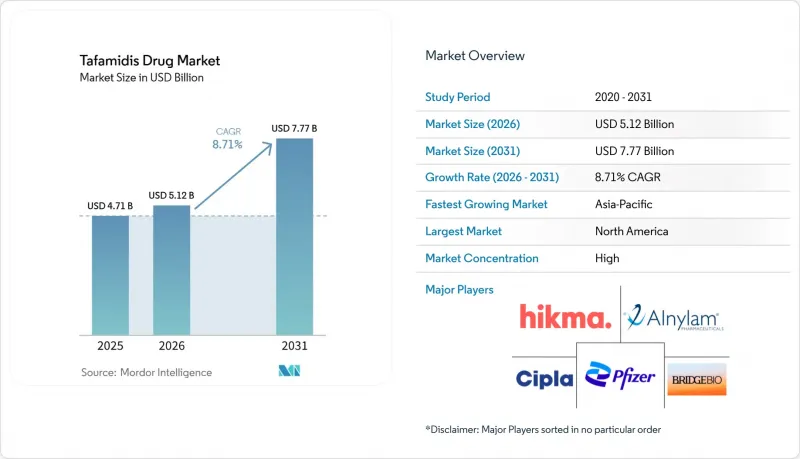
본 보고서는 제품 유형(타파미디스 메글루민, 타파미디스 유리산, 제네릭), 적응증(ATTR-CM, HATTR 다발성 신경병증, FAP, 혼합 표현형 ATTR), 유통 채널(병원, 전문 약국, 소매, 온라인 약국, 기타), 지역(북미, 유럽, 아시아태평양, 중동 및 아프리카, 남미)별로 분류되어 있습니다. 시장 전망은 금액(달러) 기준으로 제시되어 있습니다.
세계의 타파미디스 약물 시장 동향 및 인사이트
첨단 심장 영상 진단을 통한 ATTR-CM 진단 건수 증가
99mTc-PYP 및 관련 골신티그래피를 이용한 비침습적 진단으로 인해, 타파미디스 약물 시장에서 ATTR-CM의 발견 방식이 변화했습니다. 2025년 역학 조사에서는 미국 및 유럽 전역에서 발병률과 유병률 증가가 나타났으며, 특히 신티그래피 이용이 정착된 국가들에서는 65세 이상 남성에서 현저한 증가가 관찰되었습니다. 미국의 발병률은 10만 명당 44.3에 달했으나, 이는 기저 질환의 부담에 급격한 변화가 있었습니다기보다는 검출 정확도가 향상되었음을 반영한 것입니다. 영상 진단을 통해 기능이 현저히 저하되기 전에 많은 환자가 선별되어 조기 치료 시작으로 이어지기 때문에 이는 타파미디스 약물 시장에 있어 중요한 의미를 지닙니다. 조기에 치료를 시작함으로써 NYHA 등급 I 및 II 환자를 더 많이 확보하는 경향이 있으며, 이 그룹은 타파미디스 사용에 있어 가장 명확한 임상적 적응증이 되고 있습니다. 그 결과, 타파미디스 약물 시장은 진단되는 환자 수 증가와 환자 1인당 치료 기간의 연장이라는 두 가지 이점을 모두 얻게 될 것입니다.
환자층의 고령화와 고령층에서 ATTR-CM 유병률의 상승
타파미디스 약물 시장은 야생형 ATTR-CM이 고령자에게 집중되어 있다는 점에서 고령화와 밀접한 관련이 있습니다. 2024년 국제 연구에 따르면, 85세 이상의 고위험 HFpEF 집단에서 유병률은 40%에 달하거나 이를 상회하며, 사례 발견에 있어 연령이 얼마나 큰 요인인지를 뒷받침했습니다. 따라서 북미, 서유럽, 동아시아의 인구 고령화는 진단 대상 환자층을 확대시켜 치료 수요를 지속적으로 뒷받침하고 있습니다. 일본에서는 ATTR-CM의 유병률이 연간 100명/100만 명으로 보고되어 특히 두드러집니다. 그러나 이전의 적응증 기준이 더 엄격했기 때문에 그 질병 부담에 상응하는 처방량은 아직 충분히 달성되지 못하고 있습니다. 2025년에 개정된 일본의 ‘심부전 진료 가이드라인’에서는 NYHA 분류 I 및 II에 해당하는 ATTR-CM 환자에 대해 타파미디스 약물가 클래스 I, 증거 수준 A의 권고를 받게 되어, 이를 통해 보다 광범위한 사용이 촉진될 전망입니다. 이러한 가이드라인 변경에 따라, 일본의 타파미디스 약물 시장은 중기적으로 더욱 견조한 성장 궤도를 유지할 것으로 전망됩니다.
고액의 연간 치료비와 보험사의 사전 승인 요건
최근 접근성이 개선되었음에도 불구하고, 고액의 치료비는 타파미디스 약물 시장에 여전히 직접적인 제약 요인으로 작용하고 있습니다. 타파미디스 약물의 미국 내 정가는 연간 23만 4,900달러로, 이는 가장 고가의 심혈관 치료제 중 하나로 꼽힙니다. 주요 보험사는 조제를 승인하기 전에 진단 확인, 순환기 전문의의 증명 및 기능 평가를 요구하고 있으며, 각 보험 플랜마다 독자적인 이용 규정이 마련되어 있습니다. 2025년 메디케어 파트 D의 상한선 설정으로 환자의 경제적 부담은 완화되었으나, 일부 메디케어 어드밴티지 플랜에서는 여전히 빈다맥스를 ‘비우선’ 전문의약품 범주로 분류하고 있어 플랜 차원의 이용 장벽이 남아 있습니다. 즉, 타파미디스 약물 시장에서의 접근 장벽은 현재 환자의 직접적인 지불 능력보다는 행정 절차의 지연, 처방약 목록상의 위치, 그리고 서류 제출 요건에 기인하는 것으로 나타납니다. 의학적으로 필요한 치료에 대해서는 이의를 제기할 수 있는 경로가 여전히 존재하지만, 처방 의사의 부담은 여전히 커서 보급 가속화를 저해하고 있습니다.
부문 분석
2025년, 타파미지스 유리산은 타파미디스 약물 시장 점유율의 61.53%를 차지했으며, 이는 화이자사의 1일 1회 투여 '빈다맥스' 및 타국 내 관련 브랜드의 상업적 강세를 반영한 것입니다. 1캡슐 투여 방식은 기존의 4캡슐 투여 타파미지스 메글루민 제제에 비해 복약 순응도 측면에서 실질적인 이점을 가져왔습니다. 화이자가 2025년 말까지 미국에서 ‘빈다켈(Vyndaqel) 20 mg’의 판매를 중단하기로 결정함에 따라, 브랜드 의약품 매출은 유리산 제제에 더욱 집중될 전망입니다. 타파미디스 메글루민은 유리산 제제가 현지 승인을 받지 못한 시장, 기존의 치료 프로토콜에 따라 치료를 계속하고 있는 기존 환자 집단이 존재하는 시장에서 여전히 중요한 위치를 차지하고 있습니다. 2025년 중국에서 실시된 시판 후 조사에서 타파미디스 유리산 61mg은 국제적인 3상 임상시험 결과와 일치하는 안전성 및 유효성 데이터를 보여주었으며, 이는 당초 ATTR-ACT 임상시험의 피험자 등록 기반에 포함되지 않았던 시장에서 신뢰성을 입증하는 계기가 되었습니다.
타파미디스의 제네릭 의약품 시장 규모는 2031년까지 연평균 성장률(CAGR) 18.17%로 확대될 것으로 예측되며, 제네릭 타파미디스는 가장 빠르게 성장하는 제품 부문이 될 전망입니다. Dr. Reddy's Laboratories, Aurobindo Pharma, Lupin, Torrent Pharmaceuticals, Sun Pharmaceutical Industries, Zydus Lifesciences 등 인도 제약사들은 화이자(Pfizer) 및 Dexcel Pharma, Hikma Pharmaceuticals, Cipla와의 화해에 따른 2031년 6월 미국 시장 진출에 앞서, 유효 성분(API)의 생산 능력을 구축하고 있습니다. 이 부문의 성장은 고르지 않을 것으로 예측됩니다. 이는 미국 이외의 일부 시장에서는 더 유리한 환급 제도 하에서 제네릭 타파미디스를 조기에 수용할 수 있는 반면, 미국의 브랜드 의약품 시장은 2031년 중반까지 보호 상태가 지속되기 때문입니다. 이 분자는 확립된 유기화학 합성 경로를 따르기 때문에 제네릭 의약품의 진입 후 가격 하락은 제조상의 장벽이 더 복잡한 희귀질환 치료제보다 급격할 가능성이 있습니다. 이러한 전망에 비추어 볼 때, 타파미디스 약물 시장에서 브랜드 의약품 제조업체들은 제형뿐만 아니라 접근 전략의 실행, 유통 채널 관리 및 임상적 차별화를 통해 가치를 지키려 할 가능성이 높습니다.
지역별 분석
2025년, 북미는 타파미디스 약물 시장 점유율의 39.37%를 차지하며, 최대의 지역별 수익 기반이 되었습니다. 그 수요의 대부분은 미국이 주도하고 있는데, 이는 미국이 ATTR-CM 진단 인프라가 가장 잘 갖춰져 있고, 99mTc-PYP 신티그래피에 대한 접근성이 넓으며, 환자 1인당 치료비가 가장 높기 때문입니다. 2025년 메디케어 파트 D의 재설계로 환자의 경제적 부담은 경감되었으나, 플랜별 계층화로 인해 일부 메디케어 어드밴티지 제도에서는 여전히 마찰이 발생하고 있습니다. 캐나다와 멕시코는 환급 구조와 전문의 밀도가 미국에 비해 불리하기 때문에 시장 기여도는 여전히 낮은 수준입니다. 브라질과 아르헨티나를 필두로 한 남미에서는 희귀질환 접근 프로그램과 포르투갈계 주민의 유전성 TTR 돌연변이 존재로 인해 수요가 뒷받침되고 있으며, 이로 인해 ATTR-PN과 ATTR-CM 모두 임상적으로 중요한 위치를 계속 차지하고 있습니다.
유럽은 타파미디스 약물 시장에서 여전히 2위 지역을 차지하고 있으며, 독일, 영국, 프랑스, 이탈리아, 스페인이 핵심 지역을 형성하고 있습니다. 2025년 2월 유럽집행위원회가 ‘Beyonttra’를 승인함에 따라 TTR 안정화제 시장에 직접적인 경쟁 제품이 등장하게 되었으며, 이는 2031년까지 처방 및 가격 결정에 더욱 적극적으로 영향을 미칠 것입니다. 타파미디스 약물는 의사의 친숙도와 주요 의료 기술 평가 기관과 이미 확립된 보험 급여 체계의 혜택을 여전히 누리고 있습니다. 포르투갈과 스웨덴에서는 풍토성 TTR 돌연변이와 관련된 특이적인 신경병증 환자군이 유지되고 있지만, 서유럽의 전문 의료 센터 이외의 지역에서도 진단이 확대됨에 따라 유럽의 다른 지역에서도 점진적인 성장이 예상됩니다.
아시아태평양은 타파미디스 약물 시장에서 가장 빠르게 성장하고 있는 지역으로, 2026년부터 2031년에 걸쳐 연평균 성장률(CAGR) 17.63%로 확대될 것으로 예측됩니다. 일본에서는 ATTR-CM의 유병률이 연간 100명/100만 명으로, 보고된 사례 중 가장 높은 수준이며, 2025년 진료 지침 개정을 통해 NYHA 등급 I 및 II 환자에 대한 ‘Vynmac’의 보다 광범위한 사용을 위한 기반이 마련되고 있습니다. 중국에서는 중국인 환자를 대상으로 한 승인 후 데이터를 통해 타파미지스 유리산 61mg의 안전성과 유효성이 입증됨에 따라 성장 시장으로서의 입지를 강화하고 있습니다. 인도, 호주, 한국에서는 접근성이 개선됨에 따라, 특히 가격 책정이 보험 적용 확대와 더욱 부합하게 된다면 소규모 기반에서 성장이 예상됩니다. 중동 및 아프리카는 여전히 타파미디스 약물 시장에서 작은 점유율을 차지하고 있으며, 수요는 GCC 국가들에 집중되어 있습니다. 이 지역 전체의 성장은 신티그래피 검사 능력 강화 및 전문의에 의한 진단 프로세스 구축에 달려 있습니다.
기타 혜택 :
- 엑셀 형식 시장 예측(ME) 시트
- 3개월간의 애널리스트 지원
자주 묻는 질문
목차
제1장 서론
제2장 조사 방법
제3장 주요 요약
제4장 시장 구도
제5장 시장 규모 및 성장 예측
제6장 경쟁 구도
제7장 시장 기회 및 향후 전망
KTH 26.08.10According to Mordor Intelligence, the tafamidis drug market size is projected to expand from USD 4.71 billion in 2025 and USD 5.12 billion in 2026 to USD 7.77 billion by 2031, registering a CAGR of 8.71% between 2026 to 2031.
This report is Segmented by Product Type (Tafamidis Meglumine, Tafamidis Free Acid, Generic), Application (ATTR-CM, HATTR Polyneuropathy, FAP, Mixed Phenotype ATTR), Distribution Channel (Hospital, Specialty, Retail, Online Pharmacies, Others), and Geography (North America, Europe, Asia-Pacific, Middle East and Africa, South America). The Market Forecasts are Provided in Terms of Value (USD).
Global Tafamidis Drug Market Trends and Insights
Rising Diagnosis Of ATTR-CM Through Advanced Cardiac Imaging
Non-invasive diagnosis using 99mTc-PYP and related bone scintigraphy has changed the way ATTR-CM is found in the tafamidis drug market. The 2025 epidemiology review showed rising incidence and prevalence across the United States and Europe, with especially strong growth among men older than 65 in countries with established scintigraphy use. U.S. incidence reached 44.3 per 100,000 person-years, which reflected better detection rather than a sudden change in underlying disease burden. This matters for the tafamidis drug market because imaging identifies more patients before advanced functional decline, which supports earlier treatment start. Earlier initiation tends to capture more NYHA Class I and II patients, and this group has been the clearest clinical fit for tafamidis use. The result is that the tafamidis drug market gains both a larger diagnosed base and a longer treatment window per patient.
Aging Patient Pool And Higher ATTR-CM Prevalence In Older Populations
The tafamidis drug market is closely tied to aging because wild-type ATTR-CM is concentrated in older adults. A 2024 international study showed that prevalence in high-risk HFpEF populations above age 85 reached or exceeded 40%, which confirms how strongly age drives case finding. Population aging across North America, Western Europe, and East Asia is therefore enlarging the diagnosis pool and sustaining demand for treatment. Japan stands out with documented ATTR-CM prevalence of 100 per million per year, and that disease burden has not yet been fully matched by prescription volumes because earlier eligibility rules were stricter. The 2025 revision of Japan's Heart Failure Clinical Guidelines gave tafamidis a Class I, Evidence Level A recommendation for NYHA Class I and II ATTR-CM patients, which now supports wider use. This guideline shift should keep the tafamidis drug market on a firmer growth path in Japan over the medium term.
High Annual Therapy Cost And Payer Prior Authorization Requirements
High cost remains a direct limit on the tafamidis drug market even after recent access improvements. Tafamidis carries a U.S. list price of USD 234,900 per year, which places it among the most expensive cardiovascular therapies. Major payers require diagnosis confirmation, cardiology attestation, and functional assessment before they approve dispensing, and each plan has its own utilization rules. The 2025 Medicare Part D cap reduced patient financial burden, but some Medicare Advantage plans still placed Vyndamax in non-preferred specialty tiers, which kept plan-level friction in place. That means access barriers in the tafamidis drug market now come less from direct patient affordability and more from administrative delay, formulary placement, and documentation requirements. Appeals channels still exist for medically necessary treatment, but the prescriber burden remains significant and slows faster uptake.
Other drivers and restraints analyzed in the detailed report include:
- Broader Cardiology Adoption Of Disease-Modifying Therapies
- Earlier Referral From Heart Failure Clinics To Amyloidosis Centers
- Competitive Pressure From RNA-Silencing And Next-Generation Therapies
For complete list of drivers and restraints, kindly check the Table Of Contents.
Segment Analysis
Tafamidis free acid held 61.53% of the tafamidis drug market share in 2025, which reflected the commercial strength of Pfizer's once-daily Vyndamax and related brands in other countries. The single-capsule regimen offered a practical adherence advantage over the older four-capsule tafamidis meglumine presentation. Pfizer's decision to discontinue Vyndaqel 20 mg in the U.S. by the end of 2025 further concentrated branded revenue around the free acid format. Tafamidis meglumine still retains relevance in markets where the free acid version has not secured local approval or where legacy patient cohorts remain established on older treatment protocols. A 2025 post-approval study in China showed that tafamidis free acid 61 mg delivered safety and efficacy findings consistent with international Phase 3 evidence, which supported confidence in markets absent from the original ATTR-ACT enrollment base.
The tafamidis drug market size for generic products is projected to expand at a 18.17% CAGR through 2031, making generic tafamidis the fastest-growing product segment. Indian manufacturers, including Dr. Reddy's Laboratories, Aurobindo Pharma, Lupin, Torrent Pharmaceuticals, Sun Pharmaceutical Industries, and Zydus Lifesciences are building active pharmaceutical ingredient capabilities ahead of the June 2031 U.S. entry date tied to Pfizer's settlements with Dexcel Pharma, Hikma Pharmaceuticals, and Cipla. Growth in this segment is expected to be uneven because some ex-U.S. markets can absorb generic tafamidis earlier under more favorable reimbursement settings, while the U.S. branded market remains protected until mid-2031. The molecule follows established organic chemistry routes, so price erosion after generic entry could be sharper than in rare-disease therapies with more complex manufacturing barriers. That outlook means the tafamidis drug market will likely see branded companies defend value through access execution, channel control, and clinical differentiation rather than formulation alone
Complete Report Scope:
- By Product Type
- Tafamidis Meglumine
- Tafamidis Free Acid
- Generic Tafamidis
- By Application
- Transthyretin Amyloid Cardiomyopathy (ATTR-CM)
- Hereditary Transthyretin Amyloid Polyneuropathy (ATTR-PN or hATTR-PN)
- Familial Amyloid Polyneuropathy (FAP)
- Mixed Phenotype ATTR Amyloidosis
- By Distribution Channel
- Hospital Pharmacies
- Specialty Pharmacies
- Retail Pharmacies
- Online Pharmacies
- Others
- By Geography
- North America
- United States
- Canada
- Mexico
- Europe
- Germany
- United Kingdom
- France
- Italy
- Spain
- Rest of Europe
- Asia-Pacific
- China
- Japan
- India
- Australia
- South Korea
- Rest of Asia-Pacific
- Middle East and Africa
- GCC
- South Africa
- Rest of Middle East and Africa
- South America
- Brazil
- Argentina
- Rest of South America
- North America
Geography Analysis
North America held 39.37% of the tafamidis drug market share in 2025, making it the largest regional revenue base. The United States drove most of that demand because it has the deepest ATTR-CM diagnostic infrastructure, broad access to 99mTc-PYP scintigraphy, and the highest per-patient therapy spending. The 2025 Medicare Part D redesign improved patient affordability, but plan-level tiering still created friction in some Medicare Advantage settings. Canada and Mexico remain smaller contributors because reimbursement structures and specialist density are less favorable than in the United States. South America, led by Brazil and Argentina, supports demand through rare disease access programs and the presence of hereditary TTR variants in Portuguese-descended populations, which keep both ATTR-PN and ATTR-CM clinically relevant.
Europe remains the second-largest geography in the tafamidis drug market, with Germany, the United Kingdom, France, Italy, and Spain forming the core base. The European Commission approval of Beyonttra in February 2025 introduced direct TTR stabilizer competition, which will shape prescribing and pricing decisions more actively through 2031. Tafamidis still benefits from physician familiarity and from reimbursement frameworks that are already established with major health technology assessment bodies. Portugal and Sweden maintain a distinct neuropathy patient base linked to endemic TTR variants, while the rest of Europe offers incremental growth as diagnosis spreads beyond Western European specialist centers.
Asia-Pacific is the fastest-growing region in the tafamidis drug market and is forecast to expand at a 17.63% CAGR over 2026-2031. Japan has the highest documented ATTR-CM prevalence at 100 per million per year, and the 2025 guideline revision is now improving the path to broader Vynmac use in NYHA Class I and II patients. China is strengthening its position as a growth market because post-approval data in Chinese patients supported the safety and efficacy of tafamidis free acid 61 mg. India, Australia, and South Korea should grow from a smaller base as access improves, especially once pricing becomes more compatible with reimbursement expansion. The Middle East and Africa still represent a small share of the tafamidis drug market, with demand centered in GCC countries and broader regional growth dependent on stronger scintigraphy capacity and specialist diagnosis pathways
- Alnylam Pharmaceuticals
- AstraZeneca
- Aurobindo Pharma
- BridgeBio Pharma, Inc.
- Cipla
- Dexcel Pharma Technologies Ltd.
- Dr. Reddy's Laboratories
- Glenmark Pharmaceuticals
- Hikma Pharmaceuticals
- Ionis Pharmaceuticals
- Laurus Labs Limited
- Lupin
- Natco Pharma Ltd.
- Pfizer
- Sandoz Group AG
- Sun Pharmaceuticals Industries
- Teva Pharmaceutical Industries
- Torrent Pharmaceuticals Limited
- Viatris
- Zydus Lifesciences Limited
Additional Benefits:
- The market estimate (ME) sheet in Excel format
- 3 months of analyst support
TABLE OF CONTENTS
1 Introduction
- 1.1 Study Assumptions & Market Definition
- 1.2 Scope of the Study
2 Research Methodology
3 Executive Summary
4 Market Landscape
- 4.1 Market Overview
- 4.2 Market Drivers
- 4.2.1 Rising Diagnosis of ATTR-CM Through Advanced Cardiac Imaging and Biomarkers
- 4.2.2 Broader Cardiology Adoption of Disease-Modifying Therapy for Underdiagnosed Amyloidosis
- 4.2.3 Aging Patient Pool and Higher ATTR-CM Prevalence in Older Adults
- 4.2.4 Favorable Rare-Disease Access Pathways and Specialist Reimbursement Support
- 4.2.5 Treatment Consolidation Around Once-Daily Oral Tafamidis in Specialty Care Pathways
- 4.2.6 Earlier Referral From Heart Failure Clinics to Amyloidosis Centers
- 4.3 Market Restraints
- 4.3.1 High Annual Therapy Cost and Payer Prior Authorization Pressure
- 4.3.2 Generic Entry and Patent-Expiry Uncertainty
- 4.3.3 Diagnostic Delay and Misclassification of ATTR-CM as Standard Heart Failure
- 4.3.4 Competitive Pressure From RNA-Silencing and Next-Generation ATTR Therapies
- 4.4 Supply Chain Analysis
- 4.5 Regulatory Landscape
- 4.6 Technological Outlook
- 4.7 Porter's Five Forces Analysis
- 4.7.1 Threat of New Entrants
- 4.7.2 Bargaining Power of Suppliers
- 4.7.3 Bargaining Power of Buyers
- 4.7.4 Threat of Substitutes
- 4.7.5 Intensity of Competitive Rivalry
5 Market Size & Growth Forecasts (Value, USD)
- 5.1 By Product Type
- 5.1.1 Tafamidis Meglumine
- 5.1.2 Tafamidis Free Acid
- 5.1.3 Generic Tafamidis
- 5.2 By Application
- 5.2.1 Transthyretin Amyloid Cardiomyopathy (ATTR-CM)
- 5.2.2 Hereditary Transthyretin Amyloid Polyneuropathy (ATTR-PN or hATTR-PN)
- 5.2.3 Familial Amyloid Polyneuropathy (FAP)
- 5.2.4 Mixed Phenotype ATTR Amyloidosis
- 5.3 By Distribution Channel
- 5.3.1 Hospital Pharmacies
- 5.3.2 Specialty Pharmacies
- 5.3.3 Retail Pharmacies
- 5.3.4 Online Pharmacies
- 5.3.5 Others
- 5.4 By Geography
- 5.4.1 North America
- 5.4.1.1 United States
- 5.4.1.2 Canada
- 5.4.1.3 Mexico
- 5.4.2 Europe
- 5.4.2.1 Germany
- 5.4.2.2 United Kingdom
- 5.4.2.3 France
- 5.4.2.4 Italy
- 5.4.2.5 Spain
- 5.4.2.6 Rest of Europe
- 5.4.3 Asia-Pacific
- 5.4.3.1 China
- 5.4.3.2 Japan
- 5.4.3.3 India
- 5.4.3.4 Australia
- 5.4.3.5 South Korea
- 5.4.3.6 Rest of Asia-Pacific
- 5.4.4 Middle East and Africa
- 5.4.4.1 GCC
- 5.4.4.2 South Africa
- 5.4.4.3 Rest of Middle East and Africa
- 5.4.5 South America
- 5.4.5.1 Brazil
- 5.4.5.2 Argentina
- 5.4.5.3 Rest of South America
- 5.4.1 North America
6 Competitive Landscape
- 6.1 Market Concentration
- 6.2 Market Share Analysis
- 6.3 Company Profiles (includes Global Level Overview, Market Level Overview, Core Segments, Financials as available, Strategic Information, Market Rank/Share, Products and Services, Recent Developments)
- 6.3.1 Alnylam Pharmaceuticals, Inc.
- 6.3.2 AstraZeneca PLC
- 6.3.3 Aurobindo Pharma Limited
- 6.3.4 BridgeBio Pharma, Inc.
- 6.3.5 Cipla Limited
- 6.3.6 Dexcel Pharma Technologies Ltd.
- 6.3.7 Dr. Reddy's Laboratories Ltd.
- 6.3.8 Glenmark Pharmaceuticals Ltd.
- 6.3.9 Hikma Pharmaceuticals PLC
- 6.3.10 Ionis Pharmaceuticals, Inc.
- 6.3.11 Laurus Labs Limited
- 6.3.12 Lupin Limited
- 6.3.13 Natco Pharma Ltd.
- 6.3.14 Pfizer Inc.
- 6.3.15 Sandoz Group AG
- 6.3.16 Sun Pharmaceutical Industries Limited
- 6.3.17 Teva Pharmaceutical Industries Ltd.
- 6.3.18 Torrent Pharmaceuticals Limited
- 6.3.19 Viatris Inc.
- 6.3.20 Zydus Lifesciences Limited
7 Market Opportunities & Future Outlook
- 7.1 White-Space and Unmet-Need Assessment


