

|
시장보고서
상품코드
2099918
리바록사반 시장 : 시장 점유율 분석, 업계 동향 및 통계, 성장 예측(2026-2031년)Rivaroxaban - Market Share Analysis, Industry Trends & Statistics, Growth Forecasts (2026 - 2031) |
||||||
 Mordor Intelligence
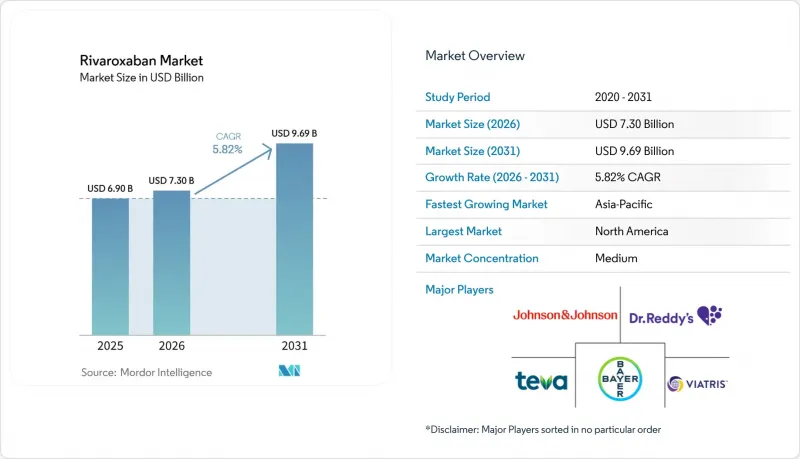
Mordor Intelligence에 의하면, 리바록사반 시장 규모는 2025년 69억 달러로 평가되었고, 2026년에는 73억 달러로 확대될 것으로 추정되고, 2026-2031년 CAGR 5.82%로 성장을 지속할 전망이며, 2031년에는 96억 9,000만 달러에 이를 것으로 예측됩니다.
본 보고서는 적응증별(심방세동, 심부정맥혈전증 등), 제형별(정제, 현탁액), 환자층별(성인, 소아), 유통 채널별(병원 및 진료소, 소매 약국, 온라인 약국, 기타), 지역별(북미, 유럽, 아시아태평양, 중동 및 아프리카, 남미)로 분류되어 있습니다. 시장 전망은 금액(달러) 기준으로 제시되어 있습니다.
세계의 리바록사반 시장 동향 및 인사이트
증가하는 심방세동 및 정맥 혈전색전증의 부담
심방세동은 2023년 전 세계적으로 5,900만 명이 앓고 있으며, 대규모의 지속적인 항응고 요법이 필요한 환자층을 지속적으로 양산하고 있어 리바록사반 시장에서 여전히 가장 큰 수요 기반을 형성하고 있습니다. 이 질환의 부담은 북미, 서유럽, 동아시아에 집중되어 있으며, 이들 지역에서는 오랫동안 확립된 항응고 요법 경로가 뇌졸중 예방을 위한 리바록사반의 광범위한 사용을 뒷받침하고 있습니다. 또한 환자층의 고령화도 중요한 요인입니다. 심방세동의 유병률은 나이가 들면서 급격히 증가하여, 단기간의 간헐적인 치료가 아닌 만성적인 외래 치료에 대한 수요를 끌어올리고 있기 때문입니다. 게다가 심방세동에서 여성의 사망률과 장애 부담이 현저히 높기 때문에 항응고 요법의 결정은 심혈관 내과 및 노인의학 진료에서 여전히 중심적인 위치를 차지하고 있습니다. 정맥혈전색전증은 또 다른 지속적인 수요층을 형성하고 있으며, 그 발생률은 연간 10만 명당 150건이지만, 70세 이상에서는 1,000명당 2-7건까지 상승합니다. 이러한 환자층이 확대됨에 따라 리바록사반 시장은 뇌졸중 예방과 혈전 예방 두 분야 모두에서 장기적인 항응고 요법에 대한 안정적인 수요에 힘입어 성장하고 있습니다.
1일 1회 투여 Xa 인자 억제제에 대한 임상적 선호도
리바록사반 시장은 장기 항응고 요법에서 1일 1회 투여라는 실용적인 이점으로 인해 계속해서 혜택을 보고 있습니다. 2025년 체계적 문헌고찰에 따르면, 비판막성 심방세동에서 1일 1회 투여 방식의 직접 경구용 항응고제(DOAC) 요법은 1일 2회 투여 요법보다 복약 순응도와 치료 지속률이 더 높은 것으로 밝혀졌습니다. 만성 항응고 요법에서 복약 누락은 여전히 항응고 효과가 불안정해지는 일반적인 원인이며, 특히 매일 여러 가지 약을 복용하는 고령자에게는 심각한 문제이므로, 이는 일상 진료에서 중요한 의미를 지닙니다. 또한, 투여 일정이 간소화됨에 따라 매니지드 케어 경로나 처방전 재발급 프로그램, 나아가 심혈관 클리닉 및 1차 진료 현장에서의 정기적인 추적 관리에도 보다 원활하게 통합할 수 있게 됩니다. 잉글랜드 국민보건서비스(NHS England) 지침에서는 직접 작용형 경구용 항응고제(DOAC)의 도입 및 최적화와 관련하여, 리바록사반의 1일 1회 투여가 높은 편의성을 특징으로 명시되어 있습니다. 리바록사반 시장에서 이러한 투여 프로파일은 가격 경쟁이 격화되고 치료 선택지가 여전히 폭넓은 상황에서도 임상의의 신뢰감을 유지하는 데 기여하고 있습니다.
여러 제네릭 제조업체 간의 경쟁으로 인한 가격 하락
특허 만료 후 리바록사반 시장에서 가격 침식은 수익을 억제하는 가장 두드러진 요인입니다. 독일에서는 Pro Generika사의 보고에 따르면, 제네릭 의약품이 오리지널 제품보다 최대 70% 낮은 가격으로 시장에 진입했으며, 이로 인해 모든 주요 정제 용량의 가격 기준이 즉시 재설정되었습니다. 동 정보원에 따르면, 제네릭으로의 완전 전환 후 법정 건강보험 제도에서 연간 5억 유로(5억 4,000만 달러)의 절감 효과가 예상된다고 지적하고 있습니다. 이러한 절감 효과는 지불자의 경제성을 개선하는 한편, 공급자의 수익을 압박하여 처방 1건당 얻는 가치를 저하시킵니다. 이러한 압박은 입찰제나 참조 가격제 제도에서 가장 강하게 나타나는데, 이는 제네릭 의약품이 시장에 진입한 직후 저비용 제품으로의 전환이 구매의 기본 옵션이 되기 때문입니다. 그 결과, 리바록사반 시장은 환자 수는 계속 증가하겠지만, 처방전 수 증가만으로는 예상되는 것보다 매출 성장세가 둔화될 전망입니다.
부문 분석
2025년에는 심방세동이 35.31%의 점유율을 차지했으나, 정맥혈전색전증(VTE) 예방을 목적으로 하는 리바록사반 시장 규모는 2026-2031년 연평균 성장률(CAGR) 7.38%로 확대될 것으로 예측됩니다. 리바록사반 시장의 지속적인 수요 대부분은 심방세동에서 비롯되는데, 이는 뇌졸중 예방에는 장기적인 치료 기간이 필요하며, 고령 환자층에서 정기적인 처방전 갱신이 이루어지기 때문입니다. 2023년 전 세계 심방세동 유병자 수는 5,900만 명에 달했으며, 이로 인해 심혈관내과, 내과, 1차 진료 등 각 채널에서 처방 대상이 광범위하게 확대되고 있습니다. 또한, 심방세동 부문은 확립된 치료 경로로부터도 혜택을 받고 있으며, 환자들은 심혈관 전문의나 약사의 감독 하에 장기간에 걸쳐 치료를 지속하는 경우가 많습니다. 1일 1회 투여법은 만성적인 사용이나 고령자를 대상으로 한 복약 순응도 중심의 관리에 적합하기 때문에 이러한 안정성을 뒷받침하고 있습니다.
정맥혈전색전증(VTE) 예방 분야는 급성기 질환을 앓는 내과 환자, 수술 후 장기 관리, 그리고 퇴원 후 혈전 예방에 있어 근거에 기반한 적응증이 확대됨에 따라 더욱 빠르게 성장하고 있습니다. 심부정맥혈전증(DVT) 및 폐색전증(PE)은 병원 프로토콜이나 응급 치료 경로를 통해 여전히 안정적인 환자 수가 항응고 요법으로 유도되고 있기 때문에 리바록사반 시장에 있어 견고한 기반으로 남아 있습니다. 기타 적응증군은 특히 관상동맥 질환이나 말초동맥 질환에서 저용량 리바록사반과 아스피린의 병용이 권장되는 경우, 중요한 두 번째 계층을 추가합니다. 이로 인해 처방 의사의 기반이 기존의 직접 작용형 경구용 항응고제(DOAC) 핵심 영역을 넘어 확대되며, 리바록사반 시장에 순환기내과 및 혈관외과 분야의 활동이 더욱 포함됩니다. 또한, 2.5mg 부문에서 제네릭 의약품의 가격 책정으로 인해 처방당 가치는 하락하는 반면 접근성은 확대되므로, 수익 분석에는 완전히 반영되지 않을 수 있는 판매량 계층도 생성됩니다.
2025년에는 정제가 64.24%의 점유율을 차지했으나, 경구 현탁액은 2026-2031년 연평균 성장률(CAGR) 6.52%를 나타낼 것으로 예측됩니다. 정제는 심방세동, 심부정맥혈전증(DVT), 폐색전증(PE) 및 수술 전 예방에 사용되는 주요 성인용 용량을 포괄하고 있어 리바록사반 시장의 핵심으로 자리 잡고 있습니다. 또한, 2.5mg 정제는 관상동맥 질환 및 말초동맥 질환에서의 심혈관 질환 예방 용도도 지원하고 있어, 그 중요성이 기존의 항응고 요법 영역을 넘어 확대되고 있습니다. 유럽에서는 아일랜드와 독일을 비롯한 각국에서의 승인 및 특허 만료 후 출시로 인해 제네릭 정제의 접근성이 확대되고 있습니다. 독일에서는 2026년부터 리바록사반 처방에 대해 최소 80%의 제네릭 조제 할당이 의무화됨에 따라, 정제는 포트폴리오 내에서 노출도가 가장 높고 확장성이 가장 뛰어난 부분으로서 그 위상을 더욱 공고히 하고 있습니다.
경구 현탁액은 적응증에 따른 경구 요법이 필요하며, 성인용 정제를 확실하게 복용할 수 없는 소아 환자를 대상으로 하기 때문에 더욱 빠르게 성장하고 있습니다. 루핀(Lupin)사는 2025년 10월, 미국에서 최초로 FDA 승인을 받은 리바록사반 경구 현탁액의 제네릭 의약품을 출시했으며, 이 회사는 이 기회를 2025년 7월 기준 미국 내 연간 매출액이 1,100만 달러에 달하는 참조 제품과 연계했습니다. J&J의 처방 지침에 따르면, 이 현탁액은 소아의 정맥혈전색전증(VTE) 치료 및 폰탄 수술 후 혈전 예방에도 적용되고 있으며, 이로 인해 이 부문은 많은 소규모 소아용 제제보다 더 명확한 임상적 역할을 수행하고 있습니다. 이는 리바록사반 업계에서 광범위한 가격 경쟁보다 적응증에 기반한 차별화가 여전히 중요시되는 몇 안 되는 분야 중 하나입니다. 소아 의료 센터에서의 진료가 표준화됨에 따라, 이 현탁액 사업은 리바록사반 시장에서 규모는 작지만 보다 안정적인 성장의 기반이 되고 있습니다.
지역별 분석
2025년, 북미는 리바록사반 시장 점유율의 44.61%를 차지했습니다. 미국은 여전히 리바록사반 시장에서 가장 큰 국가별 시장이며, 2025년 3월 기준으로 10 mg, 15 mg, 20mg 정제 용량이 추정 연간 매출 80억 5,000만 달러를 창출했으며, 2025년 1월 기준으로 2.5mg 용량이 4억 4,600만 달러를 기여하고 있습니다. 2025년에는 4가지 주요 용량 모두에 대해 정제의 승인 및 출시가 이루어짐에 따라, 미국 내 제네릭 의약품 공급이 확대되었고, 시장은 단일 브랜드 구조에서 약국의 적극적인 대체 처방으로 전환되었습니다. 이러한 변화가 중요하게 여겨지는 이유는 북미가 방대한 처방량, 소매 약국에 대한 강력한 접근성, 그리고 제네릭 의약품 공급이 실제 조제 변화로 신속하게 반영되는 지불자 제도를 모두 갖추고 있기 때문입니다. 그 결과, 이 지역의 리바록사반 시장은 가격 압박이 원개발 의약품 시대보다 빠르게 가중되고 있음에도 불구하고 여전히 최대 규모를 유지하고 있습니다.
유럽은 리바록사반 시장의 두 번째로 큰 지역 클러스터이며, 브랜드 의약품 단계에서 환급 제도가 충분히 확립되어 있었기 때문에 여전히 매우 중요한 시장으로 남아 있습니다. 이러한 구조적 전환의 가장 두드러진 사례는 독일로, 2025년 7월에 용량 관련 특허가 만료되었고, 2025년 8월 15일부터는 모든 용량이 완전히 제네릭화되었습니다. Pro Generika의 보고서에 따르면, 이 전환기 전후로 100개 이상의 제네릭 기업이 리바록사반 제품을 등록했으며, 이는 단기간에 공급 측의 대응이 얼마나 광범위해졌는지를 보여줍니다. 영국의 경우, 베넷 인스티튜트(Bennett Institute)의 데이터에 따르면 2025년 7월 시점에서 NHS 병원 트러스트에서 조제된 직접 작용형 경구용 항응고제(DOAC)의 정의 일일 투여량 중 아피사반과 리바록사반 정제가 합쳐서 87% 이상을 차지하고 있어, 2차 의료 분야에서 이 약물군의 확고한 역할이 입증되고 있습니다. 유럽의 소규모 시장에서도 단계적인 승인을 통해 접근성이 확대되고 있으며, 그 일례로 아일랜드에서는 2025년 8월에 ‘리바록사반 어센드’의 총 4유형의 정제 용량이 승인되었습니다.
아시아태평양은 리바록사반 시장에서 가장 빠르게 성장하고 있는 지역으로, 2026-2031년 연평균 성장률(CAGR) 7.65%가 예상됩니다. 이러한 성장은 급속한 인구 고령화, 심혈관 질환 부담 증가, 그리고 주요 국내 시장에서 공적 보험 적용 범위의 단계적 확대 및 저가 접근 경로의 확충에 힘입은 것입니다. 일본에서는 2024년 12월에 리바록사반 구강용해정이 시판되기 시작하면서, 기존 브랜드 의약품 중심의 구조에서 벗어나 중요한 제네릭 의약품 단계로 접어들었습니다. 인도, 한국, 걸프 국가 및 남미 시장에서도 심혈관 의료 인프라의 개선과 예방 요법에서의 리바록사반 사용을 뒷받침하는 경제성 분석이 지속적으로 이루어지고 있어 수요가 확대되고 있습니다.
기타 혜택 :
- 엑셀 형식 시장 예측(ME) 시트
- 3개월간의 애널리스트 지원
자주 묻는 질문
목차
제1장 서론
제2장 조사 방법
제3장 주요 요약
제4장 시장 구도
제5장 시장 규모 및 성장 예측
제6장 경쟁 구도
제7장 시장 기회 및 향후 전망
AJY 26.08.07According to Mordor Intelligence, the rivaroxaban market size is expected to grow from USD 6.90 billion in 2025 to USD 7.30 billion in 2026 and is forecast to reach USD 9.69 billion by 2031 at 5.82% CAGR over 2026-2031.
This report is Segmented by Indication (Atrial Fibrillation, Deep Vein Thrombosis, and More), Formulation (Tablets, Suspension), Patient Type (Adults, Pediatrics), Distribution Channel (Hospitals and Clinics, Retail Pharmacies, Online Pharmacies, Other), and Geography (North America, Europe, Asia-Pacific, Middle East and Africa, South America). The Market Forecasts are Provided in Terms of Value (USD).
Global Rivaroxaban Market Trends and Insights
Rising Atrial Fibrillation and Venous Thromboembolism Burden
Atrial fibrillation remains the largest demand base for the Rivaroxaban market because the condition affected 59 million people globally in 2023 and continues to generate a large and recurring anticoagulation population. The disease burden is concentrated in North America, Western Europe, and East Asia, which are also the regions where long-established anticoagulation pathways support broad use of rivaroxaban in stroke prevention. The patient base is also aging, and that matters because atrial fibrillation prevalence rises sharply with age and pushes demand toward chronic outpatient therapy rather than short episodic treatment. Women also carry a meaningful mortality and disability burden within atrial fibrillation, which keeps anticoagulation decisions central in cardiology and geriatric practice. Venous thromboembolism adds a second durable demand layer, with incidence at 150 per 100,000 people annually and rising to 2 to 7 per 1,000 among people aged 70 years and above. As these patient pools expand, the Rivaroxaban market gains support from a steady need for long-duration anticoagulation across both stroke prevention and clot prevention settings.
Clinical Preference for Once-Daily Factor Xa Inhibition
The Rivaroxaban market continues to benefit from the practical advantage of once-daily dosing in long-term anticoagulation. A 2025 systematic review found that once-daily direct oral anticoagulant regimens delivered stronger adherence and persistence than twice-daily regimens in non-valvular atrial fibrillation. That matters in routine care because missed doses remain a common cause of unstable protection in chronic anticoagulation, especially in older adults taking several medicines every day. A simpler schedule also fits more easily into managed care pathways, refill programs, and routine follow-up in cardiology clinics and primary care settings. NHS England guidance explicitly notes rivaroxaban's once-daily administration as a convenience feature during direct oral anticoagulant initiation and optimization. In the Rivaroxaban market, that dosing profile helps preserve clinician comfort even as price competition intensifies and therapeutic choices remain broad.
Price Erosion From Multi-Sponsor Generic Competition
Price erosion is the clearest revenue restraint in the Rivaroxaban market after patent expiry. In Germany, Pro Generika reported that generic products entered at prices as much as 70% below the originator, which immediately reset the pricing base across all major tablet strengths. The same source noted expected annual savings of EUR 500 million (USD 540 million), for the statutory health insurance system after full generic transition. Those savings improve payer economics, but they also compress supplier revenue and reduce the value captured from each prescription. This pressure is strongest in tender-based and reference-price systems, where lower-cost substitution becomes the default purchasing outcome soon after generic entry. As a result, the Rivaroxaban market can keep growing in patient volume while still facing slower topline expansion than prescription growth alone would suggest.
Other drivers and restraints analyzed in the detailed report include:
- Rapid Generic Entry After Patent Expiry
- Expansion of PAD and CAD Label-Driven Demand
- Bleeding Risk and Switching Reluctance in High-Risk Patients
For complete list of drivers and restraints, kindly check the Table Of Contents.
Segment Analysis
Atrial fibrillation held 35.31% share in 2025, while the rivaroxaban market size for prophylaxis of VTE is projected to expand at a 7.38% CAGR from 2026 to 2031. The Rivaroxaban market draws much of its recurring demand from atrial fibrillation because stroke prevention requires long treatment duration and regular refill behavior in an older patient base. Global atrial fibrillation prevalence reached 59 million cases in 2023, which keeps the prescribing pool broad across cardiology, internal medicine, and primary care channels. The atrial fibrillation segment also benefits from established care pathways, where patients are often maintained on long-running therapy under cardiologist and pharmacist supervision. The once-daily regimen supports that stability because it fits well with chronic use and with adherence-focused management in older adults.
Prophylaxis of VTE is expanding faster because evidence-backed use has widened across acutely ill medical patients, extended post-surgical settings, and post-discharge thromboprophylaxis. DVT and PE continue to provide a steady base for the Rivaroxaban market because hospital protocols and emergency treatment pathways still direct a consistent flow of patients into anticoagulation. The other indications cluster adds an important second layer, especially where coronary artery disease and peripheral artery disease use is guided by low-dose rivaroxaban plus aspirin. That broadens the prescriber base beyond the traditional direct oral anticoagulant core and brings more cardiology and vascular surgery activity into the Rivaroxaban market. It also creates a volume layer that may not appear fully in revenue-led analysis because generic pricing in the 2.5 mg segment lowers value per prescription while expanding access.
Tablets held 64.24% share in 2025, while oral suspension is forecast to grow at a 6.52% CAGR from 2026 to 2031. Tablets remain the backbone of the Rivaroxaban market because they cover the main adult strengths used across atrial fibrillation, DVT, PE, and surgical prophylaxis. The 2.5 mg tablet also supports the cardiovascular prevention use case in coronary artery disease and peripheral artery disease, which extends relevance beyond the original anticoagulation base. In Europe, generic tablet availability is widening through national approvals and post-patent launches, including Ireland and Germany. In Germany, a minimum 80% generic dispensing quota for rivaroxaban prescriptions in 2026 further reinforces tablets as the most exposed and most scalable part of the portfolio.
Oral suspension is growing faster because it serves pediatric patients who need labeled oral therapy and cannot reliably use adult tablet formats. Lupin launched the first FDA-approved generic rivaroxaban oral suspension in the United States in October 2025, and the company linked the opportunity to a reference product with USD 11 million in annual U.S. sales as of July 2025. J&J prescribing guidance also shows that the suspension covers pediatric VTE treatment and post-Fontan thromboprophylaxis, which gives the segment a clearer clinical role than many small pediatric formulations receive. This is one of the few areas in the rivaroxaban industry where label-backed differentiation still matters more than broad price competition. As pediatric centers standardize practice, the suspension business gives the Rivaroxaban market a smaller but more insulated growth pocket.
Complete Report Scope:
- By Indication
- Atrial Fibrillation
- Deep Vein Thrombosis
- Pulmonary Embolism
- Prophylaxis of Venous Thromboembolism
- Other Indications
- By Formulation
- Tablets
- Suspension
- By Patient Type
- Adults
- Pediatrics
- By Distribution Channel
- Hospitals and Clinics
- Retail Pharmacies
- Online Pharmacies
- Other Distribution Channels
- By Geography
- North America
- United States
- Canada
- Mexico
- Europe
- Germany
- United Kingdom
- France
- Italy
- Spain
- Rest of Europe
- Asia-Pacific
- China
- Japan
- India
- Australia
- South Korea
- Rest of Asia-Pacific
- Middle East and Africa
- GCC
- South Africa
- Rest of Middle East and Africa
- South America
- Brazil
- Argentina
- Rest of South America
- North America
Geography Analysis
North America held 44.61% of the rivaroxaban market share in 2025. The United States remains the largest country market within the Rivaroxaban market, with the 10 mg, 15 mg, and 20 mg tablet strengths generating estimated annual U.S. sales of USD 8.05 billion as of March 2025 and the 2.5 mg strength contributing USD 446 million as of January 2025. U.S. generic availability expanded in 2025 through tablet approvals and launches across all four key strengths, which moved the market from a single-brand structure toward active pharmacy substitution. That shift matters because North America combines large prescription volume, strong retail pharmacy reach, and payer systems that quickly translate generic availability into real dispensing change. The Rivaroxaban market in this region therefore remains the largest, even while pricing pressure rises faster than in the originator period.
Europe is the second major regional cluster for the Rivaroxaban market and remains highly relevant because reimbursement was well established during the branded phase. Germany is the clearest example of the structural transition, with the dosage patent revoked in July 2025 and all strengths becoming fully generic from August 15, 2025. Pro Generika reported that more than 100 generic companies registered rivaroxaban products around this transition, which shows how broad the supplier response became in a short period. In the United Kingdom, Bennett Institute data showed that apixaban and rivaroxaban tablets together accounted for more than 87% of direct oral anticoagulant defined daily doses dispensed from NHS hospital trusts as of July 2025, confirming the class's entrenched role in secondary care. Smaller European markets are also widening access through staged approvals, including Ireland's August 2025 authorization for Rivaroxaban Ascend across all four tablet strengths.
Asia-Pacific is the fastest-growing region in the Rivaroxaban market, with a projected CAGR of 7.65% from 2026 to 2031. Growth is being supported by rapid population aging, rising cardiovascular disease burden, and the gradual expansion of public coverage and lower-priced access pathways across large national markets. Japan entered an important generic phase with the commercial launch of rivaroxaban orally disintegrating tablets in December 2024, which marked movement beyond the earlier branded structure. India, South Korea, the Gulf states, and South American markets are also building demand as cardiovascular care infrastructure improves and economic case studies continue to support rivaroxaban use in prophylaxis settings.
- Apotex
- Aurobindo Pharma
- Bayer
- Cipla
- Dr. Reddy's Laboratories
- Fresenius
- Hetero Laboratories Limited
- Interquim, S.A.
- Johnson & Johnson
- Lupin
- Natco Pharma Limited
- Sandoz Group AG
- Sun Pharmaceuticals Industries
- Teva Pharmaceutical Industries
- Torrent Pharmaceuticals
- Viatris
- Zydus Lifesciences Limited
Additional Benefits:
- The market estimate (ME) sheet in Excel format
- 3 months of analyst support
TABLE OF CONTENTS
1 Introduction
- 1.1 Study Assumptions & Market Definition
- 1.2 Scope of the Study
2 Research Methodology
3 Executive Summary
4 Market Landscape
- 4.1 Market Overview
- 4.2 Market Drivers
- 4.2.1 Rising Atrial Fibrillation and Venous Thromboembolism Burden
- 4.2.2 Clinical Preference for Once-Daily Factor Xa Inhibition
- 4.2.3 Rapid Generic Entry After Patent Expiry
- 4.2.4 Expansion of PAD and CAD Label-Driven Demand
- 4.2.5 Institutional Formulary Rationalization in Cost-Sensitive Health Systems
- 4.2.6 Digital Adherence and Medication Management Support for Chronic Anticoagulation
- 4.3 Market Restraints
- 4.3.1 Price Erosion From Multi-Sponsor Generic Competition
- 4.3.2 Remaining Secondary Patent and Litigation Friction
- 4.3.3 Bleeding Risk and Switching Reluctance in High-Risk Patients
- 4.3.4 Reimbursement Compression in Tender-Driven Public Systems
- 4.4 Supply-Chain Analysis
- 4.5 Regulatory Landscape
- 4.6 Porter's Five Forces Analysis
- 4.6.1 Threat of New Entrants
- 4.6.2 Bargaining Power of Suppliers
- 4.6.3 Bargaining Power of Buyers
- 4.6.4 Threat of Substitutes
- 4.6.5 Industry Rivalry
5 Market Size & Growth Forecasts (Value, USD)
- 5.1 By Indication
- 5.1.1 Atrial Fibrillation
- 5.1.2 Deep Vein Thrombosis
- 5.1.3 Pulmonary Embolism
- 5.1.4 Prophylaxis of Venous Thromboembolism
- 5.1.5 Other Indications
- 5.2 By Formulation
- 5.2.1 Tablets
- 5.2.2 Suspension
- 5.3 By Patient Type
- 5.3.1 Adults
- 5.3.2 Pediatrics
- 5.4 By Distribution Channel
- 5.4.1 Hospitals and Clinics
- 5.4.2 Retail Pharmacies
- 5.4.3 Online Pharmacies
- 5.4.4 Other Distribution Channels
- 5.5 By Geography
- 5.5.1 North America
- 5.5.1.1 United States
- 5.5.1.2 Canada
- 5.5.1.3 Mexico
- 5.5.2 Europe
- 5.5.2.1 Germany
- 5.5.2.2 United Kingdom
- 5.5.2.3 France
- 5.5.2.4 Italy
- 5.5.2.5 Spain
- 5.5.2.6 Rest of Europe
- 5.5.3 Asia-Pacific
- 5.5.3.1 China
- 5.5.3.2 Japan
- 5.5.3.3 India
- 5.5.3.4 Australia
- 5.5.3.5 South Korea
- 5.5.3.6 Rest of Asia-Pacific
- 5.5.4 Middle East and Africa
- 5.5.4.1 GCC
- 5.5.4.2 South Africa
- 5.5.4.3 Rest of Middle East and Africa
- 5.5.5 South America
- 5.5.5.1 Brazil
- 5.5.5.2 Argentina
- 5.5.5.3 Rest of South America
- 5.5.1 North America
6 Competitive Landscape
- 6.1 Market Concentration
- 6.2 Market Share Analysis
- 6.3 Company Profiles (includes Global Level Overview, Market Level Overview, Core Segments, Financials as available, Strategic Information, Market Rank/Share, Products and Services, Recent Developments)
- 6.3.1 Apotex Inc.
- 6.3.2 Aurobindo Pharma Limited
- 6.3.3 Bayer AG
- 6.3.4 Cipla Limited
- 6.3.5 Dr. Reddy's Laboratories Ltd.
- 6.3.6 Fresenius Kabi AG
- 6.3.7 Hetero Laboratories Limited
- 6.3.8 Interquim, S.A.
- 6.3.9 Johnson & Johnson
- 6.3.10 Lupin Limited
- 6.3.11 Natco Pharma Limited
- 6.3.12 Sandoz Group AG
- 6.3.13 Sun Pharmaceutical Industries Ltd.
- 6.3.14 Teva Pharmaceutical Industries Ltd.
- 6.3.15 Torrent Pharmaceuticals Ltd.
- 6.3.16 Viatris Inc.
- 6.3.17 Zydus Lifesciences Limited
7 Market Opportunities and Future Outlook
- 7.1 White-Space and Unmet-Need Assessment


