

|
시장보고서
상품코드
2099436
외과 수술 시장 : 점유율 분석, 업계 동향 및 통계, 성장 예측(2026-2031년)Surgical Procedures - Market Share Analysis, Industry Trends & Statistics, Growth Forecasts (2026 - 2031) |
||||||
 Mordor Intelligence
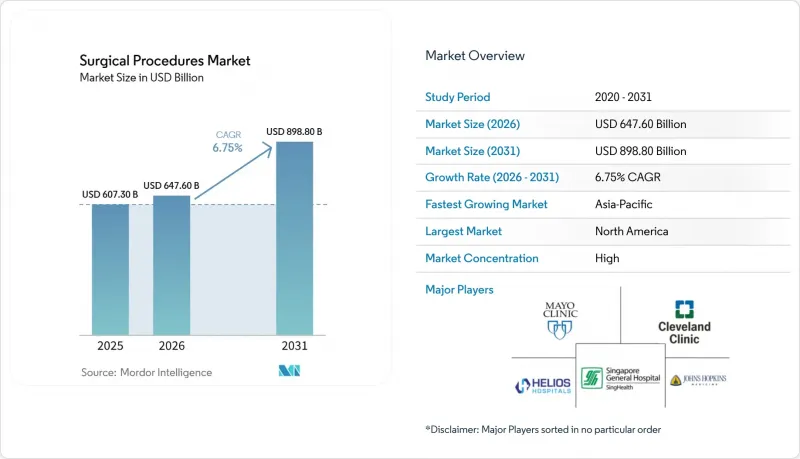
Mordor Intelligence에 의하면, 외과 수술 시장 규모는 2025년 6,073억 달러에서 2026년에는 6,476억 달러로 확대되어 2031년까지 8,988억 달러에 이를 것으로 예상되고 있어 2026년부터 2031년까지 CAGR 6.75%로 성장할 전망입니다.
본 보고서는 수술 유형(일반외과 수술, 정형외과 수술, 기타), 수술 실시 장소(병원, 외래수술센터(ASC), 기타), 수술 기법(개복 수술, 영상 유도 수술, 기타), 환자층(성인 환자, 기타) 및 지역(북미, 유럽, 기타)별로 분류되어 있습니다. 시장 전망은 금액(달러) 단위로 제시되어 있습니다.
세계 외과 수술 시장 동향 및 인사이트
만성 질환 부담 증가가 수술 건수를 끌어올리고 있습니다.
심혈관 질환은 의료 시스템 전반에서 중재 치료 및 외과 수술 사례가 계속해서 대량으로 발생하고 있어, 외과 수술 시장에서 가장 강력한 수요 축 중 하나로 자리 잡고 있습니다. 또한, 2형 당뇨병 및 병적 비만 증가로 인해 동일한 환자 경로 내에서 체중 감량 수술, 정형외과 수술, 심혈관 수술에 대한 수요가 높아지고 있어, 대사성 질환도 외과 수술 시장의 성장을 뒷받침하고 있습니다. 이러한 추세가 중요한 이유는 한 명의 환자가 여러 전문 분야에 걸쳐 치료를 받는 경우가 많아, 그 결과 개별 질환 수만으로는 나타내지 못할 정도로 수술 총 시행 건수가 증가하기 때문입니다. 미국 흉부외과학회(Society of Thoracic Surgeons)는 2026년 최신 보고서에서 성인 심장 수술 데이터베이스(Adult Cardiac Surgery Database)가 미국에서 860만 건 이상의 심장 수술을 추적하고 있다고 밝혔으며, 이는 이 수술 기반의 폭과 지속성을 보여줍니다. 또한, 만성 질환에 관한 기록이 충실해짐에 따라 재수술 건수도 보다 명확하게 파악할 수 있게 되어, 장기적으로 볼 때 외과 수술 시장 전망을 더욱 견고하게 하고 있습니다.
입원 수술에서 외래 수술 시설로의 전환
입원 시설에서 외래수술센터(ASC)로의 전환은 규제 당국이 이러한 변화를 적극적으로 뒷받침하고 있기 때문에 외과 수술 시장의 구조적 성장 요인이 되고 있습니다. CMS는 2026년 최종 규정에서 ASC 대상 시술 목록에 573개의 코드를 추가했습니다. 여기에는 심장 절제술, 요추 고정술, 그리고 이전에는 더 엄격하게 제한되었던 근골격계 시술이 포함되어 있으며, 2026년 ASC에 대한 메디케어 지급 총액은 92억 달러에 달할 것으로 예측됩니다. 따라서 외과 시술 시장에서는 단순히 연기되었던 사례의 회복에 그치지 않고, 의료 제공 장소의 재편이 진행되고 있습니다. 치료의 고도화가 진행되는 전문 분야도 이러한 변화에 점점 더 통합되고 있으며, 이로 인해 기존의 복잡도가 낮은 사례의 동향에 비해 외래 진료의 성장이 수익 및 수용 능력 측면에서 더 중요한 의미를 갖게 되었습니다. 또한, 이러한 변화로 인해 의료 서비스가 잘 갖춰진 도시 지역과 외래 진료 네트워크가 여전히 미비하고 의료 서비스가 부족한 인구 밀도가 낮은 지역 간에 격차가 발생하고 있습니다.
마취, 수술실 간호 및 수술 지원 분야의 인력 부족
인력 부족은 수술 건수 확대에 있어 여전히 명백한 제약 요인으로 작용하고 있습니다. 인력이 부족한 상황에서는 수술 수요가 자동으로 완료된 사례 수로 이어지지는 않기 때문입니다. 특히 마취과 인력 배치는 당일 몇 개의 수술실을 풀가동할 수 있는지를 직접 좌우하기 때문에 매우 중요합니다. 외과 수술 시장은 주술기 간호 인력 부족으로 인한 압박에도 직면해 있으며, 이는 수술 준비, 수술 간 전환 시간, 수술 후 모니터링에 영향을 미칩니다. 이러한 인력 부족은 단순히 성장을 둔화시킬 뿐만 아니라, 의료 기관이 장시간의 선택적 수술보다 단시간에 수익성이 높은 수술을 우선시하도록 압박하는 요인이 되고 있습니다. 이러한 변화로 인해 근본적인 수요가 여전히 견조한 경우에도 실제로 시행되는 수술의 구성 비율이 변화할 가능성이 있습니다. 그 결과, 외과 수술 시장은 계속 확대되고 있지만, 이용 가능한 인력의 제약으로 인해 예정대로 대응할 수 있는 수요량에는 여전히 한계가 있습니다.
부문 분석
2025년, 일반외과 수술은 외과 수술 시장 규모의 26.51%를 차지하며 외과 수술 시장에서 가장 큰 수술 유형 카테고리가 되었습니다. 이러한 위상은 복강경 담낭 절제술, 충수 절제술, 탈장 복구술 및 비만 수술이 모든 연령층과 의료 현장에서 널리 시행되고 있음을 반영합니다. 일반외과는 저침습 수술법에 대한 적응성이 높다는 장점이 있으며, 이는 병원 및 외래수술센터(ASC) 모두에서 수술 건수를 뒷받침하고 있습니다. 이러한 광범위한 적용 범위 덕분에 다른 전문 분야가 보험 환급이나 기술 주기에 따라 더 급격한 변동을 보이는 가운데서도, 일반외과는 외과 수술 시장에서 가장 안정적인 축을 형성하고 있습니다.
심혈관 수술도 관상동맥 질환에 의한 중재술 사례가 계속해서 대량으로 발생하고 있어 여전히 매우 중요한 위치를 차지하고 있습니다. 뇌신경외과 및 안과 수술은 규모는 작지만, 고령화 사회에서 척추 질환, 백내장, 녹내장에 의해 뒷받침되는 견고한 수요 기반을 형성하고 있습니다. 부인과, 산과 및 이비인후과 수술은 그 수요가 장기적인 만성 질환의 누적에 기인한 것이 아니라 지속적인 임상적 필요와 연결되어 있어 안정적인 수술 건수를 유지하고 있습니다. 정형외과 수술은 2031년까지 연평균 성장률(CAGR)이 7.36%로 가장 빠르게 성장하는 분야이며, 이는 고령화, 비만과 관련된 관절 퇴행, 그리고 수술 시장에서 기술 지원형 인공관절 치환술의 보급이 복합적으로 작용하여 나타나는 현상을 반영합니다.
2025년 현재, 병원은 수술 시설 점유율의 67.73%를 차지하고 있으며, 여전히 가장 복잡하고 긴급한 수술을 담당하고 있어 외과 수술 시장의 중심적인 위치를 계속 차지하고 있습니다. 외상, 다학제적 수술, 수술 후 집중 치료, 그리고 외래 시설에서는 동등한 수준의 지원을 제공할 수 없는 응급 처치 분야에서 병원의 역할은 확고합니다. 또한 병원은 더 장기적인 경과 관찰이나 전문 분야를 넘나드는 고도의 임상 협력이 필요한 사례를 계속해서 다루고 있습니다. 이는 외과 수술 시장이 병원에서 완전히 분리된 것이 아니라, 대상 수술이 더 광범위한 의료 네트워크 전체로 재분배되고 있음을 의미합니다.
클리닉은 주로 경미한 안과, 피부과, 소화기과 수술을 수행하며, 지역 규제로 인해 시술 능력이 제한되어 여전히 가장 규모가 작은 공식 의료시설로 남아 있습니다. 외래수술센터(ASC)는 2031년까지 연평균 성장률(CAGR)이 7.53%로 가장 빠르게 성장하고 있는 의료시설이며, 이는 외과 수술 시장이 보다 일상적인 사례나 선별된 중증도 높은 사례를 꾸준히 외래 채널로 전환하고 있음을 보여줍니다. CMS는 2026년 최종 지급 규정에서 ASC 대상 시술 목록을 확대하고, 특정 근골격계 시술에 대한 ‘입원 전용 목록’을 단계적으로 폐지함으로써 이러한 추세를 뒷받침했습니다. 이 정책 변경이 중요한 이유는 낮은 복잡도의 시술보다 가치가 높은 성장 분야인 정형외과 및 심장 분야에서 외래 진료의 경제적 타당성을 높이기 때문입니다. 이러한 추세가 지속됨에 따라, 외과 수술 시장에서는 외래 진료 수용 능력 및 의뢰 경로 확보를 둘러싸고 경쟁이 더욱 격화될 것으로 보입니다.
지역별 분석
2025년, 북미는 전 세계 외과 수술 시장 점유율의 41.38%를 차지하며 외과 수술 시장에서 가장 큰 기여를 한 지역이 되었습니다. 이 지역은 성숙한 병원 시스템, 대규모 민간 보험사 기반, 그리고 가장 잘 갖춰진 로봇 수술 시스템 도입 실적이라는 혜택을 누리고 있습니다. 미국은 보상 제도 개혁으로 인해 외래 진료로 전환 가능한 수술 범위가 확대되고 있어, 계속해서 이 지역의 전망을 주도하고 있습니다. 사전 승인은 여전히 진료 역량의 걸림돌로 작용하고 있으며, AAOS가 참여한 2025년 연구에 따르면, 인공 고관절 전치환술을 받는 환자는 사전 승인이 필요한 경우 38.7일간 대기한 반면, 사전 승인이 필요 없는 경우에는 4일간 대기했습니다. 『The Spine Journal』지에 게재된 2026년 연구에서도 사전 승인 요건으로 인해 선택적 척추 수술 사례의 67% 이상에서 평균 14일간의 지연이 발생하는 것으로 밝혀졌습니다.
유럽은 독일, 영국, 프랑스, 이탈리아, 스페인이 수술 건수의 주요 기반을 형성하고 있어, 외과 수술 시장에 있어 구조적으로 중요한 지역으로 남아 있습니다. 또한 독일에서는 ‘Hybrid-DRG 2026’ 및 ‘OPS 2026’의 도입으로 복강경 수술 및 관절경 수술의 외래 치료 적용 범위가 확대되어 외래 진료 경로가 확충되었습니다. 영국에서는 NHS 잉글랜드가 2026년 4월, 미완료 진료 경로가 전년 대비 2.3% 감소했다고 보고했는데, 이는 미처리 건수의 개선을 보여주는 것이지만 완전한 정상화에는 이르지 못했습니다.
아시아태평양은 2031년까지 연평균 성장률(CAGR)이 7.87%로, 외과 수술 시장에서 가장 빠르게 성장하고 있는 지역입니다. 중국과 인도는 이 성장의 중심적인 역할을 하고 있는데, 이는 만성 질환의 부담이 증가하는 한편, 병원 인프라 구축이 착실히 진행되고 있기 때문입니다. 일본도 첨단 수술 도입에 있어 중요한 위치를 차지하고 있으며, 오사카 경찰병원은 2025년 7월에 국내 최초로 다빈치 5 수술을 시행했고, 해당 시설에서는 연간 1,000건 이상의 로봇 수술을 목표로 하고 있습니다.
기타 혜택:
- 엑셀 형식 시장 예측(ME) 시트
- 3개월간의 애널리스트 지원
자주 묻는 질문
목차
제1장 서론
제2장 조사 방법
제3장 주요 요약
제4장 시장 구도
제5장 시장 규모와 성장 예측
제6장 경쟁 구도
제7장 시장 기회와 향후 전망
JHS 26.08.05According to Mordor Intelligence, the surgical procedures market size is expected to increase from USD 607.30 billion in 2025 to USD 647.60 billion in 2026 and reach USD 898.80 billion by 2031, growing at a CAGR of 6.75% over 2026-2031.
This report is Segmented by Procedure Type (General Surgery Procedures, Orthopedic Procedures, and Others), Surgical Setting (Hospitals, Ambulatory Surgical Centers, and Others), Surgical Technique (Open Procedures, Image-Guided Procedures, and Others), Patient Segment (Adult Patients and Others), and Geography (North America, Europe, and Others), The Market Forecasts are Provided in Value (USD).
Global Surgical Procedures Market Trends and Insights
Rising Chronic Disease Burden Driving the Number of Surgeries
Cardiovascular disease remains one of the strongest demand anchors for the surgical procedures market because it continues to generate a large flow of interventional and surgical cases across health systems. The surgical procedures market is also being lifted by metabolic conditions, because rising type 2 diabetes and morbid obesity are increasing the need for bariatric, orthopedic, and cardiovascular procedures within the same patient journey. This pattern matters because one patient often moves through several specialties, which raises total procedure use beyond what isolated disease counts suggest. The Society of Thoracic Surgeons stated in its 2026 update that the Adult Cardiac Surgery Database tracks more than 8.6 million cardiac surgeries in the United States, which shows the depth and persistence of this procedure base. Better chronic disease documentation also makes repeat procedures more visible, which strengthens the measured outlook for the surgical procedures market over time.
Shift From Inpatient to Ambulatory Surgery Settings
The move from inpatient hospitals to ambulatory surgical centers has become a structural growth driver for the surgical procedures market because regulation is now actively supporting that change. CMS added 573 codes to the ASC Covered Procedures List in its 2026 final rule, including cardiac ablation, lumbar spinal fusion, and musculoskeletal procedures that had been more tightly limited before, and it projected total ASC Medicare payments of USD 9.2 billion in 2026. The surgical procedures market is therefore seeing a realignment in the site of care, not just a rebound in postponed cases. Higher-acuity specialties are increasingly part of this shift, which makes outpatient growth more meaningful for revenue and capacity than older low-complexity migration trends. This change also creates a gap between well-served urban markets and underserved lower-density areas, where the outpatient network is still less developed.
Workforce Shortages in Anesthesia, OR Nursing, and Surgical Support
Workforce shortages remain a clear restraint on the volume of surgical procedures because procedure demand does not automatically convert into completed cases when staffing is thin. Anesthesia coverage is especially important because it directly controls how many operating rooms can run at full schedule on a given day. The surgical procedures market also faces pressure from perioperative nursing shortages, which affect case preparation, turnover time, and post-operative monitoring. These shortages do more than slow growth because they also push facilities to favor shorter and higher-margin procedures over longer elective cases. That shift can alter observed procedure mix even when the underlying demand remains strong. The result is that the surgical procedures market continues to expand, but available labor still limits how much demand can be served on schedule.
Other drivers and restraints analyzed in the detailed report include:
- Expansion of Minimally Invasive and Robotic-Assisted Surgical Procedures
- Aging Population Increasing Procedure Backlog and Re-treatment Rates
- Operating Room Capacity Constraints and Scheduling Inefficiencies
For complete list of drivers and restraints, kindly check the Table Of Contents.
Segment Analysis
General surgery procedures accounted for 26.51% of the Surgical procedures market size in 2025, which made them the largest procedure category in the surgical procedures market. This position reflects the wide spread of laparoscopic cholecystectomy, appendectomy, hernia repair, and bariatric procedures across age groups and care settings. General surgery benefits from strong suitability for minimally invasive techniques, which supports volume across both hospitals and ambulatory centers. That breadth makes it the most stable anchor within the surgical procedures market when other specialties move more sharply with reimbursement or technology cycles.
Cardiovascular procedures also remain highly consequential because coronary artery disease continues to generate a large flow of interventional cases. Neurosurgery and ophthalmic procedures form smaller but durable pools that are sustained by spinal disorders, cataracts, and glaucoma in aging populations. Gynecological, obstetric, and ENT procedures keep a recurring volume base because their demand is tied to continuing clinical needs rather than long-cycle chronic disease accumulation. Orthopedic procedures are the fastest-growing category at a 7.36% CAGR through 2031, which reflects the combined effect of aging, obesity-related joint degeneration, and wider acceptance of technology-supported arthroplasty in the surgical procedures market.
Hospitals held 67.73% of the surgical setting share in 2025, which kept them at the center of the surgical procedures market because they still manage the most complex and acute procedures. Their role remains secure in trauma, multi-specialty surgery, intensive post-operative care, and emergency intervention where outpatient facilities cannot match the same level of support. Hospitals also continue to handle cases that require longer monitoring or greater clinical coordination across specialties. This means the surgical procedures market is not shifting away from hospitals entirely, but is redistributing eligible procedures across a wider care network.
Clinics remain the smallest formal setting because they mainly perform minor ophthalmic, dermatologic, and gastroenterologic procedures where local rules allow limited intervention capacity. Ambulatory surgical centers are the fastest-growing setting at a 7.53% CAGR through 2031, which shows that the surgical procedures market is steadily moving more routine and selected higher-acuity cases into outpatient channels. CMS supported this trend in the 2026 final payment rule by expanding the ASC Covered Procedures List and beginning the phased elimination of the Inpatient-Only list for selected musculoskeletal procedures. That policy change matters because it improves the economic case for outpatient care in orthopedic and cardiac categories, which are more valuable growth areas than low-complexity procedures. As this pattern continues, the surgical procedures market is likely to see stronger competition around ownership of outpatient capacity and referral pathways.
Complete Report Scope:
- General Surgery Procedures
- Orthopedic Procedures
- Cardiovascular Procedures
- Neurosurgery Procedures
- Gynecological and Obstetric Procedures
- Ophthalmic Procedures
- Others (ENT and Urology Procedures, among others)
- By Surgical Setting
- Hospitals
- Ambulatory Surgical Centers
- Clinics
- Others (Academic & Research Institutes and Specialty Surgical Centers, among others)
- By Surgical Technique
- Open Procedures
- Minimally Invasive Laparoscopic Procedures
- Robotic-Assisted Procedures
- Image-Guided Procedures
- By Patient Segment
- Adult Patients
- Pediatric Patients
- Geriatric Patients
- By Geography
- North America
- United States
- Canada
- Mexico
- Europe
- Germany
- United Kingdom
- France
- Italy
- Spain
- Rest of Europe
- Asia-Pacific
- China
- India
- Japan
- South Korea
- Australia
- Rest of Asia-Pacific
- Middle East and Africa
- GCC
- South Africa
- Rest of Middle East and Africa
- South America
- Brazil
- Argentina
- Rest of South America
- North America
Geography Analysis
North America held 41.38% of the global surgical procedures market share in 2025, which made it the largest regional contributor to the surgical procedures market. The region benefits from a mature hospital system, a large commercial payer base, and the deepest installed base of robotic surgical systems. The United States continues to shape the regional outlook because reimbursement reform is widening the procedure set that can move into ambulatory settings. Prior authorization still acts as a capacity drag, and an AAOS-linked 2025 study found that total hip arthroplasty patients waited 38.7 days with prior authorization compared with 4 days without it. A 2026 study in The Spine Journal also found that prior authorization requirements created an average 14-day delay in more than 67% of elective spine surgery cases.
Europe remains a structurally important region for the surgical procedures market because Germany, the United Kingdom, France, Italy, and Spain form its core volume base. Germany also expanded its outpatient pathway through Hybrid-DRG 2026 and OPS 2026, which added more ambulatory eligibility for laparoscopic and arthroscopic procedures. In the United Kingdom, NHS England reported in April 2026 that incomplete pathways declined 2.3% from the prior year, which shows backlog improvement but not full normalization.
Asia-Pacific is the fastest-growing region in the surgical procedures market at a 7.87% CAGR through 2031. China and India are central to this growth because chronic disease loads are rising while hospital infrastructure continues to deepen. Japan also remains important in advanced surgery adoption, and Osaka Police Hospital performed the country's first da Vinci 5 surgery in July 2025 with a target of more than 1,000 robotic procedures annually from that facility.
- Apollo Hospital Enterprises
- Chang Gung Memorial Hospital
- Cleveland Cinic
- Covenant Children's Hospital
- Fortis Healthcare
- HCA Healthcare
- Helios Hospital Group
- Hospital das Clinicas - University of Sao Paulo
- Hospital Israelita Albert Einstein
- Johns Hopkins Hospital
- Karolinska University Hospital
- Massachusetts Eye and Ear
- Mayo Clinic
- Netcare Hospitals
- Prisma Health Patewood Hospital
- SCA Health
- Singapore General Hospital
- Surgery Partners
- Universal Health Services
- West China Hospital
Additional Benefits:
- The market estimate (ME) sheet in Excel format
- 3 months of analyst support
TABLE OF CONTENTS
1 INTRODUCTION
- 1.1 Study Assumptions and Market Definition
- 1.2 Scope of the Study
2 RESEARCH METHODOLOGY
3 EXECUTIVE SUMMARY
4 MARKET LANDSCAPE
- 4.1 Market Overview
- 4.2 Market Drivers
- 4.2.1 Rising Chronic Disease Burden Driving Operative Interventions
- 4.2.2 Shift From Inpatient To Ambulatory Surgery Settings
- 4.2.3 Expansion Of Minimally Invasive And Robotic-Assisted Surgery
- 4.2.4 Aging Population Increasing Procedure Backlog And Re-treatment Rates
- 4.2.5 Payer Pressure To Document Procedure Mix And Outcomes More Precisely
- 4.2.6 Growth Of Specialty Hospitals And Dedicated Surgical Centers
- 4.3 Market Restraints
- 4.3.1 Workforce Shortages In Anesthesia, OR Nursing, And Surgical Support
- 4.3.2 Operating Room Capacity Constraints And Scheduling Inefficiencies
- 4.3.3 Procedure Deferral Due To Prior Authorization And Benefit Design Friction
- 4.3.4 Coding Variability Reducing Cross-Hospital Comparability Of Volume Data
- 4.4 Value Chain Analysis
- 4.5 Regulatory Landscape
- 4.6 Technological Outlook
- 4.7 Porter's Five Forces Analysis
- 4.7.1 Threat of New Entrants
- 4.7.2 Bragaining Power of Suppliers
- 4.7.3 Bragaining Power of Buyers
- 4.7.4 Threat of Substitutes
- 4.7.5 Industry Rivalry
5 MARKET SIZE & GROWTH FORECASTS (VALUE, USD)
- 5.1 General Surgery Procedures
- 5.1.1 Orthopedic Procedures
- 5.1.2 Cardiovascular Procedures
- 5.1.3 Neurosurgery Procedures
- 5.1.4 Gynecological and Obstetric Procedures
- 5.1.5 Ophthalmic Procedures
- 5.1.6 Others (ENT and Urology Procedures, among others)
- 5.2 By Surgical Setting
- 5.2.1 Hospitals
- 5.2.2 Ambulatory Surgical Centers
- 5.2.3 Clinics
- 5.2.4 Others (Academic & Research Institutes and Specialty Surgical Centers, among others)
- 5.3 By Surgical Technique
- 5.3.1 Open Procedures
- 5.3.2 Minimally Invasive Laparoscopic Procedures
- 5.3.3 Robotic-Assisted Procedures
- 5.3.4 Image-Guided Procedures
- 5.4 By Patient Segment
- 5.4.1 Adult Patients
- 5.4.2 Pediatric Patients
- 5.4.3 Geriatric Patients
- 5.5 By Geography
- 5.5.1 North America
- 5.5.1.1 United States
- 5.5.1.2 Canada
- 5.5.1.3 Mexico
- 5.5.2 Europe
- 5.5.2.1 Germany
- 5.5.2.2 United Kingdom
- 5.5.2.3 France
- 5.5.2.4 Italy
- 5.5.2.5 Spain
- 5.5.2.6 Rest of Europe
- 5.5.3 Asia-Pacific
- 5.5.3.1 China
- 5.5.3.2 India
- 5.5.3.3 Japan
- 5.5.3.4 South Korea
- 5.5.3.5 Australia
- 5.5.3.6 Rest of Asia-Pacific
- 5.5.4 Middle East and Africa
- 5.5.4.1 GCC
- 5.5.4.2 South Africa
- 5.5.4.3 Rest of Middle East and Africa
- 5.5.5 South America
- 5.5.5.1 Brazil
- 5.5.5.2 Argentina
- 5.5.5.3 Rest of South America
- 5.5.1 North America
6 COMPETITIVE LANDSCAPE
- 6.1 Market Concentration
- 6.2 Market Share Analysis
- 6.3 Company Profiles (includes Global Level Overview, Market Level Overview, Core Segments, Financials as available, Strategic Information, Market Rank/Share, Products and Services, Recent Developments)
- 6.3.1 Apollo Hospital Enterprises
- 6.3.2 Chang Gung Memorial Hospital
- 6.3.3 Cleveland Cinic
- 6.3.4 Covenant Children's Hospital
- 6.3.5 Fortis Healthcare
- 6.3.6 HCA Healthcare
- 6.3.7 Helios Hospital Group
- 6.3.8 Hospital das Clinicas - University of Sao Paulo
- 6.3.9 Hospital Israelita Albert Einstein
- 6.3.10 Johns Hopkins Hospital
- 6.3.11 Karolinska University Hospital
- 6.3.12 Massachusetts General Hospital
- 6.3.13 Mayo Clinic
- 6.3.14 Netcare Hospitals
- 6.3.15 Prisma Health Patewood Hospital
- 6.3.16 SCA Health
- 6.3.17 Singapore General Hospital
- 6.3.18 Surgery Partners
- 6.3.19 Universal Health Services
- 6.3.20 West China Hospital
7 MARKET OPPORTUNITIES AND FUTURE OUTLOOK
- 7.1 White-Space and Unmet-Need Assessment


