
|
시장보고서
상품코드
2099440
인공지능(AI) 활용 상처 분석 : 시장 점유율 분석, 업계 동향 및 통계, 성장 예측(2026-2031년)AI-enabled Wound Analysis - Market Share Analysis, Industry Trends & Statistics, Growth Forecasts (2026 - 2031) |
||||||
 Mordor Intelligence
Mordor Intelligence에 의하면, 인공지능(AI) 활용 상처 분석 시장 규모는 2025년에 15억 8,000만 달러로 평가되었습니다. 2026년 18억 1,000만 달러에서 2031년까지 36억 2,000만 달러에 이를 것으로 예상되며, 예측 기간(2026-2031년) CAGR은 14.85%를 나타낼 전망입니다.
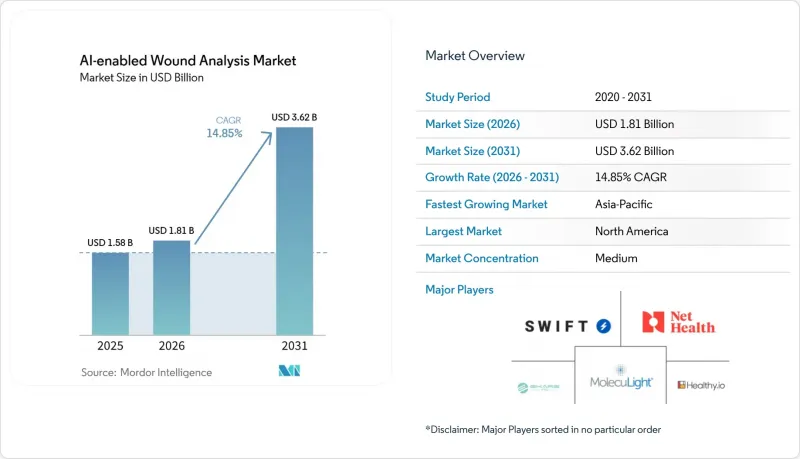
본 보고서는 제품 유형(스마트폰용 용도, 소프트웨어 등), 용도(상처 평가·모니터링, 치유 예측·의사결정 지원 등), 상처 유형(만성 상처, 급성 상처 등), 최종 사용자(병원, 재택치료 기관 등), 지역(북미, 유럽 등)별로 분류되어 있습니다. 시장 전망은 금액(달러) 기준으로 제시되어 있습니다.
세계의 인공지능(AI) 활용 상처 분석 시장 동향 및 인사이트
만성 상처 부담 증가와 당뇨병성 궤양 모니터링 수요
만성 상처 유병률 증가로 인해, 수동 평가만으로는 대규모로 대응하기 어려운 모니터링 수요가 발생하고 있습니다. 전 세계적으로 매년 약 1,860만 명이 당뇨병성 족부 궤양을 발병하고 있으며, 당뇨병 진단을 받은 사람들의 하지 절단 사례 중 80%는 이 궤양이 선행 요인으로 작용하고 있습니다. 동남아시아만 해도 2025년에는 1억 700만 명 이상이 당뇨병을 앓았으며, 이 수치는 2050년까지 1억 8,500만 명에 달할 것으로 예측됩니다. 당뇨병성 족부 궤양의 재발률은 최초 치유 후 3-5년 이내에 65%에 달할 가능성이 있으며, 이에 따라 AI를 활용한 상처 분석의 가치는 일회성 지원에서 지속적인 모니터링 인프라로 전환되고 있습니다. 유럽에서는 만성 상처 유병률이 인구 1,000명당 2.2명이며, WHO 유럽 전체에서 평생 동안 1,600만 명이 당뇨병성 발 질환을 앓을 것으로 추정됩니다. 이는 대규모 영상 기반 모니터링 도입을 뒷받침하는 근거가 되고 있습니다.
병원 업무 흐름의 부담과 보다 신속한 병상 평가에 대한 수요
입원 환자 치료에서 상처 관리는 간호 시간의 상당 부분을 차지하고 있으며, 번아웃이 인력 부족 문제를 더욱 심각하게 만들고 있습니다. Net Health가 2025년 1분기에 실시한 조사에 따르면, 상처 관리 전문가의 77.00%가 심각한 번아웃을 보고한 반면, 47%는 스마트 문서화 도구를 중요한 부담 완화책으로 꼽았습니다. AI를 활용한 병상 옆 영상 진단은 측정 편차를 줄이고, 자를 이용한 측정 오차를 제거할 뿐만 아니라, 전문 지식이 없는 직원도 일상적인 간호 과정에서 임상적으로 유효한 기록을 작성할 수 있게 해줍니다. PMC에 게재된 2025년 연구에 따르면, 14개 재택의료 지점에서 도입된 디지털화된 상처 관리 시스템 덕분에 건당 숙련 간호사의 방문 횟수가 감소하여, 단일 재택의료 기관에서 연간 최대 95만 8,201달러의 비용 절감 가능성이 생긴 것으로 밝혀졌습니다. 이러한 비용 절감 논리는 인공지능(AI) 활용 상처 분석 시장에서 공식적인 근거 확립이 실무상 수요를 아직 따라잡지 못하고 있는 상황에서도, 병원이 기록 및 모니터링 도구를 도입하고 있는 이유를 설명하는 데 도움이 됩니다.
다양한 피부색과 상처 상태에서 나타나는 임상적 타당성의 격차
인공지능(AI) 활용 상처 분석 도구는 여전히 의료 시스템에 임상적 및 조달상의 위험을 초래하는 측정 가능한 형평성 격차에 직면해 있습니다. 2025년 『PLOS One』지에 게재된 외과적 상처 AI 시스템을 평가한 연구에서는 전반적인 민감도가 89%로 보고되었으나, 피부색이 어두운 경우 일부 상처 특징의 감지 정확도가 떨어지는 것으로도 밝혀졌습니다. 2025년 IEEE BHI 연구에서는 기존 모델의 상당수가 주로 피부색이 밝은 집단에서 학습되었기 때문에 유색인종 커뮤니티의 당뇨병성 족부 궤양 인식을 목적으로 한 데이터 세트가 소개되었습니다. 『npj Digital Medicine』에 게재된 연구 역시 의료용 AI에서 피부색조 평가 및 성능 보고라는 광범위한 문제를 뒷받침하고 있으며, 공급업체에 대해 보다 종합적인 검증 결과를 제시하도록 하는 압력이 커지고 있습니다. 2025년 『Chinese Journal of Injury Repair and Wound Care』에 게재된 총설에서도 마찬가지로, 데이터의 다양성이 만성 상처 관리에서 AI 활용의 핵심적인 미해결 과제라고 지적되고 있습니다.
부문 분석
2025년, 인공지능(AI) 활용 상처 분석 시장 규모의 36.18%를 스마트폰 앱이 차지하며 최대 제품 부문이 되었습니다. 이는 영상 촬영용 하드웨어가 이미 병상이나 지역 의료 현장의 임상의 손에 있기 때문입니다. 의료 시스템이 전문의의 시간을 일상적인 문서 작성에서 해방시켜 주는 비동기형 상처 평가 모델에 대한 투자를 지속하는 가운데, 원격 의료 플랫폼은 2031년까지 연평균 성장률(CAGR) 18.81%로 확대될 것으로 예측됩니다. 이러한 제품 구성은 의료 제공업체가 우선 도입 장벽이 가장 낮은 영상 획득 도구를 선택한 후, 그 주위에 평가 워크플로를 추가하는 실용적인 구매 패턴을 반영하고 있습니다. EMR 통합 소프트웨어는 매출 측면에서는 두드러지지 않지만, 상처 영상이나 측정값이 임상 워크플로우에 통합될지, 아니면 독립형 앱 내에 갇혀 있을지 결정짓는 구조적으로 중요한 역할을 담당하고 있습니다. AI가 탑재된 영상 촬영 하드웨어는 고정밀도 부문을 차지하고 있으며, 특히 스펙트럼, 형광, 근적외선 방식에서 구매자들은 더 깊은 조직이나 감염과 관련된 신호를 원하고 있습니다.
이미징 하드웨어 분야는 규제 당국의 검증 진전과 소프트웨어 플랫폼과의 더욱 긴밀한 연동을 통해 발전하고 있습니다. 2026년 3월에 발표된 Swift Medical사의 FDA 510(k) 승인을 받은 제품 ‘Swift Ray 1’은 휴대용 스펙트럼 이미징을 병원, 재택치료, 원격 진료에서 사용하기 위한 광범위한 인공지능(AI) 활용 상처 분석 플랫폼과 연동함으로써 이러한 방향성을 보여주었습니다. 따라서 인공지능(AI) 활용 상처 분석 시장의 제품 경쟁은 규모 확대를 목표로 하는 ‘모바일 퍼스트’형 도구와 심층 분석을 목표로 하는 ‘기기 주도형’ 플랫폼으로 양극화되고 있습니다. 예산이나 교육 시간이 제한된 환경에서는 스마트폰 기반 용도이 여전히 도입하기 가장 쉽습니다. 반면, 규제상 인증이나 진료 현장에서 보다 상세한 상처 데이터가 필요한 환경에서는 하드웨어 주도형 플랫폼이 더욱 확고한 입지를 다지고 있습니다.
2025년에는 상처 평가 및 모니터링이 41.68%의 점유율을 차지했습니다. 이는 표준화된 측정이 인공지능(AI) 활용 상처 분석 시장 전체에서 여전히 첫 번째이자 가장 일반적인 이용 사례이기 때문입니다. 의료 제공업체들이 AI를 단순히 상처 상태를 기술하는 데 그치지 않고, 치료 및 경과 관찰의 지침으로도 활용하기 시작함에 따라, 치유 예측 및 의사 결정 지원은 2031년까지 연평균 성장률(CAGR) 17.86%를 나타낼 것으로 예측됩니다. 이에 따라 상업적 논의의 초점은 단순한 기록의 질에서 예상되는 치유 결과 및 의료진의 시간 효율적 활용으로 이동하고 있습니다. 감염 감지 및 조직 특성 평가는 여전히 임상적으로 중요하지만, 이러한 워크플로는 더 정교한 장비나 추가 교육이 필요한 경우가 많아 도입 속도가 더딘 임베디드니다. 또한, 영상 촬영이 의료 제공업체가 다양한 치료 환경에서 상처를 관리하는 데 있어 더욱 중심적인 역할을 하게 됨에 따라, 원격 상처 기록 및 치료 조정도 확대되고 있습니다.
이러한 용도의 조합을 통해 구매자들은 일반적으로 측정 단계에서 시작하여 이후 예측 단계로 넘어가는 경향을 보입니다. MolecuLightDX는 2026년 1월 FDA로부터 ‘의료기기 개발 도구’로 인증받았으며, 이를 통해 연구 개발 및 제품 평가 분야에서 형광 기반 상처 측정의 임상적 위상이 강화되었습니다. 원격 의료에 대한 투자가 지속되는 가운데, 원격 기록은 더 광범위한 치료 조율과 분리하여 생각하기 어려워지고 있습니다. 이는 인공지능(AI) 활용 상처 분석 업계가 단순한 영상 진단 기능뿐만 아니라 측정, 평가 및 장기적인 계획 수립을 결합한 용도으로 전환되고 있음을 의미합니다.
지역별 분석
2025년, 북미는 인공지능(AI) 활용 상처 분석 시장의 41.87%를 차지하며 최대 지역 부문이 되었습니다. 이 지역은 견고한 규제 인프라, 풍부한 전문의 자원, 그리고 보험사의 기록 기준에 대한 높은 관심 등의 혜택을 누리고 있습니다. 캐나다 역시 활발한 개발 거점 역할을 하고 있으며, Swift Medical사의 2026년 FDA 510(k) 승인 및 DIGITAL Supercluster 프로그램을 통한 연방 정부의 공동 투자가 이를 잘 보여줍니다. 멕시코는 의료 IT 격차가 여전히 단기적인 발전을 제한하고 있어 도입 단계는 여전히 초기 단계에 머물러 있습니다. 이로 인해 인공지능(AI) 활용 상처 분석 시장 전체에서 북미는 제품 설계, 검증에 대한 기대, 그리고 조달 시기 측면에서 기준이 되는 지역이 되었습니다.
유럽은 보다 ‘증거 우선’적인 도입 경로를 통해 발전하고 있으며, 영국은 해당 지역에서 가장 성숙한 도입 환경으로 두각을 나타내고 있습니다. 독일과 프랑스는 EU MDR(의료기기 규정)의 틀 안에서 발전하고 있으며, 이 틀에서는 보다 강력한 시판 후 증거와 규정 준수 체계를 지원할 수 있는 공급업체가 우대받습니다. eKare가 2025년 4월 옥스퍼드 헬스 NHS 재단 트러스트와 체결한 제휴는 조달 규모를 확대하기 전에 임상적 및 경제적 가치를 입증하는 것을 중시하는 유럽의 추세를 반영하고 있습니다.
아시아태평양은 2026년부터 2031년까지 연평균 성장률(CAGR) 19.34%로 확대될 것으로 예측되며, 지역별 인공지능(AI) 활용 상처 분석 시장 규모에서 가장 빠르게 성장하는 지역이 될 것입니다. 인도의 디지털 헬스 분야 발전, 중국의 AI 의료기기 심사 가속화, 그리고 일본의 공공 자금을 통한 상처 AI 관련 노력이 이러한 성장 속도를 뒷받침하고 있습니다. 2025년 중국에서 실시된 조사에 따르면, 만성 상처 관리 분야에서 AI의 주요 임상 도입 분야로 상처 평가, 원격 모니터링, 의사결정 지원이 꼽혔습니다.
기타 혜택 :
- 엑셀 형식 시장 예측(ME) 시트
- 3개월간의 애널리스트 지원
자주 묻는 질문
목차
제1장 서론
제2장 조사 방법
제3장 주요 요약
제4장 시장 구도
제5장 시장 규모 및 성장 예측
제6장 경쟁 구도
제7장 시장 기회 및 향후 전망
KTH 26.08.10According to Mordor Intelligence, the AI-enabled wound analysis market size was valued at USD 1.58 billion in 2025 and is estimated to grow from USD 1.81 billion in 2026 to reach USD 3.62 billion by 2031, at a CAGR of 14.85% during the forecast period (2026-2031).
This report is Segmented by Product Type (smartphone Based Applications, Software, and More), Application (Wound Assessment and Monitoring, Healing Prediction and Decision Support, and More), Wound Type (Chronic Wounds, Acute Wounds, and More), End User (Hospitals, Home Healthcare Agencies, and More), and Geography (North America, Europe, and More). Market Forecasts are Provided in Terms of Value (USD).
Global AI-enabled Wound Analysis Market Trends and Insights
Rising Chronic Wound Burden and Diabetic Ulcer Surveillance Needs
Chronic wound prevalence is creating a surveillance need that manual assessment cannot meet at scale. Globally, approximately 18.6 million people worldwide develop diabetic foot ulcers each year, and these ulcers precede 80% of lower-limb amputations among people diagnosed with diabetes.Southeast Asia alone had more than 107 million people with diabetes in 2025, a figure projected to reach 185 million by 2050. Diabetic foot ulcer recurrence can reach 65% within 3 to 5 years after initial healing, which shifts the value of AI wound analysis from one-time support to ongoing surveillance infrastructure. In Europe, chronic wounds had a prevalence of 2.2 per 1,000 people, and diabetic foot disease is estimated to affect 16 million people over their lifetime across the WHO European Region, which supports the case for image-based monitoring at scale.
Hospital Workflow Pressure and Demand for Faster Bedside Assessment
Wound care takes a heavy share of nursing time in inpatient settings, and burnout is making the capacity problem more severe. A Net Health Q1 2025 survey found that 77.00% of wound care professionals reported significant burnout, while 47% identified smart documentation tools as a critical relief mechanism. AI-enabled bedside imaging reduces measurement variability, removes ruler-based errors, and lets non-specialist staff capture clinically valid documentation during routine care. A 2025 study published in PMC found that a digitally enabled wound care system used across 14 home health branches reduced skilled nursing visits per episode and created potential annual savings of up to USD 958,201 across a single home health organization. This cost-avoidance logic helps explain why hospitals in the AI-enabled wound analysis market are adopting documentation and surveillance tools even when formal evidence development is still catching up with operational demand.
Clinical Validation Gaps Across Diverse Skin Tones and Wound Presentations
AI wound analysis tools still face a measurable equity gap that creates clinical and procurement risk for health systems. A 2025 PLOS One study evaluating a surgical wound AI system reported 89% overall sensitivity, but it also found lower detection accuracy for some wound features in darker skin tones. An IEEE BHI study in 2025 described datasets designed for diabetic foot ulcer recognition in communities of color because many existing models have been trained mainly on lighter-skinned populations. Published work in npj Digital Medicine has also reinforced the wider issue of skin-tone assessment and performance reporting in medical AI, which increases pressure on vendors to show more inclusive validation. A 2025 review in the Chinese Journal of Injury Repair and Wound Care likewise identified data diversity as a central unresolved challenge for AI use in chronic wound management.
Other drivers and restraints analyzed in the detailed report include:
- Standardized Documentation and Reimbursement Traceability Requirements
- Expansion of Remote Wound Monitoring and Telewound Programs
- Integration Friction with Legacy EHR and Nonstandard Imaging Workflows
For complete list of drivers and restraints, kindly check the Table Of Contents.
Segment Analysis
Smartphone applications held 36.18% of the AI-enabled wound analysis market size in 2025, which made them the largest product segment because the imaging hardware was already in the hands of bedside and community clinicians. Telemedicine platforms are projected to expand at an 18.81% CAGR through 2031 as health systems continue to invest in asynchronous wound review models that shift specialist time away from routine documentation. This product split reflects a practical buying pattern in which providers first choose the lowest-friction capture tool and then add review workflows around it. EMR integration software remains less visible in revenue terms, but it has a structurally important role because it determines whether wound images and measurements change the clinical workflow or stay trapped in a standalone app. AI-enabled imaging hardware occupies the high-precision tier, especially in spectral, fluorescence, and near-infrared formats, where buyers are looking for deeper tissue and infection-related signals.
The imaging hardware tier is moving forward through regulatory validation and tighter pairing with software platforms. Swift Medical's FDA 510(k)-cleared Swift Ray 1, announced in March 2026, showed this direction by linking handheld spectral imaging with a broader AI wound platform intended for hospital, home health, and remote care use. Product competition in the AI-enabled wound analysis market is therefore separating into mobile-first tools built for scale and device-led platforms built for depth. Smartphone-based applications remain easiest to deploy where budgets and training time are limited. Hardware-led platforms hold stronger positions in settings that want regulatory credentials and richer wound data at the point of care.
Wound assessment and monitoring held 41.68% share in 2025 because standardized measurement remains the first and most common use case across the AI-enabled wound analysis market. Healing prediction and decision support is projected to grow at a 17.86% CAGR through 2031 as providers start to use AI not only to describe the wound but also to guide treatment and follow-up. This changes the commercial discussion from documentation quality alone to expected healing outcomes and better use of staff time. Infection detection and tissue characterization remain clinically important, but adoption is slower because these workflows often rely on more advanced devices and extra training. Remote wound documentation and care coordination are also expanding because image capture has become more central to how providers manage wounds across care settings.
The application mix shows that buyers usually start with measurement and then move toward prediction. MolecuLightDX received FDA qualification as a Medical Device Development Tool in January 2026, which strengthened the clinical standing of fluorescence-based wound measurement in research and product evaluation. As telemedicine investment continues, remote documentation is becoming harder to separate from broader care coordination. This means the AI-enabled wound analysis industry is moving toward applications that combine measurement, review, and longitudinal planning rather than isolated imaging functions alone.
Complete Report Scope:
- By Product Type
- Smartphone Based Applications
- Telemedicine Platforms
- Electronic Medical Record Integration Software
- AI Enabled Imaging Hardware
- By Application
- Wound Assessment and Monitoring
- Healing Prediction and Decision Support
- Infection Detection and Tissue Characterization
- Remote Wound Documentation and Care Coordination
- By Wound Type
- Chronic Wounds
- Acute Wounds
- Surgical Wounds
- Burn Wounds
- By End User
- Hospitals
- Home Healthcare Agencies
- Specialty Clinics
- Long Term Care Facilities
- By Geography
- North America
- United States
- Canada
- Mexico
- Europe
- Germany
- United Kingdom
- France
- Italy
- Spain
- Rest of Europe
- Asia-Pacific
- China
- India
- Japan
- South Korea
- Australia
- Rest of Asia-Pacific
- Middle East and Africa
- GCC
- South Africa
- Rest of Middle East and Africa
- South America
- Brazil
- Argentina
- Rest of South America
- North America
Geography Analysis
North America held 41.87% of AI-enabled wound analysis market share in 2025, which made it the largest regional segment. The region benefits from stronger regulatory infrastructure, deeper specialist presence, and greater payer focus on documentation standards. Canada also acts as an active development hub, reflected in Swift Medical's 2026 FDA 510(k) clearance and federal co-investment through the DIGITAL Supercluster program. Mexico remains earlier in adoption because healthcare IT gaps still limit near-term rollout. This makes North America the reference region for product design, validation expectations, and procurement timing across the broader AI-enabled wound analysis market.
Europe is advancing through a more evidence-first adoption path, and the United Kingdom stands out as the most mature deployment setting in the region. Germany and France are progressing within the EU MDR framework, which favors vendors that can support stronger post-market evidence and compliance discipline. eKare's April 2025 partnership with Oxford Health NHS Foundation Trust reflects the European preference for proving clinical and economic value before scaling procurement.
Asia-Pacific is projected to expand at a 19.34% CAGR from 2026 to 2031, which makes it the fastest-growing region in the AI-enabled wound analysis market size by geography. India's digital health buildout, China's AI device review momentum, and Japan's publicly funded wound AI work are supporting that pace. A 2025 Chinese review identified wound assessment, remote monitoring, and decision support as the main clinical deployment areas for AI in chronic wound management.
- ARANZ Medical
- BioVisual Technologies LLC
- ConvaTec Group plc
- eKare, Inc.
- Healthy.io Ltd.
- Intellicure, Inc.
- Joerns Healthcare
- Kent Imaging
- MolecuLight
- NATROX Wound Care
- Net Health Systems, Inc.
- Perceptive Solutions, Inc.
- Smiths Group
- Solventum Corporation
- Swift Medical Inc.
- Tissue Health Plus
- WoundMatrix, Inc.
- WoundRight Technologies, LLC
- WoundVision, LLC
- WoundZoom, Inc.
Additional Benefits:
- The market estimate (ME) sheet in Excel format
- 3 months of analyst support
TABLE OF CONTENTS
1 INTRODUCTION
- 1.1 Study Assumptions and Market Definition
- 1.2 Scope of the Study
2 RESEARCH METHODOLOGY
3 EXECUTIVE SUMMARY
4 MARKET LANDSCAPE
- 4.1 Market Overview
- 4.2 Market Drivers
- 4.2.1 Rising Chronic Wound Burden and Diabetic Ulcer Surveillance Needs
- 4.2.2 Hospital Workflow Pressure and Demand for Faster Bedside Assessment
- 4.2.3 Standardized Documentation and Reimbursement Traceability Requirements
- 4.2.4 Expansion of Remote Wound Monitoring and Telewound Programs
- 4.2.5 AI-Assisted Infection Detection From Multimodal Imaging at Point of Care
- 4.2.6 Cross-Device Interoperability With EHR and Care Coordination Platforms
- 4.3 Market Restraints
- 4.3.1 Clinical Validation Gaps Across Diverse Skin Tones and Wound Presentations
- 4.3.2 Integration Friction With Legacy EHR and Nonstandard Imaging Workflows
- 4.3.3 Reimbursement Uncertainty for AI-Enabled Wound Assessment in Some Care Settings
- 4.3.4 Data Governance Constraints for Image Storage, Consent, and Cross-Site Analytics
- 4.4 Value Chain Analysis
- 4.5 Regulatory Landscape
- 4.6 Technological Outlook
- 4.7 Porter's Five Forces Analysis
- 4.7.1 Threat of New Entrants
- 4.7.2 Bargaining Power of Suppliers
- 4.7.3 Bargaining Power of Buyers
- 4.7.4 Threat of Substitutes
- 4.7.5 Competitive Rivalry
5 MARKET SIZE AND GROWTH FORECASTS (VALUE, USD)
- 5.1 By Product Type
- 5.1.1 Smartphone Based Applications
- 5.1.2 Telemedicine Platforms
- 5.1.3 Electronic Medical Record Integration Software
- 5.1.4 AI Enabled Imaging Hardware
- 5.2 By Application
- 5.2.1 Wound Assessment and Monitoring
- 5.2.2 Healing Prediction and Decision Support
- 5.2.3 Infection Detection and Tissue Characterization
- 5.2.4 Remote Wound Documentation and Care Coordination
- 5.3 By Wound Type
- 5.3.1 Chronic Wounds
- 5.3.2 Acute Wounds
- 5.3.3 Surgical Wounds
- 5.3.4 Burn Wounds
- 5.4 By End User
- 5.4.1 Hospitals
- 5.4.2 Home Healthcare Agencies
- 5.4.3 Specialty Clinics
- 5.4.4 Long Term Care Facilities
- 5.5 By Geography
- 5.5.1 North America
- 5.5.1.1 United States
- 5.5.1.2 Canada
- 5.5.1.3 Mexico
- 5.5.2 Europe
- 5.5.2.1 Germany
- 5.5.2.2 United Kingdom
- 5.5.2.3 France
- 5.5.2.4 Italy
- 5.5.2.5 Spain
- 5.5.2.6 Rest of Europe
- 5.5.3 Asia-Pacific
- 5.5.3.1 China
- 5.5.3.2 India
- 5.5.3.3 Japan
- 5.5.3.4 South Korea
- 5.5.3.5 Australia
- 5.5.3.6 Rest of Asia-Pacific
- 5.5.4 Middle East and Africa
- 5.5.4.1 GCC
- 5.5.4.2 South Africa
- 5.5.4.3 Rest of Middle East and Africa
- 5.5.5 South America
- 5.5.5.1 Brazil
- 5.5.5.2 Argentina
- 5.5.5.3 Rest of South America
- 5.5.1 North America
6 COMPETITIVE LANDSCAPE
- 6.1 Market Concentration
- 6.2 Market Share Analysis
- 6.3 Company Profiles (includes Global Level Overview, Market Level Overview, Core Segments, Financials as available, Strategic Information, Market Rank/Share, Products and Services, Recent Developments)
- 6.3.1 ARANZ Medical Limited
- 6.3.2 BioVisual Technologies LLC
- 6.3.3 ConvaTec Group plc
- 6.3.4 eKare, Inc.
- 6.3.5 Healthy.io Ltd.
- 6.3.6 Intellicure, Inc.
- 6.3.7 Joerns Healthcare LLC
- 6.3.8 Kent Imaging Inc.
- 6.3.9 MolecuLight Inc.
- 6.3.10 NATROX Wound Care
- 6.3.11 Net Health Systems, Inc.
- 6.3.12 Perceptive Solutions, Inc.
- 6.3.13 Smith and Nephew plc
- 6.3.14 Solventum Corporation
- 6.3.15 Swift Medical Inc.
- 6.3.16 Tissue Health Plus
- 6.3.17 WoundMatrix, Inc.
- 6.3.18 WoundRight Technologies, LLC
- 6.3.19 WoundVision, LLC
- 6.3.20 WoundZoom, Inc.
7 MARKET OPPORTUNITIES AND FUTURE OUTLOOK
- 7.1 White Space and Unmet Need Assessment