

|
시장보고서
상품코드
2099456
AI 검색 광고 시장 : 점유율 분석, 업계 동향 및 통계, 성장 예측(2026-2031년)AI Search Advertising - Market Share Analysis, Industry Trends & Statistics, Growth Forecasts (2026 - 2031) |
||||||
 Mordor Intelligence
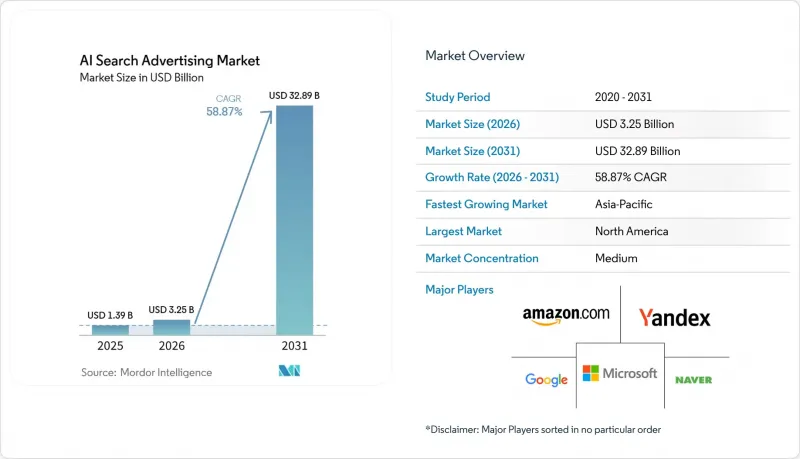
Mordor Intelligence에 의하면, AI 검색 광고 시장 규모는 2025년 13억 9,000만 달러에서 2026년에는 32억 5,000만 달러로 확대되어 2026년부터 2031년까지 CAGR 58.87%로 성장을 지속하여, 2031년에는 328억 9,000만 달러에 이를 것으로 예측됩니다.
본 보고서는 제공 형태(플랫폼 소프트웨어 및 관리형 서비스), 광고 형식(검색 결과 내 스폰서 링크, 대화형 검색 광고 등), 도입 형태(클라우드 및 On-Premise), 기업 규모(대기업 및 중소기업), 최종 사용자 산업(소매 및 전자상거래, BFSI 등), 그리고 지역별로 분류되어 있습니다. 시장 전망은 금액(달러) 기준으로 제시되어 있습니다.
전 세계 AI 검색 광고 시장 동향 및 인사이트
검색 및 어시스턴트 경험에서 AI 탑재 검색 화면의 확대
AI 검색 광고 시장은 AI 검색 인터페이스가 제품 테스트 단계에서 검색 및 어시스턴트 경험 전반으로의 상용화 단계로 전환됨에 따라 새로운 국면에 접어들었습니다. 구글은 'AI 모드'와 스폰서 컨텐츠를 답변 생성 및 발견 흐름에 더 가깝게 배치하는 새로운 제미니(Gemini) 기반 형식을 통해, AI 주도 검색 여정 내 광고의 가시성을 확대했습니다. 또한 구글은 ‘대화형 디스커버리 광고’와 ‘하이라이트된 답변’을 도입하여 AI 검색 경험 내에서 수익화 가능한 광고 슬롯의 수를 확대했습니다. 마이크로소프트의 보고서에 따르면, 2025년에는 AI 주도 세션 수가 약 3배로 증가했으며, 에이전트형 브라우저 트래픽도 급증했습니다. 이는 광고주에게 중요한 검색 행동이 얼마나 빠르게 AI 인터페이스로 이동하고 있는지를 보여줍니다. 이 점이 중요한 이유는 AI 검색 화면이 단순히 노출 수를 늘리는 데 그치지 않고, 검색 의도가 가시화되는 장소나 스폰서 검색 결과가 표시되는 장소 자체를 바꾸기 때문입니다. 발견, 비교, 답변 중심의 검색 여정이 이러한 환경으로 전환됨에 따라, AI 검색 광고 시장은 더 대규모이며 상업적으로 유용한 광고 공간 기반을 확보하게 될 것입니다.
키워드만 타겟팅하던 방식에서 의도를 인식한 광고 게재로의 전환
AI 검색 광고 시장은 키워드 매칭에서 의도를 인식한 광고 게재로의 전환에 의해서도 견인되고 있습니다. 구글은 ‘AI Max for Search’ 캠페인의 베타 버전이 2026년 4월에 종료되었음을 발표했으며, 2026년 9월부터 다이내믹 검색 광고가 AI Max로 업그레이드될 것임을 확인했습니다. 이 변경으로 인해 AI 지원 검색 환경 전반에서 폭넓은 도달 범위를 추구하는 광고주에게 의도 모델링이 실질적인 요건이 됩니다. 구글은 'AI Max'가 키워드만으로는 포착할 수 없는 더 복잡한 쿼리 행동에 광고를 매칭함으로써, 동등한 효율로 더 많은 전환을 창출할 수 있다고 밝혔습니다. 또한, 마이크로소프트도 ‘Copilot’의 광고 배치에서 더 높은 참여도와 전환 성과를 제시하고 있으며, 이는 예산을 기존의 좁은 타겟팅 로직에서 AI 주도형 검색어 해석으로 전환해야 한다는 주장을 뒷받침하고 있습니다. 그 결과, 캠페인 관리에 구조적인 변화가 일어나고 있으며, 광고주는 키워드 목록뿐만 아니라 의도의 포괄성, 훈련 데이터의 품질, 자동화 대응 능력 면에서 경쟁하게 되었습니다.
AI에 의한 요약 표시와 SERP 압축에 따른 CPC 상승 압력 및 가시성 저하
AI 검색 광고 시장의 단기적인 제약으로, AI가 생성하는 검색 레이아웃으로 인해 표시 공간이 압축되고 트래픽 패턴이 변화한다는 점을 들 수 있습니다. 검색 과정이 AI 요약, 추천 목록, 가이드형 답변 형식으로 전환됨에 따라, 광고주는 페이지 상단에 눈에 띄게 노출될 기회가 줄어들 가능성이 있습니다. 구글의 ‘AI 모드’를 통한 광고 전개는 이러한 표시 영역 내에서도 수익화가 지속되고 있음을 뒷받침하지만, 동시에 가시성이 새로운 인벤토리 규칙이나 형식 자격 요건에 점점 더 좌우된다는 것을 의미합니다. 또한, 구글이 ‘동적 검색 광고’에서 ‘AI Max’로의 전환을 의무화하고 있다는 점은 광고주가 이러한 환경 내에서 효과적으로 경쟁하기 위해서는 캠페인 구조를 업데이트해야 함을 더욱 시사합니다. 이로 인해 자동 입찰, 데이터 피드백 루프, 사내 최적화 리소스를 충분히 갖추지 못한 중소규모 광고주에게는 운영상의 부담이 가중될 가능성이 있습니다. 이러한 제약은 시간이 지남에 따라 완화될 전망이지만, 가격 책정, 게재 행동, 측정 기준이 아직 정착되는 단계에서는 여전히 도입에 있어 큰 장벽으로 작용하고 있습니다.
부문 분석
2025년 AI 검색 광고 시장에서 플랫폼 소프트웨어가 78.98%를 차지하고 있으며, 이는 광고주가 여전히 플랫폼 소유자가 관리하는 네이티브 캠페인 시스템에 얼마나 크게 의존하고 있는지를 보여줍니다. 이러한 환경은 경매 데이터, 의도 해석, 포맷 적합성과 가장 밀접한 위치에 있기 때문에 실행의 품질과 규모 측면에서 여전히 중심적인 역할을 수행하고 있습니다. 구글이 ‘다이내믹 검색 광고’에서 ‘AI Max’로 전환한 것은 가장 중요한 제품 변화가 툴스택의 주변부가 아닌 핵심 플랫폼 인프라 내부에서 일어나고 있음을 뒷받침합니다. 마이크로소프트의 ‘AI Max for Search’ 공개 파일럿 프로그램도 유사한 추세를 보여주며, AI 주도형 광고 게재에 대한 접근은 여전히 플랫폼 계층 그 자체와 밀접하게 연결되어 있습니다. 실무적인 관점에서 볼 때, 플랫폼 소프트웨어가 지배적인 역할을 수행하고 있다는 것은 광고주가 소수의 플랫폼 소유자가 설정한 규칙, 인벤토리 로직, 그리고 측정 시스템에 맞추어 워크플로를 조정해야 하는 경우가 많다는 것을 의미합니다.
매니지드 서비스는 2031년까지 연평균 성장률(CAGR) 60.72%로 확대될 것으로 예측되며, 이는 AI 검색 광고 업계 내에 명확한 실행상의 격차가 존재함을 보여줍니다. 많은 브랜드가 AI 주도형 포맷에 대한 접근권을 구매할 수는 있지만, 외부 지원 없이 퍼스트 파티 데이터 피드를 관리하고, AI Max로 전환하며, 쿼리를 해석하고, 크리에이티브를 변경하며, 어트리뷰션을 재설계할 수 있는 기업은 극소수에 불과합니다. AI 검색 캠페인이 키워드 중심에서 벗어나 자동화, 클라우드 전달, 실시간 신호 관리에 대한 의존도가 높아짐에 따라 이러한 격차는 더욱 확대되고 있습니다. 따라서 플랫폼의 복잡성을 재현 가능한 운영 모델로 전환할 수 있는 서비스 제공업체는 캠페인 설정, 거버넌스, 성과 최적화 측면에서 더 큰 역할을 담당하게 되었습니다. 이것이 바로 광고주들이 변화하는 AI 검색 워크플로우를 따라잡으려 노력하는 가운데, 매니지드 서비스가 플랫폼 소프트웨어를 대체하는 것이 아니라 그와 병행하여 확대되고 있는 이유입니다.
2025년, 검색 결과 내 스폰서 링크는 시장의 47.79%를 차지하며, 기존의 텍스트 중심 형식이 여전히 수익에서 가장 큰 비중을 차지하고 있음을 보여줍니다. 이러한 위상은 친숙함, Google 검색 및 Bing에서의 광범위한 도달 범위, 그리고 광고주가 이미 이에 대한 계획 및 최적화 프로세스를 확립해 왔습니다는 사실을 반영한 것입니다. AI 검색 광고 시장은 스폰서 링크가 여전히 주류 검색 광고 구매 행태에 깊이 뿌리내리고 있기 때문에 현재의 광고량 측면에서는 여전히 스폰서 링크에 의존하고 있습니다. 하지만 규모 면에서의 포맷 우위는 더 이상 성장세 면에서의 우위와 동의어가 아닙니다. 새로운 포맷의 이야기는 AI가 생성한 답변, 발견을 유도하는 프롬프트, 그리고 안내형 제품 평가와 더 가까운 위치에 배치되는 광고 유닛을 통해 점차 펼쳐지고 있습니다.
대화형 검색 광고는 2031년까지 연평균 성장률(CAGR) 68.34%로 확대될 것으로 예측되며, AI 검색 광고 시장에서 가장 빠르게 성장하는 광고 형식이 될 것입니다. 구글은 2026년 5월 ‘Conversational Discovery Ads’와 ‘Highlighted Answers’를 도입하여, 스폰서 메시지를 AI 모드의 추천 및 답변 환경에 직접 통합했습니다. 또한 구글은 AI 모드 사용자가 더 신속하고 확신 있게 구매 결정을 내린다는 소비자 조사 결과를 인용하고 있는데, 이는 의사결정 과정의 마찰을 줄여주는 ‘답변 내 광고’의 유효성을 뒷받침하는 것입니다. 플랫폼이 AI를 활용하여 단순히 상품을 나열하는 데 그치지 않고 검색 쿼리 수준에서 상품을 설명하게 됨에 따라, 상품 목록 광고 및 기타 커머스 주도형 형식도 탄력을 받고 있습니다. 이에 따라 단기적으로는 스폰서 링크의 관련성이 유지되겠지만, 장기적인 성장의 중심은 보다 대화형이며 문맥을 인식하는 광고 슬롯으로 이동해 갈 것입니다.
지역별 분석
2025년, 북미는 AI 검색 광고 시장 점유율의 37.78%를 차지하며, 상업적 전개와 플랫폼 지배력 양면에서 해당 지역의 주도적 지위를 유지했습니다. 구글, 마이크로소프트, 오픈AI가 모두 자국 시장을 거점으로 AI 주도형 광고 제품을 추진함에 따라, 미국은 이 부문의 운영 거점으로 자리매김했습니다. 구글은 2026년에 ‘AI 모드’를 통한 광고 게재를 시작하고, 제미니(Gemini) 기반의 새로운 광고 형식을 추가함으로써 해당 지역에서의 수익화 길을 넓혔습니다. 마이크로소프트도 ‘AI Max for Search’의 제공 범위를 더욱 확대하고, 코파일럿(Copilot) 및 빙 AI(Bing AI) 등 각 플랫폼으로 활용을 넓힘으로써 해당 지역 내 상업적 활용 측면에서 우위를 강화했습니다. 이러한 조기 접근을 통해 북미의 광고주들은 많은 해외 경쟁사들이 동등한 광고 공간을 확보하기 전에, 광고 형식 테스트, 측정 시스템 구축, 모범 사례 확립에 있어 실질적인 우위를 점할 수 있었습니다.
아시아태평양은 2031년까지 AI 검색 광고 시장 규모가 연평균 성장률(CAGR) 63.39%로 확대될 것으로 예측되며, 가장 빠르게 성장하는 지역이 될 전망입니다. 중국은 가장 강력한 성장세를 보이고 있으며, 2025년 12월 기준 생성형 AI 사용자 기반은 6억 200만 명에 달하고, 이는 인구의 42.8%에 해당합니다. 이러한 사용자 기반은 플랫폼 구조가 유럽 및 미국 시장과 다르다는 점에도 불구하고, AI 주도형 검색 수익화를 위한 견고한 행동 기반을 제공합니다. 인도는 애드테크 엔지니어링 및 플랫폼 지원의 거점으로서 중요성이 커지고 있으며, 이 지역은 수요 측면뿐만 아니라 더 광범위한 운영상의 역할도 담당하게 되었습니다. 또한, 광고주들이 모바일 우선 디지털 환경에서 AI 지원 형식을 시범적으로 도입함에 따라 호주, 한국, 동남아시아도 지역 확장에 기여하고 있습니다.
유럽에서는 일부 대화형 AI 광고 공간에 대한 광고주의 접근성이 미국만큼 완전하지 않아 당분간 제약이 남아 있을 전망입니다. 영국, 프랑스, 독일이 지역 내 도입을 주도하고 있는 반면, 이탈리아와 스페인에서는 도입 및 예산 전환이 아직 초기 단계에 머물러 있습니다. 이로 인해 유럽의 많은 지역은 이미 실제 운영 규모를 갖춘 검색 생태계에 의존할 수밖에 없어, 가격 책정의 유연성이 좁아지고 멀티 플랫폼 실험이 둔화되고 있습니다. 남미는 현재 규모는 작지만, 모바일 주도의 도입으로 인해 낮은 수준에서 출발해 향후 급속한 확장이 예상됩니다. 중동은 더욱 빠르게 발전하고 있으며, 정부가 지원하는 AI 프로그램이 디지털 인프라, 플랫폼의 준비 태세, 그리고 기업 내 도입을 뒷받침하고 있습니다. 사우디아라비아와 아랍에미리트(UAE)는 이러한 가속화를 가장 명확하게 보여주는 사례이며, 국가 차원의 AI 정책 덕분에 이 지역은 상업적 확장을 위한 더욱 매력적인 장소가 되고 있습니다. 아프리카는 여전히 가장 초기 단계에 있는 지역이지만, 남아프리카공화국은 디지털 광고 및 향후 AI 검색을 통한 수익 창출 측면에서 여전히 이 지역에서 가장 발전된 시장을 형성하고 있습니다.
기타 혜택:
- 엑셀 형식 시장 예측(ME) 시트
- 3개월간의 애널리스트 지원
자주 묻는 질문
목차
제1장 서론
제2장 조사 방법
제3장 주요 요약
제4장 시장 구도
제5장 시장 규모와 성장 예측
제6장 경쟁 구도
제7장 시장 기회와 향후 전망
JHS 26.08.05According to Mordor Intelligence, the AI search advertising market size is expected to grow from USD 1.39 billion in 2025 to USD 3.25 billion in 2026 and is forecast to reach USD 32.89 billion by 2031 at 58.87% CAGR over 2026-2031.
This report is Segmented by Offering (Platform Software and Managed Services), Ad Format (Sponsored Links in Search Results, Conversational Search Ads, and More), Deployment (Cloud and On-Premise), Enterprise Size (Large Enterprises, and Small and Medium Enterprises), End User Industry (Retail and E-Commerce, BFSI, and More), and Geography. The Market Forecasts are Provided in Terms of Value (USD).
Global AI Search Advertising Market Trends and Insights
Expansion of AI-Powered Search Surfaces Across Search and Assistant Experiences
The AI search advertising market entered a new phase when AI search surfaces shifted from product testing to commercial rollout across search and assistant experiences. Google expanded ad visibility within AI-led search journeys through AI Mode and newer Gemini-based formats that place sponsored content closer to answer-generation and discovery flows. Google also introduced Conversational Discovery Ads and Highlighted Answers, expanding the number of monetizable placements available within AI search experiences. Microsoft reported that AI-driven sessions nearly tripled in 2025 and that agentic browser traffic rose sharply, which shows how quickly advertiser-relevant search behavior is moving into AI interfaces. This matters because AI surfaces do not simply add more impressions; they also change where intent becomes visible and where sponsored results can appear. As more discovery, comparison, and answer-led journeys move into these environments, the AI search advertising market gains a larger and more commercially useful inventory base.
Shift From Keyword-Only Targeting to Intent-Aware Ad Delivery
The AI search advertising market is also being driven by the shift from keyword matching to intent-aware ad delivery. Google announced AI Max for Search campaigns left beta in April 2026 and confirmed that Dynamic Search Ads will be upgraded to AI Max from September 2026. That change makes intent modeling a practical requirement for advertisers seeking broad reach across AI-enabled search environments. Google stated that AI Max can deliver more conversions at similar efficiency by matching ads to more complex query behavior than keyword-only setups can capture. Microsoft also presented stronger engagement and conversion outcomes for Copilot ad placements, which supports the case for moving budgets toward AI-led query interpretation and away from narrower legacy targeting logic. The result is a structural change in campaign management, where advertisers increasingly compete on intent coverage, training data quality, and automation readiness rather than on keyword lists alone.
Rising CPC Pressure and Shrinking Visibility Due to AI Overviews and SERP Compression
A near-term constraint on the AI search advertising market is the way AI-generated search layouts can compress visible space and change traffic patterns. As search journeys shift toward AI summaries, recommendation lists, and guided-answer formats, advertisers may face fewer obvious placement opportunities at the top of the page. Google's rollout of ads in AI Mode confirms that monetization remains active inside these surfaces, but it also means visibility is increasingly tied to newer inventory rules and format eligibility requirements. Google's required migration from Dynamic Search Ads to AI Max further suggests that advertisers will need updated campaign structures to compete effectively inside these environments. This can increase operating pressure for smaller advertisers that lack automated bidding, data feedback loops, and in-house optimization resources. The restraint is likely to soften over time, but it remains a meaningful adoption barrier while pricing, placement behavior, and measurement standards are still settling.
Other drivers and restraints analyzed in the detailed report include:
- Higher Conversion Uplift From Search Campaign Automation and Broad Match Optimization
- Growing Demand for First-Party Data and Closed-Loop Measurement in Privacy-Constrained Search
- Limited Inventory and Weak Performance Proof in Standalone AI Chatbot Ads
For complete list of drivers and restraints, kindly check the Table Of Contents.
Segment Analysis
Platform software accounted for 78.98% of the AI search advertising market in 2025, which shows how strongly advertisers still rely on native campaign systems controlled by platform owners. These environments sit closest to auction data, intent interpretation, and format eligibility, so they remain central to execution quality and scale. Google's transition from Dynamic Search Ads to AI Max reinforces that the most important product shifts are happening inside core platform infrastructure rather than at the outer edge of the tool stack. Microsoft's open pilot for AI Max for Search also reflected the same pattern, where access to AI-led ad delivery remains tied to the platform layer itself. In practical terms, the dominant role of platform software means advertisers often need to adapt their workflows to the rules, inventory logic, and measurement systems set by a small group of platform owners.
Managed services are projected to expand at a 60.72% CAGR through 2031, indicating a clear execution gap within the AI search advertising industry. Many brands can buy access to AI-led formats, but fewer can manage first-party data feeds, migrate to AI Max, interpret queries, vary creative, and redesign attribution without outside help. That gap is widening as AI search campaigns become less keyword-led and more dependent on automation, cloud delivery, and real-time signal management. Service providers that can translate platform complexity into repeatable operating models are therefore gaining a larger role in campaign setup, governance, and performance tuning. This is why managed services are not displacing platform software, but are scaling alongside it as advertisers try to keep pace with changing AI search workflows.
Sponsored links in search results accounted for 47.79% of the market in 2025, indicating that traditional text-led formats still accounted for the largest share of revenue. That position reflected their familiarity, their broad reach across Google Search and Bing, and the fact that advertisers already had established planning and optimization processes around them. The AI search advertising market still depends on sponsored links for current volume because they remain embedded in mainstream search buying behavior. Even so, format leadership in scale is no longer the same as leadership in momentum. The newer format story is being written by ad units that sit closer to AI-generated answers, discovery prompts, and guided product evaluation.
Conversational search ads are projected to expand at a 68.34% CAGR through 2031, making them the fastest-growing ad format in the AI search advertising market. Google introduced Conversational Discovery Ads and Highlighted Answers in May 2026, which moved sponsored messaging directly into AI Mode recommendation and answer environments. Google also cited consumer research showing that AI Mode users made faster, more confident purchase decisions, which supports the case for in-answer placements that reduce friction along the decision path. Product listing ads and other commerce-led formats are also gaining traction as platforms use AI to explain products at the query level rather than just listing them. This keeps sponsored links relevant in the near term, but it shifts the long-term growth center toward more conversational, context-aware inventory.
Complete Report Scope:
- By offering
- Platform Software
- Managed Services
- By Ad Format
- Sponsored Links in Search Results
- Conversational Search Ads
- Product Listing Ads in AI Search Experiences
- Other Ad Formats (Shopping and Commerce Cards, etc.)
- By Deployment
- Cloud
- On-Premise
- By Enterprise Size
- Large Enterprises
- Small and Medium Enterprises
- By End User Industry
- Retail and E-Commerce
- BFSI
- Travel and Hospitality
- Healthcare and Life Sciences
- Media and Entertainment
- IT and Telecommunications
- Automotive
- Education
- Other End User Industry
- By Geography
- North America
- United States
- Canada
- South America
- Brazil
- Argentina
- Rest of South America
- Europe
- Germany
- United Kingdom
- France
- Italy
- Spain
- Rest of Europe
- Asia-Pacific
- China
- Japan
- India
- South Korea
- Australia
- Rest of Asia-Pacific
- Middle East and Africa
- Middle East
- Saudi Arabia
- United Arab Emirates
- Rest of Middle East
- Africa
- South Africa
- Rest of Africa
- Middle East
- North America
Geography Analysis
North America held 37.78% of the AI search advertising market share in 2025, maintaining the region's lead in both commercial rollout and platform control. The United States remained the operating center for the category because Google, Microsoft, and OpenAI all advanced AI-led ad products from their home-market base. Google made ads available in AI Mode and added new Gemini-based ad formats in 2026, widening monetization pathways in the region. Microsoft also opened AI Max for Search more broadly and extended its availability across Copilot and Bing AI surfaces, strengthening the region's lead in commercial availability. That early access gave North American advertisers a practical advantage in testing formats, building measurement systems, and shaping best practices before many international peers had comparable inventory.
Asia-Pacific is projected to expand at a 63.39% CAGR in the AI search advertising market size through 2031, making it the fastest-growing geography. China provided the strongest scale signal, with its generative AI user base reaching 602 million in December 2025, equal to 42.8% of the population. That user base provides a strong behavioral foundation for AI-led search monetization, even though platform structures differ from those in Western markets. India is becoming more relevant as an adtech engineering and platform support hub, giving the region a broader operational role than demand alone. Australia, South Korea, and Southeast Asia are also contributing to regional expansion as advertisers test AI-enabled formats in mobile-first digital environments.
Europe remains more constrained in the near term because advertiser access to some conversational AI inventory has been less complete than in the United States. The United Kingdom, France, and Germany are leading regional adoption, while Italy and Spain are still earlier in their rollouts and budget migrations. This leaves much of Europe dependent on search ecosystems that already have live scale, narrowing pricing flexibility and slowing multi-platform experimentation. South America remains smaller today, but mobile-led adoption creates room for faster future scaling from a lower base. The Middle East is developing more quickly, with government-backed AI programs supporting digital infrastructure, platform readiness, and enterprise adoption. Saudi Arabia and the UAE are the clearest examples of this acceleration, as national AI policies have made the region more attractive for commercial deployment. Africa remains the earliest-stage geography, with South Africa still the most developed regional market for digital advertising and future AI search monetization.
- Google LLC
- Microsoft Corporation
- Amazon.com, Inc.
- Yandex N.V.
- Criteo S.A.
- NAVER Corporation
- Baidu, Inc.
- OpenAI, L.L.C.
- Perplexity AI, Inc.
- Adobe Inc.
- DoubleVerify Holdings, Inc.
- Moloco, Inc.
- Verve Group
- Yahoo Inc.
- DuckDuckGo, Inc.
- The Trade Desk, Inc.
- Semrush Holdings, Inc.
- Skai, Inc.
- Optmyzr, Inc.
- Marin Software Incorporated
Additional Benefits:
- The market estimate (ME) sheet in Excel format
- 3 months of analyst support
TABLE OF CONTENTS
1 INTRODUCTION
- 1.1 Study Assumptions and Market Definition
- 1.2 Scope of the Study
2 RESEARCH METHODOLOGY
3 EXECUTIVE SUMMARY
4 MARKET LANDSCAPE
- 4.1 Market Overview
- 4.2 Market Drivers
- 4.2.1 Expansion of AI-Powered Search Surfaces Across Search and Assistant Experiences
- 4.2.2 Shift From Keyword-Only Targeting to Intent-Aware Ad Delivery
- 4.2.3 Higher Conversion Uplift From Search Campaign Automation and Broad Match Optimization
- 4.2.4 Growing Demand for First-Party Data and Closed-Loop Measurement in Privacy-Constrained Search
- 4.2.5 Rise of Conversational Commerce and Product Discovery Inside AI Search Journeys
- 4.2.6 Monetization Push By Platform Owners to Build New Search Ad Inventory
- 4.3 Market Restraints
- 4.3.1 Limited Inventory and Weak Performance Proof in Standalone AI Chatbot Ads
- 4.3.2 Rising CPC Pressure and Shrinking Visibility Due to AI Overviews and SERP Compression
- 4.3.3 Measurement Opacity From Hidden Queries and Zero-Click Search Behavior
- 4.3.4 Brand Safety, Hallucination Risk, and Inconsistent Context Matching in Generative Search Placements
- 4.4 Industry Value-Chain Analysis
- 4.5 Regulatory Landscape
- 4.6 Technological Outlook
- 4.7 Porter's Five Forces Analysis
- 4.7.1 Threat of New Entrants
- 4.7.2 Bargaining Power of Buyers
- 4.7.3 Bargaining Power of Suppliers
- 4.7.4 Threat of Substitutes
- 4.7.5 Competitive Rivalry
- 4.8 Impact of Macroeconomic Factors on the Market
5 MARKET SIZE AND GROWTH FORECASTS (VALUE)
- 5.1 By offering
- 5.1.1 Platform Software
- 5.1.2 Managed Services
- 5.2 By Ad Format
- 5.2.1 Sponsored Links in Search Results
- 5.2.2 Conversational Search Ads
- 5.2.3 Product Listing Ads in AI Search Experiences
- 5.2.4 Other Ad Formats (Shopping and Commerce Cards, etc.)
- 5.3 By Deployment
- 5.3.1 Cloud
- 5.3.2 On-Premise
- 5.4 By Enterprise Size
- 5.4.1 Large Enterprises
- 5.4.2 Small and Medium Enterprises
- 5.5 By End User Industry
- 5.5.1 Retail and E-Commerce
- 5.5.2 BFSI
- 5.5.3 Travel and Hospitality
- 5.5.4 Healthcare and Life Sciences
- 5.5.5 Media and Entertainment
- 5.5.6 IT and Telecommunications
- 5.5.7 Automotive
- 5.5.8 Education
- 5.5.9 Other End User Industry
- 5.6 By Geography
- 5.6.1 North America
- 5.6.1.1 United States
- 5.6.1.2 Canada
- 5.6.2 South America
- 5.6.2.1 Brazil
- 5.6.2.2 Argentina
- 5.6.2.3 Rest of South America
- 5.6.3 Europe
- 5.6.3.1 Germany
- 5.6.3.2 United Kingdom
- 5.6.3.3 France
- 5.6.3.4 Italy
- 5.6.3.5 Spain
- 5.6.3.6 Rest of Europe
- 5.6.4 Asia-Pacific
- 5.6.4.1 China
- 5.6.4.2 Japan
- 5.6.4.3 India
- 5.6.4.4 South Korea
- 5.6.4.5 Australia
- 5.6.4.6 Rest of Asia-Pacific
- 5.6.5 Middle East and Africa
- 5.6.5.1 Middle East
- 5.6.5.1.1 Saudi Arabia
- 5.6.5.1.2 United Arab Emirates
- 5.6.5.1.3 Rest of Middle East
- 5.6.5.2 Africa
- 5.6.5.2.1 South Africa
- 5.6.5.2.2 Rest of Africa
- 5.6.5.1 Middle East
- 5.6.1 North America
6 COMPETITIVE LANDSCAPE
- 6.1 Market Concentration
- 6.2 Strategic Moves
- 6.3 Market Share Analysis
- 6.4 Company Profiles (includes Global Level Overview, Market Level Overview, Core Segments, Financials as available, Strategic Information, Market Rank/Share, Products and Services, Recent Developments)
- 6.4.1 Google LLC
- 6.4.2 Microsoft Corporation
- 6.4.3 Amazon.com, Inc.
- 6.4.4 Yandex N.V.
- 6.4.5 Criteo S.A.
- 6.4.6 NAVER Corporation
- 6.4.7 Baidu, Inc.
- 6.4.8 OpenAI, L.L.C.
- 6.4.9 Perplexity AI, Inc.
- 6.4.10 Adobe Inc.
- 6.4.11 DoubleVerify Holdings, Inc.
- 6.4.12 Moloco, Inc.
- 6.4.13 Verve Group
- 6.4.14 Yahoo Inc.
- 6.4.15 DuckDuckGo, Inc.
- 6.4.16 The Trade Desk, Inc.
- 6.4.17 Semrush Holdings, Inc.
- 6.4.18 Skai, Inc.
- 6.4.19 Optmyzr, Inc.
- 6.4.20 Marin Software Incorporated
7 MARKET OPPORTUNITIES AND FUTURE OUTLOOK
- 7.1 White-Space and Unmet-Need Assessment


