
|
시장보고서
상품코드
2099470
가금류 가공 장비 : 시장 점유율 분석, 업계 동향 및 통계, 성장 예측(2026-2031년)Poultry Processing Equipment - Market Share Analysis, Industry Trends & Statistics, Growth Forecasts (2026 - 2031) |
||||||
 Mordor Intelligence
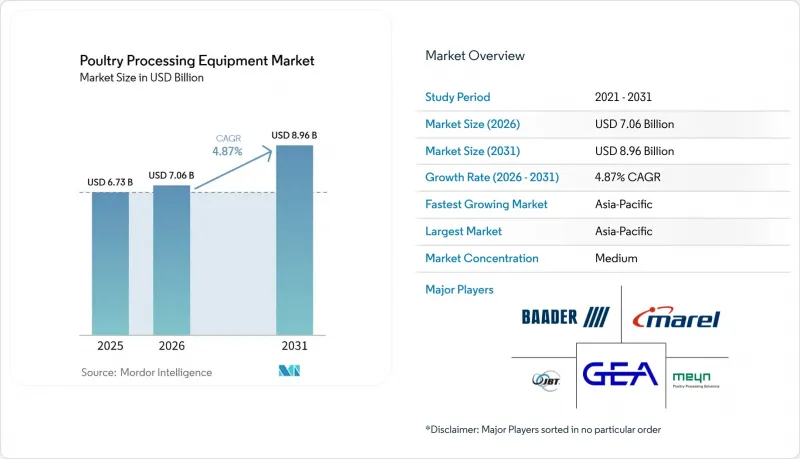
Mordor Intelligence에 의하면, 가금류 가공 장비 시장 규모는 2025년 67억 3,000만 달러로 평가되었습니다. 2026년 70억 6,000만 달러에서 2031년까지 89억 6,000만 달러로 확대되어 2026년부터 2031년에 걸쳐 CAGR 4.9%를 나타낼 것으로 예측됩니다.
본 보고서는 장비 유형(도축·제모, 절단·분할, 냉각·냉장 처리 등), 자동화 수준(완전 자동화, 반자동, 수동, 스마트 등), 용도(닭고기, 칠면조, 오리고기 등), 지역(북미, 유럽, 아시아태평양, 남미 등)별로 분류되어 있습니다. 시장 전망은 금액(달러) 기준으로 제시되어 있습니다.
세계의 가금류 가공 장비 시장 동향과 인사이트
높은 처리 능력을 갖춘 자동 가공 라인에 대한 수요 증가
가금류 가공 장비 시장에서 시설 확장 및 현대화를 추진하는 대형 가금류 가공업체들에게 높은 처리 능력은 중요한 조달 요건이 되고 있습니다. 베트남 타이닌에 위치한 드 헤우스(De Heus)사의 그린필드 공장에서 마렐(Marel)사가 추진한 프로젝트는 각 제조업체가 가동 시작 시 시간당 6,000마리를 처리할 수 있는 신규 라인을 설계하고, 핵심 기계를 교체하지 않고도 시간당 1만 2,000마리까지 확장할 수 있는 시스템을 구축했음을 보여줍니다. 이러한 단계적 확장에 대응한 설계를 통해, 반복적인 토목 공사로 인한 위험을 줄이고, 생산량을 단계적으로 확대할 계획을 세우는 가공업체를 지원합니다. 또한 메인(Main)사는 자사의 ‘Rapid Plus M5.0’ 가슴살 뼈 제거기를 사용하여, 처리 능력 향상에 따른 운영상의 이점을 입증했습니다. 이 기계는 3만 6,000시간에 달하는 기술 검증을 거쳤으며, 노르스크 킬링(Norsk Killing)사와의 2년간의 시범 운영을 통해 필레 1장당 수율을 4g 향상시켰습니다. 1마리당 수율이나 시간당 생산량을 기준으로 성과를 평가하는 가공업체가 늘어남에 따라, 측정된 실적을 제시하지 못하는 공급업체는 생산 라인 입찰에서 더 큰 압박에 직면할 가능성이 높습니다.
점점 더 엄격해지는 식품 안전 및 위생 규정 준수 요건
가공업체들이 가공 라인에 규정 준수, 추적성 및 오염 관리 기능을 통합해야 할 필요성이 점점 더 커짐에 따라, 식품 안전 규제는 가금류 가공 장비 시장의 장비 사양에 직접적인 영향을 미치고 있습니다. 미국 농무부(USDA) 식품안전검사국은 2025년 1월에 잔류 수분에 관한 지침을 업데이트했으며, 라벨 표시에 대한 완전한 준수는 2026년 1월 1일부터 발효되었습니다. 이 일정에 따라 각 공장은 관리 절차 및 문서화를 재검토해야 하는 상황에 놓여 있습니다. 유럽에서는 규정(EC) 제853/2004호에 따라 내장 제거, 냉각 및 위생 성능에 대해 계속해서 엄격한 요건이 부과되고 있어, 성숙한 시설에서의 설비 갱신 활동이 지속되고 있습니다. 인도의 라이선싱 제도 또한 소규모 가공업체들이 체계화된 소매 채널이나 수출 경로에 접근하기 위해 사업을 정식화하도록 장려하고 있어, 인증된 설비에 대한 수요를 뒷받침하고 있습니다. 그 결과, 가금류 가공 장비 시장에서 인라인 미생물 모니터링 및 이미지 인식 기반 검사는 과거에는 고급 옵션으로 간주되었으나, 현재는 표준 도구로 자리 잡아가고 있습니다.
완전 자동화 가공 라인의 높은 설비 투자 비용
자본 집약성은 가금류 가공 장비 시장에서 특히 대형 통합 기업 이외의 가공업체에게 있어 풀 라인 도입의 주요 장벽으로 남아 있습니다. 시간당 6,000마리를 처리하는 시설을 위한 완전 자동화된 내장 제거, 절단 및 뼈 제거 라인에는 토목 공사, 유틸리티, 시운전 비용을 더하기 전에도 여전히 수백만 달러 규모의 투자가 필요합니다. 이러한 비용 부담으로 인해 많은 중규모 구매자들은 단계적 투자에 집중할 수밖에 없습니다. 이러한 구매 패턴은 2025년에 반자동 시스템이 57.71%의 점유율을 차지한 이유를 설명하는 요인 중 하나입니다. 반자동 시스템이라면 완전 자동화에 드는 전체 비용을 부담하지 않고도 효율화의 이점 일부를 누릴 수 있기 때문입니다. 장비 공급업체들은 모듈식 형식으로 이에 대응하고 있으며, GEA가 2026년 4월 출시를 예정하고 있는 ‘MultiJector 500’은 공급업체들이 확장 가능한 레이아웃으로 중소규모 마리네이징 라인을 타겟으로 하고 있음을 보여줍니다. 모듈식 설계가 개선되었음에도 불구하고, 자금 조달의 폭이나 설비 담보 제도가 여전히 제한적인 가격에 민감한 지역에서는 가금류 가공 장비 시장에서 완전 자동화 도입 속도가 더딘 상황이 지속될 것으로 예측됩니다.
부문 분석
2025년에는 절단 및 분할 가공이 가금류 가공 장비 시장 점유율의 22.89%를 차지했으며, 이는 기존 설비 및 신규 투자 기준에서 가장 큰 장비 카테고리가 되었습니다. 이러한 주도적인 지위는 일관된 가슴살, 다리살, 닭날개 및 혼합 절단 사양을 필요로 하는 퀵서비스 레스토랑, 외식 산업의 구매자 및 소매 프로그램을 위해 부위별 가금류 공급이 수행하는 중요한 역할을 반영합니다. 그 결과, 가공업체들은 정밀도, 라인 속도, 수율 간의 균형을 맞추어야 하기 때문에 자동 도체 처리 라인은 여전히 가공업체들의 설비 투자의 중심을 이루고 있습니다. 또한, 이 부문은 도축, 깃털 제거, 냉각, 뼈 제거, 내장 제거와 같은 업스트림 공정의 이점도 누리고 있으며, 이러한 공정들은 궁극적으로 다운스트림 공정에서 절단 품질과 이용 가능한 부위의 회수율을 뒷받침합니다.
품질 관리 및 검사 분야는 2031년까지 연평균 성장률(CAGR) 5.74%를 나타낼 것으로 예측되며, 가금류 가공 장비 시장에서 가장 빠르게 성장하는 장비 유형이 될 것입니다. 이러한 성장은 라인 끝단에서 수작업으로 진행되는 검사에 의존하기보다는 규정 준수, 결함 감지, 수율 최적화를 단일 라인 아키텍처에 통합해야 할 필요성과 밀접한 관련이 있습니다. Meyn사의 ‘Asymmetric Rehanger with Multi Vision Quality Grading’은 검사 기능이 고속 이송 시스템으로 이동하고 있음을 보여주는 반면, BAADER사의 ‘ClassifEYE’ 플랫폼은 손실이 더욱 커지기 전에 내장 제거 라인에서 인라인 이상 감지 기능을 추가하고 있습니다. 2025년 『Foods』지에 게재된 학술 연구도 이러한 방향성을 뒷받침하고 있으며, 딥러닝 모델은 이미 생산 라인 속도에서 품질 이상 감지를 입증하여, 이를 통해 상업 가공업체들이 검사 중심의 설비 업그레이드에 대해 더 큰 확신을 가질 수 있게 되었습니다.
지역별 분석
2025년에는 아시아태평양이 가금류 가공 장비 시장 점유율의 29.57%를 차지했으며, 현재 수요 측면에서 가장 규모가 큰 지역 블록이 될 전망입니다. 중국의 기계화 진전과 인도가 신선 시장 의존에서 냉장·가공 가금류 제품으로의 꾸준한 전환을 추진하고 있는 점이 이 지역의 주도적 지위를 뒷받침하고 있습니다. 규제 정비 또한 성장을 뒷받침하고 있으며, 조직화된 소매 및 수출 채널에 제품을 공급하는 가공업체들은 보다 체계적으로 관리되고 인증된 설비 배치를 필요로 하고 있습니다. 또한, 통합형 농업·식품 기업들이 수출 지향적인 가공 역량을 구축함에 따라 베트남, 인도네시아, 태국의 중요성도 높아지고 있습니다. JBT Marel사가 베트남에서 De Heus사와 함께 추진 중인 그린필드 사업은 이러한 동향을 반영하고 있으며, 해당 생산 라인은 즉시 가동과 동일한 가공 플랫폼 내에서의 향후 확장을 염두에 두고 설계되었습니다.
또한, 아시아태평양은 2026년부터 2031년까지 7.42%라는 가장 높은 연평균 성장률(CAGR)을 보일 것으로 예측되며, 가금류 가공 장비 시장에서 가장 빠르게 성장하는 지역이 될 전망입니다. 이러한 성장을 견인하는 것은 단일 요인이 아니라, 국내 단백질 수요, 식품 안전 규제의 정비, 그리고 수출 준비의 진전이 복합적으로 작용한 결과입니다. 이 지역의 신규 공장에서는 향후 처리 능력 확대를 염두에 둔 설계가 점점 더 많이 채택되고 있으며, 이는 향후 가금류 가공 수요에 대한 강한 자신감을 보여줍니다. 이를 통해 가금류 가공 장비 시장은 처리량 증가와 기술 집약도 향상을 동시에 갖춘 강력한 지역적 성장 동력을 확보하게 될 것입니다.
북미는 2025년에도 설비 밀도가 가장 높은 지역이었습니다. 수요는 대형 가금류 가공업체들의 자동화 업그레이드, 기존 시설 개보수, 그리고 인력 감축에 대한 집중에 의해 형성될 전망입니다. 유럽은 성숙하면서도 고도로 기술적인 시장으로 남아 있을 것으로 예측됩니다. 이 시장에서는 설비 혁신, 위생 기준 준수, 그리고 연구 개발에 대한 집중이 타 지역으로의 수출에 앞서 제품 개발에 계속해서 영향을 미치고 있습니다. 남미에서는 브라질의 수출 주도형 가금류 시장을 통해 규모 확대 가능성이 계속해서 예상되지만, 자금 조달 및 환율 상황에 따라 신규 설비 구매가 둔화될 가능성이 있습니다. 중동 및 아프리카는 여전히 신흥 수요 지역이며, 식량 안보 프로그램, 자급자족 목표, 그리고 점진적인 정상화가 통합 가공에 대한 투자를 뒷받침하고 있습니다. 이 지역 전반에 걸쳐, 개조의 경제성, 수출 규정 준수 요건, 그리고 보다 잘 정비된 가금류 인프라에 대한 공공 및 민간 투자가 가금류 가공 장비 시장을 형성하고 있습니다.
기타 혜택 :
- 엑셀 형식 시장 예측(ME) 시트
- 3개월간의 애널리스트 지원
자주 묻는 질문
목차
제1장 서론
제2장 조사 방법
제3장 주요 요약
제4장 시장 구도
제5장 시장 규모 및 성장 예측
제6장 경쟁 구도
제7장 시장 기회 및 향후 전망
KTH 26.08.10According to Mordor Intelligence, the poultry processing equipment market size is projected to expand from USD 6.73 billion in 2025 and USD 7.06 billion in 2026 to USD 8.96 billion by 2031, registering a CAGR of 4.9% between 2026 to 2031.
This report is Segmented by Equipment Type (Slaughtering and Defeathering, Cut-Up and Portioning, Chilling and Cooling, and More), Automation Level (Fully Automated, Semi-Automatic, Manual, Smart, and More), Application (Chicken, Turkey, Duck, and Others), and Geography (North America, Europe, Asia-Pacific, South America, and More). The Market Forecasts are Provided in Terms of Value (USD).
Global Poultry Processing Equipment Market Trends and Insights
Rising Demand for High-Throughput Automated Processing Lines
High throughput capacity has become a key procurement requirement for large poultry processors expanding or modernizing their facilities in the poultry processing equipment market. Marel's work on De Heus's greenfield plant in Tay Ninh, Vietnam, shows how manufacturers are engineering new lines to process 6,000 birds per hour at startup, with a built-in pathway to expand to 12,000 birds per hour without replacing core machinery. This phase-ready design reduces the risk of repeated civil work and supports processors planning gradual volume ramp-ups. Meyn also demonstrated the operational benefits of higher throughput with its Rapid Plus M5.0 breast deboner, which underwent 36,000 hours of engineering validation and delivered a 4 g per fillet yield gain during a two-year pilot with Norsk Kylling. As more processors benchmark performance based on yield per bird and hourly output, suppliers that cannot demonstrate measured results are likely to face greater pressure in line tenders.
Tightening Food Safety and Hygiene Compliance Requirements
Food safety regulations are directly shaping equipment specifications in the poultry processing equipment market, as processors increasingly need compliance, traceability, and contamination control built into processing lines. The USDA Food Safety and Inspection Service is expected to update its retained water guidance in January 2025, with full label compliance set to take effect on January 1, 2026. This timeline is pushing plants to revisit control procedures and documentation. In Europe, Regulation (EC) No. 853/2004 continues to impose strict requirements for evisceration, chilling, and hygiene performance, sustaining plant upgrade activity at mature facilities. India's licensing framework is also encouraging smaller processors to formalize operations to access organized retail and export channels, supporting demand for certified equipment. As a result, inline microbial monitoring and vision-based inspection are shifting from premium options to baseline tools in the poultry processing equipment market.
High Capital Cost of Fully Automated Processing Lines
Capital intensity remains a major barrier to full-line adoption in the Poultry Processing Equipment Market, particularly among processors outside the largest integrated companies. A fully automated evisceration, cut-up, and deboning line for a 6,000-bird-per-hour facility still requires multi-million-dollar investment before civil work, utilities, and commissioning costs are added. This cost burden keeps many mid-sized buyers focused on phased investments. This buying pattern helps explain why semi-automated systems are expected to account for a 57.71% share in 2025, as they allow plants to capture part of the efficiency gains without incurring the full cost of complete automation. Equipment suppliers are responding with modular formats, and GEA's planned MultiJector 500 launch in April 2026 shows how vendors are targeting smaller and mid-capacity marination lines with scalable layouts. Despite modular design improvements, the poultry processing equipment market is expected to continue facing slower fully automated adoption in price-sensitive regions where financing depth and equipment collateral structures remain limited.
Other drivers and restraints analyzed in the detailed report include:
- Labor Shortages and Wage Inflation in Processing Plants
- Expansion of Ready-to-Cook and Ready-to-Eat Poultry Formats
- Skilled Technician Shortage for Advanced Controls and Robotics
For complete list of drivers and restraints, kindly check the Table Of Contents.
Segment Analysis
Cut-up and portioning is expected to hold 22.89% of the poultry processing equipment market share in 2025, making it the largest equipment category across the installed and new investment base. Its leadership reflects the significant role of portion-specific poultry supply for quick-service restaurants, foodservice buyers, and retail programs that require consistent breast, thigh, wing, and mixed-cut specifications. As a result, automated cut-up lines remain central to processor capital expenditure, as processors must balance accuracy, line speed, and yield. The category also benefits from upstream processes, including slaughtering, defeathering, chilling, deboning, and evisceration, which ultimately support downstream cut quality and usable portion recovery.
Quality control and inspection are projected to register a 5.74% CAGR through 2031, making it the fastest-growing equipment type in the poultry processing equipment market size. This growth is tied to the need to integrate compliance, defect detection, and yield optimization into a single line architecture, rather than relying on manual end-of-line checks. Meyn's Asymmetric Rehanger with Multi Vision Quality Grading demonstrates how inspection functions are moving into high-speed conveying systems, while BAADER's ClassifEYE platform adds inline deviation detection on evisceration lines before losses become more expensive. Academic work published in Foods in 2025 also supports this direction, as deep learning models are already demonstrating quality deviation detection at production-line speeds, giving commercial processors greater confidence in inspection-led upgrades.
Complete Report Scope:
- By Equipment Type
- Slaughtering and Defeathering
- Cut-up and Portioning
- Chilling and Cooling
- Deboning
- Evisceration
- Quality Control and Inspection
- Other Equipment Type
- By Automation Level
- Fully Automated
- Semi-automatic
- Manual
- Smart and Ai-Enabled
- By Application
- Chicken
- Turkey
- Duck
- Other Poultry Types
- By Geography
- North America
- United States
- Canada
- Mexico
- Rest of North America
- Europe
- Germany
- United Kingdom
- Italy
- France
- Spain
- Netherlands
- Belgium
- Sweden
- Poland
- Rest of Europe
- Asia-Pacific
- China
- India
- Japan
- Australia
- Indonesia
- South Korea
- Thailand
- Singapore
- Rest of Asia-Pacific
- South America
- Brazil
- Argentina
- Colombia
- Peru
- Rest of South America
- Middle East and Africa
- South Africa
- Saudi Arabia
- United Arab Emirates
- Turkey
- Morocco
- Nigeria
- Egypt
- Rest of Middle East and Africa
- North America
Geography Analysis
Asia-Pacific is expected to account for 29.57% of the poultry processing equipment market share in 2025, making it the largest regional block in current demand. Mechanization in China and India's steady shift from wet-market dependence toward chilled and processed poultry formats support the region's leadership. Regulatory formalization is also supporting growth, as processors serving organized retail or export channels require more controlled and certified equipment layouts. Vietnam, Indonesia, and Thailand are also gaining importance as integrated agri-food companies build export-oriented processing capacity. JBT Marel's greenfield engagement with De Heus in Vietnam reflects this trend, as the line was designed for immediate operation and future expansion within the same processing platform.
Asia-Pacific is also forecast to register the fastest CAGR of 7.42% during 2026-2031, making it the fastest-expanding regional part of the poultry processing equipment market size. A combination of domestic protein demand, food safety formalization, and export preparation is driving growth, rather than a single factor. New plants in the region increasingly include provisions for future throughput expansion, indicating stronger confidence in future processed poultry demand. This positions the poultry processing equipment market with a strong regional growth engine that combines volume growth with rising technology intensity.
North America is expected to remain one of the most equipment-dense regions in 2025, with demand shaped by automation upgrades, brownfield retrofits, and a focus on labor reduction across large poultry processors. Europe is expected to remain a mature but highly technical market, where equipment innovation, hygiene compliance, and research and development concentration continue to influence product development before export to other regions. South America continues to offer scale potential through Brazil's export-driven poultry market, although financing and foreign exchange conditions can slow new-unit purchases. The Middle East and Africa remain an emerging demand zone, where food security programs, self-sufficiency goals, and gradual formalization support integrated processing investment. Across these regions, retrofit economics, export compliance needs, and public or private investment in more formal poultry infrastructure are shaping the poultry processing equipment market.
- Marel hf
- John Bean Technologies Corporation
- GEA Group AG
- BAADER Group
- Meyn Food Processing Technology B.V.
- Prime Equipment Group, Inc.
- CTB, Inc.
- The Middleby Corporation
- Prime Food Processing Equipment
- Texha
- FPT Food Processing Technology
- BAADER Linco
- NUCON
- Marel Stork Poultry Processing B.V.
- Foodmate B.V.
- Bayle S.A.
- JBT Marel Corporation
- NABEL Co., Ltd.
- Linco Food Systems A/S
- CFS Europe
Additional Benefits:
- The market estimate (ME) sheet in Excel format
- 3 months of analyst support
TABLE OF CONTENTS
1 INTRODUCTION
- 1.1 Study Assumptions and Market Definition
- 1.2 Scope of the Study
2 RESEARCH METHODOLOGY
3 EXECUTIVE SUMMARY
4 MARKET LANDSCAPE
- 4.1 Market Overview
- 4.2 Market Drivers
- 4.2.1 Rising Demand for High Throughput Automated Processing Lines
- 4.2.2 Tightening Food Safety and Hygiene Compliance Requirements
- 4.2.3 Labor Shortages and Wage Inflation in Processing Plants
- 4.2.4 Expansion of Ready-to-Cook and Ready-to-Eat Poultry Formats
- 4.2.5 AI-Powered Inspection, Yield Optimization, and Vision Grading Adoption
- 4.2.6 Retrofit Demand From Brownfield Plants Seeking Uptime and Yield Gains
- 4.3 Market Restraints
- 4.3.1 High Capital Cost of Fully Automated Processing Lines
- 4.3.2 Complex Maintenance and Sanitation Downtime Requirements
- 4.3.3 Integration Friction With Legacy Slaughter and Chilling Assets
- 4.3.4 Skilled Technician Shortage for Advanced Controls and Robotics
- 4.4 Supply Chain Analysis
- 4.5 Regulatory Outlook
- 4.6 Technological Outlook
- 4.7 Porter's Five Forces Analysis
- 4.7.1 Threat of New Entrants
- 4.7.2 Bargaining Power of Buyers
- 4.7.3 Bargaining Power of Suppliers
- 4.7.4 Threat of Substitutes
- 4.7.5 Competitive Rivalry
5 MARKET SIZE AND GROWTH FORECASTS (VALUE )
- 5.1 By Equipment Type
- 5.1.1 Slaughtering and Defeathering
- 5.1.2 Cut-up and Portioning
- 5.1.3 Chilling and Cooling
- 5.1.4 Deboning
- 5.1.5 Evisceration
- 5.1.6 Quality Control and Inspection
- 5.1.7 Other Equipment Type
- 5.2 By Automation Level
- 5.2.1 Fully Automated
- 5.2.2 Semi-automatic
- 5.2.3 Manual
- 5.2.4 Smart and Ai-Enabled
- 5.3 By Application
- 5.3.1 Chicken
- 5.3.2 Turkey
- 5.3.3 Duck
- 5.3.4 Other Poultry Types
- 5.4 By Geography
- 5.4.1 North America
- 5.4.1.1 United States
- 5.4.1.2 Canada
- 5.4.1.3 Mexico
- 5.4.1.4 Rest of North America
- 5.4.2 Europe
- 5.4.2.1 Germany
- 5.4.2.2 United Kingdom
- 5.4.2.3 Italy
- 5.4.2.4 France
- 5.4.2.5 Spain
- 5.4.2.6 Netherlands
- 5.4.2.7 Belgium
- 5.4.2.8 Sweden
- 5.4.2.9 Poland
- 5.4.2.10 Rest of Europe
- 5.4.3 Asia-Pacific
- 5.4.3.1 China
- 5.4.3.2 India
- 5.4.3.3 Japan
- 5.4.3.4 Australia
- 5.4.3.5 Indonesia
- 5.4.3.6 South Korea
- 5.4.3.7 Thailand
- 5.4.3.8 Singapore
- 5.4.3.9 Rest of Asia-Pacific
- 5.4.4 South America
- 5.4.4.1 Brazil
- 5.4.4.2 Argentina
- 5.4.4.3 Colombia
- 5.4.4.4 Peru
- 5.4.4.5 Rest of South America
- 5.4.5 Middle East and Africa
- 5.4.5.1 South Africa
- 5.4.5.2 Saudi Arabia
- 5.4.5.3 United Arab Emirates
- 5.4.5.4 Turkey
- 5.4.5.5 Morocco
- 5.4.5.6 Nigeria
- 5.4.5.7 Egypt
- 5.4.5.8 Rest of Middle East and Africa
- 5.4.1 North America
6 COMPETITIVE LANDSCAPE
- 6.1 Market Concentration
- 6.2 Strategic Moves
- 6.3 Market Ranking Analysis
- 6.4 Company Profiles {(includes Global level Overview, Market level overview, Core Segments, Financials as available, Strategic Information, Market Rank/Share for key companies, Products and Services, and Recent Developments)}
- 6.4.1 Marel hf
- 6.4.2 John Bean Technologies Corporation
- 6.4.3 GEA Group AG
- 6.4.4 BAADER Group
- 6.4.5 Meyn Food Processing Technology B.V.
- 6.4.6 Prime Equipment Group, Inc.
- 6.4.7 CTB, Inc.
- 6.4.8 The Middleby Corporation
- 6.4.9 Prime Food Processing Equipment
- 6.4.10 Texha
- 6.4.11 FPT Food Processing Technology
- 6.4.12 BAADER Linco
- 6.4.13 NUCON
- 6.4.14 Marel Stork Poultry Processing B.V.
- 6.4.15 Foodmate B.V.
- 6.4.16 Bayle S.A.
- 6.4.17 JBT Marel Corporation
- 6.4.18 NABEL Co., Ltd.
- 6.4.19 Linco Food Systems A/S
- 6.4.20 CFS Europe